2428
A Grounded Unsupervised Universal Part-of-Speech Tagger for
Low-Resource Languages
Ronald Cardenas♣ Ying Lin♠ Heng Ji♠ Jonathan May♥
♣Institute of Formal and Applied Linguistics, Charles University in Prague
♠Computer Science Department, Rensselaer Polytechnic Institute
♥Information Sciences Institute, University of Southern California
[email protected] [email protected] [email protected] [email protected]
Abstract
Unsupervised part of speech (POS) tagging is often framed as a clustering problem, but prac-tical taggers need togroundtheir clusters as well. Grounding generally requires reference labeled data, a luxury a low-resource language might not have. In this work, we describe an approach for low-resource unsupervised POS tagging that yields fully grounded output and requires no labeled training data. We find the classic method of Brown et al. (1992) clusters well in our use case and employ a decipherment-based approach to grounding. This approach presumes a sequence of cluster IDs is a ‘ciphertext’ and seeks a POS tag-to-cluster ID mapping that will reveal the POS sequence. We show intrinsically that, despite the difficulty of the task, we obtain reasonable performance across a variety of languages. We also show extrinsically that incorporating our POS tagger into a name tagger leads to state-of-the-art tagging performance in Sinhalese and Kinyarwanda, two languages with nearly no labeled POS data available. We further demonstrate our tagger’s utility by incorporat-ing it into a true ‘zero-resource’ variant of the MALOPA (Ammar et al., 2016) dependency parser model that removes the current reliance on multilingual resources and gold POS tags for new languages. Experiments show that in-cluding our tagger makes up much of the accu-racy lost when gold POS tags are unavailable.
1 Introduction
While cellular, satellite, and hardware advances have ensured that sophisticated NLP technology can reach all corners of the earth, the language bar-rier upon reaching remote locales still remains. As an example, when international aid organizations respond to new disasters, they are often unable to deploy technology to understand local reports de-tailing specific events (Munro and Manning,2012;
[image:1.595.320.507.217.520.2]Lewis et al., 2011). An inability to communicate
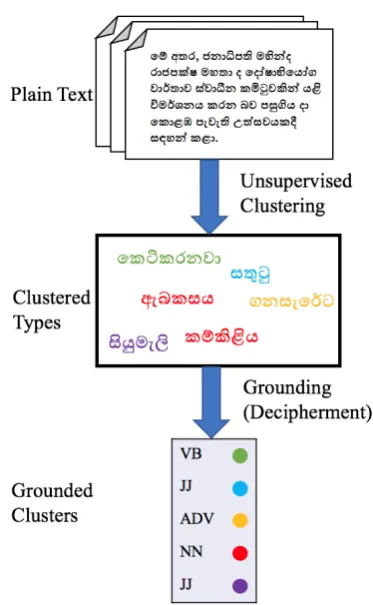
Figure 1: Overview of our approach to grounded POS tagging. We use an unsupervised clustering method (Section3.2) then reduce and ground the clusters us-ing a decipherment approach informed by POS tag se-quence data from many languages (Section3.3).
with partner governments or civilian populations in a timely manner leads to preventable casualties. The lack of adequate labeled training data has been the major obstacle to expanding NLP’s out-reach more multilingually. Developments in un-supervised techniques that require only monolin-gual corpora (Lample et al.,2018a;Artetxe et al.,
2018) and the ability to leverage labeled resources in other languages have been proposed to address this issue (Das and Petrov, 2011; Duong et al.,
methods either do not work in practice on true low-resource cases or unrealistically assume the avail-ability of some amount of supervision.
Consider syntactic parsing as a prime example. Past editions of the CoNLL Shared Task on Multi-lingual Parsing (Zeman et al., 2017, 2018) fea-tured a category of target languages for which ei-ther little or no training data was provided. How-ever, even in the ‘no-resource’ scenario that most closely matches our use case, gold part-of-speech (POS) tags for test data were provided for the participants to use. Prior to these shared tasks,
Ammar et al. (2016) proposed a variant of their main model, MALOPA, that was meant to pro-duce reasonable parses for languages under “zero-resource” conditions. In order to function, how-ever, the model requires users to provide gold POS tags and word mappings from these languages into a common semantic space, using approaches that require parallel data (Guo et al.,2015).
Indeed, the compulsion to use POS tag-labeled data in zero-resource circumstances extends to the vast, varied lines of research in unsupervised POS tagging itself! Every approach explored so far ul-timately requires POS-annotated resources for the language being studied in order to produce a fi-nal, grounded output. Even the most conservative strategies (Goldwater and Griffiths, 2007; Berg-Kirkpatrick et al.,2010;Stratos et al.,2016) that do not require any supervised signal during train-ing still ultimately produce only ungrounded clus-ters, and require a reference annotated corpus to map the inferred clusters or states to actual POS tags.
Making matters worse, evaluation is generally offered in terms of the ‘many-to-one’ or ‘one-to-one’ analysesJohnson(2007). These metrics use a reference corpus to determine theoptimal mping of clusters to tags. While this evaluation ap-proach is intuitively sensible for measuring clus-ter purity, to actuallyusesuch an output, an entire annotated training corpus is required.1 It is not enough to simply rely on ungrounded clusters in real-world systems; grounded labels offer a sort of universal API between other resources such as rule-based modules that operate on certain word types or between resources built from other anno-tated high-resource language data.
Since POS tag and parallel data resources for
1Additionally,Headden III et al.(2008) demonstrated that
these metrics are not indicative of downstream performance.
new languages are often unavailable or unreliable, we make the following contributions to ensure the surprise of a new language does not immobilize us:
• We introduce a decipherment-based
ap-proach to POS grounding, which yields fully grounded output and does not require any an-notated data or parallel corpora in the lan-guage to be analyzed. The approach uses pre-existing human-labeled POS tag sequences from high-resource parent languages (PL) but no labeled data or sequences for the tar-get, orchild language(CL). An overview of the approach is shown in Figure1.
• We demonstrate our approach by
evaluat-ing over a variety of languages spannevaluat-ing 4 families and 8 genera (Germanic, Romance, Slavic, Japanese, Semitic, Iranian, Indic, and Bantoid), and show across-the-board reason-able intrinsic performance, given the diffi-culty of the task and the stringency (straight-forward accuracy) in comparison to other un-supervised evaluation strategies.
• We test the utility of our grounded tags in a name tagging task, obtaining state-of-the-art performance for Sinhalese and Kiryarwanda, two languages with nearly no labeled POS or named entity resources.
• We further pare down the annotated resources required in an existing ‘zero-resource’ depen-dency parser model and show that our un-supervised and grounded tags are helpful at closing the gap between a nihilistic tag-free setting and an unrealistic gold tag setting.
• We release our code so that others may cre-ate zero-resource syntactic analysis and in-formation extraction systems at the onset of the next new emergency.2
2 POS Grounding as Decipherment
We consider the task of POS induction as a two-step pipeline: from word sequencewto POS tag sequencep via cluster sequencec. Formally, our conditional probability model is
2https://github.com/isi-nlp/
argmax p
Pθ(p|w)
= argmax p
X
c∈C|w|
Pθ(p, c|w)
= argmax p
X
c∈C|w|
Pθ(p|c, w)Pθ(c|w)
where C is the cluster vocabulary and θ param-eterizes our probability model. If we assume a deterministic pipelined clustering of words and a tag labeling model that does not depend on words, then for chosenˆc, this becomes
argmax p
X
c∈C|w|
Pθ(p|c, w)Pθ(c|w)
= argmax p
Pθ(p|cˆ)
= argmax p
Pθ(ˆc|p)Pθ(p) (1)
We call this model the cipher grounder. As presented it requires an estimate for Pθ(p) for
the CL, which requires POS training data. Un-der the zero-resource scenario, we instead ap-proximate Pθ(p) by the tag distribution of a PL.
Then, thecipher tablePθ(ˆc|p)can be trained using
a noisy-channel, expectation-maximization (EM)-based approach as inRavi and Knight(2011).
3 POS Tagger construction
We approach the search for optimal components in the two-step pipeline outlined in Section 2 in a cascaded manner. First, an optimal word clus-tering is determined by means of the many-to-one evaluation method. This method is explained well byJohnson(2007):
“ ...deterministically map each hidden state to the POS tag it co-occurs most frequently with, and return the propor-tion of the resulting POS tags that are the same as the POS tags of the gold-standard corpus.”
While unrealistic for POS tagger performance purposes, many-to-one is a good choice for de-termining cluster ‘purity’ and provides a
reason-able grounding upper bound. As the
calcula-tion of many-to-one does require labeled data, we constrain the use of these labels for development and will evaluate extrinsically using languages for
which we do not have any training data; see Sec-tion5.2.
Secondly, we search for the best approach to ground the chosen clusters, given several possible PL options.
After the optimal components and parameters are determined, we validate POS tag quality intrin-sically via tag accuracy on reference data where it exists, and then extrinsically on two downstream tasks. We investigate a simulated no-resource sce-narios in the task of dependency parsing, and a real low-resource scenario in name tagging.
3.1 Datasets
For intrinsic evaluation and optimization of the tagging pipeline, including all preliminary exper-iments, we use annotated corpora from Univer-sal Dependencies (UD) v2.23 for the following languages: English (en), German (de), French (fr), Italian (it), Spanish (es), Japanese (ja), Czech (cs), Russian (ru), Arabic (ar), and Farsi (fa). For Swahili (sw), we use the Helsinki Corpus of Swahili 2.0.4 Overall in these experiments we cover 11 languages and 4 language families.
In our dependency parsing experiments, we use the Universal Treebank v2.0 (McDonald et al.,
2013) for en, de, fr, es, it, Portuguese (pt), and Swedish (sv). This set of treebanks is chosen in-stead of UD in order to obtain results compara-ble to those of previous work on simulated zero-resource parsing scenarios (Ammar et al., 2016;
Zhang and Barzilay, 2015; Rasooli and Collins,
2015).
In our name tagging experiments, we use mono-lingual texts for Sinhalese (si) and Kinyarwanda (rw) provided by DARPA’s Low Resource Lan-guages for Emergent Incidents (LORELEI) Pro-gram during the 2018 Low Resource Human Lan-guages Technologies (LoReHLT) evaluation.
3.2 Unsupervised Clustering
In this step we compare two approaches to unsu-pervised ungrounded labeling. The first strategy is to cluster by word types and thus label each token with its cluster ID independently of its context.5 We consider Brown’s hierarchical clustering
algo-3
http://universaldependencies.org/
4
http://urn.fi/urn:nbn:fi: lb-2016011301
5We refer to ungrounded POS tag labels as ‘clusters’ even
rithm, (Brown et al.,1992)6BROWN; Brown’s ex-change algorithm,7(Martin et al.,1998)MARLIN; and k-means clustering of monolingual word em-beddings of dimension size 100, trained using fast-Text(Joulin et al.,2016),E-KMEANS. The second labeling strategy is context-sensitive; it uses the Bayesian HMM tagger proposed byStratos et al.
(2016), which we call A-HMM. As noted previ-ously, we evaluate unsupervised labeling extrinsi-cally, via the many-to-one approach, and use the best performing labeling in the complete two-step grounded tagging pipeline.
In preliminary experiments, we vary the num-ber of clusters and hidden states (|C|) between 17 and 500. We initially sought to create one cluster per UD POS tag and then choose the proper 1:1 as-signment of cluster to tag, following the approach ofStratos et al.(2016). However, cluster purity is low when only 17 clusters are allowed (i.e. each cluster has words with a variety of POS tags). Nat-urally, as the number of clusters is raised, the pu-rity of each cluster improves. We ultimately fix the cluster limit at 500, which gives a good trade-off between overall cluster quality for all the un-grounded tagging methods, and size small enough to allow EM-based decipherment to be tractable.
Given this setting, we evaluate our four label-ing strategies uslabel-ing the many-to-one approach, as presented in Table 1. Due to the larger number of clusters, the results presented here are higher than and not comparable to the original literature describing the methods.8 We can, nevertheless, make relative judgements. In all cases, clustering by type with Brown-based algorithms works better than using a sophisticated tagger such asA-HMM. SinceBROWNandMARLINobtain similar results, with no consistently dominant model, in all subse-quent experiments we use theBROWNlabeler with 500 clusters.
3.3 Grounding via Decipherment
We now seek an appropriate method for grounding the clusters generated in Section 3.2. We
experi-6https://github.com/percyliang/
brown-cluster
7Optimized and implemented by M¨uller and Schuetze
(2015). Available at http://cistern.cis.lmu.de/ marlin/
8
As noted by Clark(2003) andJohnson (2007), in the limit, keeping each type (or, in the case ofA-HMM,TOKEN in its own cluster will result in the maximum possible many-to-one (polysemic types prevent perfect accuracy when type clustering).
ment with en, fr, fa, and sw as CLs. For each CLt, we instantiate our model following Equation1, us-ing the Carmel toolkit (Graehl,1997) and forming the cipher table as a one-state transducer. We train these models using EM for 500 iterations or un-til convergence, and we select the model with the lowest perplexity from among 70 random restarts. Yet unspecified is the nature of the POS lan-guage model Pθ(p). We begin by training
bi-gram models of POS tag sequences with addi-tive smoothing using the SRILM toolkit (Stolcke,
2002) for each PLs ∈ S = {en, de, fr, it, es, ja, ar, cs, ru, sw}. But which PL’s POS tag data to use for each CL? We explore two initial criteria for choosing a single suitable PL s: confidence of the model during decoding (perplexity, PPL), and typological similarity. For the first criterion, the PL whose cipher grounder s-tyields the bet-ter performance is chosen. For the second crite-rion, the most similar language to CLtis chosen according to the cosine similarity between typo-logical features vectors. We employ 102 features obtained from WALS9 related to word order and morphosyntactic alignment, further reduced to 50 dimensions using PCA. However, none these cri-teria correlates significantly to tagging accuracy, as we elaborate in Section 5.1. We instead try a combined approach.
The likelihood of cluster ID replacement, Pθ(ˆci|pj),∀ˆci ∈ C,∀pj in the tagset, is replaced
by
Pavg(ˆci|pj)∼
P
s∈S,s6=tPθ(ˆci|psj)
|S| −1
wherePθ(ˆci|psj)is the likelihood of POS tagpj
be-ing represented by clusterˆciafter training with the
languagestag distribution. Note that the CL is ex-cluded fromSfor the combination. The combined cipher grounder is then defined by
argmax p
Pall(p)Pavg(ˆc|p) (2)
wherePall(p)is a language model trained over the
concatenation of POS sequences of all parent lan-guages inS. We call this approachCIPHER-AVG.
4 Downstream Tasks
4.1 Name Tagging
We experiment with the LSTM-CNN model pro-posed by Chiu and Nichols (2016), one of the
Seq. Tagger en de fr ru fa sw
BROWN 81.37 81.28 84.81 79.78 86.94 87.35
MARLIN 81.53 81.25 85.4 79.14 86.64 88.81
A-HMM 77.12 74.85 81.48 73.88 80.25 76.69
[image:5.595.158.443.62.132.2]E-KMEANS 63.01 65.14 68.68 70.80 76.94 65.08
Table 1: Comparison of labeling strategies using many-to-one mapping for target languages with available test data, using 500 clusters or number of states. Accuracy is shown in percentage points.
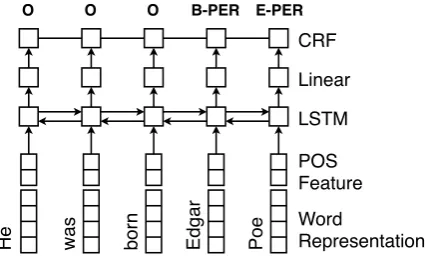
state-of-the-art name tagging models, as our base-line model. To incorporate POS features, we ex-tend the token representation (word and character embeddings) with a one-hot vector representation of the POS tag. Figure2presents an outline of the architecture.
Linear
LSTM CRF
POS Feature
Word
Representation
He was born Edgar Poe
O O O B-PER E-PER
Figure 2: Name tagging model evaluated in Sec-tion 5.2. This is an extension of the model of Chiu and Nichols(2016) with POS tag features added.
4.2 Multilingual Dependency Parsing
We base our experiments on the no-treebank setup of MALOPA(Ammar et al.,2016), but change the underlying transition-based parser to the
graph-based parser proposed by Dozat and Manning
(2017) for implementation convenience. Follow-ing this setup, for each CL except en, we train the parser on the concatenation of treebanks of the other 6 languages as PLs.
The original MALOPAwork enriches the input representation by concatenating pretrained multi-lingual word embeddings (Guo et al.,2016), mul-tilingual Brown cluster IDs, and POS tag informa-tion. However, these representations are obtained using parallel corpora and gold POS tags are re-quired for parsing at test time.
In contrast, we are interested in the realistic scenario in which no resource is available in the child language but raw text. It is important to note, however, that our objective is not to beat the state-of-the-art on this benchmark but to
investi-gate parsing performance fluctuation when cross-lingual components (gold POS annotations and su-pervised multilingual embeddings) are replaced by those obtained in an unsupervised manner.
We investigate the following variations to each component of the input representation.
• Multilingual word and cluster embed-dings. The original work of Ammar et al.
(2016) uses ‘robustly projected’ pre-trained embeddings (Guo et al.,2015) for word em-beddings and emem-beddings learned from En-glish Brown cluster IDs projected through word alignments (Guo et al.,2016) for clus-ter embeddings; both of these rely on par-allel data and we refer to them collectively
as GUO. We replace these with
monolin-gualfastTextembeddings (Bojanowski et al.,
2017) projected to a common space using
MUSE, the unsupervised method of Lample et al. (2018b). For cluster embeddings we start with fastText monolingual embeddings trained over Brown cluster ID sequences in-stead of word tokens (|C| = 256, the same as in Guo et al. (2016)). Then, unsuper-vised multilingual embeddings are derived, again usingMUSE.10Note that this approach, which we refer to collectively as MUSE, re-quires no parallel data. We compare both
MUSE and GUO approaches in Section 5.2
and Table5.
• POS tag scheme. The original work uses gold POS tag data at both train and test time. While realistic to have gold POS info from PLs for training, it is unrealistic to have this data available for new CLs at test
time. We thus compare the original GOLD
scenario with the realistic CIPHER scenario, where the training data is still gold, but the test POS tags use the method presented in this work. Another realistic scenario dispenses
10Both cluster and word
[image:5.595.76.293.279.407.2]with POS disambiguation except for the triv-ial distinction of punctuation; for compatibil-ity purposes this is done in both train and test data and is labeledNONE.
We investigate all combinations of {GUO,
MUSE}-{GOLD,CIPHER,NONE}.
5 Results and Discussion
5.1 Labeling and Cipher Grounding
The results in Table1are somewhat at odds with those presented in Stratos et al.(2016), but these are done at different operating points; we use different data, the UD-17 tag set instead of the Universal Treebank 12 tag set, and, perhaps most importantly, generate more clusters. We further note that to some degree, choosing Brown clusters
based on the results in Table 1 compromises
claims of our approach being fully ‘unsupervised’ for those six languages, however our subsequent experiments on additional languages are truly unsupervised.
Table2presents the intrinsic performance of the cipher grounder over all PL-CL pairs considered. The difference between the best and the worst performing PL for each CL ranges from 24.62 percentage points for Swahili to 48.34 points for French, and an average difference of 34.5 points among all languages. The case when PL=CL is also presented in Table2 as a reference and pro-vides a reliable upper-bound under zero-resource conditions. It is worth noting the difference in accuracy when comparing the best performing PL for each CL with its corresponding PL=CL
upper-bound. Among all CLs, the best cipher
grounder for French (es-fr) gets the closest to its upper-bound with just 4.81 percentage points of difference, followed by the English grounder (fr-en) with 13.53 points of difference. On the other hand, the best Swahili grounder (ar-sw) is the most distant from its upper-bound with 30.45 points of difference.
Given such wide performance gaps in the CL set, the choice of a suitable PL becomes crucial for performance; therein the cipher model confidence and typological similarity are explored as possible choice criteria. With regards to model confidence, the Pearson correlation between accuracy scores and PPL, expected to be negative, ranges from
−0.71for English to 0.40 for Farsi. Since the PPL values for different PLs are not comparable, we first z-normalize PPL per CL and then concatenate the results for all CLs. The Pearson correlation of the resulting PPL-accuracy values is -0.13. This last result indicates that the most confident model might not be the most accurate, hence this criterion is not suitable for choosing a suitable PL.
With regards to typological similarity, we find that the Pearson correlation between accuracy scores and cosine similarity of typological feature vectors, expected to be positive, ranges from 0.44 for English to -0.14 for Farsi. The total correlation is found to be 0.18. Again, we find that the most typologically similarsmight not be the the most accurate, hence this criterion is not suitable either.
Hence, it becomes obvious that choosing a sin-gle PL is an inefficient strategy that does not lever-age the contribution that other PLs could bring. In this situation, the combination of cipher grounders for several PLs represents a sound strategy when no prior linguistic information of a certain CL is available. As shown in Table 2, this model,
CIPHER-AVG, obtains accuracy scores of 56.4, 58.6, 37.4, and 37.8 % for en, fr, fa, and sw, re-spectively. When compared to the best performing PL for each CL (see bold cells in Table2), it can be noticed that the performance gap ranges from just 1.2 percentage points for Swahili to 13.3 points for French, with an average of 6.1 points among all target languages.
Let us now compare the performance of
CIPHER-AVG with that of a vanilla supervised neural model.11 Table3 shows precision, recall, and F1 scores for the NOUN tag. Even though
CIPHER-AVG achieved mixed results (mid to low accuracy), the model robustly achieves mid-range performance according to F1-score for all CLs. The results are even more optimistic in terms of recall for English and French, and in terms of pre-cision for Farsi and Swahili. This gives us hope that CIPHER-AVG can provide a useful, if noisy,
signal to downstream tasks that depend on non-trivial performance over specific POS tags, such as name tagging, as exposed in the next section.
11We use UDPipe v1.2.0 (Straka and Strakov´a, 2017) to
Parent Language (PL)
CL en de fr it es ja cs ru ar sw CIPHER-AVG PL=CL
en - 57.1 60.4 59.9 59.4 25.1 52.8 49.0 30.7 28.4 56.4 73.9
fr 58.1 56.0 - 68.6 71.9 23.6 48.3 47.8 35.0 26.7 58.6 76.7
fa 13.8 32.3 29.7 22.7 33.3 19.7 33.3 43.5 37.0 38.2 37.4 73.3
[image:7.595.71.524.62.146.2]sw 24.9 14.3 37.3 21.2 35.9 21.3 25.8 27.9 38.96 - 37.8 69.4
Table 2: Performance of cipher grounder usingBROWN (|C|= 500) as labeler. The best PL for each CL besides itself, is shown in bold. The artificial case where we have CL POS data (PL=CL) is shown for comparison, as is the ultimately usedCIPHER-AVGmethod.
CIPHER-AVG Supervised
CL P R F1 P R F1
en 47.70 64.4 54.81 94.04 90.44 92.20
fr 56.26 78.82 65.65 96.15 93.72 94.92
fa 64.94 51.23 57.27 96.48 97.77 97.12
[image:7.595.177.425.203.286.2]sw 53.46 51.82 52.63 98.88 97.50 98.18
Table 3: Comparison of performance over the NOUN tag, as measured by precision (P), recall (R), and F1 scores, between our combined cipher grounder (CIPHER-AVG) and a supervised tagger.
5.2 Extrinsic evaluation
In the name tagging task, our LSTM-CNN base-line obtains 78.76% and 70.76% F1 score for Kinyarwanda and Sinhalese, respectively. When enriching the input representation with CIPHER
-AVG tags, the performance goes up to 80.16%
and 71.71% respectively. These results sug-gest that the signal provided by the combined cipher grounder is significant enough for rele-vant tags such as common, proper nouns and
noun modifiers. As an example, consider
the sentence Kwizera Peace Ndaruhutse
, wari wambaye nomero 11. The
base-line model fails to recognize Kwizera Peace
Ndaruhutse as a person name. In contrast,
with the PROPN tag assigned by CIPHER-AVG
to Kwizera, Peace, and Ndaruhutse, our
model is able to identify this name.
Likewise, the utility ofCIPHER-AVGtags for de-pendency parsing under zero-resource scenarios is summarized in Table4and Table5. It is important to point out that, even though the MALOPAsetup follows the no-treebank setup of Ammar et al.
(2016), parsing scores in the first row of Table
4 differ from those reported by them (Table 8 in
Ammar et al. (2016)). Such difference is to be expected since the underlying parser used in our experiments is a graph-based neural parser (Dozat and Manning,2017) instead of a transition-based
one (Dyer et al., 2015).12 As mentioned earlier, our objective is to analyze the effect of our tagger’s signal on parsing performance under no-resource scenarios, instead of pushing the state-of-the-art for the task.
We first analyze the effect of POS tag infor-mation at test time for the MALOPA setup in Ta-ble4. First we remove all POS signal except triv-ial punctuation information (NONErow), and, pre-dictably, the scores drop significantly across all target languages. Then, we use our cipher tags (CIPHER row) and see improvements for all lan-guages in LAS and for all but one language in UAS (de). This demonstrates the value of our cipher ap-proach.
We then take the next logical step and remove the parallel data-grounded embeddings, replacing them with fully unsupervised MUSEembeddings. Table 5 summarizes these results. Let us com-pareMUSE-NONEsetup (no POS signal at train or
test time) with MUSE-GOLD (gold POS signal at train and test time). It can be observed that POS signal improves performance greatly for all
lan-guages when usingMUSEembeddings. However,
consider GUO-GOLD and MUSE-NONE. Here we note a mixed result: whilst de, sv, and it do benefit from POS information, the other languages do not, obtaining great improvements fromMUSE
embed-12Due to time constraints, we could not experiment with
dings instead. Finally, consider MUSE-CIPHER
(gold POS tags during training, cipher tags during testing). When compared toMUSE-NONEsetup, it can be observed that, unfortunately, the heuristic POS tagger is too noisy and gets inMUSE’s way.
6 Related Work
Our proposed tagging pipeline can be interpreted as first reducing the vocabulary size to a fixed number of clusters, and then finding a cluster– POS tag mapping table that best explains the data without any path constraint (a cluster ID could be mapped to any POS tag). In this sense, our ap-proach applies EM to simplify the task (e.g. when using Brown clustering (Brown et al.,1992)), fol-lowed by another EM run to optimize cipher table parameters.
Under this lens, the methods closest to our ap-proach are those which attempt to reduce or con-strain the parameter search space prior to running EM. For instance,Ravi and Knight(2009) explic-itly search for the smallest model that explains the data using Integer Programming, and then use EM to set parameter values. In a different ap-proach,Goldberg et al.(2008) obtain competitive performance with a classic HMM model by ini-tializing the emission probability distribution with a mixture of language-specific, linguistically con-strained distributions. However, both of these ap-proaches are framed around the task of unsuper-vised POS disambiguation with a full dictionary (Merialdo, 1994). Previous work relaxes the full dictionary constraint by leveraging monolingual lexicons (Haghighi and Klein, 2006; Smith and Eisner, 2005; Merialdo, 1994; Ravi and Knight,
2009), multilingual tagged dictionaries (Li et al.,
2012;Fang and Cohn,2017), and parallel corpora (Duong et al.,2014;T¨ackstr¨om et al.,2013;Das and Petrov,2011).
In addition, previous work includes sequence models that do not rely on any resource besides raw text during training, namely unsupervised POSinduction models. These models are based, with few exceptions, on extensions to the standard HMM; most, in the form of appropriate priors over the HMM multinomial parameters (Goldwater and Griffiths, 2007; Johnson, 2007; Ganchev et al.,
2009); others, by using logistic distributions in-stead of multinomial ones (Berg-Kirkpatrick et al.,
2010;Stratos et al.,2016). However, these models still need to ground or map hidden states to actual
POS tags to evaluate, and they inevitably resort to many-to-one or one-to-one accuracy scoring. Some previous work has been cautious in pointing out this ill-defined setting (Ravi and Knight,2009;
Christodoulopoulos et al.,2010), and we argue its inappropriateness for scenarios in which the test set is extremely small or even when no annotated reference corpus exists.
Therefore, the problem of grounding the se-quence of states or cluster IDs to POS tags without using any linguistic resource remains unsolved. We formulate this task as a decipherment problem. Decipherment aims to find a substitution table be-tween alphabets or tokens of an encrypted code and a known language without the need of parallel corpora. The task has been successfully applied in alphabet mapping for lost languages (Snyder et al.,2010), and machine translation at the char-acter (Pourdamghani and Knight,2017) and token level (Ravi and Knight, 2011;Dou et al., 2015). For the task of POS tag grounding, the sequence of states or cluster IDs is modeled as an encrypted code to be deciphered back to a POS sequence. Furthermore, we tackle the problem from a ‘uni-versal’ perspective by allowing the cipher learn from POS sequences from a varied pool of lan-guages.
Other recent work has declared a ‘radically uni-versal’ mantra to language inclusivity. Herm-jakob et al.(2018) presents a Romanizer that cov-ers all writing systems known to Unicode. Pan et al. (2017) extends name tagging and linking capability to hundreds of languages by leverag-ing Wikipedia. Kirov et al. (2016) has semi-automatically built inflectional paradigms for hun-dreds of languages.
7 Conclusion
We present a POS tag grounding strategy based on decipherment that does not require human-labeled data to map states or clusters to actual POS tags and thus can be used in real-world situations re-quiring grounded POS tags. The decipherment model considers state or word cluster IDs of a CL as a cipher text to be deciphered back to a POS sequence.
de fr es it pt sv Test Tags UAS LAS UAS LAS UAS LAS UAS LAS UAS LAS UAS LAS
GOLD 65.57 52.37 71.27 59.80 73.26 63.13 71.46 59.66 63.28 54.93 77.50 64.90
NONE 40.90 18.61 51.14 30.91 43.82 17.67 48.22 33.29 37.89 16.72 38.15 17.96
[image:9.595.96.503.63.106.2]CIPHER(this work) 38.31 24.72 54.46 41.04 55.56 41.16 54.05 39.78 46.97 36.07 55.06 36.51
Table 4: Impact of grounded unsupervised POS tagging on MALOPA’s ‘zero-resource’ condition. Bold entries indicate an improvement over the baseline condition of having no POS tag information (beyond punctuation)
de fr es it pt sv
Embeddings Test Tags UAS LAS UAS LAS UAS LAS UAS LAS UAS LAS UAS LAS
GUO GOLD 65.57 52.37 71.27 59.80 73.26 63.13 71.46 59.66 63.28 54.93 77.50 64.90
MUSE GOLD 66.19 56.28 80.86 72.65 81.06 73.62 82.08 72.40 81.17 76.17 72.46 61.71
MUSE NONE 57.26 45.10 73.84 63.09 77.01 67.06 71.36 60.48 75.31 68.36 60.82 45.25
MUSE CIPHER 48.56 37.13 69.94 59.22 73.86 61.68 69.30 56.85 73.41 65.23 57.39 41.49
Table 5: Changing to unsupervisedMUSEembeddings boosts MALOPA’s zero-resource performance significantly (bold entries), in many cases doing so even without any POS tag information (italicentries), however noisy decipherment-based POS tags are no longer helpful.
POS tags from is crucial for performance. We ex-plore model confidence, as measured by perplex-ity and typological similarities, as intuitive criteria for PL choice. However, both criteria prove to be not correlated with tagging accuracy scores. Thus, we propose a cipher model combination strategy in order to leverage the word-order patterns in sev-eral PLs, at the cost of an accuracy drop ranging from just 1.15 percentage points to 13.33 points.
The resulting combined grounder is completely language agnostic, making it attractive for the analysis of languages new to the academic com-munity. Furthermore, analysis over the tasks of name tagging and dependency parsing demon-strate that the tags induced by the combined grounder provide a non-trivial signal for improve-ment of the downstream task. We obtain state-of-the-art results for name tagging in Kinyarwanda and Sinhalese, languages for which POS anno-tated corpora is nearly non-existent.
Acknowledgments
Thanks to Xusen Yin, Nima Pourdamghani, Thamme Gowda, and Nanyun Peng for fruitful discussions. This work was sponsored by DARPA LORELEI (HR0011-15-C-0115).
References
Waleed Ammar, George Mulcaire, Miguel Ballesteros, Chris Dyer, and Noah A Smith. 2016. Many lan-guages, one parser. Transactions of the Association for Computational Linguistics, 4:431–444.
Mikel Artetxe, Gorka Labaka, Eneko Agirre, and Kyunghyun Cho. 2018. Unsupervised neural ma-chine translation. InProceedings of the Sixth Inter-national Conference on Learning Representations.
Taylor Berg-Kirkpatrick, Alexandre Bouchard-Cˆot´e, John DeNero, and Dan Klein. 2010. Painless un-supervised learning with features. InHuman Lan-guage Technologies: The 2010 Annual Conference of the North American Chapter of the Association for Computational Linguistics, pages 582–590, Los Angeles, California. Association for Computational Linguistics.
Piotr Bojanowski, Edouard Grave, Armand Joulin, and Tomas Mikolov. 2017. Enriching word vectors with subword information. Transactions of the Associa-tion for ComputaAssocia-tional Linguistics, 5(1):135–146.
Peter F. Brown, Vincent J. Della Pietra, Peter V. deS-ouza, Jenifer C. Lai, and Robert L. Mercer. 1992. Class-based n-gram models of natural language. Computational Linguistics, 18(4):467–480.
Jason Chiu and Eric Nichols. 2016. Named entity recognition with bidirectional LSTM-CNNs. Trans-actions of the Association for Computational Lin-guistics, 4(1):357–370.
Christos Christodoulopoulos, Sharon Goldwater, and Mark Steedman. 2010. Two decades of unsuper-vised POS induction: How far have we come? In Proceedings of the 2010 Conference on Empirical Methods in Natural Language Processing, pages 575–584, Cambridge, MA. Association for Compu-tational Linguistics.
Alexander Clark. 2003. Combining distributional and morphological information for part of speech induc-tion. InProceedings of the tenth conference on Eu-ropean chapter of the Association for Computational Linguistics-Volume 1, pages 59–66. Association for Computational Linguistics.
[image:9.595.83.513.148.200.2]Qing Dou, Ashish Vaswani, Kevin Knight, and Chris Dyer. 2015. Unifying bayesian inference and vector space models for improved decipherment. In Pro-ceedings of the 53rd Annual Meeting of the Associ-ation for ComputAssoci-ational Linguistics and the 7th In-ternational Joint Conference on Natural Language Processing (Volume 1: Long Papers), pages 836– 845, Beijing, China. Association for Computational Linguistics.
Timothy Dozat and Christopher D Manning. 2017. Deep biaffine attention for neural dependency pars-ing. InInternational Conference on Learning Rep-resentations.
Long Duong, Trevor Cohn, Karin Verspoor, Steven Bird, and Paul Cook. 2014. What can we get from 1000 tokens? a case study of multilingual POS tag-ging for resource-poor languages. InProceedings of the 2014 Conference on Empirical Methods in Natu-ral Language Processing (EMNLP), pages 886–897, Doha, Qatar. Association for Computational Lin-guistics.
Chris Dyer, Miguel Ballesteros, Wang Ling, Austin Matthews, and Noah A. Smith. 2015. Transition-based dependency parsing with stack long short-term memory. InProceedings of the 53rd Annual Meeting of the Association for Computational Lin-guistics and the 7th International Joint Conference on Natural Language Processing (Volume 1: Long Papers), pages 334–343, Beijing, China. Associa-tion for ComputaAssocia-tional Linguistics.
Meng Fang and Trevor Cohn. 2017. Model transfer for tagging low-resource languages using a bilingual dictionary. InProceedings of the 55th Annual Meet-ing of the Association for Computational LMeet-inguis- Linguis-tics (Volume 2: Short Papers), pages 587–593, Van-couver, Canada. Association for Computational Lin-guistics.
Kuzman Ganchev, Ben Taskar, Fernando Pereira, and Joao Graca. 2009. Posterior vs parameter sparsity in latent variable models. InAdvances in Neural Infor-mation Processing Systems, pages 664–672.
Yoav Goldberg, Meni Adler, and Michael Elhadad. 2008. EM can find pretty good HMM POS-taggers (when given a good start). InProceedings of ACL-08: HLT, pages 746–754, Columbus, Ohio. Associ-ation for ComputAssoci-ational Linguistics.
Sharon Goldwater and Tom Griffiths. 2007. A fully Bayesian approach to unsupervised part-of-speech tagging. In Proceedings of the 45th Annual Meet-ing of the Association of Computational LMeet-inguistics, pages 744–751, Prague, Czech Republic. Associa-tion for ComputaAssocia-tional Linguistics.
Jonathan Graehl. 1997. Carmel finite-state toolkit. ISI/USC.
Jiang Guo, Wanxiang Che, David Yarowsky, Haifeng Wang, and Ting Liu. 2015. Cross-lingual depen-dency parsing based on distributed representations.
In Proceedings of the 53rd Annual Meeting of the Association for Computational Linguistics and the 7th International Joint Conference on Natural Lan-guage Processing (Volume 1: Long Papers), pages 1234–1244, Beijing, China. Association for Com-putational Linguistics.
Jiang Guo, Wanxiang Che, David Yarowsky, Haifeng Wang, and Ting Liu. 2016. A representation learn-ing framework for multi-source transfer parslearn-ing. In AAAI Conference on Artificial Intelligence.
Aria Haghighi and Dan Klein. 2006. Prototype-driven learning for sequence models. In Proceedings of the Human Language Technology Conference of the NAACL, Main Conference, pages 320–327, New York City, USA. Association for Computational Lin-guistics.
William P. Headden III, David McClosky, and Eu-gene Charniak. 2008. Evaluating unsupervised part-of-speech tagging for grammar induction. In Proceedings of the 22nd International Conference on Computational Linguistics (Coling 2008), pages 329–336, Manchester, UK. Coling 2008 Organizing Committee.
Ulf Hermjakob, Jonathan May, and Kevin Knight. 2018. Out-of-the-box universal romanization tool uroman. In Proceedings of ACL 2018, System Demonstrations, pages 13–18, Melbourne, Aus-tralia. Association for Computational Linguistics.
Mark Johnson. 2007. Why doesn’t EM find good HMM POS-taggers? In Proceedings of the 2007 Joint Conference on Empirical Methods in Natural Language Processing and Computational Natural Language Learning (EMNLP-CoNLL), pages 296– 305, Prague, Czech Republic. Association for Com-putational Linguistics.
Armand Joulin, Edouard Grave, Piotr Bojanowski, Matthijs Douze, Herv´e J´egou, and Tomas Mikolov. 2016. Fasttext.zip: Compressing text classification models. CoRR, abs/1612.03651.
Christo Kirov, John Sylak-Glassman, Roger Que, and David Yarowsky. 2016. Very-large scale pars-ing and normalization of wiktionary morphological paradigms. In Proceedings of the Tenth Interna-tional Conference on Language Resources and Eval-uation (LREC 2016), Paris, France. European Lan-guage Resources Association (ELRA).
Guillaume Lample, Alexis Conneau, Ludovic De-noyer, and Marc’Aurelio Ranzato. 2018a. Unsu-pervised machine translation using monolingual cor-pora only. InInternational Conference on Learning Representations.
Will Lewis, Robert Munro, and Stephan Vogel. 2011. Crisis MT: Developing a cookbook for MT in cri-sis situations. InProceedings of the Sixth Workshop on Statistical Machine Translation. Association for Computational Linguistics.
Shen Li, Jo˜ao Grac¸a, and Ben Taskar. 2012. Wiki-ly supervised part-of-speech tagging. InProceedings of the 2012 Joint Conference on Empirical Methods in Natural Language Processing and Computational Natural Language Learning, pages 1389–1398, Jeju Island, Korea. Association for Computational Lin-guistics.
Sven Martin, J¨org Liermann, and Hermann Ney. 1998. Algorithms for bigram and trigram word clustering. Speech Communication, 24(1):19–37.
Ryan McDonald, Joakim Nivre, Yvonne Quirmbach-Brundage, Yoav Goldberg, Dipanjan Das, Kuz-man Ganchev, Keith Hall, Slav Petrov, Hao Zhang, Oscar T¨ackstr¨om, Claudia Bedini, N´uria Bertomeu Castell´o, and Jungmee Lee. 2013. Uni-versal dependency annotation for multilingual pars-ing. In Proceedings of the 51st Annual Meeting of the Association for Computational Linguistics (Vol-ume 2: Short Papers), pages 92–97, Sofia, Bulgaria. Association for Computational Linguistics.
Bernard Merialdo. 1994. Tagging English text with a probabilistic model. Computational Linguistics, 20(2):155–171.
Thomas M¨uller and Hinrich Schuetze. 2015. Robust morphological tagging with word representations. InProceedings of the 2015 Conference of the North American Chapter of the Association for Computa-tional Linguistics: Human Language Technologies, pages 526–536, Denver, Colorado. Association for Computational Linguistics.
Robert Munro and Christopher Manning. 2012. Short message communications: users, topics, and in-language processing. InProceedings of the Second Annual Symposium on Computing for Development, Atlanta.
Xiaoman Pan, Boliang Zhang, Jonathan May, Joel Nothman, Kevin Knight, and Heng Ji. 2017. Cross-lingual name tagging and linking for 282 languages. In Proceedings of the 55th Annual Meeting of the Association for Computational Linguistics (Volume 1: Long Papers), pages 1946–1958, Vancouver, Canada. Association for Computational Linguistics.
Nima Pourdamghani and Kevin Knight. 2017. Deci-phering related languages. In Proceedings of the 2017 Conference on Empirical Methods in Natu-ral Language Processing, pages 2513–2518, Copen-hagen, Denmark. Association for Computational Linguistics.
Mohammad Sadegh Rasooli and Michael Collins. 2015. Density-driven cross-lingual transfer of de-pendency parsers. InProceedings of the 2015 Con-ference on Empirical Methods in Natural Language
Processing, pages 328–338, Lisbon, Portugal. Asso-ciation for Computational Linguistics.
Sujith Ravi and Kevin Knight. 2009. Minimized mod-els for unsupervised part-of-speech tagging. In Pro-ceedings of the Joint Conference of the 47th Annual Meeting of the ACL and the 4th International Joint Conference on Natural Language Processing of the AFNLP, pages 504–512, Suntec, Singapore. Associ-ation for ComputAssoci-ational Linguistics.
Sujith Ravi and Kevin Knight. 2011. Deciphering for-eign language. In Proceedings of the 49th Annual Meeting of the Association for Computational Lin-guistics: Human Language Technologies, pages 12– 21, Portland, Oregon, USA. Association for Compu-tational Linguistics.
Noah A. Smith and Jason Eisner. 2005.Contrastive es-timation: Training log-linear models on unlabeled data. In Proceedings of the 43rd Annual Meet-ing of the Association for Computational LMeet-inguis- Linguis-tics (ACL’05), pages 354–362, Ann Arbor, Michi-gan. Association for Computational Linguistics.
Benjamin Snyder, Regina Barzilay, and Kevin Knight. 2010. A statistical model for lost language deci-pherment. InProceedings of the 48th Annual Meet-ing of the Association for Computational LMeet-inguis- Linguis-tics, pages 1048–1057, Uppsala, Sweden. Associa-tion for ComputaAssocia-tional Linguistics.
Andreas Stolcke. 2002. SRILM-an extensible lan-guage modeling toolkit. In Seventh international conference on spoken language processing.
Milan Straka and Jana Strakov´a. 2017. Tokenizing, POS tagging, lemmatizing and parsing UD 2.0 with UDPipe. InProceedings of the CoNLL 2017 Shared Task: Multilingual Parsing from Raw Text to Univer-sal Dependencies, pages 88–99, Vancouver, Canada. Association for Computational Linguistics.
Karl Stratos, Michael Collins, and Daniel Hsu. 2016. Unsupervised part-of-speech tagging with anchor hidden Markov models. Transactions of the Associ-ation for ComputAssoci-ational Linguistics, 4(1):245–257.
Oscar T¨ackstr¨om, Dipanjan Das, Slav Petrov, Ryan McDonald, and Joakim Nivre. 2013. Token and type constraints for cross-lingual part-of-speech tagging. Transactions of the Association for Computational Linguistics, 1:1–12.
Daniel Zeman, Jan Hajiˇc, Martin Popel, Martin Pot-thast, Milan Straka, Filip Ginter, Joakim Nivre, and Slav Petrov. 2018. CoNLL 2018 shared task: Mul-tilingual parsing from raw text to universal depen-dencies. InProceedings of the CoNLL 2018 Shared Task: Multilingual Parsing from Raw Text to Univer-sal Dependencies, pages 1–21, Brussels, Belgium. Association for Computational Linguistics.
Sampo Pyysalo, Slav Petrov, Martin Potthast, Fran-cis Tyers, Elena Badmaeva, Memduh Gokirmak, Anna Nedoluzhko, Silvie Cinkova, Jan Hajic jr., Jaroslava Hlavacova, V´aclava Kettnerov´a, Zdenka Uresova, Jenna Kanerva, Stina Ojala, Anna Mis-sil¨a, Christopher D. Manning, Sebastian Schuster, Siva Reddy, Dima Taji, Nizar Habash, Herman Le-ung, Marie-Catherine de Marneffe, Manuela San-guinetti, Maria Simi, Hiroshi Kanayama, Valeria de-Paiva, Kira Droganova, H´ector Mart´ınez Alonso, C¸ a˘grı C¸ ¨oltekin, Umut Sulubacak, Hans Uszkor-eit, Vivien Macketanz, Aljoscha Burchardt, Kim Harris, Katrin Marheinecke, Georg Rehm, Tolga Kayadelen, Mohammed Attia, Ali Elkahky, Zhuoran Yu, Emily Pitler, Saran Lertpradit, Michael Mandl, Jesse Kirchner, Hector Fernandez Alcalde, Jana Str-nadov´a, Esha Banerjee, Ruli Manurung, Antonio Stella, Atsuko Shimada, Sookyoung Kwak, Gustavo Mendonca, Tatiana Lando, Rattima Nitisaroj, and Josie Li. 2017. CoNLL 2017 shared task: Mul-tilingual parsing from raw text to universal depen-dencies. InProceedings of the CoNLL 2017 Shared Task: Multilingual Parsing from Raw Text to Univer-sal Dependencies, pages 1–19, Vancouver, Canada. Association for Computational Linguistics.