228
CCG Parsing Algorithm with Incremental Tree Rotation
Miloˇs Stanojevi´c School of Informatics University of Edinburgh
Mark Steedman School of Informatics University of Edinburgh
Abstract
The main obstacle to incremental sentence processing arises from right-branching con-stituent structures, which are present in the majority of English sentences, as well as from optional constituents that adjoin on the right, such as right adjuncts and right conjuncts. In CCG, many right-branching derivations can be replaced by semantically equivalent left-branching incremental derivations.
The problem of right-adjunction is more resis-tant to solution, and has been tackled in the
past usingrevealing-based approaches that
of-ten rely either on the higher-order unification
over lambda terms (Pareschi and Steedman,
1987) or heuristics over dependency
represen-tations that do not cover the whole CCGbank (Ambati et al.,2015).
We propose a new incremental parsing
algo-rithm for CCG following the samerevealing
tradition of work but having a purely syntactic approach that does not depend on access to a distinct level of semantic representation. This algorithm can cover the whole CCGbank, with greater incrementality and accuracy than pre-vious proposals.
1 Introduction
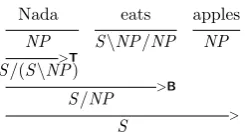
Combinatory Categorial Grammar (CCG) (Ades and Steedman,1982;Steedman,2000) is a mildly context sensitive grammar formalism that is at-tractive both from a cognitive and an engineer-ing perspective. Compared to other grammar for-malisms, the aspect in which CCG excels is incre-mental sentence processing. CCG has a very flex-ible notion of constituent structure which allows (mostly) left-branching derivation trees that are easier to process incrementally. Take for instance the derivation tree in Figure1a. If we use a non-incremental shift-reduce parser (as done in the ma-jority of transition-based parsers for CCG (Zhang
and Clark, 2011;Xu et al., 2014;Xu, 2016)) we will be able to establish the semantic connection between the subject “Nada” and the verb “eats” only when we reach the end of the sentence. This is undesirable for several reasons. First, human sentence processing is much more incremental, so that the meaning of the prefix “Nada eats” is avail-able as soon as it is read (Marslen-Wilson,1973). Second, if we want a predictive model—either for better parsing or language modelling—it is crucial to establish relations between the words in the pre-fix as early as possible.
To address this problem, a syntactic theory needs to be able to represent partial constituents like “Nada eats” and have mechanisms to build them just by observing the prefix. In CCG solu-tions for these problems come out of the theory naturally. CCG categories can represent partial structures and these partial structures can combine into bigger (partial) structures using CCG com-binators recursively. Figure 1b shows how CCG can incrementally process the example sentence via a different derivation tree that generates the same semantics more incrementally by being left-branching.
at-Nada eats apples NP S\NP/NP NP
>
S\NP
<
S
(a) Right-branching derivation.
Nada eats apples NP S\NP/NP NP
>T S/(S\NP)
>B S/NP
>
S
[image:2.595.330.453.69.137.2](b) Left-branching derivation.
Figure 1: Semantically equivalent CCG derivations.
Nada eats apples regularly NP S\NP/NP NP S\NP\(S\NP)
>T S/(S\NP)
>B S/NP
>
S
(a) Problem –S\NPthat needs to be modified was never
built.
Nada eats apples regularly NP S\NP/NP NP S\NP\(S\NP)
>T >
S/(S\NP) S\NP
>
S
(b) Incremental tree rotationreveals S\NP.
Nada eats apples regularly NP S\NP/NP NP S\NP\(S\NP)
>T >
S/(S\NP) S\NP
<
S\NP
>
S
[image:2.595.89.275.363.423.2](c) Right adjunct is attached to the revealed node.
Figure 2: Right adjunction.
tach the right adjunct of a verb phrase to a sentence constituent. A simple solution would be some sort of limited back-tracking where we would look if we could extract the verb-phrase, attach its right adjunct, and then put the derivation back together. But how do we do the extraction of the verb-phrase “eats apples” when that constituent was never built during the incremental left-branching derivation?
Pareschi and Steedman (1987) proposed to re-vealthe constituent that is needed, the verb-phrase in our example, by having an elegant way of re-analysing the derivation. This reanalysis does not repeat parsing from scratch but instead runs a sin-gle CCG combinatory rule backwards. In the ex-ample at hand, first we recognise that right adjunc-tion needs to take place because we have a cat-egory of shape X\X (concretely (S\NP)\(S\NP)
but in the present CCG notation slashes “associate to the left”, so we drop the first pair of brackets). Thanks to the type of the adjunct we know that the
constituent that needs to be revealed is of typeX, in our caseS\NP. Now, we take the constituent on the left of the right adjunct, in our example con-stituentS, and look for CCG categoryY and com-binatory ruleCthat satisfies the following relation:
C(Y, S\NP) = S. The solution to this type equation isY=NPandC=<.
To confine revealing to delivering constituents that the parsercould havebuilt if it had been less greedy for incrementality, and exclude revelation of unsupported types, such as PP in Figure2a, the process must be constrained by the actual deriva-tion.Pareschi and Steedmanproposed to do so by accessing the semantic representation in parallel, using higher-order unification, which is in general undecidable and may be unsound unless defined over a specific semantic representation.
Ambati et al. (2015) propose an alternative method for revealing where dependencies are used as a semantic representation (instead of first-order logic) and special heuristics are used for reveal-ing (instead of higher order unification). This is computationally a much more efficient approach and appears sound, but requires distinct revealing rules for each constituent type and has specific dif-ficulties with punctuation.
In this paper we propose a method of reveal-ing that does not depend on any specific choice of semantic representation, can discover multi-ple possible revealing options if they are avail-able, is sound and complete and computation-ally efficient, and gives state-of-the-art parsing results. The algorithm works by building left-branching derivations incrementally, but, follow-ingNiv(1993,1994), as soon as a left branching derivation is built, its derivation tree is rebalanced to be right-branching. When all such constituents’ derivation trees are right-branching, revealing be-comes a trivial operation where we just traverse the right spine looking for the constituent(s) of the right type to be modified by the right adjunct.
rota-tion since it is a technical term established in the field of data structures for similar operation of balanced binary search trees (Adelson-Velskii and Landis, 1962;Guibas and Sedgewick, 1978;
Okasaki, 1999; Cormen et al., 2009). Figure 2b
shows the right rotated derivation “Nada eats ap-ples” next to the adjunct. Here we can just look up the requiredS\NPand attach the right adjunct to it as in Figure2c.
2 Combinatory Categorial Grammar
CCG is a lexicalized grammar formalism where each lexical item in a derivation has a category as-signed to it which expresses the ways in which the lexical item can be used in the derivation. These categories are put together using combina-tory rules.
The binary combinatory rules we use are:
X/Y Y ⇒ X (>)
Y X\Y ⇒ X (<)
X/Y Y /Z ⇒ X/Z (>B) Y\Z X\Y ⇒ X\Z (<B) Y /Z X\Y ⇒ X/Z (<B×) Y /Z|W X\Y ⇒ X/Z|W (<B2
×) X/Y Y /Z|W ⇒ X/Z|W (>B2) Each binary combinatory rule has one primary and one secondary category as its inputs. The primary functor is the one that selects; while the secondary category is the one that is selected. In forward combinatory rules the primary functor is always the left argument, while in the backward combina-tory rules it is always the right.
It is useful to look at the mentioned combina-tory rules in a generalised way. For instance, if we look at forward combinatory rules we can see that they all follow the same pattern of combin-ingX/Y with a category that starts withY. The only difference among them is how many subcate-gories followY in the secondary category. In case of forward function application there will be noth-ing follownoth-ingY so we can treat forward function application as a generalised forward composition combinator of the zeroth order >B0. Standard forward function composition>Bwill be a gener-alised composition of first order>B1while>B2
will be>B2. Same generalisation can be applied to backward combinators. There is a low bound on the order of combinatory rules, around 2 or 3.
FollowingHockenmaier and Steedman (2007), the proclitic character of conjunctions is captured in a syncategorematic rule combining them with
the right conjunct, with the result later combining with the left conjunct1:
conj X ⇒ X[conj] (>Φ) X X[conj] ⇒ X (<Φ) Some additional unary and binary type-changing rules are also needed to process the derivations in CCGbank (Hockenmaier and Steedman,2007). We use the same type-changing rules as those de-scribed in (Clark and Curran,2007).
Among the unary combinatory rules the most important one is type-raising. The first reason for that is that it allows CCG to handle constructions like argument cluster coordination in a straight-forward way. Second, it allows CCG to be much more incremental as seen from the example in Fig-ure1b. Type-raising rules are expressed in the fol-lowing way:
X ⇒ Y /(Y\X) (>T) X ⇒ Y\(Y /X) (<T) Type-raising, is strictly limited to applying to cat-egory types that are arguments, such as NP, PP, etc., making it analogous to grammatical case in languages like Latin and Japanese, in spite of the lack of morphological case in English.
3 Parsing
CCG derivations can be parsed with the same shift-reduce mechanism used for CFG parsing (Steedman,2000). In the context of CFG parsing, the shift-reduce algorithm is not incremental, be-cause CFG structures are mostly right-branching, but in CCG by changing the derivation via the combinatory rules we also change the level of in-crementality of the algorithm.
As usual, the shift-reduce algorithm consists of a stack of the constituents built so far and a buffer with words that are yet to be processed. Parsing starts with the stack empty and the buffer contain-ing the whole sentence. The end state is a stack with only one element and an empty buffer. Tran-sitions between parser states are:
• shift(X)– moves the first word from the buffer to the stack and labels it with categoryX, • reduceUnary(C)– applies a unary
combina-tory ruleCto the topmost constituent on the stack,
• reduceBinary(C)– applies a binary combina-tory ruleCto the two topmost constituents on
1This notation differs unimportantly from Steedman
(2000) who uses a ternary coordination rule, and more recent
the stack.
CCG shift-reduce parsers are often built over right-branching derivations that obey Eisner nor-mal form (Eisner, 1996). Processing left-branching derivations is not any different except that it requires an opposite normal form.
Our revealing algorithm adds a couple of mod-ifications to this default shift-reduce algorithm. First, it guarantees that all the trees stored on the stack are right-branching – this still allows left-branching parsing and only adds the requirement of adjusting newly reduced trees on the stack to be right leaning. Second, it addsrevealingtransitions that exploit the right-branching guarantee to apply right adjunction. Both tree rotation and revealing are performed efficiently as described in the fol-lowing subsections.
3.1 Tree rotation
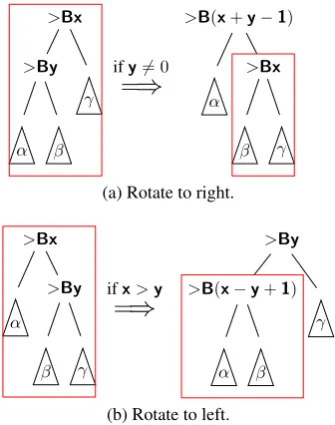
A na¨ıve way of enforcing right-branching guaran-tee is to do a complete transformation of the sub-tree on the stack into a right-branching one. How-ever, that would be unnecessarily expensive. In-stead we doincremental tree rotationto right. If we assume that all the elements on the stack are re-specting this right-branching form (our inductive case), this state can be disturbed only by reduceBi-narytransition (shiftjust adds a single word which is trivially right-branching andreduceUnarydoes not influence the direction of branching). The re-duceBinary transition will take two topmost ele-ments on the stack that are already right-branching and put them as children of some new binary node. We need to repair that potential “imperfection” on top of the tree. This is done by recursively rotating the nodes as in Figure3a.2
This figure shows one of the sources of CCG’s spurious ambiguity: parent-child relation of the combinatory rules with the same directionality. Here we concentrate on forward combinators be-cause they are the most frequent in our data— most backward combinators disappear with the addition of forward type-raising and the addition of special right adjunct transitions—but the same method can be applied to backward combinatory rules as a mirror image. Having two combina-tory rules of the same directionality is necessary
2
Although we do not discuss the operations on the se-mantic predicate-argument structure that correspond to tree-rotation, the combinatory semantics of the rules themselves guarantees that such operations can be done uniformly and in parallel.
>Bx
>By ify6= 0
=
⇒
>B(x+y−1)
>Bx
α β
γ α
β γ
(a) Rotate to right.
>Bx
>By ifx>y
=
⇒
>By
>B(x−y+1)
α
β γ α β
γ
[image:4.595.332.500.61.274.2](b) Rotate to left.
Figure 3: Tree rotation operations. The red square
sig-nifies recursion. Variablesxandyrepresent the orders
of the combinatory rules.
but not sufficient condition for spurious ambigu-ity. As visible on the Figure3aside condition, the lower combinator must not be>B0. The tree rota-tion funcrota-tion assumes that both of the children are “perfect”—meaning right-branching3— and that the only imperfection is on the root node. The method repairs this imperfection on the root by ap-plying the tree rotation transformation, but it also creates a new node as a right child and that node might be imperfect. That is why the method goes down the right node recursively until all the imper-fections are removed and the whole tree becomes fully right-branching. In the worst case the method will reach the bottom of the tree, but often only 3 or 4 nodes need to be transformed to make the tree perfectly the right branching The worst case complexity of repairing the imperfection isO(n) which makes the complexity of the whole parsing algorithmO(n2)for building a single derivation.
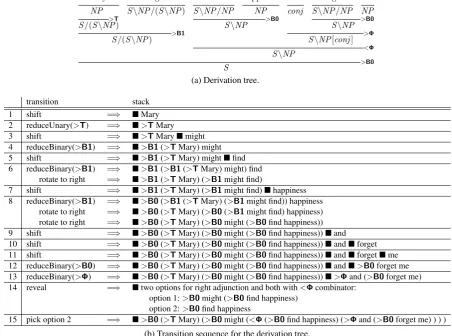
As a running example we will use a derivation tree in Figure4a for which a transition sequence is given in Figure4b. Here tree rotation is used in transitions6and8that introduce imperfections. In transition6a single tree rotation at the top was enough to correct the imperfection, while in tran-sition 8 recursive tree rotation function went to depth two.
If the upper and lower combinators are both >B2the topmost combinator on the right will
be-3By right branching we mean as right branching as it is
Mary might find happiness and forget me NP S\NP/(S\NP) S\NP/NP NP conj S\NP/NP NP
>T >B0 >B0
S/(S\NP) S\NP S\NP
>B1 >Φ
S/(S\NP) S\NP[conj]
<Φ S\NP
>B0 S
(a) Derivation tree.
transition stack
1 shift =⇒ Mary
2 reduceUnary(>T) =⇒ >TMary
3 shift =⇒ >TMarymight
4 reduceBinary(>B1) =⇒ >B1(>TMary) might 5 shift =⇒ >B1(>TMary) mightfind 6 reduceBinary(>B1) =⇒ >B1(>B1(>TMary) might) find
rotate to right =⇒ >B1(>TMary) (>B1might find)
7 shift =⇒ >B1(>TMary) (>B1might find)happiness 8 reduceBinary(>B1) =⇒ >B0(>B1(>TMary) (>B1might find)) happiness
rotate to right =⇒ >B0(>TMary) (>B0(>B1might find) happiness) rotate to right =⇒ >B0(>TMary) (>B0might (>B0find happiness)) 9 shift =⇒ >B0(>TMary) (>B0might (>B0find happiness))and 10 shift =⇒ >B0(>TMary) (>B0might (>B0find happiness))andforget 11 shift =⇒ >B0(>TMary) (>B0might (>B0find happiness))andforgetme 12 reduceBinary(>B0) =⇒ >B0(>TMary) (>B0might (>B0find happiness))and>B0forget me 13 reduceBinary(>Φ) =⇒ >B0(>TMary) (>B0might (>B0find happiness))>Φand (>B0forget me) 14 reveal =⇒ two options for right adjunction and both with<Φcombinator:
option 1:>B0might (>B0find happiness) option 2:>B0find happiness
15 pick option 2 =⇒ >B0(>TMary) (>B0might (<Φ(>B0find happiness) (>Φand (>B0forget me) ) ) )
[image:5.595.73.526.69.405.2](b) Transition sequence for the derivation tree.
Figure 4: Example of the algorithm run over a sentence with tensed VP coordination.
come >B3, a combinatory rule that may be un-necessary for defining the competence grammar of human languages, but which is required if pars-ing performance is to be as incremental as possi-ble. Fortunately, the configuration with two con-nected>B2combinatory rules appears very rarely in CCGbank.
Many papers have been published on using left-branching CCG derivations but, to the best of our knowledge, none of them explains how are they constructed from right-branching CCGbank trees. A very simple algorithm for that can be made us-ing our tree rotation function. Here we use rotation in the opposite direction i.e. rotation to left (Fig-ure3b). We cannot apply this operation from the top node of the CCGbank tree because that tree does not satisfy the assumption of the algorithm: immediate children are not “perfect” (here perfect means being left-branching). That is why we start from the bottom of the tree with terminal nodes that are trivially “perfect” and apply tree transfor-mation to each node in post-order traversal.
This incremental tree rotation algorithm is
in-spired by the AVL self-balancing binary search trees (Adelson-Velskii and Landis, 1962) and Red-Black trees (Guibas and Sedgewick, 1978;
Okasaki,1999). The main difference is that here we are trying to do the opposite of AVLs: instead of making the tree perfectly balanced we are trying to make it perfectly unbalanced, i.e. leaning to the right (or left). Also, our imperfections start at the top and are pushed to the bottom of the tree which is in contrast to AVLs trees where imperfections start at the bottom and get pushed to the top.
3.2 Revealing transitions
If the topmost element on the stack is of the form
X\Xand the second topmost element on the stack has on its right edge one or more constituents of a typeX|$ we allow reveal transition.4 This is a more general way of revealing than approaches of
Pareschi and Steedman(1987) andAmbati et al.
(2015) who attempt to reveal only constituents of typeX while we reveal any type that hasX as its prime element (that is the meaning of X|$ nota-tion).
We also treat X[conj] as right adjuncts of the left conjunct. Similarly to the previous case, if the top-most element on the stack is X[conj] and the right edge of the second topmost element on the stack has constituent(s) of type X, they are revealed for possible combination via<Φcombinator.
If reveal transition is selected, as in transition 14 in Figure 4b, the parser enters into a mode of choosing among different constituents labelled
X|$ that could be modified by the right adjunct
X\X. After particularX|$ node is chosen X\X is combined with it and the rest of the tree above
X node is rebuilt in the same way. This rebuild is fully deterministic and is done quickly even though in principle it could take O(n) to com-pute. Even in the worst case scenario, it does not make the complexity of the algorithm go higher thanO(n2).
The ability of our algorithm to choose among different possible revealing options is unique among all the proposals for revealing. For transi-tion 15 in Figure4bthe parser can choose whether to adjoin (coordinate) to a verb phrase that already contains a left modifier or without. This is simi-lar toSelective Modifier Placementstrategy from older Augmented Transition Network (ATN) sys-tems (Woods,1973) which finds all the attachment options that are syntactically legal and then allows the parser to choose among those using some cri-teria.Woods(1973) suggests using lexical seman-tic information for this selection, but in his ATN system only handwritten semantic selection rules were used. Here we will also use selection based on the lexical content but it will be broad coverage and learned from the data. This ability to seman-tically select the modifier’s attachment point is es-sential for good parsing results as will be shown.
4The “$ notation” is from (Steedman,2000) where $ is
used as a (potentially empty) placeholder variable ranging over multiple arguments.
4 Neural Model
The neural probabilistic model that chooses which transition should be taken next conditions on the whole state of the configuration in a similar way to RNNG parser (Dyer et al.,2016). The words in the sentence are first embedded using the concate-nation of top layers of ELMo embeddings (Peters et al., 2018) that are normalised to L2 norm and then refined with two layers of bi-LSTM (Graves et al.,2005). The neural representation of the ter-minal is composed of concatenated ELMo embed-ding and supertag embedembed-ding.
The representation of a subtree combines: • span representation – we subtract
representa-tion of the leftmost terminal from the repre-sentation of the rightmost terminal as done in LSTM-Minus architecture (Wang and Chang,
2016),
• combinator and category embeddings, • head words encoding – because each
con-stituent can have a set of heads, for instance arising from coordination, we model repre-sentation of heads with DeepSet architecture (Zaheer et al., 2017) over representations of head terminals.
We do not use recursive neural networks like Tree-LSTM (Tai et al., 2015) to encode subtrees be-cause of the frequency of tree rotation. These op-erations are fast, but they would trigger frequent recomputation of the neural tree representation, so we opted for a mechanism that is invariant to re-branching.
The stack representation is encoded using Stack-LSTM (Dyer et al., 2015). The configu-ration representation is the concatenation of the stack representation and the representation of the rightmost terminal in the stack. The next non-revealingtransition is chosen by a two-layer feed-forward network.
If the reveal transition is triggered, the system needs to choose which among the candidate nodes
Waiting time
Connect-edness
Right-branching 4.29 5.01
Left-branching 2.32 3.15
Ambati et al.(2015)* 0.69 2.15
[image:7.595.312.519.62.148.2]Revealing our 0.46 1.72
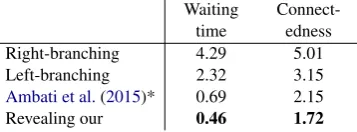
Table 1: Train set measure of incrementality. *: taken
from (Ambati et al.,2015)
could be some preference for attaching adjuncts high or low in the tree we add to the context rep-resentation of each node two position embeddings (Vaswani et al., 2017) that encode the candidate node’s height and depth in the current tree.
We optimize for maximum log-likelihood on the training set, using only the most frequent su-pertags and the most important combinators. To avoid discarding sentences with rare supertags and type-changing rules we use all supertags and combinatory rules during training but do not add their probability to the loss function. The num-ber of supertags used is 425, as in the Easy-CCG parser, and the combinatory rules that are used are the same as in C&C parser. The loss is minimised for 15 epochs on the training por-tion of CCGbank (Hockenmaier and Steedman,
2007) using Adam with learning rate 0.001. Di-mensionality is set to 128 in all cases, except for ELMo set at 300. Dropout is applied only to the ELMo input with a rate of 0.2. The parser is implemented in Scala using the DyNet toolkit (Neubig et al., 2017) and is available at
https://github.com/stanojevic/Rotating-CCG.
5 Experiments
5.1 How incremental is the Revealing algorithm?
To measure the incrementality of the proposed al-gorithm we use two evaluation metrics: waiting timeandconnectedness. Waiting time is the aver-age number of nodes that need to be shifted before the dependency between two nodes is established. The minimal value for a fully incremental algo-rithm is0(the single shift that is always necessary is not counted). Connectedness is defined as the average stack size before a shift operation is per-formed (the initial two shifts are forced so they are not taken in the average). The minimal value for connectedness is 1. We have computed these mea-sures on the training portion of the CCGbank for standard non-incremental right-branching
deriva-heads SMP LF UF Sup.
Tag
Left yes — 89.2 95.1 95.0
Right yes — 89.1 95.0 95.1
Revealing no yes 89.3 95.2 94.9
Revealing yes no 88.8 94.9 94.9
[image:7.595.92.271.63.129.2]Revealing yes yes 89.5 95.4 95.1
Table 2: Development set F1 results with greedy de-coding for CCG dependencies.
tions, the more incremental left-branching deriva-tions and our revealing derivaderiva-tions. We also put in the results numbers for the previous proposal of revealing byAmbati et al.(2015) taken from their paper but these numbers should be taken with cau-tion, because it is not clear from the paper whether the authors computed them in the same way and on the same portion of the dataset as we did. Ta-ble1 results shows that our revealing derivations are significantly more incremental even in com-parison to previous revealing proposals, and barely use more than the minimal amount of stack mem-ory.
5.2 Which algorithm gives the best parsing results?
We have tested on the development set which of the parsing algorithms gives best parsing accuracy. All the algorithms use the same neural architec-ture and training method except for the revealing operations that require additional mechanisms to choose the node for revealing. This allows us to isolate machine learning factors and see which of the parsing strategies works the best.
There are two methods that are often used for evaluating CCG parsers. They are both based on “deep” dependencies extracted from the derivation trees. The first is from (Clark et al.,2002) and is closer to categorial grammar view of dependen-cies. The second is from (Clark and Curran,2007) and is meant to be more formalism independent and closer to standard dependencies (Caroll et al.,
1998). We opt for the first option for development as we find it more robust and reliable but we report both types on the test set.
1 2 4 8 16 89
89.2 89.4 89.6 89.8 90
1 2 4 8 16
89.58
89.19
89.83
89.21
89.61
89.43
Beam size
Labelled
F1
[image:8.595.311.524.60.164.2]Revealing Left Right
Figure 5: Influence of beam size on the dev results.
on the position embeddings or also on the node’s lexical content. First we can see that Revealing approach that uses head representation and does selective modifier placement outperforms all the models both on labelled and unlabelled dependen-cies. Ablation experiments show that SMP was the crucial component: without it the Revealing model is much worse. This is a clear evidence that attachment heuristics are not enough and also that previous approaches that extract only single revealing option are sub-optimal.
A possible reason why Revealing model works better than Left and Right branching models is that Left and Right models need to commit early on whether there will be a right adjunct in the future or not. If they make a mistake during greedy de-coding there will be no way to repair that mistake. This is not an issue for the Revealing model be-cause it can attach right adjuncts at any point and does not need to forecast them. A natural question then is if these improvements of Revealing model will stay if we use a bigger beam. Figure5shows exactly that experiment. We see that the model that gains the most from the biggest beam is for the Left-branching condition, which is expected since that is the model that commits to its predic-tions the most — it commits with type-raising, un-like Right model, and it commits with predicting right adjunction, unlike Revealing model. With an increased beam Left model equals the Revealing greedy model. But if all the models use the same beam the Revealing model remains the best. An interesting result is that the small beam of size 4 is enough to get the maximal improvement. This probably reflects the low degree of lexical ambigu-ity that is unresolved at each point during parsing.
Tag UF LF
Lewis and Steedman(2014) 93.0 88.6 81.3
Ambati et al.(2015) 91.2 89.0 81.4
Hockenmaier(2003) 92.2 92.0 84.4
Zhang and Clark(2011) 93.1 — 85.5
Clark and Curran(2007) 94.3 93.0 87.6
Revealing (beam=1) 95.2 95.5 89.8
[image:8.595.80.284.63.223.2]Revealing (beam=4) 95.4 95.8 90.2
Table 3: Test set F1 results for prediction of supertags (Tag), unlabelled (UF) and labelled (LF) CCG
de-pendencies extracted using scripts fromHockenmaier
(2003) parser.
Dev LF
Test LF
Clark and Curran(2007) 83.8 85.2
Lewis and Steedman(2014) — 86.1
Yoshikawa et al.(2017) 86.8 87.7
Xu et al.(2016) 87.5 87.8
Lewis et al.(2016) tri-train 87.5 88.1
Vaswani et al.(2016) 87.8 88.3
Lee et al.(2016) tri-train 88.4 88.7
Yoshikawa et al.(2017) tri-train 87.7 88.8
Revealing (beam=1) 90.8 90.5
Table 4: F1 results for labelled dependencies extracted withgenerateprogram of C&C parser (Clark and Cur-ran,2007).
5.3 Comparison to other published models
We compute test set results for our Revealing model and compare it to most of the previous re-sults on CCGbank using both types of dependen-cies. Table 3 shows results with (Clark et al.,
2002) style dependencies. Here we get state-of-the-art results by a large margin, probably mostly thanks to the machine learning component of our parser. An interesting comparison to be made is against EasyCCG parser of Lewis and Steedman
[image:8.595.312.531.237.375.2]In Table4we show results with the second type of dependencies used for CCG evaluation. All the models, exceptClark and Curran (2007), are neural and use external embeddings. From the presented models only Revealing and Xu et al.
(2016) are transition based. All other models have a global search either via CKY or A* search. Our revealing-based parser that does only greedy search is outperforming all of them including those trained on large amounts of unlabelled data using semi-supervised techniques like tri-training (Lewis et al., 2016;Lee et al., 2016; Yoshikawa et al.,2017).
In some sense, all the neural models in Table4
are implicitly trained in semi-supervised way be-cause they use pretrained embeddings that are es-timated on unlabelled data. The quality of ELMo embeddings is probably one of the reasons why our parser achieves such good results. However, another semi-supervised training method, namely tri-training, is particularly attractive because, un-like ELMo, it is trained on a CCG parsing ob-jective which is more closely aligned to what we want to do. All tri-training models are trained on much larger dataset that in addition to CCG-bank also includes 43 million word corpus auto-matically annotated with silver CCG derivations byLewis et al.(2016). It is likely that incorporat-ing tri-trainincorporat-ing into our trainincorporat-ing setup will further increase the improvement over other models.
6 Other relevant work
Recurrent Neural Network Grammar (RNNG) (Dyer et al.,2016) is a fully incremental top-down parsing model. Because it is top-down it has no is-sues with right branching structures, but right ad-juncts would still make parsing more difficult for RNNG because they will have to be predicted even earlier than in Left- and Right- branching deriva-tions in CCG.
Left-corner parsers (which can be seen as a more constrained version of CCG Left-branching parsing strategy) seem more psychologically re-alistic than top-down parsers (Abney and John-son,1991;Resnik, 1992;Stanojevi´c and Stabler,
2018). Some proposals about handling right ad-junction in left-corner parsing are based on exten-sion to generalized left-corner parsers (Demers,
1977;Hale, 2014) that can force some grammar rules (in particular right-adjunction rules) to be less incremental. Our approach does not decrease
incrementality of the parser in this way. On the contrary, having a special mechanism for right ad-junction makes parser both more incremental and more accurate.
Revealing based on higher order unification by
Pareschi and Steedman(1987) was also proposed by Steedman (1990) as the basis for CCG ex-planation of gapping. The present derivation-based mechanism for revealing does not extend to gapping, and is targeting to model only deriva-tions that could be explained with a standard CCG grammar derived from CCGbank. While that guarantees that we stay in the safe zone of sound and complete “standard” CCG derivations, it would be good as a future work to extend sup-port for gapping and other types of derivations not present in CCGbank.
Niv(1993,1994) proposed an alternative to the unification-based account of Pareschi and Steed-man similar to our proposal for online tree rota-tion. Niv’s parser is mostly a formal treatment of left-to-right rotations evaluated against psycholin-guistic garden paths, but lacks the wide coverage implementation and statistical parsing model as a basis for resolving attachment ambiguities.
7 Conclusion
We have presented a revealing-based incremental parsing algorithm that has special transitions for handling right-adjunction. The parser is neutral with regard to the particular semantic represen-tation used. It is compurepresen-tationally efficient, and can reveal all possible constituents types. It is the most incremental CCG parser yet proposed, and has state-of-the-art results against all published parsers trained on the CCGbank under both de-pendency recovery measures that are in use for the purpose.
Acknowledgments
This work was supported by ERC H2020 Ad-vanced Fellowship GA 742137 SEMANTAX grant.
References
Steven P. Abney and Mark Johnson. 1991. Memory re-quirements and local ambiguities of parsing
strate-gies. Journal of Psycholinguistic Research, 20:233–
G M Adelson-Velskii and E M Landis. 1962. An al-gorithm for the organization of information. Soviet Mathematics Doklady, 3(2):263–266.
Anthony Ades and Mark Steedman. 1982. On the order
of words. Linguistics and Philosophy, 4:517–558.
Bharat Ram Ambati, Tejaswini Deoskar, Mark
John-son, and Mark Steedman. 2015. An Incremental
Al-gorithm for Transition-based CCG Parsing. In Pro-ceedings of the 2015 Conference of the North Amer-ican Chapter of the Association for Computational Linguistics: Human Language Technologies, pages 53–63. Association for Computational Linguistics.
Dzmitry Bahdanau, Kyunghyun Cho, and Yoshua
Ben-gio. 2014. Neural machine translation by jointly
learning to align and translate. arXiv preprint
arXiv:1409.0473.
John Caroll, Ted Briscoe, and Antonio Sanfilippo. 1998. Parser evaluation: a survey and a new
pro-posal. In First International Conference on
lan-guage resources & evaluation: Granada, Spain, 28-30 May 1998, pages 447–456. European Language Resources Association.
Stephen Clark and James R Curran. 2007.
Wide-coverage efficient statistical parsing with CCG
and log-linear models. Computational Linguistics,
33(4):493–552.
Stephen Clark, Julia Hockenmaier, and Mark Steed-man. 2002. Building deep dependency structures
with a wide-coverage CCG parser. InProceedings
of the 40th Annual Meeting on Association for Com-putational Linguistics, pages 327–334. Association for Computational Linguistics.
Thomas H. Cormen, Charles E. Leiserson, Ronald L.
Rivest, and Clifford Stein. 2009. Introduction to
Algorithms, Third Edition, 3rd edition. The MIT Press.
Alan J. Demers. 1977. Generalized left corner
pars-ing. In4th Annual ACM Symposium on Principles
of Programming Languages, pages 170–181.
Chris Dyer, Miguel Ballesteros, Wang Ling, Austin
Matthews, and Noah A. Smith. 2015.
Transition-based dependency parsing with stack long short-term memory. InProceedings of the 53rd Annual Meeting of the Association for Computational Lin-guistics and the 7th International Joint Conference on Natural Language Processing (Volume 1: Long Papers), pages 334–343, Beijing, China. Associa-tion for ComputaAssocia-tional Linguistics.
Chris Dyer, Adhiguna Kuncoro, Miguel Ballesteros, and Noah A Smith. 2016. Recurrent neural network
grammars. InProceedings of the 2016 Conference
of the North American Chapter of the Association for Computational Linguistics: Human Language Technologies, pages 199–209.
Jason Eisner. 1996. Efficient normal-form parsing for
Combinatory Categorial Grammar. InProceedings
of the 34th annual meeting on Association for Com-putational Linguistics, pages 79–86. Association for Computational Linguistics.
Alex Graves, Santiago Fern´andez, and J¨urgen
Schmid-huber. 2005. Bidirectional LSTM Networks for
Improved Phoneme Classification and Recogni-tion. In Proceedings of the 15th International Conference on Artificial Neural Networks: For-mal Models and Their Applications - Volume Part
II, ICANN’05, pages 799–804, Berlin, Heidelberg.
Springer-Verlag.
Leo J. Guibas and Robert Sedgewick. 1978.A
dichro-matic framework for balanced trees. InProceedings of the 19th Annual Symposium on Foundations of Computer Science, SFCS ’78, pages 8–21, Washing-ton, DC, USA. IEEE Computer Society.
John T. Hale. 2014. Automaton Theories of Human
Sentence Comprehension. CSLI, Stanford.
Julia Hockenmaier. 2003. Data and models for
sta-tistical parsing with Combinatory Categorial
Gram-mar. Ph.D. thesis, University of Edinburgh. College
of Science and Engineering. School of Informatics.
Julia Hockenmaier and Yonatan Bisk. 2010.
Normal-form Parsing for Combinatory Categorial Grammars with Generalized Composition and Type-raising. In
Proceedings of the 23rd International Conference on Computational Linguistics, COLING ’10, pages 465–473, Stroudsburg, PA, USA. Association for Computational Linguistics.
Julia Hockenmaier and Mark Steedman. 2007. CCG-bank: a corpus of CCG derivations and dependency
structures extracted from the Penn Treebank.
Com-putational Linguistics, 33(3):355–396.
Kenton Lee, Mike Lewis, and Luke Zettlemoyer. 2016.
Global Neural CCG Parsing with Optimality Guar-antees. InProceedings of the 2016 Conference on Empirical Methods in Natural Language
Process-ing, pages 2366–2376. Association for
Computa-tional Linguistics.
Mike Lewis, Kenton Lee, and Luke Zettlemoyer. 2016.
Lstm ccg parsing. InProceedings of the 2016 Con-ference of the North American Chapter of the As-sociation for Computational Linguistics: Human Language Technologies, pages 221–231, San Diego, California. Association for Computational Linguis-tics.
Mike Lewis and Mark Steedman. 2014. A* CCG
pars-ing with a supertag-factored model. In
Proceed-ings of the 2014 Conference on Empirical Methods in Natural Language Processing (EMNLP), pages 990–1000.
William Marslen-Wilson. 1973. Linguistic structure
and speech shadowing at very short latencies.
Graham Neubig, Chris Dyer, Yoav Goldberg, Austin Matthews, Waleed Ammar, Antonios Anastasopou-los, Miguel Ballesteros, David Chiang, Daniel Clothiaux, Trevor Cohn, Kevin Duh, Manaal Faruqui, Cynthia Gan, Dan Garrette, Yangfeng Ji, Lingpeng Kong, Adhiguna Kuncoro, Gaurav Ku-mar, Chaitanya Malaviya, Paul Michel, Yusuke Oda, Matthew Richardson, Naomi Saphra, Swabha
Swayamdipta, and Pengcheng Yin. 2017. Dynet:
The dynamic neural network toolkit. arXiv preprint
arXiv:1701.03980.
Michael Niv. 1993. A Computational Model of
Syn-tactic Processing: Ambiguity Resolution from Inter-pretation. Ph.D. thesis, University of Pennsylvania. IRCS Report 93-27.
Michael Niv. 1994. A psycholinguistically motivated
parser for CCG. InProceedings of the 32nd annual
meeting on Association for Computational
Linguis-tics, pages 125–132. Association for Computational
Linguistics.
Chris Okasaki. 1999. Red-black trees in a
func-tional setting. Journal of functional programming,
9(4):471–477.
Remo Pareschi and Mark Steedman. 1987. A Lazy
Way to Chart-parse with Categorial Grammars. In
Proceedings of the 25th Annual Meeting on As-sociation for Computational Linguistics, ACL ’87, pages 81–88, Stroudsburg, PA, USA. Association for Computational Linguistics.
Matthew E. Peters, Mark Neumann, Mohit Iyyer, Matt Gardner, Christopher Clark, Kenton Lee, and Luke Zettlemoyer. 2018. Deep contextualized word
rep-resentations. InProc. of NAACL.
Philip Resnik. 1992. Left-corner parsing and
psycho-logical plausibility. InProceedings of the 14th
Inter-national Conference on Computational Linguistics, COLING 92, pages 191–197.
Miloˇs Stanojevi´c and Edward Stabler. 2018. A sound
and complete left-corner parsing for minimalist grammars. InProceedings of the Eight Workshop on Cognitive Aspects of Computational Language Learning and Processing, pages 65–74. Association for Computational Linguistics.
Mark Steedman. 1990. Gapping as constituent
coordi-nation. Linguistics and philosophy, 13(2):207–263.
Mark Steedman. 2000. The Syntactic Process. MIT
Press, Cambridge, MA.
Kai Sheng Tai, Richard Socher, and Christopher D.
Manning. 2015. Improved semantic representations
from tree-structured long short-term memory net-works. In Proceedings of the 53rd Annual Meet-ing of the Association for Computational LMeet-inguistics and the 7th International Joint Conference on Natu-ral Language Processing (Volume 1: Long Papers), pages 1556–1566, Beijing, China. Association for Computational Linguistics.
Ashish Vaswani, Yonatan Bisk, Kenji Sagae, and Ryan
Musa. 2016. Supertagging With LSTMs. In
Pro-ceedings of the 2016 Conference of the North Amer-ican Chapter of the Association for Computational Linguistics: Human Language Technologies, pages 232–237. Association for Computational Linguis-tics.
Ashish Vaswani, Noam Shazeer, Niki Parmar, Jakob Uszkoreit, Llion Jones, Aidan N Gomez, Ł ukasz
Kaiser, and Illia Polosukhin. 2017. Attention is all
you need. In I. Guyon, U. V. Luxburg, S. Bengio, H. Wallach, R. Fergus, S. Vishwanathan, and R.
Gar-nett, editors, Advances in Neural Information
Pro-cessing Systems 30, pages 5998–6008. Curran As-sociates, Inc.
Oriol Vinyals, Meire Fortunato, and Navdeep Jaitly.
2015. Pointer networks. In C. Cortes, N. D.
Lawrence, D. D. Lee, M. Sugiyama, and R. Garnett,
editors,Advances in Neural Information Processing
Systems 28, pages 2692–2700. Curran Associates, Inc.
Wenhui Wang and Baobao Chang. 2016. Graph-based
Dependency Parsing with Bidirectional LSTM. In
Proceedings of the 54th Annual Meeting of the As-sociation for Computational Linguistics (Volume 1: Long Papers), pages 2306–2315. Association for Computational Linguistics.
William Woods. 1973. An experimental parsing sys-tem for Transition Network Grammars. In Randall
Rustin, editor,Natural Language Processing, pages
111–154. Algorithmics Press, New York.
Wenduan Xu. 2016. LSTM shift-reduce CCG parsing. In Proceedings of the 2016 Conference on Empiri-cal Methods in Natural Language Processing, pages 1754–1764.
Wenduan Xu, Michael Auli, and Stephen Christopher Clark. 2016. Expected f-measure training for shift-reduce parsing with recurrent neural networks. In
Proceedings of the 54nd Annual Meeting of the As-sociation for Computational Linguistics (Volume 1: Long Papers). Association for Computational Lin-guistics.
Wenduan Xu, Stephen Clark, and Yue Zhang. 2014. Shift-reduce CCG parsing with a dependency
model. In Proceedings of the 52nd Annual
Meet-ing of the Association for Computational LMeet-inguistics (Volume 1: Long Papers), volume 1, pages 218–227.
Masashi Yoshikawa, Hiroshi Noji, and Yuji Mat-sumoto. 2017. A* ccg parsing with a supertag and
dependency factored model. In Proceedings of the
55th Annual Meeting of the Association for Compu-tational Linguistics (Volume 1: Long Papers), pages 277–287. Association for Computational Linguis-tics.
M. Zaheer, S. Kottur, M. Ravanbakhsh, B. Poczos, R. Salakhutdinov, and A. Smola. 2017. Deep sets.
Yue Zhang and Stephen Clark. 2011. Shift-reduce
CCG parsing. In Proceedings of the 49th Annual