A Joint Dependency Model of Morphological and Syntactic Structure for
Statistical Machine Translation
Rico Sennrich and Barry Haddow School of Informatics, University of Edinburgh
[email protected],[email protected]
Abstract
When translating between two languages that differ in their degree of morpholog-ical synthesis, syntactic structures in one language may be realized as morphologi-cal structures in the other, and SMT mod-els need a mechanism to learn such trans-lations. Prior work has used morpheme splitting with flat representations that do not encode the hierarchical structure be-tween morphemes, but this structure is rel-evant for learning morphosyntactic con-straints and selectional preferences. We propose to model syntactic and morpho-logical structure jointly in a dependency translation model, allowing the system to generalize to the level of morphemes. We present a dependency representation of German compounds and particle verbs that results in improvements in transla-tion quality of 1.4–1.8 BLEUin the WMT English–German translation task.
1 Introduction
When translating between two languages that dif-fer in their degree of morphological synthesis, syntactic structures in one language may be re-alized as morphological structures in the other. Machine Translation models that treat words as atomic units have poor learning capabilities for such translation units, and morphological segmen-tations are commonly used (Koehn and Knight, 2003). Like words in a sentence, the morphemes of a word have a hierarchical structure that is rel-evant in translation. For instance, compounds in Germanic languages are head-final, and the head is the segment that determines agreement within the noun phrase, and is relevant for selectional prefer-ences of verbs.
1. sie erheben eine Hand|gepäck|gebühr.
function/postion English/German example finite (main) heergehtwalks awayschnellwegquickly
finite (sub.) [...] because he[...] weil er schnellwalks awayweggehtquickly bare infinitive he caner kann schnellwalk awayweggehenquickly
to/zu-infinitive he promiseser verspricht, schnellto walk awaywegzugehenquickly Table 1: Surface realizations of particle verb
weggehen’walk away’.
they charge a carry-on bag fee.
In example 1, agreement in case, number and gender is enforced between eine ’a’ andGebühr
’fee’, and selectional preference betweenerheben
’charge’ andGebühr ’fee’. A flat representation, as is common in phrase-based SMT, does not en-code these relationships, but a dependency repre-sentation does so through dependency links.
In this paper, we investigate a dependency rep-resentation of morphologically segmented words for SMT. Our representation encodes syntactic and morphological structure jointly, allowing a single model to learn the translation of both. Specifi-cally, we work with a string-to-tree model with GHKM-style rules (Galley et al., 2006), and a relational dependency language model (Sennrich, 2015). We focus on the representation of German syntax and morphology in an English-to-German system, and two morphologically complex word classes in German that are challenging for transla-tion, compounds and particle verbs.
German makes heavy use of compounding, and compounds such as Abwasserbehandlungsanlage
‘waste water treatment plant’ are translated into complex noun phrases in other languages, such as Frenchstation d’épuration des eaux résiduaires.
German particle verbs are difficult to model be-cause their surface realization differs depending on the finiteness of the verb and the type of clause. Verb particles are separated from the finite verb in
[image:1.595.305.525.207.296.2]main clauses, but prefixed to the verb in subordi-nated clauses, or when the verb is non-finite. The infinitive markerzu’to’, which is normally a pre-modifying particle, appears as an infix in particle verbs. Table 1 shows an illustrating example.
2 A Dependency Representation of Compounds and Particle Verbs
The main focus of research on compound split-ting has been on the splitsplit-ting algorithm (Popovic et al., 2006; Nießen and Ney, 2000; Weller et al., 2014; Macherey et al., 2011). Our focus is not the splitting algorithm, but the representation of com-pounds. For splitting, we use an approach simi-lar to (Fritzinger and Fraser, 2010), with segmen-tation candidates identified by a finite-state mor-phology (Schmid et al., 2004; Sennrich and Kunz, 2014), and statistical evidence from the training corpus to select a split (Koehn and Knight, 2003). German compounds are head-final, and pre-modifiers can be added recursively. Compounds are structurally ambiguous if there is more than one modifier. Consider the distinction between
(Stadtteil)projekt (literally: ’(city part) project)’)
and Stadt(teilprojekt) ’city sub-project’. We opt
for a left-branching representation by default.1 We also split linking elements, and represent them as a postmodifier of each non-final segment, includ-ing the empty strinclud-ing (""). We use the same repre-sentation for noun compounds and adjective com-pounds.
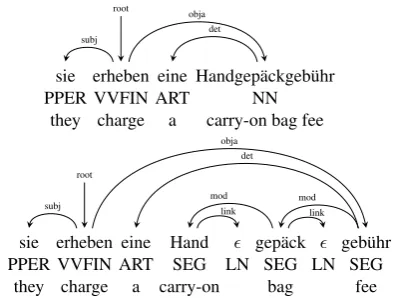
An example of the original2 and the proposed compound representation is shown in Figure 1. Importantly, the head of the compound is also the parent of the determiners and attributes in the noun phrase, which makes a bigram depen-dency language model sufficient to enforce ment. Since we model morphosyntactic agree-ment within the main translation step, and not in a separate step as in (Fraser et al., 2012), we deem it useful that inflection is marked at the head of the compound. Consequently, we do not split off inflectional or derivational morphemes.
For German particle verbs, we define a common representation that abstracts away from the vari-ous surface realizations (see Table 1). Separated
1We follow prior work in leaving frequent words or
sub-words unsplit, which has a disambiguating effect. With more aggressive splitting, frequency information could be used for the structural disambiguation of internal structure.
2The original dependency trees follow the annotation
guidelines by Foth (2005).
sie erheben eine Handgepäckgebühr PPER VVFIN ART NN
they charge a carry-on bag fee root obja
subj det
sie erheben eine Hand gepäck gebühr PPER VVFIN ART SEG LN SEG LN SEG
they charge a carry-on bag fee root
obja
subj
det
mod link mod
[image:2.595.319.518.64.213.2]link
Figure 1: Original and proposed representation of German compound.
er verspricht , schnell wegzugehen PPER VVFIN $, ADJD VVIZU
he promises to go away quickly root
subj
obji comma
adv
er verspricht , schnell zu weg gehen PPER VVFIN $, ADJD PTKZU PTKVZ VVINF
he promises to go away quickly root
subj
obji comma
adv part
avz
Figure 2: Original and proposed representation of German particle verb with infixedzu-marker.
verb particles are reordered to be the closest pre-modifier of the verb. Prefixed particles and thezu -infix are identified by the finite-state-morphology, and split from the verb so that the particle is the closest, the zu marker the next-closest pre-modifier of the verb, as shown in Figure 2. Agree-ment, selectional preferences, and other phenom-ena involve the verb and its dependents, and the proposed representation retains these dependency links, but reduces data sparsity from affixation and avoids discontinuity of the verb and its particle.
3 Tree Binarization
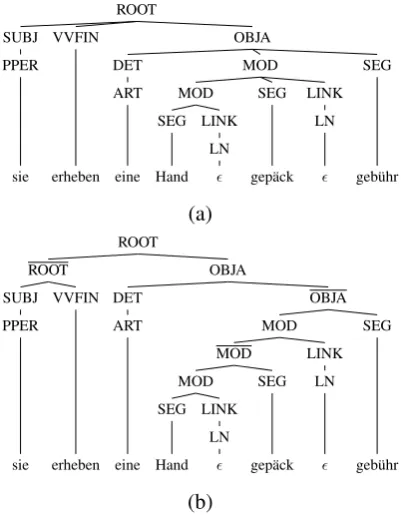
[image:2.595.314.520.262.451.2]de-pendency language model (RDLM). Figure 3 (a) shows the constituency representation of the ex-ample in Figure 1.
Our model should not only be able to produce new words productively, but also to memorize words it has observed during training. Looking at the compoundHandgepäckgebührin Figure 3 (a), we can see that it does not form a constituent, and cannot be extracted with GHKM extraction heuris-tics. To address this, we binarize the trees in our training data (Wang et al., 2007).
A complicating factor is that the binarization should not impair the RDLM. During decoding, we map the internal tree structure of each hypoth-esis back to the unbinarized form, which is then scored by the RDLM. Virtual nodes introduced by the binarization must also be scorable by RDLM if they form the root of a translation hypothesis. A simple right or left binarization would produce vir-tual nodes without head and without meaningful dependency representation. We ensure that each virtual node dominates the head of the full con-stituent through a mixed binarization.3 Specifi-cally, we perform right binarization of the head and all pre-modifiers, then left binarization of all post-modifiers. This head-binarized representa-tion is illustrated in Figure 3 (b).4
Head binarization ensures that even hypotheses whose root is a virtual node can be scored by the RDLM. This score is only relevant for pruning, and discarded when the full constituent is scored. Still, these hypotheses require special treatment in the RDLM to mitigate search errors. The virtual node labels (such as OBJA) are unknown symbols to the RDLM, and we simply replace them with the original label (OBJA). The RDLM uses sibling context, and this is normally padded with special start and stop symbols, analogous to BOS/EOS symbols inn-gram models. These start and stop symbols let the RDLM compute the probability that a node is the first or last child of its ances-tor node. However, computing these probabilities for virtual nodes would unfairly bias the search, since the first/last child of a virtual node is not nec-essarily the first/last child of the full constituent. We adapt the representation of virtual nodes in
3In other words, every node is a fixed well-formed
depen-dency structure (Shen et al., 2010) with our binarization.
4Note that our definition of head binarization is different
from that of Wang et al. (2007), who left-binarize a node if the head is the first child, and right-binarize otherwise. Our algorithm also covers cases where the head has both pre- and post-modifiers, aserhebenandgepäckdo in Figure 3.
ROOT
OBJA
SEG
gebühr MOD
LINK LN
SEG
gepäck MOD
LINK LN
SEG
Hand DET ART
eine VVFIN
erheben SUBJ PPER
sie
(a) ROOT
OBJA
OBJA SEG
gebühr MOD
LINK LN
MOD SEG
gepäck MOD
LINK LN
SEG
Hand DET ART
eine ROOT
VVFIN
erheben SUBJ PPER
sie
[image:3.595.316.517.66.324.2](b)
Figure 3: Unbinarized (a) and head-binarized (b) constituency representation of Figure 1.
RDLM to take this into account. We distinguish between virtual nodes based on whether their span is a string prefix, suffix, or infix of the full con-stituent. For prefixes and infixes, we do not add a stop symbol at the end, and use null symbols, which denote unavailable context, for padding to the right. For suffixes and infixes, we do the same at the start.
4 Post-Processing
For SMT, all German training and development data is converted into the representation described in sections 2–3. To restore the original represen-tation, we start from the tree output of the string-to-tree decoder. Merging compounds is trivial: all segments and linking elements can be identified by the tree structure, and are concatenated.
For verbs that dominate a verb particle, the orig-inal order is restored through three rules:
1. non-finite verbs are concatenated with the particle, andzu-markers are infixed.
2. finite verbs that head a subordinated clause (identified by its dependency label) are con-catenated with the particle.
particle moved to the right clause bracket.5 Previous work on particle verb translation into German proposed to predict the position of parti-cles with ann-gram language model (Nießen and Ney, 2001). Our rules have the advantage that they are informed by the syntax of the sentence and consider the finiteness of the verb.
Our rules only produce projective trees. Verb particles may also appear in positions that violate projectivity, and we leave it to future research to determine if our limitation to projective trees af-fects translation quality, and how to produce non-projective trees.
5 SMT experiments
5.1 Data and Models
We train English–German string-to-tree SMT sys-tems on the training data of the shared transla-tion task of the Workshop on Statistical Machine Translation (WMT) 2015. The data set consists of 4.2 million sentence pairs of parallel data, and 160 million sentences of monolingual German data.
We base our systems on that of Williams et al. (2014). It is a string-to-tree GHKM transla-tion system implemented in Moses (Koehn et al., 2007), and using the dependency annotation by ParZu (Sennrich et al., 2013). Additionally, our baseline system contains a dependency language model (RDLM) (Sennrich, 2015), trained on the target-side of the parallel training data.
We report case-sensitive BLEU scores on the newstest2014/5 test sets from WMT, averaged over 3 optimization runs of k-batch MIRA (Cherry and Foster, 2012) on a subset of newstest2008-12.6 We split all particle verbs and hyphenated com-pounds, but other compounds are only split if they are rare (frequency in parallel text<5).
For comparison with the state-of-the-art, we train afull systemon our restructured representa-tion, which incorporates all models and settings of our WMT 2015 submission system (Williams et al., 2015).7 Note that our WMT 2015 submission
5We use the last position in the clause as default location,
but put the particle before any subordinated and coordinated clauses, which occur in theNachfeld(the ‘final field’ in topo-logical field theory).
6We use mteval-v13a.pl for comparability to official
WMT results; all significance values reported are obtained with MultEval (Clark et al., 2011).
7In contrast to our other systems in this paper, RDLM is
trained on all monolingual data for the full system, and two models are added: a 5-gram Neural Network language model
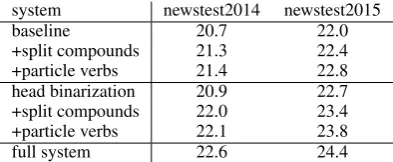
system newstest2014 newstest2015
baseline 20.7 22.0
+split compounds 21.3 22.4 +particle verbs 21.4 22.8 head binarization 20.9 22.7 +split compounds 22.0 23.4 +particle verbs 22.1 23.8
full system 22.6 24.4
Table 2: English–German translation results (BLEU). Average of three optimization runs.
system compound sep. particle verbpref. zu-infix
reference 2841 553 1195 176
baseline 845 96 847 71
[image:4.595.318.515.62.143.2]+head binarization 798 157 858 106 +split compounds 1850 160 877 94 +particle verbs 1992 333 953 169 Table 3: Number of compounds [that would be split by compound splitter] and particle verbs (separated, prefixed and with zu-infix) in new-stest2014/5. Average of three optimization runs.
uses the dependency representation of compounds and tree binarization introduced in this paper; we achieve additional gains over the submission sys-tem through particle verb restructuring.
5.2 SMT Results
Table 2 shows translation quality (BLEU) with dif-ferent representations of German compounds and particle verbs. Head binarization not only yields improvements over the baseline, but also allows for larger gains from morphological segmenta-tion. We attribute this to the fact that full com-pounds, and prefixed particle verbs, are not al-ways a constituent in the segmented representa-tion, and that binarization compensates this the-oretical drawback.
With head binarization, we find substantial im-provements from compound splitting of 0.7–1.1 BLEU. On newstest2014, the improvement is almost twice of that reported in related work (Williams et al., 2014), which also uses a hier-archical representation of compounds, albeit one that does not allow for dependency modelling. Examples of correct, unseen compounds gener-ated includeStaubsauger|roboter’vacuum cleaner robot’,Gravitation|s|wellen’gravitational waves’,
andNPD|-|verbot|s|verfahren’NPD banning
pro-cess’.8
(Vaswani et al., 2013), and soft source-syntactic constraints (Huck et al., 2014).
[image:4.595.306.532.191.262.2]Particle verb restructuring yields additional gains of 0.1–0.4 BLEU. One reason for the smaller effect of particle verb restructuring is that the diffi-cult cases – separated particle verbs and those with infixation – are rarer than compounds, with 2841 rare compounds [that would be split by our com-pound splitter] in the reference texts, in contrast to 553 separated particle verbs, and 176 particle verbs with infixation, as Table 3 illustrates. If we only evaluate the sentences containing a particle verb with zu-infix in the reference, 165 in total for newstest2014/5, we observe an improvement of 0.8 BLEU on this subset (22.1→22.9), signifi-cant withp <0.05.
The positive effect of restructuring is also ap-parent in frequency statistics. Table 3 shows that the baseline system severely undergenerates com-pounds and separated/infixed particle verbs. Bi-narization, compound splitting, and particle verb restructuring all contribute to bringing the distri-bution of compounds and particle verbs closer to the reference.
In total, the restructured representation yields improvements of 1.4–1.8 BLEU over our base-line. The full system is competitive with official submissions to the WMT 2015 shared translation tasks. It outperforms our submission (Williams et al., 2015) by 0.4 BLEU, and outperforms other phrase-based and syntax-based submissions by 0.8 BLEU or more. The best reported result accord-ing to BLEUis an ensemble of Neural MT systems (Jean et al., 2015), which achieves 24.9 BLEU. In the human evaluation, both our submission and the Neural MT system were ranked 1–2 (out of 16), with no significant difference between them.
5.3 Synthetic LM Experiment
We perform a synthetic experiment to test our claim that a dependency representation allows for the modelling of agreement between morphemes. For 200 rare compounds [that would be split by our compound splitter] in the newstest2014/5 ref-erences, we artificially introduce agreement errors by changing the gender of the determiner. For in-stance, we create the erroneous sentence sie
er-heben ein Handgepäckgebühras a complement to
Example 1. We measure the ability of language models to prefer (give a higher probability to) the original reference sentence over the erroneous one. In the original representation, both a Kneser-segmented due to its frequency.
Ney 5-gram LM and RDLM perform poorly due to data sparseness, with 70% and 57.5% accuracy, re-spectively. In the split representation, the RDLM reliably prefers the correct agreement (96.5% ac-curacy), whilst the performance of the 5-gram model even deteriorates (to 60% accuracy). This is because the gender of the first segment(s) is ir-relevant, or even misleading, for agreement. For instance,Handgepäck is neuter, which could lead a morpheme-level n-gram model to prefer the de-terminer ein, but Handgepäckgebühr is feminine and requireseine.
6 Conclusion
Our main contribution is that we exploit the hi-erarchical structure of morphemes to model them jointly with syntax in a dependency-based string-to-tree SMT model. We describe the dependency annotation of two morphologically complex word classes in German, compounds and particle verbs, and show that our tree representation yields im-provements in translation quality of 1.4–1.8 BLEU in the WMT English–German translation task.9
The principle of jointly representing syntactic and morphological structure in dependency trees can be applied to other language pairs, and we ex-pect this to be helpful for languages with a high degree of morphological synthesis. However, the annotation needs to be adapted to the respective languages. For example, French compounds such
as arc-en-ciel ’rainbow’ are head-initial, in
con-trast to head-final Germanic compounds.
Acknowledgments
This project received funding from the Euro-pean Union’s Horizon 2020 research and innova-tion programme under grant agreements 645452 (QT21), 644402 (HimL), 644333 (TraMOOC), and from the Swiss National Science Foundation under grant P2ZHP1_148717.
References
Colin Cherry and George Foster. 2012. Batch Tun-ing Strategies for Statistical Machine Translation. In Proceedings of the 2012 Conference of the North American Chapter of the Association for Compu-tational Linguistics: Human Language Technolo-gies, NAACL HLT ’12, pages 427–436, Montreal, Canada. Association for Computational Linguistics.
9We released source code and configuration
Jonathan H. Clark, Chris Dyer, Alon Lavie, and Noah A. Smith. 2011. Better Hypothesis Testing for Statistical Machine Translation: Controlling for Op-timizer Instability. In Proceedings of the 49th An-nual Meeting of the Association for Computational Linguistics, pages 176–181, Portland, Oregon. As-sociation for Computational Linguistics.
Killian A. Foth. 2005. Eine umfassende Constraint-Dependenz-Grammatik des Deutschen. University of Hamburg, Hamburg.
Alexander Fraser, Marion Weller, Aoife Cahill, and Fa-bienne Cap. 2012. Modeling Inflection and Word-Formation in SMT. InProceedings of the 13th Con-ference of the European Chapter of the Association for Computational Linguistics, pages 664–674, Avi-gnon, France. Association for Computational Lin-guistics.
Fabienne Fritzinger and Alexander Fraser. 2010. How to Avoid Burning Ducks: Combining Linguistic Analysis and Corpus Statistics for German Com-pound Processing. InProceedings of the Joint Fifth Workshop on Statistical Machine Translation and MetricsMATR, WMT ’10, pages 224–234, Uppsala, Sweden. Association for Computational Linguistics. Michel Galley, Jonathan Graehl, Kevin Knight, Daniel Marcu, Steve DeNeefe, Wei Wang, and Ignacio Thayer. 2006. Scalable inference and training of context-rich syntactic translation models. In ACL-44: Proceedings of the 21st International Confer-ence on Computational Linguistics and the 44th an-nual meeting of the Association for Computational Linguistics, pages 961–968, Sydney, Australia. As-sociation for Computational Linguistics.
Matthias Huck, Hieu Hoang, and Philipp Koehn. 2014. Preference Grammars and Soft Syntactic Constraints for GHKM Syntax-based Statistical Ma-chine Translation. InProceedings of SSST-8, Eighth Workshop on Syntax, Semantics and Structure in Statistical Translation, pages 148–156, Doha, Qatar. Association for Computational Linguistics.
Sébastien Jean, Orhan Firat, Kyunghyun Cho, Roland Memisevic, and Yoshua Bengio. 2015. Montreal Neural Machine Translation Systems for WMT’15 . InProceedings of the Tenth Workshop on Statistical Machine Translation.
Philipp Koehn and Kevin Knight. 2003. Empirical Methods for Compound Splitting. In EACL ’03: Proceedings of the Tenth Conference on European Chapter of the Association for Computational Lin-guistics, pages 187–193, Budapest, Hungary. Asso-ciation for Computational Linguistics.
Philipp Koehn, Hieu Hoang, Alexandra Birch, Chris Callison-Burch, Marcello Federico, Nicola Bertoldi, Brooke Cowan, Wade Shen, Christine Moran, Richard Zens, Chris Dyer, Ondˇrej Bojar, Alexandra Constantin, and Evan Herbst. 2007. Moses: Open Source Toolkit for Statistical Machine Translation.
In Proceedings of the ACL-2007 Demo and Poster Sessions, pages 177–180, Prague, Czech Republic. Association for Computational Linguistics.
Klaus Macherey, Andrew Dai, David Talbot, Ashok
Popat, and Franz Och. 2011.
Language-independent compound splitting with morphological operations. InProceedings of the 49th Annual Meet-ing of the Association for Computational LMeet-inguis- Linguis-tics: Human Language Technologies, pages 1395– 1404, Portland, Oregon, USA. Association for Com-putational Linguistics.
Sonja Nießen and Hermann Ney. 2000. Improving SMT quality with morpho-syntactic analysis. In 18th Int. Conf. on Computational Linguistics, pages 1081–1085.
Sonja Nießen and Hermann Ney. 2001. Morpho-syntactic analysis for Reordering in Statistical Ma-chine Translation. InMachine Translation Summit, pages 247–252, Santiago de Compostela, Spain. Maja Popovic, Daniel Stein, and Hermann Ney. 2006.
Statistical Machine Translation of German Com-pound Words. In Advances in Natural Language Processing, 5th International Conference on NLP, FinTAL 2006, pages 616–624, Turku, Finland. Helmut Schmid, Arne Fitschen, and Ulrich Heid.
2004. A German Computational Morphology Cov-ering Derivation, Composition, and Inflection. In Proceedings of the IVth International Conference on Language Resources and Evaluation (LREC 2004), pages 1263–1266.
Rico Sennrich and Beat Kunz. 2014. Zmorge: A Ger-man Morphological Lexicon Extracted from Wik-tionary. In Proceedings of the 9th International Conference on Language Resources and Evaluation (LREC 2014), Reykjavik, Iceland, May.
Rico Sennrich, Martin Volk, and Gerold Schneider. 2013. Exploiting Synergies Between Open Re-sources for German Dependency Parsing, POS-tagging, and Morphological Analysis. In Proceed-ings of the International Conference Recent Ad-vances in Natural Language Processing 2013, pages 601–609, Hissar, Bulgaria.
Rico Sennrich. 2015. Modelling and Optimizing on Syntactic N-Grams for Statistical Machine Transla-tion. Transactions of the Association for Computa-tional Linguistics, 3:169–182.
Libin Shen, Jinxi Xu, and Ralph Weischedel. 2010. String-to-dependency Statistical Machine Transla-tion. Comput. Linguist., 36(4):649–671.
Wei Wang, Kevin Knight, and Daniel Marcu. 2007. Binarizing Syntax Trees to Improve Syntax-Based Machine Translation Accuracy. In Proceedings of the 2007 Joint Conference on Empirical Methods in Natural Language Processing and Computational Natural Language Learning (EMNLP-CoNLL). Marion Weller, Fabienne Cap, Stefan Müller, Sabine
Schulte im Walde, and Alexander Fraser. 2014. Dis-tinguishing Degrees of Compositionality in Com-pound Splitting for Statistical Machine Translation. InProceedings of the First Workshop on Computa-tional Approaches to Compound Analysis (ComA-ComA 2014), pages 81–90, Dublin, Ireland. Philip Williams, Rico Sennrich, Maria Nadejde,
Matthias Huck, Eva Hasler, and Philipp Koehn. 2014. Edinburgh’s Syntax-Based Systems at WMT 2014. InProceedings of the Ninth Workshop on Sta-tistical Machine Translation, pages 207–214, Bal-timore, Maryland, USA. Association for Computa-tional Linguistics.