1858
Combining Distant and Direct Supervision for Neural Relation Extraction
Iz Beltagy Kyle Lo Waleed Ammar
Allen Institute for Artificial Intelligence, Seattle, WA, USA {beltagy,kylel,waleeda}@allenai.org
Abstract
In relation extraction with distant supervision, noisy labels make it difficult to train quality models. Previous neural models addressed this problem using an attention mechanism that at-tends to sentences that are likely to express
the relations. We improve such models by
combining the distant supervision data with an additional directly-supervised data, which we use as supervision for the attention weights. We find that joint training on both types of supervision leads to a better model because it improves the model’s ability to identify noisy sentences. In addition, we find that sigmoidal attention weights with max pooling achieves better performance over the commonly used weighted average attention in this setup. Our proposed method1achieves a new state-of-the-art result on the widely used FB-NYT dataset.
1 Introduction
Early work in relation extraction from text used directly supervised methods, e.g., Bunescu and Mooney(2005), which motivated the development of relatively small datasets with sentence-level an-notations such as ACE 2004/2005, BioInfer and SemEval 2010 Task 8. Recognizing the difficulty of annotating text with relations, especially when the number of relation types of interest is large, others (Mintz et al., 2009; Craven and Kumlien, 1999) introduced the distant supervision approach of relation extraction, where a knowledge base (KB) and a text corpus are used to automatically generate a large dataset of labeled bags of
sen-tences (a set of sentences that might express the
relation) which are then used to train a relation classifier. The large number of labeled instances produced with distant supervision make it a prac-tical alternative to manual annotations.
1https://github.com/allenai/comb_dist_
direct_relex/
However, distant supervision implicitly as-sumes that all the KB facts are mentioned in the text (at least one of the sentences in each bag expresses the relation) and that all relevant facts are in the KB (use entities that are not related in the KB as negative examples). These two as-sumptions are generally not true, which introduces many noisy examples in the training set. Although many methods have been proposed to deal with such noisy training data (e.g., Hoffmann et al., 2011; Surdeanu et al., 2012; Roth et al., 2013; Fan et al., 2014; Zeng et al., 2015; Jiang et al., 2016;Liu et al.,2017), a rather obvious approach has been understudied: combine distant supervi-sion data with additional direct supervisupervi-sion. Intu-itively, directly supervising the model can improve its performance by helping it identify which of the input sentences for a given pair of entities are more likely to express a relation.
A straightforward way to combine distant and direct supervision is to concatenate instances from both datasets into one large dataset. We show in Section4.2 that this approach doesn’t help the model. Pershina et al.(2014) also observed sim-ilar results; instead, they train a graphical model on the distantly supervised instances while using the directly labeled instances to supervise a sub-component of the model. We discuss prior work in more detail in Section5.
perfor-sentence encoder sentence encoder sentence encoder Sentence-level supervision Bag-level supervision
Entity 1 (e1) Entity 2 (e2) Relation type
Steve Jobs Apple founder_of Steve Jobs Apple ceo_of
> Jobs and Wozniak co-founded Apple in 1976 to sell Wozniak's Apple I personal computer. > Jobs and Apple co-founder Steve Wozniak are widely
recognized as pioneers of the microcomputer revolution. > Apple merged with NeXT in 1997, and Jobs became CEO of Apple within a few months.
> Jobswas forced out of Applein 1985 after a long power struggle.
no_relation
sentence encoder
Bag encoder
<e1>Jobs</e1> was forced out of <e2>Apple</e2> in 1985 after a long power struggle .
<e1>Jobs</e1> and Wozniak co-founded <e2>Apple</e2> in 1976 to sell Wozniak 's Apple I personal computer .
<e1>Jobs</e1> and <e2>Apple</e2> co-founder Steve Wozniak are widely recognized as pioneers of the microcomputer revolution .
<e2>Apple</e2> merged with NeXT in 1997 , and <e1>Jobs</e1> became CEO of Apple within a few months .
sentence
encoding P(e1~e2 | s)
0 0 0 0 1 0 0 0 0 1 0 0 0 0 0 0 0
0
P(ri= true| e1, e2)
s
+
unlabeled sentences
[image:2.595.114.487.64.216.2]KB labeled sentences
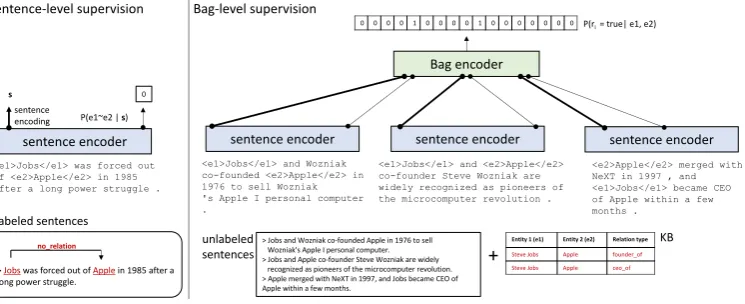
Figure 1: An overview of our approach for combining distant and direct supervision. The left side shows one sentence in the labeled data and how it is used to provide direct supervision for the sentence encoder. The right side shows snippets of the text corpus and the knowledge base, which are then combined to construct one training instance for the model, with a bag of three input sentences and two active relations: ‘founder of’ and ‘ceo of’.
mance in this model setup than the commonly used weighted average attention.
The contributions of this paper are as follows:
• We propose an effective neural network model for improving distant supervision by combining it with a directly supervised data in the form of sentence-level annotations. The model is trained jointly on both types of supervision in a multitask learning setup, where the direct su-pervision data is employed as susu-pervision for at-tention weights.
• We show experimentally that our model setup benefits from sigmoidal attention weights with max pooling over the commonly used softmax-based weighted averaging attention.
• Our best model achieves a new state-of-the-art result on the FB-NYT dataset, previously used by Lin et al. (2016); Vashishth et al. (2018). Specifically, combining both forms of supervi-sion achieves a 4.4% relative AUC increase than our baseline without the additional supervision.
The following section defines the notation we use, describes the problem and provides an overview of our approach.
2 Overview
Our goal is to predict which relation types are ex-pressed between a pair of entities (e1, e2), given
all sentences in which both entities are mentioned in a large collection of unlabeled documents.
Following previous work on distant supervi-sion, we use known tuples(e1, r, e2) in a knowl-edge base K to automatically annotate sentences
where both entities are mentioned with the rela-tion typer. In particular, we group all sentences
s with one or more mentions of an entity pair
(e1, e2) into a bag of sentences Be1,e2, then
au-tomatically annotate this bag with the set of rela-tion types Ldistant = {r ∈ R : (e
1, r, e2) ∈ K},
whereRis the set of relations we are interested in. We use ‘positive instances’ to refer to cases where
|L|>0, and ‘negative instances’ when|L|= 0. In this paper, we leverage an existing dataset of direct supervision for relations. Each direct super-vision instance consists of a token sequences con-taining mentions of an entity pair(e1, e2)and one relation type (or ‘no relation’). We do not require that the entities or relation types in the direct su-pervision annotations align with those in the KB. Furthermore, we replace the relation label associ-ated with each sentence with a binary indicator of
1if the sentence expresses one of the relationships of interest and0otherwise.
Figure 1 illustrates how we modify neural ar-chitectures commonly used in distant supervision, e.g., Lin et al.(2016); Liu et al.(2017) to effec-tively incorporate direct supervision. The model consists of two components: 1) A sentence
en-coder(displayed in blue) reads a sequence of
to-kens and their relative distances from e1 and e2,
and outputs a vector s representing the sentence encoding, as well as P(e1 ∼ e2 | s)
represent-ing the probability that the two entities are related given this sentence. 2) The bag encoder (dis-played in green) reads the encoding of each sen-tence in the bag for the pair(e1, e2) and predicts P(r= 1|e1, e2),∀r∈ R.
a multi-task learning setup by minimizing the weighted sum of the cross entropy losses for
P(e1 ∼e2 |s)andP(r = 1|e1, e2). By sharing the parameters of sentence encoders used to com-pute either loss, the sentence encoders become less susceptible to the noisy bag labels. The bag en-coder also benefits from the direct supervision by using the supervised distributionP(e1 ∼ e2 | s)
to decide the weight of each sentence in the bag.
3 Model
The model predicts a set of relation types
Lpred ⊂ Rgiven a pair of entitiese1, e2and a bag of sentences Be1,e2. In this section, we first
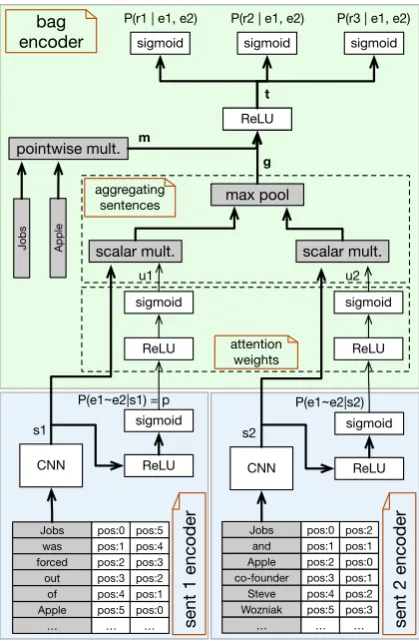
de-scribe the sentence encoder part of the model (Fig-ure2, bottom), then describe the bag encoder (Fig-ure2, top), then we explain how the two types of supervision are jointly used for training the model end-to-end.
3.1 Sentence Encoder Architecture
Given a sequence of wordsw1, . . . , w|s|in a
sen-tence s, a sentence encoder translates this se-quence into a fixed length vectors.
Input Representation. The input representation
is illustrated graphically with a table at the bottom of Figure2. We map word tokeniin the sentence
wi to a pre-trained word embedding vector wi.2 Another crucial input signal is the position of en-tity mentions in each sentences ∈ Be1,e2.
Fol-lowing Zeng et al. (2014), we map the distance between each word in the sentence and the entity mentions3to a small vector of learned parameters, namelyde1
i andd e2
i .
We find that adding a dropout layer with a small probability (p= 0.1) before the sentence encoder reduces overfitting and improves the results. To summarize, the input layer for a sentence s is a sequence of vectors:
vi = [wi;dei1;die2], fori∈1, . . . ,|s|
Word Composition. Word composition is
illus-trated with the block CNN in the bottom part of Figure 2, which represents a convolutional neu-ral network (CNN) with multiple filter sizes. The outputs of the max pool operations for different
2FollowingLin et al.(2016), we do not update the word
embeddings while training the model.
3If an entity is mentioned more than once in the sentence,
we use the distance from the word to the closest entity men-tion. Distances greater than 30 are mapped to the embedding for distance = 30.
Jobs pos:0 pos:5 was pos:1 pos:4 forced pos:2 pos:3 out pos:3 pos:2 of pos:4 pos:1 Apple pos:5 pos:0
… … …
CNN
scalar mult.
ReLU sigmoid
Jobs pos:0 pos:2 and pos:1 pos:1 Apple pos:2 pos:0 co-founder pos:3 pos:1 Steve pos:4 pos:2 Wozniak pos:5 pos:3
… … …
scalar mult. max pool
Jobs Apple
pointwise mult.
ReLU ReLU sigmoid
sigmoid sigmoid
P(r1 | e1, e2) P(r2 | e1, e2) P(r3 | e1, e2)
ReLU sigmoid
ReLU sigmoid
P(e1~e2|s1) = p P(e1~e2|s2)
CNN ReLU
sigmoid s1
t
u1
s2
u2
g m
aggregating sentences
attention weights
bag encoder
sent 2 encoder
[image:3.595.310.520.61.382.2]sent 1 encoder
Figure 2: Blue box is the sentence encoder, it maps a sentence to a fixed length vector (CNN output) and the probability it expresses a relation betweene1 and
e2 (sigmoid output). Green box is the bag
en-coder, it takes encoded sentences and their weights and produces a fixed length vector (max pool output), concatenates it with entity embeddings (pointwise
mult. output) then outputs a probability for each
re-lation typer. White boxes contain parameters that the model learns while gray boxes do not have learnable parameters. Directly supervised annotations provide supervision forP(e1 ∼e2 | s). Distantly supervised annotations provide supervision forP(r= 1|e1, e2).
filter sizes are concatenated then projected into a smaller vector using one feed forward linear layer.
Sentence encodingsis computed as follows:
cx = CNNx(v1, . . . ,v|s|),forx∈ {2,3,4,5}
s=W1[c2;c3;c4;c5] +b1,
where CNNx is a standard convolutional neural network with filter sizex,W1 andb1 are model parameters andsis the sentence encoding.
We feed the sentence encoding sinto a ReLU layer followed by a sigmoid layer with output size 1, representing P(e1 ∼ e2 | s), as illustrated in
Figure2(bottom):
P(e1∼e2 |s) = (1)
where σ is the sigmoid function and
W2,b2,W3,b3are model parameters.
3.2 Bag Encoder Architecture
Given a bagBe1,e2 ofn ≥ 1sentences, we
com-pute their encodings s1, . . . ,sn as described ear-lier and feed them into the bag encoder, which combines the information in all of the sentence en-codings and predicts the probability P(r = 1 |
e1, e2),∀r ∈ R. The bag encoder also
incorpo-rates the signal p = P(e1 ∼ e2 | s)from Equa-tion 1as an estimate of the degree to which sen-tencesexpresses “some” relation betweene1 and e2.
Attention. To aggregate the sentence encodings
s1, . . . ,sn into a fixed length vector that captures the important features in the bag, we use attention. Attention has two steps: (1) computing weights for the sentences and (2) aggregating the weighted sentences. Weights can be uniform, or computed using a sigmoid or softmax. Weighted sentences can be aggregated using average pooling or max pooling. Prior work (Jiang et al.,2016;Lin et al., 2016;Ji and Smith,2017) have explored some of these combinations but not all of them. In the ab-lation experiments, we try all combinations and we find that the (sigmoid, max pooling) attention gives the best result. We discuss the intuition be-hind this in Section4.2. For the rest of this section, we will explain the architecture of our network as-suming a (sigmoid, max pooling) attention.
Given the encoding sj and an unnormalized weight uj for each sentence sj ∈ Be1,e2, the
bag encodingg is a vector with the same dimen-sionality assj. With (sigmoid, max pooling) at-tention, each sentence vector is multiplied by the corresponding weight, then we do a “dimension-wise” max pooling (taking the maximum of each dimension across all sentences, not the other way around). Thek-th element of the bag encodingg
is computed as:
gj[k] =maxj∈1,...,n{sj[k]×σ(uj)}.
As shown in Figure 2, we do not directly use the p from Equation 1 as attention weights. In-stead, we found it useful to feed it into more non-linearities. The unnormalized attention weight for
sjis computed as:
uj =W7ReLU(W6p+b6) +b7.
Entity Embeddings. FollowingJi et al.(2017),
we use entity embeddings to improve our model
of relations in the distant supervision setting, al-though our formulation is closer to that of Yang et al. (2015) who used point-wise multiplication of entity embeddings: m=e1e2, whereis
point-wise multiplication, and e1 and e2 are the embeddings of e1 ande2, respectively. In order to improve the coverage of entity embeddings, we use pretrained GloVe vectors (Pennington et al., 2014) (same embeddings used in the input layer). For entities with multiple words, like “Steve Jobs”, the vector for the entity is the average of the GloVe vectors of its individual words. If the entity is ex-pressed differently across sentences, we average the vectors of the different mentions. As discussed in Section4.2, this leads to big improvement in the results, and we believe there is still big room for improvement from having better representation for entities. We feed the outputmas additional input to the last block of our model.
Output Layer. The final step is to use the bag
encodinggand the entity pair encodingmto pre-dict a set of relations Lpred which is a standard multilabel classification problem. We concatenate
g andmand feed them into a feedforward layer with ReLU non-linearity, followed by a sigmoid layer with an output size of|R|:
t=ReLU(W4[g;m] +b4)
P(r= 1|e1, e2) =σ(W5t+b5),
whereris a vector of Bernoulli variables each of which corresponds to one of the relations in R. This is the final output of the model.
3.3 Model Training
To train the model on the distant supervision data, we use binary cross-entropy loss between the model predictions and the labels obtained with dis-tant supervision, i.e.,
DistSupLoss= X
Be1,e2
−logP(r=rdistant|e1, e2)
where rdistant[k] = 1 indicates that the tuple
(e1, rk, e2)is in the knowledge base.
ability to predict the potential usefulness of a sen-tence. According to our analysis of baseline mod-els, distinguishing between positive and negative examples is the real bottleneck in the task. There-fore, we use the direct supervision data to super-viseP(e1 ∼ e2 |s). This supervision serves two purposes: it improves our encoding of each sen-tence, and improves the weights used by the atten-tion to decide which sentences should contribute more to the bag encoding. It also has the side ben-efit of not requiring the same set of relation types as that of the distant supervision data, because we only care about if there existssome relevant rela-tionor not between the entities.
We minimize log loss of gold labels in the di-rect supervision dataDaccording to the model de-scribed in Equation1:
DirectSupLoss= X
s,lgold∈D
−logP(l=lgold|s)
whereD is all the direct supervision data and all distantly-supervisednegativeexamples.4
We jointly train the model on both types of su-pervision. The model loss is a weighted sum of the direct supervision and distant supervision losses,
loss= 1
λ+ 1DistSupLoss+
λ
λ+ 1DirectSupLoss
(2) whereλis a parameter that controls the contribu-tion of each loss, tuned on a validacontribu-tion set.
4 Experiments
4.1 Data and Setup
This section discusses datasets, metrics, configu-rations and the models we are comparing with.
Distant Supervision Dataset (DistSup). The
FB-NYT dataset5 introduced in Riedel et al. (2010) was generated by aligning Freebase facts with New York Times articles. The dataset has 52 relations with the most common being “loca-tion”, “nationality”, “capital”, “place lived” and “neighborhood of”. They used the articles of
2005 and 2006 for training, and 2007 for test-ing. Recent prior work (Lin et al.,2016;Liu et al., 2017;Huang and Wang,2017) changed the origi-nal dataset. They used all articles for training ex-cept those from2007, which they left for testing as inRiedel et al.(2010). We use the modified dataset
4
We note that the distantly supervised negative examples may still be noisy. However, given that relations tend to be sparse, the signal to noise is high.
5http://iesl.cs.umass.edu/riedel/ecml/
which was made available by Lin et al. (2016).6 The table below shows the dataset size.
Train Test
Positive bags 16,625 1,950 Negative bags 236,811 94,917 Sentences 472,963 172,448
Direct Supervision Dataset (DirectSup). Our
direct supervision dataset was made available by Angeli et al. (2014) and it was collected in an active learning framework. The dataset consists of sentences annotated with entities and their re-lations. It has 22,766 positive examples for 41 relation types in addition to 11,049 negative ex-amples. To use this dataset as supervision for
P(e1 ∼ e2 | s), we replace the relation types of positive examples with 1s and label negative ex-amples with0s.
Metrics. Prior work used precision-recall (PR)
curves to show results on the FB-NYT dataset. In this multilabel classification setting, the PR curve is constructed using the model predictions on all entity pairs in the test set for all relation types sorted by the confidence scores from highest to lowest. Different thresholds correspond to differ-ent points on the PR curve. We use the area un-der the PR curve (AUC) for early stopping and hyperparameter tuning. Following previous work on this dataset, we only keep points on the PR curve with recall below0.4, focusing on the high-precision low-recall part of the PR curve. As a result, the largest possible value for AUC is0.4.
Configurations. The FB-NYT dataset does not
have a validation set for hyperparameter tuning and early stopping. Liu et al. (2017) use the test set for validation,Lin et al.(2016) use 3-fold cross validation, and Vashishth et al. (2018) split the training set into 80% training and 20% testing. In our experiments, we use 90% of the training set for training and keep the other 10% for validation. The main hyperparameter we tune is lambda (sec-tion4.3).
The pre-trained word embeddings we use are 300-dimensional GloVe vectors, trained on 42B tokens. Since we do not update word embeddings while training the model, we define our vocabulary as any word which appears in the training, valida-tion or test sets with frequency greater than two. When a word with a hyphen (e.g., ‘five-star’) is not
in the GloVe vocabulary, we average the embed-dings of its subcomponents. Otherwise, all OOV words are assigned the same random vector (nor-mal with mean 0 and standard deviation 0.05).
Our model is implemented using PyTorch and AllenNLP (Gardner et al., 2017) and trained on machines with P100 GPUs. Each run takes five hours on average. We train for a maximum of 50 epoch, and use early stopping with patience= 3. Each dataset is split into minibatches of size 32 and randomly shuffled before every epoch. We use the Adam optimizer with its default PyTorch parameters. We run every configuration with three random seeds and report the PR curve for the run with the best validation AUC. In the controlled ex-periments, we report the mean and standard devi-ation of the AUC across runs.
Compared Models. Our best model (Section3)
is trained on the DistSup and DirectSup datasets in our multitask setup and it uses (sigmoid, max pooling) attention.Baselineis the same model de-scribed in Section3 but trained only on the Dist-Sup dataset and uses the more common (softmax, average pooling) attention. This baseline is our implementation of the PCNN+ATT model (Lin et al., 2016) with two main differences; they use piecewise convolutional neural networks (PC-NNs Pennington et al., 2014) instead of CNNs, and we add entity embeddings before the output layer.7 We also compare our results to the state of the art model RESIDE (Vashishth et al., 2018), which uses graph convolution over dependency parse trees, OpenIE extractions and entity type constraints.
4.2 Main Results
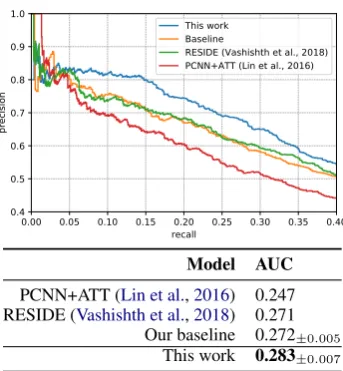
Figure 3 summarizes the main results of our ex-periments. First, we note that “our baseline” out-performs PCNN+ATT (Lin et al., 2016) despite using the same training data (DistSup) and the same form of attention (softmax, average pooling), which confirms that we are building on a strong baseline. The improved results in our baseline are due to using CNNs instead of PCNNs, and using entity embeddings.
7
Contrary to the results inPennington et al.(2014), we found CNNs to give better results than PCNNs in our experi-ments.Lin et al.(2016) also compute unnormalized attention weights asoj=sj×A×qwheresjis the sentence encod-ing,Ais a diagonal matrix andqis the query vector. In our experiments, we found that implementing it as a feedforward layer with output size= 1works better. All our results use the feedforward implementation.
0.00 0.05 0.10 0.15 0.20 0.25 0.30 0.35 0.40 recall
0.4 0.5 0.6 0.7 0.8 0.9 1.0
precision
This work Baseline
RESIDE (Vashishth et al., 2018) PCNN+ATT (Lin et al., 2016)
Model AUC
PCNN+ATT (Lin et al.,2016) 0.247 RESIDE (Vashishth et al.,2018) 0.271
Our baseline 0.272±0.005
[image:6.595.330.502.61.247.2]This work 0.283±0.007
Figure 3: Precision-recall curves and their AUC com-paring our model with the baseline and existing mod-els. Baseline is trained on DistSup and uses (softmax, average pooling) attention. Our best model is trained using multitask learning on DistSup and DirectSup and uses (sigmoid, max pooling) attention. Results ofLin et al.(2016) andVashishth et al.(2018) are copied from their papers.
pooling type
supervision signal attention weight computation
uniform softmax sigmoid
average pooling
DistSup 0.244±0.008 0.272±0.005 0.258±0.020
DistSup + DirectSup 0.224±0.009 0.272±0.009 0.256±0.009
MultiTask (our model) 0.220±0.012 0.262±0.014 0.258±0.015
max pooling
DistSup 0.277±0.009 0.278±0.001 0.274±0.004
DistSup + DirectSup 0.269±0.003 0.269±0.005 0.277±0.012
[image:6.595.307.526.369.458.2]MultiTask (our model) 0.266±0.007 0.280±0.004 0.283±0.007
Table 1: Controlled experiments for a) how the su-pervised data is used in the model, b) which function is used to compute attention weights, c) how sentence embeddings are aggregated
A new state-of-the-art. Adding DirectSup in
our multitask learning setup and using (sig-moid, max pooling) attention gives us the best result, outperforming our baseline that doesn’t use either by 4.4% relative AUC increase, and achieves a new state-of-the-art result outperform-ing (Vashishth et al.,2018).
We note that the improved results reported here conflate additional supervision and model im-provements. Next, we report the results of con-trolled experiments to tease apart the contributions of different components.
on DistSup only, DistSup + DirectSup together as one dataset with DirectSup expressed as single-ton bags, or DistSup + DirectSup in our multi-task setup. Attention weights can be uniform, or computed using softmax or sigmoid.8 Sentence vectors are aggregated by weighting them then av-eraging (average pooling) or weighting them then taking the max of each dimension (max pooling). (Uniform weights, average pooling) and (softmax, average pooling) were used byLin et al. (2016), (sigmoid, average pooling) was proposed byJi and Smith (2017) but for a different task, and (uni-form weights, max pooling) is used byJiang et al. (2016). To the best of our knowledge, (softmax, max pooling) and (sigmoid, max pooling) have not been explored before.
Pooling type. Results in Table 1show that
ag-gregating sentence vectors using max pooling gen-erally works better than average pooling. This is because max pooling might be better at picking out useful features (dimensions) from each sen-tence.
Supervision signal. The second dimension of
comparison is the use of the supervision signal used to train the model. The table shows that train-ing on DistSup + DirectSup, where the DirectSup dataset is simply used as additional bags, can hurt the performance. We hypothesize that this is be-cause the DirectSup data change the distribution of relation types in the training set from the test set. However, using DirectSup as supervision for the attention weights in our multitask learning setup leads to considerable improvements (1% and 3% relative AUC increase using softmax and sigmoid respectively) because it leads to better attention weights and improves the model’s ability to filter noisy sentences.
Attention weight computation. Finally,
com-paring uniform weights, softmax and sigmoid. We found the result to depend on the available level of supervision. With DistSup only, the results of all three are comparable with softmax being slightly better. However, when we have good attention weights (as provided by the multitask learning), softmax and sigmoid work better than uniform weights where sigmoid gives the best result with 6% relative AUC increase. Sigmoid works better
8We also tried normalizing sigmoid weights as suggested
in (Rei and Søgaard,2018), but this did not work better than regular sigmoid or softmax.
2^- 2^-1.0 2^0.0 2^1.0 2^2.0 2^3.0 2^4.0 2^5.0 2^6.0 0.255
0.260 0.265 0.270 0.275 0.280 0.285 0.290
AP
[image:7.595.331.500.49.155.2]AUC
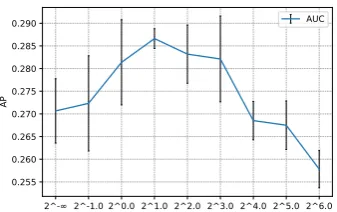
Figure 4: AUC at differentλ. X-axis is in log-scale.
than softmax, because softmax assumes that ex-actly one sentence is correct by forcing the prob-abilities to sum to 1. This assumption is not cor-rect for this task, because zero or many sentences could potentially be relevant. On the other hand, sigmoidal attention weights does not make this as-sumption, which gives rise to more informative at-tention weights in cases where all sentences are not useful, or when multiple ones are. This makes the sigmoidal attention weights a better model-ing for the problem (assummodel-ing reliable attention weights).
4.3 Selecting Lambda.
Although we did not spend much time tuning hy-perparameters, we made sure to carefully tune λ
(Equation 2) which balances the contribution of the two losses of the multitask learning. Early ex-periments showed that DirectSupLoss is typically smaller than DistSupLoss, so we experimented with λ ∈ {0,0.5,1,2,4,8,16,32,64}. Figure 4 shows AUC results for different values ofλ, where each point is the average of three runs. It is clear that picking the right value forλhas a big impact on the final result.
4.4 Qualitative Analysis.
An example of a positive bag is shown in Ta-ble 2. Our best model (Multitask, sigmoid, max pooling) assigns the most weight to the first sen-tence while the baseline (DistSup, softmax, aver-age pooling) assigns the most weight to the last sentence (which is less informative for the rela-tion between the two entities). Also, the baseline does not use the other two sentences because their weights are dominated by the last one.
5 Related Work
Distant Supervision. The term ‘distant
Baseline This work Sentences
0.00 0.029 You can line up along the route to cheer for the 32,000 riders, whose 42-mile trip will start in battery park and end with a festival atFort WadsworthonStaten Island.
0.00 0.026 Gateway is a home to the nation’s oldest continuing operating lighthouse, Sandy Hook lighthouse, built in 1764; Floyd Bennett field in Brooklyn, which was the city’s first municipal airfield;Fort WadsworthonStaten Island, which predates the revolutionary war. 0.99 0.027 home energy smart fair, gateway national recreation area,Fort Wadsworthvisitor center, bay street and school road,Staten Island.
Table 2: Weights assigned to sentences by our baseline and our best model. The baseline incorrectly predicts “no relation”, while our best model correctly predicts “neighbourhood of” for this bag.
a text corpus where two related entities are men-tioned, then developed a classifier to predict the relation. Researchers have since extended this ap-proach further (e.g., Takamatsu et al.,2012;Min et al.,2013;Riedel et al.,2013;Koch et al.,2014). A key source of noise in distant supervision is that sentences may mention two related enti-ties without expressing the relation between them. Hoffmann et al.(2011) used multi-instance learn-ing to address this problem by developlearn-ing a graph-ical model for each entity pair which includes a latent variable for each sentence to explicitly indi-cate the relation expressed by that sentence, if any. Our model can be viewed as an extension of Hoff-mann et al. (2011) where the sentence-bound la-tent variables can also be directly supervised in some of the training examples.
Neural Models for Distant Supervision. More
recently, neural models have been effectively used to model textual relations (e.g.,Hashimoto et al., 2013;Zeng et al., 2014; Nguyen and Grishman, 2015). Focusing on distantly supervised models, Zeng et al. (2015) proposed a neural implemen-tation of multi-instance learning to leverage mul-tiple sentences which mention an entity pair in distantly supervised relation extraction. However, their model picks only one sentence to represent an entity pair, which wastes the information in the neglected sentences. Jiang et al. (2016) ad-dresses this limitation by max pooling the vec-tor encodings of all input sentences for a given entity pair. Lin et al. (2016) independently pro-posed to use attention to address the same limita-tion, andDu et al.(2018) improved by using mul-tilevel self-attention. To account for the noise in distant supervision labels, Liu et al. (2017); Luo et al.(2017);Wang et al.(2018) suggested differ-ent ways of using “soft labels” that do not nec-essarily agree with the distant supervision labels. Ye et al.(2017) proposed a method for leveraging dependencies between different relations in a pair-wise ranking framework, whileHan et al.(2018) arranged the relation types in a hierarchy aiming
for better generalization for relations that do not have enough training data. To improve using addi-tional resources,Vashishth et al.(2018) used graph convolution over dependency parse, OpenIE ex-tractions and entity type constraints, andLiu et al. (2018) used parse trees to prune irrelevant infor-mation from the sentences.
Combining Direct and Distant Supervision.
Despite the substantial amount of work on both directly and distantly supervised relation extrac-tion, the question of how to combine both sig-nals has not received the same attention. Per-shina et al.(2014) trained MIML-RE from ( Sur-deanu et al., 2012) on both types of supervision by locking the latent variables on the sentences to the supervised labels. Angeli et al.(2014) and Liu et al. (2016) presented active learning mod-els that select sentences to annotate and incorpo-rate in the same manner. Pershina et al. (2014) andLiu et al.(2016) also tried simple baseline of including the labeled sentences as singleton bags. Pershina et al.(2014) did not find this beneficial, which agrees with our results in Section4.2, while Liu et al. (2016) found the addition of singleton bags to work well.
Our work is addressing the same problem, but combining both signals in a state-of-the-art neu-ral network model, and we do not require the two datasets to have the same set of relation types.
6 Conclusion
a 4.4% relative AUC increase than our baseline without the additional supervision.
Acknowledgments
All experiments were performed on beaker. org. Computations onbeaker.orgwere sup-ported in part by credits from Google Cloud.
References
Gabor Angeli, Julie Tibshirani, Jean Wu, and Christo-pher D Manning. 2014. Combining distant and par-tial supervision for relation extraction. InEMNLP.
Razvan C. Bunescu and Raymond J. Mooney. 2005. A shortest path dependency kernel for relation extrac-tion. InHLT/EMNLP.
Mark Craven and Johan Kumlien. 1999. Constructing biological knowledge bases by extracting informa-tion from text sources. InISMB.
Jinhua Du, Jingguang Han, Andy Way, and Dadong Wan. 2018. Multi-level structured self-attentions for distantly supervised relation extraction. InEMNLP.
Miao Fan, Deli Zhao, Qiang Zhou, Zhiyuan Liu, Thomas Fang Zheng, and Edward Y. Chang. 2014. Distant supervision for relation extraction with ma-trix completion. InACL.
Matt Gardner, Joel Grus, Mark Neumann, Oyvind Tafjord, Pradeep Dasigi, Nelson F. Liu, Matthew Peters, Michael Schmitz, and Luke S. Zettlemoyer. 2017. Allennlp: A deep semantic natural language processing platform.
Xu Han, Pengfei Yu, Zhiyuan Liu, Maosong Sun, and Peng Li. 2018. Hierarchical relation extraction with coarse-to-fine grained attention. InEMNLP.
Kazuma Hashimoto, Makoto Miwa, Yoshimasa Tsu-ruoka, and Takashi Chikayama. 2013. Simple cus-tomization of recursive neural networks for semantic relation classification. InEMNLP.
Raphael Hoffmann, Congle Zhang, Xiao Ling,
Luke S. Zettlemoyer, and Daniel S. Weld. 2011. Knowledge-based weak supervision for information extraction of overlapping relations. InACL.
Yi Yao Huang and William Yang Wang. 2017. Deep residual learning for weakly-supervised relation ex-traction. InEMNLP.
Guoliang Ji, Kang Liu, Shizhu He, and Jun Zhao. 2017. Distant supervision for relation extraction with sentence-level attention and entity descriptions. InAAAI.
Yangfeng Ji and Noah A. Smith. 2017. Neural dis-course structure for text categorization. InACL.
Xiaotian Jiang, Quan Wang, Peng Li, and Bin Wang. 2016. Relation extraction with instance multi-label convolutional neural networks. InCOLING.
Mitchell Koch, John Gilmer, Stephen Soderland, and Daniel S. Weld. 2014. Type-aware distantly super-vised relation extraction with linked arguments. In
EMNLP.
Yankai Lin, Shiqi Shen, Zhiyuan Liu, Huanbo Luan, and Maosong Sun. 2016. Neural relation extraction with selective attention over instances. InACL.
Angli Liu, Stephen Soderland, Jonathan Bragg,
Christopher H. Lin, Xiao Ling, and Daniel S. Weld. 2016. Effective crowd annotation for relation ex-traction. InNAACL.
Tian Yu Liu, Kexiang Wang, Baobao Chang, and
Zhi-fang Sui. 2017. A soft-label method for
noise-tolerant distantly supervised relation extraction. In
EMNLP.
Tianyi Liu, Xinsong Zhang, Wanhao Zhou, and Wei-jia Jia. 2018. Neural relation extraction via inner-sentence noise reduction and transfer learning. In
EMNLP.
Bingfeng Luo, Yansong Feng, Zheng Wang, Zhanxing Zhu, Songfang Huang, Rui Yan, and Dongyan Zhao. 2017. Learning with noise: Enhance distantly su-pervised relation extraction with dynamic transition matrix. InACL.
Bonan Min, Ralph Grishman, Li Wan, Chang Wang, and David Gondek. 2013. Distant supervision for relation extraction with an incomplete knowledge base. InHLT-NAACL.
Mike Mintz, Steven Bills, Rion Snow, and Daniel Ju-rafsky. 2009. Distant supervision for relation extrac-tion without labeled data. InACL.
Thien Huu Nguyen and Ralph Grishman. 2015. Rela-tion extracRela-tion: Perspective from convoluRela-tional
neu-ral networks. InVS@HLT-NAACL.
Jeffrey Pennington, Richard Socher, and Christo-pher D. Manning. 2014. Glove: Global vectors for word representation. InEMNLP.
Maria Pershina, Bonan Min, Wei Xu, and Ralph Gr-ishman. 2014. Infusion of labeled data into distant supervision for relation extraction. InACL.
Marek Rei and Anders Søgaard. 2018. Zero-shot se-quence labeling: Transferring knowledge from sen-tences to tokens. InNAACL-HLT.
Sebastian Riedel, Limin Yao, and Andrew D McCal-lum. 2010. Modeling relations and their mentions without labeled text. InECML/PKDD.
Sebastian Riedel, Limin Yao, Andrew D McCallum, and Benjamin M. Marlin. 2013. Relation extraction with matrix factorization and universal schemas. In
Benjamin Roth, Tassilo Barth, Michael Wiegand, and Dietrich Klakow. 2013. A survey of noise reduction methods for distant supervision. InAKBC@CIKM.
Mihai Surdeanu, Julie Tibshirani, Ramesh
Nallap-ati, and Christopher D. Manning. 2012.
Multi-instance multi-label learning for relation extraction. InEMNLP-CoNLL.
Shingo Takamatsu, Issei Sato, and Hiroshi Nakagawa. 2012. Reducing wrong labels in distant supervision for relation extraction. InACL.
Shikhar Vashishth, Rishabh Joshi, Sai Suman Prayaga, Chiranjib Bhattacharyya, and Partha Talukdar. 2018. Reside: Improving distantly-supervised neural rela-tion extracrela-tion using side informarela-tion. InEMNLP.
Guanying Wang, Wen Zhang, Ruoxu Wang, Yalin Zhou, Xi Chen, Wei Zhang, Hai Zhu, and Huajun Chen. 2018. Label-free distant supervision for rela-tion extracrela-tion via knowledge graph embedding. In
EMNLP.
Bishan Yang, Wen tau Yih, Xiaodong He, Jianfeng Gao, and Li Deng. 2015. Embedding entities and relations for learning and inference in knowledge bases. InICLR.
Hai Ye, Wen-Han Chao, Zhunchen Luo, and Zhoujun Li. 2017. Jointly extracting relations with class ties via effective deep ranking. InACL.
Daojian Zeng, Kang Liu, Yubo Chen, and Jun Zhao. 2015. Distant supervision for relation extraction via piecewise convolutional neural networks. In
EMNLP.