This paper is made available online in accordance with publisher policies. Please scroll down to view the document itself. Please refer to the repository record for this item and our policy information available from the repository home page for further information.
To see the final version of this paper please visit the publisher’s website. Access to the published version may require a subscription.
Author(s): Juan A. López-Ráez , Wouter Kohlen , Tatsiana
Charnikhova , Patrick Mulder , Anna K. Undas , Martin J. Sergeant , Francel Verstappen , Timothy D. H. Bugg, Andrew J. Thompson Carolien Ruyter-Spira and Harro Bouwmeester
Article Title: Does abscisic acid affect strigolactone biosynthesis? Year of publication: 2009
Link to published version:
For Peer Review
Does ABA affect strigolactone biosynthesis?
Journal: New Phytologist
Manuscript ID: NPH-MS-2010-09685.R2 Manuscript Type: MS - Regular Manuscript Date Submitted by the
Author:
Complete List of Authors: Lopez-Raez, Juan Antonio; Wageningen University, Laboratory of Plant Physiology; Estacion Experimental del Zaidin-CSIC, Soil Microbiology and Symbiotic Systems
Kohlen, Wouter; Wageningen University, Laboratory of Plant Physiology
Charnikhova, Tatsiana; Wageningen University, Laboratory of Plant Physiology
Mulder, Patrick; RIKILT - Institute of Food Safety, Analysis and Development
Undas, Anna; Wageningen University, Laboratory of Plant Physiology; Wageningen University, Centre for Biosystems Genomics
Sergeant, Martin; University of Warwick, Warwick-HRI
Verstappen, Francel; Wageningen University, Laboratory of Plant Physiology; Wageningen University, Centre for Biosystems Genomics
Bugg, Timothy; University of Warwick, Department of Chemistry Thompson, Andrew; University of Warwick, Warwick-HRI
Ruyter-Spira, Carolien; Wageningen University, Laboratory of Plant Physiology
Bouwmeester, Harro; Wageningen University, Laboratory of Plant Physiology; Wageningen University, Centre for Biosystems Genomics
Key Words: strigolactones , abscisic acid, hormone regulation, tomato, mutants, inhibitors
For Peer Review
Does ABA affect strigolactone biosynthesis?
1
2
Juan A. López-Ráez1,2*, Wouter Kohlen1*, Tatsiana Charnikhova1, Patrick Mulder3, Anna K. Undas1,4, 3
Martin J. Sergeant5, Francel Verstappen1,4, Timothy D. H. Bugg6, Andrew J. Thompson5, Carolien 4
Ruyter-Spira1, Harro Bouwmeester1,4φ 5
6
1
Laboratory of Plant Physiology, Wageningen University, Arboretumlaan 4, 6703 BD Wageningen, 7
The Netherlands 8
2
Present address: Department of Soil Microbiology and Symbiotic Systems, Estación Experimental del 9
Zaidín (CSIC), Prof. Albareda 1, 18008 Granada, Spain 10
3
RIKILT, Institute of Food Safety, Bornsesteeg 45, 6708 PDWageningen, The Netherlands 11
4
Centre for Biosystems Genomics, P. O. Box 98, 6700 AB Wageningen, The Netherlands 12
5
Warwick-HRI, Wellesbourne, University of Warwick, Warwickshire, CV35 9EF, UK 13
6
Department of Chemistry, University of Warwick, Coventry, CV4 7AL, UK. 14
15
* These authors contributed equally to this work 16
φ
Corresponding author 17
18
19
Corresponding author:
20
e-mail address: [email protected]
21
Telephone: +31317480528
22
Fax: +31317418094
23
For Peer Review
1Running Title: Does ABA affect strigolactone biosynthesis?
2
3
4
5
• Total word count: 6606 words
6
o Summary: 190 words
7
o Introduction: 981 words
8
o Material and Methods: 1391 words
9
o Results: 1776 words
10
o Discussion: 2159 words
11
o Acknowledgements: 110 words
12
13
• Number of figures: 5
14
• Number of tables: 2
15
• Number of supplemental figures: 2
16
17
18
19
20
21
22
For Peer Review
SUMMARY
1
2
• Strigolactones are considered a novel class of plant hormones that in addition to their 3
endogenous signaling function are also exuded into the rhizosphere acting as a signal to 4
stimulate hyphal branching of arbuscular mycorrhizal (AM) fungi and germination of root 5
parasitic plant seeds. Considering the importance of the strigolactones and their biosynthetic 6
origin (from carotenoids), we investigated the relationship with the plant hormone abscisic acid 7
(ABA). 8
• Strigolactone production and ABA content in the presence of specific inhibitors of oxidative 9
carotenoid cleavage enzymes and in several tomato ABA-deficient mutants were analyzed by 10
LC-MS/MS. In addition, the expression of two genes involved in strigolactone biosynthesis was 11
studied. 12
• The carotenoid cleavage dioxygenase (CCD) inhibitor D2 reduced strigolactone but not ABA 13
content of roots. However, in abamineSG treated plants, an inhibitor of 9-cis-epoxycarotenoid 14
dioxygenase (NCED), and the ABA mutants notabilis, sitiens and flacca, ABA and 15
strigolactones were greatly reduced. The reduction in strigolactone production correlated with 16
the down-regulation of LeCCD7 and LeCCD8 genes in all three mutants. 17
• The results show a correlation between ABA levels and strigolactone production, and suggest a 18
role for ABA in the regulation of strigolactone biosynthesis. 19
20
21
Key Words: strigolactones; abscisic acid; hormone regulation; tomato; mutants; inhibitors 22
For Peer Review
INTRODUCTION
1
2
Strigolactones are important signalling molecules that were first described as germination stimulants 3
for the seeds of parasitic plants of the genera Striga and Orobanche (Cook et al., 1972; Bouwmeester et
4
al., 2003). Later, they were also described as hyphal branching factors for germinating spores of the 5
symbiotic arbuscular mycorrhizal (AM) fungi (Akiyama et al., 2005). Therefore, strigolactones play a 6
dual and important role in the rhizosphere as host detection signals for AM fungi and root parasitic 7
plants (Akiyama et al., 2005; Harrison, 2005; Paszkowski, 2006; Bouwmeester et al., 2007). In 8
addition to their important role as rhizosphere signalling molecules, it has recently been demonstrated 9
that strigolactones also act as a new hormone class that inhibits shoot branching in plants and hence 10
regulates above-ground plant architecture (Gomez-Roldan et al., 2008; Umehara et al., 2008). 11
Strigolactones have been detected in the root exudates of a wide range of mono- and 12
dicotyledonous plant species. The strigolactones discovered so far all have a similar chemical structure 13
suggesting that they are all derived from the same biosynthetic pathway (Bouwmeester et al., 2007; 14
Yoneyama et al., 2008). Indeed, we have previously demonstrated that the ABC-part of the 15
strigolactones (Fig. 1) is derived from carotenoids through oxidative cleavage by carotenoid cleavage 16
dioxygenases, hence classifying the strigolactones as apocarotenoids (Matusova et al., 2005; López-17
Ráez et al., 2008a; Rani et al., 2008). In addition, we have postulated how, after carotenoid cleavage, 18
further enzymatic conversions are likely to lead to the production of all the strigolactones known to 19
date (Matusova et al., 2005; Rani et al., 2008). Indeed, it was recently demonstrated that two 20
carotenoid cleavage dioxygenases (CCDs), CCD7 and CCD8 - which were already proposed to be 21
responsible for the biosynthesis of the elusive shoot branching inhibiting signal (Sorefan et al., 2003; 22
Booker et al., 2004) - are directly involved in the biosynthesis of strigolactones(Gomez-Roldan et al., 23
For Peer Review
ramosus1 (rms1)] and rice [high-tillering dwarf1 or dwarf17 (htd1 or d17) and dwarf 10 (d10)] for 1
CCD7 and CCD8, respectively, produce significantly less strigolactones than the corresponding wild-2
types. In pea, the rms1 mutation reduced mycorrhizal symbiosis which could be restored by 3
exogenously applied synthetic strigolactone (Gomez-Roldan et al., 2008). Moreover, root exudates of 4
rms5 and rms1 induced less AM fungal hyphae branching and less germination of Orobanche seeds 5
(Gomez-Roldan et al., 2008). Similarly in rice, the orthologous mutants were less infected by Striga
6
hermonthica (Umehara et al., 2008). 7
In addition to the reduced production of strigolactones by the ccd7 and ccd8 mutants, it was 8
previously shown that exudates of the mutants viviparous14 (vp14) in maize and notabilis in tomato, 9
with a null mutation in the genes ZmNCED and LeNCED1 and encoding for 9-cis-epoxycarotenoid 10
dioxygenases, also induced less germination of S. hermonthica and Orobanche ramosa seeds, 11
respectively (Matusova et al., 2005; López-Ráez et al., 2008a). Moreover, by LC-MS/MS analysis it 12
was demonstrated that in the case of the tomato mutant this reduction in germination stimulatory 13
activity correlates closely with a reduction in the production of strigolactones, suggesting that NCED 14
enzymes are involved, either directly or indirectly, in the biosynthesis of these signaling molecules 15
(López-Ráez et al., 2008a). NCEDs belong to the family of carotenoid cleavage dioxygenase enzymes - 16
to which also CCD7 and CCD8 belong - that form a small family composed of nine different members 17
in Arabidopsis and twelve in rice of which five and six, respectively, belong to the NCED subgroup 18
(Tan et al., 2003; Auldridge et al., 2006; Bouwmeester et al., 2007). NCEDs catalyze a critical step in 19
the regulation of the biosynthesis of the phytohormone abscisic acid(ABA) in higher plants. 9′-Cis -20
neoxanthin and 9-cis-violaxanthin have been proposed to be the precursors for ABA biosynthesis (Li & 21
Walton, 1990; Rock & Zeevaart, 1991; Parry et al., 1992). Cleavage of these molecules by NCED 22
enzymes leads to the formation of xanthoxin that is converted to ABA-aldehyde by a short-chain 23
For Peer Review
bioactive ABA (Fig. 1) (Schwartz et al., 1997; Taylor et al., 2005). In addition to notabilis, in tomato 1
two more ABA-deficient mutants - sitiens and flacca - have been characterized. Sitiens has been shown 2
to be mutated in the enzyme AAO and flacca has a mutation in a molybdenum cofactor (MoCo) which 3
is required for the activity of the enzyme AAO (Fig. 1) (Cornish & Zeevaart, 1988; Taylor et al., 1988; 4
Sagi et al., 2002). 5
ABA plays a regulatory role in many physiological processes in all higher and lower plants 6
(Zeevaart & Creelman, 1988). It mediates plant responses to different kinds of abiotic stress such as 7
drought stress and is involved in long distance signalling in plants. ABA is the key signal regulating 8
stomatal aperture (Davies et al., 2005; Jiang & Hartung, 2008). In seeds, ABA promotes seed 9
development, embryo maturation, synthesis of storage products (proteins and lipids), desiccation 10
tolerance, and is involved in apoptosis and maintenance of dormancy (inhibition of germination) 11
(Zeevaart & Creelman, 1988; Bethke et al., 1999). In concert with other plant signalling molecules, 12
ABA is also implicated in mediating responses to pathogens and wounding (Adie et al., 2007). 13
Moreover, ABA also affects plant architecture, including root growth and morphology, and root-to-14
shoot ratios (De Smet et al., 2006). In line with its important role as a phytohormone, ABA 15
concentrations in the plant are controlled by a tightly regulated balance between biosynthesis, 16
inactivation and degradation (Zeevaart & Creelman, 1988). 17
In the present study, the production of strigolactones in tomato mutants affected in ABA 18
biosynthesis at different steps of the pathway such as notabilis, flacca and sitiens was assessed. 19
Moreover, the effect of specific inhibitors of different oxidative carotenoid cleavage enzymes such as 20
abamineSG (NCED specific) and D2 (CCD7 specific) was also analyzed. The role of the 21
phytohormone ABA in regulating the production of strigolactones in plants is discussed. 22
23
For Peer Review
MATERIALS AND METHODS
1
2
Plant material and chemicals
3
4
Seeds of tomato (Solanum lycopersicum) sitiens (LA0574) and its parental isogenic cv. Rheinlands 5
Ruhm, and flacca (LA3613) and corresponding parental isogenic cv. Ailsa Craig, were obtained from 6
the Tomato Genetics Resource Center (TGRC) at the University of California, Davis, CA, USA. Seeds 7
of cv. Ailsa Craig and notabilis (LA3614) were kindly provided by Wim Vriezen (Department of Plant 8
Cell Biology, Radboud University, Nijmegen, The Netherlands). Seeds of tomato cv. MoneyMaker 9
were purchased at a local garden centre. O. ramosa seeds were kindly provided by Maurizio Vurro 10
(Instituto di Scienze delle Produzioni Alimentari, Bari, Italy). The synthetic strigolactone analogue 11
GR24 was kindly provided by Binne Zwanenburg (Department of Organic Chemistry, Radboud 12
University, Nijmegen, The Netherlands). The strigolactone standards orobanchol and solanacol were 13
kindly provided by Koichi Yoneyama (Weed Science Center, Utsunomiya University, Japan). The 14
inhibitor abamineSG was kindly provided by Tadao Asami (RIKEN, Saitama, Japan). [2H6]-cis, trans
-15
ABA was purchased at Olchemlm Ltd (Czech Republic). 16
17
18
Growth conditions and experiments
19
20
Tomato seeds were sterilized in 4% (v/v) sodium hypochlorite containing 0.02% (v/v) Tween 20, 21
rinsed thoroughly with sterile water, and then germinated for 48 h on moistened filter paper at 25ºC in 22
darkness. Subsequently, tomato seedlings were grown in a greenhouse as described before (López-Ráez 23
For Peer Review
2007; López-Ráez et al., 2008a). Therefore, one week before root exudate collection the substrate 1
(sand:vermiculite; 1:1, v/v) in the pots was rinsed with 1.5 l (2 times the pot volume) of modified half-2
strength Hoagland solution without Pi to remove the strigolactones accumulated. Then plants were 3
watered (twice a week) with modified half-strength Hoagland nutrient solution without Pi. For root 4
exudate collection, the substrate in the pots was first rinsed as describe above to remove the 5
strigolactones accumulated. After another 5h, 0.7 l of modified half-strength Hoagland solution without 6
Pi was applied to the pots and the root exudate collected. Roots from each pot were then collected 7
separately and frozen in liquid nitrogen and stored at -80°C until use. Purification of the root exudates 8
and the germination bioassay were carried out as described before (López-Ráez et al., 2008b). 9
10
11
Treatment with inhibitors and ABA
12
13
Half-strength Hoagland solution without Pi and with or without 50 µM of the inhibitors abamineSG or 14
D2 were applied to 4 weeks-old tomato plants which were then grown for an additional 3 or 7 d. To 15
maintain the effect of the inhibitors, after 3 d plants for the 7 d treatment were watered with fresh 16
nutrient solution containing the inhibitors. Root exudates and roots were collected on day 3 and day 7 17
as described above. In an attempt to rescue the strigolactone exudation phenotype of the ABA mutants, 18
mutants were grown as described above. Half-strength Hoagland solution without Pi and with or 19
without 0.5 µM ABA was applied to 4 weeks-old plants and grown for an additional 7 d. To maintain 20
the ABA levels, after 3 d plants were watered with fresh nutrient solution containing ABA. Root 21
exudates and roots were collected after 7 d for analyses. 22
23
For Peer Review
Extraction of ABA and strigolactones from roots and shoots
1
2
For ABA and strigolactone analysis, 0.5 g of root or shoot tissue was ground in a mortar with liquid 3
nitrogen. The samples were extracted with 2 ml of cold ethyl acetate containing [2H6]-ABA as internal
4
standard (0.025 nmol or 0.25 nmol for root or shoot tissue, respectively) in a 10 ml glass vial. The vials 5
were vortexed and sonicated for 10 min in a Branson 3510 ultrasonic bath (Branson Ultrasonics, 6
Danbury, CT, US). Samples were centrifuged for 10 min at 2500 g in an MSE Mistral 2000 centrifuge 7
(Mistral Instruments, Leicester, UK) after which the organic phase was carefully transferred to a 4 ml 8
glass vial. The pellets were re-extracted with another 2 ml of ethyl acetate. The combined ethyl acetate 9
fractions were dried under a flow of N2 and the residue dissolved in 250 µl of acetonitrile:water:formic
10
acid (25:75:0.1, v/v/v). Before analysis, samples were filtered through Minisart SRP4 0.45 µm filters 11
(Sartorius, Germany) and LC-MS/MS was performed as described below. 12
13
14
Strigolactone and ABA detection and quantification by liquid chromatography-tandem mass
15
spectrometry (LC-MS/MS)
16
17
Analysis of strigolactones in tomato exudates and root extracts was conducted by comparing retention 18
times and mass transitions with those of available strigolactone standards as described before (López-19
Ráez et al., 2008b). ABA analysis was performed by LC-MS/MS using a published protocol with some 20
modifications (Saika et al., 2007). Analyses were carried out on a Waters Micromass Quattro Premier 21
XE tandem mass spectrometer (Waters, Milford, MA, USA) equipped with an ESI source and coupled 22
to an Acquity UPLC system (Waters, USA). Chromatographic separation was achieved using an 23
Acquity UPLC BEH C18 column (150 x 2.1 mm, 1.7 µm) (Waters, USA), applying a water/acetonitrile
For Peer Review
gradient, starting at 0% acetonitrile for 2.0 min, raised to 50% (v/v) acetonitrile in 8.0 min, followed by 1
a 1.0 min gradient to 90% (v/v) acetonitrile which was then maintained for 0.1 min and followed by a 2
0.2 min gradient back to 0% acetonitrile before the next run. The column was then equilibrated at this 3
solvent composition for 2.8 min. Total run time was 15 min. The column was operated at 50ºC with a 4
flow-rate of 0.4 ml min-1 and sample injection volume was 30 µl. The mass spectrometer was operated 5
in positive electrospray ionization (ESI) mode. The nebuliser and desolvation gas flows were 50 and 6
800 l h-1, respectively. The capillary voltage was set at 2.7 kV, the cone voltage at 10 V, the source 7
temperature at 120ºC and the desolvation gas temperature at 450ºC. Fragmentation was performed by 8
collision induced dissociation with argon at 3.0 x 10⁻³ mbar. Multiple reaction monitoring (MRM) was 9
used for ABA quantification. Parent-daughter transitions were set according to the MS/MS spectra 10
obtained for the standards ABA and [2H6]-ABA. Transitions were selected based on the most abundant
11
and specific fragment ions for which the collision energy (CE) was optimized. For ABA, the MRM 12
transitions m/z 265>229 at a CE of 10 eV and 265>247 at 5 eV; and for [2H6]-ABA, the transitions m/z
13
271>234 at 10 eV and 271>253 at 5 eV were selected. ABA was quantified using a calibration curve 14
with known amount of standards and based on the ratio of the summed area of the MRM transitions for 15
ABA to those for [2H6]-ABA. Data acquisition and analysis were performed using MassLynx 4.1
16
software (Waters, USA). The summed area of all the corresponding MRM transitions was used for 17
statistical analysis. 18
19
20
RNA isolation and first strand cDNA synthesis
21
22
Total RNA from tomato roots was extracted using Tri-Pure reagent(Roche, Germany) according to the 23
For Peer Review
Netherlands) at 37ºC for 15 min in order to remove the remaining genomic DNA. Before cDNA 1
synthesis, the RNA was purified through a silica column using the RNeasy RNA Cleanup kit (Qiagen, 2
Germany). The first strand cDNA was synthesized with 1 µg of purified total RNA using the iScript 3
cDNA Synthesis kit (Bio-Rad, The Netherlands) according to the manufacturer’s instructions. 4
5
6
Gene expression analysis by real time quantitative RT-PCR (qPCR)
7
8
For gene expression analysis by real time quantitative RT-PCR (qPCR) the iCycler iQ5 system (Bio-9
Rad, The Netherlands) was used (Spinsanti et al., 2008) using specific primers. LeActin: 5’-10
TCCCAGGTATTGCTGATAGAA-3’ and 5’-TGAGGGAAGCCAAGATAGAG-3’; LeNCED1: 5’-11
ACCCACGAGTCCAGATTTC-3’ and 5’-GGTTCAAAAAGAGGGTTAGC-3’; LeNCED4: 5’- 12
ACAACATCGAAAATGAAGCCG-3’ and 5’-GGCGAAAAGTTTACCTCCA-3’; LeCCD1-B: 5’- 13
AGAACAGCGTGACGGTTTCACA-3’ and 5’-AGTGTAGTTCTCGTTGATCCGTG-3’; LeCCD7: 14
5’-AGCCAAGAATTCGAGATCCC-3’ and 5’-GGAGAAAGCCCACATACTGC-3’; LeCCD8: 5’-15
CAGGACAATGGCACATAGGT-3’ and 5’-GCGTCCGATTCGATTTG-3’; SlCYP7070A1: 5’- 16
TGTCCAGGGAATGAACTTGC-3’ and 5’-CAATGGGACTGGGAATGGTC-3’; Le4: 5'-17
ACTCAAGGCATGGGTACTGG-3' and 5'-CCTTCTTTCTCCTCCCACCT-3'. Three independent 18
biological replicates were used and each PCR reaction was done in triplicate. Relative quantification of 19
mRNA amount was performed using the comparative Ct method (Livak & Schmittgen, 2001). These
20
values were then normalized using the Ct value for the tomato household gene LeActin. All the values
21
were used to determine the change in gene expression according to the following calculation: fold-22
change = 2-∆(∆Ct), where ∆Ct = Ct (target) - Ct (household) and ∆(∆Ct) = ∆Ct (treatment) - ∆Ct (control).
23
For Peer Review
12
Statistical analysis
3
4
Data for ABA and strigolactone content of tomato roots and strigolactone content in tomato root 5
exudates were subjected to one-way analysis of variance (ANOVA) using GenStat for Windows (9th 6
edition). To analyze the results of germination bioassays, ANOVA after arcsine[squareroot(X)] 7
transformation was used. When appropriate, data were subjected to the Duncan’s honestly significant 8
difference test. 9
10
11
RESULTS
12
13
Germination stimulatory activity of notabilis, sitiens and flacca root exudates
14
15
We previously demonstrated that ABA-deficient maize (vp14) and tomato (notabilis) mutants with a 16
mutation in NCED exhibit a decreased strigolactone production by the roots (Matusova et al., 2005; 17
López-Ráez et al., 2008a). It has been suggested that NCEDs are the key enzymes in the ABA 18
biosynthetic pathway (Fig. 1). To assess whether the reduction in strigolactone biosynthesis in the 19
NCED mutants is caused directly by reduced NCED action or indirectly because of its effect on the 20
ABA content of these mutants, in addition to notabilis, the tomato ABA-deficient mutants sitiens and 21
flacca and their parental isogenic lines were studied. Sitiens and flacca are blocked in the final step of 22
the ABA biosynthetic pathway, where the enzyme AAO catalyzes the oxidation of abscisic aldehyde to 23
For Peer Review
AAO enzyme and mutant leaves contain only about 11% of the wild-type ABA levels (Cornish & 1
Zeevaart, 1988; Taylor et al., 1988). The mutant flacca has a mutation in a MoCo cofactor required for 2
the activity of AAO and mutant leaves contain about 33% of the wild-type ABA levels (Cornish & 3
Zeevaart, 1988; Sagi et al., 2002). 4
The mutants notabilis, sitiens and flacca showed the characteristic wilty phenotype (Taylor et al., 5
1988; Thompson et al., 2000b). Root exudates of the three mutants and their corresponding wild-types 6
were collected for a germination bioassay with O. ramosa seeds. The synthetic germination stimulant 7
GR24, as a positive control, always induced the germination of preconditioned O. ramosa seeds (up to 8
about 85%). Water, used as a negative control, only induced 2% germination (Fig. 2). As we described 9
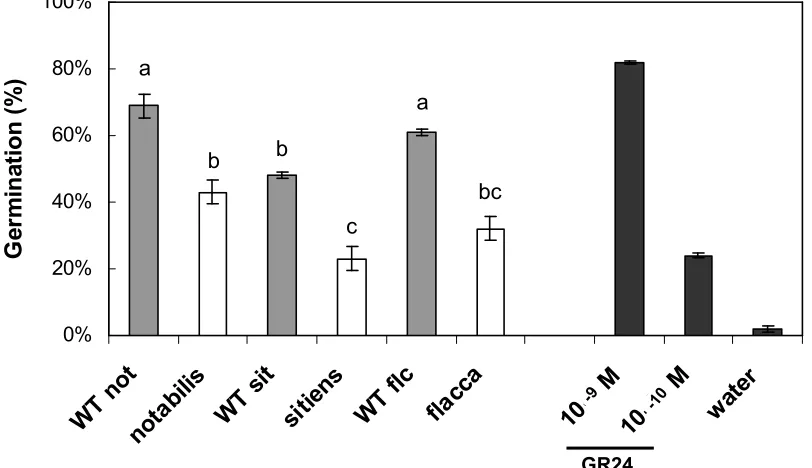
before (López-Ráez et al., 2008a), root exudates of notabilis induced about 40% less germination than 10
the corresponding wild-type (Fig. 2). The germination stimulatory activity of sitiens and flacca
11
exudates was about 52 and 48%, respectively, lower than for those of the corresponding wild-types 12
(Fig. 2). In addition to the differences between the mutants and corresponding wild-types, there was 13
some variation between the germination stimulatory activities of the wild-type exudates (Fig. 2). For 14
example, the wild-type for sitiens (cv. Rheinlands Ruhm) induced lower germination than the wild-type 15
for flacca and notabilis (cv. Ailsa Craig) (Fig. 2). 16
17
18
LC-MS/MS analysis and quantification of strigolactones
19
20
To assess whether the lower germination stimulatory activity of the ABA-deficient tomato mutants was 21
due to a decrease in the production of strigolactones, LC-MS/MS analysis was performed to compare 22
the levels of strigolactones in the root exudates of the mutants and corresponding wild-types. All the 23
For Peer Review
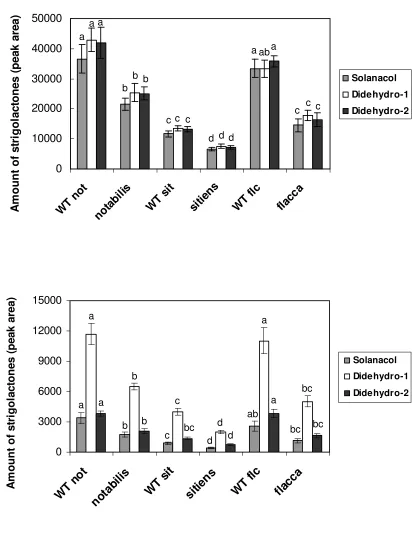
significantly (P < 0.01) reduced in the notabilis, sitiens and flacca root exudates compared with the 1
wild-types (Fig. 3A). The other strigolactone present in tomato - orobanchol - was also detected, but its 2
concentration was too low for accurate quantification. The concentration of strigolactones in the root 3
extracts showed a similar trend as for the root exudates (Fig. 3B), indicating that there is a reduction in 4
strigolactone biosynthesis in the mutants rather than just a decrease in the exudation. Interestingly, in 5
the roots the decrease in didehydro-orobanchol 1 in the ABA mutants was larger than the decrease in 6
solanacol and the didehydro-orobanchol 2 isomer, whereas in exudates the decrease in their 7
concentration was similar (Fig 3). Overall, the level of strigolactones in the exudates of notabilis, 8
sitiens and flacca was about 40, 47 and 52%, respectively, lower than the corresponding wild-types, 9
which correlates well with the reduction in the germination stimulatory activity of the mutant exudates 10
(40%, 52% and 48%, respectively). In an attempt to rescue the phenotype of the mutants, ABA (0.5 11
µM) was exogenously applied by irrigation to all the three mutants. However, no effect on 12
strigolactone biosynthesis was observed in comparison with the untreated plants (data not shown). The 13
same pattern was observed when higher ABA concentrations (1 and 10 µM) were applied to sitiens and 14
its corresponding wild-type (Fig. S1). Although no increase in ABA was detected in the roots after 15
exogenous ABA application, expression analysis of the ABA-responsive gene Le4 (Kahn et al. 1993) 16
and SlCYP707A1, an ABA-8’-hydroxylase involved in ABA catabolism (Taylor et al., 2005, Nitsch et
17
al., 2009), showed a 250- and 15-fold increase, respectively upon ABA treatment (Fig. S2), indicating 18
that ABA was effectively taken up by the roots but is also effectively catabolised. 19
Corresponding to the differences in germination stimulatory activity (see above), differences in 20
strigolactone concentration between the different wild-types were observed, with the background of 21
notabilis and flacca (cv. Ailsa Craig) producing more strigolactones than the background of sitiens (cv. 22
Rheinlands Ruhm) (Fig. 3A). 23
For Peer Review
1ABA quantification by LC-MS/MS
2
3
The tomato mutants notabilis, sitiens and flacca have previously been characterized to have a lower 4
ABA content mainly in the leaves (Cornish & Zeevaart, 1988; Thompson et al., 2000b). Since in the 5
current work we wished to study the relationship between ABA and the root-produced strigolactones, 6
we have also analyzed the levels of ABA in the roots of these three mutants. The concentration of ABA 7
detected in the roots of notabilis, sitiens and flacca was about 45, 60 and 65%, respectively, lower than 8
in the corresponding wild-types (Table 1). ABA levels in the aerial part (stems and leaves combined) 9
showed similar reductions as in the roots, although their levels were much higher (about 25-fold) than 10
in the roots (Table 1). Just as for the concentration of the strigolactones and the germination 11
stimulatory activity, significant (P < 0.01) differences between the different wild-types in the ABA 12
content were observed (Table 1). 13
14
15
Specific carotenoid cleavage enzyme inhibitors
16
17
To further investigate the involvement of NCEDs in strigolactone biosynthesis an experiment with the 18
specific NCED inhibitor abamineSG (Fig. 1) was carried out. In parallel, the effect of another inhibitor 19
- D2 - specific for the other class of carotenoid-cleaving enzymes CCD7 and CCD8, which are 20
involved in strigolactone biosynthesis (Fig. 1), was also tested. AbamineSG is a tertiary amine 21
derivative acting as a competitive inhibitor of the NCEDs (Kitahata et al., 2006). D2 is a derivative of a 22
hydroxamic acid (aryl-C2N) and is a potent inhibitor of CCD enzymes cleaving at the 9,10 position of
23
carotenoids (Sergeant et al., 2009), but is considerably less active against NCEDs (11,12 cleavage) in
For Peer Review
vitro. It has been postulated that CCD7 cleaves β-carotene at the 9,10 position to produce the 1
apocarotenoid 10-apo-β-carotene which is then further cleaved by CCD8 in the pathway leading to the 2
strigolactones (Alder et al., 2008; Gomez-Roldan et al., 2008; Umehara et al., 2008). 3
Tomato plants were treated with the inhibitors abamineSG or D2 by irrigation (see Materials and 4
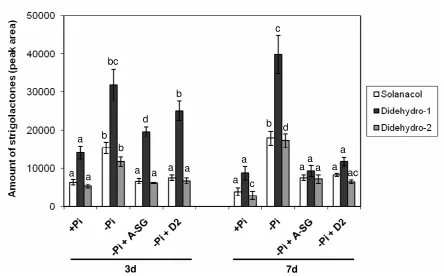
Methods) and the amount of strigolactones produced by the plants was measured by LC-MS/MS. Pi 5
starvation clearly induced the production of the tomato strigolactones solanacol, didehydro-orobanchol 6
1 and didehydro-orobanchol 2 compared with control plants grown under adequate Pi nutrition in a 7
time-dependent manner (Fig. 4). Again, orobanchol was also detected, but its concentration was too 8
low for accurate quantification. In plants treated with the inhibitor abamineSG (ABA inhibitor), the 9
increase in strigolactone production induced by Pi starvation was significantly (P < 0.01) reduced (Fig. 10
4), suggesting again an involvement of NCEDs in strigolactone biosynthesis. This inhibition was more 11
evident after 7 d of treatment, when the production and/or exudation of solanacol and the two 12
didehydro-orobanchol isomers was reduced by 58, 77 and 59%, respectively. When plants were treated 13
with D2 (strigolactone inhibitor), similarly as after treatment with abamineSG, a clear reduction in 14
strigolactone production was observed in a time-dependent manner (Fig. 4), In this case, the decrease in 15
the production of solanacol and the two didehydro-orobanchol isomers after 7 d was 54, 70 and 62%, 16
respectively. 17
To check the effect of these two inhibitors on ABA biosynthesis, the ABA content in the roots and 18
shoots after 7 d treatment was quantified. Here, a low but significant (P < 0.01) reduction of about 27% 19
was only observed in the roots of plants treated with abamineSG, whereas there was no effect on ABA 20
content after treatment with the inhibitor D2 (Table 2). When ABA levels were analyzed in the shoots, 21
no effect of either of the two inhibitors was observed. Pi starvation alone did not affect ABA content 22
neither in the roots nor in the shoots (Table 2), which is in line with previous findings in castor bean 23
For Peer Review
catabolism in shoots were induced upon phosphorus stress, while ABA content in both roots and shoots 1
was not affected (Jeschke et al., 1997). 2
3
4
Gene expression analysis for ABA and strigolactone biosynthetic genes
5
6
Expression analysis by quantitative real time RT-PCR (qPCR) was performed to check expression of 7
tomato genes encoding different carotenoid cleavage enzymes. As the tomato genome is not completely 8
sequenced, only some of the genes coding for enzymes from this family are known. The genes studied 9
in the present work are LeCCD1-B, LeCCD7, LeCCD8, LeNCED1 and LeNCED4. LeCCD1-A and -B 10
are involved in the production of the flavour volatiles β-ionone, pseudo-ionone and geranylacetone 11
(Simkin et al., 2004). CCD7 and CCD8 have been described to be involved in the biosynthesis of 12
strigolactones in pea, rice and Arabidopsis (Gomez-Roldan et al., 2008; Umehara et al., 2008). More 13
recently, CCD7 from tomato was cloned and characterized and shown to be involved in strigolactone 14
biosynthesis, shoot branching and formation of mycorrhiza-induced apocarotenoids (Vogel et al., 15
2009). In A. thaliana all NCEDs, except AtNCED4 are known to be involved in ABA production 16
(Auldridge et al., 2006; Bouwmeester et al., 2007). 17
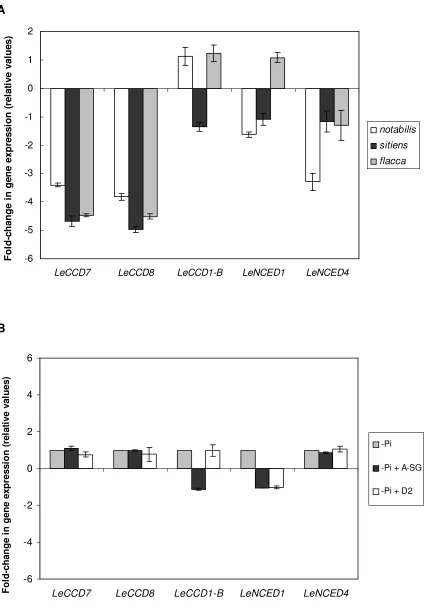
Expression of LeCCD7 and LeCCD8 was clearly reduced in all three ABA-deficient mutants - 18
notabilis, sitiens and flacca - compared with the corresponding wild-types, whereas the expression of 19
the other carotenoid cleavage genes was not affected (Fig. 5A). Moreover, this reduction was more 20
evident in sitiens and flacca, which had a lower ABA content than notabilis (Table 1). In notabilis, 21
with a null mutation in LeNCED1 caused by a single A/T base pair deletion (Burbidge et al., 1999), the 22
expression of this gene was not significantly reduced, in agreement with previous observations that 23
For Peer Review
so far described in tomato - LeNCED4 - was significantly reduced although to a lesser extent than 1
LeCCD7 and LeCCD8 (Fig. 5A). When gene expression was assessed in roots upon 7 d application of 2
the inhibitors abamineSG and D2, no significant changes were detected in the expression levels of any 3
of the selected genes (Fig. 5B). None of the genes was significantly affected by Pi starvation (data not 4
shown). 5
6
7
DISCUSSION
8
9
ABA is an important phytohormone playing many physiological roles in plants (Zeevaart & Creelman, 10
1988; Davies et al., 2005; De Smet et al., 2006; Adie et al., 2007; Jiang & Hartung, 2008). ABA is an 11
apocarotenoid produced via oxidative cleavage of epoxycarotenoids through action of NCEDs, which 12
catalyze the rate-limiting step in ABA biosynthesis (Parry & Horgan, 1992; Thompson et al., 2000a; 13
Taylor et al., 2005) (Fig. 1). We have previously demonstrated that in the ABA-deficient mutants vp14
14
and notabilis in maize and tomato, respectively - having a mutation in an NCED and therefore showing 15
a lower ABA content - the production of strigolactones was decreased by about 40% (Matusova et al., 16
2005; López-Ráez et al., 2008a). From these results it was concluded that the NCEDs either have a 17
direct role in strigolactone biosynthesis or that ABA has a regulatory role in this process (Matusova et
18
al., 2005; López-Ráez et al., 2008a). We show here that the corresponding decrease in ABA and 19
strigolactone production also occurs in two other well characterized tomato ABA-deficient mutants 20
sitiens and flacca that are mutated in the last step of ABA biosynthesis - transformation of ABA 21
aldehyde into ABA by an AAO - (Fig. 1) (Schwartz et al., 2003; Taylor et al., 1988). The decrease in 22
ABA content in the roots of these mutants was stronger than for notabilis, being 60 and 65% lower 23
For Peer Review
the shoots of sitiens and flacca is somewhat lower than previously reported, when 89 and 67% 1
reduction, respectively were detected in leaves (Cornish & Zeevaart, 1988). This discrepancy is likely 2
due to differences in the conditions under which the plants were grown and/or the analytical method 3
used. In the present study ABA content as well as strigolactones were measured using the same 4
methodology - LC-MS/MS in MRM mode - and using the same plant material. The levels of 5
strigolactones produced by the roots of sitiens and flacca were also lower than for notabilis (Fig. 3A). 6
A strong correlation was observed between the reduction of ABA and strigolactone content in the roots 7
when comparing a mutant with its corresponding wild-type, but across cultivars and mutants there was 8
no correlation between ABA and strigolactone levels. Strigolactone-deficient mutants are characterized 9
by a shoot branching phenotype (Gomez-Roldan et al., 2008; Umehara et al., 2008), but this phenotype 10
was not observed for notabilis, sitiens and flacca, even though the strigolactone content of these 11
mutants is reduced. Apparently, the reduced strigolactone level is still high enough to maintain normal 12
shoot architecture. In a recent study on tomato expressing an SlCCD7 antisense construct it was shown 13
that an 80% reduction in strigolactone level induced only a weak branching phenotype, whereas in two 14
other lines with over 90% reduction in strigolactone level branching was strongly increased (Vogel et
15
al., 2010). 16
The fact that ABA-deficient mutants with mutations in enzymes of the biosynthetic pathway other 17
than the NCEDs also produce less strigolactones seems to indicate that NCED is not directly involved 18
in strigolactone biosynthesis, but that its biosynthetic product ABA might be involved somehow in 19
regulating strigolactone biosynthesis. ABA has previously been associated to AM symbiosis as well 20
(Herrera-Medina et al., 2007; Aroca et al., 2008). These authors showed that the mutant sitiens was 21
less prone to colonization by AM fungi than the wild-type, but that continuous exogenous application 22
of ABA could not significantly compensate this effect in the mutant.Herrera-Medina and co-workers 23
For Peer Review
for a proper AM establishment. The authors also suggest that ABA may play a role in the development 1
of the arbuscule and in regulating its functionality (Herrera-Medina et al., 2007). We show here that in 2
sitiens, as well as in the other two ABA-deficient mutants notabilis and flacca, the production of 3
strigolactones is significantly reduced compared with the corresponding wild-types (Figs. 2 and 3). 4
Therefore, the reduction in AM colonization observed in sitiens may also be due to a reduction in the 5
production of strigolactones by this mutant, although an additional role of ABA in the establishment of 6
AM symbiosis cannot be discarded. Indeed, root exudates of the pea strigolactone-deficient mutants 7
rms1 and rms5, with a mutation in the CCD8 and CCD7 genes respectively, have been shown to have a 8
significantly reduced activity in promoting AM fungal hyphae branching when compared with wild-9
type exudates (Gomez-Roldan et al., 2008). Interestingly, when ABA was exogenously applied to 10
sitiens no effect on strigolactone production was observed. The failure to complement the strigolactone 11
phenotype of sitiens by exogenous ABA application is in line with the above-mentioned failure to 12
complement the AM-colonization phenotype of sitiens by exogenous ABA application (Aroca et al., 13
2008). The same lack of effect was observed when ABA was applied to the other two mutants notabilis
14
and flacca. These results suggest that endogenous ABA may be required for strigolactone production in 15
specific root cells or tissues and hence for AM colonization and development. Apparently this 16
requirement cannot be replaced by exogenous ABA application. That exogenous ABA application may 17
not be suitable to replace endogenous ABA is also clear from a study on drought-stress induced ABA 18
using luciferase ABA-reporter plants. Exposure of Arabidopsis seedlings to exogenous ABA resulted 19
in a uniform pattern of reporter expression, whereas reporter expression in response to drought stress 20
was predominantly confined to the vasculature and stomata (Christmann et al., 2005). ABA is known 21
to stimulate its own degradation via the ABA hydroxylases in order to control its homeostasis (Cutler et
22
al., 1997). Indeed, we observed induction of the gene encoding ABA hydroxylase upon ABA 23
For Peer Review
In addition to the differences between the ABA-deficient mutants and corresponding wild-types, we 1
also observed significant differences in the germination stimulatory capacity for O. ramosa seeds of 2
root exudates from the wild-type cultivars Ailsa Craig and Rheinlands Ruhm (Fig. 2). LC-MS/MS 3
analysis confirmed that the activity differences correlate with differences in the level of strigolactones 4
in the root exudates (Fig. 3A), and these correlated to the strigolactone levels in root extracts (Fig. 3B). 5
The results show that there is genetic variation for the production of strigolactones in different tomato 6
cultivars, as we previously observed for two other tomato cultivars MoneyMaker and Manapal (López-7
Ráez et al., 2008b). The genetic variation in strigolactone production indicates that selection of tomato 8
cultivars producing low levels of germination stimulants - strigolactones - may be a strategy to breed 9
tomato varieties resistant or less susceptible to Orobanche (López-Ráez et al., 2009). Selection for low 10
germination stimulant germplasm has been successfully used in other crops such as sorghum in order to 11
produce Striga resistant varieties (Ejeta, 2007). The selection process in sorghum was based on the use 12
of germination bioassays, but with the advent of extremely sensitive analytical methods such as LC-13
MS/MS in MRM mode described in the present paper, an analytically-supported selection process 14
seems now feasible. 15
Besides ABA-deficient mutants, specific inhibitors for different carotenoid cleaving enzymes were 16
used in the present study (Fig. 1). The inhibitor abamineSG - a specific inhibitor for NCEDs and 17
therefore for ABA biosynthesis (Kitahata et al., 2006) - reduced the production of the three major 18
strigolactones present in tomato, solanacol and the two didehydro-orobanchol isomers in plants grown 19
under Pi limited conditions (Fig. 4). After 7 d treatment, the reduction in strigolactone production in the 20
abamineSG-treated plants was similar to the reduction observed in the mutants sitiens and flacca. 21
Moreover, this reduction in strigolactones was accompanied by a minor but significant decrease in 22
ABA content in the roots of the treated-plants, again suggesting a regulatory effect of ABA in 23
For Peer Review
involved in the formation of apocarotenoid compounds such as flavour volatiles, cyclohexanone and 1
mycorradicin derivatives (the yellow pigment formed in host roots upon arbuscular mycorrhizal 2
colonization) and strigolactones (Simkin et al., 2004; Strack & Fester, 2006; Sun et al., 2008). CCD7 3
and CCD8 are involved in the control of plant architecture because they are involved in the production 4
of the strigolactones (Sorefan et al., 2003; Booker et al., 2005; Gomez-Roldan et al., 2008; Umehara et
5
al., 2008). It was shown that AtCCD7 can convert C40 carotenoids into C27 apocarotenoids (Schwartz 6
et al., 2004) and that, subsequently, CCD8 can cleave the C27 into a C18 apocarotenoid, the probable 7
precursor of the plant branching inhibitor (Alder et al., 2008). D2 specifically inhibits these CCDs, so 8
also strigolactone biosynthesis and was included to investigate whether low strigolactone levels also 9
affect ABA levels. Recently, it was shown that D2 showed selectivity in vitro towards CCDs that 10
cleave at the 9,10 position - such as CCD7 - rather than towards NCEDs that cleave at the 11,12 11
position of C40 cis-carotenoids (Sergeant et al., 2009). In the present study, D2 indeed caused a 12
reduction in strigolactone production suggesting that this inhibitor did indeed inhibit either CCD7 or 13
CCD8 or both (Fig. 4). However, no effect on ABA content was observed in the roots of D2-treated 14
plants, confirming that NCEDs are not significantly inhibited in vivo, thus supporting the observed in
15
vitro selectivity of the inhibitor (Sergeant et al., 2009). These results also show that a short-term 16
reduction in strigolactone levels does not lead to a reduction in ABA. The results are also in agreement 17
with those observed previously where continuous application of D2 increased the number of side 18
branches from the rosette nodes of Arabidopsis, mimicking the Arabidopsis max3 (ccd7) bushy 19
phenotype, presumably by inhibiting one or more of the CCDs involved in strigolactone biosynthesis 20
(Sergeant et al., 2009). However, in that study it was not analytically assessed whether that phenotype 21
was caused by an inhibition of strigolactone biosynthesis. Here we show that application of D2 indeed 22
inhibits strigolactone production, and thus it is a useful and selective inhibitor for use in in vivo studies 23
For Peer Review
When the expression of LeCCD7 and LeCCD8 was checked by real time qPCR, a clear decrease in 1
expression for both genes was observed in all three mutants notabilis, sitiens and flacca (Fig. 5A). This 2
reduction was most clear in sitiens and flacca, the mutants with the strongest reduction in ABA content 3
(Table 1). No differences were observed in the expression of the other carotenoid-cleaving enzymes 4
known in tomato (Fig. 5A). Although a reduction in gene expression levels does not necessarily imply 5
a reduction in the enzyme activity (Fraser et al., 2007; Carbone et al., 2009), the results shown here 6
confirm the involvement of CCD7 and CCD8 in strigolactone biosynthesis in tomato (Vogel et al., 7
2010). In contrast, the reduction in strigolactone level by abamineSG treatment did not correlate with a 8
down-regulation of LeCCD7 and LeCCD8 (Fig. 5B). This suggests that these genes are not 9
transcriptionally regulated by ABA in the short-term. Post-transcriptional regulation of CCD8 by auxin 10
was postulated to occur in Arabidopsis (Bainbridge et al., 2005). In sitiens the levels of IAA in the 11
roots have been reported to be lower than in the corresponding wild-type (Dunlap & Binzel, 1996). 12
Therefore, the decrease in strigolactone production in the tomato ABA-mutants may be mediated by a 13
decrease in auxin levels in the roots which negatively affects LeCCD7 and LeCCD8 expression and 14
hence, the production of strigolactones in these mutants. A short-term decrease in ABA through 15
abamineSG application does not lead to a similar reduction in LeCCD7 and LeCCD8 expression, even 16
though strigolactone production is decreased, suggesting that a short-term response of strigolactone 17
production to ABA is not mediated through a decrease in auxin levels and its negative effect on 18
LeCCD7 and LeCCD8 expression. 19
It has been shown that Pi starvation promotes strigolactone biosynthesis (Yoneyama et al., 2007; 20
López-Ráez et al., 2008a). Despite the fact that the strigolactones are carotenoid derived, the amount of 21
carotenoids is not increased in roots under Pi starvation (López-Ráez et al., 2008a) and no changes in 22
the expression of genes encoding enzymes involved in carotenoid biosynthesis were observed under Pi 23
For Peer Review
López-Ráez & Bouwmeester, 2008). Here we observed that Pi starvation, like ABA application, does 1
also not affect the expression of the strigolactone biosynthetic genes LeCCD7 and LeCCD8. This 2
suggests that the effect of phosphorous deficiency on strigolactone production might be at the post-3
transcriptional level or on an as yet unknown step in the strigolactone biosynthetic pathway. Our results 4
suggest that ABA could be involved in this regulation. 5
This is the first report in which a correlation is demonstrated between the levels of the 6
phytohormone ABA and the new class of phytohormones strigolactones. Our results obtained with 7
tomato ABA-deficient mutants blocked at different steps in the ABA biosynthetic pathway and the 8
application of specific inhibitors for NCEDs and CCDs suggest that ABA is one of the regulators of 9
strigolactone biosynthesis through an as yet unknown mechanism. Further research is required to 10
elucidate the mechanism by which strigolactone biosynthesis is fine-tuning regulated and the hormone 11
network behind this regulation. 12
13
14
ACKNOWLEDGMENTS
15
16
We acknowledge funding by the European Commission (Intra-European Marie Curie postdoctoral 17
fellowship FP6-MEIF-CT-2005-024345 and Reintegration Grant PERG-02-2007-224751 to Juan A. 18
López-Ráez), The Netherlands Organisation for Scientific Research (NWO; VICI-grant to HB), and the 19
UK BBSRC (Grant BB/D005787/1 to AJT and TDHB). This project was co-financed by the Centre for 20
BioSystems Genomics (CBSG) which is part of the Netherlands Genomics Initiative/Netherlands 21
Organisation for Scientific Research. We thank Binne Zwanenburg for supplying GR24, Koichi 22
For Peer Review
Maurizio Vurro for supplying O. ramosa seeds, Wim Vriezen for supplying Ailsa Craig and notabilis
1
seeds, and Harry Klee and Jonathan Vogel for LeCCD7 sequence information. 2
3
4
FIGURE AND TABLE LEGENDS
5
6
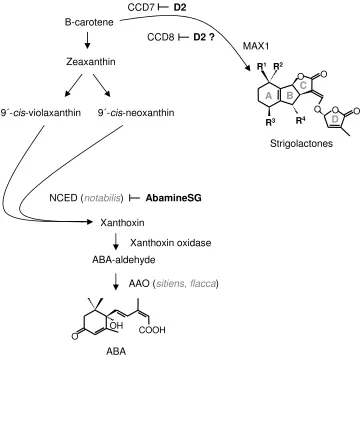
Figure 1.
7
Abscisic acid (ABA) and strigolactone biosynthetic pathways. Mutants and inhibitors ( ) used or 8
discussed in this study are shown in italics and bold text, respectively. Abbreviations of enzyme names: 9
NCED, 9-cis-epoxycarotenoid dioxygenase; AAO, aldehyde oxidase; CCD7 and CCD8, carotenoid 10
cleavage dioxygenase 7 and 8; MAX1, corresponds to the cytochrome p450 shown to be involved in 11
the biosynthesis of the branching inhibiting signal (Booker et al., 2005). 12
13
Figure 2.
14
Germination of O. ramosa seeds induced by the root exudates of the tomato mutants notabilis (not), 15
sitiens (sit) and flacca (flc) compared with the corresponding wild-types (WT). GR24 (10-9 and 10-10 16
M) and demineralized water were used as positive and negative controls, respectively. Within each 17
experiment, the concentrations of the root exudates were equalized by dilution to the same ratio of 18
volume of exudate to root fresh weight. Bars represent the average of 5 independent replicates ± SE. 19
Bars with a different letter differ significantly (P < 0.01) according to Duncan’s significant difference 20
test. 21
22
Figure 3.
For Peer Review
Strigolactone content in tomato root exudates and extracts. The amount (according to the peak area) of 1
the strigolactone solanacol and the didehydro-orobanchol isomers 1 and 2 (Didehydro-1 and 2
Didehydro-2) in the root exudates (A), and in the root extracts (B) of the tomato mutants notabilis, 3
sitiens and flacca, and corresponding wild-types (WT) was quantified. Strigolactone content was 4
analysed using LC-MS/MS (see Materials and Methods). Bars represent the average of 5 independent 5
replicates ± SE. Bars with a different letter differ significantly (P < 0.01) according to Duncan’s 6
significant difference test. 7
8
Figure 4.
9
Effect of Pi starvation and treatment with inhibitors on strigolactone production in tomato. The 10
amounts (according to the peak area and corrected to 1 g root fresh weight) of the strigolactones 11
solanacol, and the didehydro-orobanchol isomers 1 and 2 (Didehydro-1 and Didehydro-2) in the root 12
exudates of tomato (cv. MoneyMaker) plants under Pi starvation (-Pi) and under Pi starvation plus 13
treatment with 50 µM of abamineSG (-Pi +A-SG) or D2 (-Pi + D2) for 3 and 7 days. The SEPAK C18
14
purified exudates were analysed using LC-MS/MS (see Materials and Methods). Bars represent the 15
average of 5 independent replicates ± SE. Bars with a different letter differ significantly (P < 0.01) 16
according to Duncan’s significant difference test. 17
18
Figure 5.
19
Gene expression analysis by real time qPCR for the carotenoid cleaving genes LeCCD7, LeCCD8, 20
LeCCD1-B, LeNCED1 and LeNCED4 in tomato roots. A, gene expression of the tomato mutants 21
notabilis (white bars), sitiens (black bars) and flacca (grey bars). B, gene expression in roots of tomato 22
(cv. MoneyMaker) plants grown under Pi starvation (-Pi; grey bars) and under Pi starvation plus 23
For Peer Review
Real time qPCR was based on the Ct values as described in Materials and Methods. Ct values were
1
normalized using the household gene LeActin. The expression for each gene in the different mutants is 2
given relative to the expression of the same gene in the corresponding wild-type. Bars represent mean 3
values ± SE of 3 independent biological replicates. 4
5
Table 1.
6
ABA quantification in ethyl acetate extracts from roots and shoots of the tomato mutants notabilis, 7
sitiens and flacca, and corresponding wild-types (WT) by LC-MS/MS (see Materials and Methods). 8
Numbers represent the average of 5 independent replicates ± SD. Different superscript letters indicate 9
statistically significant differences between means (P < 0.01). 10
11
Table 2.
12
ABA quantification in the roots and shoots of tomato plants (cv. MoneyMaker) upon Pi starvation and 13
after treatment with inhibitors for 7 d. ABA was analysed using LC-MS/MS (see Materials and 14
methods) in extracts of tomato plants with normal Pi (+Pi), under Pi starvation (-Pi) and under Pi 15
starvation plus treatment with 50 µM of abamineSG (-Pi +A-SG) or D2 (-Pi + D2) for 3 and 7 days. 16
Numbers represent the average of 5 independent replicates ± SD. Different superscript letters indicate 17
statistically significant differences between means (P < 0.01). 18
19
20
SUPPLEMENTAL MATERIAL
21
22
Figure S1.
For Peer Review
Strigolactone content in the root exudates of the tomato ABA-deficient mutant sitiens (A), and 1
corresponding wild-type (WT) (B) after ABA (10 µM) application. The amount (according to the peak 2
area) of the strigolactone solanacol and the didehydro-orobanchol isomers 1 and 2 (Didehydro-1 and 3
Didehydro-2) was quantified. Strigolactone content was analysed using LC-MS/MS. Bars represent the 4
average of 4 independent replicates ± SE. 5
6
Figure S2.
7
Gene expression analysis by real time qPCR of Le4 (A) and ABA-8’-hydroxylase (SlCYP7070A1) (B) 8
upon ABA application (10 µM) to sitiens (black bars) and corresponding wild-type (Reinlands Rhum, 9
WT) (grey bars) for 48 hours. Real time qPCR was based on the Ct values as described in Materials and
10
Methods. Ct values were normalized using the gene LeActin as an endogenous control gene. The
11
expression for each gene is given relative to the expression of the same gene in plants not treated with 12
ABA. Bars represent mean values ± SE of 3 independent biological replicates. 13
14
REFERENCES
15
16
Adie BAT, Perez-Perez J, Perez-Perez MM, Godoy M, Sanchez-Serrano J-J, Schmelz EA, Solano
17
R. 2007. ABA is an essential signal for plant resistance to pathogens affecting JA biosynthesis 18
and the activation of defenses in Arabidopsis. Plant Cell19(5): 1665-1681. 19
Akiyama K, Matsuzaki K, Hayashi H. 2005. Plant sesquiterpenes induce hyphal branching in 20
arbuscular mycorrhizal fungi. Nature435(7043): 824-827. 21
Alder A, Holdermann I, Beyer P, Al-Babili S. 2008. Carotenoid oxygenases involved in plant 22
branching catalyse a highly specific conserved apocarotenoid cleavage reaction. Biochemical
23
Journal416: 289-296. 24
Aroca R, Alguacil MD, Vernieri P, Ruiz-Lozano JM. 2008. Plant responses to drought stress and 25
exogenous ABA application are modulated differently by mycorrhization in tomato and an 26
ABA-deficient mutant (sitiens). Microbial Ecology56(4): 704-719. 27
Auldridge ME, McCarty DR, Klee HJ. 2006. Plant carotenoid cleavage oxygenases and their 28
apocarotenoid products. Current Opinion in Plant Biology9(3): 315-321. 29
Baindridge K, Sorefan K, Ward S, Leyser O. 2005. Hormonally controlled expression of the 30
For Peer Review
Bethke PC, Lonsdale JE, Fath A, Jones RL. 1999. Hormonally regulated programmed cell death in 1
barley aleurone cells. Plant Cell11(6): 1033-1045. 2
Booker J, Auldridge M, Wills S, McCarty D, Klee H, Leyser O. 2004. MAX3/CCD7 is a carotenoid 3
cleavage dioxygenase required for the synthesis of a novel plant signaling molecule. Current
4
Biology14(14): 1232-1238. 5
Booker J, Sieberer T, Wright W, Williamson L, Willett B, Stirnberg P, Turnbull C, Srinivasan
6
M, Goddard P, Leyser O. 2005.MAX1 encodes a cytochrome p450 family member that acts 7
downstream of max3/4 to produce a carotenoid-derived branch-inhibiting hormone. 8
Developmental Cell8(3): 443-449. 9
Bouwmeester HJ, Matusova R, Zhongkui S, Beale MH. 2003. Secondary metabolite signalling in 10
host-parasitic plant interactions. Current Opinion in Plant Biology6(4): 358-364. 11
Bouwmeester HJ, Roux C, López-Ráez JA, Bécard G. 2007. Rhizosphere communication of plants, 12
parasitic plants and AM fungi. Trends in Plant Science12(5): 224-230. 13
Burbidge A, Grieve TM, Jackson A, Thompson A, McCarty DR, Taylor IB. 1999.
14
Characterization of the ABA-def.icient tomato mutant notabilis and its relationship with maize 15
Vp14. Plant Journal17(4): 427-431. 16
Carbone G, Preuss A, de Vos RCH, D'Amico E, Perrotta G, Bovy AG, Martens S, Rosati C. 2009.
17
Developmental, genetic and environmental factors affect the expression of flavonoid genes, 18
enzymes and metabolites in strawberry fruits. Plant Cell and Environment32: 1117-1131. 19
Cook CE, Whichard LP, Wall ME, Egley GH, Coggon P, Luhan PA, McPhail AT. 1972.
20
Germination stimulants. 2. The structure of strigol, a potent seed germination stimulant for 21
witchweed (Striga lutea Lour.). Journal of the American Chemical Society94(17): 6198-6199. 22
Christmann A, Hoffmann T, Teplova I, Grill E, Muller A. 2005. Generation of active pools of 23
abscisic acid revealed by in vivo Imaging of water-stressed Arabidopsis. Plant Physiology
24
137(1): 209-219. 25
Cornish K, Zeevaart JAD. 1988. Phenotypic expression of wild-type tomato and three wilty mutants 26
in relation to abscisic acid accumulation in roots and leaflets of reciprocal grafts. Plant
27
Physiology87(1): 190-194. 28
Cutler AJ, Squires TM, Loewn MK, Balsyich JJ. 1997. Abscisic acid induces abscisic acid 8'-29
hydroxylase in corn cells. Plant Physiology114(3): 795-795. 30
Davies WJ, Kudoyarova G, Hartung W. 2005. Long-distance ABA signaling and its relation to other 31
signaling pathways in the detection of soil drying and the mediation of the plant's response to 32
drought. Journal of Plant Growth Regulation24(4): 285-295. 33
De Smet I, Zhang HM, Inze D, Beeckman T. 2006. A novel role for abscisic acid emerges from 34
underground. Trends in Plant Science11(9): 434-439. 35
Dunlap JR, Binzel ML. 1996. NaCl reduces indole-3-acetic acid levels in the roots of tomato plants 36
independent of stress-induced abscisic acid. Plant Physiology112: 379-384. 37
Ejeta G. 2007. Breeding for Striga resistance in sorghum: Exploitation of an intricate host-parasite 38
biology. Crop Science47(S3): S216–S227. 39
Fraser PD, Enfissi EMA, Halket JM, Truesdale MR, Yu D, Gerrish C, Bramley PM. 2007.
40
Manipulation of phytoene levels in tomato fruit: Effects on isoprenoids, plastids, and 41
intermediary metabolism. Plant Cell19(10): 3194-3211. 42
Gomez-Roldan V, Fermas S, Brewer PB, Puech-Pagés V, Dun EA, Pillot JP, Letisse F, Matusova
43
R, Danoun S, Portais JC, Bouwmeester H, Bécard G, Beveridge CA, Rameau C,
44
Rochange SF. 2008. Strigolactone inhibition of shoot branching. Nature455(7210): 189-194. 45
Harrison MJ. 2005. Signaling in the arbuscular mycorrhizal symbiosis. Annual Review of
46