This paper is made available online in accordance with
publisher policies. Please scroll down to view the document
itself. Please refer to the repository record for this item and our
policy information available from the repository home page for
further information.
To see the final version of this paper please visit the publisher’s website.
Access to the published version may require a subscription.
Author(s): Xiao-Bing Hu and Ezequiel A. Di Paolo
Article Title: A Ripple-Spreading Genetic Algorithm for the Aircraft
Sequencing Problem
Year of publication: 2011
Link to published article: http://dx.doi.org/10.1162/EVCO_a_00011
Publisher statement: © 2011 The MIT Press. A Ripple-Spreading
Genetic Algorithm for the Aircraft Sequencing Problem.
Xiao-Bing Hu
[email protected] School of Engineering, University of Warwick, Coventry, CV4 7AL, United KingdomEzequiel A. Di Paolo
[email protected]Ikerbasque, Department of Logic and Philosophy of Science, University of the Basque Country, San Sebastian, 20080, Spain
Abstract
When genetic algorithms (GAs) are applied to combinatorial problems, permutation representations are usually adopted. As a result, such GAs are often confronted with fea-sibility and memory-efficiency problems. With the aircraft sequencing problem (ASP) as a study case, this paper reports on a novel binary-representation-based GA scheme for combinatorial problems. Unlike existing GAs for the ASP, which typically use permutation representations based on aircraft landing order, the new GA introduces a novel ripple-spreading model which transforms the original landing-order-based ASP solutions into value-based ones. In the new scheme, arriving aircraft are pro-jected as points into an artificial space. A deterministic method inspired by the natural phenomenon of ripple-spreading on liquid surfaces is developed, which uses a few parameters as input to connect points on this space to form a landing sequence. A traditional GA, free of feasibility and memory-efficiency problems, can then be used to evolve the ripple-spreading related parameters in order to find an optimal sequence. Since the ripple-spreading model is the centerpiece of the new algorithm, it is called the ripple-spreading GA (RSGA). The advantages of the proposed RSGA are illustrated by extensive comparative studies for the case of the ASP.
Keywords
Arrival sequencing problem, ripple-spreading model, feasibility, optimization, binary representations.
1
Introduction
crossover, which were developed on the basis of binary representation, are hard to apply to permutation-based GAs in combinatorial problems.
Recently, a novel GA scheme, based on binary representations, free of both feasi-bility and memory-efficiency problems, has been applied to quite a few combinatorial problems (the traveling salesman problem, Hu and Di Paolo, 2007, the topology op-timization of complex networks, Hu, Di Paolo, and Barnett, 2008, the airport gate assignment problem, Hu and Di Paolo, 2009b, and the network coding problem, Hu, Leeson, et al., 2010). The results have illustrated its advantages and potential in terms of feasibility, memory efficiency, and compatibility. The basic idea of this scheme is the following. First, a combinatorial problem is transformed by creating a problem-specific artificial space and then projecting the elements that compose the solutions to the combinatorial problem onto this space. Secondly, this is followed by designing a parameterized ripple-spreading process, so that for each given set of values for the parameters, the ripple-spreading process will connect all elements on the space to form a unique solution to the original combinatorial problem. And lastly, a basic binary-representation based GA is used to evolve these ripple-spreading parameters in order to find an optimal or near-optimal solution. Since the ripple-spreading process plays a crucial role in this new GA scheme, it is called the ripple-spreading GA (RSGA). The work of Hu and colleagues (Hu and Di Paolo, 2007; Hu, Di Paolo, and Barnett, 2008; Hu and Di Paolo, 2009b; Hu, Leeson, et al., 2010) provided some preliminary results on the RSGA, which were reviewed in Hu, Wang, et al. (2010). This paper aims to make a deeper and more systematic investigation of the RSGA scheme using another challenging task, the aircraft sequencing problem (ASP), as a study case.
to help evolutionary operators to produce valid/feasible chromosomes. Some GAs have even discarded the crossover operator altogether, simply because it turned out to be more destructive than effective in terms of feasibility (Cheng et al., 1999; Hu and Chen, 2005). The matrix-representation-based GAs in Hu and Di Paolo (2008) and Hu and Di Paolo (2009a) were claimed to have achieved better performance than others, but they suffered from O(n2) memory problem, which means that while suitable for the ASP, they might not be able to generalize their advantages to other large-scale problems like complex network optimization with the same underlying representation issues.
This paper applies the RSGA scheme to the ASP. Thanks to the novel ripple-spreading model, the proposed RSGA can employ a value-based representation that has nothing (directly) to do with aircraft landing sequence. As a result, the new algorithm is compatible with all classic evolutionary operators, and free of both feasibility and memory-efficiency problems. It is also for this reason easy to generalize to other com-binatorial problems. From this case study, a better understanding of the RSGA scheme at work is achieved, which is important to push the scheme toward real-world applica-tions in the future. The remainder of this paper is organized as follows. The basic idea of the RSGA scheme is explained in Section 2. The mathematical description of the ASP is given in Section 3. The associated transformed problem, that is, the ripple-spreading model of the ASP, is described in Section 4. Some important GA-related issues are dis-cussed in Section 5. Further analyses are given in Section 6. An extensive simulation study is reported in Section 7, which is followed by some conclusions in Section 8.
2
The RSGA Scheme
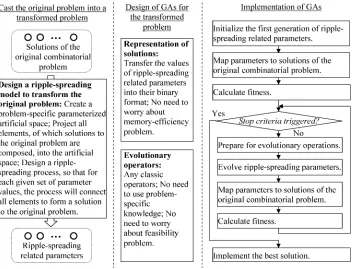
As discussed in Section 1, permutation representations often make it difficult to de-sign effective and efficient evolutionary operators because of feasibility and memory-efficiency issues. In order to address these issues, an often used methodology is to transform the original problem into a new problem for which solutions are based on value rather than order or permutation, and then apply a basic binary GA to resolve the transformed problem. Properly transforming the original problem is the centerpiece of this methodology. Inspired by the natural ripple spreading phenomenon that occurs when liquid surfaces are perturbed, this paper reports a novel problem transforming process, which has good potential to become a generalized technique for transforming a wide range of combinatorial problems.
A solution to a combinatorial problem determines how to organize a set of elements, particularly, in what kind of order. Suppose such elements are associated with some points in a space where some spreading ripples will be generated randomly (like when a stone is thrown in a pond). Then as the ripples are spreading out in this space, the points representing the components of a solution can be organized according to, say, the order by which the ripples reach each of them (or by some other choice). Obviously, such an order is determined by the values of the ripple-spreading related parameters, for example, the epicenter, speed, and amplitude of ripples. In this way, a combinato-rial solution (a sequence of elements) is transformed into a value-based solution (the parameters of a spatial ripple spreading process). This is the original inspiration of remodeling/transforming a combinatorial problem into a ripple spreading process that leads to the proposed RSGA scheme.
Figure 1: Conventional way of applying GAs.
free of feasibility and memory-efficiency problems and compatible to all classic evolu-tionary operators. Figure 1 summarizes the conventional way of applying GAs and the central idea of the RSGA scheme is illustrated in Figure 2.
In the implementation of the RSGA, the only thing different from a classic GA is that, before the fitness of a chromosome is calculated, the represented solution to the transformed problem, that is, a set of values for the ripple-spreading related parameters, needs to be mapped back into the associated solution to the original combinatorial problem. Obviously the most important and also the most difficult step in the RSGA scheme is to design a proper ripple-spreading model. This largely depends on each individual original problem. Despite this, there is still great freedom and flexibility for designing a ripple-spreading model. For instance, regarding the design of artificial space, previous studies (Hu and Di Paolo, 2007; Hu, Di Paolo, and Barnett, 2008; Hu and Di Paolo, 2009b; Hu, Leeson, et al., 2010) have shown the following.
Figure 2: Basic idea of the RSGA.
non-geographic networks or graph and information theories (Hu, Di Paolo, and Barnett, 2008). The artificial spaces used in these studies are purely imaginary, and the elements are projected in a rather arbitrary manner.
• The artificial space can in principle be of any dimension, for example, in the existing studies, there are one-dimensional (Hu, Leeson, et al., 2010), two-dimensional (Hu and Di Paolo, 2007; Hu, Di Paolo, and Barnett, 2008), and three-dimensional artificial spaces (Hu and Di Paolo, 2009b). In an artificial space with more than one dimension, different axes may have different distance units, like in Hu and Di Paolo (2009b), the distance units for the time axis and the passenger number axis are completely different and even incommensurable. In this case, we need to introduce an artificial coefficient to homogenize two different distance scales. Such coefficients, along with other ripple-spreading parameters, can be later evolved by the GA. This can help to optimize the ripple-spreading model, in order to improve the performance of RSGA.
Regarding the design of the ripple-spreading process, we can also get some useful observations from existing studies.
Figure 3: Aircraft waiting to land.
states/features/values to choose from, such as the network coding problem (Hu, Leeson, et al., 2010), the amplitude of a ripple when it reaches an element point plays the most important role in determining how to generate combinatorial solu-tions. Some other combinatorial problems could be very complicated, where there are complex interactions or relationships between elements in a combinatorial so-lution, for example, how to distribute connections between nodes to generate a random complex network (Hu, Di Paolo, and Barnett, 2008). In this case, an ele-ment point can be activated by a ripple to generate new ripples, which may activate other elements in return.
• The choice for ripple-spreading related parameters is also broad. In the existing studies, the location of ripple epicenter, initial states of a ripple (including initial amplitude, initial point energy, frequency, initial phase, etc.), coefficients in the dynamic functions which define the behavior of ripples, and even some artificial space related parameters were used as ripple-spreading related parameters.
Hu, Wang, et al. (2010) provide a comprehensive review and some useful guidelines regarding how to design an RSGA for a combinatorial problem. The general idea is easier to understand when seen at work on a specific case. More details about how to design a good RSGA will be explained in the following sections through a case study on the ASP.
3
The Aircraft Sequencing Problem (ASP)
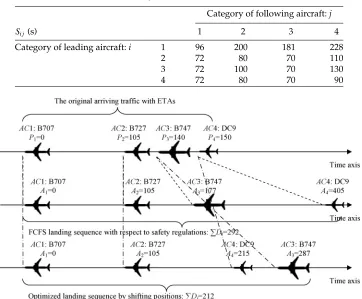
A simple way to perform an ASP is to schedule arriving aircraft in a first-come-first-served (FCFS) order based on their estimated times of arrival (ETAs) at the runway. Although FCFS scheduling establishes a fair order in terms of ETA, it ignores other useful information which can help make the most of the capacity of the airport, reduce airborne delays and/or improve the airport service to airlines (Pelegrin, 1994; Carr et al., 1999, 2000). As is well known, shifting positions of aircraft according to landing time interval (LTI), which is the minimum permissible time interval between two successive landings, can significantly reduce airborne delays during the arriving and landing phase (Andreatta and Romanin-Jacur, 1987; Bianco and Odoni, 1993; Dear, 1976).
Table 1: Minimum landing time intervals (LTI; Bianco et al., 1997).
Category of following aircraft:j
Sij(s) 1 2 3 4
Category of leading aircraft:i 1 96 200 181 228
2 72 80 70 110
3 72 100 70 130
4 72 80 70 90
Figure 4: FCFS and position shifting.
andT can be used to estimate the degree of congestion at the runway of the airport. For theith aircraft, ACi, in the original arriving traffic,i=1, . . . , NAC, there is an ETA at the runway, denoted asPi. Based on this set of ETAs,Pi, i=1, . . . , NAC, an FCFS landing sequence can be directly worked out with respect to safety regulations.
way, whereAi, i=1, . . . , NAC, is the scheduled time of arrival (STA) for theith aircraft in the original arriving traffic.
The ASP based on position shifting can be mathematically described as a minimiza-tion problem. LetQ(n) record thenth aircraft in the optimized landing sequence, where Q(n)=i means theith aircraft in the original arriving traffic turns out to be thenth aircraft in the optimized landing sequence. WithQone can calculateAias
AQ(n) =
PQ(n) n=1;
max(PQ(n), AQ(n-1)+S(CQ(n-1), CQ(n))) n >1,
(1)
whereCi is the category of theith aircraft in the original arriving traffic, andS(i, j) is the LTI for an aircraft of categoryj to follow an aircraft of categoryito land. Then the airborne delay of theith aircraft in the original arriving traffic is
Di=Ai−Pi, i=1, . . . , NAC. (2)
The objective of the ASP in the period ofT is to find an optimal landing sequence, Q(1), . . . , Q(NAC), such that the total airborne delay can be minimized, as formulated as following
min
Q(1),...,Q(NAC)J, J =
NAC
i=1
Di. (3)
One should be aware of that the above mathematical formulation of the ASP is simplified. The real-world ASP operation needs to consider many more factors and constraints which are missing or ignored here for the sake of simplicity. For instance, arriving aircraft should be delayed as equally as possible in a fair landing sequence. It is not the same to delay five aircraft by 10 min as to delay only one by 50 min. For each aircraft, a maximal allowable delay must be observed due to the limited fuel on board. Also for each aircraft, the STA should be within a landing time window. In the real-world ASP practice, sometimes a negative delay may apply to aircraft, which means that an aircraft may be required to speed up to land before its ETA in order to allow other aircraft to land on time. Different aircraft may have different landing priority in terms of fuel and passenger convenience. Furthermore, how to execute an optimized landing sequence in a dynamic environment (the situation may change during the time windowT) is also an important issue which needs to be addressed in real world.
4
Transformed Problem: A Ripple-Spreading Model of ASP
The ripple-spreading model is the core technique in the RSGA scheme. In this section, we will describe a ripple-spreading model for the ASP. To this end, arriving aircraft are projected as points onto an especially parameterized artificial space, and then a ripple-spreading process is designed in order to form a landing sequence by connecting all aircraft points according to certain parameters.
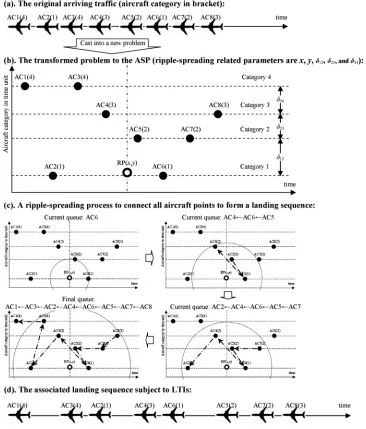
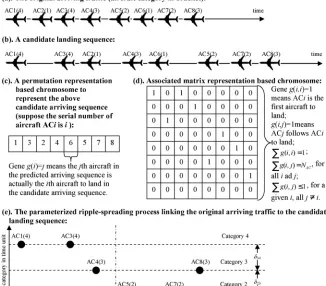
First of all, we need to set up an artificial space for projecting arriving aircraft. Here a two-dimensional space is designed, where thex axis is time and they axis is an aircraft category axis but measured in the same time units as the x axis. Then we project all aircraft as points onto the artificial space according to their ETA and category. Here we define three parameters which can partially determine how aircraft points are distributed in the artificial space:δ12,δ23, andδ34. They are, along theyaxis, the distances between category 1 and category 2, between category 2 and category 3, and between category 3 and category 4, respectively. Note thatδ12,δ23, andδ34are real numbers, and may have negative values. Besides the aircraft points, we also have a reference point in the artificial space denoted as RP and defined by its coordinates (x, y). This RP will determine the epicenter of the ripple spreading process. Figure 5(a) and Figure 5(b) illustrate how the original arriving traffic is projected onto the artificial space.
With the above artificial space ready, we now need to design a ripple-spreading process that connects all aircraft points as a function of δ12,δ23,δ34, and RP in order to generate a unique landing sequence. It is desirable that such a process should gen-erate a landing sequence that is absolutely feasible and reasonably good in terms of airborne delay. By mimicking the natural ripple-spreading phenomenon, we propose the following process.
Step 1: Calculate the distances between aircraft points to the given RP. InitializeUas the set of all original arriving aircraft, set the current landing sequenceQas an empty vector, and letj =0.
Step 2: Do whileU = ∅
Step 2.1: Letj =j+1. Choose all aircraft points that have thejth shortest distance to the RP. Suppose in these chosen aircraft points,NEaircraft have an ETA smaller thanx, andNLaircraft have an ETA larger than x. Remove these aircraft fromU.
Step 2.2: Insert theNE aircraft that have an ETA smaller thanx to the front of the current landing sequenceQin the following way. An aircraft with a larger ETA should be inserted earlier to the front of the current Q. If some aircraft have the same ETA, then they should be inserted in a specified order which is predetermined by aircraft categories in order to give the least total delay for those aircraft with the same ETA. If some aircraft have the same ETA as well as the same category, then insert them randomly to the front of the currentQ.
Figure 5: Illustration of the transformed problem and ripple-spreading process.
aircraft have the same ETA as well as the same category, then append them randomly to the end of the currentQ.
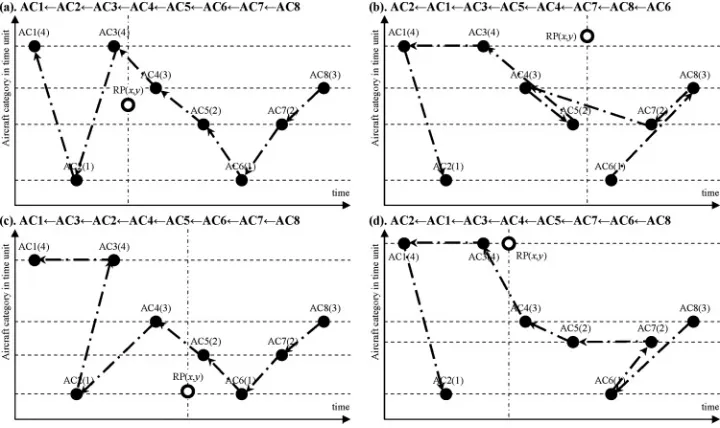
Figure 6: Effect of ripple-spreading parameters on landing sequence.
Figure 5(c) and Figure 5(d) illustrate how the above ripple-spreading process calculates a landing sequence step by step.
It is clear that different δ12, δ23, δ34, and/or RP may result in different landing sequences. For example, Figure 6(a) and Figure 6(b) use the same set of δ12,δ23,δ34 as Figure 5(b), but they have different RPs, and therefore different landing sequences. Figure 6(c) has the same RP as Figure 5(b), but uses a different set ofδ12,δ23, andδ34, which also results in a different landing sequence. Theδ12,δ23,δ34, and RP in Figure 6(d) are different from those in Figure 5(b), and so is the landing sequence. Therefore, δ12,δ23,δ34, and RP are all ripple-spreading parameters in this model. An interesting observation is that ifδ12 =δ23=δ34=0, then the resulting landing sequence is actually a FCFS sequence, regardless of the location of RP.
to the design of evolutionary operators in the RSGA. This is, however, often difficult for permutation-representation-based GAs for the ASP, which directly integrate problem-specific knowledge and/or heuristic rules into their evolutionary operators.
It should be noted that the design of the ripple-spreading model is highly problem-dependent. Different problems may need quite different ripple-spreading models (e.g., see Hu and Di Paolo, 2007, 2009b; Hu, Di Paolo, and Barnett, 2008). Even for the same problem, there may be many different suitable ripple-spreading models, probably with equivalent or similar effects. For instance, the ripple-spreading model described in this section can be modified by putting the RP on thex axis and definingδ1,δ2,δ3, andδ4 as the locations of category lines with reference to thexaxis. One can easily derive that the modified model is actually equivalent to the first model.
5
GA Related Techniques
Based on the above ripple-spreading model for the ASP, a traditional GA with the basic binary representation and all classic evolutionary operators can be designed to evolve the ripple-spreading parameters in order to find an optimal landing sequence.
5.1 Chromosome Structures
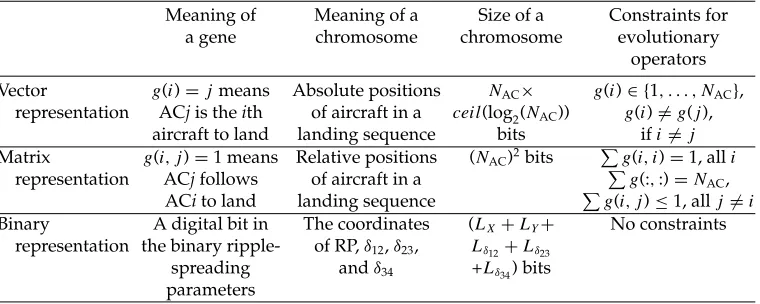
In the RSGA, a chromosome is simply a binary string for the values ofδ12,δ23, andδ34, and the coordinates of RP, that is,xandy. For comparative purposes, here we also discuss two permutation representations for the ASP: one is anNAClong vector recording the absolute positions of all aircraft in the represented landing sequence, that is,g(i)=j means the jth aircraft in the original arrival traffic is the ith to land, as illustrated in Figure 7(c) (Hansen, 2004; Cheng et al., 1999; Hu and Chen, 2005). The other, as shown in Figure 7(d), is a 0-1-valued matrix in a size ofNAC×NAC, with each entry g(i, j) indicating the relative positions of aircraft in the associated landing sequence (Hu and Di Paolo, 2008), that is,g(i, j)=1 means thejth aircraft in the original arrival traffic will follow theith aircraft in the original arrival traffic to land. The contents of a chromosome in the RSGA have nothing directly to do with the associated landing sequence, but are simply the ripple-spreading parameters, that is, a chromosome in the RSGA is a binary string of the values for the ripple-spreading parameters, as depicted in Figure 7(f), where
LX =ceil(log2((X−X)/XS)), (4)
LY =ceil(log2((Y −Y)/YS)), (5)
Lδ12 =ceil(log2((δ−δ)/δS)), (6)
Lδ23 =ceil(log2((δ−δ)/δS)), (7)
Lδ34 =ceil(log2((δ−δ)/δS)), (8)
Figure 7: Different representations.
searching steps can affect the performance of the RSGA. In general, the searching steps should become smaller if the problem is more complicated, for example, in the case of the ASP, ifNACis larger. In this study, we setXS=YS=δS=0.00001 unless otherwise specified.
Table 2: Features of different representations.
Meaning of Meaning of a Size of a Constraints for a gene chromosome chromosome evolutionary
operators Vector g(i)=jmeans Absolute positions NAC× g(i)∈ {1, . . . , NAC},
representation ACjis theith of aircraft in a ceil(log2(NAC)) g(i)=g(j),
aircraft to land landing sequence bits ifi=j
Matrix g(i, j)=1 means Relative positions (NAC)2bits
g(i, i)=1, alli
representation ACjfollows of aircraft in a g(:,:)=NAC,
ACito land landing sequence g(i, j)≤1, allj=i
Binary A digital bit in The coordinates (LX+LY+ No constraints
representation the binary ripple- of RP,δ12,δ23, Lδ12+Lδ23
spreading andδ34 +Lδ34) bits
parameters
the matrix representation have to satisfy some special constraints in order to get feasible chromosomes. Actually, the constraints for the vector representation are so restrictive to evolutionary operations that crossover has been discarded in some papers (Cheng et al., 1999; Hu and Chen, 2005). In Hu and Di Paolo (2008), a computationally expen-sive process had to be added to guarantee the feasibility of crossover. However, the matrix representation used in this case has a potentialO(n2) memory problem. There-fore, the second advantage of the binary representation is its memory efficiency. That is, the RSGA, with similar demands for memory capacity, can easily apply to all problem scales, because the length of its chromosomes has no direct link toNAC. Actually, the RSGA uses the ripple-spreading process in Section 4 to reconstruct online the full infor-mation of a landing sequence from the simple data stored in a chromosome. In other words, the ripple-spreading process helps the RSGA to save the memory allocated to chromosomes. The cost is the computational burden caused by the ripple-spreading process. Fortunately, this added computational burden can be largely offset by the re-duced computational burden in the evolutionary operations due to the use of binary representation, as will be discussed later. One may argue that the memory efficiency of RSGA is not significant in the ASP, as NAC will rarely exceed 100. The reason for mentioning the memory efficiency of RSGA here is to note the potential of RSGA. As mentioned before, the RSGA scheme can be applied to many different combinatorial problems, and in some of them, the memory efficiency of RSGA is extremely important. For instance, to represent and optimize a complex network with millions of nodes, a traditional chromosome based on an adjacency matrix requires trillions of bits of mem-ory, while the RSGA only needs to record tens of ripple-spreading related parameters (Hu, Di Paolo, and Barnett, 2008).
5.2 Common Genes
Figure 8: Common genes in different representations.
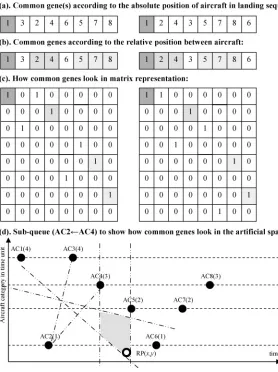
method is employed. For the matrix representation, identifying common genes based on the relative positions of aircraft is straightforward: conduct an & operation between two matrixes, and then common genes are those resulting entries with value 1 (Hu and Di Paolo, 2008).
5.3 Evolutionary Operators
For the vector representation in Hu and Chen (2005), the design of mutation is very sim-ple: exchange the contents of two genes which are randomly chosen, that is,g(i)↔g(j). This mutation reflects straightforwardly the physical meanings of position-shifting. However, due to potential feasibility problems, the GA in Hu and Chen (2005) failed to give any crossover operator that could effectively identify, inherit, and protect common genes based on relations of relative position. For the matrix representation in Hu and Di Paolo (2008), a relatively complicated procedure was introduced to adopt the muta-tion in Hu and Chen (2005), and an even more complicated procedure was proposed to conduct uniform crossover aiming to make the most of fit common genes based on relative positions of aircraft.
In the RSGA, since a binary chromosome is based on value rather than on permu-tation, all classic evolutionary operators can easily apply without any modification. As discussed before, this full freedom of choosing and designing evolutionary operators mainly comes from no constraint to the binary representation. The mutation operator used in the RSGA is to randomly reverse a gene in the chromosome: if gene C(i) is chosen to mutate at a given probability, then we have
C(i)→ |1−C(i)|. (9)
In the RSGA, we choose uniform crossover, which is probably the most powerful crossover operator (Sywerda, 1989). Thanks to the binary representation, the original uniform crossover can directly apply in the RSGA. Uniform crossover uses two parents to produce only one offspring, and the principle is simple: theith gene in the offspring inherits theith gene of either parent with a 50% probability.
5.4 Heuristic Rules
In GAs based on a permutation representation for the ASP many problem-specific heuristic rules are integrated into the evolutionary operations. For example, in Hu and Chen (2005) and Hu and Di Paolo (2008), the FCFS sequence is used to initialize a certain proportion of chromosomes, otherwise it is very likely that almost all chromosomes at the beginning of the evolution are very unfit. The probability of applying the mutation operation largely depends on the ETA of the chosen genes, in order to avoid shifting the positions of two aircraft which are far away from each other in the original arriving traffic.
6
Further Analyses on the RSGA
6.1 Completeness of Solution Space
An obvious question about the RSGA is: will the ripple-spreading model cover the whole solution space of the original ASP? In other words, for any candidate landing sequence, will there always exist at least one set of values for the ripple-spreading related parameters, such that the output of the ripple-spreading model is the candidate landing sequence?
It is indeed possible to design an RSGA that can in theory cover the whole solution space of the original ASP. Suppose we randomly distributeNACRPs (not just one RP) in the artificial space; each RP has a serial number and will generate its own ripple. The first aircraft point which is reached by a ripple will be assigned to the RP where the ripple originates. The aircraft assigned to theith RP will land as theith aircraft in the landing sequence. Then, we encode the coordinates of all RPs in a chromosome, and evolve them by selection, mutation, and crossover. It is easy to see that, by randomly distributing theNACRPs, we can get any candidate landing sequence, which means the solution space of the original ASP is completely covered by this RSGA, in other words, it is theoretically possible for this GA to find the global optima. This GA, which can guarantee the completeness of solution space, still follows the basic idea of the RSGA scheme proposed in this paper: it transforms the original order-based ASP solutions into value-based solutions, that is, the coordinates of RPs, which can be easily handled by all classic evolutionary operators free of feasibility problems. Figure 9 illustrates this RSGA with a guarantee of the completeness of solution space.
However, from a practical point of view, it is not necessary to demand GAs to guarantee the completeness of solution space. It is often acceptable that they find good solutions effectively and efficiently. This is because (i) even though a GA can guarantee such completeness, it only theoretically stands a very slim chance to find a global optimum, while practically, it very often ends up with suboptimal or just fairly good solutions, particularly in the case of complex problems, and (ii) it is often the case in various implementations of GAs that finding a global optimum is not essential as long as the algorithms are capable of finding a suboptimal or fairly good solution within a specified time window with limited hardware resources.
Therefore, from a practical point of view, we need to further analyze whether the RSGA described in Section 4 and Section 5 can cover a sufficiently large set of good solutions and find some of them very quickly. As mentioned in Section 4 and Section 5, in real-world ASP use, empirical knowledge informs decisions: (i) two aircraft of same category should not be swapped, (ii) shifting the positions of two aircraft with close ETAs is likely to improve the landing sequence, and (iii) it is rarely of any help to shift the positions of two aircraft which are far away from each other. A candidate landing sequence observing the above knowledge is likely to be a good solution to the ASP. Therefore, conventional GAs based on permutation representations (i.e., Beasley et al., 2001; Hansen, 2004; Cheng et al., 1999; Hu and Chen, 2005; Hu and Di Paolo, 2008, 2009a) need to explicitly integrate the above empirical knowledge into their evolutionary operations in order to achieve a satisfactory performance. For the proposed RSGA, we can theoretically prove as follows that the above knowledge is automatically or naturally reflected in the ripple-spreading model.
Figure 9: Illustration of an RSGA with guarantee of completeness of the solution space.
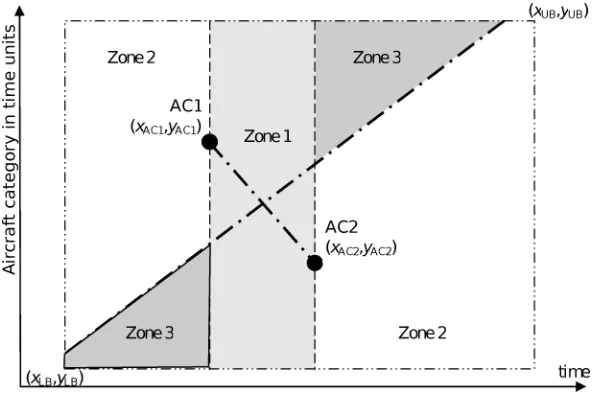
[image:19.504.105.406.417.615.2]random point within the rectangular area defined by (xLB, yLB) and (xUB, yUB). Accord-ing to the ripple-spreadAccord-ing model given in Section 4, one has that, only when the RP is located within Zone 3 will AC1 and AC2 shift positions. Therefore, the probability of swapping two aircraft is determined by the probability at which the RP is located within Zone 3. This can be calculated by dividing the area of Zone 3 by the area of the rectangle defined by (xLB, yLB) and (xUB, yUB). Due to the limited space, here we skip the detailed mathematical deduction, but from Figure 10, one can easily see: (i) if yAC1=yAC2, which means two aircraft are of the same category, the volume of Zone 3 is always 0, which implies the probability of shifting positions is 0, while ifyAC1=yAC2, then (ii) as the gap betweenxAC1andxAC2decreases, the dot-and-dash lines in Figure 10 will turn clockwise, which leads to an increase in the area of Zone 3 and therefore a larger probability of swapping two aircraft, and (iii) if (xAC2−xAC1) is larger than a critical value, Zone 3 will disappear, which means no chance to shift positions. Now, we can come to the conclusion that the RSGA proposed in Section 4 and Section 5 naturally observes the empirical knowledge learned in real-world ASP practice. As a result, although the simple RSGA cannot guarantee the completeness of solution space, it is very likely to cover a considerable proportion of good solutions.
6.2 Extension to a Multi-Runway System
The RSGA proposed above can be easily extended to handle some more complex situations, for example, the ASP in a multi-runway system (denoted as MRASP). Simply speaking, the MRASP is the problem of assigning arriving aircraft to different runways at the airport and generating efficient landing sequences and landing times so that the safety separation between arriving aircraft is guaranteed, the available capacity at the airport is efficiently used, and airborne delays are minimized. The complexity in the MRASP comes not just from the fact that there areNRrunways to choose from, but also from the fact that theNRrunways may have quite different operational conditions, for example, they start service at different times, and may be exclusive to certain categories of aircraft. The mathematical description of the ASP in Section 3 can easily be extended to a MRASP version. However, due to limited space, here we skip the MRASP formulation (see Hansen, 2004, for details) and mainly focus on how to design a RSGA for the MRASP. It is easy to extend the RSGA for the ASP to a multi-runway version: (i) use NRRPs rather than just one, and assign a runway to each RP, for example, therth RP is related to runwayr; (ii) associate two constants with each RP, one istSS(r), which is the time for runwayrto start service, and the other is a constant vectorV(r), which defines the restricted aircraft categories to runwayr; (iii) in the ripple-spreading process, the NR RPs compete with each other to connect, subject totSS(r) andV(r), those aircraft points which are not connected yet, in order to generate landing sequences to different runways (those aircraft connected by RPr will form the landing sequence to runway r). The above MRASP version of RSGA is illustrated in Figure 11, from which one can see that the modified RSGA can effectively arrange arriving aircraft to land at different runways subject to runway operational conditions.
7
Simulation Results
7.1 Simulation Analysis on the Completeness of the Solution Space
Figure 11: RSGA for the multi-runway problem (MRASP).
Table 3: Simulation analysis on completeness of solution space (20 aircraft).
Probability that Total number of Total number of different shifting position is potential good solutions covered by
potentially useful landing sequences the transformed problem Congested case ∼0.4915 ≤257,690 ≥27,769
Normal case ∼0.2901 ≤152,109 ≥14,137
Under-congested case ∼0.2046 ≤107,269 ≥5,769
Suppose 20 arriving aircraft are uniformly randomly distributed within a time win-dow of 1000/2000/3000 s (congested/normal/under-congested case). Basically, it is very likely that shifting positions is not necessary unless the gap between the ETAs of two aircraft is less than the associated LTI. We randomly generate 100 sets of arriving traffic data for each case (each set has 20 aircraft), and then count how many times on av-erage the LTIs in Table 1 are violated. The result is: the probability that shifting positions is potentially useful is about 0.4915/0.2901/0.2046 in the congested/normal/under-congested cases. The actual probability should be much smaller, because, as discussed in Section 4, if two adjacent aircraft not satisfying the required LTI are of the same category, then shifting their positions will only make things worse.
Since the average gap between aircraft is close to the average LTI in Table 1, we assume it is only necessary to shift positions between adjacent aircraft in the original arriving traffic. Then for an arriving traffic of 20 aircraft, the total number of candidate landing sequences is no more than 219 =524,288. Actually, the number is much less than 524,288, because, for instance, if the first aircraft in the original traffic is put as the second aircraft in a candidate landing sequence, then the second aircraft in the original traffic must take the first place in that landing sequence, otherwise, at least two aircraft that are not adjacent in the original traffic have to shift their positions, which is not allowed under our assumption for this analysis. For conservative purposes again, we use 524,288 as the total number of candidate landing sequences. Therefore, the number of potentially good landing sequences can be estimated by multiplying 524,288 by the probability at which shifting positions is potentially useful.
Then for each of the 100 sets of traffic data in the congested/normal/under-congested case, we use a reasonably small sampling step to sample the solution space of the transformed problem, and count the number of different solutions we find. Ob-viously, the number of different solutions found by sampling the solution space of the transformed problem is less than the actual number of different solutions in such a solu-tion space. However, still for conservative purposes, we assume the size of the solusolu-tion space of the transformed problem equals such a number determined by sampling, and we take the average of the 100 sets in each case.
Table 4: Definitions of traffic scenarios.
NAC
20 30 40 50 60
T Under-congested case 3,000 4,500 6,000 7,500 9,000 (s) Normal case 2,000 3,000 4,000 5,000 6,000 Congested case 1,000 1,500 2,000 2,500 3,000
delay, then it will be safe to say the transformed problem can at least cover many useful solutions exploited by existing algorithms.
7.2 ASP Performance
In this section, the performance of the RSGA proposed in this paper is studied by exten-sive simulations. For comparative purposes, the method reported in Bianco et al. (1997) (denoted as DTSPM since it is a deterministic method developed based on traveling salesman problem modeling), the GA reported in Hu and Chen (2005) (whose chromo-some structure is based on the absolute position of aircraft), and the GA developed in Hu and Di Paolo (2008) (whose chromosome structure is based on the relative positions of aircraft) are also used to tackle the ASP. Hereafter, for distinguishing purposes, the GA in Hu and Chen (2005) is denoted as GA1, the GA in Hu and Di Paolo (2008) as GA2, and the RSGA proposed in Section 4 and Section 5 as RSGA1. Besides, a FCFS procedure is also used to establish FCFS landing sequences, in order to illustrate the important role of the position-shifting operation in the ASP. For the RSGA, the basic mutation probability and crossover probability are 0.2 and 0.5, respectively, and the population size is determined according to the problem scale, that is,NAC, by the same function used in Hu and Di Paolo (2008).
Like Hu and Chen (2005) and Hu and Di Paolo (2008), the initial traffic data used in the simulation are randomly generated by referring to the data used in Bianco et al. (1997). Suppose that the total number of aircraft coming to land varies between 20 and 60, and accordingly, the length of an operating day varies between 3,000 s and 9,000 s in under-congested cases, between 2,000 s and 6,000 s in normal cases, and between 1,000 s and 3,000 s in congested cases, respectively. Table 4 gives the definitions of all traffic scenarios used in the simulation. In each case, we randomly generate 100 sets of initial arriving traffic data. In each test, only one set of initial arriving traffic data is used, one simulation run is conducted under the DTSPM, while 50 simulation runs are conducted under each GA, and then the averages are taken regarding average airborne delay (AAD) and average computational time (ACT) consumed by each algorithm.
[image:23.504.115.388.87.158.2]Table 6: Test results in under-congested cases.
NAC
AAD
(s) 20 30 40 50 60
FCFS 94.47 114.75 125.70 124.86 124.82 DTSPM 75.73 86.51 95.60 98.40 98.91 GA1 73.56 85.74 93.80 96.98 95.82 GA2 73.56 84.01 91.26 93.47 94.30
RSGA1 72.77 85.24 92.13 93.09 95.14
Table 7: Test results in normal cases.
NAC
AAD
(s) 20 30 40 50 60
FCFS 254.07 357.50 439.14 533.00 578.14 DTSPM 181.00 251.85 312.09 359.37 389.52 GA1 174.55 236.25 288.39 339.32 351.93
GA2 170.61 230.54 284.51 328.72 349.42
[image:25.504.137.370.324.415.2]RSGA1 170.64 227.37 285.62 331.97 348.33 Table 8: Test results in congested cases.
NAC
AAD
(s) 20 30 40 50 60
FCFS 598.70 912.83 1,205.45 1,521.50 1,809.38 DTSPM 457.75 698.96 909.89 1,128.07 1,326.60 GA1 446.83 686.58 894.32 1,106.61 1,305.93 GA2 443.70 675.89 887.04 1,093.34 1,294.08 RSGA1 439.60 660.88 869.11 1,075.47 1,280.49
Tables 6 through 8 compare the performance of FCFS, DTSPM, GA1, GA2, and RSGA1 when they are applied to under-congested cases, normal cases, and congested cases with differentNACvalues. We make the following observations from these tables: • With the position-shifting operation, DTSPM, GA1, GA2, and RSGA1 can signif-icantly reduce the airborne delays of arriving traffic compared with FCFS. On average, the position-shifting operation results in 20–30% fewer airborne delays.
• In the same congestion condition, the delay AAD should be at the same level for the same algorithm, regardless of the number of aircraft,NAC. However, Tables 6 through 8 show that AAD goes up asNACincreases, which reflects the nature of the ASP. As the ASP is an NP-hard problem, no method used in the simulation can guarantee finding optimal solutions. When the problem scale is small, say NAC=20, it is relatively easy to find optimal or suboptimal solutions, which means a smaller AAD in the same congestion condition; while if the problem scale is large, say,NAC=60, all algorithms often end up only with good feasible solutions, which means a larger AAD.
Figure 12: Computational time for the different algorithms.
congested cases, the gaps expand significantly. This is understandable, because, in under-congested cases, the FCFS landing sequences already give reasonably good performance in terms of airborne delay, and a few position-shifting opera-tions can slightly improve the sequences, while in congested cases, the FCFS land-ing sequences often result in heavy airborne delays, and many position-shiftland-ing operations are required to significantly reduce airborne delays. If a method can effectively locate some of these useful positions for shifting in congested cases, it may achieve outstanding performance. Therefore, congested cases can be con-sidered as the most demanding cases in the ASP simulation for evaluating the different methods.
• When their parameters are properly tuned, all GAs achieve fewer airborne de-lays than DTSPM. GA1 gives about 2% fewer airborne dede-lays than DTSPM, GA2 gives 5% fewer, and RSGA1 gives 6% fewer. This probably implies that stochastic searching algorithms are more suitable than deterministic methods for NP-hard problems like the ASP. However, the cost all GAs have to pay is the much heavier computational burden compared with DTSPM, as shown in Figure 12.
• As reported in Hu and Di Paolo (2008), GA2 outperforms GA1, mainly because the chromosome structure and the uniform crossover used by GA2 are particularly effective for identifying, inheriting, and protecting useful relative positions of air-craft, which, from the position-shifting point of view, are much more important than the absolute positions of aircraft used in GA1. However, to record all relative positions of aircraft and to operate on them, GA2 requires a huge memory capacity as well as some computationally expensive feasibility-guaranteeing measures. As a result, the ACT is much larger than the GA1. Actually, from Figure 12, one can see that GA2 is the most computationally expensive algorithm of all.
cases and normal cases, while in congested cases, which are probably the most important cases in the ASP, RSGA1 beats GA2 by giving 1–2% fewer airborne delays. Therefore, it should now be safe to claim that the RSGA proposed in this paper does work well for the ASP as expected.
• RSGA1 also exhibits very promising performance in terms of computational bur-den. Actually, Figure 12 shows that RSGA1 is the least computationally expensive algorithm of all the GAs. There are two main reasons: (i) as a deterministic process, the ripple-spreading model is computationally cheap, just like the deterministic method DTSPM, which is computationally much cheaper than all GAs, and (ii) the value-based representation used in RSGA1 makes it possible and easy to apply all classic evolutionary operations in a very straightforward way, in other words, no additional measures are needed in the evolutionary operations to serve any non-evolutionary purposes. The merit of RSGA1 in terms of computational burden, as illustrated in Figure 12, might not be very apparent in a dynamic ASP, where GA1 and GA2 can take advantage of the receding horizon control strategy to improve their real-time properties, as reported in Hu and Chen (2005) and Hu and Di Paolo (2008). However, this merit gives RSGA1 a better potential of applying to other large scale static combinatorial problems, particularly when compared with GA2. Due to its matrix representation, when GA2 is applied to large scale problems, it will faceO(n2) memory problems, of which RSGA1 is totally free.
• Tables 6 through 8 can help answer the question about the completeness of solu-tion space raised in Secsolu-tion 6.1. Since RSGA1 achieves performance similar to the other methods, which are designed directly based on the original ASP, and some-times, mainly in congested cases, RSGA1 gives better solutions, one may conclude that the transformed problem introduced in Section 4 covers a considerably large proportion of high-quality solutions from the original ASP.
7.3 Tests on the MRASP
Table 9: Scenario 1 in Hansen (2004).
Method 4 in GA4 in
Initial traffic data Hansen (2004)∗ Hu and Di Paolo (2009a)∗∗ RSGA2† AC No. Category ETA RW No. STA Del§ RW No. STA Del§ RW No. STA Del§
DL130 Heavy 10 3 10 0 3 10 0 2 10 0
AA335 Small 15 1 15 0 1 15 0 2 15 0
UA123 Heavy 7 1 7 0 1 7 0 1 7 0
DL1920 Heavy 6 1 6 0 3 6 0 3 6 0
UA1133 Large 10 1 10.5 0.5 2 10 0 1 10 0
NW2123 Heavy 5 3 5 0 3 5 0 3 5 0
AA205 Large 15 1 16 1 2 15 0 1 15 0
DL3319 Heavy 7 1 8 1 3 7 0 3 7 0
SW200 Small 6 2 7 1 2 7 1 2 7 1
DL510 Heavy 9 1 9 0 1 9 0 2 9 0
UA410 Heavy 4 3 4 0 3 4 0 3 4 0
SW185 Large 6 3 6.5 0.5 1 6 0 1 6 0
TAD 4 1 1
§Del: Delays in units of time.
Table 10: Summary of MRASP test results (delays in units of time).
Test cases in TAD under TAD under TAD
Hansen (2004) Method 4 in GA4 in under
Scenario NAC NR Heavy aircraft Hansen (2004) Hu and Di Paolo (2009a) RSGA2
1 12 3 Yes 3.5 1.0 1.0
2 15 3 Yes 9 5.5 5.2
3 20 5 Yes 12 7.7 7.6
4 12 3 No to runway 3 8.5 4.3 4.9
test results. Table 10 lists the average results of 10 runs of RSGA2 in each scenario, as well as the relevant results in Hansen (2004) and Hu and Di Paolo (2009a). From Table 10, one can see the RSGA proposed in this paper works fairly well in the MRASP.
8
Conclusions
This paper reports on a novel ripple-spreading genetic algorithm (RSGA) scheme by using the aircraft sequencing problem (ASP) as a case study. In the RSGA, the original ASP is transformed into a ripple-spreading model, where arriving aircraft are projected as points in an artificial space, and a ripple-spreading process is designed to use certain ripple-spreading parameters as input to connect all aircraft points to form a landing sequence. A very basic binary GA is then used to evolve these ripple-spreading param-eters in order to find an optimal landing sequence. From this study, we can formulate the following conclusions.
[image:28.504.63.441.332.416.2]2. The RSGA is also highly memory-efficient and thus scalable because a chromo-some stores only the values of a few ripple-spreading parameters regardless of the problem scale.
3. The ripple-spreading model can automatically filter out many bad solutions in-corporating empirical knowledge, therefore, from a practical point of view, the RSGA has good potential as an application, although it may not guarantee the completeness of solution space.
4. The proposed RSGA scheme has good flexibility and extendibility, for example, the ripple-spreading model can easily be modified to guarantee the completeness of solution space or to apply to the MRASP.
5. An extensive simulation study shows that the new algorithm can outperform existing GAs based on permutation representations for the ASP, or at least achieve similar performance without their disadvantages.
6. However, the ASP is highly simplified in this study and it is necessary to increase the complexity of the ASP in future studies by taking into account more realistic factors and constraints, such as using more aircraft categories and considering the equity of delays and landing time windows.
7. The simplified ASP still makes a good case study to verify the proposed RSGA scheme, which has a very good potential of being suitable to a wide range of combinatorial optimization problems, such as general job scheduling and net-work topology optimization, in which permutation representations are typically used to construct chromosomes in the implementation of GAs.
Acknowledgments
This work was supported by EPSRC Grant EP/C51632X/1. The authors would also like to thank the anonymous reviewers, whose comments were of great help to improve the quality of the paper.
References
Andreatta, G., and Romanin-Jacur, G. (1987). Aircraft flow management under congestion. Trans-portation Science, 21(4):249–253.
B¨ack, T., Hammel, U., and Schwefel, H.-P. (1997). Evolutionary computation: Comments on the history and current state.IEEE Transactions on Evolutionary Computation, 1(1):3–17.
Beasley, J. E., Sonander, J., and Havelock, P. (2001). Scheduling aircraft landings at London Heathrow using a population heuristic.Journal of the Operational Research Society, 52(4):483– 493.
Bianco, L., Dell’Olmo, P., and Odoni, A. R. (1997).Modelling and simulation in air traffic management. Berlin: Springer Verlag.
Bianco, L., and Odoni, A. R. (1993). Large scale computation and information processing in air traffic control. Berlin: Springer Verlag.
Carr, G. C., Erzberger, H., and Neuman, F. (1999). Delay exchanges in arrival sequencing and scheduling.Journal of Aircraft, 36(5):785–791.
Carr, G. C., Neuman, F., and Erzberger, H. (2000). Fast-time study of aircraft-influenced arrival sequencing and scheduling.Journal of Guidance, Control and Dynamics, 23(3):526–531. Cheng, V. H. L., Crawford, L. S., and Menon, P. K. (1999). Air traffic control using genetic search
techniques. In Proceedings of the IEEE International Conference on Control Applications, pp. 643–649.
Ciesielski, V., and Scerri, P. (1998). Realtime genetic scheduling of aircraft landing times. InThe 1998 IEEE Congress on Evolutionary Computation, pp. 360–364.
Dear, R. G. (1976).The dynamic scheduling of aircraft in the near terminal area. Cambridge, MA: MIT Press.
Eiben, A. E., and Schoenauer, M. (2002). Evolutionary computing. Information Processing Letters, 82(1):1–6.
Eiben, A. E., and Smith, J. E. (2003).Introduction to evolutionary computing. Berlin: Springer Verlag. Hansen, J. V. (2004). Genetic search methods for air traffic control. Computers and Operations
Research, 31(3):445–459.
Holland, J. H. (1975). Adaptation in natural and artificial systems. Ann Arbor, MI: University of Michigan Press.
Hu, X., Di Paolo, E., and Barnett, L. (2008). Ripple-spreading model and genetic algorithm for random complex networks: Preliminary study. InThe 2008 IEEE Congress on Evolutionary Computation (in the 2008 IEEE World Congress on Computational Intelligence), pp. 3642–3649. IEEE Press.
Hu, X. B., and Chen, W. H. (2005). Genetic algorithm based on receding horizon control for arrival sequencing and scheduling.Engineering Applications of Artificial Intelligence, 18(5):633–642. Hu, X. B., and Di Paolo, E. (2007). A hybrid genetic algorithm for the travelling salesman problem.
InNature Inspired Cooperative Strategies for Optimization (NICSO 2007), pp. 357–367. Berlin: Springer.
Hu, X. B., and Di Paolo, E. (2008). Binary representation based genetic algorithm for aircraft arrival sequencing and scheduling. IEEE Transactions on Intelligent Transportation Systems, 9(2):301–310.
Hu, X. B., and Di Paolo, E. (2009a). An efficient genetic algorithm with uniform crossover for air traffic control. Computers and Operations Research, 36(1):245–259.
Hu, X. B., and Di Paolo, E. (2009b). A ripple-spreading genetic algorithm for airport gate assign-ment problem. InThe 2009 IEEE Congress on Evolutionary Computation, pp. 1857–1864. Hu, X. B., Di Paolo, E., and Wu, S. F. (2008). A comprehensive fuzzy-rule-based self-adaptive
genetic algorithm.International Journal of Intelligent Computing and Cybernetics, 1(1):94–109. Hu, X. B., Leeson, M. S., and Hines, E. L. (2010). A ripple-spreading genetic algorithm for the
network coding problem. InThe 2010 IEEE World Congress on Computer Intelligence. Hu, X. B., Wang, M., Leeson, M. S., Hines, E. L., and Di Paolo, E. (2010). A review on
ripple-spreading genetic algorithms for combinatorial optimization problems. In The 9th IEEE International Conference on Cognitive Informatics, pp. 441–448.
Psaraftis, H. N. (1978). A dynamic programming approach to the aircraft sequencing problem. Cambridge, MA: MIT Press.
Psaraftis, H. N. (1980). A dynamic programming approach for sequencing identical groups of jobs.Operations Research, 28(6):1347–1359.
Robinson, J. E., III, Davis, T. J., and Isaacson, D. R. (1997). Fuzzy reasoning-based sequencing of arrival aircraft in the terminal area. InAIAA Guidance, Navigation and Control Conference. Sywerda, G. (1989). Uniform crossover in genetic algorithms. InProceedings of the 3rd International
Conference on Genetic Algorithms, pp. 2–9. Morgan Kaufmann.
Venkatakrishnan, C. S., Barnett, A., and Odoni, A. R. (1993). Landings at Logan Airport: Describ-ing and increasDescrib-ing airport capacity.Transportation Science, 27(3):211–227.