Feasibility of End-To-End Encryption
using Attribute Based Encryption in
Health Care
Dennis Schroer
University of Twente P.O. Box 217, 7500AE Enschede
The Netherlands
2016
Abstract
Attribute-Based Encryption (ABE) is an encryption technique which allows to provide end-to-end encryption in situations where data is shared with multiple users, based on their roles or properties of the data. This is espe-cially useful in situations where data is stored in an online environment, like cloud storage services.
We propose a construction using ABE which allows to meet certain re-quirements that are, in our view, required for ABE to be practically feasible in an application. We provide an implementation of this construction, as well as implementations of several ABE schemes. Multiple experiments are per-formed to investigate the feasibility and performance of four selected ABE schemes in this construction, by means of an example case of an health care application.
Contents
Abtract 1
1 Introduction 4
2 Overview on Attribute-Based Encryption 7
2.1 Types of Attribute-Based Encryption . . . 7
2.2 Multiple authorities . . . 8
2.3 Algorithms . . . 8
2.4 Attribute Universe . . . 9
3 Related work 10 3.1 Multiple Authorities in Attribute-Based Encryption . . . 10
3.2 Access revocation . . . 11
3.3 Authentication . . . 12
3.4 Applications of Attribute-Based Encryption . . . 13
4 Research goal 16 4.1 Topics of interest . . . 16
5 Write access and authentication 19 5.1 Traditional access control . . . 19
5.2 Signatures . . . 19
5.3 Private key with write policy . . . 20
5.4 Attribute-Based Signature . . . 20
5.5 Conclusion . . . 21
6 Access revocation 22 6.1 Attribute revocation . . . 22
6.1.1 Indirect attribute revocation . . . 22
6.1.2 Direct attribute revocation . . . 23
6.2 User revocation . . . 24
6.3 Policy update . . . 24
6.4 Selected approach . . . 24
6.5 Ownership proof . . . 25
7 Example case 26 8 Selected Attribute-Based Encryption schemes 28 8.1 Requirements for schemes . . . 28
9 Construction 32
9.1 Steps . . . 32
9.2 Practical considerations . . . 34
9.3 Meeting requirements . . . 35
9.4 Application in example case . . . 35
10 Implementation 39 10.1 Used techniques . . . 39
10.2 ABE implementations . . . 39
11 Experiments 41 11.1 Methodology . . . 41
11.2 Measured variables . . . 41
11.3 Experiment 1: Base scenario . . . 43
11.4 Experiment 2: Influence of policy size and format . . . 47
11.5 Experiment 3: Influence of number of attributes on user key size . . . 49
11.6 Experiment 4: Influence of file size . . . 50
12 Conclusions 51
13 Future work 53
Acknowledgements 54
Glossary 55
1
Introduction
For my Master’s thesis, I investigate the feasibility and performance of Attribute-Based Encryption (ABE). This relatively new approach to en-cryption interests me because it offers to provide end-to-end enen-cryption, while at the same time it offers high expressiveness in defining who has ac-cess to the data. Especially in the area of cloud storage, this can be useful. My curiosity on the practical application of ABE and on the performance of such encryption leads to this research.
This thesis is the result of the research, which I conducted in coopera-tion with Topicus. Topicus is an innovative ICT service provider, active in multiple sectors and specialized in integrations, Software as a Service (SaaS) and process management. One of the sectors they focus on is Health Care, offering services to improve information exchange between different health care parties.
Attribute-Based Encryption ABE is an encryption technique in which data can be encrypted based on attributes. Attributes are assigned to users, and the data is protected using an access policy over these attributes. Only when the attributes of the user satisfy the access policy, the user is able to decrypt the ciphertext.
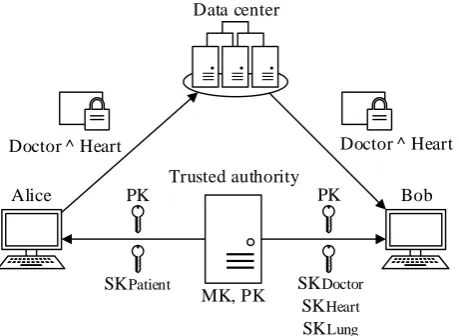
As an example, Alice encrypts a document with the access policyDoctor∧ Heart, indicating that only classified cardiologists are allowed to access the file. Bob’s attributes includeDoctor andHeart, and thus satisfy the access policy. Bob is therefore able to decrypt the ciphertext. The example is visualized in Figure 1.
The attributes are issued to the users by one or more trusted authorities. Each attribute has an associated public and secret key. The public keys are used during encryptions, while the secret keys are used to generate the user keys.
ABE is useful when data is stored in an online environment, like a cloud storage service. Especially in situations where data has to be shared with multiple users based on user roles or data properties, ABE promises to offer fine grained access control while still offering end-to-end encryption. Even when the stored data is out in the open, malicious users are still unable to access the data.
In these situations, ABE also provides less key overhead compared to traditional encryption methods. Traditional encryption methods can pro-vide end-to-end encryption, but for shared data either users share the same decryption keys or the data is stored in multiple instances, encrypted with different keys. Both results are undesirable.
Data center
Alice Bob
SKPatient PK
SKDoctor SKHeart SKLung
PK Doctor ^ Heart
Trusted authority
MK, PK
[image:6.595.182.412.135.303.2]Doctor ^ Heart
Figure 1: Example of ABE. Alice encrypts a document with the access policy
Doctor∧Heart. Because Bob’s attributes satisfy the access policy, he is able to decrypt the ciphertext.
a realistic scenario, users are able to securily exchange data using end-to-end encryption, while the data itself is stored in the cloud. Furthermore, users are able to grant write access to stored data, such that these users are able to securely update already stored data. Moreover, users are able to grant access to other users, while they can also revoke access.
In this paper, we investigate the feasibility of ABE in such a realistic scenario, in the context of an example case developed with Topicus. This example case allows users to securely share data with health care profession-als employed by an insurance company, while employees of the insurance company are unable to access the data.
For this, we propose a construction which enables to satisfy these require-ments of write access control, authentication and access revocation and show that the performance allows for practical use.
Contribution Our contribution comprehends four parts:
• We investigate the requirements which are, in our view, needed for ABE to be applicable in practice, in the context of the healt care data center.
• We combine several solutions in one new approach to create a scheme able to provide end-to-end encryption in a scenario in which the re-quirements of write access control and access revocation are met.
• We run several experiments in order to analyze the performance and scalability in a health care data center scenario in which the require-ments are coped with.
2
Overview on Attribute-Based Encryption
Attribute-Based Encryption (ABE) is a technique in which data is encrypted and decrypted using a set of attributes ω. Attributes are assigned to users, and the secret keys of the users are based on these attributes. A user is only able to decrypt a ciphertext if his assigned attributes fulfil the access policy
γ of the ciphertext.
The access policy is a collection of non-empty subsets of the attributes [5]. In most schemes, the access policy is represented by a tree containing logical operators in the nodes, while the attributes are the leaves in the tree. However, other representations exist.
An access policy γ is satisfied by a set of attributes ω if at least one of the sets in the access policy is a subset of the attributes ω of the user. Using access policies provides a way to incorporate access control in the encryption, as only users who possess enough attributes needed to fulfil the access policy are able to decrypt the ciphertext.
The attributes are issued by an entity called theattribute authority. The attribute authority is trusted to only hand out attributes to users who are eligible.
An important aspect of ABE is collusion prevention: it should not be possible for multiple users to combine their keys in order to gain access to data they did not have access to before. In practice, this is achieved by embedding a random component in the secret keys of a user, which is cancelled out when used in decryption.
2.1 Types of Attribute-Based Encryption
Two types of Based Encryption exist: Key Policy based Based Encryption (KP-ABE) [9] and Ciphertext Policy based Attribute-Based Encryption (CP-ABE) [6]. In KP-ABE, the access policy is associ-ated with the users, while the data is encrypted using a set of descriptive attributes. In CP-ABE, this is the other way around. The data is encrypted using an access policy, while the users possess a set of attributes. In the first case, the access policy determines which data the user is able to decrypt. In the latter case, the access policy associated with the data determines which users are able to decrypt the ciphertext.
2.2 Multiple authorities
In the first ABE schemes, distributing the task of the attribute authority among multiple parties was not possible. This single attribute authority possessed master keys, with which it was able to generate keys for attributes as well as the secret user keys. This introduced the problem ofkey escrow: a single authority is able to generate keys for all attributes, and therefore can access all data. Were the authority to be breached, malicious users could also access all data.
Furthermore, using a single attribute authority often does not fit a real scenario. Consider a scenario where there are multiple parties, for example, a hospital managing its employees and a national database containing reg-istered doctors. Having a single authority would mean there is one party responsible for both roles.
Therefore, most recent researches allow to use multiple authorities. In-stead of one authority, there are multiple authorities which are each respon-sible for a disjoint subset of the attributes. When encrypting data using attributes from multiple attribute authorities, breach of a single attribute authority does not allow malicious users to decrypt the data.
To avoid collusion of user keys, a random element can no longer be applied to the secret keys. Otherwise, the user keys from multiple authorities can not be used simultaneously. To mitigate this problem, a global user identifier is introduced and embedded in the secret keys issued to the users.
2.3 Algorithms
In Multi-Authority Attribute-Based Encryption (MA-ABE), a central au-thority is required to generate global public parameters. These parameters make sure that the keys of the attribute authorities can be used together in the encryption. The central authority is only required in the setup phase.
In general, the schemes consist of the following steps:
Setup The central party generates global public parameters GP. These public parameters ensure that keys from the attribute authorities can be used together, and are required for the setup of the authorities.
Authority setup The attribute authorityAAigenerates public keysP Ki
and secret keys SKi for the attributes ωi this authority is responsible for,
using the global public parametersGP.
Encryption The message M is encrypted using an access policy γ and the public keysP Ki for each attribute authoritesAAi of which at least one
KeyGen The attribute authority AAi creates secret keys U Ku,i for the
set of attributesωu,i managed by this authority and owned by user u∈U.
The secret keysSKiand public keysP Kiof the authority, as well as a global
user identifierGIDu of the user are used in the creation of these keys. The
user identifier is included to avoid collusion of the user keys. It outputs a decryption key U Ku,i.
Decryption The algorithm takes as input the ciphertextCencrypted with access policy γ and, for each attribute authority AAi of which at least one
attribute is used in the policy, the decryption keysU Ku,i of the user and the
public keysP Ki of the attribute authorites. If the attributes ωu used in the
generation ofU Ku(union of allU Ku,ifor useru) satisfy the accesspolicyγ of
the ciphertext, the algorithm is able to decrypt the ciphertext and outputs the message M. If the access policy can not be fulfilled, the algorithm outputs an error symbol⊥.
2.4 Attribute Universe
Another way to categorize ABE schemes is to look to the attribute universe. Most schemes support a small attribute universe, which means that the possible number of attributes is limited, because each attribute requires its own private and public key which have to be initialized during setup.
3
Related work
In this section, related work is analyzed. First, the related work on ABE is investigated, with a focus on schemes supporting multiple authorities. Next, ABE schemes supporting access revocation are explored, after which exist-ing approaches to authentication in ABE are analyzed. Finally, proposed applications using ABE are investigated.
3.1 Multiple Authorities in Attribute-Based Encryption
The Fuzzy Identity-Based Encryption (FIBE) scheme proposed by Sahai et al. [22] can be seen as the predecessor of ABE. In this scheme, a user has a private key for the attribute set ω and is able to decrypt a ciphertext encrypted with the attribute set ω0 only when the two sets overlap with a certain threshold value, thus introducing some fault tolerance.
Chase et al. [8] extend this scheme to support multiple authorities. The scheme only allows to define that the decryptor should possess at least dk
attributes for each authorityk, without specifiying which attributes. As opposed to this limitation, the multi-authority scheme proposed by Lewko et al. [13] supports any boolean access policy and does not require a central authority, except for setup. Authorities do not have to be aware of each other and can generate their own public and private keys, based on some predetermined public parameters. However, users have to reveal their identifier and the scheme does not support a large attribute universe.
Rouselakis et al. [20] improve the scheme of Lewko et al. by proposing a scheme which both supports a large attribute universe and improves the performance. Instead of the authorities having a public and private key for every attribute, each authority has just one public and private key. By using a hash function a random string can be mapped to a group element, which makes it possible to use any attribute.
Each attribute is uniquely linked to an authority by appending the iden-tifier of the authority to each attribute name. This way, different authorities can still issue an attribute with the same id, while the keys are different.
Yang et al. [23] propose data access control for multi-authority cloud storage based on ABE. The scheme allows to partially outsource decryption to the cloud. The server calculates a decryption token using the attribute keys of the user. To make sure that the server is not able to decrypt the ciphertext, a public and private key are issued to each user by the central authority. To avoid the central authority to be able to decrypt ciphertexts, each attribute authority calculates its own keys independently of the other authorities.
ciphertexts. The latter can be used for proxy re-encryption.
Although the scheme has many features, it does not offer a solution to control write access. Furthermore, due to the possiblity to outsource decryption, additional keys are added to the system.
Rao et al. [19] propose a scheme with fast decryption. As opposed to other schemes, the size of the ciphertext is not linear to the number of attributes in the policy, but the number of authorized sets.
In this scheme, the access policy should be expressed in disjuctive nor-mal form, in other words as a single OR gate over multiple AND gates. This makes the scheme somewhat limited, while it still it has the same expres-siveness as any binary tree of other schemes. As a result of this, and the fact that for each authorized set the messages is re-encrypted, the size of the ciphertext can be large.
A temporal attribute based access control scheme is proposed by Yang et al. [24]. Data is encrypted for one or more time periods. Secret keys for attributes are issued only once to each user, and special update keys are published for each timeslot. The scheme is useful when access grants are in most cases limited to a certain time period only.
For each attribute, a binary tree is created in which users are assigned to the leaves. The keys of users are based on the values on the nodes from root to leaf. This allows to efficiently revoke attribute from users by simply only updating the minimum set of nodes covering all non-revoked users. On the other hand, it also increase the amount of keys, and thus the size of storage required.
For each time period, update keys have to be calculated. Furthermore, the number of users who could possess an attribute is limited to the size of the binary tree, which is determined during setup.
All of these schemes offer various features, but none of the schemes pro-vides a complete solution which allows access revocation, write access control and multiple authorities.
3.2 Access revocation
Ibraimi et al. [12] introduce a mediated form of the ABE. In this scheme, the secret keys of the users are split in two parts. A semi-trusted mediator owns the first part of the secret key, while the user owns the second part. Using an Attribute Revocation List, The mediator checks whether attributes are revoked and, if the non-revoked attributes still satisfy the policy, out-puts a new ciphertext which is decrypted (or rather re-encrypted) with the mediator’s part of the secret key.
Yu et al. [25] combine CP-ABE with proxy re-encryption in order to be able to revoke attributes at any time. The access policy is represented by a single and gate, while each attribute can have three occurrences: positive,
updates the public key, generates proxy re-key’s and transmits these to semi-trusted proxy servers. These proxy servers then can re-encrypt existing ciphertexts and update user secret key components if necessary. A version number is used to track the version of the current keys. The proxies keep a list of re-keys, which also makes it possible to aggregate multiple updates. As a result, the proxy is also able to re-encrypt the ciphertext only when this ciphertext is requested.
A drawback of this scheme is that users are required to have a key for every existing attribute, even though they do not possess all attributes. Furthermore, each ciphertext contains a part for every existing attribute.
A disadvantage of both schemes is that they introduce another party which has to be online at all time. Another disadvantage of both schemes is that all chipertexts have to be re-encrypted when an attribute is revoked. For [12], this encryption is required for each decryption. In [25], the re-encryption is required only when attributes are revoked. This leads to a lot of computational overhead. Furthermore, the need to send the updated ciphertexts introduces additional traffic and delay.
Attrapadung et al. [4] introduce a so called Broadcast Attribute-Based Encryption (bABE) scheme. The scheme has a single authority and can be used for both KP-ABE and CP-ABE. The access policy is combined with a user setS ⊆U, whereU is the universe of user identifiers. Users inS have access to the data, given that their attributes satisfy the other part of the access policy. Revocation is possible by settingS=U\R, whereRcontains the identifiers of users whose access is revoked
However, as the policy is updated when a user is revoked, there is need to re-encrypt the data for which the user is revoked. Furthermore, the identity of each user has to be known.
Although the scheme does not support multiple authorities, it is possible to construct a disjunctive multi-authority ABE from the scheme at the cost of removing the revocation from the scheme. Moreover, this requires that the underlying schemes supports access delegation.
In all these schemes, re-encryption is required on revocation. Existing schemes attempt to move this re-encryption to the cloud, by introducing an additional mediator or proxy which should be online at all times. The mentioned bABE scheme is not sufficient either, as it does not support multiple authorities.
3.3 Authentication
A user first has to obtain a token from a trusted party. Using this token, he is able to request keys for encryption, decryption and signing from the authorities. Replay attacks are prevented by adding a timestamp to the token. This also makes sure that a revoked user is unable to create or update data when his access is revoked.
However, revocation other than simply no longer issuing this timed keys is not possible. This means that the possibility to authenticate can be revoked in some sense, but not the ability to decrypt data. Furthermore, the scheme is not implemented, so a practical application of the scheme is not tested.
Li et al [14] propose a scheme which uses signatures with a time period embedded to authenticate a user in order to control write access. Only within these time periods, the user is allowed to update the data. The signatures are provided by the user’s organization or the data owner.
Although the data owner does not always has to be online, he still has to know in advance when the other should have write access, and should come online periodically to re-grant access. Moreover, the data owner has to know exactly who has write access, while for read access a description using attributes is sufficient. Revocation of write access is only possible by simply not providing signatures any longer.
So although both approaches introduce authentication, both schemes also have their own drawbacks. Existing techniques using attributes for authentication lack the support for revocation, and are not tested in a prac-tical application. Other approaches require the need to know the identities of users.
3.4 Applications of Attribute-Based Encryption
Proposed applications of ABE often involve Electronic Health Record (EHR) systems. This section discusses related work performed in this area, where the focus is on techniques applying ABE.
Akenyele et al. [1] propose an EHR system using dual ABE, a combina-tion of CP-ABE and KP-ABE. They present a policy engine which proposes access policies, based on the author and the content of the record.
However, a single attribute authority is used, which is kept offline to nar-row the attack model. Furthermore, they do not discuss how write access control is managed, even though the data records are created in a hierarchi-cal structure.
EHR systems using ABE are also proposed in [3] and [18]. However, both constructions use a single attribute authority. In [3], an implemen-tation is analyzed, but no details about the used ABE schemes are given. Furthermore, the experiments are only repeated several times.
EHR with keyword search Narayan et al. [16] construct an EHR sys-tem which uses bABE to guarantee confidentiality and privacy, while allow-ing to revoke access of users. This allows patients to share health data with health care providers. However, a single trusted authority is used.
Additionally, a primitive calledSecure Channel Free Public-Key Encryp-tion with Keyword Search is used to enable a keyword search over the en-crypted data, without revealing information about the used keyword itself. In this scheme, the health care providers manage the keys and attributes. After each session, all data on the client is deleted to prevent adversaries to retrieve data.
In the scheme, the patient is the only entity able to update the data or the policy. Furthermore, the given scheme is only proposed and not implemented, so the efficiency of the scheme is questionable.
Multiple domains Some proposed applications divide the system in two security domains, the professional domain and the personal domain. The first consists of users who access the data for professional use, such as doc-tors and medical researchers, while the second consists of users personally associated with the EHR owner, such as family and close friends. Examples of these are [11] and [14].
In [11] by Ibraimi et al., a single trusted authority is used for the pro-fessional domain and the attributes describe the characteristics of the users. For the personal domain each patient has his own trusted authority, while the attributes categorize the data. The scheme lacks support for access revocation.
Because of the use of a single trusted authority, the scheme is unable to cope with the key escrow problem. Furthermore, the use of two domains require each user to describe the data in two ways.
In [14] of Li et al., multiple authorities are applied in the professional domain. Attributes describe the roles of users and are divided in types which are divided among multiple authorities. To avoid key escrow, each access policy has to contain at least one attribute of each type, while wildcards are allowed. In emergency situations, temporarily read keys can be granted by the emergency department.
In the personal domain, KP-ABE is applied. The attributes are based on intrinsic properties of the records, while keys are managed and distributed by the user himself. Proxy re-encryption is applied to make attribute revocation possible. Moreover, the scheme employs write access control using signatures issued by data owners or organizations, as described earlier in Section 3.3
As with the other scheme, the user has to describe the data in two ways: one time by describing which roles the users should have, and one time to describe the properties of the data.
4
Research goal
ABE is investigated in many researches, but existing solutions lack several features which are, in our view, required for ABE to be practically feasible in most applications. There are several open problems, which should be coped with before ABE can be used in such an application.
The first open problem involves write access control. In most realistic scenarios, data should also be updatable. However, current research mainly focusses on the control of read access. Additional measures are required to enable secure control of write access.
Write access requires validation of the rights of the updating user. This means that there should be some way to tell which users are allowed to update the data, as well as a means to validate this. Likewise, such validation is required for updates of the access policy.
Another problem is the problem of access revocation. Several different approaches are proposed, but each approach comes at a cost. Determining which approach is best suited to enable access revocation is a problem which depends on the application and the requirements. This should be considered carefully.
We now state the goal of this research. Next, several topics of interest are investigated in more detail.
The goal of this paper is to investigate the feasibility and per-formance of ABE in a realistic scenario in which several actors securely exchange data, on a relatively small scale.
4.1 Topics of interest
Realistic scenario In a realistic scenario, users want to securely share data with other users. Securely here means that the data is encrypted using end-to-end encryption. In a realistic scenario, users should not only be able to read data, but also update this data while other users with access rights can still access the updated data. Furthermore, users should be able to control who has rights to access the data. Access revocation should also be possible.
Feasibility ABE is considered feasible in the realistic scenario, when the scheme allows to securely perform all the required actions (data update, pol-icy update and access revocation), while the performance is still acceptable. To enable this, several requirements should be met.
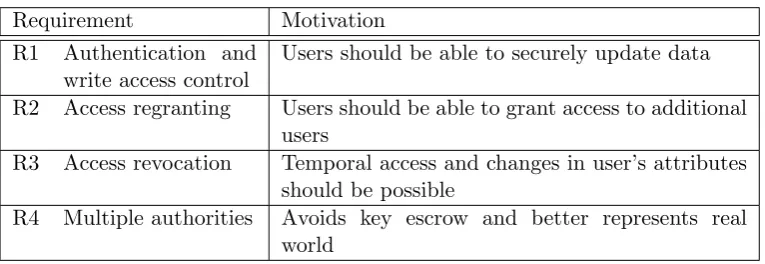
Secondly, it should be possible to grant access to other users when data is already shared with several users, in a secure manner (R2). This can be achieved by an update of the policy. However, the owner of the data should be the only entity allowed to update the access policy.
The third requirement (R3) is thataccess revocation should be possible. This is an important aspect in the application of ABE, as it both enables temporal access and the possibility to revoke attribute of users in case of job resignation or leaked credentials. Moreover, the robustness of the system is improved, and it allows to respond to breaches.
Furthermore, we require that in a feasible application multiple authori-ties are used (R4). Having only a single authority introduces the so called
key escrow problem: the single authority has a master key, and is therefore able to generate keys for all attributes. Were the authority to be breached, malicious users could access all data.
By using multiple authorities, this problem can be mitigated by enforcing policies to contain attributes from multiple authorities. No single author-ity has a master key for all attributes, and data can be encrypted using attributes from multiple authorities. This way, all authorities should be breached before any data can be accessed.
The last requirement is therefore that the application should utilize mul-tiple authorities.
None of the currently proposed constructions using ABE both meets al these requirements and is tested on feasibility and performance in a realistic scenario.
[image:18.595.118.501.511.643.2]The requirements for a feasible application of ABE are summarized in Table 1.
Table 1: Requirements for an application of ABE to be feasible.
Requirement Motivation
R1 Authentication and write access control
Users should be able to securely update data
R2 Access regranting Users should be able to grant access to additional users
R3 Access revocation Temporal access and changes in user’s attributes should be possible
R4 Multiple authorities Avoids key escrow and better represents real world
We aim attention at the performance and resource usage of the schemes. The main goal is to provide insight into the current performance of the most suitable ABE schemes, and compare them. We aim to give insight in whether the performance is acceptable, although this can change in the long term and it being acceptable highly depends on the type of application. Using this, we can also see where there is room for improvement, for example because a certain operation requires much time. Moreover, we can state which schemes are preferred.
Scale We test our goal using an example case in which the stated require-ments are present. Furthermore, the effect of other inputs on the perfor-mance is investigated, to see how well the schemes scale. For example, the influence of the number of attributes or the size of the policy on durations and storage is investigated.
The example case itself is on a relative small scale. In this case, a user is enabled to securely share data with health care professionals acquired by an insurance company. The professionals act as reviewers, which have temporal access to the data shared by users in order to judge the medical need of a surgery.
5
Write access and authentication
In this section, the problem of authentication and write access control is investigated. Authentication means that the claimed identity of a user is verified. Write access control means that the rights to write access, for instance to update some data, can be controlled and verified. In an attribute-based scenario, users are not identified by a user identifier, but attributes are used instead.
We assume that the write access is enforced with a write policy. This write policy determines whether a user is allowed to update the data; Only when the user has enough attributes to satisfy the write policy, he is allowed to update the data. The access policy can therefore be separated in two access policies: theread policy and thewrite policy.
To enable write access control, the updating user should prove that he owns enough attribute to satisfy the write policy. This authentication is therefore required to enable write access control.
Firstly, traditional access control mechanisms are discussed, as well as why these are not sufficient for an attribute based scenario. Next, alternative approaches are discussed. The focus is on signatures schemes, as these provide bothauthenticity andintegrity. Authenticity means that the origin of a message can be verified, while integrity concerns the verification that a message is unchanged.
5.1 Traditional access control
In a traditional server-client scenario, the client proves his identity by pre-senting credentials like a password, key or uniquely generated code to the server. The server has a great responsibility, as it has to validate these cre-dentials and, if valid, enable the user to perform certain actions like accessing or updating data. Both the authentication (validating the user’s identity) and authorization (determining the access of the user) are performed by the server, so much trust in the server is required.
However, an advantage of ABE is that it allows to provide security in cases where the server is trusted as little as possible. It is preferable that for the control of write access, the required trust in the server is also limited as much as possible. Therefore, the server should perform as few checks as possible. Traditional access control approaches are thus not sufficient for our case.
5.2 Signatures
Message Authentication Code (MAC) is computed based on this hash and the secret key.
The receiver can validate the signature by using the corresponding public key to retrieve the hash from the signature and comparing this hash to the calculated hash of the message. If the hashes are equal, the receiver can be sure that the signature was created by a user having the private key.
5.3 Private key with write policy
In order to apply such a signature to prove that the signing user possesses enough attributes to satisfy the write policy, the private key can be en-crypted using ABE with the write policy. When a data record is created, the creator of the data record generates a random public and private key, and signs the record using the private key. The public key is added to the data record in plain text, while the private key is encrypted using ABE with the write policy and added to the data record.
When a user wants to update the data, he first encrypts the new data. He then decrypts the encrypted secret key for the signature using his attributes satisfying the write policy, and signs the data using the obtained secret key. The updated encrypted data and the signature are sent to the storage server. The receiver validates the update by verifying the signature using the updated data and the already stored public key. If the check is successful, the receiver knows the data is signed with the private key corresponding to the public key, which can only be accessed by users with enough attributes to satisfy the write policy. Thus, the data is updated by a user with sufficient rights.
5.4 Attribute-Based Signature
Another approach is using the attributes directly to create a signature. This so called Attribute-Based Signatures (ABS) [15] is a relatively new technique which enables a user to sign a message using a subset of the attributes he owns. The signature assures that the message is sent by a user whose attributes satisfy a certain predicate.
An important property of ABS is anonymity [15]. This means that the signature does not reveal the identity of the user, or the way in which the signature was created. It only shows to the verifier that the user’s attributes satisfy the predicate, and nothing more.
Equal to ABE, collusion prevention is an important requirement of ABS. Users should not be able to create signatures they could not create individ-ually by colluding their keys.
The main advantage of using ABS in a health care application is that it allows authentication of users without the need to store and validate the identity of individual users. The latter is, for instance, needed in public key signatures, where for each user the public key has to be known.
Another advantage is that it overlaps with ABE, and can use the same architecture or even the same attributes, as long as both schemes allow this. Also, users can be authenticated based on the capabilities they possess. As the attributes already need to be distributed to the users for the encryption, ABS can be combined with ABE.
5.5 Conclusion
6
Access revocation
Revocation of access is an important aspect of the application. Access revo-cation allows to enable temporal access, as well as the possibility to revoke users in case of leaked credentials or changes in job status. This improves the security of the system, and allows to respond to breaches.
Within the ABE landscape, there exist several approaches to access re-vocation. These approaches are described first, after which the selected approaches for our example case are discussed.
6.1 Attribute revocation
In the first approach, attributes are revoked from users, by removing an attribute from the set of attributes assigned to a user. As these attributes are issued in the form of secret keys, the revocation of attributes comes down to updating the secret keys of users.
Attribute revocation is needed when the access rights of a specific user, or a group of users, should be updated. Attribute revocation can be realized by re-creating the keys for the attribute to be revoked. Only the users who still possess this attribute receive the new secret key, while the users for whom the attribute is revoked do not receive an updated key.
Attribute revocation can be separated in two categories,direct and indi-rect revocation. Direct revocation means that a revocation has immediate effect. From the moment the revocation is applied, the user does not have access anymore to the involved records. Inindirect revocation, on the other hand, it can take some time before the revocation has effect.
It should be clear thatdirect revocation is the preferred approach. Direct
revocation, however, has some drawbacks. It is hard or impossible to enforce a key update for every user. Malicious users could simply not update their keys, after which they would still be able to access the data, despite the fact that they do not have sufficient attributes. Thus, re-encryption of the data is required to ensure that only the updated attribute keys can be used.
6.1.1 Indirect attribute revocation
In theindirect approach, revocation is realized by embedding a time period in the secret keys of users. Only in the embedded time period, the secret key can be used to decrypt the ciphertext. This enforces the user keys to be updated regularly. Attribute revocation is realized when the secret key for an attribute is no longer issued to the user.
as there are many keys which should be updated at the same time when a time period has ended. Furthermore, depending on the granularity of the time periods the amount of keys increases, as each time period requires new keys which need to be calculated and distributed.
Some schemes support the encryption of a message for multiple time periods. However, when data should be accessible for many multiple con-secutive time periods, at some point re-encryption is still needed.
The indirect approach is used, among others, in [6], [7] and TAAC [24]. Although not all ABE schemes support indirect attribute revocation, it can easily be added by appending a time period to each attribute.
6.1.2 Direct attribute revocation
As opposed to theindirect approach, in a direct approach the access revo-cation has immediate effect. Direct revorevo-cation can always be realized by updating attribute keys, re-encrypting all ciphertexts using these keys and only sending the updated keys to non-revoked users. However, this is not really efficient. Moreover, re-encryption requires decryption of the cipher-text, and thus can not be performed by servers if end-to-end decryption is desired.
To avoid the need for re-encryption on the client side, other approaches have been designed. In these approaches, the user’s secret keys are split in two parts. The user receives the first part, while the second part is stored by a third party, called a proxy or a mediator. Only the combination of both parts enables to decrypt the ciphertext.
The third party, let us call it the mediator maintains a revocation list. Each time a user wants to decrypt a ciphertext, he has to contact this mediator. The mediator executes part of the decryption by using its share of the secret key, as long as the user is not on the revocation list. The user can complete the decryption with his share of the secret keys.
An attribute can be revoked by adding the user to the revocation list of the attribute. An example of a scheme using this approach is [12].
In a slightly different approach, upon revocation new keys for the at-tributes are generated, and encryption keys are calculated. These re-encryption keys are used to update the ciphertexts to the new keys. The re-encryption key does not reveal any information about the secret keys. As the mediator acts as a proxy between the storage server and the user, this is also calledproxy re-encryption.
A scheme which utilizes proxy re-encryption is [25].
6.2 User revocation
In another approach, the access of a single user can be revoked per data record. This is achieved by adding the identifiers of non revoked users to the access policy of a data record. When a user’s access is revoked, the identity of the user is removed from the access policy. This type of encryption is called Broadcast Attribute-Based Encryption (bABE) [4].
An advantage of this approach is that the access of single users can be revoked. However, to accomplish this the revoking party should know the identities of the users. Furthermore, re-encryption is required when the policy is updated.
6.3 Policy update
An update of the policy allows to change which users have access to a certain data record. This means that, if updating the policy is possible, either the access policy can be loosened allowing more users to access the data, or be made stricter, allowing less users to access the data.
Updating the access policy is the most convenient solution when the access to a single data record should be revoked for a group of users.
An update of the access policy always has an immediate effect. From the moment the policy is updated, involved users no longer have access. They can, however, still access the ’old’ data record using their old keys. Furthermore, being able to update the policy also allows to grant access to other users.
When the new policy is more restrictive than the old one was, the data itself has to be re-encrypted. Otherwise, users who had access under the old policy could still access the decryption key and decrypt the data. In cases when new access is granted however, re-encryption is not required.
6.4 Selected approach
The main problem in all the approaches is that, to be really secure, re-encryption is required after access is revoked to ensure that users who had access before revocation no longer have access after the revocation. Only the indirect approach really avoids this problem, at the cost of restricting encryption to predetermined time periods.
However, in our example case, most data access is only temporal. Direct revocation gives much overhead, as it introduces a third party which should be online at all time to partially decrypt data. We want to avoid introducing such additional parties.
policy allows to revoke access from a single data record, which is needed for most cases where access should be revoked. Furthermore, to enable sharing the data with more users it should be possible to extend the access policy. Both use cases can be performed when it is possible to update the access policy.
6.5 Ownership proof
There is one consideration left. We assume that only the owner of a data record is allowed to update the access policies of this data record. In order to check whether it indeed was the owner who updated the access policy, the owner has to prove his identity. However, we do not want to introduce unique user identifiers or a public key dictionary for all possible data owners. This would both increase the needed storage space as well as decrease the anonymity of the individual users.
Another approach to prove ownership is to introduce a unique attribute for each possible data owner. An update of the policy then has to be signed with this attribute, while the read and write policy have to be converted to always allow the owner access. However, this approach increases the amount of attributes dramatically. Furthermore, this would enable the authority responsible for the owner attributes to update all data.
Instead, we propose an approach in which each owner has one or more public and private key-pairs. On creation of a new data record, one of the public keys is added to the data record to indicate ownership. This removes the need for verifiers to know the public keys of all users.
When the access policy is updated, the data owner signs the new policies using the same public-private key pair. The receiver verifies the update by checking whether the new policies are indeed signed using the private key belonging to the already stored public key.
Whether the data owner uses a new or an existing key depends on the desires of the data owner. Decreasing the storage costs by reusing keys is at the cost of decreased anonymity and unlinkability of data records, and vice versa.
7
Example case
To investigate the practical feasibility of the proposed construction, we de-veloped an example case of a practical situation involving a health care application, in cooperation with Topicus. In this example case, users are able to securely share data with certain employees of an insurance company, in particular with health care professionals acting as reviewers for the insur-ance company. These reviewers judge the medical need for certain surgeries based on data presented by the patient, and thereby determine whether the surgery is covered by the insurance of this patient.
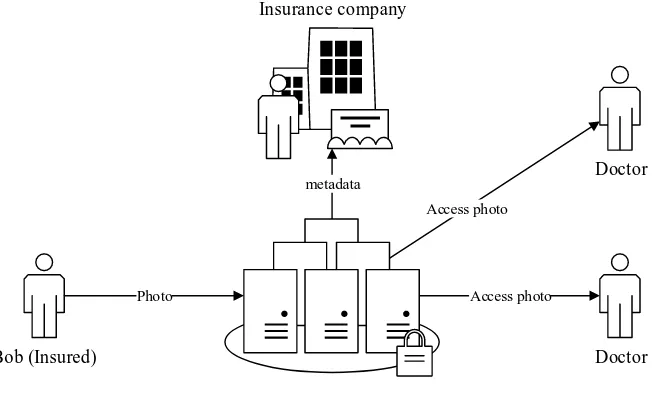
To further illustrate the example case, we give a use case which illus-trates different actions and requirements in this example case. A graphical representation can be found in Figure 2.
Bob wants to undergo surgery for correcting his eyelids. The insurance company only reimburses such a cosmetic surgery when there is a medical need. To qualify for a compensation, Bob has to send a picture of his face to his insurance for approval of the operation. Bob sends his picture, but allows only the reviewers of the picture to access the image. The picture is encrypted to make sure nobody else has access to it, and Bob sends it to the insurance company.
Insurance company
Bob (Insured) Doctor
Photo
metadata
Access photo
Doctor
Access photo
[image:27.595.132.458.434.633.2]Health care system
The staff of the insurance company does not judge the picture, but out-sources this task to a doctor. The employee of the insurance company only needs access to the meta data of the picture: he is allowed to know that there is a picture and where he can find it, but he is not allowed to view the picture himself.
The employee shares the picture with a doctor. The doctor then is able to decrypt the picture and take a look at it. The doctor gives an advise, and the insurance company processes this advice. Afterwards, the access of the doctor to this picture is revoked.
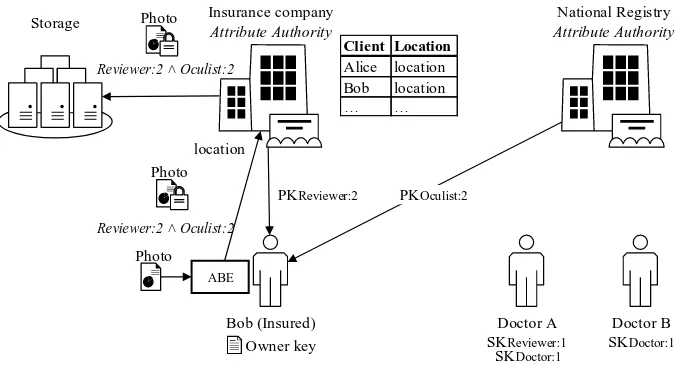
As the request of Bob is rejected because of a negative advise from the doctor, he requests a second opinion. A second doctor is allowed to access the picture, and he also gives an advice. The advice is processed by the insurance company, and the permissions on the photo are revoked again. At this moment, none of the doctors has access to the picture.
However, the possibility exists that the insurance company gets another request to make the data available for a other purposes. Thus, on a later moment it should be possible to grant permissions for data access to other parties.
8
Selected Attribute-Based Encryption schemes
In this section, existing ABE schemes are analyzed, in order to find schemes which can be feasible in our construction. At first, requirements for the schemes are described. Based on this, a comparison is given and possibly feasible schemes are selected.
8.1 Requirements for schemes
Our first requirement (RABE1) is that the scheme should be a CP-ABE
scheme. This approach, where data is encrypted under access policies and attributes are assigned to users, is more suited to the use case than KP-ABE. In the example case, users have certain roles based on their profession. CP-ABE allows to express these roles in the form of attributes. Moreover, it allows users to be more expressive about the access to the data. Instead of categorize the data using attributes, the access is granted based on the roles of the users.
A second requirement (RABE2) for an ABE scheme to be feasible, is
that the scheme should support multiple authorities. This is a requirement, as a single authority suffers the problem of key escrow, which can be miti-gated by the use of multiple authorities. Moreover, in most cases, including our example case, the real world can be represented better using multiple authorities.
Furthermore, we compare the schemes on a couple of additional features, which are not strictly required for our example case. These weak require-ments make the scheme more suitable for our use case and could be relevant in other cases.
The first of these features is the support for a large attribute universe (WABE1). The introduction of time periods attached to attributes greatly
increases the number of attributes in the system, and support for a large attribute universe could result in a decrease of attribute key size.
Another weak requirement is the possibility to efficiently revoke at-tributes. In our construction, access revocation is enabled by applying timed attributes and policy updates, so support for other revocation approaches are not strictly required. However, being able to directly revoke (WABE2)
attribute greatly improves the security and robustness of the system. Fur-thermore, support for indirect revocation is not strictly required (WABE3)
as it can be added to every scheme, although native support for time periods could have a positive impact on the performance.
The last weak requirement (WABE4) is the support of re-encryption
Re-encryption of a ciphertext does no longer have to be performed by the client, but can be outsources to a proxy server.
8.2 Comparison of schemes
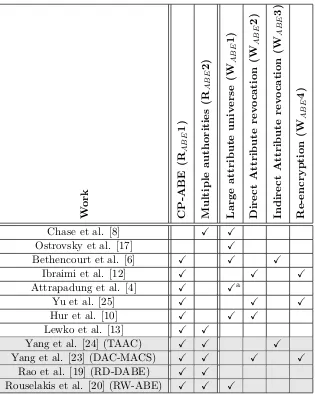
We compared several existing ABE schemes on how they fulfil the stated requirements. The result is given in Table 2 on page 30.
In the table, each column contains a requirement or feature, and the cells indicate whether a scheme supports the given aspect. A checkmark
Xmeans that the scheme on that row supports the aspect. When a cell is empty, the scheme does not support that aspect. If there are different types of the given aspect, the cell contains a description of the type supported by the scheme instead of a checkmark.
As can be seen in the table, there are several ABE schemes which satisfy all our requirements. On the other hand, has not yet been published an ABE scheme which satisfies all the stated features, including weak requirements, at the same time. Each scheme supports different aspects, and each scheme has its own advantages and disadvantages.
Two of the schemes, [10] and [24], utilize binary trees to manage ad-ditional keys for each attribute. Using this, attributes can efficiently be revoked from users, at the cost of additional storage requirements. Users are assigned to leaves, and the path from root to leaf define the user’s key.
Much of the schemes ([17], [6], [12], [25], [10]) are not suited for our use case, as they do not support multiple attribute authorities. Furthermore, [4] does not support multiple authorities by default. Multiple authorities are only supported by using access delegation, which means that there also should be a central authority to ’delegate’ access to the authorities, so the authorities can delegate the access again to the users. This central authority possesses a master key, which grants him access to every encrypted file, thus the scheme is not suited for our case.
Only two of the investigated MA-ABE schemes support a large attribute universe. However, the scheme of [8] is not sufficient, as this scheme requires a fixed amount of attributes from each authority in each access policy, and only supports the of operator with a fixed threshold. Furthermore, this scheme is not strictly a CP-ABE scheme, as a set of attributes is related to both the user keys and ciphertext a set of attributes. This only leaves [20] when a large attribute universe is required.
When we focus on attribute revocation, the scheme by Yang et al. [23] is the most favorable candidate. This scheme does not only support multiple authorities and direct attribute revocation, but also has the possibility to outsource decryption and re-encryption.
Table 2: Comparison of existing ABE schemes. A gray background marks the selected schemes
W ork CP-ABE (R AB E 1) Multiple authoriti es (R AB E 2) Large attribute univ erse (W AB E 1) Direct A t tribute rev o cation (W AB E 2) Indirect A ttribute rev o cation (W AB E 3) Re-encryption (W AB E 4)
Chase et al. [8] X X
Ostrovsky et al. [17] X
Bethencourt et al. [6] X X X
Ibraimi et al. [12] X X X
Attrapadung et al. [4] X Xa
Yu et al. [25] X X X
Hur et al. [10] X X X
Lewko et al. [13] X X
Yang et al. [24] (TAAC) X X X
Yang et al. [23] (DAC-MACS) X X X X
Rao et al. [19] (RD-DABE) X X
Rouselakis et al. [20] (RW-ABE) X X X
a Although there is support for a large attribute universe, this
scheme requires more storage for these update keys and the used binary trees, the scheme is potential beneficial for our use case since it was created with timed attributes at its base.
Although the scheme of Roa et al. [19] does not offer a large attribute universe or support for attribute revocation, it promises to offer fast decryp-tion. Compared to the other schemes, this could be so much more efficient that it may outweigh the benefits of supporting a large attribute universe or having native attribute revocation.
Finally, the scheme of Lewko et al. [13] is a CP-ABE scheme with support for multiple authorities. However, the scheme by Rouselakis et al. [20] scheme is an improvement of this scheme. Furthermore, it does not provide any more advantages compared to the other multiple authority schemes.
9
Construction
We now describe our proposed construction. The construction consists of several steps, which will be described first. Next, some practical consider-ations are discussed, and we analyze how the proposed construction allows to meet the requirements. Finally, the application of the construction in the example case is described.
9.1 Steps
setup In the setup phase, a central authority determines the global pa-rameters. These are required to allow to use the attributes of multiple authorities in the same encryption.
authsetup In the authsetup step, the different authorities generate the public and private keys for the attributes they are responsible for.
register For the DAC-MACS scheme, it is required for each user to reg-ister itself to the central authority, in order to receive special keys. In the
register step, this registration is performed. In the other schemes, this step is skipped.
keygen In this step, the secret keys of attributes are issued to the users who are eligible. Determining which attributes should be issued to the users is something we assume is performed outside the scheme. The keys are representations of the roles of the users, and are linked to a time period.
update keys For the TAAC scheme, next to the secret keys of the user, special update keys are required. These update keys are linked to a time period, and are updated every time period for the non-revoked users. In theupdate keys step, these update keys are generated and published to the users.
In the other schemes, this step is skipped.
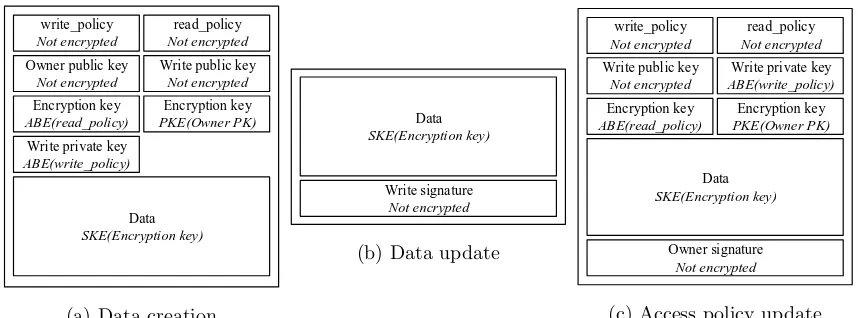
encrypt In theencryptstep, a user encrypts a file using a read policy and a write policy. The user fetches the public keys representing these policies. For efficiency, the data is encrypted using a symmetric key encryption scheme. Any symmetric key encryption scheme can be used here.
The key used in the encryption is encrypted both using ABE with the read policy and the public key of the owner. This way, both rightful users and the owner have access to the data. The public key of the owner is added to the data record to facilitate owner proof.
write_policy Not encrypted read_policy Not encrypted Encryption key ABE(read_policy) Data SKE(Encryption key) Owner public key
Not encrypted
Encryption key PKE(Owner PK) Write public key Not encrypted
Write private key ABE(write_policy)
(a) Data creation
Data SKE(Encryption key)
Write signature Not encrypted
(b) Data update
write_policy Not encrypted read_policy Not encrypted Encryption key ABE(read_policy) Data SKE(Encryption key) Encryption key PKE(Owner PK) Write public key
Not encrypted
Write private key ABE(write_policy)
Owner signature Not encrypted
[image:34.595.83.512.127.286.2](c) Access policy update
Figure 3: Layout of a transferred data record for different steps in the construction. The second line in each block indicates whether the data in the block is encrypted, and which encryption technique is applied.
public key is added in plain text to the data record, while the private key is encrypted using ABE with the write policy.
The content of the data record sent to the server can be found in Fig-ure 3a. This record is sent to the storage provider, in our case the insurance company. The storage provider is responsible for the management of the data storage, and returns a location pointer of the created data. Further-more, the location pointer is sent to uses with whom the data is shared.
decrypt When a user wants to access a file, he requests the data record from the storage provider by sending the location of the file to the data service. The provider responds with the data record.
After the file is fetched, he can use the required attributes in his secret key to decrypt the ciphertext, as long as his attributes satisfy the read policy. If the user does not possess enough attributes to satisfy this policy, the decryption algorithm outputs an error.
data update An update of the data can only be performed by a user having enough attributes to satisfy the write policy. As the policies are not changed, none of the encryption keys has to be updated.
Upon receiving, the storage provider validates the signature over the updated data by using the already stored public write key. If the signature is valid, the encrypted data is updated. Otherwise, the server rejects the request and keeps the data record unchanged.
policy update The policy update step provides the ability for the data owner to update the access policies of a data record. The user re-encrypts the data under the new policy. Re-encryption is required to make sure that users whose access is revoked do not have access to data updates after revocation. In our construction, the data is always re-encrypted, although this is not required when the policy does not restrict access.
A user can prove that he is allowed to update the policy by signing th policies using the private key belonging to the public key in the original data record. The contents of a policy update record are shown in Figure 3c.
The receiver verifies the signature with the already stored public key of the owner, and only accepts the update when the policy is correctly signed.
9.2 Practical considerations
After creating a new data record, this data data record is sent to the storage provider, in our case the insurance company. The storage provider can perform additional checks to validate whether the user is allowed to create data, but this is outside the scope of this project.
A problem in the aforementioned system is that for the different parties to contact each other, the locations of the parties should be known. The service of the insurance company is available at some fixed location, but the users do not know how to reach the attribute authorities and vice versa. However, for the key distribution, communication between the authorities and the users is required.
In our approach, we simply assume that the users know the locations of the different authorities, and that these locations are valid. How the users know these locations and how this is verified, is outside the scope of this project.
Although we want to limit the required trust in the services as much as possible, each user still has to have a certain amount of trust in the different services.
Each user has to trust the attribute authorities to only hand out at-tributes to eligible users. However, a corrupt authority does not necessarily mean that an attacker can decrypt the ciphertext.
The storage provider is assumed to try to gather as much information as possible, but still behaves as intended.
9.3 Meeting requirements
The construction described in this section meets the requirements to allow a feasible application of ABE, as stated in section 4 and summarized in Table 1. In this section, we described the problem and stated several re-quirements which should be met before an application of ABE is, in our view, considered feasible.
The first requirement (R1) is that users should be able to securly update data and control write access. This is achieved by introducing the data update step, as well as adding special write keys to the data record in order to allow write access control.
In the second requirement (R2), it is stated that the data owner should be able to update the policies over the data in order to allow other users access to the data. The third requirement (R3) states that it should be possible to revoke access.
The policy update step allows to grant more access or revoke access for a single data record. Furthermore, the use of timed attributes aids in the access revocation.
In the final requirement (R4), multiple authorities are required to avoid key escrow and to better fit the real world. This is achieved by only selecting ABE schemes which support multiple authorities.
9.4 Application in example case
We now describe how this construction can be applied in the example case as described in section 7. In the example case, patients are enabled to securely share data with health care professionals acting as reviewers for an insurance company.
Figure 4 visualizes the task of attribute authorities in the setup phase. The authorities generate keys for the different attributes for a certain time period. The public keys are stored and made publicly available. Two at-tribute authorities, an insurance company and a national registry, hand out keys to two doctors. The insurance company has employed one of the doc-tors as reviewer, and issues a key indicating this role to this doctor.
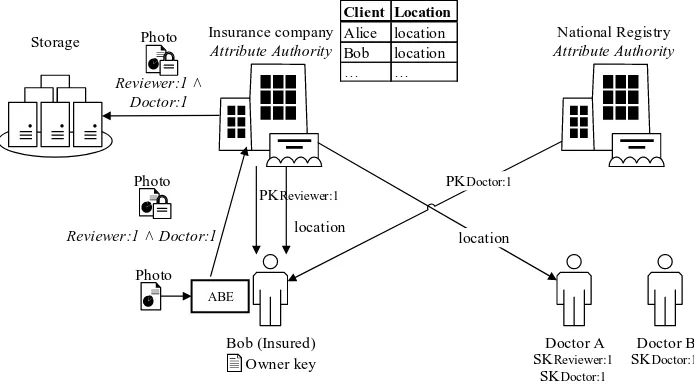
In Figure 5, Bob wants to send his photo to the insurance company. He encrypts the photo under the read policyReviewer∧Doctorfor time period 1 using the public keys from the attribute authorities.
SKDoctor:1 SKDoctor:1 PKReviewer:1
PKAdministration:1 ...
PKDoctor:1 PKRadiologist:1 ...
Insurance company Attribute Authority
Bob (Insured) Doctor A
National registry Attribute Authority Storage
[image:37.595.132.476.159.310.2]Doctor B SKReviewer:1
Figure 4: In the setup phase, timed attribute keys are generated by attribute authorities. Public keys are published, while secret keys are issued to eligible users.
Insurance company
Attribute Authority
Bob (Insured) Doctor A
National Registry
Attribute Authority
Client Location
Alice location Bob location
… …
Storage
Photo
Reviewer:1 ˄ Doctor:1
Doctor B location
SKReviewer:1 SKDoctor:1 SKDoctor:1
Photo ABE
PKReviewer:1 Photo
Reviewer:1 ˄ Doctor:1
PKDoctor:1
location
Owner key
Figure 5: Bob encrypts his photo using the access policyReviewer∧Doctor
[image:37.595.122.469.430.624.2]location Insurance company
Attribute Authority
Bob (Insured) Doctor A
National Registry
Attribute Authority
Client Location
Alice location Bob location
… …
Storage
Photo
Reviewer:1 ˄ Doctor:1
Doctor B Photo
ABE Photo
Reviewer:1 ˄ Doctor:1
location
SKReviewer:1 SKDoctor:1 SKDoctor:1
[image:38.595.122.471.129.323.2]Owner key
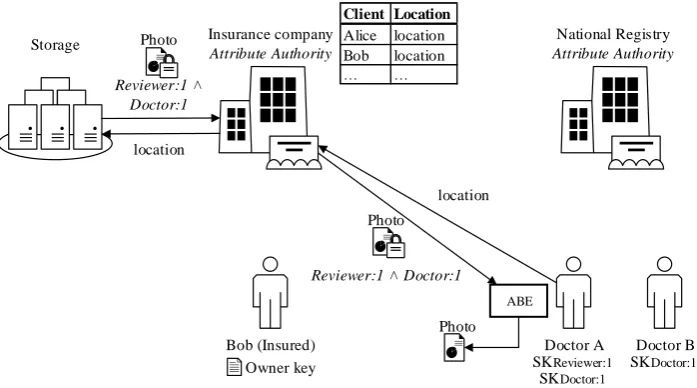
Figure 6: The doctor requests the ciphertext from the storage server and decrypts it using his secret keys.
location. Furthermore, the insurance company notifies a doctor that there is a picture to be reviewed, and sends the location of the file to the doctor. Figure 6 visualizes the reviewing doctor requesting the photo from the storage server. The doctor decrypts the ciphertext using his attributes. His access is automatically revoked when the time period has elapsed.
Insurance company
Attribute Authority
Bob (Insured) location
Doctor A
National Registry
Attribute Authority
Client Location
Alice location Bob location
… …
Storage
Photo
Reviewer:2 ˄ Oculist:2
Doctor B Photo
ABE
PKOculist:2 Photo
Reviewer:2 ˄ Oculist:2
SKReviewer:1 SKDoctor:1 SKDoctor:1
[image:39.595.122.463.297.482.2]Owner key PKReviewer:2
10
Implementation
We provide an implementation of the construction1, as well as implementa-tions for two of the compared ABE schemes. Furthermore, we improved the implementations of the two other schemes.
In the construction the different entities like users, attribute authorities and storage providers are modelled. The network connections between the parties are modelled as well, to enable measurements on the data exchanged between the parties.
All details related to a specific encryption schemes are wrapped in com-mon interfaces to make them interchangeable. This way, when a different ABE scheme is used, as much of the implementation as possible remains equal, offering the best possible base for comparison. Furthermore, the used symmetric key and public key encryption schemes can easily be changed.
Next to the implementation of the construction, a framework for per-forming the experiments is created. The framework allows to specify a certain scenario and test case, which can be simulated an arbitrary amount of times. In each repetition the performance is monitored in separate runs, where in each run only one variable is measured. This way, possible in-fluence of one measurement on the other is avoided. The output of the measurements are automatically written to several files.
10.1 Used techniques
For the implementation of both the construction and the ABE schemes, the Charm framework [2] is used. This framework is based on the Python language and targeted at rapid prototyping of advanced cryptosystems. In-ternally, native C modules and existing libraries are used for the intensive mathematical operations. The framework has been used for many imple-mentations of state of the art ABE schemes.
The construction itself is also implemented in the Python language. For the symmetric encryption of the data, AES is used with a key size of 256 bits. The public key encryption scheme used for the signature is RSA with a key size of 1024 bits, the recommended minimum size. Different elliptic curves can be used in the ABE schemes. The Charm framework offers various curves, of which we use the SS512 curve in the experiments. This is a super-singular symmetric curve with a base field of 512 bits.
10.2 ABE implementations
As the Charm framework has been used for many implementations of state of the art schemes, there is already a great number of ABE scheme
imple-1
mentations ready to be used. However, for some of the schemes which we consider possibly feasible, an implementation was not present. Part of our contribution is therefore that we provided implementations of the TAAC scheme of Yang et al [24], as well as the RD-DABE scheme of Rao et al. [19].
Furthermore, we improved the implementations of the other schemes. The DAC-MACS scheme, as described by Yang et al. [23], has support for multiple authorities. However, the implementation present in Charm only supports a single authority. We adapted the implementation to support multiple authorities as in the original definition, in order to make it usable for our case.
11
Experiments
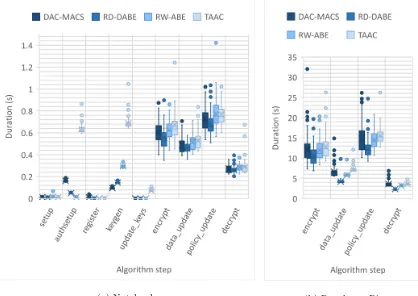
In order to investigate the feasibility and performance of the implementa-tions, several experiments are conducted. In the first experiment, a base scenario is investigated to settle a base case and to compare the different implementations. In the next experiments, we analyze the influence of the policy, the number of attributes and the size of the files on the performance of the construction.
In this section, the experiments are described in more detail and the results are discussed, but first the methodology and measured variables are outlined.
11.1 Methodology
Each experiment contains a specific scenario, in which various cases are repeated 100 times. Each case has a different input value, for example a different policy. For each case, various measurements are performed in multiple runs, to limit the mutual influence of the measurements.
Two different environments are used for the experiments. The first envi-ronment is a notebook machine with an Intel Core i7-2760QM CPU running at 2.4 GHz. The experiments are run on a virtual machine running Linux Mint 18 allocated with 2.0 GB of RAM.
The second environment is a Raspberry Pi in order to analyze the per-formance on devices with limited capabilities. The Raspberry Pi is a model B containing a Broadcom BCM2835 ARM processor with a frequency of 700 MHz, and 512 MB of RAM. The Raspberry Pi runs the Raspbian Jessie Lite2 operating systems, dating from 27 May 2016.
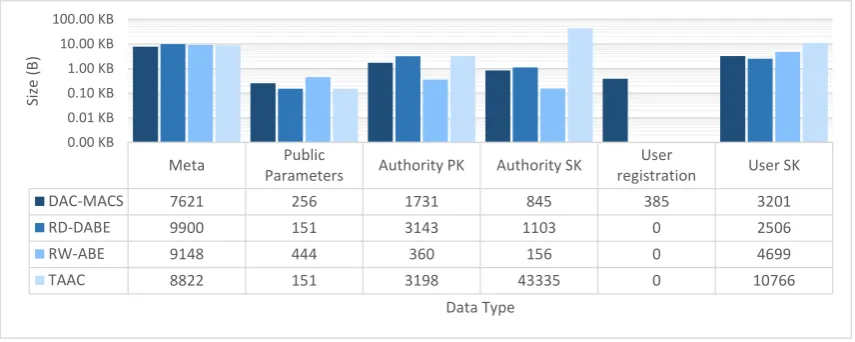
In the experiments, the encrypted data and the meta information (poli-cies and keys) are stored in two separate files. This allows to easily measure the size of the meta information.
11.2 Measured variables
Several variables are measured during the experiments. In this section, these variables are described, and possible external influences are discussed. Moreover, we discuss how the measurements are performed and, if a tool is used, which tool is used.
Time The first measurement factor is the time required for each opera-tion. This is an important indicator of the performance and feasibility of the implementation. The time duration for each step in the algorithm is measured.