Recibido: 04/26/2017 Aceptado: 07/05/2017 ITECKNE Vol. 14 Número 2 • ISSN 1692-1798 • ISSN Digital 2339-3483 • diciembre 2017 • 156 - 163 http://dx.doi.org/10.15332/iteckne.v14i2.1770
Resumen− La electrocardiografía fetal no invasiva, usa electrodos superficiales puestos sobre el abdomen materno. El reto consiste en extraer la señal fetal de la mezcla abdominal. La Separación Ciega de Fuentes es una forma de hacerlo empleando ya sea ICA o PCA. Los algoritmos COMBI y MULTICOMBI ofrecen un novedoso esquema para combinar ICA y PCA. En este trabajo, se compara el desempeño de los algoritmos COMBI, MUL-TICOMBI, EFICA, WASOBI y los tradicionales JADE e ICA, usando un marco de referencia estándar para la realiza-ción de un análisis comparativo y pruebas regulatorias de algoritmos de extracción del electrocardiograma fe-tal no invasivo. Se usa la medida F1 que combina los picos detectados falsos negativos y falsos positivos para medir la precisión en la detección del complejo fetal QRS. Se llevan a cabo dos experimentos. Uno para de-terminar el valor de un parámetro de entrada requerido por los algoritmos WASOBI y COMBI, y otro para compa-rar el desempeño de los algoritmos empleando la medi-da F1. En el primer experimento se estableció que el or-den AR requerido como entrada para COMBI es 10. En el segundo experimento, se obtuvo la precisión media to-tal en la detección del QRS feto-tal (considerando todos los eventos no estacionarios). Los mejores desempeños en cada grupo fueron 96.4% para COMBI, 95.8% para EFI-CA, 95.2% para JADEIEFI-CA, 94.6% para PEFI-CA, 93,6% para ICAdef, 92.9% para MULTICOMBI, 92,7 para ICAsym, y 89,7% para WASOBI.
Palabras clave− FECG, ICA, PCA, pruebas de estrés. Abstract− The non-invasive foetal ECG makes use of surface electrodes placed onto the maternal abdomen. The challenge is to extract the foetal signal from the
ab-dominal mixture. Blind source separation is one way to do this using either ICA or PCA algorithms. COMBI and MULTICOMBI algorithms offer novel schemes for com-bining ICA and PCA. In this work, the performance of the algorithms COMBI, MULTICOMBI, EFICA, WASOBI and traditional JADE and ICA algorithms are compared, using a standard framework for benchmarking and regu-latory testing of NI-FECG extraction algorithms. We use the F1-measure combining true positive, false negative and false positive detected peak for measure the accu-racy of FQRS detection. Two experiments were carried out. One to determine a WASOBI algorithm input para-meter, also necessary in COMBI, and other to compare performance using F1 measure. In first experiment it was established that the AR order required as input for COMBI is 10. In second experiment, the overall median FQRS detection accuracies (i.e. considering all no sta-tionary events) are obtained. For the best performing methods in each group were 96.4% for COMBI, 95.8% for EFICA, 95.2% for JADEICA, 94.6% for PCA, 93,6% for ICAdef,, 92.9% for MULTICOMBI, 92,7 for ICAsym, and 89,7% for WASOBI.
Keywords− FECG, ICA, PCA, stress-testing
1. INTRODUCTION
The foetal electrocardiogram (FECG) is a viable al-ternative to Cardiotocography (CTG) to assessing foetal cardiac activity. The foetal electrocardio-gram (FECG) can be recorded invasively using a needle-like electrode attached to the foetal scalp, but this technique, have associated risk of
infec-using framework for stress-testing extraction
algorithms
Técnicas BSS híbridas para extracción del ECG fetal usando un
marco de referencia para pruebas de esfuerzo de algoritmos
de extracción
Luis Omar Sarmiento-Álvarez
M.Sc. Potencia Eléctrica Unidades Tecnológicas de Santander
Bucaramanga, Colombia [email protected]
José Millet-Roig
Ph. D. Ingeniería industrial Universidad Politécnica de Valencia
Valencia, España [email protected]
tion and it can be used during labour only. The non-invasive FECG (NI-FECG), makes use of surfa-ce electrodes plasurfa-ced onto the maternal abdomen. The challenge is to extract the foetal signal from the abdominal ECG (AECG) mixture since FECG overlaps both in frequency and time domain with maternal interfering source ECG (MECG), and va-rious muscular noise sources.
Several FECG extraction approaches have produ-ced interesting results: methods based on blind or semi-blind source separation techniques, inde-pendent component analysis ( ICA), [1],[2], prin-cipal component analysis (PCA) or singular value decomposition (SVD) [3], [4], [5]; average MECG subtraction [6], [7]; different variants of adaptive filters [8],[9],[10]; wavelet decomposition[11]. BSS is the most widely used technique for extrac-ting the FECG, since it has been shown that BSS methods are better than the adaptive filters [12], and nonlinear transformations have greater com-putational load and require some parameters to be set empirically.
In this paper we introduce COMBI [13] and MUL-TICOMBI [14] algorithms based on hybrid Blind Source Separation (BSS) for extracting FECG from AECG. Aiming at accurate detection of fetal QRS complex [FQRS], we compare the performance of COMBI, MULTICOMBI, ICA, JADE [15], PCA, WASO-BI [16], and EFICA[17] using a standardized eva-luation procedure for NI-FECG signal processing algorithms[18].
2. METHODS 2. 1 Blind Source Separation
In the context of NI-FECG extraction, BSS aims to separate the FECG the others underlying statisti-cally independent sources, MECG and noise. To solve this problem different methods have been proposed, Principal Component Analysis (PCA) and Independent Component Analysis (ICA). PCA assu-me that sources x have a Gaussian distribution function completely determined by its second-or-der statistics, while ICA assumes that sources x are statistically independent and are not Gaussian and that the distribution function is determined by its higher order statistics.
One way to implement PCA is the SOBI algorithm (Second Order Blind Identification)[19] and its im-proved version WASOBI (Weights-Adjusted Second Order Blind Identification)[20]. In turn, one way to implement ICA is the FASTICA algorithm [21] and its improved version EFICA [22].
ICA-based methods are the most used for the analysis of AECG because it is considered that the sources are predominantly non-Gaussian and statistically independent of one another. But, since real-world signals are both Gaussian and non-Gaussian components, it is interesting to test methods that incorporate both approaches. In that sense, algorithms have been developed which combine both WASOBI and EFICA algorithms. The-se algorithms are called COMBI and MULTICOM-BI. Recently these algorithms have been applied in the task of extracting the FECG from the AECG using a proprietary semi synthetic database [23]. However, due to the lack of annotated public da-tabases and defined protocols for assessing these algorithms, available studies may be biased and of questionable reproducibility[18].
2. 2 Combi and Multicombi algorithms
Under certain conditions, WASOBI and EFICA are asymptotically optimal. WASOBI only take advan-tage of time-structure, disregarding the statistical distributions of the sources, whereas EFICA can only take advantage of non-Gaussianity of the sources, ignoring any time-structure. However, realistic mixtures are many times compound of sources which present both diverse time-structure and non-Gaussianity, rendering WASOBI and EFI-CA severely suboptimal. COMBI and MULTI-COMBI Algorithms offer novel schemes for combining WA-SOBI and EFICA, enabling exploit the strengths of both techniques [24].
To verify a good degree of separation, G=WA is de-fined as the gain matrix, with A the original mixing matrix. For a perfectly estimated de-mixing matrix, W, G is equal to its identity matrix. The performan-ce of blind-sourperforman-ce separation algorithms is usua-lly measured by the interference over signal ratio matrix,
ISR
kl=
G G k l
kl2 kk2, ,
=
1 2
, ,
f
, ,
d
wherek
andl
denote the observed and estimated sources, andd
is sources number. However, theoriginal mixing matrix, A, is not generally known for real data sets.
EFICA requires a user-defined choice of a set of nonlinear functions gk^ h$ , for extracting each of
the sources. Then, ISR matrix for the EFICA algori-thm can be approximated by ISRklEF N1 1 l k k l l K l l 2 2 2 2 , x c x c x c c x + + + ^ ^ h h ^ h where ck=bk-n nk2, k=E S g S6tk k^ htk @,xk= nk-t tk, k=
E g S6 l tk^ hk @andbk=E g S6 k2^ htk@ E[.] denotes the
expec-tation operator and glk^ h$ denotes the derivative of gk^ h$ , and Stk is the kth observed signals of S [14].
WASOBI is based on approximate joint diagonaliza-tion of several (say M) time-lagged estimated corre-lation matrices, Rtx6x@=N1-x|nN=-1xX n X n6 @ T6 +x x@, =0,f,M-1
, whereX n6 @ denotes the nth column of X. If all
sources are Gaussian AR of order M 1- , then
un-der asymptotic conditions the ISR matrix is
ISR N R R 1 1 0 0 2 kl WA kl lk kl l k k l 2 2 , v v U UU - 66 @@ ^ h where kl 1 , a a R i j k, k i j M il jl k 2| 01 v
U = -= 6 - @ , and l denote the
observed and the estimated sources,vk2 is the va-riance of the innovation sequence of the kth sour-ce, ail iM0
1 =
-" , are the auto-regression coefficients of the lth source, and R mk6 @ is the autocorrelation of
the kth source at time lag m [13].
In COMBI, the ISR matrices are obviously unknown (nor can they be consistently estimated from the data). However, it is possible to substitute these with the mean ISR, %I RS WA and %ISREF. COMBI apply
both EFICA and WASOBI to X and estimate %I RS WA
and %ISREF select for each source the
reconstruc-ted version that has the best total ISR of the two. This basic selection approach can then be turned into a successive scheme, such that in each ite-ration only the “best” separated sources are “ac-cepted,” and the remaining signals (which are still weakly separated mixtures of the remaining sources) are subjected to an additional iteration of separation and selection [13].
MULTICOMBI uses a clustering technique based on “multidimensional component”. A multidimen-sional component is a cluster of signal compo-nents that can together be well separated from the other components in the mixture, yet are di-fficult to separate from one another. For EFICA, only components that have (nearly) Gaussian distributions might form such a cluster, hence at most one such cluster may exist. For WASOBI, any components sharing similar correlation structures (i.e., power spectra) are hardly separable from one another, but may be easily separated as a cluster, hence several such clusters might coexist [14]. MULTICOMBI uses this clustering technique in which both algorithms, EFICA and WASOBI, are run on the set of unseparated sources Xt and their
ISREF
% and
I RS WA
% , in (1) and (2), are estimated. The
signals are then clustered depending on whether their specific ISRkl is lower for the EFICA or
WA-SOBI case. Then, the process is repeated until all clusters are singletons, ie. only contain one signal per cluster, and the signals are hence optimally separated [25].
2. 3 Framework for stress-testing NI-FECG algorithms
In this work, we use a standardized methodology for stress testing NI-FECG algorithms [18]. The fre-mework include a large database (FECGSYNDB) of realistic artificial signals of multichannel data ab-solute data, as well as extraction and evaluation routines. This dataset include several non-statio-nary events (e.g. foetal movements, uterine con-tractions and heart rate fluctuations) for evaluating extraction routines [26]. FECGSYNDB is the result of a simulator representing maternal and foetal hearts as punctual dipoles with different magnitu-des and spatial positions. The database contains foetal–maternal mixtures by treating each abdo-minal signal component (e.g. foetal/maternal ECG or noise signals) as an individual source, whose signal is propagated onto the observational points (‘electrodes’). This framework is useful to inves-tigate the output of NI-FECG processing BSS me-thods in the presence of such non-stationarities. The modeled volume conductor, sampled from 34 channels (32 abdominal and 2 maternal ECG refe-rence channels), is shown in Fig. 1.
Fig. 1 SIDE (A) AND UPPER (B) VIEW THE OF VOLUME CONDUCTOR. POSITIONS FOR FOETAL (SMALL SPHERE) AND MATERNAL (LARGER SPHERE) HEARTS ARE SHOWN
Source: taken from [18]
2. 4 Dataset and preprocessing.
In this work, we use the Sub01 dataset in FE-CGSYNDB (available in https://physionet.org/phy-siobank/database/fecgsyndb/). In this dataset, seven different physiological events were conside-red as described in Table I. Besides this, there were five different levels of additive noise (0, 3, 6, 9 and 12 dB) and 5 repetitions for each com-bination of settings. Overall a total of 7 (cases) x 5 (SNR levels) x 5 (repetitions) = 175 synthetic signals were used. Each signal had a duration of 5 minutes, and was sampled at 250 Hz with a 16-bit resolution. The SNR levels are 0, 3, 6, 9 and 12 dB.
TABLE I.
PHYSIOLOGICAL EVENTS INCLUDED IN SUB01 DATASET
Case Description
Baseline Abdominal mixture (no noise or events) 0 Baseline (no events) + noise
1 Foetal movement + noise
2 MHR /FHR acceleration / decelerations + noise 3 Uterine contraction + noise
4 Ectopic beats (for both foetus and mother) + noise 5 Additional NI-FECG (twin pregnancy) + noise
Source: the authors
2. 5 Performance parameters
In order to assess the accuracy of FQRS detection, we use the F1-measure[18]:
F
1=
2
TP FN FP
+
2
TP
+
^ h
3
where true positive (TP) denotes correctly de-tected peaks, false negative (FN) existing peaks which were not detected, and false positive (FP) nonexistent peaks that were falsely detected, as defined in ANSI/ AAMI EC57. It is defined a ± 50 ms acceptance interval between detection and the closest reference annotation to account for the higher expected fetal heart rate. The F1 me-asure well adopted by many participants in the Physionet Challenge 2013 as well as used for the Challenge 2014 [27].
3. EXPERIMENTS AND RESULTS
Two experiments were carried out. One to deter-mine a WASOBI algorithm input parameter, also necessary in COMBI, and other to compare perfor-mance using F1 measure.
3. 1 AR order
COMBI and MULTICOMBI algorithms combine WA-SOBI and EFICA algorithms. In WAWA-SOBI, an asymp-totically optimal weight matrix must be obtained for the cases of Auto-Regressive (AR) Gaussian sources.
Therefore, the algorithm requires as input the AR order, the first experiment focused in this prelimi-nary consideration relevant to the usage of COMBI in the following experiments. Sub01 dataset was
processed whit COMBI, AR order between 2 and 10. In order to determine the highest achievable accuracy by each AR order, the foetal R peak de-tection results were obtained using the F1 mea-sure. The Sub 01 dataset was pre-processed with 0.5-100 Hz Bandpass filter. Each signal has 32 channels available, as depicted in Fig. 1, we use eight (1, 8, 11, 14, 19, 22, 25 and 32).
3. 2 COMBI and MULTICOMBI comparing
This experiment consisted of comparing COMBI and MULTICOMBI with ICA (deflation approach, symmetric method, and JADEICA), PCA, EFICA and WASOBI BSS based NI-FECG extraction techni-ques, in stationary and non-stationary scenarios by means of F1 measure. The experiment aims at obtaining an overview of how the presence
of non-stationary mixtures affect extraction me-thods. The AR order used in this analysis was de-cided considering results from the previous expe-riment. The same channels and bandwidth in first experiment were used.
3. 3 Results
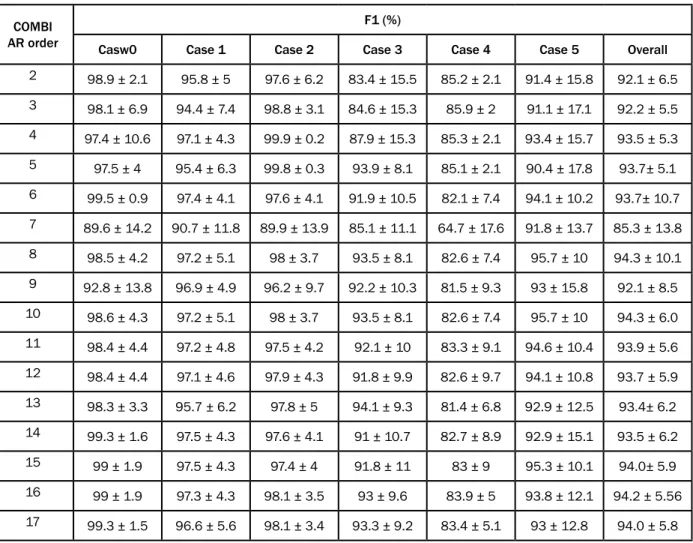
Results of a previous study showed that COMBI produces better results than MULTICOMBI at the work removing the FECG from AECG [28]. For this reason, COMBI was selected to represent hybrid BSS techniques in experiment 1. Table II shows the F1 results of COMBI, AR order between 2 and 17. AR order=8 and AR order = 10 have the same result. AR order= 10 was selected for its lower dis-persion. Cases with noise or events were taken into account only, i.e. case 0 to case 5.
TABLE II. F1 RESULTS.
COMBI performance with respect to the AR order. Both WASOBI and COMBI algorithms require AR order as input parameter. AR order=8 and AR order = 10 have the same result, 94.3%. AR order= 10 was selected for its lower dispersion.
Cases with noise or events were taken into account only, i.e. case 0 to case 5
COMBI AR order
F1 (%)
Casw0 Case 1 Case 2 Case 3 Case 4 Case 5 Overall
2 98.9 ± 2.1 95.8 ± 5 97.6 ± 6.2 83.4 ± 15.5 85.2 ± 2.1 91.4 ± 15.8 92.1 ± 6.5 3 98.1 ± 6.9 94.4 ± 7.4 98.8 ± 3.1 84.6 ± 15.3 85.9 ± 2 91.1 ± 17.1 92.2 ± 5.5 4 97.4 ± 10.6 97.1 ± 4.3 99.9 ± 0.2 87.9 ± 15.3 85.3 ± 2.1 93.4 ± 15.7 93.5 ± 5.3 5 97.5 ± 4 95.4 ± 6.3 99.8 ± 0.3 93.9 ± 8.1 85.1 ± 2.1 90.4 ± 17.8 93.7± 5.1 6 99.5 ± 0.9 97.4 ± 4.1 97.6 ± 4.1 91.9 ± 10.5 82.1 ± 7.4 94.1 ± 10.2 93.7± 10.7 7 89.6 ± 14.2 90.7 ± 11.8 89.9 ± 13.9 85.1 ± 11.1 64.7 ± 17.6 91.8 ± 13.7 85.3 ± 13.8 8 98.5 ± 4.2 97.2 ± 5.1 98 ± 3.7 93.5 ± 8.1 82.6 ± 7.4 95.7 ± 10 94.3 ± 10.1 9 92.8 ± 13.8 96.9 ± 4.9 96.2 ± 9.7 92.2 ± 10.3 81.5 ± 9.3 93 ± 15.8 92.1 ± 8.5 10 98.6 ± 4.3 97.2 ± 5.1 98 ± 3.7 93.5 ± 8.1 82.6 ± 7.4 95.7 ± 10 94.3 ± 6.0 11 98.4 ± 4.4 97.2 ± 4.8 97.5 ± 4.2 92.1 ± 10 83.3 ± 9.1 94.6 ± 10.4 93.9 ± 5.6 12 98.4 ± 4.4 97.1 ± 4.6 97.9 ± 4.3 91.8 ± 9.9 82.6 ± 9.7 94.1 ± 10.8 93.7 ± 5.9 13 98.3 ± 3.3 95.7 ± 6.2 97.8 ± 5 94.1 ± 9.3 81.4 ± 6.8 92.9 ± 12.5 93.4± 6.2 14 99.3 ± 1.6 97.5 ± 4.3 97.6 ± 4.1 91 ± 10.7 82.7 ± 8.9 92.9 ± 15.1 93.5 ± 6.2 15 99 ± 1.9 97.5 ± 4.3 97.4 ± 4 91.8 ± 11 83 ± 9 95.3 ± 10.1 94.0± 5.9 16 99 ± 1.9 97.3 ± 4.3 98.1 ± 3.5 93 ± 9.6 83.9 ± 5 93.8 ± 12.1 94.2 ± 5.56 17 99.3 ± 1.5 96.6 ± 5.6 98.1 ± 3.4 93.3 ± 9.2 83.4 ± 5.1 93 ± 12.8 94.0 ± 5.8
Fig. 2. F1 RESULTS FOR MET1= ICASYM, MET2=ICADEF, MET3=JADEICA, MET4=PCA, MET5=EFICA, MET6= WASOBI, MET7= COMBI AND MET8= MULTICOMBI
Source: the authors
Fig 3. BENCHMARKING OF VARIOUS BSS BASED EXTRACTION ALGORITHMS. THE BEST MEDIANS RESULTS WERE 96.4% FOR COMBI
AND 95.8% FOR EFICA
Source: the authors
4. CONCLUSIONS
In this work, we evaluate eight BSS based algori-thms, including two hybrid algorithms that combi-ning both WASOBI and EFICA. We use a standard framework for benchmarking and regulatory tes-ting of NI-FECG extraction algorithms. Thus, our re-sults can be checked and verified by other resear-chers. We find that the best AR order required as input for COMBI is 10. Benchmarking showed that COMBI have overall median FQRS detection formance. In turn, WASOBI exhibits the worst per-formance, but combining both WASOBI and EFICA Box plots may also have (whiskers) indicating
The boxplot in Fig. 2 shows F1 results for second experiment. The variability outside the upper and lower quartiles is indicating by lines extending ver-tically from the boxes, and the point inside the box is the second quartile (the median). Here, Met1= ICAsym, Met2=ICAdef, Met3=JADEICA, Met4=PCA, Met5=EFICA, Met6= WASOBI, Met7= COMBI and Met8= MULTICOMBI. COMBI has better results in Case 2, MHR /FHR acceleration / decelerations + noise and Case 5, additional NI-FECG (twin preg-nancy) + noise. On the other hand, COMBI has similar results to higher performance algorithms in Case 0, abdominal mixture + noise and Case 3, uterine contraction + noise. Finally, COMBI has slightly lower results in Case 1, Foetal movement + noise and Case 4, ectopic beats (for both foetus and mother) + noise.
In Fig. 3, the overall median FQRS detection ac-curacies (i.e. considering all no stationary events) are obtained. For the best performing algorithms in each group were 96.4% for COMBI, 95.8% for EFICA, 95.2% for JADEICA, 94.6% for PCA, 93,6% for ICAdef, 92.9% for MULTICOMBI, 92.7% for ICAsym, and 89.7% for WASOBI.
in COMBI and MULTICOMBI, the strengths of both techniques are exploited exhibiting better perfor-mance. From these results we can conclude that FECG signals have both Gaussian and non-Gaus-sian components, Gausnon-Gaus-sian lesser degree, as also was demonstrated in [23],[24] using a semi-syn-thetic database. However, this statement must be verified in real databases. MULTICOMBI presents more dispersed results than COMBI. In that sense, the clustering scheme needs to be optimized for the task of separating the sources in AECG, or new methods that combine ICA and PCA and exploit characteristics present in AECG can be developed.
REFERENCES
[1] L. De Lathauwer, B. De Moor, and J. Vandewalle, “Fetal electrocardiogram extraction by blind source subspa-ce separation,” IEEE Trans. Biomed. Eng., vol. 47, no. 5, pp. 567–572, 2000.
[2] V. Zarzoso and A. K. Nandi, “Noninvasive fetal electro-cardiogram extraction: blind separation versus adapti-ve noise cancellation,” Biomed. Eng. IEEE Trans. On, vol. 48, no. 1, pp. 12–18, 2001.
[3] D. Callaerts, B. De Moor, J. Vandewalle, W. Sansen, G. Vantrappen, and J. Janssens, “Comparison of SVD me-thods to extract the foetal electrocardiogram from cu-taneous electrode signals,” Med. Biol. Eng. Comput., vol. 28, no. 3, pp. 217–224, 1990.
[4] M. Kotas, “Projective filtering of time-aligned ECG beats for repolarization duration measurement,” Com-put. Methods Programs Biomed., vol. 85, no. 2, pp. 115–123, 2007.
[5] R. Sameni, C. Jutten, and M. B. Shamsollahi, “A de-flation procedure for subspace decomposition,” Signal Process. IEEE Trans. On, vol. 58, no. 4, pp. 2363– 2374, 2010.
[6] S. Cerutti et al., “Variability analysis of fetal heart rate signals as obtained from abdominal electrocardiogra-phic recordings,” J. Perinat. Med.-Off. J. WAPM, vol. 14, no. 6, pp. 445–452, 1986.
[7] S. M. Martens, C. Rabotti, M. Mischi, and R. J. Sluijter, “A robust fetal ECG detection method for abdominal re-cordings,” Physiol. Meas., vol. 28, no. 4, p. 373, 2007.
[8] B. Widrow et al., “Adaptive noise cancelling: Princi-ples and applications,” Proc. IEEE, vol. 63, no. 12, pp. 1692–1716, 1975.
[9] R. Sameni, “Extraction of fetal cardiac signals from an array of maternal abdominal recordings,” Sharif Uni-versity of Technology, Tehran, Iran, 2008.
[10] M. Niknazar, B. Rivet, and C. Jutten, “Fetal ECG extrac-tion by extended state Kalman filtering based on sin-gle-channel recordings,” Biomed. Eng. IEEE Trans. On,
vol. 60, no. 5, pp. 1345–1352, 2013.
[11] A. Khamene and S. Negahdaripour, “A new method for the extraction of fetal ECG from the composite abdomi-nal sigabdomi-nal,” Biomed. Eng. IEEE Trans. On, vol. 47, no. 4, pp. 507–516, 2000.
[12] B. Widrow et al., “Adaptive noise cancelling: Princi-ples and applications,” Proc. IEEE, vol. 63, no. 12, pp. 1692–1716, 1975.
[13] P. Tichavskỳ, Z. Koldovskỳ, E. Doron, A. Yeredor, and G. Gómez-Herrero, “Blind signal separation by combining two ICA algorithms: HOS-based EFICA and time struc-ture-based WASOBI,” in Eur. Signal Process. Conf.(EU-SIPCO), Florence, 2006.
[14] P. Tichavsky, Z. Koldovsky, A. Yeredor, G. Gómez-He-rrero, and E. Doron, “A hybrid technique for blind se-paration of non-Gaussian and time-correlated sources using a multicomponent approach,” Neural Netw. IEEE Trans. On, vol. 19, no. 3, pp. 421–430, 2008.
[15] J.-F. Cardoso and A. Souloumiac, “Blind beamforming for non-Gaussian signals,” in IEE Proceedings F (Radar and Signal Processing), 1993, vol. 140, pp. 362–370.
[16] A. Yeredor, “Blind separation of Gaussian sources via second-order statistics with asymptotically optimal weighting,” Signal Process. Lett. IEEE, vol. 7, no. 7, pp. 197–200, 2000.
[17] Z. Koldovsky, P. Tichavsky, and E. Oja, “Efficient Va-riant of Algorithm FastICA for Independent Compo-nent Analysis Attaining the Cram&# 201; r-Rao Lower Bound,” Neural Netw. IEEE Trans. On, vol. 17, no. 5, pp. 1265–1277, 2006.
[18] F. Andreotti, J. Behar, S. Zaunseder, J. Oster, and G. D. Clifford, “An open-source framework for stress-testing non-invasive foetal ECG extraction algorithms,” Phy-siol. Meas., vol. 37, no. 5, p. 627, 2016.
[19] A. Belouchrani, K. Abed-Meraim, J.-F. Cardoso, and E. Moulines, “A blind source separation technique using second-order statistics,” Signal Process. IEEE Trans. On, vol. 45, no. 2, pp. 434–444, 1997.
[20] A. Yeredor, “Blind separation of Gaussian sources via second-order statistics with asymptotically optimal weighting,” Signal Process. Lett. IEEE, vol. 7, no. 7, pp. 197–200, 2000.
[21] A. Hyvarinen, “Fast and robust fixed-point algorithms for independent component analysis,” Neural Netw. IEEE Trans. On, vol. 10, no. 3, pp. 626–634, 1999.
[22] Z. Koldovsky, P. Tichavsky, and E. Oja, “Efficient va-riant of algorithm FastICA for independent component analysis attaining the Cramér-Rao lower bound,” Neu-ral Netw. IEEE Trans. On, vol. 17, no. 5, pp. 1265– 1277, 2006.
[23] L. O. Sarmiento Alvarez, A. Gonzalez, and J. Millet, “Hy-brid BSS Techniques for Fetal ECG Extraction Using a semi-synthetic database,” in Signal Processing, Ima-ges and Computer Vision (STSIVA), 2015 20th Sympo-sium on, 2015, pp. 1–6.
[24] L. O. Sarmiento-Álvarez, J. Millet-Roig, and A. Gonzá-lez-Salvador, “Fetal electrocardiogram extraction using hybrid BSS technique: COMBI and MULTICOMBI algo-rithms,” Iteckne, vol. 11, no. 2, pp. 121–128, 2014.
[25] I. P. Waldmann, “OF” COCKTAIL PARTIES” AND EXO-PLANETS,” Astrophys. J., vol. 747, no. 1, p. 12, 2012.
[26] J. Behar, F. Andreotti, S. Zaunseder, Q. Li, J. Oster, and G. D. Clifford, “An ECG simulator for generating mater-nal-foetal activity mixtures on abdominal ECG recor-dings,” Physiol. Meas., vol. 35, no. 8, p. 1537, 2014.
[27] J. Behar, F. Andreotti, S. Zaunseder, J. Oster, and G. D. Clifford, “A practical guide to non-invasive foetal electrocardiogram extraction and analysis,” Physiol. Meas., vol. 37, no. 5, p. R1, 2016.
[28] L. Sarmiento, A. Gonz, and others, “Fetal ECG extrac-tion using hybrid BSS techniques,” in 2015 Computing in Cardiology Conference (CinC), 2015, pp. 141–144.