What we learn in school:
Cognitive and non-cognitive skills in the educational production function
María Emma García García
.
Submitted in partial fulfillment of the requirements for the degree of Doctor of Philosophy
under the Executive Committee of the Graduate School of Arts and Sciences COLUMBIA UNIVERSITY
© 2013
María Emma García García
WHAT WE LEARN IN SCHOOL:
COGNITIVE AND NON-COGNITIVE SKILLS IN THE EDUCATIONAL PRODUCTION FUNCTION
María Emma García García
This dissertation revisits the traditional educational production function, offering alternative strategies to model how achievement and socio-emotional skills enter the relationship and how they are affected during the schooling period. The proposed analyses use a combination of estimation methodologies (longitudinal, multilevel and simultaneous equations models) to empirically assess the importance of the different inputs in the educational process. These estimates can be compared to those obtained using traditional estimation methods to complement our understanding of what educational outcomes are generated in school and which school inputs are most important in producing certain outcomes. The analyses try to provide a broader understanding –both conceptually and statistically- of how education is produced and unbiased estimates of the relative importance of the determinants of academic and behavioral performance.
Study design and methods
This dissertation is composed of three empirical questions about the conceptual and statistical structure of the educational production function, aimed at identifying what educational outcomes are generated and what determinants affect them. The empirical analyses use the Early Childhood Longitudinal Study, Kindergarten Class of 1998-99.
1. Estimation of cognitive achievement: an overview of the traditional educational
production function
2. Estimation of non-cognitive achievement: educational production function for
achievement and behavioral skills
Question 1 involves the estimation of the production of cognitive skills, and educational achievement in reading and mathematics; Question 2 involves the estimation of the production of non-cognitive skills in school, and particular behavioral skills such as internalizing and externalizing behavioral problems, and self-control (reported by the teacher). I use three different estimation methods for both questions: ordinary least squares; students’ fixed effects; and multilevel students’ fixed-effects.
In Question 3 I model the production of simultaneous outcomes, using a cross-sectional and a dynamic simultaneous equation model of the production of education. This framework is an attempt to account for simultaneity and interdependence between outcomes and several educational inputs, leading to a more realistic formulation of how different educational ingredients can be interrelated over time, and acknowledging that educational components can be both inputs and outputs of the process, at different points in time. The estimation methods are three-stage least squares for the cross-sectional estimates; and within-three stages least squares for the longitudinal model.
Findings
The findings obtained from the estimation of the three research questions indicate, in accordance with the existing literature, that the associations between teacher and schools characteristics and the production of cognitive skills and non-cognitive skills are small and mainly statistically insignificant.
First, the results using students’ fixed effects estimation suggest that the effects of teacher’s educational attainment on the cognitive skills index; and experience on the
non-skills.
Secondly, the estimates using the multilevel students’ fixed effects estimation, which controls for the clustered structure of the ECLS-K dataset, indicate that some the effects of certain school level characteristics are statistically significant for the production of reading achievement. These variables are type of school (Catholic school versus public) or class size (medium size versus small). Similarly, the effects of certain teacher characteristics, such as higher educational attainment are statistically significant for the production of mathematics achievement. Regarding the non-cognitive skills, teachers with more experience lead to better non-cognitive skills, while students in private schools, versus students in public schools, have lower non-cognitive skills, as reported by their teachers.
Finally, the results using the cross-sectional simultaneous equations model confer a statistically significance importance to the associations between cognitive and non-cognitive skills in all the grade-levels. Compared to the teacher and school characteristics associations, the coefficients associated with the simultaneous relationships are educationally important.
Policy implications
The design of a comprehensive model of educational outcomes and the study of their associations with the different school inputs are expected to uncover interesting features of the educational production process. Consequently, and building on all the existing knowledge on the production of education, these analyses can help to shed some light on fundamental knowledge for educational research: to better understand the educational process. The empirical findings arising from the study can be useful for informing policymakers and school practitioners and guiding decision making, by offering complementary frameworks that more accurately represent
educational interventions that are efficient and effective in producing higher quality and quantity of educational outcomes, by incorporating the assessment of non-cognitive skills into the interventions’ expected outcomes. Indirectly, this could also stimulate the creation of newer theoretical frameworks, statistical methods and more comprehensive empirical sources for the study of education.
i
Table of Contents
Chapter I... 1
INTRODUCTION ... 1
1.1. Background (context and motivation) ... 1
1.2. Statement of the problem ... 3
1.3. Empirical exercises-Research questions ... 6
1.4. Contributions... 7
1.5. Overview of the organization of the study ... 9
Chapter II ... 13
LITERATURE REVIEW ... 13
2.1. Introduction ... 13
2.2. An historical perspective of what is learnt in the educational process ... 14
2.3. Why this topic is important in the economics of education: non-cognitive skills as human capital 20 2.4. Educational outcomes: definition and measurement ... 23
2.4.1. Cognitive skills ... 23 2.4.1.1. Definition ... 23 2.4.1.2. Measurement ... 24 2.4.2. Non-cognitive skills ... 24 2.4.2.1. Definition ... 24 2.4.2.2. Measurement ... 28
2.4.3. Other consequences of education: social benefits from education ... 30
ii
2.5.1. Cognitive skills as an outcome in the education process ... 32
2.5.2. Cognitive skills as an input in the earnings equation and other adulthood outcomes .... 38
2.5.2.1. Earnings ... 38
2.5.2.2. Health... 41
2.5.2.3. Crime ... 42
2.5.3. Non-cognitive skills as an output in the educational process: The production of non-cognitive skills in the different levels of education ... 43
2.5.3.1. Pre-school ... 45
2.5.3.2. Compulsory education ... 50
2.5.3.3. Tertiary education ... 51
2.5.3.4. How non-cognitive skills are produced ... 52
2.5.4. Non-cognitive skills as an input in the educational process... 53
2.5.5. Non-Cognitive skills as an input in other adulthood outcomes ... 63
2.5.6. A comparison of the relative importance of cognitive and non-cognitive skills ... 68
2.5.7. The production of education using simultaneous equation models ... 70
2.6. Conclusions ... 72
Chapter III ... 75
METHODOLOGY ... 75
3.1. Introduction ... 75
3.2. Empirical Exercises ... 78
iii
3.3.1. Estimation of Cognitive Achievement: an Overview of the Traditional Educational
Production Function ... 79
3.3.2. Estimation of Cognitive Achievement: Educational Production Function for Non-Cognitive Skills ... 88
3.3.3. A Simultaneous Equation Model of the Determinants of Educational Outcomes: Achievement and Behavioral Skills ... 95
3.4. Assessing Biases: Achievement Measured in Levels or in Gains?... 105
3.5. Assumptions in Empirical Analyses ... 111
Chapter IV ... 115
THE DATABASE ... 115
4.1. Data source and sampling strategy ... 115
4.2. Contents of the database ... 116
4.3. Selection of variables ... 117
4.3.1. Educational outcomes ... 117
4.3.2. Educational inputs ... 123
4.4. Sample selection: attrition, missingness and final sample size... 129
4.4.1. Populations of interest for the different analyses ... 129
4.4.2. Analytical samples: attrition and missing data ... 130
4.5. Descriptive frequencies ... 133
4.6. The focus on school level variables and ECLS-K’s non-cognitive variables: Final considerations regarding the dataset ... 138
iv
Chapter V ... 167
ESTIMATION OF COGNITIVE ACHIEVEMENT: AN OVERVIEW OF THE “CLASSIC” EDUCATIONAL PRODUCTION FUNCTION ... 167
5.1. Introduction ... 167
5.2. Organization of the discussion of empirical findings ... 169
5.3. Cognitive skills composite index (Analytical results-I)... 170
5.3.1. Cross sectional estimates ... 171
5.3.2. Pooled estimates ... 175
5.3.3. Longitudinal estimates ... 177
5.3.4. Longitudinal and multilevel estimates ... 180
5.4. Achievement in reading and mathematics (Analytical results- II) ... 181
5.4.1. Reading... 182
5.4.2. Mathematics ... 186
5.5. Discussion about the model’s statistics... 189
5.5.1. Discussion about the model’s statistics ... 189
5.6. Conclusions ... 190
5.6.1. Summary ... 190
5.6.2. Other limitations ... 193
5.6.3. Further research ... 194
v
Chapter VI ... 207
ESTIMATION OF COGNITIVE ACHIEVEMENT: THE PRODUCTION OF NON-COGNITIVE SKILLS ... 207
6.1. Introduction ... 207
6.2. Organization of the discussion of empirical findings ... 210
6.3. Non-cognitive skills composite index (Analytical results-I) ... 211
6.3.1. Cross sectional estimates ... 212
6.3.2. Pooled estimates ... 215
6.3.3. Longitudinal estimates ... 217
6.3.4. Longitudinal -multilevel estimates ... 220
6.4. Internalizing behavior problems score, externalizing behavior problems score, and self-control (Analytical results-II) ... 222
6.4.1. Internalizing behavioral problems score ... 222
6.4.2. Externalizing behavior problems ... 225
6.4.3. Self-Control ... 229
6.5. Other non-cognitive skills in ECLS-K (Analytical results-III)... 231
6.5.1. Self-concept and locus of control ... 232
6.5.2. Self-reported internalizing behavioral problems ... 233
6.6. Discussion about the models’ statistics... 236
6.6.1. The statistics in the fixed effects estimates ... 236
6.7. Conclusions ... 237
6.7.1. Summary ... 237
vi
6.7.3. Further research ... 242
Tables ... 243
Chapter VII ... 261
A SIMULTANEOUS EQUATION MODEL OF THE DETERMINANTS OF EDUCATIONAL OUTCOMES: ACHIEVEMENT AND BEHAVIORAL SKILLS ... 261
7.1. Introduction ... 261
7.2. Organization of the discussion of empirical findings ... 263
7.3. 2-equations SEM assumptions ... 267
7.3.1. Groups of instruments ... 267
7.3.2. Identification assumption ... 268
7.4. Cross sectional estimates (Analytical results I) ... 269
7.4.1. Comprehensive cognitive and non-cognitive skills (grade-levels K to 8) ... 270
7.4.1.1. The simultaneous effects ... 270
7.4.1.2. The relationships between the outcomes and the teacher’s variables ... 272
7.4.1.3. The relationships between the outcomes and the school variables ... 274
7.4.2. Restricted cognitive and non-cognitive skills (grade-levels K to 5) ... 277
7.4.2.1. The simultaneous effects ... 277
7.4.2.2. The relationships between the outcomes and the teacher’s variables ... 278
7.4.2.3. The relationships between the outcomes and the school variables ... 279
7.5. Longitudinal estimates (Analytical results II)... 281
7.5.1. Restricted cognitive and non-cognitive skills (grade-levels K to 5) ... 281
vii
7.5.1.2. The relationships between the outcomes and the teacher’s variables ... 282
7.5.1.3. The relationships between the outcomes and the school variables ... 283
7.6. Sensitivity analysis I: Cross-sectional estimates... 284
7.6.1. Comprehensive cognitive and non-cognitive skills (grade-levels K to 8) ... 284
7.6.1.1. Altering the way the indices are constructed ... 284
7.6.1.2. Altering the instruments ... 285
7.6.1.3. Altering the way the indices are constructed and the instruments ... 287
7.6.2. Restricted cognitive and non-cognitive skills (grade-levels K to 5) ... 287
7.6.2.1. Altering the way the indices are constructed ... 287
7.6.2.2. Altering the instruments ... 287
7.6.2.3. Altering the way the indices are constructed and the instruments ... 288
7.7. Sensitivity analysis II: Longitudinal estimates ... 289
7.7.1. Restricted cognitive and non-cognitive skills (grade-levels K to 5) ... 289
7.7.1.1. Altering the way the indices are constructed and the instruments ... 289
7.8. Sensitivity analysis III: Reduced form estimates ... 289
7.8.1. Comprehensive cognitive and non-cognitive skills (grade-levels K to 5) ... 289
7.8.2. Restricted cognitive and non-cognitive skills (grade-levels K to 5) ... 290
7.9. Conclusions ... 292
7.9.1. Summary ... 292
Tables ... 294
viii
Chapter VIII ... 333
CONCLUSIONS... 333
8.1. Summary of findings... 334
8.2. Limitations: Dataset, assumptions, and interpretation ... 339
8.3. Further research: on implications for educational policy ... 342
8.4. Concluding remarks ... 352
ix
List of Tables
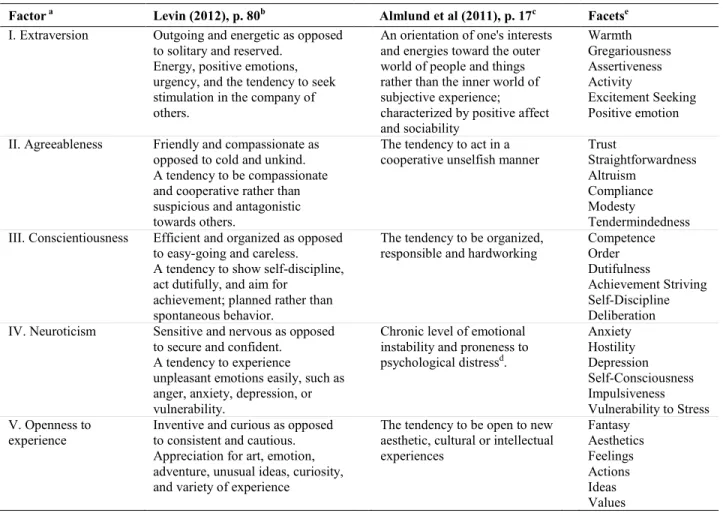
1-Table 2.1: The “Big Five” Factors and the facets in them ... 27
2-Table 3.1: Summary of bias in the estimates in the different specifications ... 109
3-Table 4.1 Study sample size, by grade level and wave (or testing period) ... 141
4-Table 4.2 Scale reliability coefficient by grade level (wave). ... 141
5-Table 4.3 Number of observations per educational outcome, by grade (wave). ... 142
6-Table 4.4 Students per wave. Sample with valid school identifier ... 142
7-Table 4.5 Number of students in longitudinal analyses covering different waves. Sample with valid school identifier ... 143
8-Table 4.5 Numbers and rates of missing data for each variable, by grade, and for the pooled waves 2 to 6 ... 144
9-Table 4.6 Descriptive statistics for selected variables unweighted), by wave ... 147
10-Table 4.7 Descriptive statistics for selected variables (cross-sectional weights used), by wave 151 11-Table 4.8 Descriptive statistics for selected variables (unweighted), pooled dataset ... 155
12-Table 4.9 Descriptive statistics for selected variables (weighted), pooled dataset ... 158
13-Table 4.10 Correlation coefficients among the educational outcomes (plus ars_c) ... 161
14-Table 4.11: The “Big Five” Factors and the facets in them a ... 162
15-Table 5.1. The determinants of the cognitive skills index. Cross sectional estimates. ... 196
16-Table 5.2. The determinants of the cognitive skills index. Longitudinal estimates. ... 200
x
18-Table 5.4. The determinants of math achievement. Longitudinal estimates. ... 204
19-Table 5.5. The student’s fixes effects models statistics ... 206
20-Table 6.1. The determinants of the non-cognitive skills index. Cross sectional estimates. ... 244
21-Table 6.2. The determinants of the non-cognitive skills index. Longitudinal estimates. ... 249
22-Table 6.3. The determinants of internalizing-behavioral problems. Longitudinal estimates. .... 251
23-Table 6.4. The determinants of externalizing-behavioral problems. Longitudinal estimates. ... 253
24-Table 6.5. The determinants of self-control. Longitudinal estimates. ... 255
25-Table 6.6. The determinants of self-concept and locus of control. Cross sectional estimates. .. 257
26-Table 6.7. The determinants of self-reported internalizing behavioral problems. Longitudinal estimates. ... 258
27-Table 6.8. The student’s fixes effects models statistics ... 260
28-Table 7.1: Characteristics of the estimated simultaneous equations models for the production of cognitive and non-cognitive skills ... 263
29-Table 7.2: The simultaneous effects (using the full population’s distribution of scores in the construction of the indices). ... 295
30-Table 7.3: SEM-Teacher and school level effects. Comprehensive cognitive and non-cognitive skills indices (the full population’s distribution of scores in the construction of the indices). ... 297
31-Table 7.4: The simultaneous effects (using the full population’s distribution of scores in the construction of the indices). ... 299
xi
32-Table 7.5: SEM-Teacher and school level effects. Cognitive and non-cognitive skills indices
using 5 components (the full population’s distribution of scores in the construction of the
indices). ... 301
33-Table 7.6: Longitudinal SEM-Simultaneous effects. Cognitive and non-cognitive skills indices using 5 components (the full population’s distribution of scores in the construction of the indices). ... 303
34-Table 7.7: Longitudinal SEM-Teacher and school level effects. Cognitive and non-cognitive skills indices using 5 components (the full population’s distribution of scores in the construction of the indices) ... 304
35-Table 7.8: The simultaneous effects: sensitivity estimates ... 306
36-Table 7.9: The simultaneous effects: Sensitivity analysis ... 310
37-Table 7.10: The simultaneous effects-Longitudinal SEM: Sensitivity analysis ... 314
38-Table 7.11: The reduced form coefficients-Comprehensive indices (using the full population’s distribution of scores in the construction of the indices) ... 315
39-Table 7.12: The reduced form coefficients-Restricted indices (using the full population’s distribution of scores in the construction of the indices) ... 317
40-Table A.7.3*: SEM-Teacher and school level effects. Comprehensive cognitive and non-cognitive skills indices (using the analytical sample’s distribution of scores in the construction of the indices) ... 320
41-Table A.7.3**: SEM-Teacher and school level effects. Comprehensive cognitive and non-cognitive skills indices (using the full population’s distribution of scores in the construction of the indices and comprehensive set of instruments) ... 322
xii
42-Table A.7.3***: SEM-Teacher and school level effects. Comprehensive cognitive and
non-cognitive skills indices (using the analytical sample’s distribution of scores in the construction of the indices and comprehensive set of instruments). ... 324
43-Table A.7.5*: SEM-Teacher and school level effects. Cognitive and non-cognitive skills indices
using 5 components (using the analytical sample’s distribution of scores in the construction of the indices) ... 326
44-Table A.7.5**: SEM-Teacher and school level effects. Cognitive and non-cognitive skills
indices using 5 components (using the full population’s distribution of scores in the construction of the indices and comprehensive set of instruments) ... 328
45-Table A.7.5***: SEM-Teacher and school level effects. Cognitive and non-cognitive skills
indices using 5 components (using the analytical sample’s distribution of scores in the construction of the indices and comprehensive set of instruments). ... 330
xiii
List of Figures
1-Figure 4.1 Distribution of cognitive skills index by grade (final sample) ... 163
2-Figure 4.2 Distribution of non-cognitive skills index by grade (final sample) ... 164
3-Figure 4.3 Distribution of the cognitive skills index gains/value added by grade (final sample) 165 4-Figure 4.4 Distribution of the non-cognitive skills index gains/value added by grade (final sample) ... 166
5-Figure 5.1. Catholic school dummy over grade levels (cross-sectional estimates) ... 198
6-Figure 5.2. SES over grade levels (cross-sectional estimates) ... 198
7-Figure 5.3. Class-size: medium size dummy over grade levels (cross-sectional estimates) ... 199
8-Figure 5.4. Class-size: large size dummy over grade levels (cross-sectional estimates) ... 199
9-Figure 6.1. Teacher’s experience over grade levels (cross-sectional estimates) ... 246
10-Figure 6.2. Catholic school dummy over grade levels (cross-sectional estimates) ... 246
11-Figure 6.3. Private school dummy over grade levels (cross-sectional estimates) ... 247
12-Figure 6.4. Class-size: medium size dummy over grade levels (cross-sectional estimates) ... 247
13-Figure 6.5. Class-size: large size dummy over grade levels (cross-sectional estimates)... 248
14-Figure 7.1: The simultaneous effects (specification 3) (using the full population’s distribution of scores in the construction of the indices) ... 296
15-Figure 7.2: The simultaneous effects (specification 3) (using the full population’s distribution of scores in the construction of the indices) ... 300
xiv
16-Figure 7.3: The simultaneous effects (specification 3) (using the analytical sample’s distribution
of scores in the construction of the indices)... 307
17- Figure 7.4: The simultaneous effects (using the full population’s distribution of scores in the
construction of the indices and comprehensive set of instruments). ... 308
18- Figure 7.5: The simultaneous effects (using the analytical sample’s distribution of scores in the
construction of the indices and comprehensive set of instruments). ... 309
19-Figure 7.6: The simultaneous effects (specification 3) (using the analytical sample’s distribution
of scores in the construction of the indices)... 311
20-Figure 7.7: The simultaneous effects (using the full population’s distribution of scores in the
construction of the indices and comprehensive set of instruments). ... 312
21-Figure 7.8: The simultaneous effects (using the analytical sample’s distribution of scores in the
construction of the indices and comprehensive set of instruments). ... 313
22-Figure 7.9: The reduced form coefficients-Comprehensive indices (using the full population’s
distribution of scores in the construction of the indices) ... 316
23-Figure 7.10: The reduced form coefficients-Restricted indices (using the full population’s
distribution of scores in the construction of the indices) ... 318
24-Figure 7.11: The reduced form coefficients-Comprehensive and restricted indices (using the full
xv
Acknowledgments
This Doctoral Dissertation has been written with the advice, support, encouragement and example of numerous persons and institutions.
First of all, I would like to express my infinite gratitude to Professor Henry Levin, who sponsors this dissertation. I have had the privilege of learning from his advice on all professional facets a graduate student can develop (student, research assistant, teaching assistant and researcher). While these contributed to my training as a scholar and as a researcher, it was through being his listener and observing him that I have grown the most, both professionally and personally. Because he teaches by example, much learning happens by association. And there was no more privileged working space than mine in this respect. Fond memories from his mentorship are among the most valuable outcomes of my years in graduate school.
To Professor Francisco Rivera-Batiz, who was co-advisor of the current study, I also want to express my gratitude and admiration. The results of his classes, conversations with him, and advice on this particular research are well kept in my notes and mind. Developing just a few of those ideas would give several of us (on behalf of my classmates and colleagues) work for the rest of our careers. We should always keep in mind the points for success he mentioned in his moving retirement celebration a few days ago, when developing our profession (hard work, persistence, help from others, love).
Professors Jane Waldfogel, Douglas Ready, and Elizabeth Tipton kindly accepted my request to serve on the committee and provided me with very insightful comments and suggestions on the study and throughout its development (especially Professor Ready, for his energy and generous willingness to help me at very early stages of my study). I especially admire their clarity in approaching and addressing policy questions. Their advice will guide most of the
xvi
extensions of this dissertation, especially the ones that lead to relevant educational policy implications.
It is hard to find a way to express how decisive Professor Amado Petitbò has been in my career, in general, and in particular in the completion of the doctorate. Perhaps the best way to explain this is to refer to the dimensions of success Professor Rivera-Batiz points out, and acknowledge that he has contributed to all of them, with his example, advice, demand, support, and wisdom. I admit he was just right about the need of pursuing further education, and I hope what I deliver in return during my career makes him proud.
The list of acknowledged supervisors starts with Professor Clive Belfield, my supervisor during several research projects I participated in since 2010. His guidance, instruction and generosity sharing his knowledge have been crucial ingredients to develop my training as a researcher and the completion of my studies. It is also with my greatest admiration and gratitude that I write this thank-you to him. Extremely important has been Professor Chris Weiss’s advice and supervision during all these years, as well as his trust and energy. His continuous willingness to help, review, talk, write, comment, has been an awesome motivator and a fantastic example all these years. Finally, Professor Greg Eirich brought to my research a lot of encouragement and confidence, through his positivism, suggestions and interest in my ideas, in all the semesters I was his TA. A very long list of fantastic supervisors could be made explicit here, if I mentioned all the persons who helped me develop my interest and skills for research and academia (Manuel Moreno and Guillem Lopez in UPF, and José Antonio Herce, Simón Sosvilla, Juan Francisco Jimeno, José María Labeaga, Antonio Díaz Ballesteros, in FEDEA). To all of them, I also want to express my gratitude.
xvii
I want to acknowledge the help received from my workmates Jiyun Lee (always there, always helping, always ready), Ilja Cornelisz (always helping, too, in so many different occasions), Fiona Hollands (who also teaches by example), Brooks Bowden (always with a “yes”), Jonah Liebert (an admirable researcher and great study-mate this year), Sam Abrams (for his reading recommendations, patience, and time reviewing some of these paragraphs), Yilin Pan and Charisse Gulosino (for always finding the time to listen and help), and Amrit Thapa, Rob Shand, Henan Cheng and Barbara Hanisch. Special thanks also go to my colleagues Milagros Nores (whose generous contribution at earlier stages of this study was crucial: she selflessly helped with ECLS-K, and suggested the idea of using indices for cognitive and non-cognitive skills, instead of variables, for clarifying the goal of part of the analyses in this dissertation), Miyako Ikeda, Sandro Parodi and Haydeeliz Carrasco. Working with them, in different capacities, and enjoying their friendship, advice and generosity, really made my abilities and skills much better and my days much happier.
My gratitude also goes to Professor David Kaplan, for his comments on an earlier version of this research, and Professor Mun Tsang, for his support of my work. Their advice and specific comments are included in this dissertation.
I am grateful to several institutions for having funded my research as well as coursework. My doctoral research was supported by a grant from the American Educational Research Association, which receives funds for its "AERA Grants Program" from the National Science Foundation under Grant #DRL-0941014, and by the Education Policy and Social Analysis Department’s Education Policy Dissertation Fellowship. Valuable support and motivation were provided by Professor Jacquelynne Eccles, Executive Director Felice Levine, Professor Jeremy Kilpatrick, George Wimberly, and Kevin Dieterle. I am moreover indebted to Fundación Rafael
xviii
del Pino for its financial support of my master’s and doctoral studies at Columbia University. I have benefited extremely from their generous sponsorship and from the professional and social networks they have made available to me.
Special thanks go to the persons who have been consistently much nicer and more generous than one would expect, during the endeavor of completing the doctoral program, in class, research centers, offices supporting students, and libraries. My personal gratitude and recognition goes to the Education Policy and Social Analysis department, my other professors, classmates, teaching assistants, students, and other personnel in school. Professor Xavier Sala-i-Martin was extremely supportive during my first year. Professors Maria Fridink, Jennifer Hill, Joydeep Roy, Michael Rebell, and Miguel Urquiola provided me with advice and help at different stages of my studies, including the dissertation period. I also want to acknowledge the advice provided by Professors Douglas Almond, Thomas Bailey and Judith Scott-Clayton in previous years. Josefina Sáez-Illobre, Pilar Sáez de Aja, Sherene Alexander, Sarah Roe, Gary Ardan, Rong Li, Josephine Takeall and Jasmine Ortiz were excellent facilitators of my daily life. Many people helped me at particular moments, happy and less happy moments. In here, I want to mention Laura Llauger, Tania Heres, Corinne Mette, Ariel Scheirer, Christy Baker-Smith, Xavier Torrebadella, Maite Novo, Carmen Moreo, Carmen Arias, Leticia Moreno, Patricia Guerrero, Miriam Feu, Eva Ferreres, Arifa Khandwalla, Karen Chatfield, Xin Gong, Haogen Yao, David López Rodríguez, Remei Capdevila, Vanessa Otha, Katia Herrera, Mina Dadgar, Susana Martínez-Restrepo, Radhika Iyengar, David Blakeslee, Ritam Chaurey, Patrick Assuming, Alper Dincer, Vicente García, Katie Cohn, Maham Mela and many other friends and colleagues whom I walked with these years.
xix
Finally, I want to publicly express my gratitude to my family, who has been always showing what is important in life. Without their values, encouragement, contributions and love, this research(er) would not exist. No words (few, many) could ever express what is driven by feelings.
Chapter I INTRODUCTION
1.1.Background (context and motivation)
Individuals in most countries of the world spend a considerably large amount of time in school, especially at younger ages. Schools, as structures designed by societies, play an important role in the development of individuals and citizens, whose skills in adulthood are critical to their wellbeing and also the wellbeing of societies themselves. In schools, students acquire formal knowledge, transmitted by teachers through the instructional framework of a curriculum, concepts and theories, and through self-learning. In addition to that, schools are one of the primary institutions where interactions among students and between students and teachers may shape their behavior and personality traits. This dissertation explores some of these processes and studies the mechanisms behind the relationships between students’ educational performance and school factors that may create or enhance learning and personal development.
The analysis of the relationships between educational inputs and the students’ educational performance or outcomes technically defines the production of education. Within the Economics
of Education, this dissertation represents a contribution to the production of education research. Through examining how to improve and complement our understanding of the process and production of education, it attempts to generate frameworks of analyses and discussion that can be useful across other areas of work in the discipline, such as the analysis of the benefits and costs of education, the returns to investments in education, the assessment of the quality of education, the analysis of financing policies that ensure equity and adequacy in education, and
the assessment of the role of education in economic growth.1
As with the economics of education field in general, our knowledge about the production of education has notably expanded since the discipline emerged in the middle of the twentieth century. Economics of education’s researchers have faced substantial limitations associated with a relative lack of tradition and background about the educational process during these decades among other difficulties. However, with serious dedication, they have provided solid contributions to the educational community, both from theoretical and empirical points of view, in the different areas of work embraced by the discipline. Indeed, remarkable breakthroughs have
been made that have deepened our knowledge on several complex educational issues.2 However,
after several decades of research in the educational production function field, researchers and policymakers continue to seek a conclusive explanation of how educational outcomes are generated, or what factors determine them. The debates around these issues are organized along two different dimensions. On the one hand, there is a debate around what the true outcomes of the educational process are, with some consensus among disciplines—psychology, sociology, education, etc.—on the belief that schooling enhances other skills besides formal cognition or
1 See Levin (2011) for a summary of the concepts and seminal contributions in the different areas of work in the
Economics of education.
achievement. On the other hand, there is also a debate around what the optimal combination of educational resources should be, when looking at efficiency and effectiveness of educational systems.
All the existing knowledge on the production of education up to now and also the current debates are embedded in this research endeavor. From them, this study aims at undertaking a further step: to provide a comprehensive analysis of what is produced in school, and how it is produced, utilizing statistical tools that have become available to researchers and have been relatively unexplored in the production of education.
I frame the problem, research questions and expected outcomes in the sections below.
1.2. Statement of the problem
This dissertation embraces the study of “What we learn in school: cognitive and
non-cognitive skills in the educational production function”, revisiting the production of education as a result of the schooling process. The proposed analyses are conceptual and statistical extensions of the traditional educational production framework, and aim at providing comprehensive evidence on what is actually produced while individuals are in school, and which school inputs are most important in producing certain outcomes.
While considerable attention has been paid to the evaluation of formal skills learnt in school, much less is known about the role of schools and teachers in the development of personalities or non-cognitive skills of students. Accountability, standards and assessment dominate the spectrum of the educational policy and the research agenda, but their definitions attribute little importance to other potential dimensions of learning that are not related to objective evaluation of cognitive skills. Certainly, the lack of tradition in assessing other
behavioral attributes (or non-cognitive skills3) in education could be justified, for the task of understanding the roles of soft or behavioral skills in the educational process. First of all, it is difficult to tackle abstract concepts such as motivation or conscientiousness –both conceptually and in their measurement. In addition to this, all the attributes (cognitive and non-cognitive) embedded in the educational process are subject to mutual dependence beyond independent
change, which increases the requirements of the statistical frameworks used to model them.4 In
fact, this dissertation explores the use of alternative methodological and statistical tools to study the importance of traditional educational inputs in determining educational outcomes plus assessing any interrelationships between inputs and outputs in education.
Overall, the revision of the production function undertaken in this dissertation builds on three main premises from which the research questions studied in this dissertation are derived.
First of all, I assume that schooling promotes the development of several
educational outcomes, such as formal cognitive skills and behavioral skills, as evidenced by the existing literature. Regarding this, the empirical analyses developed in this study constitute an attempt to model the production of multiple educational outcomes, diverse in their nature. This is seen as an extension of the traditional setting of the production of “achievement” in education, and also an attempt to provide a theoretical contribution to the production of education framework.
Secondly, this study benefits from the availability of comprehensive
observational information about multiple educational outcomes for school-aged children. The database used is the Early Childhood Longitudinal Study, Kindergarten Class of
3 Section 2.4 presents detailed definitions of both types of skills.
4 The chosen model is a simultaneous equations model, explained in Sections 2.5.7 and 3.3.3. Other elements that
1998-99 (ECLS-K), which includes a set of questions regarding the personality traits and behavior of the children, in addition to the traditional standardized cognitive achievement
outcomes (in math, reading and sciences), between grade-levels Kindergarten to 8th. The
cognitive variables are the students’ achievement in mathematics, reading and sciences. The non-cognitive variables are obtained from the teacher’s reported values on the student’s internalizing and externalizing behavioral problems, and self-control. Thus, the database provides us with the opportunity to examine the interdependence or cross- relational effects between skills, as well as the dynamic aspects of cognitive and non-cognitive development or learning.
Thirdly, this dissertation uses the availability of relatively unexplored
statistical methods in education to model and estimate the production of education, such as longitudinal multilevel estimation strategies, or simultaneous equations models. The longitudinal structure of ECLS-K allows us to study the dynamic aspects of cognitive and
non-cognitive development5, and to estimate the causal effect of changes in school inputs
on students’ outcomes. Besides this, the fact that repeated observations from students nested within schools may not be independent from each other is controlled for with the
longitudinal multilevel models.6 The simultaneous equation models7 overcome the
simultaneity bias, and provide a more realistic framework of how education may be produced. Overall, the methodologies are able to account for data-structure specificities (fixed effects and clustering) and statistical issues associated with the educational process
5 Longitudinal or panel data models for education were first suggested by Boardman and Murnane (1979), as a way
to “provide a more satisfactory basis for deriving causal inferences concerning the determinants of children’s achievement” (p. 113), in contrast to research based on cross-sectional estimates.
6 See Bryk and Raudenbush (1992) and Willms and Raudenbush (1989) for an overview of multilevel models. 7 Levin (1970) estimated the first simultaneous equations model for the production of education.
itself (potential biases associated with omitted variables, specification and estimation
problems).8 Thus, they are expected to lead to more statistically precise estimates of the
determinants of school performance.
1.3. Empirical exercises-Research questions
This dissertation is composed of three empirical questions about the conceptual and statistical structure of the educational production function, aiming at identifying what educational outcomes are generated and what determinants affect them.
1. Estimation of cognitive achievement: an overview of the traditional educational
production function
2. Estimation of non-cognitive achievement: educational production function for
non-cognitive skills
3. A simultaneous equation model of the determinants of educational outcomes:
achievement and behavioral skills
Question 1 involves the estimation of the production of educational achievement in reading and mathematics; Question 2 involves the estimation of the production of non-cognitive skills in school, both using longitudinal multilevel models. These two questions explore whether
the educational process may be such that two types of outcomes, cognitive and non-cognitive9,
are generated, and the relevance of the teacher and school variables in predicting them. In particular, I first examine the determinants of achievement in reading and mathematics, and its development over time, for students from Kindergarten up to middle school (fifth grade). I extend this investigation to the identification of the determinants of performance in behavioral
8 All these topics are explained in detail in Chapter III. 9 These variables are defined in Section 4.3.
skills such as internalizing and externalizing behavioral problems (reported by the student and the teacher), and self-control (reported by the teacher); also looking at changes over time.
In Question 3 the proposed analysis develops a model that represents how education could be actually produced, building on the framework provided by simultaneous equation models for the production of cognitive and non-cognitive skills in school. This framework is an
attempt to account for simultaneity and interdependence10 between outcomes and several
educational inputs, leading to a more realistic formulation of how different educational ingredients can be interrelated over time, and acknowledging that educational components can be both inputs and outputs of the process, at different points in time.
1.4.Contributions
The design of a comprehensive model of educational outcomes and the study of their associations with the different school inputs are expected to uncover interesting features of the educational production process. Consequently, building on all the existing knowledge on the production of education, these analyses can help to shed some light on the fundamental cornerstone for education and research: to better understand the educational process.
An overview of how the analyses developed in this dissertation will deepen our knowledge about the educational process, allows me to review some of the components that
motivate the current study, which also shape its ulterior impacts.11
First of all, the dissertation examines the outcomes and production of
outcomes in the educational process. Despite any limitations arising in the analyses12,
10 These terms are defined in Section 3.3.3
11 Some of these ideas are not direct contributions of this dissertation but suggestions for further research in the
given the amount of individual and social dimensions directly and indirectly affected by education, this is seen as an important contribution: it is well-known that, in the short run, economic resources invested in education and therefore, not invested in any competing
service, are quantitatively important.13 In the long run, education affects, if not
determines, many outcomes in adulthood, including earnings, health, well-being, or a
country’s quality of institutions.14
Secondly, this dissertation aims to provide the research field in the
production of education with complementary frameworks that more accurately represent the educational process. In addition to modeling the existence of multiple educational outcomes, the frameworks would also reflect interdependences between outcomes and changes over time, and explain how other inputs affect their production, which may extend our current understanding of the educational relationships.
Thirdly, the empirical findings arising from the study can be useful for
informing policymakers and school agents (practitioners) and guiding decision making, by uncovering a more realistic understanding of the educational ingredients.
Fourthly, the results may be useful for designing and evaluating
educational interventions that are efficient and effective in producing higher quality and quantity of educational outcomes, by incorporating the assessment of non-cognitive skills into the interventions’ expected outcomes. Indirectly, this could also stimulate the
12 Explained in several sections in Chapters IV, V, VI, VII, and VIII.
13 For instance, citing one example, the US devoted 8% of its GDP to institutional expenditures on education from
kindergarten through higher education, in 2008-2009 (according to Levin, 2011). At the time when this dissertation was in the process of preparation, economies in the world were facing budget cuts affecting expenditures on education, and other social services. The amount spent on education varies across nations and over the economic cycles, but it nevertheless consumes a relatively important fraction of public and private resources.
creation of newer theoretical frameworks, statistical methods and more comprehensive empirical sources for the study of education.
1.5.Overview of the organization of the study This study is organized in eight chapters.
The introductory chapter (Chapter I) explains the context and motivation of the study and provides an overview of its contents and organization.
The literature review (Chapter II) summarizes existing literature that ascertains what is learnt in school. It provides an overview of the empirical and theoretical evidence on what is produced in the educational process, emphasizing the existence of arguments identifying both cognitive and non-cognitive skills in the educational process. The review presents a historical overview of the thoughts and theories on what schools produce (Section 2.2). Section 2.3 justifies why a broad assessment of educational outcomes is a relevant topic for the economics of education field. Educational outcomes—both cognitive and non-cognitive skills—are defined in Section 2.4. Section 2.5 surveys the empirical evidence on what is produced in the educational process, under a comprehensive approach: the educational production function literature and extensions of it that acknowledge the impacts of behavior and non-cognitive skills on the production of education and other outcomes are reviewed. Cognitive and non-cognitive skills are analyzed as outcomes of the educational process, as inputs in the production of each other (cognitive skills as an input in the production of non-cognitive skills, and non-cognitive skills as an input in the production of cognitive skills), and as inputs in the production of other adult outcomes.
Chapter III presents the methodology used in the empirical analyses. In particular, it explains the theoretical and statistical frameworks necessary to develop the proposed ideas. It also covers the estimation methodologies that are used for empirically testing the proposed research questions and associated specifications (the estimated equations). This chapter includes a discussion about potential biases affecting school impacts in the production of cognitive and non-cognitive outcomes, under different specifications and assumptions regarding the potential role of learning dynamics (Section 3.4). Finally, it reviews the identification assumptions underlying the empirical findings (Section 3.5), which determine their overall validity.
The dataset is described in Chapter IV. The database used in the empirical analysis is the Early Childhood Longitudinal Study, Kindergarten Class of 1998-99 (ECLS-K), which has some useful features to address the questions stated in this research (Sections 4.1 and 4.2). We define the variables utilized in the study (Section 4.3), and connect them with one of the best-known classifications of non-cognitive variables—the Big 5 personality traits defined in Section 2.4— which is extensively used in the literature nowadays (see Table 4.11). The criteria for selection of the population used in the analysis are explained (Section 4.4), and the characteristics of the analytical sample are described.
Chapters V (for Research question 1), VI (for Research question 2) and VII (on Research question 3) present detailed analysis of the empirical findings of this study’s research questions. Some extensions are included after the analyses—especially in Chapter VII—in order to provide the findings with a sensitivity analysis or confidence interval for the true coefficient size, given the limitations arising from the model’s assumptions and dataset features.
Chapter VIII presents a summary of the key findings, together with a more detailed analysis of the implications for educational policy and further research that can be designed using the findings from this study.
Chapter II
LITERATURE REVIEW
2.1. Introduction
In this chapter I review existing literature that assesses what is learnt in school. For this
purpose, this review presents an historical overview of the thoughts and theories on what schools produce (section 2.2). This is used to support the hypothesis stated in the previous chapter, according to which schools are the site where many types of skills may be developed. Section 2.3 justifies why a broad assessment of educational outcomes, as undertaken in this study, is a relevant topic for the economics of education field. Educational outcomes –cognitive and non-cognitive skills- are defined in section 2.4, including a short overview of the theoretical
framework that explains how educational outputs are produced15. The most important part of this
chapter is devoted to surveying the empirical evidence on what is produced in the educational process, under a comprehensive approach (section 2.5). Cognitive and non-cognitive skills are
analyzed both as outcomes of the educational process, as inputs in the production of the complementary outcome, and as inputs in the production of other adulthood outcomes. Section 2.6 concludes.
2.2. An historical perspective of what is learnt in the educational process
Before the seminal publications on the economics of human capital literature by Becker (1964) or Schultz (1961) were disseminated, other distinguished names (mainly philosophers, sociologists and psychologists) had provided interpretations and analyses of what education meant to societies and about the role of educational institutions in producing multiple skills. Theorists in sociology or psychology made remarkable attempts to identify educational outcomes
other than traditional cognitive skills. 16 These outcomes, despite being relatively more difficult
to define and less quantifiable than cognitive outcomes, were still notably detectable and important. These disciplines shed some light on new dimensions for the analysis of the purposes and consequences of education.
Throughout the previous century, various authors attempted to ascertain how educational outcomes are produced and what the roles of schools, teachers and peers were in the production of formal knowledge and of personal traits. Although the perspectives summarized below are not fully in accord, they agree on acknowledging the diversity of educational outcomes, and attribute substantial relevance to non-cognitive skills in the formation of an individual and in school. Incorporating them into the economics of education would be, thus, a natural extension and challenge.
16 Psychologists were the first to develop sets of tests to measure non-cognitive skills (see Sternberg, 1985).
Primarily, as mentioned by Heckman and Rubinstein (2001), these outcomes are used to screen workers, and not so much to ascertain college readiness or school outcomes.
From a chronological perspective, Dewey (1916) defined education as a moral act, an activity with intrinsic and individualistic value through which the individuals develop and grow. Dewey was one of the main defenders of the liberal theory of education, and an exponent of the pragmatist approach to the definition of education. According to his view, the education process is an end in itself, not measurable by outcomes from the process, but from changes along the way. Thus, an array of outcomes for the individual would be generated while in school.
A substantially different perspective was used by Inkeles (1966). His approach is known as the functionalist approach, where functional competencies in the individual are expected to be developed especially in the school years. For Inkeles, the main purposes of education and other social institutions are to build the total culture of a society. Education, through school, socializes individuals. It prepares them to function in a modern society and to become “competent adults”. Competence is defined in a broad sense, as the ability to attain and perform in valued social roles (p. 280). Becoming competent includes the development of skills related to knowledge – command of language, arithmetic, different cognitive modes, etc.- and also personalities – interaction effects, motives, etc.- (see figure on p. 267). For Inkeles, a skill is a “socialized aptitude”. His framework acknowledges the interaction between the person and the socio-cultural system, and the importance of identifying the most efficient way in shaping these personalities.
Dreeben (1968)17 mentions that “traditional approaches to understanding the educational
process have been concerned primarily with the explicit goals of school as expressed in curriculum content, pedagogy or methods of instruction” (p. 42). Under his view, this is not representative of the importance of schools, and his work reinforces Inkeles’s perspective on the role of school in the socialization of the individual. Dreeben viewed the school process in the
17 Note the similarities between Dreeben’s book title and this dissertation’s. The goals and scope of both works are
context of a developmental sequence that the individual experiences. The structural properties of schools (as of families) exert an influence in shaping the experiences of children and in promoting learning patterns of conduct. Schools are incorporated within an institutional network composed by family, economy and polity (p. 92). More concretely, schooling forms the link between the family life of children and the public life of adults, which means that it must provide experiences conducive to learning the principles of conduct and patterns of behavior appropriate to adulthood. According to this author, there are normative outcomes, values and behaviors or principles of conduct–learnt through the imposition of sanctions or rewards associated with teachers’ legitimacy- that are generated in the sequence of school experiences. Another important argument he raises is that teachers act beyond emotions that are typical from families, but they also administer particular social and emotional practices in order to motivate the students. School, for the individuals, is the place of work, and the relevance of the learned skills is judged in terms of its direct usefulness in later employment.
A similar approach is offered by Gintis (1971) in which he emphasizes the multi-goal role of school. Gintis acknowledges the role of school as the institution where a path of individual personality development is produced. Features such as the grading system, or other pedagogic instruments are thought to shape the student’s future role as a working individual. “Failure of schooling to inculcate the required non-cognitive personality traits” is observed in groups where the rate of return to education is low (p. 267).
Bowles and Gintis (1976) review the several functions of education, in line with several statements by Dewey. Education has an integrative function, an egalitarian function, and a developmental function. Education can “be seen as a major instrument in promoting the psychic and moral development of the individual” (p. 21), and, quoting Dewey, a means of social
continuity of life. School is an important institution in the integration of new generations into the social order (p. 102). Importantly, this book by Bowles and Gintis is normally cited as one of the first references that ackowledged the role of non-cognitive skills on attainment. In particular, they suggested that educational attainment, the outcome of the educational process would be dependent “not only on ability, but also on motivation, drive to achieve, perseverance and sacrifice” (p. 106). For Bowles and Gintis, the “role of schools in promoting cognitive growth by no means exhausts their social functions. […] a cognitive approach to the educational system which focuses on the production of mental skills cannot provide the basis for understanding the link between schools and the economy” (p, 109 and 110). Finally, they suggested that non-cognitive traits (work-related personality characteristics, models of self-presentation and credentials) were involved in the association between educational level and economic success (p. 140). In a study with one high school in New York, cognitive scores had provided the best single prediction of the GPA value. However, a combination of different personality measures
possessed a very close predictive value (p. 136)18.
Bowles and Gintis (2002)’s work19 discussed “how economic institutions shape the
process of human development; and the importance of schooling, cognitive skill, and personality as determinants of economic success and their role in the intergenerational perpetuation of inequality” (p. 2). They reviewed the parallelism that exists between schools and the workplace structure –what they call the correspondence principle- to evaluate whether skills transmitted through schooling are accompanied by other products, such as the socialization embedded by the schooling process. Their understanding of socialization includes the idea that in school, students accept “beliefs, values and forms of behavior on the basis of authority, rather than the students’
18 See Appendix B for more information and definitions. 19 Also in the book published in 1976.
own critical judgements of their interests” (p. 12). Their article reinforces Inkeles and Dreeben’s
functionalist argument in that respect (also supported by Oakes, 1982)20, and therefore, would be
in disagreement with the theory of culture and cultural change. Their research would then reinforce the idea that school –and not just personal development or family settings- is likely to affect behavioral skills.
From the economics perspective, it is traditionally argued that most of the first contributions to a conceptual framework overlooked the existence of different educational outcomes (Heckman, 2000; Todd & Wolpin, 2003). From the first years of development of the literature in the economics of education field, contributions in the discipline were elaborated around the skills that are embodied in the individual (Becker, 1964) and are represented by the overall term of human capital. For decades, human capital has been associated with education and training, as “the most important investments in human capital” (Becker, 1964, p. 17). Becker (1964) emphasizes that the accumulation of human capital is usually spread over a lengthy investment period (p. 117). This accumulation takes place in different settings, such as family and friends, school and peers. During that process, individuals experience situations that shape their minds, what they know and how they understand life. Becker set up the foundations for most of the subsequent theoretical analyses on formal education (investment in education,
returns to education, etc.21), in what was called the economics of human capital. On many
occasions, while not explicitly formalized through a model, he recognized the importance or
20 Bowles and Gintis (1976) would also support this view regarding the hierarchical organization of schools, which
mimics that of a work place, and the system of incentives in school –which mirrors salaries and other external rewards-. (pp. 12 and 129). However, they would modify the approach, in the sense that schools are not just producers of economic agents who seek profit and domination, but human need and individual development (p. 54). They would disagree on the educational system etching the meritocratic perspective into individuals and the legitimization of economic inequality. Ideologically, they believe that the educational system legitimates de principle of meritocracy and greater equality, but they argue that these are not what the system delivers, only what the system tries to make people believe.
relevance of other skills, besides formal skills or schooling, for many life outcomes (he did not place them in a formal setting –since this was not the goal of his publication-). For example, among the various references to the diverse educational outcomes, he highlighted the influence of families on the “knowledge, skills, values and habits” of their children (p. 21). One could likely think that a similar reasoning could be applicable to schools.
In general, the approach followed by many researchers at that time was especially focused on more tangible outcomes or variables. As an example, we can cite Schultz (1961), who declared that “by investing in themselves [in education], people can enlarge the range of choice available to them. It is one way free men can enhance their welfare” (p. 2). While the economic concepts of human capital and welfare are mainly concepts linked to directly quantifiable magnitudes, it is fair to provide attribution to both Becker and Schultz, in the sense that their understanding of these words could very likely incorporate various components (i.e., most likely cognitive and non-cognitive skills).
Compared to other areas of research, the economics of education literature has just recently started to acknowledge non-cognitive skills in education. In part, the problem is generated because economics emphasis on skills is based upon knowledge and capabilities which tend to favor a cognitive dimension and, later, a test score interpretation. Traditionally, economists have assumed that cognitive skills can be improved, but personality cannot. However, more recently the evaluation of educational interventions and educational reforms (especially early childhood programs) has examined changes of behavior induced by educational interventions or by different types of teachers (see Jackson, 2013, for a model of teacher’s effects on both cognitive and non-cognitive skills, using administrative data in North-Carolina).
Researchers also examine the links that these attributes could have later on life effects for individuals.
2.3. Why this topic is important in the economics of education: non-cognitive skills as human capital
One important mission of the economics of education discipline is to study individual’s decisions in terms of their investments in human capital. In combination with economics and policy analysis, our field also aims at designing interventions that lead to an optimal distribution and use of the resources available (and other constraints). We evaluate effects from individual decisions and policies, and look at their benefits, in terms of earnings (or production), productivities of individuals (Becker, 1964, p. 228) and others. In all these areas, the potential role played by non-cognitive skills should be ascertained. This would be especially relevant if there were any theory or any empirical evidence suggesting that non-cognitive skills are human capital constituents, and that behavioral traits could introduce certain incentives and capabilities that would alter human-capital related decisions.
In terms of the latter, economic agents face constraints that limit their optimal choices in terms of the allocation of resources to satisfy needs in an environment where there are scarce means to satisfy competing ends (based on Becker, 1978, p. 3 and 5). For Becker, scarcity and choice, through behavior (based on maximization, stable and volatile preferences, with full or
limited information, etc.) characterize all resources allocated by any agent in the economy22.
22Optimal investment decisions can be evaluated under the assumption that the individual maximizes his utility or
wellbeing. At the aggregate level, elements from public economics goals, existence of externalities, credit market failures, and inter-generational considerations can be introduced. See Gruber (2009) for a theoretical discussion of some of these public economics features/rationales.
The individual’s investment decisions on human capital determine total human capital embodied in an individual. Under the standard economic framework, individual economic productivity comprises a list of attributes or skills that the individual offers in the labor market and that can generate economic returns. Using different words, human capital is defined as those skills that can generate an economic return in the labor market (Jennings and DiPrete, 2010, p. 137). This opens the possibility for non-cognitive skills to be considered as part of human capital.
Despite the fact that traditionally, human capital has been associated with the amount of education attained by an individual, there is a common agreement in every community that formal education (plus on the job training and learning by doing) does not represent all the skills that are valued in a production environment. Other capacities such as flexibility, creativity and ability that transcend intra-organizational boundaries (p. 165, Sheldon and Biddle, 1998) are relevant for individual economic productivity. Yet cautiously, several empirical papers and survey papers have started to notice the importance of non-cognitive skills for many educational outcomes. For example, Levin (2012) acknowledges that personality characteristics “may also predict both academic and economic productivity” (p. 68), although they have traditionally been given little attention in comparison with the focus on cognitive skills. If social and behavioral skills generate economic returns in the labor market (or enhance productivity), a comprehensive definition of human capital should consider their production, allocation and returns.
It is argued that cognitive skills belong with the type of attributes that are non-definable, non-tangible and non-measurable, and that this limited their study (Almlund, Duckworth, Heckman, & Kautz, 2011, among others). As a first approach to their conceptualization, economists (primarily) defined non-cognitive skills as the complement of
cognitive skills. In other words, all individual skills that are not cognitive-typified skills should be called non-cognitive skills.
Obviously, such a definition cannot be fully satisfactory either for a social science or for
the economics of education discipline in particular23. Although it may be a convenient short-cut
for some quantitative and statistical purposes, it does not provide room for their direct study within the economics of education. Clearly, considerable room for improvement must be allowed if we are to understand the role of non-cognitive skills in the educational process.
This literature review is conceived as an attempt to compile the contributions by several disciplines about non-cognitive skills. These disciplines have used different approaches and levels of analysis, but they contribute to the elaboration of a comprehensive framework for the study of cognitive and non-cognitive skills. Mainly I limit my focus to elements that are related to school’s effe