Attribute-Based Secure Messaging in the
Public Cloud
Zhi Yuan Poh, Hui Cui, Robert H. Deng, and Yingjiu Li School of Information Systems, Singapore Management University
Abstract.Messaging systems operating within the public cloud are gaining popu-larity. To protect message confidentiality from the public cloud including the pub-lic messaging servers, we propose to encrypt messages in messaging systems us-ing Attribute-Based Encryption (ABE). ABE is an one-to-many public key encryp-tion system in which data are encrypted with access policies and only users with attributes that satisfy the access policies can decrypt the ciphertexts, and hence is considered as a promising solution for realizing expressive and fine-grained access control of encrypted data in public servers. Our proposed system, called Attribute-Based Secure Messaging System with Outsourced Decryption (ABSM-OD), has three key features: enabling expressive and fine-grained access control of encrypted messages by users, supporting outsourced decryption to the cloud while without compromising confidentiality of decrypted messages, and allowing server-aided re-vocation to provide effective and instant user rere-vocations.
Keywords.Attribute-Based Encryption, Secure Messaging, Outsourced Decryption
1. Introduction
Messaging systems such as WhatsApp, Facebook Messenger, WeChat, Line, Viber, etc are becoming very popular. Users from different localities have their preferred choices of messaging services1. Since these messaging systems reside in the public domain and are subjected to threats on the Internet, security savvy users might be reluctant to trust the service providers to protect the privacy of their messages and there is a growing demand to provide end-to-end encryption in public messaging services. Furthermore, in a threat landscape study, instant messaging platforms are becoming attack vectors which can result in further damages2.
Messages can be in the form of Electronic Mail (Email), Short Message Service (SMS), Instant Messaging (IM), etc which allow users to share information and collab-orate effectively. Previous messaging services focus on functionality over security and the threats on the Internet poses challenges on these messaging services. In 1991, Phil Zimmermann introduced the Pretty Good Privacy (PGP)3to protect the confidentiality
and authenticity of emails. Later in 1995, Secure/Multipurpose Internet Mail Extensions (S/MIME) (currently version 3.24) was introduced to provide a standard way to protect
1https://www.similarweb.com/blog/worldwide-messaging-apps
2https://www.fortinet.com/content/dam/fortinet/assets/white-papers/Executive-Summary-CTAP.pdf 3PGP https://en.wikipedia.org/wiki/Pretty Good Privacy
4S/MIME version 3.2 Message Specification https://tools.ietf.org/html/rfc5751
© 2017 The authors and IOS Press. This article is published online with Open Access by IOS Press and distributed under the terms of the Creative Commons Attribution Non-Commercial License 4.0 (CC BY-NC 4.0). doi:10.3233/978-1-61499-744-3-86
Multipurpose Internet Mail Extensions (MIME) email messages. However, due to the complexity of the solutions and the need for user involvement, both PGP and S/MIME are not widely adopted today [14]. In 2014, Google started implementing the OpenPGP5 standard (IETF RFC48806) as a Chrome Extension (End-To-End)7to enhance the mes-saging security within the browser. However, PGP and S/MIME are based on the tra-ditional public key encryption hence have a drawback in scalability. Transport messag-ing protocols like Secure Sockets Layer (SSL), Transport Layer Security (TLS), and Se-cure Shell (SSH), etc were introduced and enhanced to protect the delivery of messages. However, transport protection is inadequate in protecting message security and privacy as these messaging systems assume that the servers are trusted.
The Signal protocol is used in Signal [7], WhatsApp8, Facebook Messenger9and Allo10 to provide end-to-end encryption. These systems rely on trusted servers to
ex-change users’ public keys during communication. With the threats in the public domain, key management and transport protection are insufficient in protecting the data security of messaging systems. In addition, these messaging systems assume that the servers re-siding in the public domain are trusted. Public threats and malicious insiders can reduce the data security and user privacy of these messaging systems.
ABE is a one-to-many public-key encryption where private keys of users and access policy of encrypted data are based on user attributes. ABE allows a sender to embed access policy with encrypted data and only authorized users will be able to gain access to the original data and is widely considered as a promising technique for providing expressive and fine-grained access control of end-to-end encrypted data.
Some studies have considered secure messaging from an access control perspective by integrating ABE with existing messaging systems [4][11][17]. However, these sys-tems require the users to perform full decryption which can be resource intensive for mobile users, especially if the ciphertexts have complex access policies. In [4] and [11], revocation is achieved by issuing decryption keys with expiry date, however a direct revocation approach might be more desirable.
In this work, we propose an Attribute-Based Secure Messaging System with Out-sourced Decryption (ABSM-OD) which provides end-to-end message security on the cloud. ABSM-OD is designed to operate in environments where the messaging servers reside in a public untrusted domain. Messages are stored on the cloud and only autho-rized users will be able to obtain the original data. Specifically, ABSM-OD possesses the following three features.
Fine-grained Access Control of Encrypted MessagesThe use of ABE allows ex-pressive and fine-grained access control to be enforced on encrypted messages which ensures end-to-end message confidentiality.
Outsourced DecryptionThe computation of ABE decryption is offloaded to the cloud, hence keeping the resource requirements on the users to the minimal and without exposing users’ messages to the cloud.
5MIME Security with OpenPGP https://tools.ietf.org/html/rfc3156 6OpenPGP Message Format https://tools.ietf.org/html/rfc4880 7End-To-End https://github.com/google/end-to-end
8https://whispersystems.org/blog/whatsapp-complete/ 9https://whispersystems.org/blog/facebook-messenger/ 10https://whispersystems.org/blog/allo/
Effective User RevocationCompromised users can be directly revoked from the system with the use of server-aided revocation technique. Users and attributes can be managed effectively within the system.
With the features of ABSM-OD, enterprises operating their messaging systems in the cloud will be able to preserve message security. Since only ciphertexts are available on the cloud, cloud service providers will have no access to the underlying messages. If the messaging systems are compromised, adversaries will only obtain the ciphertexts and not the original messages. Furthermore, enterprises will be able to manage the access control of messages effectively within a cloud environment.
2. Preliminaries
This section describes the notions that are to be used in the construction of ABSM-OD.
Symmetric Key Encryption: The scheme consists of the following:
• Key Generationk←GenSE: It outputs a random keyk.
• Encryption CTM←EncSE(k,M) : Takes a keyk and message M. It encrypts messageMwith keykand outputs ciphertextCTM.
• DecryptionM/⊥ ←DecSE(k,CTM): Takes a keykand ciphertextCTM. It de-crypts ciphertextCTMwith keykand outputs messageMor⊥indicates error.
Digital Signature: The scheme consists of the following:
• Key Generation(pk,sk)←GenDS: It outputs a signing keyskand verifying key pk.
• Message SigningσM←SignDS(sk,M): Takes a signing keyskand messageM. It signs messageMwith signing keyskand outputs message signatureσM.
• Message Verification 1/0←VerifyDS(pk,M,σM) : Takes a verifying key pk, messageMand message signatureσM. It verifies messageMwith verifying key pk. It outputs 1 when the message is valid, 0 if otherwise.
Ciphertext-Policy ABE with outsourced decryption: An ABE with outsourcing decryption scheme proposed by Green et al. [9] that we denote as ABE-OD consists of the following:
• (MSK,MPK)←SetupABE(κ,U): Takes a security parameter κ and generates master secret keyMSKand master public keyMPK.
• CTAM←EncryptABE(MPK,M,AM): EncryptsMusingMPKand access
struc-tureAMand outputs an ABE ciphertextCTAM. • (DKAu,TKAu)←KeyGen
ABE(MSK,
Au): Generates transformation and
decryp-tion keys using input master secret keyMSKand user attributesAu. It outputs a
decryption keyDKAu and a transformation keyTKAu.
• CTout←TransformABE(TKAu,CTAM): Partially decrypts ciphertextCTAM
us-ing transformation keyTKAuand outputs a partially decrypted ciphertextCTout.
• M/⊥ ← DecryptABE(DKAu,CTout): Decrypts partially decrypted ciphertext CToutwith decryption keyDKAuand outputs a messageMor⊥where⊥indicates
3. Proposed System Overview
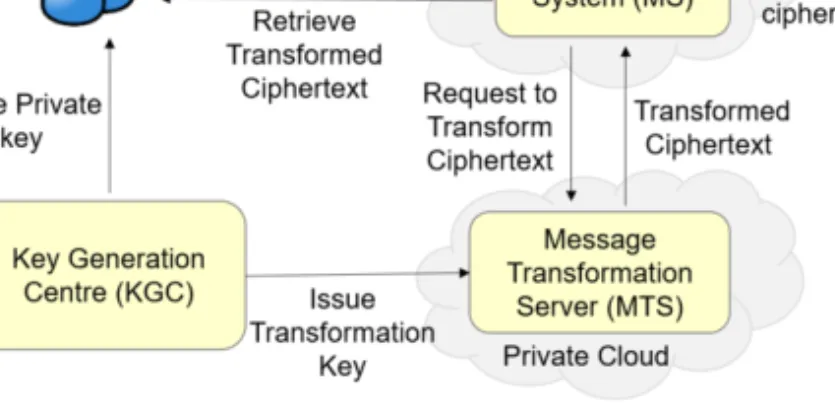
Figure 1. Attribute-Based Secure Messaging System with Outsourced Decryption
Figure 1 illustrates the overall proposed system architecture of ABSM-OD. The sys-tem comprises of four parties namely Key Generation Centre (KGC), Message Transfor-mation Server (MTS), Messaging System (MS) and users. The KGC manages user at-tributes, issues decryption keys to users based on their attributes and generates transfor-mation keys to the MTS. The MTS determines recipients using the access policies of the ciphertexts and transforms the ciphertexts for each recipient. The MS stores two types of ciphertexts, ciphertexts received from the users and ciphertexts transformed by the MTS. Users interact with the MS to send/retrieve ciphertexts.
The KGC generates the public parameter and the master private key, and issues MTS with a signing and verifying key pair. Before a user can send/retrieve ciphertexts, a user needs to be registered in the system. The user generates a signing and verifying key pair and provides the verifying key to the KGC. The KGC registers the user with the verifying key, a set of user attributes and an user identifier, and generates ABE attribute keys (i.e. transformation and decryption keys) for the user. The KGC issues the decryption key to the user and distributes the user identifier, user verifying key, user attributes and trans-formation key to the MTS. Thereafter, the user will be able to send/retrieve ciphertexts.
When the user wants to send a message, the user encrypts the message with an ac-cess policy and signs the ciphertext with a timestamp and the user identifier. The user then sends the ciphertext, timestamp, user identifier and signature to the MS. When the MS receives the ciphertext, the MS requests the user verifying key from the MTS us-ing the user identifier. If the user is unauthorized or revoked, no user verifyus-ing key is returned and the MS will discard the ciphertext. If the user is valid, the MTS will return the user verifying key to the MS for ciphertext verification. If MS fails to verify the ci-phertext, the ciphertext will be discarded. Once the ciphertext is verified, the MS will forward the verified ciphertext to the MTS. As the MS is subjected to attacks in the pub-lic domain, the MTS will verify the ciphertext again. If the verification fails, MTS will discard the ciphertext. Once the ciphertext is verified, MTS resolves the recipients based on the access policy of the ciphertext, transforms the ciphertext for each recipient and signs on the transformed ciphertexts. Thereafter, the MTS requests for MS to store the transformed ciphertexts. When the users request for the ciphertexts, the MS will send the
transformed ciphertexts to the users. Users will verify the transformed ciphertexts using the MTS verifying key. If verification fails, the transformed ciphertexts are discarded. If the ciphertexts are valid, users will use their decryption keys to decrypt the ciphertexts to obtain the original messages.
When a user is compromised, KGC will remove the user verifying key, user at-tributes and transformation key from the MTS. Subsequently, the compromised user will not be able to retrieve existing and new ciphertexts and any new ciphertexts generated by the compromised user will be rejected by the MS or MTS.
3.1. Threat Model
We assume that the KGC is trusted. MTS is honest-but-curious such that it will honestly follow the protocol as required but will attempt to obtain sensitive information such as the message encrypted in a ciphertext. MTS operates within a private cloud and is assumed not to collude with users. MS is untrusted and resides in the public cloud.
Any adversary will be able to compromise and gain access to the MS within the pub-lic domain. If the adversary gain access to the MS, the ciphertexts and the transformed ciphertexts should not reveal sensitive information.
3.2. Design Objectives
• Confidentiality
The main objective is to design a secure messaging system that can provide end-to-end message confidentiality. The sender determines the access policies of the encrypted messages and only privileged users can access the underlying mes-sages.
• Efficient Decryption
As mobile users may have limited resources, it is desirable to reduce the com-putational cost of users in decryption. Towards this end, we adopt an ABE with outsourced decryption [9] to offload decryption operations to the cloud.
• Message Authenticity
With the prevalent of spam and malicious messages, it can be challenging for users to recognize if received messages are valid, hence it will be desirable that received messages are indeed authentic. As the sender will sign on the message ciphertexts and MTS will sign on the transformed ciphertexts, the signing of ci-phertexts will provide the authenticity of the messages.
• Traceability
The source and changes of ciphertexts can be crucial for audit purposes, hence it is desirable for the system to maintain the traceability of the ciphertexts. To achieve traceability, user identifiers are included into the ciphertexts and digital signatures are used by the sender and MTS to sign the ciphertexts.
• Revocation
revoked users should no longer be able to access the system to send/retrieve mes-sages. The use of direct revocation of users with server-aided technique achieves this objective.
4. ABSM-OD Construction
In this section, we describe a concrete construction of ABSM-OD based on ABE-OD [9], symmetric encryption and digital signature.
Assuming that the KGC keeps a listKGCST ORE, storing the user identifieroidu,
user verifying key pku, user attributes Au. A tuple in KGCST ORE is represented as
oidu,pku,Au.
The MTS keeps a listMT SST ORE, storing the user identifieroidu, user verifying
key pku, user attributesAu, transformation keyTKu. A tuple inMT SST OREis
repre-sented asoidu,pku,Au,TKu.
The MS keeps two types of ciphertexts (message ciphertexts and transformed cipher-texts) in the listMSGST ORE. A message ciphertext includes a message identifiermidM, user identifieroidu, access structureAM, message timestamptsM, message ciphertext
CTABEM and ciphertext signatureσCT
ABE. A tuple of message ciphertext inMSGST ORE
is represented asmidM,oidu,AM,tsM,CTABEM ,σCTABE. A transformed ciphertext
in-cludes a new message identifiermidTM
i, sender user identifieroids, recipient user
iden-tifieroidri, a creation timestamptsTMi, transformed ciphertextCT
ABE
TMiand transformed
ciphertext signatureσTi. A tuple of transformed ciphertext inMSGST OREis represented
asmidTM
i,oids,oidri,tsTMi,CT
ABE
TMi,σTi.
System Initialization(MPK,MSK,pkmts,skmts)←Setup(κ,U): During the
initial-ization, KGC runs the ABE setup to create the master secret keyMSKand public pa-rametersMPK(i.e(MPK,MSK)←SetupABE(κ,U)). In addition, KGC issues a pair of signing key and verifying key to the MTS (i.e.(pkmts,skmts)←GenDSfor MTS).
User Registration(DKu,TKu)←RegisterUser(MSK,oidu,pku,Au): To allow a user
u to use the system, KGC needs to register the useru in the system. First, the useru generates a signing and verifying key pair(pku,sku)←GenDSand provides the
verify-ing key pku to the KGC. KGC registers the useru in the system with the user
identi-fieroidu, user verifying keypku, user attributesAuand provides the user identifieroidu,
user verifying key pku to the MTS. KGC performs the Attribute Key Generation(i.e
(DKu,TKu)←KeyGen(oidu,MSK,Au)) to update transformation keyTKuand user
at-tributesAuof useruto the MTS and issues the decryption keyDKuto useru.
Attribute Key Generation (DKu,TKu)←KeyGen(oidu,MSK,Au): When a user
u requires a set of attribute keys, KGC performs the ABE Key Generation (i.e (DKu,TKu)←KeyGenABE(MSK,Au)) to obtain the decryption key DKuand
transfor-mation keyTKuof useru.
Attribute Key Update(DKu,TKu)←KeyUpdate(oidu,MSK,Au): When the user
at-tributes of useruchanges fromAutoA
u, KGC updates the user attributes fromAutoA
KGC revokes the transformation keyTKuof useruon the MTS. Also, KGC performs
Attribute Key Generation(i.e(DKu,TKu)←KeyGen(oidu,MSK,Au)) and updates MTS
with the new transformation keyTKuand new user attributesAu. KGC issues the new decryption keyDKuto useru.
User Revocation1/0←RevokeUser(oidu): When a useruis compromised, the user
u will need to be revoked in the system. KGC and MTS will need to revoke the user verifying key pku, user attributesAuand transformation keyTKuof useru. The tuples
inKGCST OREandMT SST OREwill be updated asoidu,−,−andoidu,−,−,−
re-spectively. Once revoked, any verification of ciphertexts signed by useruwith identifier oiduat the MS and MTS will fail and the MTS will not transform any new ciphertexts
for useru.
Message Encryption CTABE ←EncryptMessage(MPK,M,AM,oidu,sku): When
a user u wants to send a message M, the user u will specify the access structure AM to encrypt the message. The useru generates a random keykM←GenSE to en-crypt the message M (i.eCTM=EncSE(kM,M)). The user u performs the ABE en-cryption on the random key kM with access structure AM to get the key ciphertext
CTABEk
M =Encrypt
ABE(MPK,
kM,AM). The ciphertextCTABEM = (CTM,CTABEk M)forms
the ciphertext for the messageM. The ciphertextCTABEM , a message identifier midM, user identifier oidu and ciphertext timestamp tsM forms the ciphertext CTABEM =
(midM,oidu,AM,tsM,CTABEM ) for the MS. Before sending the ciphertext CTABEM,
the useru signs the ciphertextCTABE
M with the user signing key sku (i.eσCTABE ←
SignDS(sku,CTABEM)) and sends the ciphertextCTABE = (CTABEM,σCT
ABE)to MS.
MS and MTS will verify the ciphertextCTABE= (CTABEM,σCT
ABE)using the user
verifying keypku(i.eVerifyDS(pku,CTABEM,σCT
ABE)). Once the ciphertext is verified,
the MTS determines recipients with attributes that satisfies the access structureAMof the ciphertextCTABE. With the list of recipientsRAM, the MTS uses the transformation
keyTKriof each recipientri∈RAMto transform the ciphertextCTABE.
Message TransformationCTTM
i←TransformMessage(CTABE,oidri,TKri,skmts):
The MTS parses the ciphertext CTABE = (CTABEM,σCT
ABE), then parses ciphertext
CTABEM = (midM,oidu,AM,tsM,CTABEM )and transforms the ciphertextCTABEM for a
useru. The MTS transforms the key ciphertextCTABEk M (CT
ABE
M = (CTM,CTABEkM)) to get
the transformed key ciphertextCTABEout
i =Transform
ABE(TK ri,CT
ABE
kM)for a useru. Once
the key ciphertextCTABEk
M is transformed, MTS needs the MS to store the transformed
ciphertextCTABEout
i. The ciphertext CT
ABE
TMi= (CTM,
CTABEout
i)forms the transformed
ci-phertext for user u. A transformed message identifiermidTM
i, sender user identifier
oidu, recipient user identifieroidri and timestamptsTMi form the transformed
cipher-textCTTi= (midTMi,oidu,oidri,tsTMi,CT
ABE
TMi)for useruthat will be stored by MS.
signature σTi (i.e σTi ←Sign
DS(sk
mts,CTTi)). The MTS will then send the ciphertext
CTTMi= (CTTi,σTi)to the MS. It outputs the transformed ciphertextCTTMi.
Message DecryptionM/⊥ ←DecryptMessage(CTTM
i,pkmts,DKri): When a user
ureceives the transformed ciphertextCTTM
i= (CTTi,σTi), the useruverifies the
trans-formed ciphertextCTTM
iwith MTS verifying keypkmts(i.eVerify
DS(pk
mts,CTTi,σTi)).
Once the transformed ciphertext is verified, the user will decrypt the transformed key ciphertextCTABEout
i using the decryption keyDKri to retrieve the random keykM/⊥=
DecryptABE(DKri,CT
ABE
outi)or⊥indicates error.
If the useruis able to retrieve the random keykM. The useruperforms the decryp-tion to retrieve the messageM/⊥=DecSE(kM,CTM). If the decryption fails, an error
⊥will be returned to the user indicating an error. 4.1. Security Analysis
This section analyses the security of the system.
• Confidentiality
Since all the ciphertexts are stored in the encrypted forms, malicious users whose attributes do not satisfy the access policy of the ciphertext cannot obtain the con-tent of the underlying message. Therefore, our ABSM-OD system preserves the confidentiality of the data users.
• Efficient Decryption
With the use of ABE-OD scheme, the MTS will help the privileged users with decryption and each user will only be required to perform the final decryption to retrieve the original message, hence reducing the computational cost require-ments on the users.
• Message Authenticity
Any modification of ciphertexts will be detected by the signature verification.
• Traceability
When some ciphertexts or transformed ciphertexts are found with issues, the ci-phertexts can be traced back to the source according to the ciphertext signature.
• Revocation
Once a user is revoked from the system, KGC updates the list in the MTS. The ciphertext with a signature signed by a user that is not in the user list in the MTS will not be accepted by MTS. Also, no ciphertext will be transformed for revoked users as there is no transformation key in the MTS for revoked user. Users are effectively revoked from the system.
5. Implementation
We implemented the ABSM-OD as a Simple Chat System in Java. Tests were conducted for the main functions of the system. In the tests, we measure the recipients resolution
time, encryption time, transformation time and decryption time with different number of attributes and data size. The recipients resolution time is the time taken to determine the number of recipients based on the access policy of a ciphertext. Other performance over-heads like database, disk and network latency which are dependent on the deployment are not the focus of our tests.
We tested the performance of recipients resolution on a system with Intel i7 2.6GHz processor with 768 MB of RAM. Assuming that the system is supporting 10K users, we generated random messages that are encrypted with access policies of 10 attributes and operators (”AND”/”OR”). The results indicate that the system is able to resolve on average 1404 recipients in around 514ms.
We also tested the performance of cryptographic operations on a system with Intel i7 2.6GHz processor with 8 GB of RAM. We generated random messages of different sizes (1-64 MB) with access policies of 10 attributes and ”AND” operators. The messages were encrypted with an average time of around 556ms, transformed around 144ms and decrypted around 7ms. To test for possible worst case situation, we generated messages of different sizes (1-64 MB) with access policies of 50 attributes and ”AND” operators. The messages were encrypted with an average time of around 2.8s, transformed around 728ms and decrypted around 7ms. Table 1 summarized the preliminary results.
Table 1. Performance of Cryptographic Operations No of Attributes Message Size Operators Average Time
Encryption Transformation Decryption 10 1-64 MB AND 556ms 144ms 7ms 50 1-64 MB AND 2.8s 728ms 7ms
6. Related Work
Attribute-Based Encryption- ABE schemes can be broadly categorized into two cate-gories namely, Key Policy ABE (KP-ABE) and Ciphertext- Policy ABE (CP-ABE). In KP-ABE schemes, ciphertexts are associated with attributes while decryption keys are associated with access structures. However, in CP-ABE schemes, the association is re-versed where ciphertexts are associated with access structures while decryption keys are associated with attributes.
The concept of ABE was first proposed by Sahai and Waters [13] as a type of Fuzzy Identity Based Encryption (Fuzzy-IBE) scheme. Subsequently, Goyal et al. [8] intro-duced the notion of KP-ABE and CP-ABE and provided the construction for KP-ABE scheme. Soon after, Bethencourt et al. [3] provided the construction for CP-ABE. Initial work on ABE schemes focus on monotonic access structures, but soon, Ostrovsky et al. [10] proposed an ABE scheme with non-monotonic policies to represent negative con-straints. To meet the need for complex access policy, several efforts focus on providing more fine-grained access control. For instance, Bobba et al. [5] extended CP-ABE by rep-resenting attributes as a recursive set structure and named the scheme Ciphertext-policy Attribute-Set-Based Encryption (CP-ASBE or ASBE) while Wang et al. [16] introduced Hierarchical Attribute-Based Encryption (HABE) by combining Hierarchical Identity-based Encryption (HIBE) with CP-ABE. Thereafter, Wan et al. [15] introduced
Hierar-chical Attribute-Set-Based Encryption (HASBE) by extending ASBE with users orga-nized into a hierarchical structure to provide a more scalable, flexible and fine-grained control of ABE.
Revocable ABE- Attrapadung and Imai [1] proposed two types of revocation tech-niques, namely direct revocation and indirect revocation. Direct revocation is performed by sender specifying the revocation list while indirect revocation is enforced by the key authority providing key updates to non-revoked users. Attrapadung and Imai [2] also presented a hybrid revocable attribute encryption (HR-ABE) by combining the two tech-niques and data owner may select either technique. Boldyreva et al. [6] proposed an ef-ficient revocable KP-ABE scheme by improving the key updates. Sahai et al. [12] pro-posed a revocable scheme by revoking stored data together with key updates. Yang et al. [18] proposed a revocable ABE scheme by denying user decryption capability via a cloud server.
Secure Messaging - Messaging protocols and solutions secure messages with a wide range of techniques [14]. In particular, ABE is an upcoming and promising tech-nique that can achieve secure messaging. Bobba et al. [4] proposed Attribute-Based Mes-saging (ABM) by integrating ABE with Mail Transfer Agent (MTA). Weber et al. [17] proposed MundoMessage which integrated ABE and Location-Based Encryption (LBE) into emergency communication. In healthcare, Picazo-Sanchez et al. [11] incorporated ABE into messaging protocol for monitoring and managing the medical wireless body area networks (WBANs). Unger et al. [14] evaluated existing messaging systems and established that messaging systems face three key challenges: trust establishment, con-versation privacy and transport privacy. They also proposed a framework to evaluate the properties of messaging systems.
7. Conclusion
In this paper, we proposed a system architecture for an Attribute-Based Secure Messag-ing System with Outsourced Decryption (ABSM-OD) that provides end-to-end message security in the cloud. ABSM-OD is built upon ABE-OD scheme [9] and achieves three key features namely fine-grained access control, outsourced decryption and effective user revocation. Our prototype implementation demonstrates the feasibility of the architec-ture with reasonable performance. From our preliminary results, the system is able to determine recipients from the access polices of ciphertexts within an acceptable amount of time. Also, the decryption of transformed ciphertexts are more manageable for mobile users. Hence, ABSM-OD can provide scalable and secure messaging within the public cloud.
Acknowledgments
This research work is supported by the Singapore National Research Foundation under the NCR Award Number NRF2014NCR-NCR001-012.
References
[1] N. Attrapadung and H. Imai.Attribute-Based Encryption Supporting Direct/Indirect Revocation Modes, pages 278–300. Springer Berlin Heidelberg, Berlin, Heidelberg, 2009.
[2] N. Attrapadung and H. Imai. Conjunctive Broadcast and Attribute-Based Encryption, pages 248–265. Springer Berlin Heidelberg, Berlin, Heidelberg, 2009.
[3] J. Bethencourt, A. Sahai, and B. Waters. Ciphertext-policy attribute-based encryption. InProceedings of the 2007 IEEE Symposium on Security and Privacy, SP ’07, pages 321–334, Washington, DC, USA, 2007. IEEE Computer Society.
[4] R. Bobba, O. Fatemieh, F. Khan, A. Khan, C. A. Gunter, H. Khurana, and M. Prabhakaran. Attribute-based messaging: Access control and confidentiality. ACM Trans. Inf. Syst. Secur., 13(4):31:1–31:35, Dec. 2010.
[5] R. Bobba, H. Khurana, and M. Prabhakaran. Attribute-sets: A practically motivated enhancement to attribute-based encryption. InProceedings of the 14th European Conference on Research in Computer Security, ESORICS’09, pages 587–604, Berlin, Heidelberg, 2009. Springer-Verlag.
[6] A. Boldyreva, V. Goyal, and V. Kumar. Identity-based encryption with efficient revocation. In Proceed-ings of the 15th ACM Conference on Computer and Communications Security, CCS ’08, pages 417–426, New York, NY, USA, 2008. ACM.
[7] T. Frosch, C. Mainka, C. Bader, F. Bergsma, T. Holz, et al. How secure is textsecure? In2016 IEEE European Symposium on Security and Privacy (EuroS&P), pages 457–472. IEEE, 2016.
[8] V. Goyal, O. Pandey, A. Sahai, and B. Waters. Attribute-based encryption for fine-grained access control of encrypted data. InProceedings of the 13th ACM conference on Computer and communications security, pages 89–98. ACM, 2006.
[9] M. Green, S. Hohenberger, and B. Waters. Outsourcing the decryption of abe ciphertexts. InProceedings of the 20th USENIX Conference on Security, SEC’11, pages 34–34, Berkeley, CA, USA, 2011. USENIX Association.
[10] R. Ostrovsky, A. Sahai, and B. Waters. Attribute-based encryption with non-monotonic access struc-tures. InProceedings of the 14th ACM Conference on Computer and Communications Security, CCS ’07, pages 195–203, New York, NY, USA, 2007. ACM.
[11] P. Picazo-Sanchez, J. E. Tapiador, P. Peris-Lopez, and G. Suarez-Tangil. Secure publish-subscribe pro-tocols for heterogeneous medical wireless body area networks.Sensors, 14(12):22619, 2014. [12] A. Sahai, H. Seyalioglu, and B. Waters.Dynamic Credentials and Ciphertext Delegation for
Attribute-Based Encryption, pages 199–217. Springer Berlin Heidelberg, Berlin, Heidelberg, 2012.
[13] A. Sahai and B. Waters. Fuzzy identity-based encryption. InProceedings of the 24th Annual Interna-tional Conference on Theory and Applications of Cryptographic Techniques, EUROCRYPT’05, pages 457–473, Berlin, Heidelberg, 2005. Springer-Verlag.
[14] N. Unger, S. Dechand, J. Bonneau, S. Fahl, H. Perl, I. Goldberg, and M. Smith. Sok: Secure messaging. In2015 IEEE Symposium on Security and Privacy, pages 232–249, May 2015.
[15] Z. Wan, J. Liu, and R. H. Deng. Hasbe: A hierarchical attribute-based solution for flexible and scalable access control in cloud computing.IEEE Transactions on Information Forensics and Security, 7(2):743– 754, April 2012.
[16] G. Wang, Q. Liu, J. Wu, and M. Guo. Hierarchical attribute-based encryption and scalable user revoca-tion for sharing data in cloud servers.Comput. Secur., 30(5):320–331, July 2011.
[17] S. G. Weber, Y. Kalev, S. Ries, and M. M¨uhlh¨auser. Mundomessage: Enabling trustworthy ubiquitous emergency communication. InProceedings of the 5th International Conference on Ubiquitous Infor-mation Management and Communication, ICUIMC ’11, pages 29:1–29:10, New York, NY, USA, 2011. ACM.
[18] Y. Yang, X. Ding, H. Lu, Z. Wan, and J. Zhou.Achieving Revocable Fine-Grained Cryptographic Access Control over Cloud Data, pages 293–308. Springer International Publishing, Cham, 2015.