3
Developing an IS/IT Strategy:
Establishing Effective
Processes
Developing an IS/IT strategy is taken to mean thinking strategically and planning for the effective long-term management and optimal impact of information in all its forms: information systems (IS) and information technology (IT) incorporating manual and computer systems, computer technology and telecommunications. It also includes organizational aspects of the management of IS/IT.
A concise but somewhat narrower definition offered by Lederer and Sethi' is 'the process of deciding the objectives for organizational com-puting and identifying potential computer applications which the organ-ization should implement.' A further perspective, underpinning the close relationship between business and IS strategies is: 'An IS strategy brings together the business aims of the company, an understanding of the information needed to support those aims, and the implementation of computer systems to provide that information. It is a plan for the devel-opment of systems towards some future vision of the role of IS in the organization.'2 A more recent definition, which fits with the approach of this book, is 'the process of identifying a portfolio of computer-based applications to be implemented, which is both highly aligned with corporate strategy and has the ability to create an advantage over competitors.'3
The most common aims for organizations adopting an IS/IT strategy process are:
• alignment of IS/IT with the business to identify where IS/IT contributes most, and the determination of priorities for investment;
• gaining competitive advantage from business opportunities created by using IS/IT;
Developing an IS/IT Strategy: Establishing Effective Processes 119 • building a cost-effective, yet flexible technology infrastructure for the
future;
• developing the appropriate resources and competencies to deploy IS/ IT successfully across the organization.
This chapter is concerned with establishing a framework and process for developing IS/IT strategies. It assumes that it must be closely integrated with business strategy, and that, to be effective, it must be a continuous process, with a flow of deliverables that dovetail with the outcomes of business strategic thinking and planning.
Where an IS/IT strategy-formulation process has not become estab-lished, it may be necessary to undertake initiatives in one or more areas of the business, to foster awareness of the importance of delivering real benefits to the business through the deliberate application of IS/IT in support of its critical business needs, and to achieve the transition in an acceptable timescale. This will also offer the opportunity to ensure that old, inappropriate planning methods are stopped, and better, more comprehensive approaches are adopted. The process should introduce the required disciplines, controls and new techniques, establish good relationships, and identify tasks and responsibilities and thus define planning resource requirements. However, as soon as possible, the IS/ IT strategy process needs to become an integral part of the development of business strategy, business plans and their subsequent implementation.
One of the most compelling arguments for integrating business and IS strategy formulation and planning is so that the finite resources of the business can be allocated in a coherent manner to achievable strategies and plans that collectively will deliver benefits to the business.
The IS/IT Strategy Process: Some Definitional Clarity
The writings in the area of IS/IT strategy can be a little confusing, not least because of the variety of terms encountered and the inconsistent usage of language for seemingly similar concepts. In the research literature, 'strategic information systems planning' (SISP), 'information systems planning' (ISP), 'information systems strategy planning' (ISSP) and 'business systems planning' are just some of the terms frequently encountered. Examining the meanings of these concepts as they are used reveals that they are essentially similar. Indeed, the emphasis on 'planning' probably originates as a consequence of portraying IS/IT as part of the implementation of the business strategy—IS/IT investments were planned once the business strategy had been formulated. With IS/IT increasingly shaping the strategy of a business, the strategizing aspect
must be emphasized.
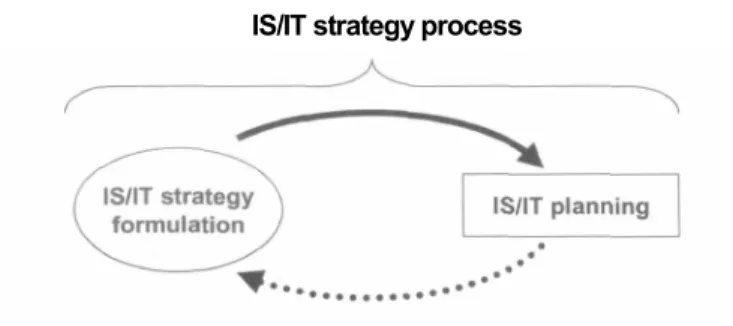
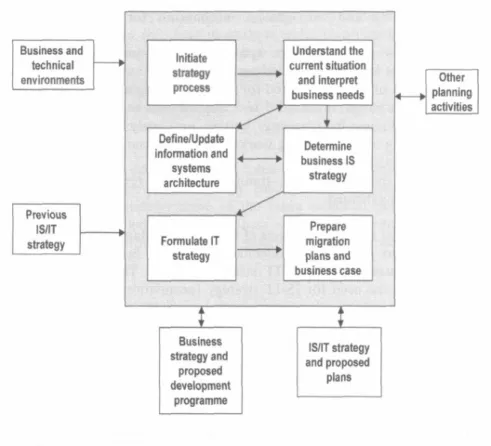
Figure 3.1 IS/IT strategy process
In this book, a distinction is made between IS/IT strategy formulation and IS/IT planning—this difference between 'strategy' and 'planning' was addressed in Chapter 2. Formulation is concerned with developing the IS/IT strategy and is addressed in this book through a process of alignment and competitive impact. Once that strategy has been formulated, an implementation plan can then be constructed—IS/IT planning. The IS/IT strategy process refers to both formulation and planning (see Figure 3.1). While the IS/IT strategy drives IS/IT planning, constructing the IS/IT plan may reveal aspects that cause the IS/IT strategy to be reconsidered.
THE EVOLUTION OF THE IS/IT STRATEGY PROCESS: FROM TECHNOLOGY FOCUS TO STRATEGIC FOCUS
Research has highlighted that, in many organizations, approaches to IS strategy formulation have tended to follow an evolutionary process. In Stage 1, the focus is on planning to deliver technology. At Stage 5, the organization has reached a stage of maturity where the emphasis is on assessing the competitive impact of IS/IT and in ensuring the alignment between business strategies and IS/IT investments. This evolution can be explained as follows:
• Stage 1—typical early data processing (DP) planning—the IT de-partment need to plan the interfaces between applications developed separately, project by project, in order to make them work effectively and efficiently, both in business operations and the utilization of technology. Obtaining management understanding of the increasing dependence of the business on its systems is the key objective, to enable a more coherent, less piecemeal, approach to be adopted. Essentially, support applications are being built and management
The Evolution of the IS/IT Strategy Process 121
perceives IS/IT in that limited role, but the dependence is steadily increasing.
• Stage 2—management, now aware (often because of some crisis or key system failure), initiate a top-down review of IS/IT applications in the light of business dependence—priorities are agreed based on the relative importance of business needs. For example, should the order processing redevelopment take precedence over the new sales analysis system? The approaches used are very methodological, normally based on derivatives of IBM's 'Business Systems Planning'4 or similar methodologies, and involve gaining a management consensus of criticalities and priorities. An extended, prioritized 'shopping list' of key operational type applications for both operational and management information requirements will generally result.
• Stage 3—the next stage is centred around detailed IS/IT planning, to determine the best way of implementing the applications and supporting technologies or, in some cases, reimplementing existing systems in more appropriate, integrated and perhaps less costly ways. The portfolio needs to be better balanced—greater attention is paid to the now (perceived to be critical) key operational systems and less resource is dedicated to support applications, each having been 'prioritized' in Stage 2. An 'Application Support Centre' or 'Help desk'5 concept may be implemented for support-type systems, and application packages will probably be introduced to rationalize and replace internally-developed systems. Stage 3 can take considerable time to implement effectively and, while this is going on, nothing else can really happen, since all IT resources are budgeted against a known detailed 2-3-year plan.
Through Stages 1 to 3, the evolution from isolated 'efficiency'-driven applications to integrated 'effectiveness' systems has been occurring— but the objective has not yet been overt use of IS/IT for competitive advantage; the main purpose is to stop IS/IT being problematic and to ensure that it is causing no disadvantages.
• Stage 4—the users take the reins, not necessarily encouraged by senior management, but not discouraged either, because they do not wish to prevent business-led, entrepreneurial use of IS/IT by users seeing new opportunities, using information in new ways to provide business leverage/competitive advantage. This may start during Stage 3 as frustration builds up in the 'jam tomorrow' stage of detailed planning and implementation. It is important that users, unfettered in any way by IS/IT procedure or control, exercise this
freedom to innovate, even if 90% of the ideas are of little strategic potential. It is the source of tested ideas that, with later IS/IT support, can be turned to advantage—literally, high potential opportunities driven by the business. Many strategic applications originate this way.6 • Stage 5—this is the difficult stage to reach, particularly if Stage 3 is
delayed and Stage 4 is more user-rebellion than business stimulated innovation. It requires bringing it all back together—not just IS/IT-based strategy formulation as in Stage 2, but also the formulation of business strategy. In essence, the innovation ideas of Stage 4 require evaluation in the business context along with the opportunities now made available from the key operational infrastructure (i.e. the knowledge of what to do and the ability to deliver it effectively). Linking IS/IT potential to the business strategy is the main task, and this requires the simultaneous attention of senior executives, line management and IT specialists—the first time in this process that they have all acted as a coalition together. There is no 'methodology' available—multiple methods implies business strategizing and planning methods plus IS/IT top-down and bottom-up approaches. Strategic applications can be identified and agreed upon in the context of the business strategy.
The 'process' does not always occur sequentially in an organization, and there will always be overlap across the stages. In large organizations, different businesses or functions may be at different stages in their evolu-tion. What is surprising, in some ways, is how often the stages are followed quite sequentially as an organization gets more sophisticated in its application and deployment of IS/IT. All these variations on the IS/IT strategy process will be discussed in more detail later in the book, with special focus on the latter stages, which most organizations now have to address successfully.
APPROACHES TO IS/IT STRATEGY DEVELOPMENT
There is a difference between having an IS/IT strategy and having an IS/ IT strategy that is closely aligned and integrated with the business strategy. Over the years, organizations have adopted a variety of approaches in planning IS/IT investments; unfortunately, these have not always resulted in the organization deploying IS/IT strategically. Larl7 has studied the changing focus and increasing maturity of the IS/ IT strategy process in a number of organizations and has identified five main types of approach. The chief characteristics of these five types are
Approaches to IS/IT Strategy Development 123
summarized in Table 3.1, adapted from Earl's more detailed assessment. The analysis considers the main task that is carried out, the main objectives, who drives the planning forward and the approaches adopted. By looking at each of these aspects, the effectiveness of the linkage between IS/IT strategy and business strategy can be determined, and consequently how likely the organization is to gain competitive advantage from IS/IT. This implies that, although an organization should develop more 'mature' approaches to IS/IT strategy formulation and planning in order to achieve a full and relevant portfolio, some earlier approaches need to be maintained in order to manage the total matrix of applications. Not every application of IT needs all the complexity implied in Stage 5. However, one thing is certain, if the organization is poor at formulating business strategy, it will have considerable difficulty developing an IS/IT strategy.
An organization can identify from the types of planning approaches in place (i) where it is in relation to the eventual need for integration of IS/ IT and business planning, and (ii) which approaches it needs to adopt in the short term to move it toward that eventual goal.
The names given by Earl to the dominant rationale at each stage (see the summary description in Table 3.1) imply the following:
1. Business led—carried out mainly by IT specialists who define an IS/ IT investment plan based on the current business strategy. While acknowledging IS as a strategic resource, with this approach the organization is taking the view that business strategy should lead IS/IT strategy and not the other way around. The business strategy is not challenged and the approach does not explore competitive opportunities through IS/IT unless incorporated in the business strategy.
2. Method driven—the use of techniques (often a consultant's method-ology) to identify IS needs by analysing business processes—an 'engineering' philosophy based on top-down analysis of information needs and relationships.
3. Technological—IS/IT planning is seen as an exercise in process and information modelling. Here, IS professionals use analytical modelling and tools (e.g. Computer Aided Software Engineering [CASE]) to produce IS plans in the form of blueprints—perhaps one each for applications, data, communications and computing. Earl noted that the word 'architecture' may replace 'plans' or 'strategies'.8
4. Administrative—the main objective is to establish IT capital and expense budgets and resource plans to achieve approved IS applica-tions, usually based on a prioritized wish list from users. Business
systems planning', MIS Quarterly, Vol. 17, No. 1, 1993, 1-24) MJ. Earl, 'Experiences in strategic information
Stage 1 Stage 2 Stage 3 Stage 4 Stage 5
Linkage to business strategy Integrating IS and business strategies Coalition of users/ management and IT Multiple method at same time Strategic/Competitive advantage Pursuing opportunities Main task IS/IT application Defining business Detailed IS planning
mapping needs
Key objective Management Agreeing priorities Balancing the understanding portfolio
Senior management User and IT together initiative
Executives/Senior management and users Entrepreneurial (user innovation)
Direction from IT led
Main approach Bottom-up Top-down analysis Balanced top-down development and bottom-up
'Organization led' Summary 'Technology led' 'Method driven' 'Administrative' 'Business led'
Problems and Barriers 125
plans, usually at a functional level, are analysed to identify where IS/ IT is most critical in meeting short to medium-term needs. 5. Organizational— the development of key themes for IS/IT investment derived from a business consensus view of how IS/IT can help meet overall business objectives, agreed by the senior management team.
It is not too difficult to align these approaches to the characteristics of the planning environments described by Sullivan (see Figure 1.9). The fit is not exact but the Technology led, Method driven and Administrative approaches are more appropriate and practical where diffusion is low (i.e. low decentralization of IS/IT control) and fit the needs of the tradi-tional and backbone environments best. Business led and Organizatradi-tional appear more relevant to high degrees of diffusion, the former being most appropriate for creating new opportunities and the latter for providing the eclectic type of planning for the 'complex' part of the matrix.
In an empirical study using Earl's descriptions, Doherty et a/.9 found that the Organizational, Business-led and Administrative approaches could be identified and clearly distinguished in the sample of 267 com-panies. The study also showed that the organizations believed they were more successful in IS planning if they followed the Organizational approach; of the three, Business-led came second and Administrative was third. They argued that the Organizational approach had, based on the survey evidence, very similar characteristics to the 'rational adaptation' mode of planning that Segars et al.10 had observed as the most successful approach in their study.
Doherty and colleagues, however, could not clearly distinguish between Method led and Technology led, even in their large sample, and suggested that the two, together, formed an intrinsically IT-led approach they called 'systematic'. This is a reasonable conclusion, given that, over the last decade, many large application and utility software packages have effectively become part of the infrastructure. Application software and technology plans cannot always be separated, but require highly integrated, detailed planning (i.e. systematic). In the survey, the
systematic approach had a similar level of perceived success as Business led.
PROBLEMS AND BARRIERS
Despite an understanding of the importance of strategic planning for IS, in the past decade many organizations have developed perfectly sensible IS strategies that have been left to gather dust, or have been implemented
in a half-hearted manner, because they did not have enough management commitment invested in them. These were not merely uplifted user 'wish lists' that had been renamed 'strategies', nor IT-inspired total systems— information and technology architectures—that never deserved to gain business backing. Rather, they were derived from a thorough investigation of business needs and priorities, driven from business strategy and objectives, and constructed by business teams. They may have even obtained the sought-after sign-off from the board, but were then left with the IS function to implement them, while management got on with its 'real' job of running the business.
A number of surveys have attempted to identify criteria for successful IS/IT strategy development. Lederer and Mendelow11 surveyed 20 US companies to determine the senior management problems preventing effective development of IS/IT strategic plans. An earlier survey had shown that obtaining top-management commitment was a prerequisite for success, but that it was often difficult to obtain. Their research iden-tified the following reasons for this, in order of frequency of occurrence: 1. Top management lacked awareness of the impact IS/IT is having
generally and did not understand how IS/IT offered strategic advan-tages. They tended to see 'computers' in purely an operational context—still essentially a DP era view.
2. They perceived a credibility gap between the 'hype' of the IT industry as to what IT can actually do and how easy it is to do it, given the difficulties their organization had had in delivering the claimed benefits.
3. Top managers did not view information as a business resource to be managed for long-term benefit. They only appreciated its criticality when they could not get what they needed.
4. Despite the difficulty in expressing all IS benefits in economic terms, top management still demand to see a financial justification for investments.
5. Finally, and an increasingly apparent problem today, is that top managers have become action orientated with a short-term focus that militates against putting much effort into long-term planning, especially of IS/IT, given the other issues above.
In a similar UK survey, Wilson12 identified a number of barriers that prevented an effective IS/IT strategy being developed and then implemented. Organizations claiming to have an IS/IT strategy (73 of the total of 186 surveyed) were asked to identify barriers inhibiting, first, the development of the strategy and, second, implementing it. In this survey, top-management commitment was less critical than the ability to measure
Problems and Barriers 127
benefits from the overall plan, to deal with major business issues such as diversification or growth and to provide appropriately-skilled user and IT resources. The factors cited seem to reflect views based on the past evolution of IS/IT, rather than its future implications. The survey also highlights one or two of the 'softer' issues—politics and middle manage-ment's insecurity in the face of change. Ninety per cent of respondents claimed that the IS/IT strategy was either a formal, documented part of the business strategy, or that the strategy was aligned to strategic aims.
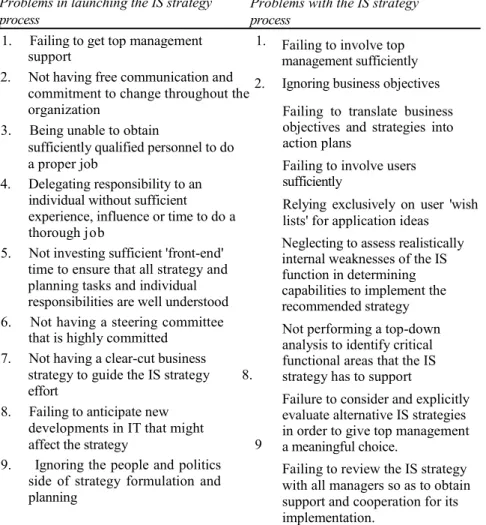
In a more recent survey of senior IS executives, Teo and Ang13 identified the major problems associated with the IS/IT strategy process. Dividing the process into three phases (the launch phase, the plan development phase and the implementation phase), they reported that, in all three phases, failing to secure top management support is the most serious problem. Not having free communication flow and not being able to obtain sufficiently-qualified personnel are the other two major problems in the first phase. In the second phase, respondents reported ignoring business goals and failing to translate these goals/strategies into action plans as major problems as well. Table 3.2 summarizes the top problems in the first two phases.
Earl's survey of 21 UK companies, referred to earlier, ranked the unsuccessful features of strategic IS planning as: resource constraints, the strategy not implemented fully, lack of top management acceptance, length of time involved, and poor user—IS relationships. In research exploring the enablers and inhibitors of alignment between IS and business strategies, Luftman and Brier14 identified the six most important enablers and the six main inhibitors (see Table 3.3). What is striking about these is that the same topics (executive support, understand the business, IT-business relations and leadership) show up as both enablers and inhibitors. Our research supports these conclusions.15
All these surveys indicate that several of the prime requirements for the effective formulation of IS/IT strategy revolve around people. Undoubt-edly, it is essential for knowledgeable, experienced, highly skilled and well-motivated staff to be involved and for them to be committed to the work. This was borne out by the findings of Lederer and Sethi16 in their survey of 80 companies. The pitfalls in establishing an effective IS/ IT strategy process relating to people, which were among the most fre-quently cited, are listed in Table 3.4.
While all the foregoing problems and barriers focus on IS strategy, a number of them originate in the business strategy, and many of the same problems could be cited for business strategy development and planning. This is partly because the strategic developments required for organiza-tions to meet the challenges facing them are often poorly served by traditional, functionally orientated business plans. For example, many
Table 3.2 Problems encountered in the IS strategy process ("source: adapted from T.S.H. Teo and J.S.K. Ang, 'An examination of major IS planning problems', International Journal of Information Management, Vol. 21, 2001, 461)
Problems in launching the IS strategy process
Problems with the IS strategy process
1. Failing to get top management 1. support
2. Not having free communication and commitment to change throughout the organization
3. Being unable to obtain
sufficiently qualified personnel to do a proper job
4. Delegating responsibility to an individual without sufficient experience, influence or time to do a thorough job
5. Not investing sufficient 'front-end' time to ensure that all strategy and planning tasks and individual responsibilities are well understood 6. Not having a steering committee
that is highly committed 7. Not having a clear-cut business
strategy to guide the IS strategy 8. effort
8. Failing to anticipate new developments in IT that might
affect the strategy 9
9. Ignoring the people and politics side of strategy formulation and planning
Failing to translate business objectives and strategies into action plans
Failing to involve users sufficiently
Relying exclusively on user 'wish lists' for application ideas Neglecting to assess realistically internal weaknesses of the IS function in determining capabilities to implement the recommended strategy Not performing a top-down analysis to identify critical functional areas that the IS strategy has to support
Failure to consider and explicitly evaluate alternative IS strategies in order to give top management a meaningful choice.
Failing to review the IS strategy with all managers so as to obtain support and cooperation for its implementation.
organizations have an impressive array of mission statements, objectives, values, critical success factors and performance targets, but when the task of translating the strategy into effective and coordinated action plans has been left to the functional directorates, it has all too rarely been consolidated and managed as an integrated business-wide program. The functions have been, on the whole, too focused on current problems to be able to put a satisfactory strategic perspective into their plans.
Failing to involve top management sufficiently 2. Ignoring business objectives
The Environment of the IS/IT Strategy 129
Table 3.3 Enablers and inhibitors of strategic alignment ("source: J. Luftman and T. Brier, 'Achieving and sustaining business-IT alignment', California Management Review, Fall, 1999, 109-122)
Enablers Inhibitors
• Senior executive support • IT/business lacks close
for IT relationships
• IT involved in strategy • IT does not prioritize well development • IT fails to meet commitments • IT understands the business • IT does not understand business • Business-IT partnership • Senior executives do not • Well-prioritized IT projects support IT
• IT demonstrates leadership • IT management lacks leadership
Table 3.4 Pitfalls to planning, in relation to people (source: adapted from A.L. Lederer and V. Sethi, 'The implementation of strategic information systems planning methodologies', MIS Quarterly, Vol. 12, No. 3, 1988, 445-461)
Problems, listed in order of severity
1. Difficulty in obtaining top management commitment for implementing the plan 2. Success of the approach is greatly dependent on the planning team leader 3. Difficulty in finding a team leader who meets the criteria specified for the role 4. Difficulty in convincing top management to fund the planning exercise 5. Difficulty in finding team members who meet the specified criteria 6. The exorbitant number of hours demanded from top management 7. Failure to establish a permanent planning group as a result of the planning
exercise
8. Time and expense involved in finding planning support staff
THE ENVIRONMENT OF THE IS/IT STRATEGY
The requirement to determine the information systems strategy over an extended period demands that a consolidated approach should retain the flexibility to respond to changing business and organizational needs and incorporate new IS/IT options. In order to do that, the processes used to analyse situations and assess opportunities must be capable of being revisited in part, at any time, to assess the implications without a major rethink of the whole strategy.
In Chapter 1, a simple model relating business, IS and IT strategies was described (see Figure 1.6). In Chapter 2, a view of the business strategic process that considered the realities of attempting to plan in
an ever-changing environment was also described (see Figure 2.3). Com-bining this view from Johnson and Scholes17 with the earlier, simpler model, a more comprehensive and pragmatic model can be denned, which describes the environment within which IS/IT strategy formulation and planning takes place.
Figure 3.2 shows that, while, at any one time, a comprehensive analysis of the business and IS/IT internal and external environments can be carried out to define an intended set of strategies, it is unlikely that all aspects of these strategies will be realized. Changes will occur in both the business and IT environments, and these will cause changes to be made to the IS strategy. The 'intended' IS strategy may also fail to be implemented successfully and hence will have to be revised either in timescale or content.
In addition, changes in the business or IT environments may impose constraints on the IS strategy or open up new IS opportunities. These factors, which force changes from the intended strategies, will not always occur at convenient moments in the planning cycle! All three strategies, business, IS and IT, must be realigned whenever new opportunities or constraints emerge. Equally importantly (and this is often overlooked), these changes to the strategy will make parts of the old strategy redun-dant. In many organizations, considerable IS/IT effort and resource can be consumed pursuing effectively obsolete requirements because the plans, derived perhaps a year earlier, have been overtaken by events— events that have not been interpreted in terms of their effects on the IS/IT developments already under way. This problem can be compounded where large IS/IT projects are involved and the majority of the money has been spent—'we've started, so we'll finish' seems to be the rule, even if by finishing the system development no actual benefits will now occur! Even in such circumstances it is best to stop work and redirect the resources to the new emerging needs.
The need to be able to revisjt and revise any aspect of the strategies implies that, as far as possible, all facets of the internal and external environments that can affect the strategies are included in the initial derivation. Then, if any of them change, the implications of the changes can more easily be identified and understood in order to revise the strategies appropriately.
THE CHALLENGES OF PLANNING STRATEGICALLY FOR IS/IT TODAY
The necessity to improve return on investments, coupled with the high risk potential of investing very substantial sums unwisely, have long been
key objectives for developing a strategy for IS/IT. Prominent among them are the vast sums of money that organizations have spent on 'e-commerce' or 'Internet' strategies that have, on average, delivered little business value to date. In addition, an ever-increasing number of examples, cited as demonstrating improved competitive success resulting from implementing computer and telecommunications systems, has also boosted awareness and interest. American Airlines, Merrill Lynch, American Hospital Supplies, Thomson's Holidays and several others were reported so extensively, in the 1980s and 1990s, that they have been elevated almost to legend status. More recently, the exploits of some organizations on the Internet such as Amazon.com, Lastminute.com, eBay.com and Betdaq.com, coupled with the media hype, has also raised awareness. There are many other examples that have so far received less widespread coverage but are equally significant as sources of ideas for other organizations. Many of these are referred to throughout this book.
As the focus on delivering customer value and improving customer service becomes ever more critical for so many enterprises, and com-petitive, economic and regulatory pressures mount, there is a recognition by enlightened businesses that incremental and disconnected improvements will not be good enough. There is also the growing recognition that delivering satisfactory performance is dependent on robust business processes. This is the environment in which gaining control of key pro-cesses has become a popular focus of attention, and many major change programs revolve around improving the performance of core business processes. In this environment, business process redesign gained a strong foothold, which continues today. Hammer18 cautioned against 'paving the cow paths' with IT, and called on managers to look for opportunities to redesign processes to take account of the opportunities provided by IT.
In this context, a fully-integrated business strategy framework is needed that can encompass the development and implementation of major change programs, a series of supporting strategies in response to key business drivers, and the management of a coordinated program of strategic and tactical projects (see Figure 3.3).
Developing an IS/IT strategy in today's competitive environment is not easy to achieve. By definition, it must be deeply embedded in business issues, since it promotes IS/IT as direct tools of competitive strategy. At the same time, it must continue to meet information processing and managerial information needs, but its primary orientation has turned from merely cost reduction to direct value adding; from mainly admin-istrative efficiency and organizational fluency to delivering competitive impact, both to gain advantage or avoid being disadvantaged. A key point is that its objectives and priorities are derived from business
There is no standard approach that can guarantee success, and this book is not attempting to put forward a prescriptive methodology for conducting IS/IT strategy formulation and planning. It would be fool-hardy to attempt to do so, since each situation is unique, warranting careful consideration, and requiring its own tailored approach. Rather, a framework and 'tool box' of techniques for IS/IT strategy formulation and planning are proposed that can be adapted to fit a wide spectrum of environments from the most to the least sophisticated, and which responds to the many external and internal, business and technical drivers.
Similar views about the need for flexible and evolutionary approaches to the IS/IT strategy process were expressed almost two decades ago by Sullivan.19 He proposed a number of key elements within effective planning approaches that were needed to enable the realization of the competitive potential of IS/IT. Even today, they are still valid, and are embedded in the approach advanced in this book. He proposed:
• The search for competitive advantage through the application of IS/ IT.
• A broader scope for planning, which incorporates a wider spectrum of technologies, rather than just traditional uses of IT for processing data and information.
• The need to unite technologies, as they emerge, as well as with the installed base.
• The development of information, systems and technology architec-tures to guide the introduction and integration of new and existing systems and technologies.
• A shift away from traditional, formal structured plans toward much more flexible approaches, whose aims are to find and implement the most important initiatives for the benefit of the business, and epitomized by their:
- responsiveness in being able to shift resources to where they are needed;
- increasingly creative use of IT by users; - ability to evaluate options;
- use of benchmarking to establish standards of performance of external and competitive organizations.
Similar conclusions have been reached by Earl, Segars, Lederer, Doherty and others.
The framework and outline of the process for developing IS/IT strategies are described in this chapter, and the techniques for assessing
Establishing an IS/IT Strategy Process 135
the environment and identifying information needs and future opportu-nities are covered in Chapters 4 and 5.
ESTABLISHING AN IS/IT STRATEGY PROCESS A Continuous Process
Once a strategic perspective on IS/IT is established and a strategy process is instituted, it should become a continuously evolving process, where the strategies and plans are refreshed regularly and even frequently, according to external forces, business needs and opportunities, the planning timetable, culture of the organization, and the benefits delivered by im-plementation of the strategy. Depending on the scope of the strategy process, the main deliverables, hard or soft, may be virtually unchanged or may be completely revised. For example:
• plans arising from the IS/IT strategy need to be updated as required, the frequency determined by the underlying pace of change;
• development or acquisition of applications takes place in response to prioritized demands, tightly linked to broader business initiatives; • the supporting IT infrastructure, once denned to meet a business
strategy, should have a relatively long lifespan;
• mechanisms for monitoring internal and external business and IS/IT perspectives are essential elements of the strategic management process and, once put into place, are likely to stay in place, although the parameters monitored will vary.
A Learning Process
As well as being a continuous process, strategic IS planning is also a learning process. Both IS specialists and business people are becoming more aware of business and technology issues, and learning to identify and exploit opportunities within a cooperative environment. At best, the culture of partnership between the IS function and the rest of the organ-ization reorientates itself to treat information, systems and technology as core resources in the day-to-day life of the business and its continuing development. This also takes place alongside a continuing evolution in the maturity of the IS function.
For the organization that does not have a strategic perspective on IS/ IT and has not begun to develop an IS/IT strategy, there is an under-standable problem in not knowing how to go about it. It is a far from
trivial change to go from the tactical planning used to develop information systems based on catalogued users' demands—usually referred to as 'wish lists'—or from IT technical infrastructure planning, to developing an IS/IT strategy closely aligned with the business strategy, especially since the outcome of such an approach is very likely to have far-reaching impacts on the future role of the IS/IT in the business and the role of the IS function.
When the move is from traditional developmental planning, focusing on technology delivery, to IS/IT strategy development, where the target applications portfolio is more balanced and where the emphasis is on future strategic importance, then several characteristics need to change. Typically, timescales for the planning horizon move out from one to two or more years, and development and provisioning plans are driven by current and future business needs rather than being incremental extensions from earlier developments or recorded backlog lists. Alternatively, the shift may not entail an extension of the planning horizon, but a radical change to achieve rapid strategic moves, where the focus is on flexibility, responsiveness and fast delivery.
Initiating the Strategy Cycle
Before embarking on the development of an IS/IT strategy, whether for the first time or as part of a continuous strategic management process, there are many aspects to be considered, so that a clear brief and Terms of Reference (TOR) can be agreed for the planning activity. These will not be set in stone, but should give a sound foundation to build on.
It is crucial that an adequate amount of time and effort is spent in the process of planning for planning, since the effort spent here can determine whether 'success' is achievable. How to go forward depends on the maturity of the process, particularly experiences to date, the starting point, the purpose of planning and the targets being sought, if they can be defined. It is also markedly affected by the issues and stimuli prompting the activity. Box 3.1 contains a list of questions that require answering before embarking on an IS/IT strategy process. The key questions are examined in the following sections, although, clearly, the answers will vary widely within different organizational contexts.
It should be re-emphasized that there is no one 'best' way to tackle strategy formulation and planning for IS/IT. It is essential to assess the situation and the needs carefully, and then to deploy the most appropriate people, methods and techniques to suit this context. Each organization merits a different approach, which will vary according to its current circumstances, and the stimuli prompting the need for strategy
Establishing an IS/IT Strategy Process 137
Box 3.1 Questions that need to be answered before embarking on IS/IT strategy formulation and planning
• What are the purpose and the main stimuli prompting the need for planning, and what are the key business drivers to be addressed? • What aspects of the current business and technical environment,
and what issues, constraints, underlying problems and risks are likely to affect the conduct and outcome of the process?
• What should be the scope of planning, and where should planning be focused—on the corporate organization as a whole, at strategic business unit level or on specific core business processes?
• How can the IS/IT strategy process be effectively integrated with business strategy?
• What are the expectations and objectives to be met, and what deliverables are required?
• How should the IS strategy be 'marketed' and consolidated with the other elements of the business strategy to ensure that optimal support and cooperation are obtained from the organization? • Should the approach employed be totally prescriptive, tailored or a
mixture of both, and how can the organization build on its previous experience of IS/IT strategy formulation and planning? • What are the most effective approaches, and which techniques
achieve the best results (e.g. determining the critical success factors associated with top-level business functions or employing business analysis down to a very detailed level)?
• What resources, from which areas of the business, fulfilling which roles and responsibilities, and with which skills, should ideally be involved in the process and are they available? What training will be required?
• What other resources are required (automated tools, administrative support, physical facilities)?
• How long will the strategy process take and what will it cost? • How should the process be steered and managed?
development. Once the questions are answered, the TOR can be created and senior management's role in the process established—their active involvement is essential from the start, as it signals that 'strategy and planning' is actually going to happen.
Establishing Success Criteria
What is a good approach to IS/IT strategy development and how can success be ensured and measured? Assuredly, the impact of an IS/IT strategy is not instantaneous, and it may, in fact, take some time— often two or more years—between embarking on an IS/IT strategy formulation and planning process, for the first time, and demonstrating any significant impact on business practices and results.20 The outcome of strategizing and planning varies widely with:
• the starting point (how comprehensive or how constraining is the current application portfolio and how appropriate are IT supply services);
• the opportunities (whether to search for some 'early winners'— easily-achieved, high-impact applications—or to build or acquire a portfolio of applications that meet the current and future business requirements);
• the degree to which top management is involved in and committed to the process;
• the history of IT, particularly 'IS/IT success' in the organization. These and other issues such as defining and implementing an appropriate relationship between the IS function and the business, and establishing objectives for IS/IT, have to be addressed.
At the outset, it is important to distinguish between IS/IT objectives and implementation issues. The objectives for an IS/IT strategy should not be concerned with object orientation, relational database technology, the Internet, HTML, hardware specification, or with end-user or central IT development. These are prominent implementation issues. Any objectives set for IS/IT must be similar to those for the business, focusing on, for example, improving customer service, enhancing productivity or providing the means for product differentiation.
At the same time as defining objectives for the strategy process, it is helpful to sharpen the perspective on these by establishing criteria for how success will be measured. Clearly, it is impossible to give a general set of success factors for any strategy process, as these will be dictated by a number of factors including objectives, stimuli and perception of the business community. Establishing success criteria is likely to reveal any 'hidden agenda' behind the stated TOR and objectives (e.g. understanding and meeting the expectations of executives, or 'achieving and maintaining credibility of the IS function in the business environment'). They may also include one or two reminders to the strategy team (e.g. to avoid delving into too much detail at any point, or to keep the final product in
Establishing an IS/IT Strategy Process 139
mind). Once success criteria and measures are agreed, they can be reviewed regularly; at least, at every progress meeting, to ensure that they are being satisfied.
The primary objective of developing an IS strategy is to identify a value-added portfolio of applications that will have a strategic impact on the organization and increase its performance. Yet, a key challenge is how to define and measure strategic impact and how to relate the approach to IS strategy formulation to organizational performance. There are a number of reasons that this is difficult, including the long lead time before benefits are realized, the intangible nature of certain benefits and different purposes for engaging in an IS/IT strategy process.
There are a number of ways in which IS strategy success can potentially be operationalized and measured.21 In a conceptual treatise, King22 suggested a framework to measure success, arguing that the measurement of success should be multidimensional, and based on both judgemental and objective assessments. Dimensions proposed by King include the effectiveness of the strategy approach, its relative worth, the role and impact of IS strategy, the performance of IS/IT plans, and the relative efficiency of the strategy process, the adequacy of resources made available and strategic congruence.
Ramanujam and Venkatraman23 conducted an empirical study involving 207 organizations in the USA, aimed at examining the relationship between the IS strategy process and success dimensions. The IS strategy process dimensions include contextual dimensions (resources and resist-ance levels) and systems design dimensions (internal, external, functions and techniques). IS strategy effectiveness dimensions include system cap-ability, objective fulfilment and relative competitive performance. The study found evidence of a strong relationship between the strategy process dimensions and strategy effectiveness dimensions. The findings also indicated that the most important influence on the effectiveness of the IS/IT strategy process is the extent of stakeholders' resistance, followed by the resources committed to the exercise.
More recently, Segars and Grover24 conducted an empirical study in-volving 253 senior IS executives in the USA, aimed at exploring and examining success dimensions and measurements. Using the earlier work of Ramanujam and Venkatraman, they described four common approaches to measuring IS/IT strategy success: goal-oriented judge-ment, comparative judgejudge-ment, normative judgement and improvement judgement. Goal-oriented judgement refers to the assessment of the degree of attainment in relation to the goals of the strategy process.
Comparative judgement refers to the comparison between a particular system of planning and other similar systems. Normative judgement
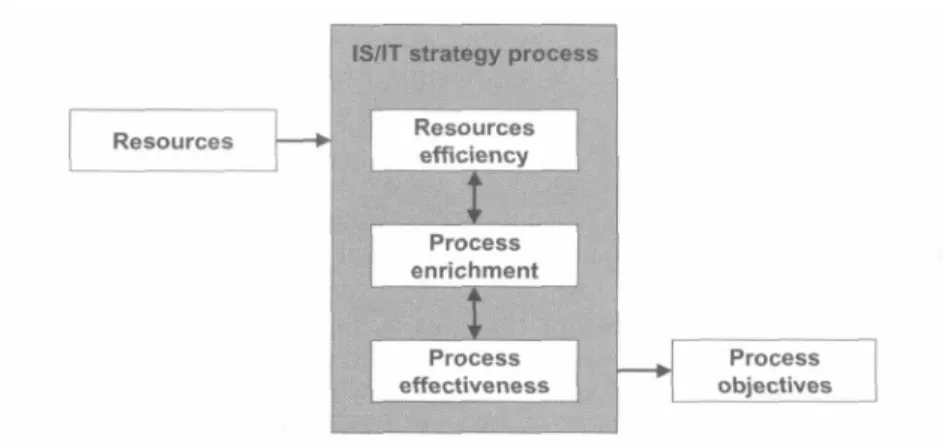
Figure 3.4 Success criteria
an ideal system. Improvement judgement refers to the assessment of how the strategy process has evolved or adapted in supporting organizational strategic planning needs. Segars and Grover note that comparative judgement and normative judgement have a narrow focus and, therefore, are more relevant to assess a specific approach to strategy formulation, whereas goal-oriented judgement and improvement judgement have a wider focus and, therefore, are more relevant to assess the broader processes involved in developing this IS/IT strategy.
From analysis of the research literature,25 the following success dimensions can be gleaned:
• improving the contribution of IS/IT to the performance of the organization;
extent of alignment of IT investment with the business strategy; gaining competitive advantage through deployment of IS/IT;
identifying new and higher payback applications; identifying strategic applications; increasing top-management commitment; improving communications with users; better forecasting of IT resource
requirements; improved allocation of IT resources; development of an information architecture; increased visibility for IS/IT in the
organization.
Figure 3.4 illustrates a model that relates resource inputs to the IS/IT strategy process and the objectives of the process. IS strategy process dimensions can be summarized in three aspects: resource efficiency, process enrichment and process effectiveness. This multidimensional
Purpose and Stimuli Driving IS/IT Strategy Development 141
perspective of the IS strategy process provides a more comprehensive method of assessing success.
Resource efficiency refers to the efficient use and management of input to the process or resources required for the process. This dimension, in some respects, is similar to 'the relative efficiency of IS planning system' and 'the adequacy of IS planning resources', as described by King. It deals with the ability of the strategy process to manage the input resources in order to maximize their use. Resources involved in the IS/IT strategy process include financial resources and time and effort of IS staff, users and management.
Enrichment is process-oriented and refers to the improvement, en-hancement and adaptability of the IS/IT strategy process, enabling it to be responsive to continuous changes in the environment and to produce incremental learning. It focuses on communications, interaction, innovation, learning, commitment, motivation, control, change and improvements, advanced by conducting a strategy exercise.
Effectiveness is output-oriented and refers to the effectiveness of the IS/ IT strategy process in meeting the intended goals. Goals of the process include predicting future trends, evaluating alternatives, avoiding problem areas, enhancing management understanding and knowledge, improving short-term and long-short-term performance, IS-business alignment, agreement concerning development priorities, viable implementation schedules and clarifying managerial responsibilities.
PURPOSE AND STIMULI DRIVING IS/IT STRATEGY DEVELOPMENT
The purpose in developing an IS/IT strategy is to ensure that the best possible value can be delivered from IS/IT investments. This can be achieved by tightly aligning the IS demand to the business strategy— strategic alignment—and by exploring opportunities for IS/IT to shape the business strategy where it is possible to improve the overall competitiveness, productivity and fitness of the organization to meet the forces acting upon it—competitive impact.
The arrival of threats and opportunities cannot be forced into a con-venient timetable to suit the business strategy cycle. An organization that is setting out to be flexible and responsive needs to be prepared to respond to fast-moving stimuli and to change its plans accordingly, and the IS strategy needs to be able to respond in the same way. Figure 3.5 shows how the pace of change in the external environment can prompt business responses. The effect can mean activity in all four quadrants, with IS/IT following the business lead. There is always the
142 Developing an IS/IT Strategy: Establishing Effective Processes
danger that all of the activity falls into the 'Defend' box, but IS/IT can help to strengthen the ability to respond by building up strategic capability.
There are a number of sources of stimuli for IS/IT strategy develop-ment, or revising the existing strategy, any of which may have an effect on the aims and objectives of planning.
External Business Factors. These factors drive the development and revision of business strategy. They were discussed at some length in Chapter 2, and were mentioned above.
External Technology Factors. These sometimes pose threats or oppor-tunities that directly stimulate IS/IT strategy activity. For example: • competitive opportunities and threats (real or potential) based on
new IS/IT developments (e.g. the Internet and wireless technologies); • new products or markets created by IS/IT;
• major cost-factor changes giving real or potential competitive advantage, producing an urgent need to improve productivity via technology or risk losing business.
If the emphasis in the strategy is on exploitative and entrepreneurial use of technology, it probably implies new attitudes to the use of IS/IT are
Purpose and Stimuli Driving IS/IT Strategy Development 143
required, as well as for new skills and for different people to become involved with new types of technology. It is important that the IS function keeps abreast of technology trends, innovative use of technology and how competing or similar organizations are applying IS/IT, so that they recognize when significant and achievable opportunities emerge, or when to respond to technology threats.
Internal Business Factors. Changes in the nature of the business or the structure and organization of the enterprise may result in the need to revisit or reconsider the IS/IT strategy. The stimuli may be as diverse as: • response to the regular business-planning cycle or budgeting cycle; • takeover by a new owner(s) or the appointment of a new CEO or
management team—this may simply mean a new attitude to technology, or it may herald more drastic change if it occurs as a result of a merger or takeover;
• major rationalization caused by, for example, downturn in the economy, necessitating a severe trimming of IS/IT budgets;
• restructuring—often resulting from corporate strategic planning (e.g. changing a business from a production-led to a marketing-led orientation, and leading to radical business re-engineering);
• new products or markets or channels-to-market—where there is a recognition that the present infrastructure is incapable of adapting to new requirements;
• recognition of the importance of strategy formulation and planning for IS/IT, based on the need to increase its direct contribution to the business.
Internal Technical Factors. These factors may arise from the need to deliver increased value for money, to cut costs, to improve the working relationship between the IS function and the business, the recognition that the current environment and legacy systems are starting to 'creak' and numerous other factors. They may all prompt IS management or business management to recognize the need to reassess the role of IS/IT and its current strategy. For example, the inability of many legacy systems to handle the new millennium dates absorbed the greater part of many IT budgets for up to two years to solve the so-called Y2K problem.
Assessment of the Current Organizational Environment
During the initiation stage of strategy formulation, the current organiza-tional environment and any pertinent issues will need to be understood, so that the planning activity is set up to deal with these factors. While the
precise issues will be specific to the organization at the time of planning, there are common factors worth assessing so that the IS strategy process is properly positioned and set up to be successful such as:
• A broad overview of the business perspective, as far as it is avail-able—its long-term mission, goals, vision for the future, strategy, drivers for change, proposed change initiatives, structure, values, culture, management style, performance monitoring and any short-term critical demands. Detailed analysis and interpretation of all these will take place later on in the planning process.
• How effective IS has been in supporting business strategy in the past, and the composition and strengths and weaknesses of the current application portfolio.
• The current role of IS/IT in the organization, its effectiveness, coverage, structure, skills and maturity, and the role IS/IT is playing in comparable external organizations in the same industry or similar businesses.
• The views held by business managers regarding IS/IT.
• How IS/IT strategies have been developed in the past, their deliver-ables and the benefits derived.
SCOPE, OBJECTIVES AND EXPECTATIONS
Having confirmed the purpose of the IS/IT strategy process and assessed the current organizational environment, it is then necessary to determine clearly the scope and objectives of the planning activities, and to ensure that the business has clear expectations of what will emerge as a result. In establishing the scope, it is important to reiterate a point made in Chapter 1. While most IS/IT practitioners understand that their objec-tives have shifted, there is still a tendency to consider technology issues alongside business needs in such a way that confuses the supply (technology as a means of delivery) and demand (business needs expressed as information systems requirements). This is why it is critical to make the distinction between IS strategy and IT strategy.
IS strategy deals with what to do with information, systems and tech-nology, and how to manage the applications from a business point of view. It thus focuses on the close alignment of information and systems in support of business needs and on identifying and exploiting competitive opportunities for IS/IT. IT strategy designates how technology is to be applied in delivering information and how the technology resources are managed to meet the range of business needs.
Scope, Objectives and Expectations 145
The Strategic Business Unit (SBU)
In a large organization, where there are likely to be a number of distinct business units, it is probable that each should have its own IS strategy, tightly coupled to its business strategy. The available evidence suggests that organizations that have done this achieve and recognize a more direct contribution from IS/IT to business performance. It does not necessarily follow that there should be IT strategies one for one with IS strategies in that organization. A single IT strategy may be appropriate for the whole organization, especially if there is centralization of other corporate functions. On the other hand, it may be more effective to focus IT support at divisional, regional or even unit level in a diverse and highly-distributed enterprise (see Figure 3.6).
A PIMS/MPIT study26 showed that IS/IT is, generally, more effec-tively deployed in organizations where vertical integration is between 50 and 75% (i.e. 50-75% of total business costs are under the control of the business unit), enabling management to control the degree of systems integration across functions. Second, the study showed it is more feasible to develop a coherent IS/IT strategy for a strategic business unit than for any other organizational grouping. Given the arguments above, this would seem to follow.
In practice, information flows through the business, along its primary
IS/IT industry
and business
business processes, to and from customers, across logistics and product processes, and to and from suppliers, to enable supply and demand and the use of resources to be reconciled. The primary systems requirements depend on effective linkages through these processes. The secondary/ supportive control and planning systems can be overlaid on that structure, although, in the past, these types of system have often driven the primary systems requirements. This aspect will be considered in more detail when the value chain analysis techniques are discussed later in Chapter 5, and also when business process redesign and business re-engineering approaches are discussed.
Implications of Focusing IS Strategy Formulation on the SBU
Considering the implications of focusing strategic planning activities at the business unit level, as reflected in Figure 3.6, some conclusions can be drawn:
• Historically, 'strategies' were essentially the cumulative total of func-tional and/or departmental systems 'strategies', which often lacked integration with the business and each other. Personal computing, in the 1980s, often caused an even lower set of 'individual' strategies to develop, as discussed in Chapter 1. The senior management and IS management reaction was often to attempt to develop a 'corporate IS/IT strategy'. There is little evidence that this can be achieved. Most case histories of the attempts of large companies to develop an overall, comprehensive 'corporate IS/IT' strategy from the centre show that lengthy planning blights descend on the units and then nothing results! It can work where all the units are replicas of one another, operating in different locations. Unless the corporation is essentially a single business-unit company, or the units are nearly identical, the task is almost impossible.
• Developing IS/IT strategies at 'group level' is equally unlikely to be successful, unless it is a group of very similar businesses. There are potential dangers associated with attempting to develop common systems across group companies. Unless the whole organization is very similar in terms of its products, operational strategies and markets, then each unit is likely to have very different business needs. In this case, an IS strategy that meets one unit's needs is not likely to be optimal for another's. Even when the individual business units are very similar, they are still likely to have different IS priorities. For example, their market penetrations may be different, or their customer base has a different profile or, because of scale factors, their unit costs are very different. Even where organizations
Scope, Objectives and Expectations 147
have 'imposed' common strategies for ERP or CRM applications, the implementation in each unit may vary considerably, producing little commonality in terms of systems, although the software package is the same. Often, group reorganization can occur such as the refocusing and restructuring of many organizations in the 1990s from a manufacturing- or product-based structure to more market-based, making a nonsense of any previous group systems synergy. In conglomerates, where the buying and selling of businesses is a key part of the corporate strategy, it obviously makes most sense to align the strategy to each business unit, and it is probably impossible, in reality, to do much else.
IS Strategy for the 'Corporate' SBU
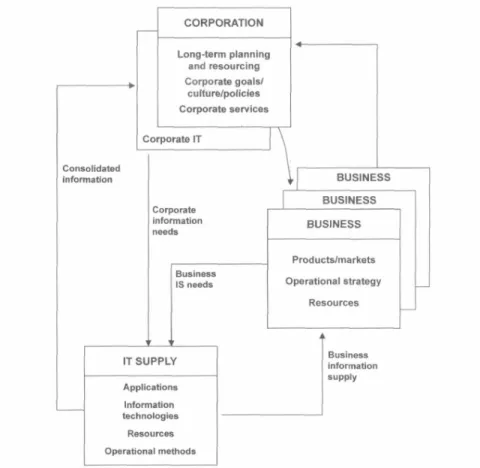
The 'corporation', in many cases, is best seen as a business unit in its own right—it will have information system needs based on the way it chooses to manage the component businesses, whatever at any one time they are. At one end of the scale, a holding company may only be concerned with a very limited number of objectives and, as such, may only need a few elementary enquiry and modelling systems, to access, say, profit and revenue figures. Alternatively, there may be a need for an IS strategy to meet corporate information requirements, which are entirely different from those of the business units, whose interests are in supporting their own particular business strategies. Corporate information needs support long-term planning and allocation of resources, and draw on consolidated information from the business units. Frequently, common policies for IT across the whole organization are implemented to achieve economy of supply and consistency across internal interfaces. The focus of strategies at the corporate, business and IS/IT levels and the relationships between these levels are illustrated in Figure 3.7.
Selecting a Starting Point
While the scope may be obvious when there is only one SBU under consideration, it may be more difficult when there are several. A few pointers that are worth considering in making the choice of starting point, for example, when choosing an SBU where:
• strong management commitment and involvement are assured; • clear business plans and direction are known and available; • the role of IS/IT is already respected;
• strategic business planning is well established.
Figure 3.7 Relationships and information demand/supply
In cases where an IS/IT strategy process is not well established, it might be more appropriate to scale down the scope of the exercise so that the learning curve can be contained and the new techniques and processes of IS strategy formulation and planning can be exercised on a small scale to demonstrate their validity, before being applied to a larger organizational unit.
Consolidation across Business Units
If more than one unit is engaging in an IS/IT strategy process, and especially if the units are similar in their business profile, then cross-referencing during the strategy process is a good idea. Alternatively, planning activities can be staggered to take advantage of common elements. There may well be common factors emerging from the outputs for each unit. Opportunities for mutual support can be as diverse as: