Information Theoretic Graph Kernels
Lu Bai
A Thesis Submitted for the Degree of Doctor of Philosophy
Department of Computer Science University of York
Abstract
This thesis addresses the problems that arise in state-of-the-art structural learning methods for (hyper)graph classification or clustering, particularly focusing on develop-ing novel information theoretic kernels for graphs.
To this end, we commence in Chapter 3 by defining a family of Jensen-Shannon dif-fusion kernels, i.e., the information theoretic kernels, for (un)attributed graphs. We show that our kernels overcome the shortcomings of inefficiency (for the unattributed diffusion kernel) and discarding un-isomorphic substructures (for the attributed diffusion kernel) that arise in the R-convolution kernels. In Chapter 4, we present a novel framework of computing depth-based complexity traces rooted at the centroid vertices for graphs, which can be efficiently computed for graphs with large sizes. We show that our methods can characterize a graph in a higher dimensional complexity feature space than state-of-the-art complexity measures. In Chapter 5, we develop a novel unattributed graph kernel by matching the depth-based substructures in graphs, based on the contribution in Chapter 4. Unlike most existing graph kernels in the literature which merely enumerate similar substructure pairs of limited sizes, our method incorporates explicit local substructure correspondence into the process of kernelization. The new kernel thus overcomes the shortcoming of neglecting structural correspondence that arises in most state-of-the-art graph kernels. The novel methods developed in Chapters 3, 4, and 5 are only restricted to graphs. However, real-world data usually tends to be represented by higher order re-lationships (i.e., hypergraphs). To overcome the shortcoming, in Chapter 6 we present a new hypergraph kernel using substructure isomorphism tests. We show that our kernel limits tottering that arises in the existing walk and subtree based (hyper)graph kernels.
In Chapter7, we summarize the contributions of this thesis. Furthermore, we analyze
Contents
List of Figures vi
List of Tables vii
Acknowledgments viii
Declaration ix
1 Introduction 1
1.1 The Problems . . . 1
1.2 Motivations and Our Goals . . . 4
1.3 Contributions . . . 5
1.3.1 Jensen-Shannon Diffusion Kernels for (Un)attributed Graphs . . . 5
1.3.2 Depth-based Complexity Traces of Graphs . . . 7
1.3.3 A Depth-Based Matching Kernel for Unattributed Graphs . . . . 8
1.3.4 A Hypergraph Kernel from The Subtree Isomorphism Tests . . . 9
1.4 Thesis Outline . . . 10
2 Literature Review 12 2.1 Kernel Methods . . . 13
2.1.1 Kernel Functions . . . 14
2.1.2 Information Theoretic Kernels . . . 16
2.2 Complexity Measures of Graphs . . . 20
2.2.1 Deterministic and Probabilistic Complexity Measures . . . 20
2.2.2 Thermodynamic Depth-based Complexity Measures . . . 23
2.3 Hypergraph Representations in Pattern Recognition . . . 24
2.4 Conclusion . . . 26
3 Jensen-Shannon Diffusion Kernels for (Un)attributed Graphs 28 3.1 Entropy Measures for Unattributed Graphs . . . 29
3.1.1 Von Neumann Entropy . . . 30
3.1.2 Shannon Entropy associated with Steady State Random Walks . . 32
3.2 A Label Entropy for An Attributed Graph . . . 32
3.2.1 A Tree-Index Based Vertex Label Strengthening Method . . . 33
3.2.2 A Label Shannon Entropy for Attributed Graphs . . . 35
3.3 Jensen-Shannon Diffusion Kernels for Graphs . . . 36
3.3.1 The Jensen-Shannon Divergence . . . 36
3.3.2 The Unattributed Jensen-Shannon Diffusion Kernel . . . 38
3.3.3 The Attributed Jensen-Shannon Diffusion Kernel . . . 41
3.4 Experimental Results . . . 44
3.4.1 Graph Datasets . . . 45
3.4.2 Experiments on Graph Classification . . . 46
3.4.3 Computational Evaluation . . . 49
3.5 Conclusion . . . 51
4 Depth-based Complexity Traces of Graphs 53 4.1 Entropy-Based Complexity Measures . . . 54
4.2 Depth-Based Complexity Traces of Graph Structures . . . 56
4.2.1 Centroid Vertex and Centroid Expansion Subgraphs . . . 56
4.2.2 Entropy Complexity Traces of Graphs . . . 58
4.2.4 Graphs of Different Sizes . . . 60
4.2.5 Computational Complexity Evaluation . . . 60
4.3 Experimental Results . . . 61
4.3.1 Evaluation of Interior Complexity Traces . . . 62
4.3.2 Stability Evaluation of Complexity Traces . . . 65
4.3.3 Computational Evaluation of The Proposed Complexity Traces . . 67
4.3.4 Real-world Datasets . . . 71
4.3.5 Experiments on Bioinformatics Datasets . . . 73
4.4 Conclusion . . . 80
5 A Depth-Based Matching Kernel for Unattributed Graphs 81 5.1 h-layer Depth-based Representations . . . 82
5.2 Depth-based Graph Matching Kernel . . . 83
5.2.1 Depth-based Graph Matching . . . 83
5.2.2 A Depth-based Graph Kernel . . . 85
5.2.3 The Depth-based Graph Kernel onN Graphs . . . 87
5.2.4 Linkage to the All Subgraph Kernel . . . 87
5.3 Experimental Results . . . 89
5.3.1 Datasets . . . 90
5.3.2 Experiments on Graph Datasets . . . 91
5.3.3 Computational Evaluation . . . 99
5.4 Conclusion . . . 102
6 A Hypergraph Kernel from Subtree Isomorphism Tests 103 6.1 Directed Line Graphs . . . 104
6.1.1 Definitions and Notations . . . 104
6.1.2 Theoretical Properties . . . 107
6.2 A Hypergraph Kernel . . . 108
6.2.2 An Isomorphism-Based Hypergraph Kernel . . . 112
6.2.3 Discussions and Related Work . . . 116
6.3 Experimental Results . . . 117
6.3.1 Experiments on Hypergraphs . . . 119
6.3.2 Experiments on Graphs . . . 120
6.3.3 Computational Evaluation . . . 122
6.4 Conclusions . . . 123
7 Conclusions and Future Work 124 7.1 Summary of Contributions . . . 124
7.1.1 Information Theoretic Graph Kernels for Graphs . . . 124
7.1.2 Depth-Based Complexity Traces for Graphs . . . 125
7.1.3 The Depth-Based Matching Kernel for Graphs . . . 126
7.1.4 The Hypergraph Kernel Based on Isomorphism Tests . . . 126
7.2 Weaknesses . . . 127
7.3 Future Work . . . 129
List of Figures
3.1 Example of TI algorithm. . . 35
3.2 Runtime evaluations for the unattributed diffusion kernel. . . 49
3.3 Runtime evaluations for the attributed diffusion kernel. . . 50
4.1 The left-most figure shows the determination ofK-layer centroid
expan-sion subgraphs for a graphG(V, E)which hold|N1
ˆ
vC|= 6and|N
2 ˆ
vC|= 10
vertices. While the middle and the right-most figure show the
correspond-ing 1-layer and2-layer subgraphs regarding the centroid vertexvˆC, and
are depicted by red-colored edges. In this example, the vertices of
differ-entK-layer subgraphs regarding the centroid vertexˆvC are calculated by
Eq.(4.9), and pairwise vertices possess the same connection information
in the original graphG(V, E). . . 58
4.2 (a)-(d): Entropy complexity trace distributions using the a) Shannon
en-tropy, b) von Neumann enen-tropy, and entropies computed using
informa-tion funcinforma-tionals c)fV2 and d)fP2. . . . 63
4.3 (a)-(d): Entropy difference complexity trace distributions using the a)
Shannon entropy, b) von Neumann entropy, and entropies computed using
4.4 (a)-(d): Distance distributions of entropy complexity traces using the a) Shannon entropy, b) von Neumann entropy, and entropies computed using
information functionals c)fV2 and d)fP2. . . . 66
4.5 (a)-(d): Distance distributions of entropy difference complexity traces us-ing the a) Shannon entropy, b) von Neumann entropy, and entropies com-puted using information functionals c)fV2 and d)fP2. . . . 68
4.6 Runtime evaluations. . . 70
5.1 Embedding from kPCA for the COIL5 dataset. . . 92
5.2 Embedding from kPCA for the BAR31 dataset. . . 93
5.3 Embedding from kPCA for the BSPHERE31 dataset. . . 94
5.4 Embedding from kPCA for the GEOD31 dataset. . . 95
5.5 Distance matrix for the COIL5 dataset. . . 96
5.6 Distance matrix for the BAR31 dataset. . . 97
5.7 Distance matrix for the BSPHERE31 dataset. . . 98
5.8 Distance matrix for the GEOD31 dataset. . . 99
5.9 Eigenprojection of graphs. . . 100
5.10 The accuracy with differenthlayer. . . 101
5.11 Runtime evaluations. . . 102
6.1 An example of transformation a hypergraph into a directed line graph. . . 106
6.2 Hypergraph examples. . . 108
6.3 An in-subtree and out-subtree of height 3rooted at the vertex1 on a di-rected graph. . . 112
List of Tables
3.1 Information of the graph-based datasets . . . 46
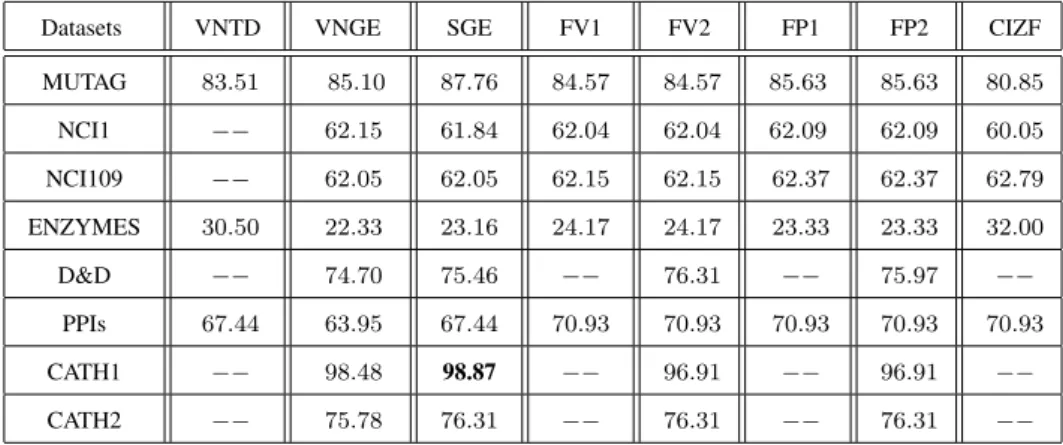
3.2 Classification accuracy (in%±standard error) comparisons . . . 47
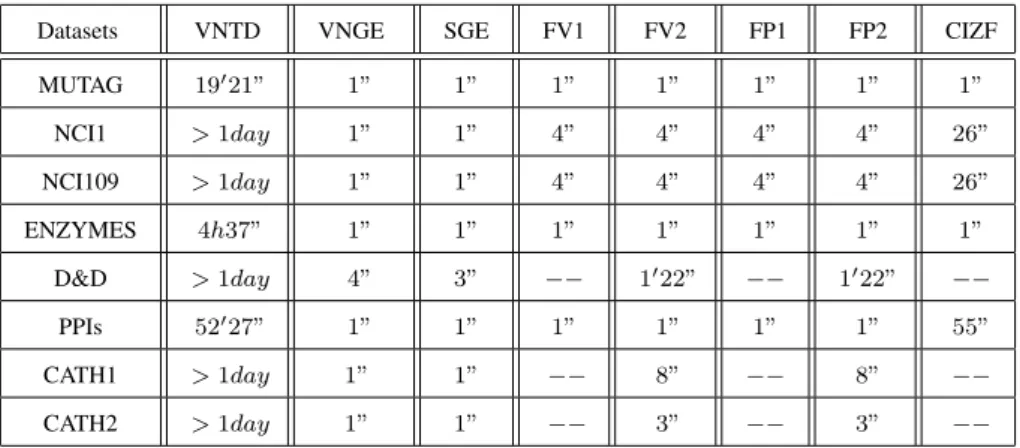
3.3 CPU runtime comparisons on graph datasets . . . 47
4.1 Information of the graph based bioninformatics datasets . . . 72
4.2 Performance of proposed complexity traces . . . 74
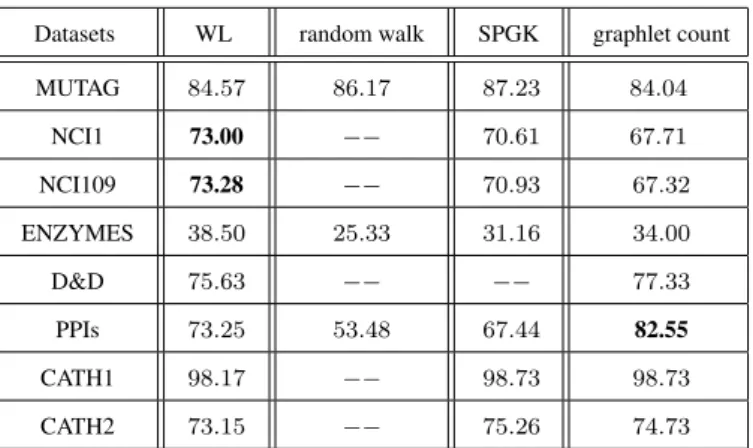
4.3 Performance comparisons of graph complexity based methods and the CIZF 75 4.4 Performance comparisons of graph kernel methods . . . 76
4.5 Runtime of proposed complexity traces . . . 78
4.6 Runtime comparisons of graph complexity based methods and the CIZF . 78 4.7 Runtime comparisons of graph kernel methods . . . 79
5.1 Classification accuracy (in%±standard error) comparisons using C-SVM. 90 5.2 Rand index for K-means method. . . 91
5.3 The standard error with differenthlayers. . . 101
6.1 Accuracy comparisons on hyperraph datasets . . . 119
6.2 Accuracy (in%±standard error) comparisons on graph datasets . . . 121
Acknowledgments
First, I would like to express my sincere appreciation and gratitude to my supervisor, Prof. Edwin R. Hancock, for his support and advice throughout my PhD work at York. I have learnt a lot from Edwin, such as how to formulate an academic problem in theoretical way and how to develop the research outcome in professional manner. I also thank my assessor, Dr. William Smith, for his impartial assessment and constructive comments on my work, and my co-authors, Prof. Horst Bunke, Prof. Francisco Escolano, Prof. Andrea Torsello, Prof. Peng Ren, Dr. Luca Rossi and Dr. Lin Han, for their help on my research. My thanks also go to Prof. Richard Wilson, Dr. Pablo Suau, Dr. Furqan Aziz and all friends at York for their academic suggestions, help, kindness and friendship.
There are some other researchers who have provided valuable help for my research. In this respect, I thank Prof. Karsten Borgwardt and Dr. Nino Shervashidze for providing the Matlab implementation for the various graph kernel methods, and Dr. Geng Li for providing the graph datasets.
Finally, I would like to dedicate this thesis to my family. Their help and support were invaluable for the successful completion of my PhD.
Declaration
I hereby declare that all the work in this thesis is solely my own, except where attribut-ed and citattribut-ed to another author. Most of the material in this thesis has been previously published by the author. Below, a complete list of publications can be found.
Journal Papers
1. Lu Bai, Luca Rossi, Andrea Torsello, and Edwin R. Hancock. A Quantum
Jensen-Shannon Graph Kernel for Unattributed Graphs. To appear inPattern Recognition,
2014.
2. Lu Bai, and Edwin R. Hancock. Depth-Based Complexity Traces of Graphs. In Pattern Recognition, vol. 47, no. 3, pp. 1172-1186, 2014.
3. Lu Bai, and Edwin R. Hancock. Graph Kernels from the Jensen-Shannon
Diver-gence. InJournal of Mathematical Imaging and Vision, vol. 47, no. 1-2, pp. 60-69,
2013.
Conference Papers
1. Lu Bai, Luca Rossi, Horst Bunke and Edwin R. Hancock. Attributed Graph
Conference on Machine Learning and Principles and Practice of Knowledge
Dis-covery in Databases(ECML-PKDD), 2014.
2. Lu Bai, Peng Ren, Francisco Escolano, and Edwin R. Hancock. Depth-Based
Hy-pergraph Complexity Traces from Directed Line Graphs. To appear inProceedings
of 22nd International Conference on Pattern Recognition(ICPR), 2014.
3. Lu Bai, Peng Ren, and Edwin R. Hancock. A Hypergraph Kernel from
Isomor-phism Test. To appear inProceedings of 22nd International Conference on Pattern
Recognition(ICPR), 2014.
4. Lu Bai, Horst Bunke, and Edwin R. Hancock. A Jensen-Shannon Diffusion Kernel
for Attributed Graphs. To appear inProceedings of 22nd International Conference
on Pattern Recognition(ICPR), 2014.
5. Lu Bai, Peng Ren, Xiao Bai, and Edwin R. Hancock. A Graph Kernel from the
Depth-Based Representation. To appear inJoint IAPR International Workshops on
Structural and Syntactic Pattern Recognition and Statistical Techniques in Pattern Recognition(S+SSPR), 2014.
6. Andrea Torsello, Andrea Gasparetto, Luca Rossia, Lu Bai, and Edwin R. Hancock. Transitive State Alignment for the Quantum Jensen-Shannon Kernel. To appear in Joint IAPR International Workshops on Structural and Syntactic Pattern Recogni-tion and Statistical Techniques in Pattern RecogniRecogni-tion(S+SSPR), 2014.
7. Lu Bai, Edwin R. Hancock, and Lin Han. A Graph Embedding Method using the
Jensen-Shannon Divergence. InProceedings of 15th International Conference on
Computer Analysis of Images and Patterns(CAIP), pp. 102-109, 2013.
8. Lu Bai, and Edwin R. Hancock. A Fast Jensen-Shannon Subgraph Kernel. In Proceedings of 17th International Conference on Image Analysis and Processing (ICIAP), pp. 181-190, 2013.
9. Lu Bai, Edwin R. Hancock, Andrea Torsello, and Luca Rossi. A Quantum
Jensen-Shannon Graph Kernel using the Continuous-Time Quantum Walk. In
Proceed-ings of 9th IAPR-TC-15 International Workshop on Graph-Based Representations in Pattern Recognition(GbRPR), pp. 121-131, 2013.
10. Lu Bai, and Edwin R. Hancock. Graph Clustering using Graph Entropy Complexity
Traces. In Proceedings of 21st International Conference on Pattern Recognition
(ICPR), pp. 2881-2884, 2012.
11. Lu Bai, Edwin R. Hancock, and Peng Ren. Jensen-Shannon Graph Kernel using
In-formation Functionals. InProceedings of 21st International Conference on Pattern
Recognition(ICPR), pp. 2877-2880, 2012.
12. Lin Han, Richard C. Wilson, Edwin R. Hancock, Lu Bai, and Peng Ren. Sampling
Graphs from A Probabilistic Generative Model. InProceedings of 21st
Internation-al Conference on Pattern Recognition(ICPR), pp. 1643-1646, 2012.
13. Lu Bai, Edwin R. Hancock and Peng Ren. A Jensen-Shannon Kernel for
Hyper-graphs. InProceedings of Joint IAPR International Workshop on Structural,
Syn-tactic, and Statistical Pattern Recognition(S+SSPR), pp. 181-189, 2012.
14. Lu Bai, and Edwin R. Hancock. Graph Complexity from the Jensen-Shannon
Di-vergence. InProceedings of Joint IAPR International Workshop on Structural,
Syn-tactic, and Statistical Pattern Recognition(S+SSPR), pp. 79-88, 2012.
15. Lu Bai, and Edwin R. Hancock. Graph Clustering Using the Jensen-Shannon
K-ernel. In Proceedings of 14th International Conference on Computer Analysis of
Submitted Journal Papers
1. Lu Bai, and Edwin R. Hancock. Fast Depth-based Subgraph Kernels for
Unattribut-ed Graphs. SubmittUnattribut-ed toPattern Recognition.
2. Lu Bai, Peng Ren, Francisco Escolano, Cheng Ye, and Edwin R. Hancock. Depth-based Hypergraph Complexity Traces from Directed Line Graphs. Submitted to IEEE Transactions on Neural Networks and Learning Systems.
Chapter
1
Introduction
In this chapter we provide an introduction and motivation for the research work presented in this thesis, explaining why we are interested in kernel methods for structured data (i.e., graphs and hypergraphs). We commence by introducing the problems encountered in existing state-of-the-art methods on structured data. Then we briefly describe the possible alternative approaches that overcome these problems, following by our research goals and contributions. Finally, an outline of the thesis is provided at the end of this chapter.
1.1
The Problems
Graph based relational representations, which are widely used in the field of structural pattern recognition, have proven to be both powerful and flexible. Compared to vector based pattern recognition, a major drawback with graph representations is the lack of a natural correspondence order for the vertices or edges. This limits the direct application of standard machine learning algorithms to problems such as clustering or classifying graphs. One way to overcome this problem is to embed graphs into a vector space, where standard machine learning techniques can be employed. Specifically, in the embedding space, similar graph structures are expected to be close while dissimilar ones far apart.
be of different sizes, the vectors may be of different lengths. The second problem is that some information residing on the edges of a graph is discarded. In order to overcome these problems, Riesen and Bunke recently proposed a method for embedding graphs in-to a vecin-tor space [1] that bridges the gap between the powerful graph based representation and the algorithms available for the vector based representation. The ideas underpinning graph dissimilarity embedding framework were first described in Duin and Pekalska’s work [2]. Riesen and Bunke generalized and substantially extended the methods to the graph mining domain. The key idea is to use the edit distance from a sample graph to a number of class prototype graphs to give a vectorial description of the sample graph in the embedding space. Furthermore, this approach potentially allows any (dis)similarity measure of graphs to be used for graph (dis)similarity embedding as well. Unfortunately, the edit distance between a sample graph and a prototype graph requires expensive com-putations, and as a result the graph dissimilarity embedding using the edit distance can not be efficiently computed for graphs.
Other successful approaches that embed graphs into vectors include a) representing a graph structure using permutation invariant polynomials computed from the eigen-vectors of the Laplacian matrix based on algebraic graph theory [3], and b) computing permutation-invariant graph features via the Ihara zeta function [4]. Unfortunately, the computation of these methods also tends to be expensive. Because the characteristics values highly rely on the graph size, and tend to be infinite valued with graphs of large
sizes (e.g., graphs having more than500 vertices). Furthermore, all these graph
embed-ding methods tend to approximate structural correlations of graphs in a low dimensional pattern space, and thus lead to information loss.
To address the shortcomings that arise in the graph embedding methods, an interesting recent addition to the literature is to use graph kernels [5]. Graph kernels can character-ize graph features in a high dimensional space and thus better preserve graph structures. Most existing graph kernels (i.e., the R-convolution kernels) can be generally categorized
into three classes [6, 7], i.e., graph kernels based on comparing all pairs of a) walks, b) paths, and c) restricted subgraph and subtree structures. There are mainly three shortcom-ings arising in the R-convolution kernels. First, the R-convolution kernels do not easily scale up to large sized structures, and thus compromise to use limited sized substructures. Unfortunately, graph kernels with substructures of limited sizes tend to reflect restricted topological information of a graph. Second, the R-convolution kernels roughly compare any pair of isomorphic substructures, and thus ignore the relative locations between the substructures within a graph. Third, the R-convolution kernels only count the number of pairwise isomorphic substructures. As a result, the substructures having no corresponding isomorphic substructures are discarded. Generally speaking, these shortcomings limit the precise similarity measure (i.e., the kernel value) for graphs. Therefore, it is fair to say that developing efficient and effective graph kernels still remains a challenge.
Furthermore, complex data in real world tends to exhibit multiple relationships that are hard to characterize by using graphs. To overcome this problem, hypergraph based strategies have been investigated for representing and processing structures where the re-lations present are of higher order. A hypergraph is a generalization of a graph [8]: unlike the pairwise edges in a graph, hypergraph representations allow a hyperedge to encompass an arbitrary number of vertices, and can hence capture multiple relationships among fea-tures. There have been several successful methods for characterizing hypergraphs, which include a) marginalizing higher order relationships to unary order [9], b) marginalizing the higher order relationships to pairwise order and then adopting pairwise graph match-ing methods [10], c) performmatch-ing visual clustermatch-ing by adoptmatch-ing tensors for representmatch-ing uniform hypergraphs [11], and d) exploiting a set of coefficients from hypergraph Ihara zeta function to capture frequency of the cycle structures in a hypergraph [12]. One main limitation of the existing methods for hypergraph characterization is that they are usually limited to uniform structures, and do not fully capture hypergraph characteristics. On the other hand, existing hypergraph characterization methods also tend to require prohibitive
computational overheads. In order to overcome these problems, an attractive alternative is to use kernel methods. Wachman and Khardon [13] have summarized the existing graph kernels based on walks and then proposed a rooted kernel for hypergraphs. Unfortunate-ly, like the walk based graph kernels, the rooted hypergraph kernel also suffers from the notorious tottering problem. This occurs when a random walk on a hypergraph moves to one direction and then immediately returns to the starting position through the same vertices and hyperedges multiple times. As a result, tottering may result in many redun-dant paths in a hypergraph. This shortcoming limits the precise kernel measure between hypergraphs.
1.2
Motivations and Our Goals
The main goal of this thesis is to develop novel methods that address the problems en-countered in the mentioned state-of-the-art methods. Specifically:
I) We present novel information theoretic kernels, i.e., a family of Jensen-Shannon diffusion kernels, for (un)attributed graphs based on the Jensen-Shannon divergence. We will show how the unattributed diffusion kernel can overcome the inefficiency of the R-convolution kernels. Furthermore, we will show how the attributed diffusion kernel can overcome the shortcoming of discarding substructures having no corresponding isomor-phic substructures that arises in the R-convolution kernels.
II) We present a novel framework for characterizing graphs based on computing depth-based complexity traces. We will show that the complexity traces can, not only reflect high dimensional complexity characteristics of graphs, but also be computed efficiently for graphs of large sizes.
III) We develop a novel unattributed graph kernel (i.e., the depth-based matching ker-nel) based on the depth-based representations of graphs and a graph matching using these representations. We will show that the new depth-based matching kernel can, not only
reasonably reflect depth-based characteristics of graphs, but also overcome the shortcom-ing of neglectshortcom-ing structural correspondence that arises in the R-convolution kernels.
IV) We develop a new hypergraph kernel based on a new developed Weisfeiler-Lehman isomorphism test for directed graphs. We will show that our new hypergraph kernel can limit the tottering problem that arises in the existing walk and subtree based (hyper)graph kernels.
1.3
Contributions
To achieve the research goals described in Section 1.2, we make the following specific contributions.
1.3.1
Jensen-Shannon Diffusion Kernels for (Un)attributed Graphs
In Chapter 3 we propose a family of Jensen-Shannon diffusion kernels for (un)attributed graphs using the Jensen-Shannon divergence. In mutual information, the Jensen-Shannon divergence is a dissimilarity measure between probability distributions in terms of the entropy difference associated with the probability distributions [14]. To develop a novel kernel using the divergence measure, we require an entropy measure for each graph. To this end, for an unattributed graph, we compute the von Neumann entropy developed by Han et al. [15]. Furthermore, we also develop a new Shannon entropy associated with a steady state random walk for the undirected graph. For an attributed graph, we perform a tree-index method developed by Dahm et al. [16] for the purpose of strengthening the vertex labels. For a vertex, the tree-index method strengthens the vertex label by taking the union of the neighbouring vertex labels as lists. Unfortunately, this tree-index method tends to lead a rapid explosion of the strengthened label length. Moreover, strengthening a vertex label by only taking the union of the neighbouring label lists also tends to ignore the original label information of the vertex. To overcome these problems and improve
the tree-index method, we propose to strengthen the label of a vertex as a new label list by taking the union of both the original vertex label and its neighbouring vertex labels. We also use the Hash function for the purpose of compressing the strengthened label list into a new short index label. As a result, we compute a new label Shannon entropy for the attributed graph in terms of the frequency of the strengthened labels. With a pair of (un)attributed graphs and their entropies to hand, the diffusion kernel for the graphs can be computed using the Jensen-Shannon divergence between a composite entropy of the graphs and their individual entropies.
We show the advantages of our Jensen-Shannon diffusion kernels for (un)attributed graphs. For the unattributed Jensen-Shannon diffusion kernel, the required entropy for a graph can be computed without the need to decompose the graph. As a result, the unattributed diffusion kernel overcomes the inefficiency arising in the R-convolution ker-nels. On the other hand, for the attributed Jensen-Shannon diffusion kernel, each strength-ened vertex label corresponds to a subtree rooted at the vertex. Furthermore, each of the strengthened labels is used for computing the label Shannon entropy. As a result, unlike existing R-convolution kernels which count the number of pairwise isomorphic substruc-tures, our method incorporates all of the identified subtrees into the computation of the kernel. The new attributed diffusion kernel thus overcomes the shortcoming of discarding substructures having no corresponding isomorphic substructures.
We study the performance for either the unattributed or the attributed Jensen-Shannon diffusion kernel on several graph datasets abstracted from bioinformatics databases. We show that our new Jensen-Shannon diffusion kernel for unattributed graphs can easily outperform the existing state of the art graph kernels in terms of computational efficiency. Moreover, we show that our new Jensen-Shannon diffusion kernel for attributed graphs can easily outperform the existing state of the art graph kernels in terms of the classifica-tion accuracy.
1.3.2
Depth-based Complexity Traces of Graphs
In Chapter 4, we propose a novel framework to compute the depth-based complexity traces for graphs by linking the ideas of graph entropies and depth-based representations. The depth-based representations of undirected graph structures have been proven power-ful tool for characterizing the topological structure in terms of the intrinsic complexity
[17, 18]. One approach is to gauge the information content flow through a family of K
layer subgraphs of a graph (e.g., subgraphs around a vertex having a maximum topology
distance or minimal path length K) of increasing size and to use the flow as a
struc-tural signature. Furthermore, this approach allows a complexity trace to be defined which gauges how the complexity of the graph varies as a function of depth. Unfortunately, to construct such a complexity trace of a graph requires a burdensome measure of intrinsic structural complexity, e.g., the time complexity of the heat flow complexity measure on
a subgraph havingnvertices is O(n5). Moreover, straightforwardly constructing a
com-plexity trace that characterizes a graph structure in global manner is an elusive problem, since it is difficult to determine a fine root vertex in the graph.
To overcome the problems, we focus on developing an efficient depth-based signa-ture, that can both capture fine structure and be evaluated relatively efficiently. To locate dominant substructures within a graph, we commence by identifying a centroid vertex which has the minimum shortest path length variance to the remaining vertices. For each graph a family of centroid expansion subgraphs is derived from the centroid vertex in or-der to capture dominant structural characteristics of the graph. Since the centroid vertex is identified through a global analysis of the shortest path length distribution, the expan-sion subgraphs provide a fine representation of a graph structure. We then compute the depth-based complexity traces of a graph based on two strategies. The first strategy is to establish an entropy complexity trace by measuring how the entropies on the centroid ex-pansion subgraphs vary with the increasing layer size of the exex-pansion subgraphs. While the second strategy is that we construct a complexity trace by measuring how the
dif-ferences between the subgraphs and the graph vary with respect to the increasing layer size of the expansion subgraphs. Since the required entropy measures on the condensed subgraph family enable efficient complexity computation, the complexity traces result-ing from the two strategies can be constructed efficiently. We empirically demonstrate that depth-based complexity traces of graphs can easily scale up to large graphs. The performance of our framework is competitive to the state-of-the-art graph based learning methods in the literature.
1.3.3
A Depth-Based Matching Kernel for Unattributed Graphs
In Chapter 5, we investigate how to incorporate the depth-based representations into graph matching and thus develop a novel graph kernel for unattributed graphs. We commence by generalizing the depth-based complexity trace around the centroid vertex that was developed in Chapter 4. We compute the complexity traces of a graph around each ver-tex. To avoid the inefficient subgraph enumeration in computing the intrinsic complexity [17], we compute the depth-based representation around a vertex by measuring the Shan-non entropy on each of its expansion subgraphs associated with the steady state random walk. The depth-based representation gauges the Shannon entropy flow via the expansion subgraphs, and thus reflects a high dimensional complexity characteristics of the graph around the vertex. Based on the obtained depth-based representations for two graphs we develop a matching strategy similar to that developed by Scott et al. in [19], for point set matching. The purpose of this step is to match the vertices of the graphs by using the vertex information extracted from the depth-based representations. For a pair of graphs, we use the Euclidean distance between the depth-based representations to compute an affinity matrix. The correspondences between pairwise vertices are obtained from the affinity matrix. The affinity matrix characterizes local structural similarity between a pair of graphs and can be used for graphs of different sizes. Finally, we develop the novel depth-based graph matching kernel by counting the matched vertex pairs. We show that
the novel kernel is positive definite. Furthermore, we show the relationship between the depth-based graph kernel and the all subgraph kernel and thus explain the reasons for the effectiveness of the new graph kernel. We empirically demonstrate the effectiveness and efficiency of our new graph kernel on graphs from computer vision databases.
1.3.4
A Hypergraph Kernel from The Subtree Isomorphism Tests
The family of Jensen-Shannon diffusion kernels proposed in Chapter 3, the depth-based complexity traces proposed in Chapter 4, and the depth-based matching kernel proposed in Chapter 5 are only restricted to graphs. However, real-world data usually tends to be represented by higher order relationships (i.e., hypergraphs). To address the limitation, in Chapter 6, we propose a new hypergraph kernel based on isomorphic substructures. This is facilitated by a Weisfeiler-Lehman (WL) isomorphism test for undirected graphs [20]. The WL isomorphism test for undirected graphs is a canonical labeling method. The key idea of the WL isomorphism test is to strengthen the set of vertex labels by the labels of the set of neighbouring vertices (i.e., strengthen a vertex label using a tree-index method). Here each new label of a vertex corresponds a subtree rooted from the vertex. Since the computational complexity of the WL isomorphism test on an undirected graph is only linear in the number of edges or quadratic in the number of vertices, the isomorphism test offers an elegant way of defining a fast graph kernel. Shervashidze and Borgwardt [7] have defined a fast subtree kernel (i.e., the WL subtree kernel) for undirected graphs by performing the WL isomorphism test to update the vertex labels, and then counting the number of matched vertex labels (i.e., counting the number of pairwise isomorphic subtrees).
Unfortunately, straightforwardly measuring the WL isomorphism test for hypergraphs tends to be elusive since a hypergraph may exhibit various relational orders. To overcome the mentioned problems and construct a hypergraph kernel using the WL isomorphism test, we transforme a hypergraph into a directed line graph using the Perron-Frobenius
op-erator [12]. The Perron-Frobenius opop-erator accurately reflects the multiple relationships exhibited by both uniform and nonuniform hypergraphs, moreover it also represents a di-rected backtrackless structure for (hyper)graph representations [21]. Hence, the didi-rected line graph for a hypergraph representation provides not only a convenient framework for measuring isomorphisms but also an elegant way of limiting the tottering problem arising in the walk based (hyper)graph kernels [13, 22].
We propose a new directed WL isomorphism test on directed graphs for the purpose of measuring the isomorphism between hypergraphs. The directed isomorphism test is based on two steps. The first is to assign a vertex a new in-label using the in-degree of the vertex and that of its in-neighborhood. The second is to assign a vertex a new out-label using the out-degree of the vertex and that of its out-neighborhood. As a result, the proposed kernel for a pair of hypergraphs is defined by performing the new directed WL isomorphism test to update the in-labels and out-labels of their directed line graphs, and then counting the number of newly matched in-labels and out-labels (i.e., counting the number of pairwise isomorphic in-subtrees and out-subtrees). We empirically demonstrate the effectiveness and efficiency of our new hypergraph kernel on several challenging (hyper)graph datasets.
1.4
Thesis Outline
The rest of the thesis is organized as follows: In Chapter 2, we give a thorough review of the relevant literature. First, we review the concepts of kernel methods in pattern recogni-tion. These methods include a) the kernels for vectorial data, b) the information theoretic kernels for probability distributions over structured data, and c) the kernels for graphs (i.e., graph kernels). Second, we review some state-of-the-art complexity measures for graphs. Finally, we review hypergraph representations in pattern recognition. In Chapter 3, we propose a family of Jensen-Shannon diffusion kernels for (un)attributed graphs, by using the Jensen-Shannon divergence. In Chapter 4, we propose a novel framework to compute
depth-based complexity traces of graphs. In Chapter 5, we propose a novel depth-based matching kernel for unattributed graphs. The kernel is based on the depth-based repre-sentations of graphs and a graph matching using the reprerepre-sentations. In Chapter 6, we propose a new hypergraph kernel based on a new developed directed Weisfeiler-Lehman isomorphism test for directed graphs. Finally, in Chapter 7 we summarize the contribu-tions of this thesis and suggest avenues for future work.
Chapter
2
Literature Review
Graphs are important representations in the field of structural pattern recognition. To address the problems of existing state-of-the-art methods mentioned in Section 1.1, we aim to develop novel methods that can be effectively and efficiently performed on graphs for the objective of graph classification or clustering. To achieve this, we focus in more details on using the kernel methods and entropy based complexity measures for graphs.
In the light of this aim, we commence in Section 2.1 by reviewing kernel theory in pattern recognition. We introduce the concepts of kernels for vectorial data in gener-al, and for graphs in particular. Furthermore, we discuss the strength and weakness for some state-of-the-art graph kernels. We explain our motivation of defining novel kernel methods for graphs. In Section 2.2, we review several state-of-the-art deterministic and probabilistic complexity measures for graphs. We discuss the strength and weakness of the previous researches on quantification of these complexity measures for (un)directed graphs. Furthermore, we review an attractive alternative complexity measure for undi-rected graphs, namely the thermodynamic depth-based complexity. We point out that this approach allows a depth-based complexity trace to be defined as a function of depth. We discuss the problem of constructing such a complexity trace for a graph. Finally, in this section (i.e., Section 2.2), we explain our motivation for computing an efficient and ef-fective depth-based complexity trace of a graph by linking the ideas of the depth-based
complexity and the entropy measures.
Complex data in the real world tends to exhibit multiple relationships that are hard to characterize by using graphs. Thus, in Chapter 2.3 we also review hypergraph represen-tations in pattern recognition. We review some state-of-the-art hypergraph based learning methods. We explain our motivation for computing a new hypergraph kernel based on isomorphism tests. Finally, in Section 2.4, we conclude this chapter.
2.1
Kernel Methods
In pattern recognition and machine learning, kernel methods have been widely used in kernel machines (e.g., the Support Vector Machine (SVM) [23] and the kernel Principle Component Analysis (kPCA) [24]) for classification or clustering. Typical applications include a) image classification [1], b) protein prediction [25], c) handwriting recognition [26], and d) molecule classification [13]. The main advantages of using kernel methods are threefold [25]. First, kernel methods allow efficient algorithms to be developed that can deal with high dimensional data without the need of constructing an explicit high dimensional feature space. Second, kernel methods provide an elegant way of making standard machine learning methods for vectorial data applicable to more complex data (e.g, strings, trees, graphs and hypergraphs), and thus bridge the gap between statisti-cal and structural pattern recognition. Third, kernel methods allow us to extend linear algorithms to non-linear ones.
This subsection provides a general introduction to kernel methods. To this end, we commence by reviewing the kernel methods. Some basic concepts and properties of k-ernel methods are introduced. Furthermore, we review a family of alternative kk-ernels on probability distributions over structured data, namely the information theoretic kernel-s. Finally, we review some state-of-the-art graph kernelkernel-s. We explain the motivation of developing novel graph kernel methods.
2.1.1
Kernel Functions
In this subsection, we review some basic concepts of kernel methods. We commence by introducing the concept of a positive definite kernel, based on the definition from
Sch¨olkopf et al. [27]. Let X denote a nonempty pattern set. A kernel function k :
X × X → R is a symmetric function, i.e., k(yp, yq) = k(yq, yp), that maps the pair of
patternsyp andyq to a real value. The kernel functionk is called a positive definite (pd)
kernel if and only if
N
∑
p,q=1
cpcqk(yp, yq)≥0, (2.1)
for allN,{c1, . . . , cN} ⊆R, and any choice of{y1, . . . , yN} ⊆ X.
Note that, a positive definite kernel function is usually called a valid kernel [28]. Moreover, a kernel for a pair of patterns can be seen as a similarity measure between the patterns. In the literature [29], some standard kernel functions have been developed
for the case where X is a vector space. Examples include a) the linear kernel, b) the
RBF kernel, c) the Polynomial kernel, and d) the Sigmoid kernel. For a pair of vectors
yp, yq ∈ X in a vector spaceX, these kernels are defined as follows.
1. Linear kernel: k⟨⟩(yp, yq) =⟨yp, yq⟩. (2.2) 2. RBF kernel: kRBF(yp, yq) = exp(−γ∥yp−yq∥2), (2.3) whereγ >0. 3. Polynomial kernel: kpoly(yp, yq) = (⟨yp, yq⟩+c)d, (2.4) whered∈Nandc≥0.
4. Sigmoid kernel:
ksig(yp, yq) = tanh (α⟨yp, yq⟩+β), (2.5)
whereα >0andβ <0.
Note that, the linear kernel, the RBF kernel, and the Polynomial kernel are positive def-inite (see details in [29]). On the other hand, the Sigmoid kernel is not always valid. However, the Sigmoid kernel has nonetheless been successfully used for real-world
ap-plications [25]. Furthermore, if α is close to zero andβ is small enough, the Sigmoid
kernel tends to behave similar to the RBF kernel [25].
In fact, from these given kernels, we can also compute some more sophisticated
k-ernels that better represent the data, based on the closure properties [25]. Assume k1
and k2 are two valid kernels on X × X, k3 is a valid kernel on H × H, φ : X → H
and f : X → R are two mappings, and a ∈ R+. The kernel functions defined by a)
k(yp, yq) = k1(yp, yq) +k2(yp, yq), b) k(yp, yq) = k1(yp, yq)k2(yp, yq), c) k(yp, yq) =
ak1(yp, yq), d)k(yp, yq) =f(yp)f(yq), and e)k(yp, yq) =k3(φ(yp), φ(yp))are also valid
kernels.
Next, we show how the kernel matrix can be computed using a given kernel function
k. Let{y1, . . . , yN} ⊆ X be a training set havingN patterns. The kernel matrixKis a
N ×N square matrix, K= k11 k12 . . . k1N k21 k22 . . . k2N .. . ... . .. ... kN1 kN2 . . . kN N , (2.6)
where each elementkp,q(1≤p, q ≤N) is a real number given bykp,q =k(yp, yq).
This matrix plays a central role in kernel-based methods (e.g., the kernel machines SVM [23] and kPCA [24]), since all the information available to a kernel-based method
is contained inK[25]. As a result, the kernel matrixKis an interface between the pattern
2.1.2
Information Theoretic Kernels
There has recently been an increasing interest in positive definite kernels for probability
distributions [30]. By mapping each data point in the input spaceX to a fitted distribution
in a parametric familyS, where a kernel for the distributions may be defined, a kernel for
the data points in terms of the distributions can be automatically induced on the original input space. This framework provides us an alternative way of defining kernels that map data (e.g., structured data) to a statistical manifold [31]. In real-world applications, these kernels outperform SVM classifiers associated with linear kernels [32]. Some of these kernels create a bridge between kernel methods and information theory, and thus have an information theoretic interpretation [33, 34].
In [30], Martins et al. have reinforced the bridge by developing a new family of nonextensive information theoretic kernels for probability distributions over structured data using nonextensive entropies. The extensive entropy is such that the entropy for
different variables is additive over the independent variables. Assume X is a random
variable that takes values in a finite set X based on a probability distribution PX. An
entropy, e.g., the Shannon entropyHS andHS(X), E[lnPX], is extensive: ifX andY
are independent, thenHS(X, Y) = HS(PX) +HS(PY). By contrast, the nonextensive
entropy abandons the requirement of extensivity. The idea of nonextensive entropy was first introduced by Havrda and Charvit [35], and its applications have been extensively documented by Gell-Mann and Renyi [36].
Some of the nonextensive entropic kernels (i.e., the nonextensive information theo-retic kernels) are related to the Jensen-Shannon divergence, that is a mutual information dissimilarity measure between probability distributions in terms of the entropy difference associated with the probability distributions. Examples include a) the Jensen-Shannon kernel [34], b) the exponentiated Shannon kernel [37], c) the weighed Jensen-Shannon kernel [30], and d) the exponentiated weighed Jensen-Jensen-Shannon kernel [30]. All these kernels have been performed for text categorization applications that demonstrate
their effectiveness.
We are interested in computing an information theoretic kernel for graphs from the Jensen-Shannon divergence measure. The problems of computing the divergence based kernel for graphs are those of constructing the required probability distributions and com-puting their associated entropies. As a result, the kernel for a pair of graphs can be de-fined as the difference between the entropies of the graphs and that of a composite graph formed by the graphs, using the Jensen-Shannon divergence. Unfortunately, each of these problems has been proved elusive, and thus leads a serious obstacle to the successful construction of information theoretic graph kernels.
2.1.3
Graph Kernels
Most existing graph kernels are instances of the R-convolution kernel [38] proposed by Haussler. R-convolution is a generic way for defining graph kernels by comparing al-l pairs of isomorphic substructures under decomposition (e.g., graph kerneal-ls based on comparing all pairs of a) walks, b) paths, and c) restricted substructures). Different types
of decompositions will result in a new graph kernel. For a pair of graphsG1(V1, E1)and
G2(V2, E2), suppose{S1;1, . . . ,S1;n1, . . . ,S1;N1}and{S2;1, . . . ,S2;n2, . . . ,Sq;N2}are the
sets of the substructures of G1 and G2 respectively. An R-convolution kernel kR [38]
betweenG1 andG2 can be defined as
kR(G1, G2) = N1 ∑ n1=1 N2 ∑ n2=1 δ(S1;n1,S2;n2), (2.7) where δ(S1;n1,S2;n2) = 1 if S1;n1 ≃ S2;n2, 0 otherwise. (2.8)
δis the Kronecker delta, that is, it is1if the arguments are equal and0otherwise. It can
With this scenario, Kashima et al. [22] have proposed a random walk kernel by com-paring pairs of isomorphic random walks in a pair of graphs. The main drawback of the random walk kernel is the notorious tottering problem. This occurs when a random walk on a graph moves in one direction and then immediately returns to the starting position through the same vertices and edges possibly multiple times. To overcome this shortcom-ing, Borgwardt et al. [39] have proposed a shortest path kernel by counting the numbers of pairwise shortest paths having the same length in a pair of graphs. Aziz et al. [21] have defined a backtrackless kernel using the same length cycles in a pair of graphs. Both of the methods overcome the tottering problem by capturing backtrackless substructures (i.e., the shortest paths or cycles in graphs). Unfortunately, shortest paths and cycles are structurally simple, and reflect limited topology information. Moreover, the computation-al efficiency of the two kernels computation-also tends to be burdensome (i.e., the runtime may be a couple of days) for graphs of large sizes (e.g. a graph having more than one thousand vertices). To address the problem of inefficiency, Shervashidze et al. [7] have developed a fast subtree kernel by comparing pairs of subtrees identified by the Weisfeiler-Lehman algorithm. Costa and Grave [40] have defined a neighborhood subgraph pairwise distance kernel by counting the number of pairwise isomorphic neighborhood subgraphs in a pair of graphs. Both kernels can be computed in polynomial time. Other graph kernels that are developed from the R-convolution framework include a) the segmentation graph kernel developed by Harchaoui and Bach [41], b) the point cloud kernel developed by Bach [42], and c) the subgraph matching kernel developed by Kriege and Mutzel [43].
Unfortunately, there are three common shortcomings arising in the existing R-convolution kernels. First, the R-convolution kernels may discard the substructures having no corre-sponding isomorphic substructures when a pair of graphs are compared. This occurs when we compute a kernel by simply counting the number of isomorphic substructure pairs. In other words, the R-convolution kernel may discard some information residing on the structural arrangement of graphs. Second, the R-convolution kernels do not easily
scale up to structures of large sizes. Thus, these kernels compromise to use substructures of limited sizes. Although this strategy curbs the notorious inefficiency of comparing large substructures, these kernels still require significant computational overheads. More-over, graph kernels with limited sized substructures can only reflect restricted topological characteristics of a graph. Third, the R-convolution kernels do not indicate the relative locations between substructures within a graph, and thus cannot establish a precise struc-tural correspondence between vertices of a pair of graphs. Generally speaking, these shortcomings limit the precise similarity measure (i.e., the kernel value) for graphs.
We aim to propose novel information theoretic graph kernels addressing the short-comings of state-of-the-art graph kernels. To this end, we consider to propose a family of Shannon diffusion kernels for (un)attributed graphs by measuring the Jensen-Shannon divergence between graph entropies. For a pair of unattributed graphs, the com-putational complexity of the diffusion kernel is only quadratic in the vertex number of the larger graph. The Jensen-Shannon diffusion kernel for unattributed graphs thus over-comes the inefficiency arising in the R-convolution kernels. On the other hand, for a pair of attributed graphs, we strengthen the vertex labels for each graph by using a tree-index method, and each strengthened vertex label corresponds to a subtree. The required Shan-non entropy for an attributed graph is computed in terms of all the strengthened labels (i.e., all the identified subtrees from the tree-index method), the Jensen-Shannon diffusion ker-nel for attributed graphs thus overcomes the shortcoming of discarding un-isomorphism substructures that arises in the R-convolution kernels. Furthermore, we also consider us-ing depth-based representations [17] as a means of definus-ing a new depth-based matchus-ing kernel for graphs. The depth-based representation is a powerful tool that can characterize a graph in terms of rich complexity information (see details in Section 2.2.2). On the other hand, the resulted depth-based matching reflects the correspondence information between pairwise vertices. Thus, the depth-based matching kernel can overcome the shortcomings of using limited substructures and neglecting local substructure correspondence that arise
in the R-convolution kernels.
2.2
Complexity Measures of Graphs
In this section, we start by reviewing the concepts of the deterministic and probabilistic complexity measures for graphs. We focus more on the entropy-based complexity mea-sures. Moreover, we also review an alternative complexity measure for graphs, namely the thermodynamic depth-based complexity measure for graphs. Finally, we explain the motivation for computing a fast depth-based complexity trace for a graph by linking the ideas of entropy measures and depth-based representations.
2.2.1
Deterministic and Probabilistic Complexity Measures
The quantification of the complexity of undirected graphs and networks has attracted significant attention due to its fundamental practical importance, and has proven powerful in a number of fields such as network analysis [44], chemistry, and pattern recognition [5]. Broadly speaking, there are two different approaches to measuring the complexity of graphs, namely a) deterministic complexity measures, and b) probabilistic complexity measures.
The available deterministic complexity measures include the encoding, substructure counting, and generative approaches. The encoding approach aims to measure the Kol-mogorov complexity of the structure [45]. The substructure counting approach is based on the frequency of different substructures in a graph [46, 47, 48]. Finally, the genera-tive approach aims to specify a basis set of elementary graph substructures and a set of operations which allow the substructures to be combined to form a larger graph. The complexity of the graph is then defined as the minimum number of operations required to form the graph from the basis structures [49].
probability distribution associated with a graph. Existing approaches to computing prob-abilistic complexity are based on the notion of either randomness complexity or statistical complexity. Randomness complexity aims to quantify the degree of randomness or disor-ganization of a combinatorial structure. This approach aims to characterize an observed graph structure probabilistically and compute its associated Shannon entropy. Statistical complexity, on the other hand, aims to characterize a combinatorial structure using sta-tistical features such as vertex degree statistics, edge density or the Laplacian spectrum. Viewed historically, most early work in this area falls into the randomness class, while recent work is statistically based. The main drawback of randomness complexity is that it does not properly capture the correlations between vertices [50]. Statistical complexity aims to overcome this problem by measuring regularities beyond randomness, and does not necessarily grow monotonically with randomness. In this thesis, we focus in more detail on using the entropy as a probabilistic complexity measure.
Unfortunately, the computation of the entropy of a graph is by no means a straightfor-ward problem. In early work, K¨oner [51] developed a graph entropy which poses com-plexity characterization as an optimization problem. Assuming that there is a probability distribution associated with the vertices of the graph, the complexity is the minimal cross entropy between the probability distribution and the vertex packing polytype of the graph. However, this approach is not applicable to more general unweigthed graphs. To address this shortcoming, Dehmer [52, 53] has turned to information theory and proposed a novel and efficient means of computing graph entropies using information functionals which are derived from the topological structure of a graph and quantify the information content of the given graph structure. This approach avoids the combinatorial computations over different vertex partitions and achieves polynomial time complexity by constructing lo-cal information subgraphs for a given graph. Anand et al. [54] and Passerini et al. [55] have applied the von Neumann entropy (or quantum entropy) to the domain of graphs through a mapping between discrete Laplacians and quantum states [56]. If the discrete
Laplacian [57] is scaled by the inverse of the volume of the graph we obtain a density matrix whose entropy can be computed using the spectrum of the discrete Laplacian. The measure distinguishes between different structures. For instance it is maximal for random graphs, minimal for complete ones and takes on intermediate values for star graphs. In addition, when there is degree heterogeneity then the Shannon (classical) and von Neu-mann (quantum information theoretic) entropies are correlated. However, since the von Neumann entropy relies on the computation of the normalized Laplacian spectrum, its computational complexity is cubic in the number of vertices.
To render the computation more efficient, Han et al. [15] have shown how the compu-tation can be rendered quadratic in the number of the vertices by its quadratic counterpart. An analysis of the quadratic entropy reveals that it can be computed from a number of permutation invariant matrix trace expressions. This leads to a simple expression for the approximate entropy in terms of elements of the adjacency matrix. Another straightfor-ward route to compute the entropy of a graph is to use the probability state vectors of random walks on a graph [58]. For instance, in the case of the steady state of the discrete time random walk, the elements of the state vector are proportional to the normalized degrees of the vertices. From this probability distribution it is straightforward to compute the Shannon entropy.
Furthermore, to develop the approximate von Neumann entropy of Han et al. [15] one step further, Ye et al. [59] have explored how the von Neumann entropy for an undirected graph can be extended for a directed graph. To do this, they used Chung’s [60] definition of the normalized Laplacian on a directed graph. According to this definition, the directed normalized Laplacian is Hermitian, so the interpretation of Passerini et al. in [55] still holds for the domain of directed graphs. The von Neumann entropy is essentially the Shannon entropy associated with the normalized Laplacian eigenvalues. The resulted von Neumann entropy expression of a directed graph depends on the in-degree and out-degree of pairs of vertices connected by edges.
2.2.2
Thermodynamic Depth-based Complexity Measures
An attractive alternative complexity measure for an undirected graph is to compute its thermodynamic depth complexity using based representations [17]. The depth-based representation of undirected graph structures has been proven powerful tool for characterizing the topological structure in terms of the intrinsic complexity [17, 18]. One
approach is to gauge the information content flow through a family ofK layer
subgraph-s of an undirected graph (e.g., subgraph-subgraphsubgraph-s around a vertex having a maximum topology
distance or minimal path lengthK) of increasing size and to use the flow as a structural
signature. By measuring the heat flow complexity of each subgraph, Escolano et al. [17] have shown how to use this approach to characterize each casual trajectory of an undi-rected graph leading a vertex to the graph by using the minimal enclosing Bregman balls (MEBBs) [61]. Then the depth complexity of such an undirected graph relies on the variability of the different trajectories from each vertex to the graph. Furthermore, this approach also allows a depth-based complexity trace to be defined which gauges how the complexities of the subgraphs vary as a function of depth [17]. However, to construc-t such a complexiconstruc-ty construc-trace of an undirecconstruc-ted graph requires an expensive compuconstruc-taconstruc-tion on measuring the intrinsic structural complexity. Moreover, straightforwardly constructing a complexity trace that characterizes an undirected graph structure in global manner is an elusive problem, since it is difficult to determine a fine root vertex in the graph.
To develop a depth-based complexity trace that addresses the mentioned problem-s, a condense family of expansion subgraphs around a dominant vertex and an efficient complexity measure for each of the (sub)graphs are required. To this end, we consider to define a centroid vertex as the dominant root vertex for a graph, and compute the entropies on a family of centroid expansion subgraphs derived from the vertex. As stated in Section 2.2.1, some of the entropies can be computed in a polynomial time. The resulted com-plexity trace of the graph linking the ideas of the depth-based representation and entropy measures can thus be efficiently computed. Like the graph embedding methods mentioned
in Section 1.1, such a complexity trace offers us an elegant way to represent a graph into a feature vector. Moreover, the complexity trace can reflect a high dimensional complexity characteristics for a graph through the family of centroid expansion subgraphs. By con-trast, the existing entropy based and the thermodynamic depth complexity measures only provide an one dimensional complexity feature for a graph.
2.3
Hypergraph Representations in Pattern Recognition
Graph based representations have been proven powerful in structure based pattern recog-nition. However, complex data in real world tends to exhibit multiple relationships that are hard to characterize by using graphs. To overcome this problem, hypergraph based s-trategies have recently been investigated for representing and processing structures where the relations present between objects are higher order. A hypergraph is a generalization of a graph [8]. Unlike the pairwise edges in a graph, hypergraph representations allow a hyperedge to encompass an arbitrary number of vertices, and can hence capture multiple relationships among features. One way to manipulate hypergraph structures is to exploit existing graph based methods for learning higher order models. Agarwal et al. [62] have performed hypergraph clustering by partitioning a weighted graph obtained by transform-ing the original hypergraph ustransform-ing a weighted sum of hyperedges to form edges. Zhou et al. [63] have presented a similar graph approximation method for hypergraphs by normal-izing the Laplacian matrix of the star expansion of a hypergraph. On the side, the tensor (higher order matrix) based strategy has also been adopted for straightforwardly charac-terizing the higher order relations in a hypergraph rather than conducting a graph based pairwise approximation. Zass et al. [9] and Duchenne et al. [64] have separately applied high-degree affinity arrays (i.e., tensors) to formulate hypergraph matching problems us-ing different cost functions. Both methods address the matchus-ing process in an algebraic manner but become intractable to compute if the hyperedges are not suitably sampled.
Shashua et al. [11, 65] have performed visual clustering using tensors to represent unifor-m hypergraphs (i.e. those for which the hyperedges have identical cardinality) extracted from images and videos. For detecting numbers of clusters in a tensor-based framework, their work has been complemented by He et al.’s [66] algorithm. Similar methods include those described in [67, 68, 69, 70, 71], in which tensors are used to represent the multi-ple relationships between objects. One limitation of the existing methods for hypergraph characterization is that they are usually restricted to uniform structures and cannot be ap-plied to hypergraphs with arbitrary relational orders. To address this shortcoming, Ren et al. [12] have exploited a set of polynomial coefficients obtained from the hypergraph Ihara zeta function for characterizing nonuniform hypergraphs. Though effectively cap-turing the varying relational orders, the hypergraph Ihara coefficients tend to require an expensive computation even for hypergraphs of intermediate sizes.
Like graph based pattern recognition, an alternative approach for characterising hy-pergraphs is to use kernel methods. Unfortunately, most existing R-convolution kernels can not be performed on hypergraphs, due to the high order relationship among vertices. To overcome this problem, Wachman and Khardon [13] have generalized the existing graph kernels based on walks and then proposed a rooted kernel for hypergraphs based on random walks. Unfortunately, similar to the walk based graph kernels, one limitation of the rooted hypergraph kernel is the notorious tottering problem. This shortcoming limits the precise kernel measure between hypergraphs.
To address this problem, the substructure based strategy can be used. To this end, we consider to propose a new hypergraph kernel based on a new directed Weisfeiler-Lehman isomorphism algorithm for directed graphs. The new kernel for a pair of hypergraph-s can be computed by performing the new ihypergraph-somorphihypergraph-sm algorithm on the directed line graphs transformed from the hypergraphs. We show that the directed line graph of a (hy-per)graph is a backtrackless structure, the new hypergraph kernel from the line graphs thus overcomes the shortcoming of tottering arising in the rooted hypergraph kernel.
2.4
Conclusion
We have reviewed the research literature on the domains of the entropy based complexity measures, depth-based complexity measures and kernel methods on structured data. We have analyzed the deficiencies of existing state-of-the-art methods and pointed out our possible solutions for overcoming these shortcomings. This chapter can be summarized as follows.
In Section 2.1, we review the basic concepts of kernel methods for vectorial data. Furthermore, we review some state-of-the-art information theoretic kernels for proba-bility distributions. Finally, we review some state-of-the-art graph kernels, i.e., the R-convolution kernels. We analyze the strength and weakness of the existing graph kernels. We point out that defining an efficient and effective graph kernel still remains a challenge. To overcome the shortcomings of the existing graph kernels, we consider to define a new family of Shannon diffusion kernel for (un)attributed graphs using the Jensen-Shannon divergence. Moreover, we also propose to use the depth-based representations as a means of defining a depth-based matching kernel for graphs.
In Section 2.2, we first review two kinds of graph complexity measures, namely a) deterministic complexity measures, and b) probabilistic complexity measures. Further-more, we generally review the history of developing entropy based complexity measures for graphs. We point out that some of the entropies can be computed in polynomial time. Finally, we review an attractive alternative complexity measure for an undirected graph, namely the thermodynamic depth complexity using depth-based representation-s. This approach allows a depth-based complexity trace to be defined for a graph as a function of depth. Unfortunately, to construct such a complexity trace for an undirected graph requires an expensive computation on measuring the intrinsic structural complexi-ty. Moreover, this approach also requires a fine root vertex in the graph. To address these problems, we propose to define a family of centroid expansion subgraphs rooted at a cen-troid vertex of a graph. As a result, a complexity trace of the graph can be computed by
measuring the efficient entropies on the subgraphs.
In Section 2.3, we give the concept of a hypergraph. A hypergraph is a generalization of a graph. We review some state-of-the-art methods for hypergraphs. We analyze the shortcomings of the existing methods. To address these problems, we propose to trans-form a hypergraph into a directed line graph which can reflect full characteristics of the hypergraph. Then a new hypergraph kernel can be developed by performing a new devel-oped directed Weisfeiler-Lehman isomorphism algorithm on the directed line graphs.
Chapter
3
Jensen-Shannon Diffusion Kernels for
(Un)attributed Graphs
In this chapter, we present our first contribution to the design of a family of Jensen-Shannon diffusion kernels for (un)attributed graphs. For an unattributed graph, we com-mence by computing the von Neumann entropy that is developed by Han et al. [15]. Fur-thermore, we also develop a new Shannon entropy associated with a steady state random walk for the graph. For an attributed graph, we perform a tree-index method developed by Dahm et al. [16] for the purpose of strengthening the vertex labels. For a vertex, the tree-index method strengthens the vertex label by taking the union of the neighbouring vertex labels as lists. Unfortunately, this tree-index method tends to lead a rapid explosion of the strengthened label length. Moreover, strengthening a vertex label by only taking the union of the neighbouring label lists also tends to ignore the original label information of the vertex. To overcome these problems and improve the tree-index method, we propose to strengthen the label of a vertex as a new label list by taking the union of both the o-riginal vertex label and its neighbouring vertex labels. We also use the Hash function for the purpose of compressing the strengthened label list into a new short index label. As a result, we compute a new label Shannon entropy for the attributed graph in terms of the frequency of the strengthened labels.
With a pair of (un)attributed graphs and their entropies to hand, the diffusion kernel for the graphs can be computed using the Jensen-Shannon divergence between a com-posite entropy of the graphs and their individual entropies. We show that the Jensen-Shannon diffusion kernel for unattributed graphs overcomes the inefficiency arising in the R-convolution kernels. Moreover, we show that the Jensen-Shannon diffusion kernel for attributed graphs not only accommodates attributed graphs but also overcomes the short-coming of discarding un-isomorphic substructures arising in the R-convolution kernels. We explore our Jensen-Shannon diffusion kernel on several graph datasets abstracted from bioinformatics databases. The experimental results demonstrate the effectiveness and ef-ficiency of our new kernel.
Chapter outline
The remainder of this chapter is organized as follows. Section 3.1 gives the concepts of the von Neumann entropy and the Shannon entropy associated with a steady state random walk for an unattributed graph. Section 3.2 gives the concept of a tree-index based vertex label strengthening algorithm. Moreover, we analyze the shortcoming of the tree-index method and show how the tree-index method can be improved by addressing the shortcoming. Finally, a label Shannon entropy for an attributed graph is defined. Section 3.3 gives the definition of the Jensen-Shannon diffusion kernel for (un)attributed graphs. Section 3.4 provides the experimental evaluation. Finally, Section 3.5 concludes our work.
3.1
Entropy Measures for Unattributed Graphs
In this section we introduce two entropy measures for unattributed graphs required in this chapter. We commence by reviewing the concept of the von Neumann entropy proposed by Han et al. in [15]. Finally, we propose an alternative Shannon entropy using the
probability distribution associated with a steady state random walk on a graph.
3.1.1
Von Neumann Entropy
We commence by reviewing the definition of the von Neumann entropy for a graph. The von Neumann entropy of a graph is the Shannon entropy associated with the eigenvalues
of the normalized graph Laplacian [54]. We denote the graph under study by G(V, E)
where V is the set of vertices and E ⊆ V × V is