The University of Southern Mississippi The University of Southern Mississippi
The Aquila Digital Community
The Aquila Digital Community
DissertationsSpring 2020
The Relationship Between the Perceived Value of Professional
The Relationship Between the Perceived Value of Professional
Development, Job Satisfaction, and Intent to Leave
Development, Job Satisfaction, and Intent to Leave
Wendy Marie WellsUniversity of Southern Mississippi
Follow this and additional works at: https://aquila.usm.edu/dissertations
Part of the Business Administration, Management, and Operations Commons, Higher Education Commons, Organizational Behavior and Theory Commons, and the Training and Development Commons
Recommended Citation Recommended Citation
Wells, Wendy Marie, "The Relationship Between the Perceived Value of Professional Development, Job Satisfaction, and Intent to Leave" (2020). Dissertations. 1751.
https://aquila.usm.edu/dissertations/1751
This Dissertation is brought to you for free and open access by The Aquila Digital Community. It has been accepted for inclusion in Dissertations by an authorized administrator of The Aquila Digital Community. For more
THE RELATIONSHIP BETWEEN THE PERCEIVED VALUE OF PROFESSIONAL DEVELOPMENT, JOB SATISFACTION, AND INTENT TO LEAVE
by
Wendy Marie Wells A Dissertation
Submitted to the Graduate School, the College of Arts and Sciences
and the School of Interdisciplinary Studies and Professional Development at The University of Southern Mississippi
in Partial Fulfillment of the Requirements for the Degree of Doctor of Philosophy
Approved by:
Dr. Heather M. Annulis, Committee Chair Dr. H. Quincy Brown Dr. Cyndi H. Gaudet Dr. Dale L. Lunsford ____________________ ____________________ ____________________ Dr. Heather M. Annulis Committee Chair Dr. Heather M. Annulis Director of School Dr. Karen S. Coats
Dean of the Graduate School May 2020
COPYRIGHT BY Wendy Marie Wells
2020
ABSTRACT
Organizations striving to remain competitive compete in the war for talent in order to recruit and retain employees. Studies assessing intent to leave and turnover suggest numerous strategies to mitigate the revolving door of employees quitting jobs (Allen, 2008; Allen, Bryant, & Vardaman 2010; Lee, Hom, Eberly, & Li, 2018). This study assesses the relationship between the perceived value of professional development, job satisfaction, and intent to leave. Results of the study reveal as one finds professional development, valuable job satisfaction increases. In assessing the relationship between professional development and intent to leave, the results of the study suggest that as professionals find professional development more valuable, intent to leave decreases. Finally, in assessing the relationship between job satisfaction and intent to leave, the results of this study align with previous research. As job satisfaction increases, intent to leave decreases.
Researchers such as Allen (2008), Allen et al. (2010), Shuck (2014), and The Conference Board (2018) assert the investment in professional development for employees may improve job satisfaction. Findings from this research confirm the association between professional development and job satisfaction. Therefore, organizations should strive to provide professional development opportunities for employees. Additionally, organizations should consistently seek feedback from
employees to determine the professional development needs of employees to improve job satisfaction and mitigate intent to leave (Lee, 2018).
ACKNOWLEDGMENTS
I want to acknowledge the faculty and staff of the HCD program. From my first phone call with Dr. Gaudet to learn more about the program to present, everyone has been so encouraging and welcoming. On numerous occasions, my trip to the coast or phone calls to the department faculty and staff have been highlights of my week. I also want to acknowledge the entire department for allowing us and requiring us to attend Dissertation or Bust sessions and to present our research progress. I can truly contribute the completion of my degree to feeling a sense of urgency and striving to be further along each time I attended Dissertation or Bust. I know many times we may hear things that we do not want to hear; however, I appreciate you all pushing us to give our best in our research efforts. From Ms. Suzy Robinson purchasing snacks and lunches for us to enjoy to the pertinent feedback we received from professors and peers, it truly helped.
I would like to thank my committee chair, Dr. Heather Annulis, for always being supportive and also challenging me to continue to push forward. Thank you for only accepting top quality and being honest and direct when I was not quite ready.
I would not have accomplished this great feat without my committee members. Dr. Gaudet, thank you for creating a department that truly encompasses human capital development. With your leadership, the entire staff has been nothing short of supportive and encouraging for students to be their best selves. Dr. Brown, thank you for your candid feedback. Throughout this entire process, I consistently heard your voice speaking on the importance of ethics in research and of course, checking APA format. Dr.
enjoyed completing a quantitative study, and without your assistance, I would not have been able to do it.
Finally, so what! Today, I am a better researcher, student, and professional because of your guidance and leadership. Thank you all for your investment in me! I also would like to acknowledge my classmate Dr. Valeria Williams for her continued support throughout this program. You truly led the way as I tried to keep up. Thank you for all of the encouraging memes, phone calls, and texts to ensure I was consistently working!
DEDICATION
First and foremost, I want to thank God for allowing me to be a vessel and a positive example to those around me. Secondly, thank you to my family, who has been my greatest support system.
To my mother, the late Angelia M. Williams Wells. Although you did not see me through this process on this side of the earth, the love and support you provided me as a child helped me become the person I am today. I hope that I have made you proud!
To my dad, Glenn Wells Sr. Thank you for always believing in me and encouraging me to be my best self. To my stepmom, Mrs. Laura Wells, thank you for being my biggest support system. You have walked with me through so many life changes, and I truly value the relationship we have and experiencing life with you!
To my siblings: Lucretia Wells, thank you for always being willing to help. Whether it is editing my papers, helping me pack, or just being someone to listen, I truly appreciate you never failing to provide assistance. You drop whatever you have going on to make sure I am okay. I cannot thank you enough. To Glenn Wells Jr., William Seals, and Mary Wells Bumpus, thank you for always telling me how proud you are of me. It has encouraged me to continue to strive for greatness. To April and Sherman, the oldest and youngest of the 7 of us, you two are the start and completion of our family. I am happy to be a part of this great family!
To my nieces and nephews: Dyneshia, Angeletta, Hezekiah, Glenn III, Avery, and Bella, please let this accomplishment show you that we can do anything we set our minds to do. The sky is the limit. I cannot wait to see how each of you contribute to society and help create a positive name for our family for generations to come!
TABLE OF CONTENTS
ABSTRACT ... ii
ACKNOWLEDGMENTS ... iii
DEDICATION ... v
TABLE OF CONTENTS ... vi
LIST OF TABLES ... xiv
LIST OF ILLUSTRATIONS ... xvi
LIST OF ABBREVIATIONS ... xvii
CHAPTER I - INTRODUCTION ... 1
Background ... 3
Professional Development ... 3
Job Satisfaction ... 4
Intent to Leave ... 6
Statement of the Problem ... 8
Purpose of the study ... 10
Research Objectives ... 10
Significance of the Study ... 11
Conceptual Framework ... 11
Operationalized Definitions ... 14
Summary ... 16
CHAPTER II - LITERATURE REVIEW ... 18
Professional Development ... 18
Professional Development Investments ... 19
Training and Development Defined... 20
Distinction between Training and Development. ... 21
Development and Performance Plans ... 22
Needs Analysis... 22
Evaluation of Training ... 25
Professional Development as a Benefit to the Organization and Employee ... 27
Job Satisfaction ... 28
Foundational Theories for Job Satisfaction ... 29
Hackman and Oldham’s Job Characteristics Theory. ... 29
Maslow’s Hierarchy of Needs. ... 30
Herzberg’s Two-Factor Theory. ... 31
Assessing Job Satisfaction ... 32
Identifying Job Satisfaction Dimensions. ... 32
Spector’s (1985) Job Satisfaction Facets. ... 34
Promotion ... 35 Supervision. ... 35 Fringe benefits. ... 36 Contingent Rewards. ... 37 Operating conditions. ... 38 Coworkers. ... 39 Nature of work. ... 40 Communication. ... 41
Job Satisfaction and Professional Development ... 42
Intent to Leave ... 43
Employee Withdrawal Process ... 43
Impact of Employee Turnover ... 46
Costs Associated with Employee Turnover ... 47
Types of Employee Turnover ... 48
Utilizing Ratios to Assess Types of Turnover ... 49
Turnover as a Positive Contribution to the Workplace ... 51
Paths to Turnover ... 52
Retaining Employees ... 53
Assessing Retention ... 54
Professional Development ... 57
Compensation and Rewards ... 57
Supervision ... 58
Engagement and Coworkers ... 58
Job Satisfaction and Organizational Commitment ... 59
Summary ... 60
CHAPTER III - METHODOLOGY ... 61
Research Objectives ... 61
Research Design... 62
Population ... 63
Description of the Population ... 63
Description of the Sample ... 65
Participation Criterion ... 66
Sample Size ... 66
Instruments ... 66
Demographics ... 67
Professional Development Instrument ... 67
Cendana (2012) Adapted Survey Instrument Questions. ... 68
Description of Questions for the Current Study. ... 69
Missing Data for the professional development instrument. ... 70
Validity and Reliability for the professional development instrument. ... 71
Job Satisfaction Survey (JSS) ... 71
Scoring the JSS. ... 73
Normative Approach ... 74
Absolute Approach ... 74
Missing Data for JSS. ... 75
Validity and Reliability for JSS ... 75
Anticipated Turnover Scale ... 77
Scoring the ATS. ... 78
Missing Data for ATS. ... 78
Validity and Reliability of ATS. ... 78
Description of Survey Instrument Questions ... 80
Survey Map ... 80
Data Collection Procedures ... 82
Pilot Study ... 83
Survey Distribution ... 84
Increasing Response Rate ... 84
Conducting Data Analysis ... 86
IRB Approval ... 90
Confidentiality ... 91
Storing and Disposition of Data ... 91
Data Analysis ... 92
Summary ... 94
CHAPTER IV – RESULTS OF THE STUDY... 95
Research Objective 1: ... 95
Years of Experience in the Field. ... 95
Years in Current Position. ... 96
Type and Size of Institution. ... 97
Ethnic Affiliation. ... 98
Gender and Highest Level of Education Completed. ... 100
Research Objective 2: ... 101
Professional Development Available. ... 101
Professional Development in which Respondents Participate. ... 103
Formal Training Received. ... 106
Research Objective 3: ... 108
Assumptions of Spearman’s rho ... 109
RO3 Results. ... 110
RO4 Results. ... 113
Research Objective 5: ... 114
Pearson product moment correlation assumptions ... 115
RO5 Results. ... 117
Research Objective 6: ... 118
Two-way ANOVA Assumptions. ... 119
RO6 Results. ... 120
Summary of Two-Way ANOVA and Simple Main Effects. ... 124
Summary ... 127
CHAPTER V – FINDINGS, CONCLUSION, AND RECOMMENDATIONS ... 128
Finding One ... 128 Conclusion One ... 129 Recommendation One ... 129 Finding Two ... 130 Conclusion Two ... 130 Recommendation Two ... 131 Finding Three ... 132 Conclusion Three ... 132 Recommendation Three ... 133
Delimitations ... 134
Discussion ... 135
Recommendations for Future Research ... 138
Summary ... 139
Appendix A– Permission to Recreate Tables ... 142
Appendix B– Survey Instrument and Pilot Study Questions ... 144
Pilot Study Questions ... 168
Appendix C– Permission to Use Survey Instruments ... 170
Appendix D– Introductory Email and Follow-up Emails to Participants ... 174
Appendix E- IRB Approval ... 177
LIST OF TABLES
Job Satisfaction Survey subscales and associated questions ... 72
Survey Map ... 81
Data Collection Procedures ... 87
Cronbach’s Alpha ... 90
Data Analysis Plan ... 92
Years of Experience in the Field ... 96
Number of Years in current position ... 97
Type of Institution ... 97
Size of Institution ... 98
Ethnic Affiliation ... 99
Gender ... 100
Education Level ... 100
Professional Development Opportunities Available... 102
Frequency in Which Respondents Participate in Professional Development Opportunities... 104
Frequency in Which Respondents Participate in Professional Development Opportunities... 106
Type of Training Respondents Receive ... 107
Frequency in Which Respondents Receive Training ... 108
Professional Development and Job Satisfaction Correlations ... 111
Professional Development and Intent to Leave Correlations ... 114
Levene’s Test of Equality of Error Variances ... 120 Tests Between-Subjects Effects ... 121 Simple Main Effects of Job Satisfaction Level ... 123 Simple Main Effects of the Perceived Value of Professional Development ... 124 Simple Main Effects Matrix Table ... 126
LIST OF ILLUSTRATIONS
Figure 1. Conceptual Framework. ... 13
Figure 2. The Employee Turnover Decision Process. ... 45
Figure 3. Professional Development and Job Satisfaction Monotonic Relationship ... 110
Figure 4. Professional Development and Intent to Leave Monotonic Relationship... 113
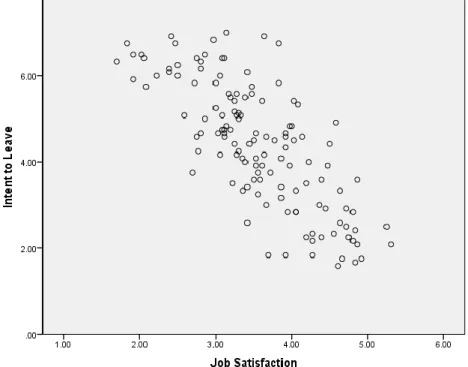
Figure 5. Linear relationship between job satisfaction and intent to leave. ... 115
Figure 6. Extreme Outlier for Professional Development Rated at the Not Valuable Level for Respondents who are Dissatisfied with their Jobs. ... 116
LIST OF ABBREVIATIONS
ACPA The American College Personnel Association SEAHO The Southeastern Association of Housing Officers SWACUHO The Southwest Association of College and
CHAPTER I- INTRODUCTION
“Train employees well enough so they can leave. Treat them well enough so they don’t want to.” -Richard Branson (2014).
Competition for employees continues to increase as organizations strive to fill open positions (Work Institute, 2019). The war on talent emerges as organizations
compete to attract employees. Gallup (2019) asserts that employees have an advantage in this war on talent due to a greater demand for employees than the supply of employees. As employees experience discontent, organizations experience turnover, unfilled
positions, loss of customers, overworked staff, and compromised profits (Work Institute, 2019). According to the U.S. Bureau of Labor Statistics (BLS; 2019), the number of job openings totals 7.1 million, reflecting a 138% increase since 2010 (Work Institute, 2019). The likelihood of employees changing jobs for perceived better opportunities increases as a result of an increase in job openings (Phillips & Edwards 2009; Woo & Allen, 2013; Work Institute, 2018, 2019). The Work Institute (2019) states that 38% of all turnover in 2018 attributes to employees leaving within their first year on the job. Forty-three out of 100 new employees quit within the first 90 days of a new job (Work Institute, 2019).
The Work Institute’s 2019 annual report, which includes 250,000 employees representing multiple industries, reveals a 27% national turnover rate resulting from 40.1 million employees voluntarily quitting jobs (BLS, 2018; Work Institute, 2019). With an 8.3% increase from 2017 and an 88% increase from 2010, voluntary turnover continues to surge upward (Work Institute, 2019). Researchers predict a continual upward trend of voluntary turnover, which could result in a 35% increase in turnover by 2023 (Work
Institute, 2019). According to Cho, Johanson, and Guchait (2009), the terms turnover and intent to leave are often used interchangeably.
Mamun and Hasan (2017) identify job satisfaction as the key factor of turnover intention. Therefore, organizations should strive to improve job satisfaction and mitigate intent to leave and turnover. Implementing retention strategies such as professional development for employees serves as a strategy for improving job satisfaction, which is necessary to exist and thrive in a competitive market (Bryant & Allen, 2013; The Society of Human Resource Management, [SHRM]; 2018). Former senior advisor to President Barack Obama, Valerie Jarret states, “Employers who recognize the importance of investing in their workforce have a more productive workforce, a more efficient workforce, a more loyal workforce, less turnover, and, in the private sector, are more profitable” (As cited in Kahn, 2016, p. 1). Employees play a significant role in achieving organizational goals and success (Quinn, 2018). Becker (1993) describes the
development of human capital as a benefit to the organization. In other words, to
maximize profits, organizations should focus on human capital development as a means to capitalize on the talents of employees in the organization (Craig, 2018).
Chapter One of this study details the background of the study. Included in this chapter is the statement of the problem which addresses the pertinence of the study. The purpose of the study and the significance of the study follows the problem statement, which guides this research. The next section, research objectives, also help guide the study and are detailed in this chapter. The conceptual framework, assumptions, and operationalized definitions are explained after the research objectives. Lastly, the summary provides a brief overview of chapter One.
Background
Organizations seeking to attract and retain talent should focus on the professional development of employees (The Conference Board, 2018). As the number of open jobs increases, the competition to retain qualified employees also increases, thus requiring organizations to ensure the satisfaction of employees to minimize intent to leave and employee turnover (Bryant & Allen, 2013; The Conference Board, 2018; Work Institute, 2019). Implementing retention strategies that meet the professional development needs of employees proves beneficial to organizations (The Work Institute, 2019). Surveys
assessing job satisfaction reveal that employees seek professional development to assist with preparation for advancement and promotion opportunities (Gallup, 2016; Work Institute, 2019; SHRM, 2016).
Professional Development
Human Capital refers to the knowledge, skills, abilities, and traits that allow one to perform specific functions or tasks and contributes to cost efficiency, which yields economic value (Becker, 1993; Shultz, 1961). Investing in the development of new employees serves as a component of human capital development. Cascio (2015) defines development as improving employees’ knowledge, skills, abilities, and other
characteristics in order to preserve and enhance their competence in jobs. Jacobs and Washington (2003) explain that employee development integrates planned programs to enhance employees’ ability in meeting performance goals.
Professional development serves as a means for employees to improve skills and abilities while building human capital. The Society of Human Resource Management (SHRM; 2016) describes professional development as receiving learning opportunities
through formal and informal training and obtaining certificates or degrees. Professional development opportunities may include conferences or workshops, online educational programs, academic courses, or mandatory skills training (Blimling, 2014; Mokhtar, 2010; Schreiber et al., 1994).
When organizations invest in employees through training, learning opportunities, and development, employees may feel a sense of indebtedness to the organization (Brum, 2007), thus significantly influencing an employee’s decision to stay with an organization (Mamun & Hasan 2017). Bryant and Allen (2013) agree that employees who see a potential for growth and advancement are more likely to stay with an organization, even when they are not completely satisfied with the organization. An organization’s failure to provide opportunities to learn and grow limits employees’ chances to improve skills and abilities (Mamun & Hasan, 2017). Professional development remains necessary to enhance skills and knowledge of employees (Belch, Wilson, & Dunkel, 2009; Cendana, 2012; Davidson, 2012; Henning, Cilente, Kennedy, & Sloane, 2011; Schreiber, Dunkel, & Jahr, 1994; SHRM, 2016). Additionally, providing professional development
contributes to job satisfaction and assists in retaining high performing employees (Bryant & Allen, 2013; Radford, Shacklock, & Meissner, 2015; SHRM, 2016; 2018).
Job Satisfaction
Implementing practices to increase job satisfaction of employees helps in retaining employees. Retaining desired employees continues as one of the most critical issues organizations face (Allen, 2008; Lee, Hom, Eberly, & Ji, 2018; SHRM, 2018). Researchers describe job satisfaction as the positive interactions and pleasure one receives in their workplace (Judge et al., 2012; Locke, 1969; Spector, 1997).
Additionally, job satisfaction enhances productivity, innovation, and commitment to the organization (Maheswari, 2014). Spector (1997) informs that job satisfaction divides into two categories. One category includes the job environment, and the second category includes individual factors employees bring to the job. The environment consists of characteristics of the job while organization and individual factors encompass personalities and experiences (Spector, 1997).
Using job satisfaction dimensions identified through a review of literature, Spector (1985) identifies nine facets associated with job satisfaction. Facets include: (a) pay, (b) promotion, (c) supervision, (d) fringe benefits, (e) contingent rewards
(performance-based rewards), (f) operating procedures (required rules and procedures), (g) coworkers, (h) nature of work, and (i) communication. These facets describe
characteristics of a job. Researchers suggest all employees in an organization are responsible for the job satisfaction of personnel (Lee et al., 2018). Human resources departments provide services and opportunities, such as compensation structure, staff training and rewards and recognition of performance (Sattar, Ahmad, & Hassan, 2015), which researchers identify as factors contributing to job satisfaction (Bryant & Allen, 2013; SHRM, 2018; Shuck et al., 2018).
Swanson and Holton (2009) describe human resource development as “a process of developing and unleashing expertise for the purpose of improving individual, team, work process, and organizational system performance” (p. 4). Human resource
management refers to the actions of connecting employees and the organization to maximize accomplishing the goals of each (Maheswari, 2014). Human resource management professionals strive to improve job satisfaction and self-actualization of
employees through encouraging and assisting them to reach full potential (Maheswari, 2014). Focusing on human resource development assists human resource managers in accomplishing the goal of improving job satisfaction and self-actualization of employees.
According to researchers, human resource managers should focus on retention strategies to assist in improving job satisfaction and decreasing employee turnover (Allen, 2008; Bryant & Allen, 2013; Shuck, Twyford, Reio, & Shuck, 2014; SHRM, 2018). Human resources practices include recruitment criteria, work plans, compensation structures, staff training and rewards and recognition for exemplary performance (Sattar, Ahmad, & Hassan, 2015). Shuck et al. (2014) affirm that employees value receiving organizational support for participating in professional development activities. Receiving support contributes to employees’ job satisfaction and mitigates intent to leave (Shuck et al., 2014).
Intent to Leave
Judeh (2012) defines intent to leave as an individual’s intention to leave voluntarily from their organization or job. Conversely, the chance or probability of continued membership in an organization describes intent to stay (Price & Mueller, 1981). Based on the definitions of intent to leave and intent to stay, intent to stay is the opposite of intent to leave. Researchers associate intent to leave as the final decision prior to employees leaving the organization (Allen & Bryant, 2013; Mobley, 1977; Tett & Meyer, 1993). Organizations should work to recognize and alleviate behaviors and practices that may lead to intent to leave or turnover in an effort to forgo negative consequences associated with employee turnover (Allen & Bryant, 2013; Lee et al., 2018).
As employee turnover continues as a topic of concern, numerous studies assess the impact of turnover on organizational performance (Judge et al., 2001; Lee et al., 2018; Phillips & Edwards, 2009; Reina, Rogers, Peterson, Byron, & Hom, 2018; Wynen, Dooren, Mattijs, & Deschamps, 2018). Other studies focus on retaining talent (Allen, 2008; Ballinger, Cross, & Gray, 2011; Bryant & Allen, 2013; Lee et al., 2018; Reina, Rogers, Peterson, Byron, & Hom, 2018;), the role of human resources in employee retention (Allen, 2008; Bryant & Allen, 2013), and the impact of job satisfaction on retention (Bryant & Allen, 2013; Lee et al., 2018; Locke, 1969; Mobley, 1977; Phillips & Edwards, 2009; Spector, 1997). Negative consequences such as high costs (Phillips & Edwards, 2009; Lee et al., 2018; Work Institute, 2018), loss of productivity and
performance (Lee et al., 2018; Phillips & Edwards, 2009), loss of expertise (Phillips & Edwards, 2009), quality of service (Lee et al., 2018; Phillips & Edwards, 2009), disruptions among remaining employees (Phillips & Edwards, 2009), and increased workload of current employees compensating for incomplete tasks due to staff departures (Lee et al., 2018; Phillips & Edwards, 2009), result from turnover.
Organizations incur increased costs with high turnover. Substantial costs
associated with turnover pose a financial challenge and concern for organizations (Lee et al., 2018; The Work Institute, 2018). Turnover costs can range from one to one and a half times the salary of the employee leaving the organization (Allen, 2008; Bryant & Allen, 2013; O’Connell & Kung, 2007). Organizations spend billions of dollars annually in turnover costs (Work Institute, 2019). In addition to costs, employee turnover can negatively affect the quality of service provided to customers. Eckardt, Skaggs, and Youndt (2014) purport that due to service industries providing direct interactions with
customers for products, the high turnover resulting in new or poorly trained employees can immediately impact the customer experience and the financial performance of the organization. The significance of reducing intent to leave and employee turnover remains paramount.
Statement of the Problem
Researchers identify professional development as a retention strategy that can positively influence job satisfaction and retention of employees (SHRM, 2018; Shuck et al., 2014; Work Institute, 2018). Additional retention strategies that focus on
recruitment, socialization of new employees, compensation and rewards, supervision, and engagement may also assist in managing employee retention (Allen, 2008; Allen, Bryant, & Vardman, 2010; Bryant & Allen, 2013; Shuck et al., 2014; SHRM, 2018) Retention strategies assist organizations in minimizing employees’ intent to leave. By focusing efforts on strategic initiatives to retain employees, organizations benefit from attracting and retaining employees by decreasing turnover costs and minimizing intent to leave (Allen, 2008; Allen, Bryant, & Vardman, 2010; Bryant & Allen, 2013; SHRM, 2018).
Talented and productive employees leaving organizations result in a skills gap for the organization and can negatively impact job satisfaction for employees remaining with the organization (Eckardt, 2014; Lee et al., 2018; Phillips & Edwards, 2009; Work Institute, 2018). Organizations pay substantial costs related to turnover. Costs range from 25% to 500% of an employee’s salary depending on the departing employee’s position (Ballinger et al., 2011; Bryant & Allen, 2013; O’Connell & Kung, 2007; Work
Institute, 2018). Costs of turnover amounted to $567 billion in 2017, $617 billion in 2018, and is projected at an alarming $800 billion for 2023 (Work Institute, 2018).
High turnover costs can prove detrimental to an organization’s performance, productivity, and ability to remain competitive (Aguines & Kraiger, 2009; Ballinger et al., 2011; SHRM, 2018; Work Institute, 2019; Wynen et al., 2018). Additionally, high turnover negatively impacts the quality of customer service provided. Therefore, the necessity for organizations to invest in human capital development practices in an effort to decrease intent to leave and employee turnover remains (Sears & Fyne, 2017).
Employees disclose a desire for professional development opportunities through surveys assessing job satisfaction (SHRM, 2016; The Conference Board, 2018). Therefore, researchers suggest that focusing on professional development opportunities for
employees may increase job satisfaction and reduce intent to leave (Allen, 2008; Bryant & Allen, 2013; Lee et al., 2018).
In conclusion, employees are requesting more professional development and identify a lack of professional development as negatively impacting job satisfaction (SHRM, 2016; The Conference Board, 2018). Previous studies identify job satisfaction as impacting intent to leave; specifically, job dissatisfaction leads to increased chances of employee turnover (Bryant & Allen, 2013; Phillips & Edwards, 2009; Spector, 1997). When organizations fail to cater to the needs and desires of employees, employees may experience job dissatisfaction resulting in increased intent leave the organization.
Purpose of the study
The purpose of this study is to determine the relationship between the perceived value of professional development, job satisfaction, and intent to leave. Researchers suggest providing professional development opportunities as a strategy for improving job satisfaction and minimizing intent to leave (Allen, 2008; Bryant & Allen, 2013; Shuck et al., 2014). This study assists in identifying how professional development impacts job satisfaction and intent to leave.
Research Objectives
The study aims to determine the relationship between the perceived value of professional development, job satisfaction, and intent to leave. The following research objectives guide this study.
RO1- Describe the demographics of study participants, including years of experience in the field, number of years in current position, type of institution, size of institution, highest level of education completed, ethnic affiliation, and gender.
RO2- Describe available professional development opportunities and professional
development opportunities in which respondents participate.
RO3- Determine the relationship between the perceived value of professional
development and job satisfaction.
RO4- Determine the relationship between the perceived value of professional development and intent to leave.
RO5- Determine the relationship between job satisfaction and intent to leave.
RO6- Compare the influence of the perceived value of professional development and
Significance of the Study
Implementing retention strategies that focus on professional development serves as a means to decrease intent to leave and assists in the retention of employees (SHRM, 2018; Shuck et al., 2014; Work Institute, 2018). By determining the relationship between the perceived value of professional development, job satisfaction, and intent to leave, employers can determine how to meet the needs of employees. The results of the study may assist learning and development professionals and supervisors in identifying professional development opportunities that contribute to job satisfaction and ultimately reduce intent to leave.
Conceptual Framework
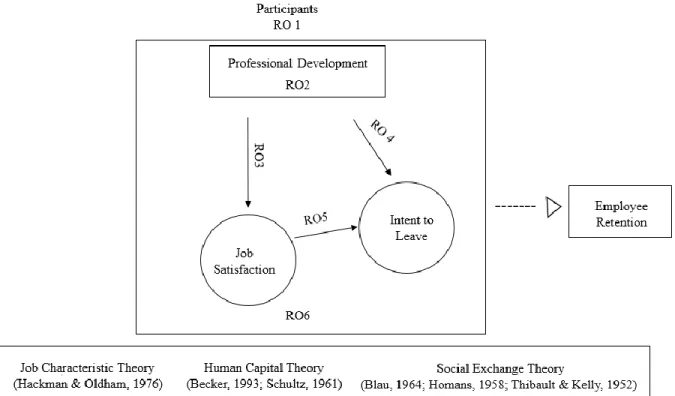
A conceptual framework serves as an illustration of the research problem (Roberts, 2010). The illustration includes a theory or constructs that conceptualizes the research perspective and focus of the study (Roberts, 2010). Figure 1 depicts the
conceptual framework for this study. The conceptual framework represents factors such as professional development and job satisfaction as contributing to an employee’s intent to leave an organization. Professional development includes training and development as well as educational courses, seminars, or conferences that contribute to employee
knowledge and skill development (Blimling, 2014; Mokhtar, 2010; SHRM, 2016). The conceptual framework exemplifies the perceived relationship between professional development, job satisfaction, and intent to leave. Based on the perceived relationship, professional development affects job satisfaction and contributes to an employee’s decision to leave an organization. The framework reflects the research objectives of the study. Three theories serve as the theoretical foundations of the study.
Human capital theory, social exchange theory, and job characteristics theory provide the foundation for the study. Human capital theory acknowledges that incurring costs to improve knowledge and skills professionally and personally serve as investments in human capital (Becker, 1993; Schultz, 1961). Social exchange theory emphasizes the rewards and costs of relationships through interactions with others. The theory implies employees who feel supported and valued by their organization engage and contribute to innovative initiatives (Blau, 1964; Homans, 1958; Thibaut & Kelley, 1954). Hackman and Oldham’s (1976) job characteristic theory asserts the notion that people who enjoy their jobs tend to find meaning in their jobs and have the motivation to perform well. The theory states specific characteristics produce a psychological state that leads to job performance, job satisfaction, motivation, and turnover. Spector (1985) uses this theory along with dimensions identified in the literature to determine the nine job satisfaction facets mentioned previously.
Figure 1. Conceptual Framework.
The conceptual framework represents factors such as professional development and job satisfaction as contributing to an employee’s intent to leave an organization.
Assumptions
Assumptions delineate postulates, premises, and propositions accepted as
necessary and operational for the purpose of the study (Lunenburg & Irby, 2008). Several assumptions relate to this study. One assumption is that the instruments utilized to collect data are valid and reliable for determining the perceived value of professional
development, job satisfaction, and intent to leave. A second assumption is that
participants in the study will answer the survey questions honestly. A third assumption is the sample of participants for this study represents the population.
Operationalized Definitions
The operationalized definitions section provides definitions of common terms and
concepts utilized throughout the study. Listed below are the operationalized definitions:
Employee retention— the opposite of employee turnover; refers to the percent of employees that remain with the organization (Phillips & Edwards, 2009).
Employee turnover— the percent of employees that leave the organization for any reason (Cascio, 2015; Phillips & Edwards, 2009).
Intent to leave— an individual’s intention to leave voluntarily from their organization or job (Judeh, 2012). This term is used interchangeably with turnover (Cho, Johanson, & Guchait, 2009).
Intent to stay— the chance or probability of continued membership in an organization (Price & Mueller, 1981).
Job satisfaction— the positive interactions and pleasure individuals receive in the workplace. Job satisfaction is commonly attributed to employee engagement, positive work performance, and employee retention (Judge et al., 2012; Locke, 1969; Spector, 1997).
Persistence— a student’s desire and action to remain in the system of higher education from their first year through completion of a degree (Berger & Lyon, 2005).
Professional development— learning opportunities through formal and informal training, and obtaining certificates or degrees (SHRM, 2016).
Residence Life— most commonly known as housing or housing and residence life. Residence life provides living options to students, social and educational programs,
faculty and staff collaborations, and assist in the student conduct process (Messer-Roy, 2006).
Residence life live-in professional staff— individuals required by their position to live in an apartment within the residence halls or building where they work. Common titles for these positions include Residence Hall Director, Community Director, and Residence Life Coordinator (Rankin, 2013). Titles can vary depending on the university (Cendana, 2012).
Resident Assistants (RAs)— student employees who reside on each floor of the residence hall and are responsible for creating community among residents in the hall (Belch & Kimble, 2006).
Retention— An institution’s ability to retain a student from admission to the university until graduation (Berger, Ramirez, & Lyon, 2005).
Southeastern Association of College and University Housing Officers (SEAHO)— A
professional organization that allows membership to institutions of higher education with
housing officers involved in the administration, operations, facility management, and residential life in the ten southeastern states of the United States including Alabama, Florida, Georgia, Kentucky, Louisiana, Mississippi, North Carolina, South Carolina,
Tennessee, and Virginia (SEAHO, 2019).
Southwest Association of College and University Housing Officers (SWACUHO)— A professional organization that allows membership to institutions of higher education (junior colleges, four-year colleges and universities) located in Arkansas, Oklahoma, and Texas, and have housing officers involved in the coordination of administration,
educational programming or food service operation for students and staff members (SWACUHO, 2018).
Student Affairs— the role of student affairs professionals is to create a learning
environment by engaging and supporting students in their collegiate experience. Duties can include academic advising, residence hall operations, and other tasks associated with creating a positive experience for all college students (Cawthon & McDonald, 2002).
Summary
Employee retention remains a concern for many organizations (Collins & Hirt, 2006; Davidson, 2012; Dunkel & Schreiber, 1994; Forney et al. 1982; Lee et al., 2018; Marshall et al., 2016; SHRM, 2018; Spector, 1997; Tull, 2006; Work Institute, 2018). Marshall et al. (2016) acknowledge the importance of retention in order for organizations to avoid losses in cost and time. Researchers identify job satisfaction as contributing to employee retention. Implementing retention strategies help organizations improve job satisfaction and reduce intent to leave and employee turnover (Bryant & Allen, 2013; Lee et al., 2018; SHRM, 2018). Providing professional development opportunities that allow employees to enhance their knowledge, skills, and abilities can serve as a retention strategy (Blimling, 2014; Bryant & Allen, 2013; SHRM, 2018). This study aims to determine the relationship between the perceived value of professional development, job satisfaction, and intent to leave. By identifying the relationship between the perceived value of professional development, job satisfaction, and intent to leave, organizations may determine professional development strategies to improve job satisfaction and employee retention.
The remainder of this study encompasses four chapters. Chapter Two includes a review of literature, which provides findings of previous research and supports this study. Chapter Three consists of the research methodology and design. Additionally, Chapter Three includes the population and sample of the study, instruments, data collection procedures, IRB approval. Chapter Four includes an analysis of the data and Chapter Five provides findings, conclusions, and recommendations.
CHAPTER II- LITERATURE REVIEW
Organizations strive to remain competitive in a constant changing environment. As the unemployment rate continues to decrease, organizations face the challenge of retaining employees (Work Institute, 2019). With an increased number of job openings, employees consider other job alternatives (Work Institute, 2019). Organizations
capitalize on the opportunity of individuals seeking new job options by hiring currently employed individuals to meet business needs. Organizations must focus on initiatives and efforts to meet the needs and desires of employees (The Conference board, 2018).
Professional Development
Employee development focuses on integrating planned programs over a period of time that enhance employees’ competence and ability to meet performance expectations in an effort to meet organizational goals (Jacobs & Washington, 2003). Approaches to employee development may include training on and off the job, educational courses or seminars, job rotations, self-study materials, or mentoring programs (Jacobs &
Washington). Jacobs and Washington (2003) explain the objective of employee development is to provide opportunities that increase employees’ competence for the present job or future job. According to Fenwick (2003), professional development is an aspect of employee development focusing on continuous learning. Professional
development assists with personal and professional growth in the long term in order to enhance the practices of professionals. SHRM (2016) describes professional development as receiving learning opportunities through formal and informal training and obtaining certificates or degrees. Attending conferences or workshops, online educational programs, taking academic courses or mandatory skills training programs are
professional development opportunities that assist in informal learning (Blimling 2014; Mokhtar, 2010; Schreiber et al., 1994).
Professional Development Investments
Sung and Choi (2013) identify investments in professional development as contributing to innovation in the workplace. Types of professional development include corporate training expenditure and financially supporting education and professional development. Corporate training expenditure includes an investment in firm specific training for the purpose of building skills and performance gains immediately. Corporate training expenditures typically include training programs which are created and delivered by the organization to reinforce firm-specific human capital (Hatch & Dyer, 2004; Sung & Choi, 2013). A second form of investment involves financially supporting education and professional development for employees. Financially supporting education and professional development supports the employee’s development towards career goals and competence and will benefit the organization as well (Jacobs & Washington, 2003).
In comparing the two types of investment, corporate training expenditures directly impact the organization whereas financially funding education and professional
development allows the individual to develop more skills for the present and future jobs. Sung and Choi (2013) explain both types of investment are beneficial and contributes positively to the organization. However, organizations must ensure financially supporting education and professional development are allocated fairly to employees and be careful to not exclude employees.
By allocating a budget for professional development, employees feel valued and supported by the organization. Organizations also benefit from investing in professional
development when employees gain more skills and knowledge and master their job responsibilities. In a survey conducted by SHRM (2016), 49% of the 600 employees who took the survey rated professional development as very important. Additionally, 59% of participants reported satisfaction with their organization’s contribution to professional development. Organizations that budget for professional development show pride in investing in employees (SHRM, 2016).
Additionally, Bashir and Jehanzeb (2013) assert the necessity of organizations’ investment in training and development in order to prepare employees to keep pace with the quickly changing business environment and remain competitive in the job market. With increased knowledge, employees become more competitive for promotions and advancement opportunities. Identifying training and development needs assists organizations in determining best practices for employees in the workplace. Training and Development Defined
Training and development can be categorized as a subset of professional development. Fitzgerald (1992) defines training as a tool to assist in the acquisition of knowledge and skills to complete tasks at a particular point in time for organizational success. Training prepares individuals to meet job expectations and assists the
organization to successfully meet goals. Aguines and Kraiger (2009) corroborate the relationship between training and organizational productivity by defining training as a systematic approach to enhancing knowledge, skills, and attitudes with the goal of improving individual, team, and organizational effectiveness. Fitzergard (1992) emphasizes that training is considered effective when a change in behavior occurs as a result of newly gained knowledge and skills. Training must link to performance
outcomes, otherwise the organization does not benefit from the training investment. Salas, Tannenbaum, Kraiger, and Smith-Jentsch (2012) assert that training should not be viewed as a cost, but as an investment in the organization’s human capital. The terms training and development are often utilized together. However, Fitzgerald (1992) identifies a distinction between the two terms.
Distinction between Training and Development. Fitzgerald (1992) makes a distinction between the terms training and development. Training involves individuals participating in training activities or classes to gain knowledge and skills. Development focuses on improving an individuals’ knowledge, skills, abilities, and other
characteristics to preserve and enhance competence in an employee’s current job and for future positions (Aguinis & Kraiger, 2009; Cascio, 2015; Fitzgerald, 1992). According to Fitzgerald (1992), development occurs over a period of one to three years whereas training occurs in a year or less. When employees are developed, they are able to
contribute positively to the organization and assist in its long-term success. Development takes place by utilizing and improving the knowledge and skills gained during training activities and classes (Fitzgerald, 1992).
As time progresses, one can continue improving skills and knowledge to become an expert. Dreyfus and Dreyfus (1986) explain individuals go through five stages in the acquisition of a new skill. These stages include novice, advanced beginner, competent, and expert. As individuals progress through these stages, development occurs. An
essential part of development includes creating plans to assist in identifying development opportunities (Dunkel & Schreiber, 1994), as well as tracking progression of
Development and Performance Plans
Fitzgerald (1992) explains development plans and performance plans serve as tools to help enhance both training and development of employees. Performance plans should link to employee reviews. These plans, typically short term spanning six months to a year, include performance expectations and how performance will be measured. Learning or training activities that may assist in attaining the performance expectations are included. A development plan complements performance plans. According to Fitzgerald (1992), the development plan, typically a long-term plan spanning up to three years, includes approximately three measurable objectives and serve as an action plan for an employee’s current or future job opportunities. This plan focuses solely on growth and development of the employee. When creating development and performance plans, determining the needs of employees helps ensure proper training and development occurs.
Needs Analysis
Aguinis and Kriager (2009) affirm that organizations must remain competitive in the market they operate. In order to remain competitive, it is essential employees possess the knowledge and skills necessary to perform well and meet organizational goals. Organizations invest funds annually to train and develop employees (Salas et al., 2012). Prior to creating training opportunities, organizations should determine specific training needs of employees (Phillips & Phillips, 2012; Salas et al., 2012). A training needs analysis serves as a method to assess training needs. According to Salas et al. (2012) a training needs analysis results from an assessment of training areas, individuals who need training, and the type of system necessary for training effectiveness. From the needs
analysis, learning outcomes, training design and delivery, evaluation plans, and challenges that can affect training success are determined.
Phillips and Phillips (2012) explain a needs analysis begins with preference needs and continues through payoff needs. The analysis begins with level one, preference need. In the preference need level, a review of preferences for implementing a particular training occurs. These preferences can include stakeholders’ perceived relevance of the training, significance of the training, necessity for the training or program, as well as the delivery method and implementation. The second level, learning needs, assess the learning gap. Specifically, this level identifies the knowledge and skills needed to
improve performance. According to Phillips and Phillips (2012), the performance need is the third level in the needs analysis. Performance needs focus on changes that should occur in order to improve business measures. The fourth level, business needs, involves assessing the needs of the organization. This step assesses whether the training or program under review connects to a need or business measure of the organization. Business measures typically include output, costs, customer service, or quality. The fifth level is the payoff needs, which assesses whether the problem is worth solving. The payoff need helps determine if training is linked to a business need and if the benefits of having the training or program warrants the cost to implement the intervention.
Salas et al. (2012) explain the difference between implementing training for performance improvement and preparing one for their role. The researchers note that all new employees should receive training to prepare them for the new role. Throughout the course of one’s tenure with the organization, the need for additional training may occur. According to Salas et al. (2012) training is not always the solution to a performance
discrepancy. Conducting a needs analysis helps determine if training will improve performance. If the decision is made to implement training, participant retention and application of new knowledge influences the success of the training (Salas et al., 2012). Participant’s Role in Training
While a needs analysis helps determine training needs, participants of the training influence actual training outcomes. Salas et al. (2012) identify self-efficacy, goal
orientation, and motivation to learn, as the three components individuals contribute to an effective training. Self-efficacy focuses on individuals’ belief in their own abilities. This belief in the participant’s ability influences the training outcomes. Goal orientation focuses on the mentality one has in interpreting and shaping their behavior in learning environments. Influenced by the work environment and training, individual
characteristics drive employee motivation to learn (Salas et al., 2012). While participants influence the outcomes of training, the delivery method significantly impacts retention of information (Salas et al., 2012). Including various delivery methods and types of training helps cater to multiple learning styles (Salas et al., 2012).
Salas et al. (2012) describes various types of training which include behavioral role modeling, self-regulation, traditional lecture style, computer-based training, or simulations. With behavioral role modeling, participants gain new knowledge and skills by watching others perform those skills. Self-regulation involves learner cognitions that allow individuals to sustain focused learning to self-monitor performance, compare progress to an end goal, and adjust learning efforts and strategies for retention of information. Traditional lecture style training resembles a classroom setting in which a lecture is presented. Computer based training may occur using internet platforms,
individual workstations, or utilizing tablets or smart phones. Simulations use games through computer-based systems to emulate scenarios which provide participants with hands-on experience to navigate through scenarios (Galvao, Martins, & Gomes, 2000). While various types of training exist, organizations should utilize research findings to determine the best method to provide engaging and challenging learning environments (Salas et al., 2012). Implementing a process to evaluate training allows the organization to determine the effectiveness of the type of training (Salas et al., 2012).
Evaluation of Training
Evaluating training programs ensures efficiency and effectiveness of training. A training evaluation allows organizations to assess whether training contributes to an increase in knowledge and skills (Aguines & Kraiger, 2009; Kraiger, McLinden, & Casper, 2004). In evaluating training, several models prove useful. Researchers consider the Kirkpatrick model one of the most frequently used models (Kraiger et al. 2004; Salas et al. 2012). The authors note Kirkpatrick’s 1994 four-level hierarchy serves as a guide for evaluating practices of training (Kraiger et al., 2004; Salas et al., 2012).
Kirkpatrick’s four-level model includes: reaction, learning, behavior, and results (Kilpatrick, 2006). According to Kirkpatrick (2006), level one, reaction, measures participants’ reaction to the program or training implemented. Level two, learning, assesses a change in participants’ attitudes, knowledge, and skills resulting from the training program. Level three, behavior, assesses a change in behavior and practice as a result of the training program. Level four, results, include outcomes that occur as a result of participating in the training program. Kirkpatrick (2006) asserts results can include an
increase in production, quality improvement or other outcomes the training directly affects.
Kraiger et al. (2004) inform that Kirkpatrick’s hierarchy model lacks guidance for methodology in regard to selecting measurement outcomes for the purpose or type of evaluation. Phillip’s model introduced in 1997 provides a modification to Kirkpatrick’s third and fourth level by suggesting new terms for the third and fourth level and
introducing a fifth level (Kaiger et al., 2004). Similar to Kirkpatrick’s model, Phillips and Phillips’ model consists of five levels of evaluation.
Phillips and Phillips (2012) identify level one as reaction/satisfaction. This level measures participants’ reactions and satisfaction with a training program. The second level, learning, assesses changes in knowledge, skills, and attitudes resulting from
participating in a training program. The third level, application/implementation, measures the changes in actions and behaviors of participants as knowledge and skills are
implemented or applied as an outcome of a training program. Level four, business
impact, assesses changes in business impact measures. Business impact measures include quality, costs, output, job satisfaction, time, or customer satisfaction that change as a result of implementing a program. Level five, return on investment compares the monetary benefits to the cost of implementing the training program. In addition to these five levels, Phillips and Phillips (2012) identify costs related to the training program as level 0. Intangible data include impact measures such as attitudes, customer service, or engagement. The intangibles are not converted to monetary value and define level six. Assessing training allows organizations to make changes or adjustments to ensure each
training session or program produces the desired outcomes. Providing quality training and development benefits both the organization and its employees (Serbes, 2017). Professional Development as a Benefit to the Organization and Employee
Whether through formal training or other professional development opportunities, research shows professional development remains necessary to enhance skills and
knowledge (Schreiber et al., 1994; Belch et al., 2009; Davidson, 2012; Henning et al., 2011; Cendana, 2012; SHRM, 2016). Both the organization and employees benefit from the enhancement of knowledge and skills through professional development (Serbes, 2017). Bashir and Jehanzeb (2013) emphasize an ideal training and development program should include an amalgamation of knowledge, career development, and goal setting. By incorporating training and development programs and professional development
opportunities, employees typically feel valued, supported, show more engagement, and exhibit increased productivity and job performance (Cascio, 2015; Shuck et al., 2014).
Brunetto et al.’s (2014) study assessing the impact of management on the engagement and well-being of high emotional labor employees found that managers of both nurses and police officers can increase the engagement, commitment, and ultimately retention of employees by increasing working conditions. Additionally, the researchers state that providing more access to quality training and development enhances the engagement and commitment of police and nurses, thus increasing the retention of these professionals. In the hospitality industry, Davies, Taylor, and Lawson (2001) assess the role of appraisals, compensation, and training on improving staff relations and turnover. Of the three factors, training and development initiatives arose as contributing to quality, productivity, and reduced turnover, thus emphasizing the importance of training and
development in increasing job satisfaction, minimizing intent to leave and improving employee retention.
According to a study conducted by The Conference Board (2018) assessing job satisfaction, participants ranked satisfaction of professional development low in
comparison to the other 23 components listed in the study. The survey assesses 23 components that contribute to job satisfaction. Of the 23 components assessed, the top five components with the highest percent reflecting satisfaction in rank order include people at work, commute to work, interest in work, supervisor, and physical
environment. Conversely, the lowest ranked components include promotion policy, bonus plan, performance review process, educational and job training programs, and workload. Of the 1,500 employees in the survey, only 32.6 % were satisfied with educational and job training programs. Satisfaction with educational and job training was the fourth from the lowest ranked satisfaction job component. The Conference Board (2018) explains the low ranking of professional development reveals a warning for organizations striving to attract and retain talent. Additionally, with the numerous job opportunities available, organizations must intentionally focus on job satisfaction of employees for retention and productivity.
Job Satisfaction
Spector (1997) cites job satisfaction as a variable most frequently studied in organizational behavior. Job satisfaction from the employee perspective reflects one’s treatment within a job. From the employer’s perspective, job satisfaction of employees may lead to behaviors that impact the operations and performance of the organization. While job and satisfaction are words often utilized together in research, Maheswari
(2014) and Somir and Kaushik (2012) define job and satisfaction separately. Job is defined as payment received from an organization in exchange for work performed by individuals (Maheswari, 2014; Somvir, 2012). Satisfaction is the extent to which a job fulfills individual needs and aligns with their expectations and values (Maheswari, 2014; Somvir, 2012).
Researchers identify Locke’s (1969) definition of job satisfaction as widely known in seminal research. According to Locke (1969), job satisfaction encompasses the positive interactions and pleasure individuals receive in the workplace. Judge and
Kammeyer-Mueller (2012) explain job satisfaction as a state in which individuals express contentment and positive feelings towards one’s job.
Foundational Theories for Job Satisfaction
Prior research assessing job satisfaction identifies theories associated with job satisfaction and notates factors attributed to job satisfaction. Hackman and Oldham’s (1976) Job Characteristic theory serves as a foundational theory for job satisfaction. The researchers identify the early works of Maslow (1954) as relevant to identifying job satisfaction dimensions. As the years progress, other researchers identify factors that align with Maslow’s (1954) hierarchy of needs and also contribute other dimensions as further research is conducted.
Hackman and Oldham’s Job Characteristics Theory. Spector (1997) explains that Hackman and Oldham’s 1976 and 1980 job characteristic theory is the most influential theory on the impact of job characteristics on people. He explains the theory as the notion that individuals who enjoy their jobs and find them meaningful tend to like their jobs and are motivated to perform well. Additionally, the theory states specific characteristics
produce a psychological state that contributes to job performance, job satisfaction, motivation, and turnover (Hackman & Oldham, 1976). These characteristics include skill variety, task identity, task significance, autonomy, and job feedback (Hackman &
Oldham, 1976; Spector, 1997).
Hackman and Oldham (1976) ascertain five core characteristics prompt
psychological states which result in positive personal and work outcomes. Psychological states include experiencing meaningful work, accepting responsibility for outcomes of the work, and knowing the results of work activities. Skill variety, task identity, and task significance contribute to experiencing meaningful work. Autonomy allows one to experience taking responsibility for work outcomes. Feedback provides the opportunity for employees to learn results of work activities. When these characteristics align with employee psychological states, internal work motivation increases and can lead to high quality work performance, high satisfaction with the work, and low absenteeism and turnover. Hackman and Oldham (1976) explain the job characteristics model applies to individual employees and does not serve as an effective design when working in teams. Researchers recognize Maslow’s hierarchy of needs as one of the foundational behavioral theories identifying the need for satisfaction in one’s job (Gawel, 1997; Locke,1976; Spector, 1997).
Maslow’s Hierarchy of Needs. Maslow’s 1954 theory suggests individuals possess satisfaction needs that must be met in a particular order. Maslow’s hierarchy of needs includes physiological needs, safety needs, love and belongingness, esteem, and self-actualization (Maslow, 1970). In describing each level of need, Maslow (1970) assigns food, water, and air to physiological needs. Safety needs include the freedom
from physical threats and harm, and economic security. Love and belongingness involve feeling loved and accepted. The need for mastery and achievement as well as the need for recognition and approval from others encompass esteem needs. Self-actualization
becomes operative when the four lower level needs are met. Self-actualization involves the need for becoming what one is capable of being.
Maslow (1970) explains needs must be met in order of dominance to effectively meet all needs. For example, lower level needs such as physiological needs or safety needs must be satisfied before the higher-level needs such as self-actualization can become operative. Locke (1976) discusses Maslow’s hierarchy of needs and explains an optimal job for an employee includes one in which the job aligns with the employee’s hierarchal needs. In addition to identifying needs, Herzberg’s two factor theory identifies factors that contribute to both job satisfaction and job dissatisfaction. Hackman and Oldham (1976) identify Herzberg’s two factor theory as one of the most influential theories to work redesign and employee satisfaction.
Herzberg’s Two-Factor Theory. Herzberg’s two factor theory states that specific factors contribute to job satisfaction and a separate set of factors contribute to job dissatisfaction (Herzberg, 1959). Motivators, factors associated with job satisfaction, include feeling challenged at work, recognition, advancement, and personal growth (Herzberg, 1959). Hygiene factors contribute to job dissatisfaction and include work environment, supervisors, compensation, policies, and coworker relationships (Herzberg, 1959). In describing hygiene factors, Herzberg (1959) explains deleterious factors may affect the job and result in negative job attitudes. When hygiene factors diminish to a level deemed unacceptable, job dissatisfaction occurs. Conversely, factors that contribute
to positive attitudes satisfy an individual’s need for self-actualization. Motivator factors align with positive attitudes through meeting the needs of individuals in accomplishing their goals and aspirations. In order to determine job satisfaction of employees,
organizations must utilize methods such as assessments to gather information on employee job satisfaction.
Assessing Job Satisfaction
In assessing job satisfaction, the distinction between the global job satisfaction and the facet approach to job satisfaction remains pertinent to collect appropriate data. Spector (1997) describes global job satisfaction as assessing satisfaction as a whole, solely to determine whether one likes their job. The facet approach assesses which areas of the job contributes to job satisfaction or job dissatisfaction. The facet approach helps organizations determine areas of improvement for increasing job satisfaction. Typically, individuals do not have global sentiments that produce identical levels of satisfaction with every aspect of the job, thus signifying the importance of the facet approach to job satisfaction (Spector, 1997). In order to use a facet approach, researchers conduct a factor analysis to identify dimensions of job satisfaction (Locke, 1976; Spector, 1997).
Identifying Job Satisfaction Dimensions. Locke (1976) suggests factor analysis as a popular approach to identify contributing factors of job satisfaction. Factor analysis intercorrelates participant responses to a group of attitudes and groups responses into factors based on correlation of attributes. An inference of elements for the items in each factor then occurs. Results of a factor analysis depends on the characteristics a researcher chooses to utilize such as the population, employment type, environment, and method of
analysis. Due to the variety in characteristics, numerous job satisfaction factors circulate in accordance with the large number of studies presented (Locke, 1976).
In using the facet approach to identify job satisfaction dimensions, several researchers identify factors contributing to job satisfaction. Numerous factors identified by researchers align with the early works of researchers such as Herzberg (1959), Locke (1976), and Spector (1985). Locke (1976) identifies nine job dimensions typically studied in previous research. Job dimensions include: (a) work, (b) pay, (c) promotions, (d) recognition, (e) benefits, (f) working conditions, (g) supervision, (h) coworkers, and (i) company and management. Locke (1976) explains that the dimension described for a job falls between two categories, events or conditions and agents. Events or conditions are outcomes caused by a person or something occurring. Agents, on the other hand, result from the perceived like or dislike of someone due to something done or the failure of completing a task. Work, pay, promotions, recognition, benefits, and working conditions describe conditions. Supervision, co-workers, and company and management describe agents.
Sypniewska (2014) identifies work environment, job stability, relationships with coworkers, and relationships with supervisors, as contributing to job satisfaction. Alegre, Mas-Machucha, and Mirabent (2016) identify organizational commitment (identifying with organizational goals), work-family balance, autonomy, supervisor support and collaboration through teamwork as contributors to job satisfaction. SHRM (2016) identifies compensation, work environment, management relationships, and career development as factors that contribute to job satisfaction. Through the compilation of