Iran University of Medical Sciences
____________________________________________________________________________________________________________________ 1. MSc of Occupational Therapy, Department of Occupational Therapy, School of Rehabilitation Sciences, Iran University of Medical Scienc-es, Tehran, Iran. [email protected]
2. (Corresponding author) Assistant Professor, Department of Occupational Therapy, School of Rehabilitation Sciences, Iran University of
Medical Sciences, Tehran, Iran. [email protected]
3. Associate Professor, Department of Occupational Therapy, Rehabilitation Research Center, School of Rehabilitation Sciences, Iran Universi-ty of Medical Sciences, Tehran, Iran. [email protected]
4. Assistant Professor, Department of Physical Therapy, Tehran University of Medical Sciences, Tehran, Iran. [email protected]
5. Assistant Professor, Department of Neuroscience, School of Advanced Medical Sciences and Technologies, Shiraz University of Medical Sciences, Shiraz, Iran. [email protected]
A computer-based selective visual attention test for first-grade
school children: design, development and psychometric properties
Farzaneh Yazdani1, Malahat Akbarfahimi2, Afsoon Hassani Mehraban3
Shohreh Jalaei4, Mohammad Torabi-nami5
Received:20 May 2014 Accepted:27 July 2014 Published:23 February 2015
Abstract
Background: Visual attention is known as a critical base for learning. The purpose of the present study was to design, develop and evaluate the test-retest and internal consistency reliability as well as face, content and convergent validity of the computer- based selective visual attention test (SeVAT) for healthy first-grade school children.
Methods: In the first phase of this study, the computer-based SeVAT was developed in two ver-sions of original and parallel. Ten experts in occupational therapy helped to measure the content va-lidity using the CVR and CVI methods. Face vava-lidity was measured through opinions collected from 10 first-grade children. The convergent validity of the test was examined using the Spearman correla-tion between the SeVAT and Stroop test. In addicorrela-tion, test-retest reliability was determined by meas-uring the intra-class correlation (ICC) between the original and parallel versions of the SeVAT in a single session. The internal consistency was calculated by Cronbach's alpha coefficients. Sixty first grade children (30 girls/30boys) participated in this study.
Results: The developed test was found to have good content and face validity. The SeVAT showed an excellent test-retest reliability (ICC= 0.778, p<0.001) and internal consistency (Cronbach's Alpha of original and parallel tests were 0.857 and 0.831, respectively). SeVAT and Stroop test demon-strated a positive correlation upon the convergent validity testing.
Conclusion: Our results suggested an acceptable reliability and validity for the computer-based SeVAT in the assessment of selective attention in children. Further research may warrant the differ-ential validity of such a test in other age groups and neuro-cognitively disordered populations.
Keywords: Children, Computer-based, Test, Reliability, Validity, Attention.
Cite this article as:Yazdani F, Akbarfahimi M, Hassani Mehraban A, Jalaei Sh, Torabi-nami M. A computer-based selective visual atten-tion test for first-grade school children: design, development and psychometric properties.Med J Islam Repub Iran2015 (23 February). Vol. 29:184.
Introduction
Based on a definition from the psycholo-gist and philosopher Williams James, atten-tion is “taking possession of the mind in clear and vivid form, of one out of what may seem several simultaneously possible objects or trains of thought s…. It implies
with drawal from some things in order to deal effectively with others" (1). Along the-se lines, visual attention as a cognitive property is known to provide a critical base for learning (2), working memory (3), self-regulation (4) and word learning (5). Ac-cording to multiple models, attention has
different classifications (6). One of the most important types of attention with a significant role in learning and enhancing school achievement is selective or focused attention (7). Selective attention is defined as a preferential allocation of limited pro-cessing resources to events that have be-come behaviorally relevant (8) and depends on working memory capacity (9, 10). Over-all, sustained selective attention has an im-portant role in academic performance (11, 12) such as reading efficiency (13-15) and mathematical skills (16). According to Pos-ner and Rothbart, the stimulation of brain networks which involve in attention mech-anism could enhance this skill in early childhood (17). Therefore, it is worthwhile to investigate the possible effect of inter-ventions in this critical period. Results un-derscore the need for research on the course of attention problems and the necessity to test interventions on children’s early atten-tion problems and their effects on subse-quent academic achievement (18).
Different tools are available to assess var-ious types of attention. Some currently val-idated neuropsychological tests for atten-tion in children include the d2test(19), Test of Everyday Attention for Children (TEA-Ch) (20), Stroop (21) and Trail Making Test(part B)(22) which allow measuring the visual selective attention, and there is also the Persian version of the Sustained Audi-tory Attention Capacity Test(23)which is designed to assess auditory sustain atten-tion. Since recently, there exist some com-puterized instruments to test cognitive skills such as attention which provide abundant proof. These instruments include Test of Variables of Attention (TOVA) (24, 25), the Integrated Visual and Auditory Continuous Performance Test (IVA plus) (26) and the Connors' Continuous Perfor-mance Test (CPT) (27)which assesses sus-tained attention. Such computer-based as-sessments have two major benefits: first, they can be used to score the tests prompt-ly, they are able to keep proper record of reaction time and accurate responses and can also generate an interpretive profile
based on the normative data and provide concurrent stimuli (28); and second, they seem to be quite interesting for children and can increase their motivation to have more cooperation and participation during the evaluation (29). Although a variety of computer-based assessments for auditory selective/sustained attention, such as Paced Auditory Serial Addition Test (PASAT) (30) and Test of Sustained Selective Atten-tion (TOSSA) (31), are available, it seems there is a limitation in computer-based as-sessment of visual selective attention.
The computer-based version of the Stroop test is currently available. Stroop Interfer-ence Test was originally developed as a paper-based tool to measure selective atten-tion and cognitive flexibility (32), ability to set shifting (33), inhibition (34) and extinc-tion (35). The original Stroop has been translated into numerous languages such as Chinese, Czechoslovakian, German, He-brew, Swedish, Japanese (35), Spanish (36) and Persian (37). There are a variation of Stroop tasks i.e., word-color and number-color. Some limitations of this test are that the tool may not be administered to illit-erate subjects such as preschoolers and is not specific for selective attention as it as-sesses set shifting and executive function as well. While attention difficulties are wispread among preschool children (7), de-velopment of a tool to evaluate the selec-tive visual attention which fits into chil-dren’s conditions and requirements seems crucial.
To achieve this goal and upon designing the selective attention test complying with children’s requirements, four important fac-tors were considered as essential and they are as follows: 1)When children are illit-erate, using the pictorial stimuli is the pre-ferred method as elementary school chil-dren can grasp visualized concepts more easily and they can reply to picture-based questions as instantly as written concepts (38);2) Tasks were preferred to be designed in a game format because games are con-sidered the most significant means of communication in elementary school
dren (29) and may notably make them mo-tivated once experimenters try to evaluate their cognitive skills. Games can also allow children to have enhanced attentional con-trol as well as greater cognitive flexibility. This would be served as a new route to bet-ter address developmental disorders (39); 3) Simple design and use of familiar stimuli should be preferred. Attention tests rarely resemble daily life activities and most such tests require quite a lot of focus, probably much more than daily life activities; 4) The investigation of attention to both visual fields is required. It is well known that right hemisphere distributes attention in both hemispheres and visual fields. Meanwhile, the left hemisphere shifts attention predom-inantly to the right visual field/hemi space. The activation of the attentional network appears to occur primarily in the right hem-isphere (6).
The objectives of the current study were to design and develop a computer-based visual selective attention test (SeVAT) with stimuli requiring the attention level in daily life, and secondly, to evaluate the psycho-metric properties including content, face and convergent validity and test-retest and internal consistency reliability of the devel-oped test. The test was designed as a game in order to engage children in a play and prevent them from feeling bored.
Methods
The study involved the assessment of original and parallel forms of the Comput-er-based Selective Visual Attention Test and was carried out in two phases:
- Phase 1: The Development of Comput-er-Based Selective Visual Attention Test (SeVAT): The parallel form of the Com-puter-based SeVAT was designed to im-prove the test reliability and eliminate the carry over and learned effect. The reliabil-ity for the parallel test was measured by comparing two different tests with similar but not fully equal content. This was basi-cally done by creating a bank of questions or stimuli which measure the same quality after which stimuli are randomly divided
into two separate tests. Both tests will then be simultaneously administered to the same subjects. This is considered a common method to assess the test reliability. Absent or insufficient consistency in each test (for instance difference in question items or the content) or measurement error diminishes the test reliability (40).
To create the preliminary design of this test, all variables involved in the computer-based selective attention test were taken into account. This was based on the availa-ble evidence and inputs provided from our experts panel which has been described in our previous study (41). The first phase of this study (the development of SeVAT) is outlined below.
Stimuli Selection: Based on our previous record, 20 experts from various related dis-ciplines including cognitive science, reha-bilitation and computer-based game de-signer (9 occupational therapists, two cog-nitive neuroscientists, two psychologists, six computer game designers and one pedi-atric psychologist) validated the selected stimuli (n = 200) for both the original and parallel versions. The stimuli were selected from a picture bank consisting of 600 pic-tures in different categories including cloths, familiar cartoons characters (which are popular in media), fruits, foods, ani-mals, toys, geometric shapes and signs, let-ters and numbers (42-44). Based on the consensus reached by the experts panel, pictures from cloths, familiar cartoons characters, fruits, foods, animals and toys categories were selected. These pictures were shown to children while they were being asked to decide whether the pictures were attractive, familiar and simple to rec-ognize. Results demonstrated that the cloth-ing subgroup was the least attractive (97%agreements) while the food and fruit subgroups (100% agreements) were the most attractive items. Eventually, the test contained 5 subgroups which were attrac-tive to children and acceptable based on the view points of the experts.
Task: The test comprised of20 trials (10 right-10 left visual fields in order to assess
the visual field effect on attention alloca-tion). In each trial, five pictures of each subtest were framed. They were shown in the column of the right or left side of the screen, and one of them was taken as the target. In each trial, first, the target picture was largely displayed at the middle of the screen and was then paused for 1500 milli-seconds based on the experts' opinion (41). Next, the target picture shrank to small size and moved above a column with five cells in the right (or left) side of the screen and stayed there till the end of trial presentation (in order to decrease the memory effect). Each cell of the columns was differently colored. Then, five pictures moved hori-zontally from the left side of the screen to-wards this column. Children were expected to click on the color opposite to the target picture. After the first 10 replications, the position of the column and direction of the pictures were changed in order to compare the asymmetric effect of the attention net-work.
Software: The software codes were de-fined in Action script 3 and the test was executed in Adobe Flash Professional CS 5, Adobe Air 3, Adobe Photoshop CS 5.5, Sublime Text 2 and Notepad++9.8. The an-imation platform was designed using the Green sock Tween Engine software. The attribute of this test were reaction time in millisecond, accuracy and false reaction.
- Phase 2: The Psychometric Properties of Computer-Based SeVAT
Content Validity: Ten experts (occupa-tional therapists) who did not take part in the first stage endorsed the appropriateness of the quality and quantity of each trial of the test. The inclusion criteria were as fol-lows:1)being the author of at least one rele-vant article and 2)acquiring 10-years aca-demic work experience as a faculty mem-ber. The experts assessed the amount of essentiality of each trail in the test. The content validity ratio (CVR) and content validity index (CVI) were calculated based on the Lawshe method (45). Responses from experts were pooled and the number indicated the "essentiality" for each item.
Face Validity: After valid at ingeach stimulus, ten children (7 years old) who did not take part in the first stage assessed the degree of attractiveness, the presentation time and degree of simplicity of each trial. Besides, they identified how much each task was interesting using the visual analog scale (VAS) where 0 indicated boring and 10 indicated very interesting. In addition, once the test was over, all participants (60 children) answered the open question of "Do you want to play it again?”
Convergent Validity: Sixty first-grade students were enrolled to measure the test-retest reliability and convergent validity of the test. The participants were all selected through convenience sampling method from two elementary schools located in the1stdistrict of Tehran during April-May 2013. Participants were 30 girls with the mean age of 80.83 months and standard deviation of 3.26 and 33 boys with the mean age of 81.50 months and standard deviation of 2.58. The inclusion criteria were age 78-84 months years old, normal visual acuity and hearing, no color blind-ness confirmed by the Ishihara test, normal visual field documented by visual confron-tation test performed by an occupational therapist, normal intelligence score IQ≥90 based on Raven Intelligence Questionnaire for Children and fluency in reading color names ability. The participants were ex-cluded from the study if they revealed any history of a neurological disorder, loss of consciousness due to head injury, any med-ical condition that might affect cerebral functioning and epilepsy based on their medical record and interview with their parent(s). Lack of ADHD signs was con-firmed using the teacher version of Con-ners’ Rating Scales for children in elemen-tary schools (46) which was confirmed by their teachers. Three boys were excluded from the study due to fever and lack of proper cooperation.
In order to evaluate the convergent validi-ty, the correlation between the average of reaction time and accuracy of Computer-based SeVAT and the Persian version of
Computerized Stroop Color-Word Test was determined. The Persian version of Com-puterized Stroop Color-Word Test (Ravan-Sina Inc, Iran) includes two stages. In the first stage, the training phase, the partici-pant should choose the color of the circle which is shown on the monitor in four pos-sible colors of blue, red, yellow and green and press the keys which are covered with colorful labels (V (blue), B (red), N (yel-low), M (green)]on the keyboard. The score of this stage has no influence on the final result. The main part of the test consists of 96 colorful words - 48 colorful congruent words (the meaning of the word complies with the ink color in which the word is written) and 48 colorful incongruent words (the meaning of the word does not comply with the ink color in which the word is written) - which was displayed in pseudo-randomly order on the middle of the moni-tor for 2000 milliseconds (ms) with 800 ms inter-stimulus interval (ISI). The partici-pants were asked to identify the color of the words regardless of their meaning (47). The Persian version of the Stroop testhas good validity and reliability (48).
Reliability: To examine the test-retest re-liability, the parallel version was designed and all the 60 children were administered the original and parallel versions in a single session.
Procedure: All children participating in this study completed the two versions (orig-inal and parallel) of the computer-based SeVAT and the Persian version of Comput-erized Stroop Color-Word Test in a random order. All children had a snack before the experiment with 5-10 minutes resting time between the tests. Participants were seated comfortably on a chair in a quiet room at their schools in the morning during 8-12
am. The distance from monitor was 50 cm. The participants were initially briefed about the overall procedure (by training in prac-tice block) and clicked on the correct pic-ture using the mouse. The ethical protocol of this study was based on the approval from the Ethic Committee of Iran Universi-ty of Medical sciences (IUMS) and was signed by all the participants and one of their parents. Written informed consent was received prior to enrollment.
Statistical Analyses
Result of the Kolomogorov-Smirnov test determined the non-normal distribution of the Stroop test data and normal distribution of the original and parallel versions of Se-VAT. As such, the Spearman correlation coefficients, intra-class Correlation Coeffi-cient (ICC) and Cronbach's alpha coeffi-cients were used to examine the convergent validity, test-retest reliability and internal consistency, respectively. The analysis was done in SPSS 17.0. (The Statistical Package for the Social Sciences). Throughout the experiment, p<0.05 was considered signifi-cant. The reliability correlation coefficients less than 0.4, between 0.4 and 0.7 and more than 0.7 were considered as weak, tolerable to fine and great reliability, re-spectively (49).
Results
Content Validity:The content validity ra-tio (CVR) of the SeVAT’s 20 trials was determined by 10 occupational therapists. While the experts marked 19 trials as "es-sential", the CVR for all trials was1 except for one trial (animals' pictures CVR=0.8). The content validity index (CVI) was 0.995.
Face Validity: Based on the inputs
col-Table 1. Reliability of Test-Retestusing the ICC (n=60)
Com- puter-based SeVAT
Original Version Parallel Version ICC
SEM SD M Min Max SEM SD M Min Max LL UL p r
CN 1.92 5.09 10.08 0 19 1.94 4.73 10.5 1 18 0.629 0.868 0.778 <0.001
SEM: Standard Error of Measurement, SD: Standard Deviation, M: Mean, UL: Upper, Limit, LL: Lower limit, CN: Number of correct answers
lected from10 first-grade participants, the test was perceived to be attractive (n=10, 100%), the time duration for each trial was sufficient (n=8, 80%) and the task was sim-ple (n=8, 80%). Besides, they acknowl-edged that the task was interesting (mean VAS= 9.5).The answers of all the partici-pants to the question "Do you want to play it again?" were yes.
Test-Retest Reliability: With regards to the test-retest reliability using the ICC, there was a correlation between the original and parallel version of SeVAT (p<0.001, r=0.778) (Table 1).
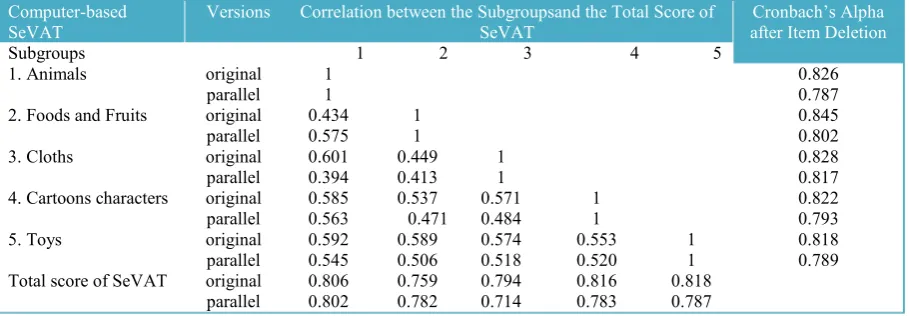
Internal Consistency: The internal con-sistencies (Cronbach's alpha) of scores in the original and parallel tests were 0.857 and 0.831, respectively. Cronbach’s alpha of each subgroups revealed that no item needed to be deleted, since all were less than the total score (Table 2).
The correlation between the subgroups and the total scores in the both versions aredemonstratedin Table 2. There wasa significant relationship between the sub-groups and the total scores in the original (0.759< r <0.818) as well as the parallel
(0.714< r <0.802) versions of the SeVAT. The Correlation between the subgroups and the total score for the original version of SeVAT was shown to be tolerable to fine (0.434< r <0.601), and it was weak to toler-able (0.394< r <0.575) for the parallel ver-sion of SeVAT.
Convergent Validity: The Spearman’s correlation coefficient demonstrated a sig-nificant positive relationship between the number of correct answers and reaction time to correct answers in the origi-nal/parallel versions of SeVAT with the congruent/incongruent stimuli of the Stroop test (Table 3).
Repeated-measure ANOVA demonstrated neither a significant main/interaction ef-fects of the right and left visual field in the original (F (1, 53] = 0.003, p= 0.956) and parallel (F (1, 57] = 0.379, p= 0.541 )tests on the reaction time to corrected answers nor on the number of correct answer of the-se two versions of the computer-bathe-sed orig-inal (F (1, 57] = 0.970, p= 0.329) and paral-lel (F (1, 59] = 0.506, p= 0.480 ) SeVAT. Table 2. Internal Consistency (Correlation between the Subgroups and Total Scores in both Versions of the Computer-Based SeVAT) in First-Grade School Children (n=60)
Cronbach’s Alpha after Item Deletion Correlation between the Subgroupsand the Total Score of
SeVAT Versions Computer-based SeVAT 5 4 3 2 1 Subgroups 0.826 1 original 1. Animals 0.787 1 parallel 0.845 1 0.434 original
2. Foods and Fruits
0.802 1 0.575 parallel 0.828 1 0.449 0.601 original 3. Cloths 0.817 1 0.413 0.394 parallel 0.822 1 0.571 0.537 0.585 original
4. Cartoons characters
0.793 1 0.484 0.471 0.563 parallel 0.818 1 0.553 0.574 0.589 0.592 original 5. Toys 0.789 1 0.520 0.518 0.506 0.545 parallel 0.818 0.816 0.794 0.759 0.806 original
Total score of SeVAT
0.787 0.783 0.714 0.782 0.802 parallel
*: all subgroups are significantly correlated at p<0.05
Table 3. Assessing the Convergent Validity of the Computer-Based SeVAT in First-Grade School Children (n=60)
Computer-based SeVAT Stroop test
Congruent Incongruent
Versions R p r p
CN Original 0.407 0.001
** 0.323 0.012*
Parallel 0.434 0.001** 0.304 0.018*
RT (ms) Original 0.363 0.005
** 0.414 0.001**
Parallel 0.322 0.012* 0.352 0.006**
CN: Number of correct answers, RT: Reaction time to corrected answers, **: p<0.001 is significant, *: p<0.05 is significant, r: Spearman’s rho correlation, ms: millisecond
Discussion
The aim of this study was to develop and validate an instrument, which is interesting to children, to test their selective attention. To do so, a computer-based SeVAT was designed and developed. Following the administration of the test to first-grade children, the validity (content, face and convergent) and reliability (test-retest and internal consistency) of the test was as-sessed.
There are several models of attention for adults and fewer for children (50). One lim-itation of applying the attentional models on younger children was the greater overlap with other developing skills; for instance, executive function, language, visuospatial skills (51). Therefore, attentional tests in preschools may be influenced by develop-ment of other skills. Hence, the design of the current test was based on the perceptual matching tasks method in which children watched the target pictures in the monitor and chose the picture which was the same as the target picture among the5 other pic-tures. In other words, the participants were asked to track the target picture among the other stimuli which were moving from the right to the left or vice versa (based on the visual field) with the task being somehow similar to visual tracking. Basically, these two methods are similar to other tasks for selective attention testing as described by Mahone and Schneider in 2012. They in-troduced “perceptual matching tasks, cen-tral-incidental learning tasks and visual search tasks” as common methods to meas-ure the selective attention (7).
All the selected stimuli in each trial were chromatic pictures in warm colors. Hayakawa and colleagues recorded the re-sponses of 111 children to colorful pictures to be more rapid than the gray scale regard-less of the content as compared to the adults (52). The stimuli were selected from familiar pictures for children. Task design-ers believed that illiterate children could grasp concepts in pictures faster than let-ters, numbers and words as confirmed by evidence (53)as well, and they could
under-stand concepts in familiar pictures more quickly than the unfamiliar ones.
The target stimuli in the SeVAT was shown at the middle part of the monitor and in a larger size than other stimuli and then became equal to others in the SeVAT based on the experts’ opinion which was recorded in our previous study (41). This might have rooted in the fact that concentration and fixation in visual field relies on the center and larger objects are processed in shorter period of time which is in agreement with the results found by Yao and colleagues (2011). They declared that categorization of the complex natural images may occur within a limited area of the visual field, re-ferred to as "field of attention" (FA). The FA is limited to20o x 24o of visual field within almost 0.1 second without eye movement. They recorded the accuracy rate of more than 90%in FA (54). As such, the target stimuli in the Stroop test are in the middle of the visual field (48).
In the SeVAT, each of the5 stimuli in the trial moves horizontally in a straight line from the right to the left and vice versa on the monitor. Then children should track the stimulus which is found as same as the tar-get. Chosing this design for SeVAT was done based on the agreements of the ex-perts panel (41).Firstly, the visual tracking is considered as an essential skill for read-ing (55). Secondly, based on Galera et al. (56) and Maunsell et al. (57) studies, mov-ing objects and orientation changes may attract more attention capacity. Based on the Lieberman et al. study, moving objects are more interesting for childrenand cause more excitement (58).
The hierarchical visual perception pro-cessing which begins with eye movement is followed by visual attention and is com-pleted with visual memory (59). As stated by Burnham et al. (2014), parallel with load theory, the visual and spatial working memory may influence selective attention (9). Consequently, test designers are sug-gested to reduce the impact of working memory by selecting 5 stimuli as distracters since normal working memory capacity for
adult is 7±2 , or by letting the target stimu-lus remain displayed on the screen until the end of the replication. This finding is con-sistent with that of Tricket al. studies. They showed that the responses of children in the Multiple-Object Tracking Task (parts track-ing and recogniztrack-ing the movtrack-ing position) were affected by their age (60). Thus, 6-year-old children can track the positions of more than four moving items because of their working memory capacity (61, 62).
The computer-based SeVAT measures se-lective attention in the right and the left visual fields. No significant difference was found between the two visual fields with regards to the reaction time and the number of correct answers when the two versions were compared. Such finding was not in line with that of Michael and colleagues in 2005. They found a significant difference in responses from left vs. right visual fields and confirmed the existence of hemispheric asymmetry in selective attention and con-cluded that stimuli similarity may play a critical role in this asymmetry (63). Alt-hough such result should be validated by examining the test in ADHD or patients with unilateral neglect, some possible rea-sons for this disparity may be small sample size, unrestricted head movement during the test, lack of sensitivity of the test (for which some electrophysiology modalities such as ERP or eye tracking are preferred) and presenting 10 trials for each right or left visual field orderly instead of random-ly; to justify this, conducting further re-search is suggested.
Validity: One of the most important fac-tors in developing tests is their validity. Regarding the content validity stages of the computer-based SeVAT, the value of both versions of the test was approved by the experts panel. According to the experts’ analysis, the content validity of the whole test, stimuli, psychophysics properties and the homogeneity of computer-based Se-VAT subgroups were quite favorable for assessing selective attention.
With regards to the face validity, the val-ues found were considerably high. All
chil-dren found this test to be interesting and they wanted to play it again. However, they indicated that the Stroop test was boring for them and made them feel as anxious as at the time of the examination.
With respect to the convergent validity, there was a positive and significant correla-tion between raw scores in the original and parallel versions of the SeVAT test and Stroop test. Therefore, the SeVAT may be a proper tool to measure selective attention in 7 year-old children.
Reliability: Both versions of the comput-er-based SeVAT showed a great internal consistency. This means that there were very strong relationships between different subgroups of the SeVAT with the total scores. In addition, the different subgroups of the computer-based SeVAT were strong-ly interrelated, indicating a good internal consistency for the test. Meanwhile, exclu-sion of each subgroup decreased the inter-nal consistency of the scale which con-firmed the SeVAT measuring a specific area.
Concerning the test-retest reliability of the computer-based SeVAT, findings on the repeatability of the scores, using the parallel version to examine test retest in a single session, demonstrated agreat rela-tionship. This suggested that the original and parallel versions of the computer-based SeVAT may be conducted interchangeably.
Further studies should be conducted to assess the differentiated validity of the Se-VAT in other age groups of preschool chil-dren and in other disorders such as ADHD, learning disorders and PDD. However, the main limitation of this study was the lack of other computer-based visual selective atten-tion tests to measure convergent validity in children, and expectedly lack of relevant evidence to compare the results. The sam-ple size of this study was small and narrow. Moreover, lack of any alternative test rather than the Stroop test made us to wait till the end of the first grade in which kids acquire an acceptable literacy level. This was con-sidered a practical limitation.
Conclusion
The computer-based Selective Visual At-tention Test is an easily administered in-strument to assess selective attention in children who were not literate. Considering the good validity and reliability of the Se-VAT, it can be used as a test besides other children’s cognitive assessment toolbox. Children were found to perceive it as “a game they like to play” and they demon-strated very good cooperation during the test. The applicability of such a test al-soneeds to be examined in other age groups (3-7 year-old kids) and in different sub-groups with neuro-developmental predica-ments.
Acknowledgements
This paper was a part of a Master’s de-gree thesis of the first author in Occupa-tional Therapy in Iran University of Medi-cal Sciences (IUMS) entitled “Design and Development of Computer-based Selective and Sustain Attention Test for First-Grade Kids: A Validity and Reliability Assess-ment”. The study was supported by the Re-search Deputy of Iran University of Medi-cal Sciences. We are grateful to all the ex-perts and children for their participation in this study.
References
1. James W. principles of psychology. New York: Holt; 1890.
2. de Bourbon-Teles J, Bentley P, Koshino S, Shah K, Dutta A, Malhotra P, et al. Thalamic con-trol of human attention driven by memory and learn-ing. Curr Biol2014 May 5;24(9):993-9.
3. Lenartowicz A, Delorme A, Walshaw PD, Cho AL, Bilder RM, McGough JJ, et al. Electroenceph-alography correlates of spatial working memory deficits in attention-deficit/hyperactivity disorder: vigilance, encoding, and maintenance. J Neuro-sci2014 Jan 22;34(4):1171-82.
4. Posner MI, Rothbart MK. Toward a physical basis of attention and self-regulation. Phys Life Rev2009 Jun; 6(2):103-20.
5. Tenenbaum EJ, Amso D, Abar B, Sheinkopf SJ. Attention and word learning in autistic, language delayed and typically developing children. Front Psychol2014; 5:490.
6. Posner K, Melvin GA, Murray DW, Gugga SS,
Fisher P, Skrobala A, et al. Clinical presentation of attention-deficit/hyperactivity disorder in preschool children: the Preschoolers with Attention-Deficit/Hyperactivity Disorder Treatment Study (PATS). J Child Adolesc Psychopharmacol 2007 Oct; 17(5):547-62.
7. Mahone EM, Schneider HE. Assessment of at-tention in preschoolers. Neuropsychol Rev2012 Dec;22(4):361-83.
8. Mesulam MM. Spatial attention and neglect: pa-rietal, frontal and cingulate contributions to the mental representation and attentional targeting of salient extra personal events. Philos Trans R Soc Lond B BiolSci1999 Jul 29;354(1387):1325-46.
9. Burnham BR, Sabia M, Langan C. Components of working memory and visual selective attention. J Exp Psychol Hum Percept Perform 2014 Feb; 40(1):391-403.
10. Lin SH, Yeh YY. Domain-specific control of selective attention. PLoS One;9(5):e98260.
11. Vuontela V, Carlson S, Troberg AM, Fontell T, Simola P, Saarinen S, et al. Working memory, attention, inhibition, and their relation to adaptive functioning and behavioral/emotional symptoms in school-aged children. Child Psychiatry Hum Dev2013 Feb; 44(1):105-22.
12. Posner MI, Rothbart MK. Attention to learning of school subjects. Trends Neurosci Educ 2013 Mar 1;3(1):14-7.
13. Rowe KJ, Rowe KS. The relationship between inattentiveness in the classroom and reading achievement (Part B): an explanatory study. J Am Acad Child Adolesc Psychiatry 1992 Mar; 31(2): 357-68.
14. Rabiner D, Coie JD. Early attention problems and children's reading achievement: a longitudinal investigation. The Conduct Problems Prevention Research Group. J Am Acad Child Adolesc Psy-chiatry2000 Jul; 39(7):859-67.
15. Casco C, Tressoldi PE, Dellantonio A. Visual selective attention and reading efficiency are related in children. Cortex1998 Sep;34(4):531-46.
16. Anobile G, Stievano P, Burr DC. Visual sus-tained attention and numerosity sensitivity correlate with math achievement in children. J Exp Child Psychol2013 Oct;116(2):380-91.
17. Posner MI, Rothbart MK. Research on atten-tion networks as a model for the integraatten-tion of psy-chological science. Annu Rev Psychol2007;58:1-23. 18. Breslau N, Breslau J, Peterson E, Miller E, Lucia VC, Bohnert K, et al. Change in teachers' rat-ings of attention problems and subsequent change in academic achievement: a prospective analysis. Psy-chol Med2010 Jan;40(1):159-66.
19. Izquierdo MC, Pérez MJdI, Losa MAB, L َ◌pez MM, Pérez Ll, Solis G, et al. Psychometric proper-ties of the d2 selective attention test in a sample of premature and born-at-term babies. Psicothema 2007;19(4):706-10.
20. Manly T, Robertson, I.H, Anderson V, &
Nimmo-Smith I. The test of everyday attention for children (TEA-CH). . In: Edmunds BS, editor. Thames Valley Test Company 1999.
21. Stroop JR. Studies of interference in serial verbal reactions. Journal of Experimental Psycholo-gy1935;18(6):643–62.
22. Gaudino E, Geisler M, Squires N. Construct validity in the Trail Making Test: what makes Part B harder? J ClinExpNeuropsychol1995;17(4):529-35.
23. Soltanparast S, Jafari Z, Sameni SJ, Salehi M. Psychometric properties of Persian version of the Sustained Auditory Attention Capacity Test in chil-dren with attention deficit-hyperactivity disorder. Medical Journal of The Islamic Republic of Iran2014;28(14):1-8.
24. Greenberg LM, inventor Tests of Variables of Attention1991.
25. Greenberg LM, Kindschi CL, Dupuy TR, Hughes SJ, inventors; T.O.V.A.® Screening Manu-al, Test Of Variables of Attention Continuous Per-formance Test. USA2008.
26. Sandford JA, Turner A. Inventors; integrated visual and auditory continuous performance test (IVA+Plus). 2007.
27. Conners CK, (Eds.) MS, inventors; conners’ continuous performance test ii: computer program for windows technical guide and software manual. North Tonawanda, NY: Multi-Health Systems 2000. 28. Mead A, Drasgow F. Equivalence of comput-erized and paper-and-pencil cognitive ability tests. A Meta-Analysis. Psychological Bulletin1993; 114 (449-458).
29. Ferdig R. Handbook of research on effective electronic gaming in education. University of Flori-da: USA; 2008.
30. The Psychological Corporation, inventor; the paced auditory serial addition test. Harcourt Brace and Company 1998.
31. Kovács F, inventor TOSSA Manual: Test of sustained selective attention version 3.0 build 1 2012.
32. MacLeod CM. Half a century of research on the Stroop effect: an integrative review. Psychol Bull1991 Mar;109(2):163-203.
33. Spreen O, Strauss E. A compendium of neuro-psychological tests: Adminsitration, norms, and commentary (2nd ed.): NY: Oxford University Press.; 1998.
34. Archibald SJ, Kerns KA. Identification and description of new tests of executive functioning in children. Child Neuropsychology1999;5:115-29.
35. Homack S, Riccio CA. A meta-analysis of the sensitivity and specificity of the Stroop Color and Word Test with children. Arch Clin Neuropsy-chol2004 Sep;19(6):725-43.
36. Assef EC, Capovilla AG, Capovilla FC. Com-puterized stroop test to assess selective attention in children with attention deficit hyperactivity disor-der. Span J Psychol2007 May;10(1):33-40.
37. Zarghi A, Zali A, Tehranidost M, Zarindast M,
Khodadadi S. Application of cognitive computer-ized test in assessment of neurocognitive domain. Pejouhandeh2012;17(4):164-71.
38. Gelman SA, Markman EM. Young children's inductions from natural kinds: the role of categories and appearances. Child Dev1987 Dec;58(6):1532-41.
39. Cardoso-Leite P, Bavelier D. Video game play, attention, and learning: how to shape the de-velopment of attention and influence learning? Cur-rOpinNeurol2014 Apr;27(2):185-91.
40. Murphy KR, Davidshofer CO. Psychological testing: principles and applications (6th ed). Upper Saddle River, N.J. Pearson/Prentice Hall.2005.
41. Yazdani F, Akbarfahimi M, Hassani Mehraban A, Jalai S. Determination factors affecting computer based assessment for selective attention in children with first grade of elementary. J Rehab Med2014; 3(2):8-14.
42. Rubby D. Animal for kids. (cited 2010 Jun20]; Available from: http://www.animaldream guide.com.
43. Cortney A. Free wallpaper. 2011 (cited 2011 Dec 14]; Available from: http://fin6.com.
44. Gray D. Picture for kids. (cited 2011 Dec 14]; Available from: http://www.apszoom.com.
45. Lawshe CH. A quantitative approach to con-tent validity personnel psychology 1975; 28:563-75. 46. Shahim S, Yousefi F, Shahaeian A. Standardi-zation and psychometric characteristics of the con-ner's teacher rating scale. Journal of education and psychology2007;14(1-2):26-31.
47. SinaInstitue. Tehran2014 (cited 2014 July]; Available from: www.sinapsycho.com.
48. Zarghi A, Zali A, Tehranidost M, Ashrafi F. Assessment of selective attention with cscwt (com-puterized stroop color-word test) among children and adults. US-China Education Review 2012:121-7.
49. Fleiss J. Design and analysis of clinical exper-iments New York: John Wiley & Sons; 1986.
50. Mahone EM. Measurement of attention and re-lated functions in the preschool child. Ment Retard DevDisabil Res Rev2005;11(3):216-25.
51. White RF, Campbell R, Echeverria D, Knox SS, Janulewicz P. Assessment of neuropsychologi-cal trajectories in longitudinal population-based studies of children. J Epidemiol Community Health2009 Jan; 63Suppl 1:i15-26.
52. Hayakawa S, Kawai N, Masataka N. The in-fluence of color on snake detection in visual search in human children. Scientific Reports 2011;1:1-4.
53. Houts PS, Doak C, Doak LG, Loscalzo MJ. The role of pictures in improving health communi-cation: A review of research on attention, compre-hension, recall, and adherence. Patient Education and Counseling 2006;61(2):173-90.
54. Yao JG, Gao X, Yan HM, Li CY. Field of at-tention for instantaneous object recognition. PLoS One2011;6(1):e16343.
55. De Luca M, Borrelli M, Judica A, Spinelli D, Zoccolotti P. Reading words and pseudowords: an eye movement study of developmental dyslexia. Brain Lang2002 Mar;80(3):617-26.
56. Galera C, GrünauMv, Panagopoulos A. Auto-matic focusing of attention on object size and shape. Psicológica2005;26:147-60.
57. Maunsell JH, Treue S. Feature-based attention in visual cortex. Trends Neurosci 2006 Jun; 29(6): 317-22.
58. Lieberman DA. Management of chronic pedi-atric diseases with interactive health games: theory and research findings. J Ambul Care Manage 2001 Jan; 24(1):26-38.
59. Theeuwes J, Belopolsky A, Olivers CN. Inter-actions between working memory, attention and eye
movements. Acta Psychol (Amst) 2009 Oct; 132(2): 106-14.
60. Trick LM, Perl T, Sethi N. Age-related differ-ences in multiple-object tracking. J Gerontol B Psy-cholSciSocSci2005 Mar; 60(2):P102-5.
61. Trick LM, Audet D, Dales L. Age differences in enumerating things that move: implications for the development of multiple-object tracking. Mem-Cognit2003 Dec; 31(8):1229-37.
62. Trick LM, Jaspers-Fayer F, Sethi N. Multiple-object tracking in children: The “Catch the Spies” task. Cognitive Development2005; 20:373-87.
63. Michael GA, Ojeda N. Visual field asymme-tries in selective attention: evidence from a modified search paradigm. Neurosci Lett 2005 Nov 11; 388(2):65-70.