Advanced Ceramics Progress
J o u r n a l H o m e p a g e : w w w . a c e r p . i r
Characterization of Structural, Optical and Hydrophilicity properties of TiO
2Nano-Powder Synthesized by Sol-Gel Method
S. Esfandiaria,*, H. Honarvar Nazaria, A. Nematib, M. Kargar Razic, S. Baghshahid
aDepartment of Materials Engineering, Science and Research Branch, Islamic Azad University, Tehran, Iran bDepartment of Materials Engineering, Sharif University of Technology , Tehran, Iran
cDepartment of Chemistry, North Tehran Branch, Islamic Azad University , Tehran, Iran dDepartment of Materials Engineering, Imam Khomeini International University, Qazvin, Iran
P A P E R I N F O
Paper history: Received 04 January 2015
Accepted in revised form 14 February 2016
Keywords: Titanium Dioxide Sol-gel Optical Band Gap Photocatalyst Hydrophilicity
A B S T R A C T
In this paper, titanium dioxide nano-powder was synthesized by sol-gel method in acidic medium. The microstructure, optical band gap, and hydrophilicity of the sample were studied. Optical band gap of titanium dioxide was probed via Diffuse Reflectance Spectra (DRS). Contact angle was measured to investigate hydrophilicity of the powder. XRD analysis was used to study the crystalline structure of the sample. Scanning electron microscopy (SEM) and transmission electron microscopy (TEM) were also performed. The results showed high crystallinity of the sample with average crystallite size of ~21 nm. Besides, the ratio of anatase to rutile phase demonstrated that the amount of anatase in the sample was seven times greater than that of rutile. The obtained optical band gap for the sample was 3.35 eV with direct linear fitness in Tauc equation. Contact angle (CA) measurements indicated super-hydrophilicity after UV-Radiation for 40 minutes. The results revealed that even though anatase phase was dominant, the existence of rutile phase led to the improvement of both hydrophilicity and photocatalytic properties.
1. INTRODUCTION1
Titanium dioxide has been investigated for several decades as a semiconductor. It has three crystalline forms, i.e. anatase, rutile and brookite, among which anatase has the most photocatalytic activity [1] with indirect optical band gap of ~3.3 eV [2]. Due to TiO2
attractive merits, high potentialities and stability under UV-ray, it is used in dye-synthesized solar cells [3], anti-reflection coatings [4], transparent conductive oxides (TCO) [5], paints [6], self-cleaning windows [7], and the like. TiO2 nano-particles had been obtained by
several methods such as sol-gel [8], hydrothermal treatment [9], and plasma enhanced chemical vapor deposition (PECVD) [10]. Among these methods, sol-gel has been widely used by many researchers [9-12] which could synthesize highly pure and different nano-structure titanium dioxide without any need for high temperatures, or vacuum condition [13]. It was obtained by researchers that titanium dioxide nano-powders were highly pure with small nano-size in sol-gel method [11].
1*Corresponding Author’s Email:[email protected] (S.Esfandiari)
Low temperatures in synthesis of anatase was favored to prevent phase transient to rutile which was more stable than anatase [14]. Moreover, rutile had indirect optical band gap of ~3.1 eV [15, 16]. Thus, synthesis of titanium dioxide by employing low temperature is of great importance. Therefore, sol-gel method with the possibility of controlling the temperature during calcination could be a promising method for preparation of TiO2 with low cost. Owing to the high optical band
gap of anatase, electron-hole separation happened only under UV radiation [14]. Hence, synthesis of anatase with lower band gap was favorable, since small percent of solar spectrum could excite electron from valance band to conduction band. Self-cleaning property of titanium dioxide has been under extensive studies by different groups which have reported that the oxide is highly applicable in industry [7].
In this paper, morphology, optical, and hydrophilicity properties of titanium dioxide are targeted and empirically investigated. The main aim of the current study was to obtain highly crystalline TiO2. Rather than
traditional methods such as thermal methods, stirring velocity was changed which is the major reason for obtaining TiO2 with great properties; in which anatase
phase was prevalent, but to maintain rutile phase in the nano-powder to improve CA and photocatalytic properties of the powder.
2. MATERIALS AND METHODS
To synthesize dioxide nano-powder, 10 ml of titanium iso-propoxide (C12H28O4Ti) (Merck, >99% purity) and
40 ml isopropanol ([(CH3)]2.CHOH) (Merck, >99%
purity) were mixed via stirring at 500 rpm for 30 minutes. A mixture of 10 ml distilled-water and 10 ml isopropanol was added drop-wise to the first solution. During stirring, acetic acid was added to achieve acidic media (pH=4). In the meantime, magnetic mixer with 350 rpm agitated the new sol for 3 hours. Afterward, the sol was aged for 24 hours. After it was dried in the oven for 4 hours in oven at 120oC, the gel was heated at 500oC for 3 hours. To examine self-cleaning properties, a thin film of TiO2 nano-powder was employed on soda
lime substrate. At first, the substrate was cleaned by ethanol, acetone and deionized water. Then, it was dried in the oven at 100oC for 30 minutes. Dip-coating route was also employed to deposit the TiO2 on the substrate.
The dipping rate was 5 cm/min. To avoid freezing of the compound, it was heated at 80oC for 15 min. Finally, the coating of TiO2 on the substrate was done. XRD
analysis was used in the range of 20-80 degree (PANalytical–X’Pert Pro MPD, CuKα=1.54 ̇) to study
the crystallinity of titanium dioxide. Transmission electron microscopy was performed for the analysis
(Zeiss-EM10C-80 KV). Diffuse reflectance
spectroscopy (DRS) was used to measure band gap of titanium dioxide (Avantes-2048-TEC) by K-M method in the range of 300-600 nm. Scanning electron microscopy (TESCAN VEGA-ΙΙ) showed surface morphology of the sample. Hydrophilicity of the oxide was measured by Data-Physics (OCA-15 plus) at 3 different periods.
3. RESULT AND DISCUSSION
3.1. Crystal structure and morphology
Figure 1. shows the XRD pattern of TiO2 nano-powder,
illustrating high crystallinity of the powder. It was illustrated that the most intense peak at 25.45 degree conforms to anatase phase. The peak illustrated a tetragonal structure (a=3.783 ̇, c=9.512 ̇) and the orientation plane corresponded to (101). According to Debye-Scherrer equation, average crystallite size of the synthesized TiO2 could be calculated as follows [17]:
= . (1)
where λ is the wavelength, β is the half width of maximum intensity of the main diffraction peak, and θ
is the Bragg angle. Average crystallite sizes were measured to be ~21 nm, which were almost as small as
that of P25 Degussa commercial production [18]. All peaks were in great agreement with standard spectrum (JCPDS no.: 88-1175 and 84-1286). The most intense peak at 25.45 corresponds to (101) which is in agreement with the results obtained by other groups [12, 19]. The XRD pattern showed that the peak of rutile in about 27.57 degree corresponds to (110) plane [20]. Seeing that the existence of two crystal phases of TiO2,
the sample should stage as an outstanding photocatalysis due to improvement of stability of the powder and better absorption of incident light [21, 22]. It was discussed that the existence of rutile, owing to smaller band gap than that of anatase, could introduce some localized states which could result in improvement of absorption of light [22].
SEM micrograph of the synthesized titanium dioxide nanoparticles is shown in Figure 2. Particles with a broad size distribution were obtained in the experiment. As can be seen, some particles are as small as ~38 nm. Agglomeration of the powder was due to the small particle sizes and high surface energy of nanoparticles which would lead to the increment of sticking coefficient [23]. The amount of the rutile phase in the sample could be estimated as follows [24]:
ℎ % =
. ( ) (2)
where IA is the intensity of anatase (101) and IR is the
intensity of rutile (110) diffraction peaks. Accordingly, the calculated rutile phase percent of the sample was 12.44%. Since the sample was pure, it could be assumed that the rest of the powder phase was anatase. It was assumed that since the strain was so great in the system, owing to stirring, it led to the increment of free Gibbs energy. Moreover, due to low temperature (ambient temperature), no additional energy was introduced to the system. Hence, the overall energy was not sufficient to eliminate instability and procuring a nano-powder. Due to the fact that the sample contained a great amount of anatase phase with high crystallinity, the synthesized titanium oxide should be a great photocatalyst as was claimed previously [21]. In addition, it was believed that rutile phase existence can improve the decomposition of some organic compounds and not allow them to enhance on the surface of a material [25]. Hence, improvement of photocatalytic behavior would lead to better CA.
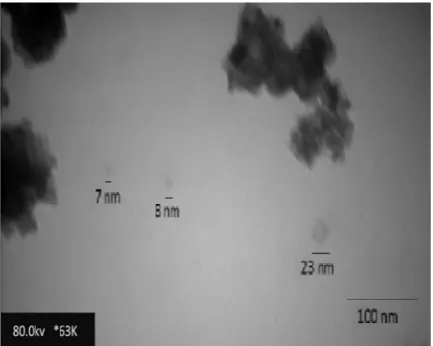
Figure 3. shows TEM images of titanium dioxide nano-particles. It could be learned that nanoparticle sizes as small as 7, 8, and 23 nm were obtained. The agglomeration of TiO2 nano-powder was also observed.
[28]. Therefore, the acquired sample would certainly stage as a great photocatalyst as previously approved by XRD and equation (2). Moreover, as Reddy et al had discussed, synthesized nano-particles should not be as large as 1μm since they could scatter the incident light rather than abosrbing it [2].
Figure 1. XRD pattern of the synthesized titanium dioxide
Figure 2. SEM micrograph of the synthesized titanium dioxide.
Figure 3.TEM image of the synthesized titanium dioxid
3.2. Optical property Diffuse reflectance spectroscopy (DRS) and Kubelka-Munk method were
used to investigate the optical property of synthesized powder. According to the method, the following equation was applied for determination of band gap by reflectance [29]:
=( ) (3)
where K is the transformed of reflectance to K-M function, and R is the diffuse reflectance spectra (%). The diffuse reflectance spectrum versus wavelength for the synthesized titanium dioxide is presented in Figure 4. The energy band gap of the sample was calculated by utilization of Tauc equation [30]:
( ∗ ℎ ) = (ℎ − ) (4)
where A is a constant, h is Planck’s constant, ν is frequency of light, and Eg is the energy gap. For direct
and indirect band gap materials, n is equal to 2 and 0.5, respectively [2]. By extrapolation of linear region of (K*hν)n versus energy of photon, the band gap of the material can be calculated in terms of (K*hν)n=0 [31]. Although it was believed that TiO2 was an indirect band
gap material, data fitness signified that optical band gap of the titanium dioxide was direct since the measured band gap (2.9 eV with indirect transient formula) had no similarity with other reports in the literature [2]. It was not only in contrast to band gap of anatase which had been previously reported, but it also rejected the quantum effect owing to the considerably small particle size. The same results have been reported by Reddy et al [2]. Photons could be absorbed only if they had exactly the same energy as the material's band gap [32]. Therefore, for a highly crystalline material with low impurities, which could result in localized states [14], the absorption edge should be sharp [33]. As can be seen in Figure 4. (diffuse reflectance spectra versus wavelength), the curve did not follow a vertical curvature in the region in spite of a sharp steep. Hence, it could be derived that there were different phases of TiO2 in the sample as was confirmed by XRD analysis.
As a matter of fact, this represented the band gap of TiO2 nano-powder. According to Figure 5. the band gap
for TiO2 nano-powder was about 3.35 eV (obtained
from diffuse reflectance). Similar results have been reported in literature [2, 31]. Due to the effects of the additives and/or the defects in the system, localized states would enhance photocatalytic properties of titanium dioxide.
shift in optical band gap which was experienced in the experiment, conformed with the results of TEM microstructure indicating some particles smaller than 10 nm [2].
Figure 4. Diffuse reflectance spectra (DRS) versus wavelength for the synthesized titanium dioxide
Figure 5. (K*hν)2 versus hν plot of the synthesized TiO 2
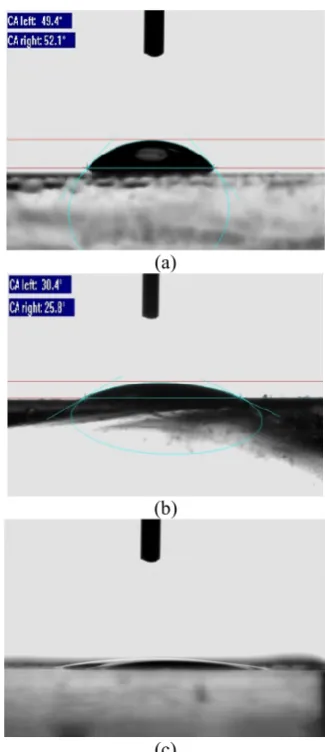
3.3. Hydrophilicity Titanium dioxide contact angle photos and results are presented in Figure 5. and TABLE 1. respectively. The contact angle of TiO2 nano-powder was measured at three different
periods. The powder was first placed in a dark room. Then, it was placed under UV-ray for 20 min. For the second period, titanium dioxide nano-powder was placed under the ray for 40 min. It was obvious that the contact angle was decreasing with time. After 40 minutes under UV-Ray, the contact angle of titanium dioxide particles decreased from 50.75 degree to less than 10 degree. It was believed that CA less than 10 degree is potential to show super-hydrophilic characterization [35]. Being discussed by Eshaghi et al, self-cleaning property comes from both effects of super-hydrophilicity and Photocatalysis [24]. Therefore, with respect to the great properties of the synthesis TiO2, one
could expect self-cleaning properties of the synthesized TiO2.
TABLE 1. The measured contact angle of the sample under UV-ray at different periods.
Duration of radiation (minute)
Contact angle (degree)
Duration of radiation (minute)
0 50.75 0
20 28.1 20
40 >10 40
4. CONCLUSION
Titanium dioxide nano-powder was successfully synthesized by heat treatment of the gel at 500oC for 3h. XRD analysis of synthesized TiO2 nano-powder showed
that the most prevalent phase in the sample was anatase, although some rutile peaks were observed with low intensity compared with those of anatase.
(a)
(b)
(c)
Figure 5. Contact angle measurement: a) in the dark room, b) under UV-ray for 20 min, c) under UV-ray for 40 min
SEM and TEM micrographs showed extremely small particle sizes ~8 nm, despite some agglomerations were also observed. Band gap of TiO2 was shown to be ~3.35
of incident light and better photocatalytic behavior. In a nutshell, this paper suggested highly pure titanium dioxide preparation which was cost effective, simple, and highly applicable for various purposes in industry.
REFERENCES
1. Luttrell, T., Halpegamage, S., Tao, J., Kramer, A., Sutter, E. and Batzill, M., "Why is anatase a better photocatalyst than rutile? - Model studies on epitaxial TiO2 films", Scientific Reports,Vol. 4, (2014), 4043.
2. Reddy, K.M., Manorama, S.V. and Reddy, A.R., "Bandgap studies on anatase titanium dioxide nanoparticles", Materials Chemistry and Physics, Vol. 78, No. 1, (2003), 239-245. 3. O’Regan, B. and Grätzel, M., "A low-cost, high-efficiency solar
cell based on dye-sensitized colloidal TiO2 films",Nature, Vol.
353,(1991), 737-740.
4. Jayasinghe, R.C., Perera, A.G.U., Zhu, H. and Zhao, Y., "Optical properties of nanostructured TiO2thin films and their
application as antireflection coatings on infrared detectors",
Optics Letters, Vol. 37, No. 20, (2012), 4302-4304.
5. Hitosugi, T., Yamada, N., Nakao, S., Hirose, Y. and Hasegawa, T., "Properties of TiO2‐based transparent conducting oxides", physica status solidi,Vol. 207, No. 7, (2010), 1529-1537. 6. Braun, J.H., Baidins, A. and Marganski, R.E., "TiO2 pigment
technology: a review", Progress in Organic Coatings,Vol. 20,
No. 2, (1992), 105-138.
7. Yaghoubi, H., Taghavinia, N. and Alamdari, E.K., "Self cleaning TiO2 coating on polycarbonate: surface treatment,
photocatalytic and nanomechanical properties", Surface and coatings technology, Vol. 204, No. 9, (2010), 1562-1568. 8. Zhu, Y., Zhang, L., Gao, C. and Cao, L., "The synthesis of
nanosized TiO2 powder using a sol-gel method with TiCl4 as a
precursor", Journal of Materials Science, Vol. 5, No. 16, (2000), 4049-4054.
9. Nagaraju, G., Manjunath, K., Ravishankar, T., Ravikumar, B., Nagabhushan, H., Ebeling, G. and Dupont, J., "Ionic liquid-assisted hydrothermal synthesis of TiO2 nanoparticles and its
application in photocatalysis", Journal of Materials Science, Vol. 48, No. 24, (2013), 8420-8426.
10. Kowalski, J., Sobczyk-Guzenda, A., Szymanowski, H. and Gazicki-Lipman, M., "Optical properties and morphology of PECVD deposited titanium dioxide films", Journal of Achievements in Materials and Manufacturing Engineering,
Vol. 37, No. 2, (2009), 6.
11. Venkatachalam, N., Palanichamy, M. and Murugesan, V., "Sol– gel preparation and characterization of nanosize TiO2: Its
photocatalytic performance", Materials Chemistry and Physics,
Vol. 104, (2007), 454-459.
12. Legrand-Buscema, C., Malibert, C. and Bach, S., "Elaboration and characterization of thin films of TiO2 prepared by sol–gel
process", Thin Solid Films,Vol. 418, No. 2, (2002), 79-84. 13. Hench, L.L. and West, J.K., "The sol-gel process", Chemical
Reviews, Vol. 90, No. 1, (1990), 33-72.
14. Chen, X. and Mao, S.S., "Titanium dioxide nanomaterials: synthesis, properties, modifications, and applications",
Chemical Reviews, Vol. 107, No. 7, (2007), 2891-2959. 15. Hanao, D.A. and Sorrell, C.C., "Review of the anatase to rutile
phase transformation", Journal of Materials Science,Vol. 46, No. 4, (2011), 855-874.
16. Ye, X., Sha, J., Jiao, Z. and Zhang, L., "Size effect on structure and infrared behavior in nanocrystalline magnesium oxide",
Nanostructured Materials,Vol. 8, No. 7, (1997), 945-951. 17. Cullity, B.D. and Stock, S.R., "Elements of X-ray Diffraction",
Prentice Hall, (2001).
18. Rui, Z., Wu, S., Peng, C. and Ji, H., "Comparison of TiO2
Degussa P25 with anatase and rutile crystalline phases for
methane combustion", Chemical Engineering Journal, Vol. 243, (2014), 254-264.
19. Jeong, S-H., Kim, B-S. and Lee, B-T., "Structural and Optical Properties of TiO2 Films Prepared Using Reactive RF
Magnetron Sputtering", Journal of the Korean Physical Society, Vol. 41, No. 1, (2002), 67-71.
20. Euvananont, C., Junin, C., Inpor, K., Limthongkul, P. and Thanachayanont, C., "TiO2 optical coating layers for
self-cleaning applications", Ceramics International,Vol. 34, No. 4, (2008), 1067-1071.
21. Choudhury, B. and Choudhury, A., "Oxygen defect dependent variation of band gap, Urbach energy and luminescence property of anatase, anatase–rutile mixed phase and of rutile phases of TiO2 nanoparticles", Physica E: Low-dimensional Systems and Nanostructures,Vol. 56, (2014), 364-371. 22. Cha, S.I., Hwang, K.H., Kim, Y.H., Yun, M.J., Seo, S.H., Shin,
Y.J., Moon, J.H. and Lee, D.Y., "Crystal splitting and enhanced photocatalytic behavior of TiO2 rutile nano-belts induced by
dislocations", Nanoscale,Vol. 5, No. 2, (2013), 753-758. 23. Mandzy, N., Grulke, E. and Druffel, T., "Breakage of TiO2
agglomerates in electrostatically stabilized aqueous dispersions", Powder Technology,Vol. 160, No. 2, (2005), 121-126.
24. Behnajady, M.A., Eskandarloo, H., Modirshahla, N. and Shokri, M., "Investigation of the effect of sol–gel synthesis variables on structural and photocatalytic properties of TiO2 nanoparticles", Desalination,Vol. 278, No. (1–3), (2011), 10-17.
25. Eshaghi, A., "Self-cleaning Properties of TiO2-SiO2-In2 O3
Nanocomposite Thin Film", Bulletin of the Korean Chemical Society,Vol. 32, No. 11, (2011), 3991-3995.
26. Fujishima, A. and Honda, K., "Electrochemical Photolysis of Water at a Semiconductor Electrode", Nature,Vol. 238, No. 5358, (1972), 37-38.
27. Yu, J., Zhao, X., Yu, J.C., Zhong, G., Han, J. and Zhao, Q., "The grain size and surface hydroxyl content of super-hydrophilic TiO2/SiO2 composite nanometer thin films", Journal of Materials Science Letters, Vol. 20, No. 18, (2001), 1745-1748.
28. Anpo, M,, Shima, T., Kodama, S. and Kubokawa, Y., "Photocatalytic hydrogenation of propyne with water on small-particle titania: size quantization effects and reaction intermediates", The Journal of Physical Chemistry,Vol. 91, No. 16, (1987), 4305-4310.
29. Valencia, S., Marín, J.M. and Restrepo, G., "Study of the Bandgap of Synthesized Titanium Dioxide Nanoparticules Using the Sol-Gel Method and a Hydrothermal Treatment", The Open Materials Science Journal, Vol. 4,(2010), 9-14. 30. Dejam, L., Mohammad Elahi, S., Nazari, H.H., Elahi, H.,
Solaymani, S. and Ghaderi, A., "Structural and optical characterization of ZnO and AZO thin films: the influence of post-annealing", Journal of Materials Science: Materials in Electronics,Vol. 27, No. 1, (2016), 685-696.
31. Valencia, S.H., Marín, J.M. and Restrepo, G.M., "Evolution of natural organic matter by size exclusion chromatography during photocatalytic degradation by solvothermal-synthesized titanium dioxide", Journal of hazardous materials, Vol. 213-214, (2012), 318-324.
32. Pierret, R.F., Semiconductor Device Fundamentals, Addison-Wesley; 1996.
33. Dorranian, D., Dejam, L., Sari, A.H. and Hojabri, A., "Structural and optical properties of copper nitride thin films in a reactive Ar/N2 magnetron sputtering system", The European Physical Journal Applied Physics, Vol. 50, No. 2, (2010), 20503.
Mangiapane, P. and Scardi, P., "CZTS stoichiometry effects on the band gap energy", Journal of alloys and compounds,Vol. 582, (2014), 528-534.