Marching Method: A New Numerical Method for Finding
Roots of Algebraic and Transcendental Equations
J. A. Ugboh, I. M. Esuabana*
Department of Mathematics, University of Calabar, Calabar, Cross River State, Nigeria
Abstract
A new method for finding approximate roots (one at a time) of Nonlinear Algebraic or Transcendental Equations is developed similar in form with the bisection method. Given such an equation say,f x
( ) = 0
, with a root, say on the interval
a,b a ,b0 0
, or the succeeding interval
a ,bn n
is partitioned into ten equal subintervals. Thefunction is then evaluated at the mid-point
x
5 and compared withf a
( )
f a
(
0)
or with f a
n for the nth iteration. If0 5 5
( ) ( ) > 0 or
( ) ( ) > 0
nf a f x
f a f x
, the root is to the right ofx
5 otherwise it is to its left. A search is then conducted to determine which of the remaining five subintervals contains the root. The midpoint of such an interval is the approximate rootn 1, n 0,1,2,3
. After the nth iteration, the approximate root n+1 is the midpoint of the interval whose length is
n n 0
2 10 L ; where L0 b0 a0 and
a ,b0 0
is the initial interval. A theorem that gurantees the convergence of theapproximate roots to the actual root was stated and proved. Half the length of the succeeding interval
a ,bn n
serves as upperbound for the error in the approximation. An algorithm was developed and a program coded in JAVA was used to solve seven test problems. The results show that the method yielded approximations which are all correct to ten decimal places after ten iterations; and correct to fifteen decimal places after fifteen or fourteen iterations.
Keywords
Nonlinear, Algebraic, Transcendental, Equations, Roots, Iterations, Approximations, Errors1. Introduction
Given a non linear algebraic or transcendental equation of the form:
f x
( ) = 0
; one often resort to numerical methods where analytic solution are not easy to come by. A good number of such methods are available and one of the simplest is the bisection method. However, the rate of convergence for the bisection method is very slow and so not suitable in a situation where high precision is required. It is therefore necessary to search for a method that is as simple but yeild highly accurate results in a few number of iterations. In this work, we present a method that is simple with high precision in a few number of iterations, machine implementable and guarantee convergence to desired root.The marching method involves partitioning the given interval
a,b a ,b0 0
, or the succeeding interval
a ,bn n
into ten subintervals of equal size with
0 0 1 2 9 10 0
a x x x x x b or
* Corresponding author:
[email protected] (I. M. Esuabana) Published online at http://journal.sapub.org/ajcam
Copyright©2019The Author(s).PublishedbyScientific&AcademicPublishing This work is licensed under the Creative Commons Attribution International License (CC BY). http://creativecommons.org/licenses/by/4.0/
n 0 1 2 9 10 n
a x x x x x b ; one of which must contain the root or one of the end points must be the root. For succeeding intervals In
a ,bn n
at the nth iteration, thelower and upper end points becomes respectively an and
n
b . A search is conducted from the midpoint
x5 of theinterval either to the left or right to determine the subinterval which contains the root. Given f x
0 on
a,b with
f a f b 0, and midpoint 0 0 5
a b
a b x
2 2
in the
first iteration; (or n n 5
a b
x 2
for the nth iteration); the
following decision rule applies: if f x
5 0, the root is x5and we stop; otherwise, we search to the right of the midpoint if f x
5 has same sign as f a
0 or f a
n ; and to the leftotherwise. In either case, a maximum of four searches is required. It is worthy of note that the search might just be once!
Once the subinterval,
x ,xk k 1
or
xk 1 ,xk
containingthe root is found, the approximate root n 1 , n0,1,2,3... is taken as the midpoint of that subinterval leading to a
succeeding interval I1
a ,b1 1
of length 0 0 1b a
L 20
n n n
I a ,b of length n n n
b a
L 20
. Thus, in the first
iteration, an upper bound for the error in approximation is
0 0 1
b a
1 L
2 40
.
After n iterations, the upper bound for the error is expected to be half of the length
a ,bn n
, that is, the error bound aftern iterations is n n n 1 n 0
b a
2 .10 .L
1
2 20 ;
where L0 is
the length of the starting interval. It is simple, machine implementable (can be coded in many high level languages), converges very fast to desired root and conserve space. However, it is a bit more difficult when compared to the bisection method due to the search. In any case, with high precision computers, the very high rate of convergence compensates for the extra work. An algorithm and a model software program in JAVA will be developed for the method. Seven test problems have been earmark for machine solution.
2. Preliminaries
A number of methods have been developed to solve nonlinear algebraic and/or transcendental equations of the form
f x
( ) = 0
. The bisection method, secant method, Newton-Raphson method, regular falsi method and the general iteration technique are among the most commonly used ([1], [5], [7]). Slow convergence is one of the major drawbacks of most of these methods (except for Newton-Raphson). Newton- Raphson method though converges fast, has the flaw of requiring existence of first derivative and evaluation of two functional values per step ([3], [5], [6]]. Nonlinear equations have become indispensible tools among scientist in various disciplines hence, faster methods of solutions are in high demand. With the advent of high speed/precision computers and sophistication in proggamming, new methods of solutions are emerging. The efficiency, consistency, simplicity and economy of such a method are the measuring indexes ([6], [8], [4]).Lemma 2.1 Let f :X Y be any given real-valued function continuous on the closed and bounded interval
[ , ]
a b
such thatf a f b
( ). ( ) < 0
; then there exists at least( , )
a b
such thatf
( ) = 0
. [3], [2], [6]The above theorem, a consequence of intermediate value theorem, enables us determine interval where a root of the equation
f x
( ) = 0
exists. However, if the function is highly oscillatory, there is a possibility of several roots in that interval. In other to avert this, the end points are taken close enough or a rough graph ofy
=
f x
( )
may be sketched to determine a rough point where the curve crosses thex
axis.3. Methodology
Suppose we desire to find the root of the algebraic or transcendental equation say,
f x
( ) = 0
on the closedinterval
[ , ]
a b
whereb
anda
are close enough to avoidthe existence of more than one root of
f
. The marching method involves the following steps.Step (i) Evaluate
f a
( ), ( )
f b
and confirm that( ) ( ) < 0
f a f b
. Setaa0 and bb0 and error level p10 , p .
N
Step (ii) Partition the interval
a,b a ,b0 0
(or thesucceeding interval
a ,bn n
) into ten equal parts with0 0 1 2 9 10 0
a x x x x x b or
n 0 1 2 9 10 n
a x x x x x b .
In the first iteration we take
0 0
k 0
b
1
x a k
0 a
, where
k = 0, 1, 2 · · · 10.
In general, we take
n n
k n
b
1
x a k
0 a
for the nth
iteration, where k = 0, 1, 2 · · · 10 and n = 0, 1, 2, 3,· · ·
Step (iii): Conducting the search. Evaluate f x( )5 , if it is equal to zero you have the root,or
|
b
a
|
, stop, desired root isx
5; otherwise if it has the same sign as0
( ) = ( )n
f x f a then the search is to the right of
x
5, and ifof opposite sign, the search is to the left of
x
5. The search is conducted as follows:(a) Suppose
f x
( )
5 andf a
( )
have the same sign, we evaluatef
atx x x
6,
7,
8, or
x
9 and for any k = 6, 7, 8 or 9 which f x
k 0, xk is the root, otherwise,if f x
k has opposite sign withf x
5 ; we have found the interval containing the root to be:
xk 1 ,xk
, if not, the last interval which is
x ,x9 10
mustcontain the root. The approximate root is then:
1
= ; 6, 7,8, 9 or 10; 0,1, 2, 3, 2
k k
x x
k n
(1)
End points of new interval: Next evaluate f
n 1
; if
n 1
f 0 or n 1 n ; n = 0, 1, 2, 3 · · · or n = N
maximum number of iterations, the root isn 1 , stop, else, if
n 1
f has same sign with f x
k 1
then an 1 n 1 ,and bn 1 x ,k otherwise, bn 1 n 1 , and an 1 xk 1 .
New or succeeding interval In 1
an 1 ,bn 1
; go to step (ii).at
x x x
1,
2,
3or
x
4 . For k = 1, 2, 3, or 4 ; should
kf x 0, we have the root as x ,k otherwise if f x
khas same sign as f a
n , then the interval[ ,
x x
k k1]
contains the root. Where none of these function values has same sign as f x( ) = ( )0 f an , then the root must be in the first interval[ , ]
x x
0 1 . The approximate root is then:1
( )
= ; where = 0,1, 2, 3, or 4; 2
n = 0,1,2,3, k k
x x
k
(2)
End points of new interval: Next evaluate f
n 1
;if f
n 1
0 or n 1 n ; n = 0, 1, 2, 3 · · · or n =N maximum number of iterations, the root is n 1 , stop,
else, if f
n 1
has same sign with f x
k 1
thenn 1 n 1
a , and bn 1 x ,k otherwise, bn 1 n 1 , and
n 1 k 1
a x . New or succeeding interval In 1
an 1 ,bn 1
;go to step (ii).
(c) In summary, at any new iteration level we have
the points of partition: = ( ) 10
k
k b a
x a ; where
= 0,1, 2
10
k
. The midpoint of the interval[ , ]
a b
isalways
x
5.The approximate root is:
1
5
1 1
5
( )
, 0 4 2
=
( )
; 6 10 2
k k
n
k k
x x
if search is to the left of x k
x x
if search is to the left of x k
(3)
where n = 0, 1, 2, 3,
New Interval: Next evaluate f
n 1
and if zero youhave the root, otherwise, If the search was to the left of x5
and f
n 1
has same sign with f x
k then an 1 n 1 ,and bn 1 xk 1 , else, bn 1 n 1 , and an 1 xk ; go to
step (ii).
If the search was to the right of x5 and f
n 1
hassame sign with f x
k then an 1 n 1 , and bn 1 x ,kotherwise, bn 1 n 1 , and an 1 xk 1 ; go to step (ii). The processes in steps (ii) to (iii) and (a) or (b) is continued until we have:
f x
( ) = 0
or|
b
a
|<
or after the desired number of iterations; where
is the tolerable error.In all, seven test problems will be solved comprising of four polynomials and three transcendentals.
Theorem 3.1 Let
f x
( )
be any function continuous at all points of the interval [ , ]a b with f a f b( ) ( ) < 0, thenthe iteration = ( 1)
2
k k n n
x x
or =( 1 )
2
k k n n
x x
conerges to the root ( , )a b , where n= 1, 2, 3, Proof.
f
is continuous on the bounded interval[ , ]
a b
so with
f a
( )
andf b
( )
having opposite signs, we have a root
( , )
a b
by theorem 2.1 . For the first iteration,the interval containing the root is of length = 1 2(10)
L
L ;
where L is the initial or starting length; (i.e. L=b a ). To obtain the next interval containing the root, the above interval is partioned into ten and the mid point of the new subinterval containing the root is used as the next approximation. Thus, the length of the second interval is
1
2(10) of 2(10)
L giving the length
2 2 2
1
= ( )( ) =
2(10) 2(10) 2 (10 )
L L
L . Continuing in this manner,
at the
n
th iteration, the length of the interval containing theroot will be =
2 (10 ) n n n
L
L . As n ,Ln0 meaning
that
|
n1
n|<
L
n
0
. Since Ln0 and the root( , )
a b
with b a <Ln0 ;
n must converge to the root
( , )
a b
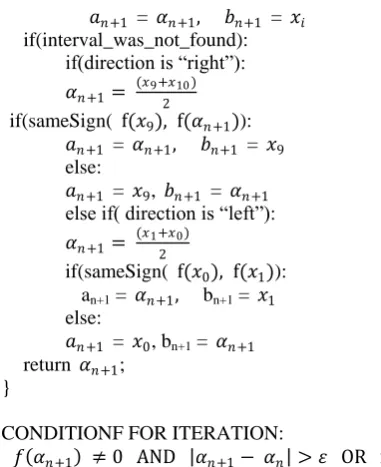
.3.1. Algorithm
Function sameSign(x, y) {
if( 𝑥 < 0 𝐴𝑁𝐷 𝑦 < 0 𝑂𝑅 ( 𝑥 > 0 𝐴𝑁𝐷 𝑦 > 0) ) return true;
else return false; }
Note: 𝑥𝑘= 𝑎𝑛+𝑘(𝑏𝑛10−𝑎𝑛)
Function Search(lowerLimit, upperLimit) { if( sameSign( 𝑓 𝑥5 , 𝑓 𝑎𝑛 ) )
let direction = “right”; else let direction = “left”;
for i = lowerLimit to upperLimit AND interval_not_found:
if(direction is “right”):
if(Not sameSign(f(𝑥5), f(𝑥𝑖)):
𝛼𝑛+1= (𝑥𝑖−12+𝑥𝑖)
if(sameSign(𝑓 𝛼𝑛+1 , f(𝑥𝑖−1)):
//update a, and b
𝑎𝑛+1 = 𝛼𝑛+1, 𝑏𝑛+1 = 𝑥𝑖
else:
𝑎𝑛+1 = 𝑥𝑖−1, 𝑏𝑛+1 = 𝛼𝑛+1
else if(direction is “left”): if(Note sameSign(f(𝑥0), f(𝑥𝑖)):
𝛼𝑛+1= (𝑥𝑖−12+𝑥𝑖)
if(sameSign(𝑓 𝛼𝑛+1 , f(𝑥𝑖)):
𝑎𝑛+1 = 𝑥𝑖−1, 𝑏𝑛+1 = 𝛼𝑛+1
𝑎𝑛+1 = 𝛼𝑛+1, 𝑏𝑛+1 = 𝑥𝑖
if(interval_was_not_found): if(direction is “right”): 𝛼𝑛+1= (𝑥9+𝑥210)
if(sameSign( f(𝑥9), f(𝛼𝑛+1)):
𝑎𝑛+1 = 𝛼𝑛+1, 𝑏𝑛+1 = 𝑥9
else:
𝑎𝑛+1 = 𝑥9, 𝑏𝑛+1 = 𝛼𝑛+1
else if( direction is “left”): 𝛼𝑛+1= (𝑥1+𝑥2 0)
if(sameSign( f(𝑥0), f(𝑥1)):
an+1 = 𝛼𝑛+1, bn+1 = 𝑥1
else:
𝑎𝑛+1 = 𝑥0, bn+1 = 𝛼𝑛+1
return 𝛼𝑛+1;
}
CONDITIONF FOR ITERATION:
𝑓 𝛼𝑛+1 ≠ 0 AND 𝛼𝑛+1− 𝛼𝑛 > 𝜀 OR n < 𝑁
3.2. Comparative Analysis of Steps/Error
The method is about a modification of the well known bisection method. In each iteration step, the marching method partition the given interval
a,b
a ,bn n
intoten sub intervals, evaluate functioal value of the mid point and at most four others, [but could be only one] (to its left or right) which it compare with that of the lower limit f a .
nWith the excution of each step the length of the succeeding
interval is reduced to 1
20 of the previous interval
a ,b .n n
At the end of each step condition for succeeding interval which is excatly as in the bisection method is implimented. On the other hand, in the bisection method, the interval is halfed per each iterative step, mid point functional value compared with one of the end points f a
n or f b
n in each iteration step. At each of the step succeeding interval conditions are also implimented.Four steps in the bisection method can reduce the length of
the interval
a ,b .n n
by a factor of 41 2 .
To surpass the accuracy level of the marching method, five iterations of the bisection method will be required. From the search algorithm for the marching method, with one, two or three searches per step, the matching method will involve less work and post more accurate results, [i,e, 75 percent of the time]. After n iterations the length of the succeeding interval for the bisection method is: 2 n
b0 a ;0
while
that of the marching method is: n n
0 02 10 b a . If that of the bisection is further divided by 8, we still have:
n n n
0 0 0 0
2 b a 2 10 b a
1
. 8
Error: Like in other brackecting methods, the maximum absolute error in the marching method is half the length of the nth interval. Thus after n iterations, the maximum absolute error in the method is:
n n
a n 1 2 1 0 0 .
1
2 0 b a
The convergence rate is linear. If we use the maximum or upper bound for the error at the nth iteration and denote it by
n
then we have (Chapra and Canale, 2006, Mathews, 1987)
-n-1 -n-1
0 0
-n -n
0 0
[2 10 (b - a )] [2 10 (b - a )]
1 n 1 2 1
n 2
1 20
n 1
n 1 n
n
K K ,
where K 1 20
is a constant, hence the convergence is
linear. For the bisection method the constant K 1 2 . It
follows that the bisection method redues the bracketing interval by half while the marching method reduces same interval by a factor of 20.
4. Results
The following test problems were solved with the marching method using a program coded in JAVA.
Problem 1: Use the matching method to find the root of
2
( ) = 3 10
f x x x in [1, 2]; using the first 15 iterations. Out put the successive intervals and the approximate root in each interval.
Table 1. Results showing approximate roots of f x( ) = 3x2 x 10 in [1, 2]; obtained from a JAVA coding
1 1.6500000000000001 1.895 1.6500000000000001 2 1.6622500000000002 1.6855250000000002 1.6622500000000002 3 1.6657412500000004 1.6696980000000003 1.6657412500000004 4 1.6665326000000005 1.6667304375000005 1.66673
j a b x
04375000005 5 1.6666611943750005 1.6667096645625006 1.6666611943750005 6 1.6666660413937504 1.6666684649031254 1.6666684649031254 7 1.6666666472710943 1.6666671925607035 1.6666666472710943 8 1.6666666472710943 1.6666666745355747 1.6666666745355747 9 1.6666666663562306 1.6666666677194546 1.6666666677194546 10 1.6666666666288754 1.6666666666970367 1.6666666666970367 11 1.666666666666364 1.6666666666847676 1.666666666666364 12 1.666666666666364 1.6666666666672842 1.6666666666672842 13 1.66666666666664 1.666666666666686 1.666666666666686 14 1.6666666666666652 1.6666666666666776 1.6666666666666652 15 1.6666666666666665 1.666666666666667 1.666666666666667
decimal places at the 15th. The exact root is
2
23.Problem 2: Use the matching method to find the root of
2
( ) =
3
2
f x
x
x
in [ 3, 1.5] ; using the first 14 iterations. Output the successive intervals and the approximate root in each interval.Table 2. Results showing approximate roots of f x( ) =x2 3x 2 in [ 3, 1.5] obtained from a JAVA coding
1 2.025 1.6575 2.025
2 2.0066249999999997 1.9717124999999998 2.0066249999999997 3 2.0013881249999996 1.9954529999999997 2.0013881249999996 4 2.0002010999999995 1.9999043437499995 1.9999043437499995 5
j a b x
2.0000082084374995 1.9999355031562496 2.0000082084374995 6 2.0000009379093746 1.999997302645312 1.999997302645312 7 2.000000029093359 1.9999992111589449 2.000000029093359 8 2.000000029093359 1.9999999881
966382 1.9999999881966382
9 2.000000000465654 1.9999999984208183 1.9999999984208183 10 2.000000000056687 1.9999999999544453 1.9999999999544453 11 2.000000000000454 1.9999999999728488 2.000000000000454 12
2.000000000000454 1.9999999999990736 1.9999999999990736 13 2.00000000000004 1.999999999999971 1.999999999999971 14 2.0000000000000018 1.9999999999999833 2.0000000000000018 15 2.000000000000001 1.99999999
99999991 2.000000000000001
Root = -2.000000000000001. The exact root in this interval is - 2. Observe that the root is correct to 10 decimal places with the 10th iteration and to 15 decimal places at the 15th.
Problem 3: By using the marching method, obtain an approximate root of
f x
( ) = 8
x
2
3
x
5
in[0,1]
using the first 15 iterations. Out put the successive intervals and the approximate root in each interval.Table 3. Results showing approximate roots of
f x
( ) = 8
x
2
3
x
5
in [0,1]; obtained from a JAVA coding1 0.6000000000000001 0.6500000000000001 0.6500000000000001 2 0.6225 0.6252500000000001 0.6225 3 0.6237375000000001 0.6238887500000001 0.6237375000000001 4 0.6238055625000001 0.62381388125 0.6238055625000001 5 0.62
j a b x
38093059375001 0.6238097634687501 0.6238093059375001 6 0.6238095118265625 0.6238095369907812 0.6238095118265625 7 0.623809523150461 0.623809524534493 0.623809523150461 8 0.6238095237732755 0.6238095238493973 0.6238095237732755 9 0.6238095238075303 0.623809523811717 0.6238095238075303 10 0.6238095238094143 0.6238095238096446 0.6238095238094143 11 0.623809523809518 0.6238095238095307 0.623809523809518 12 0.6238095238095238 0.6238095238095245 0.6238095238095238 13 0.623809523809524 0.623809523809524 0.623809523809524
Root = 0.623809523809524.From the 13th iteration the root is correct to 15 decimal places! Excat root unknown but is in
[0,1]
.Problem 4: By using the marching method obtain an
approximate root for
f x
( ) = sin
x
x
cos
x
in[0, ]
; [x
in radians] using the first 15 iterations. Output end points of successive interval and the approximate roots in each interval.Table 4. Results showing approximate roots of
( ) = sin( ) cos( )
f x x x x on [0, ] ; obtained from coding in JAVA
1 2.7475000000000005 3.0615 2.7475000000000005 2 2.7946000000000004 2.84798 2.7946000000000004 3 2.7972690000000004 2.8023401000000003 2.7972690000000004 4 2.7982832200000005 2.7985367750000005 2.798536775000000
j a b x
5 5 2.7982958977500005 2.7983199854750005 2.7982958977500005 6 2.79831878108875 2.7983199854750005 2.79831878108875 7 2.7983199252556883 2.7983199854750005 2.7983199252556883 8 2.798319982464035 2.7983199854750005 2.798319982464035 9 2.7983199853244525 2.7983199854750005 2.7983199853244525 10 2.798319985467473 2.7983199854750005 2.798319985467473 11 2.798319985474624 2.7983199854750005 2.798319985474624 12 2.798319985474982 2.7983199854750005 2.798319985474982 13 2.7983199854749996 2.7983199854750005 2.7983199854749996 14 2.7983199854750005 2.7983199854750005 2.7983199854750005
Root = 2.7983199854750005 correct to 15 decimal places after 14 iterations. Excat root not known.
Problem 5: Obtain an approximate root of
6 4 3
( ) =
2
1
f x
x
x
x
on[0,1]
; with the marching method using the first 15 iterations. Out put the end points of successive intervals and the approximate root in each.Table 5. Results showing approximate roots of
6 4 3
( ) = 2 1
f x x x x on [0,1]; obtained from a JAVA coding
1 0.8500000000000001 0.985 0.8500000000000001 2 0.8770000000000001 0.88375 0.88375 3 0.8827375000000001 0.8836487500000001 0.8827375000000001 4 0.8827830625 0.8828696312500001 0.8827830625 5 0.8827873909375 0.88279
j a b x
561496875 0.8827873909375 6 0.8827886245421875 0.8827900226275001 0.8827886245421875 7 0.8827886944464531 0.8827888272645579 0.8827886944464531 8 0.8827887409327898 0.882788775465497 0.8827887409327898 9 0.8827887461126959 0.8827887519832561 0.8827887461126959 10 0.8827887461126959 0.8827887464062238 0.8827887464062238 11 0.8827887463636623 0.8827887463915475 0.8827887463915475 12 0.8827887463803934 0.8827887463817876 0.8827887463817876 13 0.8827887463815854 0.8827887463817179 0.8827887463817179 14 0.8827887463816987 0.8827887463817112 0.8827887463817112 15 0.8827887463817081 0.8827887463817106 0.8827887463817081
Root = 0.8827887463817081 which is correct to 15 decimal places at the 15th iteration. Exact root not known.
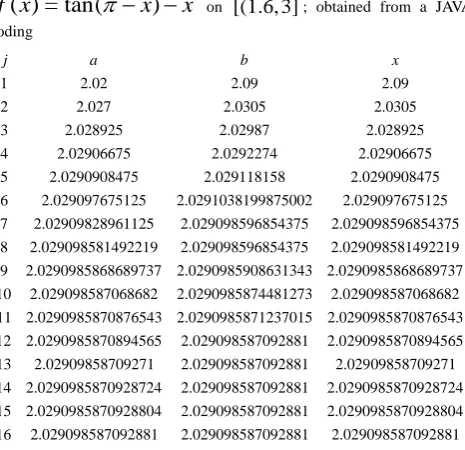
Problem 6: Determine the approximate root of
( ) = tan(
)
f x
x
x
on the interval[(1.6, 3]
whereTable 6. Results showing approximate roots of
( ) = tan(
)
f x
x
x
on [(1.6, 3]; obtained from a JAVA coding1 2.02 2.09 2.09
2 2.027 2.0305 2.0305
3 2.028925 2.02987 2.028925
4 2.02906675 2.0292274 2.02906675 5 2.0290908475 2.029118158 2.0290908475 6 2.029097675125 2.0291038199875002 2.029097675125 7 2.02909828961125 2.029098596
j a b x
854375 2.029098596854375 8 2.029098581492219 2.029098596854375 2.029098581492219 9 2.0290985868689737 2.0290985908631343 2.0290985868689737 10 2.029098587068682 2.0290985874481273 2.029098587068682 11 2.0290985870876543 2.0290985871237015 2.0290985870876543 12 2.0290985870894565 2.029098587092881 2.0290985870894565 13 2.02909858709271 2.029098587092881 2.02909858709271 14 2.0290985870928724 2.029098587092881 2.0290985870928724 15 2.0290985870928804 2.029098587092881 2.0290985870928804 16 2.029098587092881 2.029098587092881 2.029098587092881
Root = 2.029098587092881 after 16 iterations. Exact root not known but in
[1.6, 3]
.Problem 7: Determine the approximate root of
( ) =
x2
1
f x
xe
x
on the interval [1, 2] correct to 15 decimal places or using the first 15 iterations of the marching method.Table 7. Results showing approximate roots of f x( ) =xex2x1 on [1, 2]; obtained from a JAVA coding
1 1.05 1.145 1.05
2 1.07375 1.095125 1.07375
3 1.07481875 1.0768493749999999 1.07481875 4 1.0750218125 1.07512334375 1.07512334375
5 1.0750268890624999 1.0750365345312498 1.0750268890624999 6 1.0750360522578122 1.07503
j a b x
65345312498 1.0750360522578122 7 1.0750365104175779 1.0750365345312498 1.0750365104175779 8 1.0750365333255663 1.0750365345312498 1.0750365333255663 9 1.0750365344709656 1.0750365345312498 1.0750365344709656
10 1.0750365345282356 1.0750365345312498 1.0750365345282356 11 1.075036534531099 1.0750365345312498 1.075036534531099 12 1.0750365345312423 1.0750365345312498 1.0750365345312423 13 1.0750365345312494 1.0750365345312498 1.0750365345312494
14 1.0750365345312498 1.0750365345312498 1.0750365345312498
Root = 1.0750365345312498 correct to 15 decimal places after 14 iterations. Exact root in [1, 2] is not known.
5. Conclusions
The matching method is designed to determine a root of
nonlinear equation at a time. Given that a root exists on the interval
[ , ]
a b
, i.e.f a f b
( ) ( ) < 0
, the interval ispartitioned into ten equal parts with
a
=
x
0 andb
=
x
10. Either one of the end points of the subintervals is the root or one of the subintervals contains the root. A search is conducted to determine this interval. This search might involve evaluation of at most four functional values or might just be one or two per step! The approximate root is taken as the mid-point of the new interval and if it is not the root, the process is repeated until the root is found or the stopping criterion is met. An algorithm was developed and a program coded in JAVA was used to solve seven test problems involving polynomials and transcendental functions. Results are tabulated the tables give the intervals and the approximate roots for each step. Results obtained show a very high precision of about ten decimal places in ten iterations which is equivalent to one decimal per step. For few decimal places or iterations, computation with calculator can be used.The Marching Method ensures that the approximation converges to the desired root, highly accurate, economical in terms of space and time, easy to program and can be used to solve nonlinear algebraic or transcendental equations. The program coding can be done in any other high level language that is capable of searching.
REFERENCES
[1] Ele, B. I. and Ugboh, J. A.. Numerical Computations for Science and Engineering with C++ Programming Basics. Radiant Ventures Press, Calabar – Nigeria, 2017.
[2] Gaughan, E. G., Introduction to Analysis. Brooks/Cole Publishing company, California, 1993.
[3] Grewal, B. S., Numerical Methods in Engineering and Science. Khanna Publishers, Delhi, 1997.
[4] Haeussler, E. F., Paul, R. S., and Wood, R. J., Introductory Mathematical Analysis for Business, Economics, and Life and Social Sciences. Printice-Hall, Boston, 2011.
[5] Mathews, J. H., Numerical Methods for Computer Science, Engineering and Mathematics, Printice-Hall, New Jersey, 1987.
[6] Olayi, G. A., Introduction to Numerical Analysis. ABU Press, Zaria – Nigeria, 2000.
[7] Riley, K. F., P., H. M., and Bence, S. J., Mathematical Methods for Physics and Engineering, Cambridge University Press, United Kingdom, 1998.