Available Online at www.ijpret.com 122
INTERNATIONAL JOURNAL OF PURE AND
APPLIED RESEARCH IN ENGINEERING AND
TECHNOLOGY
A PATH FOR HORIZING YOUR INNOVATIVE WORK
A THEORETICAL EVALUATION OF GAP FUNCTION AS A FUNCTION OF K/K
FOF AN
ATOMIC FERMI GAS NEAR THE UNITARY LIMIT.
TUSHAR KUMAR MOHANTA1, L. K. MISHRA2
1.Department of Physics, St. Columba’s College, Hazaribag-825302(Jharkhand) 2.Department of Physics, Magadh University, Bodh-Gaya-824234(Bihar)
Accepted Date: 25/01/2018; Published Date: 01/02/2018
\
Abstract: - Using the theoretical formalism of S.De Palo etal (Laser Phys. 15, 376 (2005)), we have theoretically studied super fluidity of an atomic Fermi gas near the unitarily limit. Our theoretically evaluated values of gap function (k) as a function of
F
k k
for different values of
F
g n / E show that the gap function has a damped
oscillatory behaviour. Our theoretically evaluated results of the ratio 0 F
E
and
F
E
as a function of F
g n / E show that 0 F
E
decreases and
F
E
increases as a function
of
F
g n / E . For large value of
F
g n / E , 0
F E
becomes constant while
F E
increases and becomes positive from negative values. These results also indicate that the
resonance is along BEC side. Our theoretically evaluated results of 0
F
k T
as a function
F
T T
for different values of
F
g n / E indicate that the values decrease as F
T T
for all values
of
F
g n / E . We observed that the narrow resonance favours occurrence of super fluidity. It is also observed that the smooth temperature behaviour is the manifestation of short ranged, bosonic character of the result. Using the theoretical formalism of Q. Chen [Phys. Rev. A86, 023610 (2012)], we have theoretically evaluated the super fluid transition
temperature in a unitary atomic Fermi gas on a lattice. Our theoretically evaluated result of TC 6t
as a function of U 6t
for different densities show that maximum TC occurs on the BEC
side of unitary limit. We theoretically evaluated results of C
F T E
as a function of U
6t
for different densities which indicate that TC has a functional form
2 C t T U . Our
theoretically evaluated result of C F
T E
as a function of 1 3
n show that C
F T E
exhibits higher order nonlinear dependence of 1 3
n . The minimum value of TC is on BCS region. Our theoretically evaluated results are in good agreement with the other theoretical workers.
These theoretical studies may be relevant for constructing a complete theoretical description of the crossover from BEC of composite bosons to BCS of Cooper pairs. Till today, we do not have very successful reliable theory for high TC-superconductors. It is our firm belief that BCS-BEC crossover physics can give some valuable insight into this direction.
Available Online at www.ijpret.com 123
INTRODUCTION
Experimental realization of super fluidity in cold atomic Fermi gas has given the study of BCS-BEC crossover a strong boost over the past decade1-5. Moreover the main attention has been paid to the strongly interacting limit, where the s-wave scattering length ‘a’ is large. In particular the unitary limit where the scattering length diverges has become a test point of theories6-8.
In a cold Fermi gas with an equal mixture of two hyperfine states, wide-range control of the short-range inter atomic interaction via Feshbach resonance9 has enabled the mapping of a new landscape of super fluidity popularly known as BCS-BEC crossover super fluidity. It connects BCS super fluids of loosely bound pairs to a BEC of tightly bound bosonic dimmers
made up of two fermions of opposite sign. For a weakly attractive interaction F s
1
( 1)
k a = with
KF being the Fermi momentum of a Free Fermi gas of same density, the gas shows a super fluid behaviour originating from many-body physics of Cooper pairs that are formed from weak pairing of atoms of opposite spin and momentum. For a strongly attractive interaction
F s
1
( 1)
k a ?
the gas shows a super fluid behaviour that can be explained by the Bose-Einstein condensation of tightly bound bosons made up of two fermions of opposite spins. In the
crossover region/ unitary region F s
1
( 1)
k a
bridging the two well-understood regions above, the gas is strongly interacting, which means that the interaction energy is comparable to the Fermi energy of a free Fermi gas of the same density. This also obeys perturbation many-body
techniques. The physics in the so called unitary limit as or as 0 is very important in
the sense that the thermodynamic properties are expected to be independent of the scattering Corresponding Author: MR. TUSHAR KUMAR MOHANTA
Access Online On:
www.ijpret.com
How to Cite This Article:
Tushar Kumar Mohanta, IJPRET, 2018; Volume 6 (6): 122-144
Available Online at www.ijpret.com 124
length. Here the remaining length 1/KF is approximately the inter particle distance appears in the equation of states while the interaction effect appears as a universal dimensionless parameter. The physics is unique in the sense that the constituents are independent and is non-perturbative due to strong interaction. The unitary Fermi gas has been the test bed for various theoretical techniques developed so far10-15.
Cold atomic gases also provide insights into other forms of matter. Inside neutron stars, there might be quark matter made up of different ratio of quarks, and the imbalance might result in a new super fluid. Such super fluid is in Fulde-Farrel-Larkin-Ovehnnikov (FFLO) phase. Such phase has spatially-non uniform order parameter16. There is possibility that the electric charge neutrality of atoms might change their picture. The more information one can generate from the investigations on imblanced atomic Fermi gas17. Another example is the quark-gluon plasma (QGP) created in relativistic heavy-ion collider (RHIC)18. A QGP with a temperature of about 1012K was produced by smashing nuclei together. Measurements on its expansion after its creation show that the QGP is nearly perfect fluid with very small shear viscosity. A cloud of atomic Fermi gases at unitary shows the same strange behaviour while the origin of the similarity between hot and cold matter are to be speculated19.
In this paper, we have studied the behaviour across resonance in the unitary limit a . As one knows that in the unitary limit, the thermodynamic properties are expected to be independent of the scattering length and the only available length scale is the inter particle distance20. However this argument fails in the case of resonance when the scattering phase shift significantly changes over the energy range of the Fermi energy21. The second length scale called effective range plays an important role. Using the theoretical formalism of S.De Palo etal.22, we have theoretically studied super fluidity of an atomic Fermi gas near the unitary limit. Using the theoretical formalism of Q. Chen23, we have theoretically studied super fluid transition temperature in an atomic Fermi gas on 3D isotropic lattice with an attractive on-site interaction in the unitary limit. Our theoretically evaluated results are in good agreement with the works of other theoretical workers24,25.
MATERIALS AND METHODS
Available Online at www.ijpret.com 125
back-ground scattering length abg. The thermodynamics properties of atomic gas in the unitary limit are investigated as function of resonance width by resorting to a mean-field solution of the BCS-like equations.
One models the presence of Feshbach resonance by the interaction potential given by
V(r) =V0 r<r0
=V1 r0<r<r1
=0 otherwise (1)
The potential is characterized by an attractive well depth V0 and width r0 and a barrier with height V1 and width r1 –r0 =rw. This barrier –well model allows one to incorporate the essential energy dependence of the scattering physics into a single channel scattering scheme. The well can support resonant states with a width dependent on the tunnelling through the potential barrier. Here, there are three distinct parameters like diluteness nr03, the interaction strength
na3 and the width
v
of the resonance on the scale of the Fermi energy2 2 F F
k
E
2m
h
with 1
2 3 F
K
(3
n)
.
v
can be expressed in terms of the matrix element g for the couplingbetween the closed and open channels as
v
=g n
, n is the particle density.One requires that the diluteness conditions na3 <<1 is always satisfied while staying within the
unitary limit na3>>1. One thus vary the width of the resonance by tuning the parameter F
v
E
. The parameters of the model potential can in principle be adjusted to reproduce the scattering properties of an atomic sample22. One chooses two sets of parameters that are suitable for the physical behaviour of the sample. One fixes the scattering length to a large and positive values a=5000a0 (a0 is Bohr radius). This is for staying on BEC side of the resonance under unitary-limited conditions. The other parameter is range r0 which is taken to be equal to r0 =500a0 such that na3=0.002<<1. Now, one solves the scattering problem for V(r) shown in equation (1) in the
Available Online at www.ijpret.com 126
The T-matrix contains all the necessary information. The scattering length a is determined from its definition
2
k 0
4
a
Lim
T(k)
m
h
(2)
The usual relation is
2
T(k)
2
h
i[S(K) 1] / mk
(3)
The Feshbach form for the S-matrix in the one resonance parameterization is given by
bg
2 2ika
2 2 2
2
2ik g
S(k)
e
[1
]
4
k
(v
) ik g
m
m
h
h
(4)
The parameter g is defined in terms of the effective range27
2 2 1
eff 2 k 0
4
d T(K)
R
(
)[
]
m
dk
h
(5)
Reff is always negative close to resonance. One obtains
2 2
eff
8
g
mR
h
(6)
One has removed the background abg =0
Now, one finds the equilibrium state of the Fermi gas interacting via the non-local potential interaction modeled by V(r). The ground state is determined within the usual variational BCS scheme that utilizes the wave functions28
† †
0 k
(u
kv a
k ka
k) 0
Available Online at www.ijpret.com 127
where †
k
a
is the creation operator for the electrons in spin
.
0 is normalized giving thecondition
2 2
k k
u
v
1
. The expected value of the ground state energy at T=0 is given by
2 * *
0 k k k kk ' kk ' k k k ' k '
E
2
v
V u v u v
kk 'V u u v v
kk ' k *k k ' *k ' (8)Now, one solves the above equation by converting the summations into one-dimensional integral
2
k kk ' 3
1
V F(k
')
dqq V(k,q)F(q)
(2 )
(8)V(k,q) is determined from the three-dimensional Fourier transform
0
0 1
sin r k
q
2
V(k, q)
(V
V )[
kq
k
q
-0
sin r k
q
]
k
q
-1 1
1
sin r k
q
sin r k
q
V [
]
k
q
k
q
(9)
The BCS solution results from the minimization of the free energy with respect to the
variational parameter uk and vk and chemical potential
fixed by the constraint of particle-density conservation
f
0H
0 0N
0 (10)The two resulting self-consistent equations for the isotropic super fluid gap and the particle density are given by
2 3
1
(q)
(k)
dqq V(k,q)
2E(q)
(2 )
Available Online at www.ijpret.com 128
k 3
1
n
dk n
(2 )
11(b)k
(k )
n
1
E(k )
11(c)In equations 11(a) to 11(c) the excitation energy E(k) is expressed as
2 2
E(k)
(k)
(k)
(12)
Here,
(k)
is gap function and(k )
is the single-particle energy and is given byk k q 0 k kk ' k '
1
(k )
V
n
V n
2
(13)
In this equation, the terms second and third contains the Hartee-Fock corrections to the single
particle energy. Equations 11(a) and 11(b) are solved self-consistently to find
)k)
at eachk-vector and
.The Bogoliubov parameters uk and vk were evaluated and the values are given by
1 2 k
1
(k)
u
(k)[ (1
)]
2
E(k)
14(a) 1 2 k1
(k)
v
[ (1
)]
2
E(k)
14(b)
At finite temperature, the equations are modified to include Fermi function f(k) which is given by
1
f (k )
[exp(( (k ) / K T)]
15(a)
2 3
1
(q)
(k)
dqq V(k,q)
(1 2f (q))
E(q)
(2 )
Available Online at www.ijpret.com 129
k 3
1
n
dk n
(2 )
15(c)
2 2
k k k
n
2v
(1 f (k)
2u f (k))
15(d)The single-particle excitation energy
(k )
is modified accordingly by substituting the new nk from equation 15(c) and 15(d).
Evaluation of super fluid transition temperature of atomic Fermi gas on an optical lattice in an unitary limit
Now, one studies the super fluid transition temperature of atomic Fermi gas on an optical lattice in an unitary limit. In an unitary limit, scattering length diverges. On a lattice, the fermion dispersion is written as28
k
2t(3 cos k
x
cos k
y
cos k )
z
k 16(a)Here, t is nearest neighbour hopping integral,
k is the kinetic energy and
is the chemical potential. One uses Lippman-Schwinger relation which is written as29
k 2
k
m
1
1
V
4 a
h
16(b)Critical coupling strength is given by
c
k k
1
U
1
16(c)
Available Online at www.ijpret.com 130
k sc(k)
pg(k)
16(d)
2
sc
(k)
scG (k )
0
16(e)
pg(k)
Q pgt (Q)G (Q K)
0
16(f)sc
is the super fluid order parameter and
sc(k)
vanishes at and above TC. The finite momentum T-matrix is given by
pg
U
t
(Q)
1 U (Q)
(17)Here
U
is on-site attractive interaction,t
pg is calculated from summation of ladder diagramsin the particle-particle channels and
Q
is the pair momentum. Pair susceptibility
(Q)
is given by
(Q)
kG(K)G(Q K)
18(a)K is in four vector notation
K
(i
l, k )
(18(b)
Q
(i
nq )
18(c)
KT
l n 18(d)
QT
n q 18(e)Here
l(
n)
are the odd (even) Matsubara frequencies. The pseudo gap parameter
pg is given by
1
pg Q pg
t
(Q)
Z
qb(
q)
Available Online at www.ijpret.com 131
Now, one solves the gap equation
k k
k
(1 2f (E )
1 U
0
2E
(20)
Here, b(x) is Bose distribution function and f(x) is Fermi-Dirac distribution function. Number equation n is given by
k
k k
k
n
[1
(1 2f (E )]
E
(21)
Now, equations (19), (20) and (21) form a closed set. From a given interaction U, These
equations are solved self-consistently to calculate TC,
and
respectivelyRESULTS AND DISCUSSION;
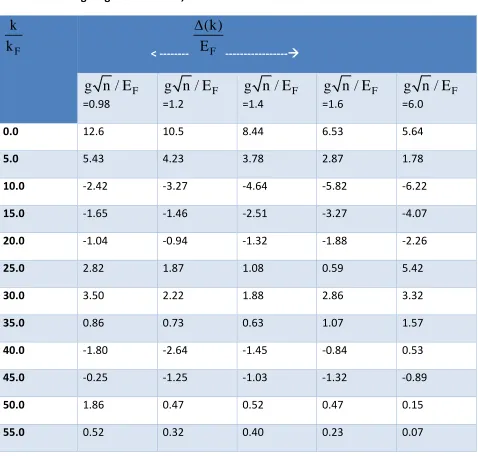
Using the theoretical formalism of S.De Palo etal22, we have studied super fluidity of an atomic Fermi gas near the unitary limit. The studies show that the thermodynamic properties of an atomic gas near the unitary limit are not universal as long as the resonance is narrow on the scale of Fermi energy. This formalism uses a mean-field BCS-like approach with a model potential that is able to reproduce the main character of Feshbach resonance. The formalism also gives a complete theoretical description of the crossover from BEC of composite bosons to BCS-type of Cooper pairs. It was also observed that the thermodynamic properties of the super fluid with large and positive scattering length on BEC side of resonance are affected by the energy dependence of the phase shift. The narrow resonance favours the occurrence of the strong coupling super fluidity. In table T1, we have shown the evaluated results of gap function
(k)
as a function of Fk
k
for different values ofg n / E
F in the unitary limit. We havetaken the values of
g n / E
F=0.98, 1.2, 1.4, 1.6 and 8.0. We observed that the gap function show the damped oscillatory behaviour in the scale of 1/r0. This is the manifestation of the pairing potential. The wavelength and damping coefficient of oscillations are almostindependent of the resonance width. Our theoretically evaluated results show that F
(k)
E
Available Online at www.ijpret.com 132
very sensitive with F
k
k
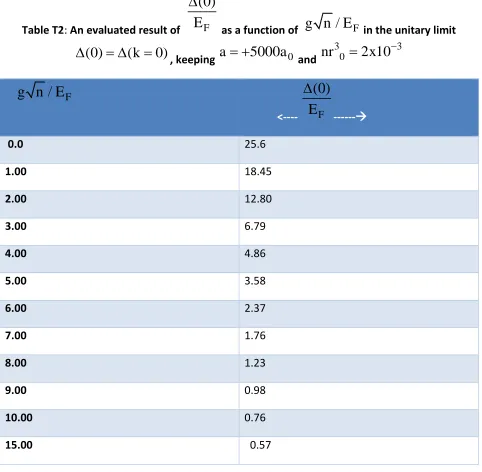
. In table T2, we have presented an evaluated results of 0
F
E
as a
function of
g n / E
F. One observes that there is a BCS-type of solution where resonanceshrinks on the scale of EF. The ratio 0
F
E
is seen to decrease as a function of
g n / E
Fandbecomes almost constant at values
g n / E
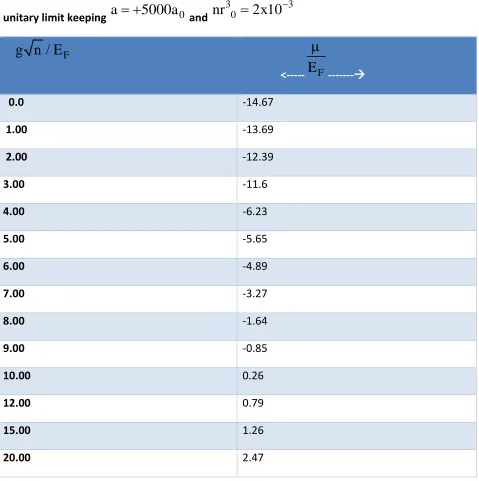
F=8.0. We have kept different parameters like scattering length a=5000a0 and nr03=2x10⁻³. In table T3, we have presented an evaluated resultsof chemical potential
E
F
as a function of
g n / E
F. Others parameters are same as in table T2. Our theoretical results show that chemical potential is large and negative and increaseswith
g n / E
F and forg n / E
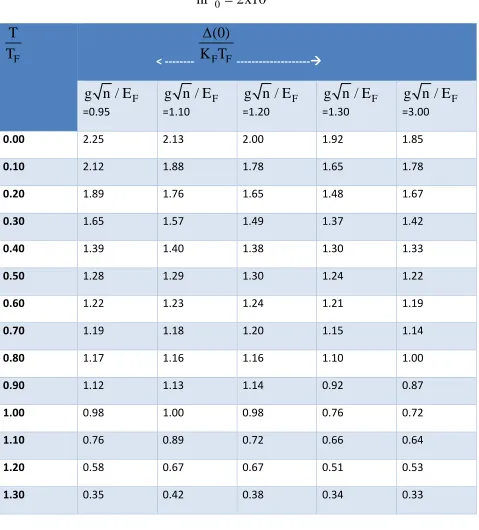
F=10, it becomes positive. We also observed that the ground state energy equation (8) behaviour that narrowing the resonance has now effect of increasing the limit of the interaction. These results are obtained on the BEC side of the resonance. It also suggests that high quality resonance leads to a non universal regime in theunitary limit. In table T4, we have shown the evaluated results of 0
F
k T
as a function of F
T
T
for different values of
g n / E
Fin the unitary limit. The others parameters are same as intable T2 and T3. Our theoretical results show that the ratio 0
F
k T
decrease with F
T
T
for all
values of
g n / E
F. This result also indicates as to how narrow resonance favours the emergence of super fluid state with regard to both the gap strength and the value of thetransition temperature. The smooth temperature behaviour of
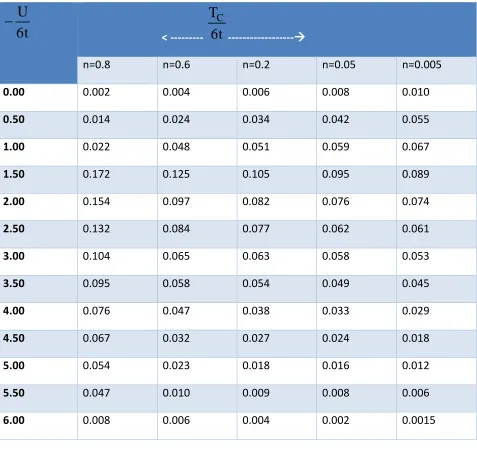
0 near the transition is a manifestation of the short ranged, bosonic character of the resulting state. Using the theoretical formalism of Q. Chen23, we have theoretically studied super fluid transition temperature in an atomic Fermi gas on 3D isotropic lattice with an attractive on-site interactionin the unitary limit. In table T5, we have shown an evaluated result of C
T
on-Available Online at www.ijpret.com 133
site interaction
U
6t
for various densities n. Here, t is the nearest neighbour hopping integral, U is on-site attractive interaction. The evaluation is performed for various densities n=0.8, 0.6,
0.2, 0.05 and 0.005. Our theoretically evaluated results indicate that C
T
6t
increase attainmaximum value and then decrease as a function of
U
6t
for various densities. Here, 6t is half band width. For n=0.8, the maximum TC occurs on the BEC side of unitary. Even at n=0.005, the
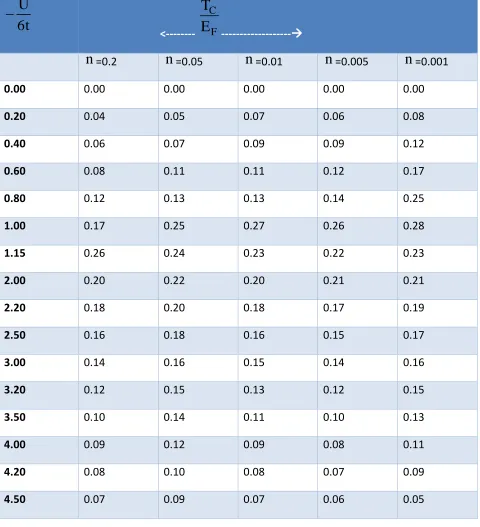
maximum is on BCS side. In table T6, we have shown an evaluated result of C
F
T
E
as a function
of
U
6t
for various densities n. Our theoretically obtained results indicate that as n increases the peak becomes narrower and narrower and moves closer to unitary. Here, TC follows a functional form
2
C
t
T
(
)
U
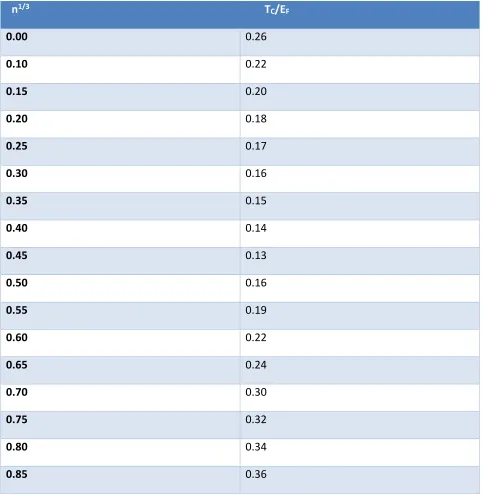
This is due to virtual ionization during the pair hopping in the BEC regime30,31. In table T7, we
have presented an evaluated result of C
F
T
E
as a function of1 3
n
on a3D isotropic lattice in theunitary limit. We observed for low n, the lattice effect is expected to vary as n1/3 to the leading order
1 2
2
C c 3 3
0 0
F F
T (n)
T (0)
a n
(a
/ n )
E (n)
E (0)
where
is proportionality constant. Here, 1 3 0a n
represents the ratio between the lattice
period and the mean inter particle distance. Our theoretically evaluated results show that C
F
Available Online at www.ijpret.com 134
decrease as 1 3
n
and attain minimum value at1 3
n
=0.45 and after that it increase sharply. Thereis some recent calculations32-38 which also reveals the similar behaviour.
CONCLUSIONS
From the above theoretical investigations and analysis, we have come across the following conclusions:
1. We have studied super fluidity of an atomic Femi gas near the unitary limit. Our evaluated
results of gap function
(k)
as a function of Fk
k
for different values ofg n / E
F show anoscillatory damped behaviour. This is because of manifestation of the pairing potential.
2. Our theoretically evaluated values of 0
F
E
and
E
F
as a function of
g n / E
F show aBCS-like solution. Our results of 0
F
E
decrease and
E
F
increase with
g n / E
F. Here, the chemical potential is large and negative. The results are obtained on BEC side of resonance. This is the nontrivial regime in the unitary limit.3. Our theoretically evaluated result of 0
F
k T
as function of F
T
T
for different values of
F
g n / E
indicate that 0
F
k T
decrease with F
T
T
for all values of
g n / E
F. These results also show that the narrow resonance favours the emergence of the super fluid state both in regard to gap strength and the value of transition temperature. This behaviour is an indication of short ranged, bosonic character of the resulting state.4. Our theoretically evaluated results of C
T
6t
as a function ofU
6t
Available Online at www.ijpret.com 135
5. Our theoretically evaluated results of C
F
T
E
as a function ofU
6t
for different values of n show that as n decrease the peak becomes narrower and narrower and moves closer to unitary.
Beyond the unitary limit the value of n=0.005, C
F
T
E
exhibit a rapid falloff with pairing potential.The decreasing trend follow a functional form of TC as
2 C
T
( t / U)
.
6. Our theoretically evaluated results of C
F
T
E
as a function of 1 3
n
show that for low n, thelattice effect is expected to vary as 1 3
n
. We also observed thatC
F
T
E
is highly nonlinear as afunction of 1 3
n
. As n decreasesC
F
T
E
decreases and attains minimum value at1 3
n
=0.45 andafter that it increases sharply.
Available Online at www.ijpret.com 136
Table T1: An evaluated result of the gap function F
(k)
E
as a function of F
k
k
for different
values of
g n / E
F=0.98, 1.2, 1.4 ,1.6 and 6.0. in the unitary limit. The other parameters arescattering length a=
5000a
0,3 3
0
nr
2x10
as a function of resonance width
F
k
k
< --- F
(k)
E
---
F
g n / E
=0.98
F
g n / E
=1.2
F
g n / E
=1.4
F
g n / E
=1.6
F
g n / E
=6.0
0.0 12.6 10.5 8.44 6.53 5.64
5.0 5.43 4.23 3.78 2.87 1.78
10.0 -2.42 -3.27 -4.64 -5.82 -6.22
15.0 -1.65 -1.46 -2.51 -3.27 -4.07
20.0 -1.04 -0.94 -1.32 -1.88 -2.26
25.0 2.82 1.87 1.08 0.59 5.42
30.0 3.50 2.22 1.88 2.86 3.32
35.0 0.86 0.73 0.63 1.07 1.57
40.0 -1.80 -2.64 -1.45 -0.84 0.53
45.0 -0.25 -1.25 -1.03 -1.32 -0.89
50.0 1.86 0.47 0.52 0.47 0.15
55.0 0.52 0.32 0.40 0.23 0.07
Available Online at www.ijpret.com 137
Table T2: An evaluated result of F
(0)
E
as a function of
g n / E
F in the unitary limit(0)
(k
0)
, keepinga
5000a
0and
3 3
0
nr
2x10
g n / E
F<---- F
(0)
E
---
0.0 25.6
1.00 18.45
2.00 12.80
3.00 6.79
4.00 4.86
5.00 3.58
6.00 2.37
7.00 1.76
8.00 1.23
9.00 0.98
10.00 0.76
Available Online at www.ijpret.com 138
Table T3: An evaluated result of chemical potential
E
F
as a function of
g n / E
F in theunitary limit keeping
a
5000a
0 and3 3
0
nr
2x10
g n / E
F<---
E
F
---
0.0 -14.67
1.00 -13.69
2.00 -12.39
3.00 -11.6
4.00 -6.23
5.00 -5.65
6.00 -4.89
7.00 -3.27
8.00 -1.64
9.00 -0.85
10.00 0.26
12.00 0.79
15.00 1.26
20.00 2.47
Available Online at www.ijpret.com 139
Table T4: An evaluated result of F F
(0)
K T
as a function of F
T
T
for different values of
F
g n / E
=0.95, 1.10, 1.20, 1.30 and 3.00 in the unitary limit keepinga
5000a
0and
3 3
0
nr
2x10
F
T
T
< --- F F
(0)
K T
---
F
g n / E
=0.95
F
g n / E
=1.10
F
g n / E
=1.20
F
g n / E
=1.30
F
g n / E
=3.00
0.00 2.25 2.13 2.00 1.92 1.85
0.10 2.12 1.88 1.78 1.65 1.78
0.20 1.89 1.76 1.65 1.48 1.67
0.30 1.65 1.57 1.49 1.37 1.42
0.40 1.39 1.40 1.38 1.30 1.33
0.50 1.28 1.29 1.30 1.24 1.22
0.60 1.22 1.23 1.24 1.21 1.19
0.70 1.19 1.18 1.20 1.15 1.14
0.80 1.17 1.16 1.16 1.10 1.00
0.90 1.12 1.13 1.14 0.92 0.87
1.00 0.98 1.00 0.98 0.76 0.72
1.10 0.76 0.89 0.72 0.66 0.64
1.20 0.58 0.67 0.67 0.51 0.53
Available Online at www.ijpret.com 140
1.40 0.28 0.29 0.25 0.21 0.20
1.50 0.17 0.19 0.18 0.16 0.14
Table T5: An evaluated result of C
T
6t
as a function of attractive on-site interactionU
6t
for various densities n, the evaluation is performed on a 3D isotropic lattice in the unitary limit.
U
6t
< ---
C
T
6t
---n=0.8 n=0.6 n=0.2 n=0.05 n=0.005
0.00 0.002 0.004 0.006 0.008 0.010
0.50 0.014 0.024 0.034 0.042 0.055
1.00 0.022 0.048 0.051 0.059 0.067
1.50 0.172 0.125 0.105 0.095 0.089
2.00 0.154 0.097 0.082 0.076 0.074
2.50 0.132 0.084 0.077 0.062 0.061
3.00 0.104 0.065 0.063 0.058 0.053
3.50 0.095 0.058 0.054 0.049 0.045
4.00 0.076 0.047 0.038 0.033 0.029
4.50 0.067 0.032 0.027 0.024 0.018
5.00 0.054 0.023 0.018 0.016 0.012
5.50 0.047 0.010 0.009 0.008 0.006
Available Online at www.ijpret.com 141
Table T6: An evaluated result of C
F
T
E
as a function ofU
6t
for various densities n=9.2, 0.05, 0.01, 0.005 and 0.001 for 3D isotropic lattice in the unitary limit
U
6t
<---
C
F
T
E
---n
=0.2n
=0.05n
=0.01n
=0.005n
=0.0010.00 0.00 0.00 0.00 0.00 0.00
0.20 0.04 0.05 0.07 0.06 0.08
0.40 0.06 0.07 0.09 0.09 0.12
0.60 0.08 0.11 0.11 0.12 0.17
0.80 0.12 0.13 0.13 0.14 0.25
1.00 0.17 0.25 0.27 0.26 0.28
1.15 0.26 0.24 0.23 0.22 0.23
2.00 0.20 0.22 0.20 0.21 0.21
2.20 0.18 0.20 0.18 0.17 0.19
2.50 0.16 0.18 0.16 0.15 0.17
3.00 0.14 0.16 0.15 0.14 0.16
3.20 0.12 0.15 0.13 0.12 0.15
3.50 0.10 0.14 0.11 0.10 0.13
4.00 0.09 0.12 0.09 0.08 0.11
4.20 0.08 0.10 0.08 0.07 0.09
Available Online at www.ijpret.com 142
5.00 0.06 0.08 0.06 0.05 0.04
Table T7: An evaluated result of TC/EF as a function of n1/3 on a 3D isotropic optical lattice in
the unitary limit
n1/3 T
C/EF
0.00 0.26
0.10 0.22
0.15 0.20
0.20 0.18
0.25 0.17
0.30 0.16
0.35 0.15
0.40 0.14
0.45 0.13
0.50 0.16
0.55 0.19
0.60 0.22
0.65 0.24
0.70 0.30
0.75 0.32
0.80 0.34
Available Online at www.ijpret.com 143
0.90 0.38
1.00 0.43
REFERENCES:
1. P. Nozieres and S. Schmitt-Rink., J. Low Temp. Phys (JLTP) 59, 195 (1985)
2. C. A. R. Sa de Melo, M. Randeria and J. R. Engelbrecht, Phys. Rev. Lett.(PRL) 71, 3202 (1993)
3. J. N. Milstein, S. J. J. F. Kokkelmans and M. J. Holland, Phys. Rev. A66, 043604 (2002)
4. Y. Ohashi and A. Griffin, Phys. Rev. Lett. (PRL) 89, 130402(2002)
5. R. Haussmann, Phys. Rev. B49, 12975 (1994)
6. R. Haussmann, W. Rantner, S. Cerrito and W. Zwerger, Phys. Rev. A75, 023610 (2007)
7. S. Floerchinger, M. Scherer, S. Diehl and C. Wetterich, Phys. Rev. B78, 174528(2008)
8. Z-Q. Yu, K.Huang and L. Yin, Phys. Rev. A79, 053636 (2009)
9. H. Feshbach, Ann. Phys. (N. Y.) 19, 287(1962)
10. M. W. Zwierlein etal., Nature 435, 1047(2005)
11. A. J. Leggett, Rev. Mod. Phys. 73, 307(2001)
12. F. Dalfovo etal., Rev. Mod. Phys. 71, 463 (1999)
13. I. Bloch, J. Dalibard and W. Zwerger, Rev. Mod. Phys. 80, 885(2008)
14. S. Giorgini, L. P. Pitaevskii and S. Stringari, Rev. Mod. Phys. 80, 1215(2008)
15. O. Morsch and M. Oberthaler, Rev. Mod. Phys. 78, 179(2006)
16. P. Fulde and R. A. Ferrell, Phys. Rev. 135, A550(1964)
17. G. B. Partridge etal., Science 311, 503(2006)
18. C. Cao etal., Science 331, 58(2011)
Available Online at www.ijpret.com 144
20. H. Heiselberg, Phys. Rev. A63, 043606(2001)
21. J. Carlson etal., Phys. Rev. Lett. (PRL) 91, 50401(2003)
22. S. De. Palo etal., Laser Phys. 15, 376(2005)
23. Q. Chen, Phys. Rev. A86, 023610(2012)
24. P. Magierski etal., Phys. Rev. Lett. (PRL) 103, 210403(2009)
25. G. Wlazlowski etal., Phys. Rev. Lett. (PRL) 110, 090403(2013)
26. M. Holland etal., Phys. Rev. Lett. (PRL) 86, 1915(2001)
27. L. D. Landau and E. M. Lifshitz, ‘Course of Theoretical Physics, Vol 3: Quantum Mechanics: Non-Relativistic Theory; 2nd ed. (Oxford Univ. Press., Oxford, 1965)
28. J. R. Schrieffer, ‘ Theory of Superconductivity (Nauka, Moscow, 1970)
29. Y. Yu and Q. J. Chen, Physica C470, 5900(2010)
30. Q. J. Chen etal., Phys. Rev. B59, 7083(1999)
31. Q. J. Chen etal., Phys. Rep. 412, 1(2005)
32. A. Adam. etal., New J. Phys. 14,115009(2012)
33. G. Wlazlowski etal., Phys. Rev. A88, 013639(2013)
34. M. Blub metal., Phys. Rev. A90, 063615(2014)
35. J. A. Joseph etal., Phys. Rev. Lett. (PRL) 115, 020401(2015)
36. G. Wlazlowski etal., Phys. Rev. A91, 031607 (R)(2015)
37. C. Marios etal., Phys. Rep. 622, 1-52(2016)