Wireless Sensor Network Technology Based on
Security Trust Evaluation Model
https://doi.org/10.3991/ijoe.v14i04.8590
Jinghua Zhu
Hunan Mechanical & Electrical Polytechnic, Changsha, China [email protected]
Abstract—Because the current research on wireless sensor networks is not thorough enough, with such shortcomings as lack of objectivity and insufficient accuracy of the trust evaluation model of network nodes, this paper proposes a trust evaluation model with multi-factor comprehensive consideration and Bayesian model, an improved trust evaluation model, by combining trust man-agement mechanism, trust factor, fuzzy set and D-S evidence theory, solving factor singleness and imprecise evaluation in the original model. The simulation results show that the proposed model has good dynamic adaptability, higher de-tection rate and lower dede-tection error rate, and it consumes less energy and im-proves the security of the network.
Keywords—Trust evaluation model, Multi-factor, Bayesian model, Wireless sensor
1
Introduction
With the advent of information age, people need more and more fine and extensive monitoring and precise transmission of environmental physical information through wireless sensors. The wireless sensors include sensors of temperature, humidity, grav-ity, pressure, lighting, etc., which make up the wireless sensor networks (WSN), which can monitor the data in real time and transmit it to the control center by wire-less communication [1-2]. With such advantages as low cost, simple installation, small energy consumption and self-work, it greatly saves manpower, material re-sources and financial rere-sources, and thus it has great application prospect in every field of national life and is considered as one of the most practical and scientific key technologies.
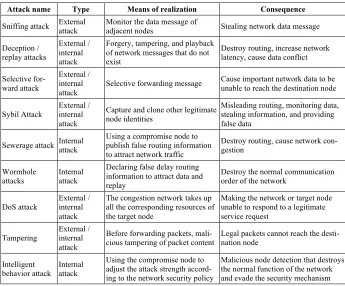
Table 1. Common types of attack in wireless sensor networks
Attack name Type Means of realization Consequence
Sniffing attack External attack Monitor the data message of adjacent nodes Stealing network data message
Deception / replay attacks
External / internal attack
Forgery, tampering, and playback of network messages that do not exist
Destroy routing, increase network latency, cause data conflict
Selective for-ward attack
External / internal
attack Selective forwarding message
Cause important network data to be unable to reach the destination node
Sybil Attack External / internal attack
Capture and clone other legitimate node identities
Misleading routing, monitoring data, stealing information, and providing false data
Sewerage attack Internal attack Using a compromise node to publish false routing information to attract network traffic
Destroy routing, cause network con-gestion
Wormhole
attacks Internal attack
Declaring false delay routing information to attract data and replay
Destroy the normal communication order of the network
DoS attack External / internal attack
The congestion network takes up all the corresponding resources of the target node
Making the network or target node unable to respond to a legitimate service request
Tampering External / internal attack
Before forwarding packets,
mali-cious tampering of packet content Legal packets cannot reach the desti-nation node
Intelligent
behavior attack Internal attack
Using the compromise node to adjust the attack strength accord-ing to the network security policy
Malicious node detection that destroys the normal function of the network and evade the security mechanism
The traditional security mechanism based on encryption and authentication can on-ly resist the attack from outside and cannot resist the attack from inside the network, so it can not satisfy the increasingly developing technology demand. Therefore, the trust management mechanism becomes the effective supplementary means of the traditional security mechanism. In that management mechanism, the node is evaluated and analyzed according to different characteristics, so as to ensure the transmission safety between the nodes, and thereby ensure the safety and reliability of the whole network. The researchers at home and abroad established various trust management models through different trust evaluation techniques (fuzzy logic, Bayesian theory, entropy theory, game theory, etc.), such as reputation-based model, position beacon information based on sensor network, reputation model based on agent, etc.) [6-8].
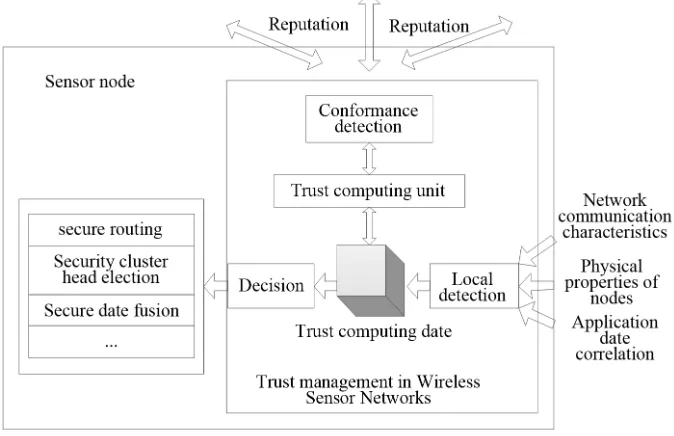
Fig. 1. WSN trust management architecture
2
Design of Trust Evaluation Model
In order to solve that problem that no relevant factors are considered in the tradi-tional trust evaluation model, in combination with the uncertainty of trust manage-ment, a trust model of multi-factor comprehensive evaluation is proposed and is ana-lyzed by using simulation experiment. In that model, the node trust calculation, the fuzzy partition and the fusion are carried out successively through the trust factor, the fuzzy set and the D-S evidence theory [9-11], with information security improvement in this paper.
2.1 Theoretical bases
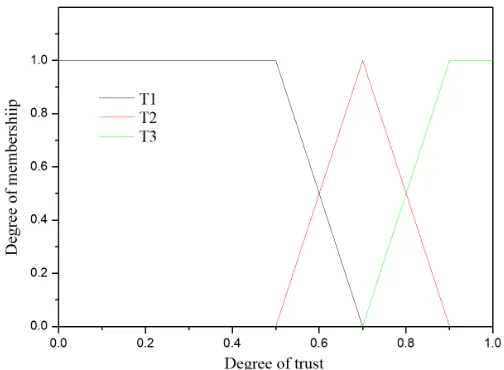
Fuzzy classification. In order to make the trust measure of wireless sensor
Fig. 2. Fuzzy classification of node trust
D-S evidence theory. D-S evidence theory is a theory of reasoning and calculation for evidence with inaccuracy and uncertainties. So, it can effectively solve the prob-lem of computing uncertain information in trust evaluation. The formula of reliability function and likelihood function in its basic theory are as follows:
! ! ! !!!!!!!!!!!! ! ! !!!! ! ! !!!
!!!! ! (1)
!"# ! ! ! ! ! !!! !!! ! !!
!!! (2)
!" ! ! ! ! !"# ! !!!!! ! !! (3) Identity-based public key cryptosystem. Identity-based public key cryptosystem is to bind personal identity information to public key. The trusted agency (CA) calcu-lates the user's private key (private key =F (main key, public key)) through its own main key and public key, and securely and confidentially transmit it to the user, and the third-party organization and the directory to store public key or certificate are not needed. Compared with the certificate-based public key cryptosystem, the identity-based public key cryptosystem has the following advantages, as shown in Table 2.
Table 2. Comparison between certificate and identity based public key cryptosystem.
Comparison Public key cryptosystem based on certificate Identity based public key cryptosystem
Resource occupancy Space for large storage of public key certificates Saving storage resources
Authentication mechanism
More complex locks, public key certificates issued by CA are required and the legitimacy of the CA signature needs to be verified.
Simple, direct or evolving user identity information as a public key
2.2 Description of the trust evaluation model
Analysis of credibility factors. The premise of comprehensive evaluation of node trust is reasonable selection of trust metrics and analysis of credibility factors. The single trustworthiness factor evaluation system used in the current trust model cannot calculate the trust value of the node accurately and objectively, and the trustworthi-ness factors of multiple influence factors should be considered comprehensively, such as forwarding rate factor, integrity factor, consistency factor, and availability factor [12-14]. In addition to trustworthiness factors, there are network main task factor, network energy consumption factor and other influencing factor. Therefore, all trust-worthiness factors are divided into network communication properties, node physical properties and application data security, and their trustworthiness factors (forwarding rate factor, integrity factor, availability factor) are defined.
Forwarding rate factor!!!!!! ! : Nodes in wireless sensor networks have limited
energy, which needs to be relayed while sensing and transmitting data. Therefore, it is possible to analyze and judge whether the node is attacked or not by analyzing the data forwarding of the nodes. The forwarding rate factor function may be expressed as:
!!!!! ! !!"!!!!!!!!!
!!!!!! (4)
Where, !"!!!!!!! is the number of feedback packets; !!!!!!!! is the number of
packets to forward; i is evaluation node; and j is the node to be evaluated.
Integrity factor (!!!!! ! ): When the data packet is sent to the next node, the source node will monitor whether the data packet is tampered or not and whether it is for-warded completely within a certain period of time, which ensures that the integrity and correctness of the data is not tampered with. The integrity factor function can be expressed as:
!!!!! ! !!!!!!!!!!!!!!!!!!! (5)
Where, !!!!!!!! is the number of completely and correctly forwarded packets and
!!!!!!!! is the number of packets to forward.
Availability factor (A!!!! ! ): The node cannot be used due to the interference of
the network channel and the extremely harsh environment, so it is necessary to prove the evaluated node by sending and inspecting data packet. The availability factor calculation formula can be expressed as:
!!!!! ! !!"!!!!!"!! !!"#!!!!!!! !!!!!!! (6)
2.3 Experimental simulation and performance analysis
The trust model is simulated and compared with the model RFSN and the model TMS. The experimental parameters are set as shown in Table 3.
Table 3. Experimental parameters
Parameter Data
Packet loss rate and tamper rate 70-100%
Trust update cycle /! 10s
Adaptive time factor / ("s, "I) 0.3, 0.8
Threshold of node trust classification / (#, $) 0.3, 0.09
Simulation area 100*100
Number of nodes 100
Node radius 30
Packet size 100
Only when the trust model has good dynamic adaptability, can the attack behavior of nodes be recognized in time and accurately. Figure 3 shows the variation of the direct trust value under ON-OFF attack. It can be seen from the figure that the basic confidence function m ({T}) of the node-trusted proposition gradually increases, the basic confidence function m ({T, -T}) of the node-state uncertainty proposition grad-ually decreases, and the basic confidence function of the node-untrusted proposition always is 0. When a malicious attack is launched, the trust that slowly accumulates decreases rapidly. Therefore, it is particularly important to timely identify and elimi-nate malicious attacks.
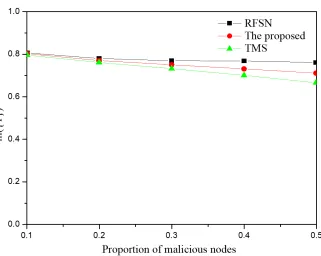
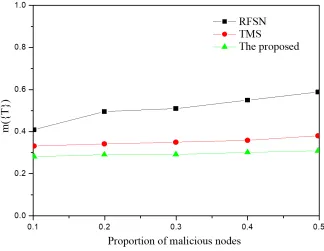
When the indirect trust values are considered, a bad - facing attack can easily oc-cur. The trust model is analyzed and compared with the RFSN model and the TMS model respectively for two cases such as a malicious node discrediting a normal node and a malicious node advocating other malicious nodes, and the results are shown in Figures 4 and 5.
As can be seen from Figure 4, when a malicious node discredits a normal node, the RFSN model is the least influenced, followed by the proposed trust model, and the TMS model is the greatest influenced, which shows that the proposed model can be improved in the aspects of comprehensiveness and objectivity. However, it can be seen from Figure 7 that the RFSN model cannot resist the advocacy of the malicious node to the accomplice, but the proposed model has good resistance. This is mainly because the proposed trust model considers both direct trust and indirect trust, and the value of node trust is more objective and accurate.
Fig. 3. Change of direct trust value under ON-OFF attack
Fig. 5. Malicious nodes advocating malicious nodes
3
Implementation of Improved Bayesian Distributed Trust
Evaluation Model
On the basis of the above, the typical Bayesian trust evaluation model is improved, mainly by modifying the abnormal attenuation factor, updating the sliding window and adaptive forgetting factor, and using the direct trust value reliability to judge the demand of indirect trust. Based on weight allocation of information entropy, the im-proved model is verified and analyzed by simulation.
3.1 Model algorithm flow
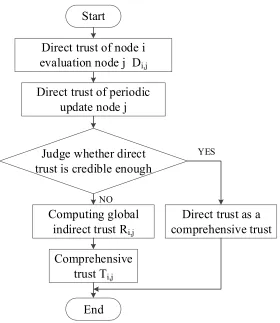
This model is mainly to observe and count the normal and abnormal behavior of nodes, and judge in cooperation with the behavior recommended by the third party, which is only started when the direct trust level is insufficient, so that the energy consumption of the node can be reduced, and the detailed algorithm flow is shown in Figure 7.
Start
Direct trust of node i
evaluation node j D
i,jDirect trust of periodic
update node j
Judge whether direct
trust is credible enough
Computing global
indirect trust R
i,jComprehensive
trust T
i,jEnd
Direct trust as a
comprehensive trust
YES
NO
3.2 Simulation experiment and analysis of results
The improved trust model is simulated and compared with the literature (Denko, M.K., et al, 2011). The experimental parameters are set as shown in Table 4.
Table 4. Simulation parameters
Parameter Data
Forwarding rate [0.9,1.0]
Initial energy of node Einit 0.5J
Transmission and reception of energy consumption Eelec 50nJ/bit
Amplifier power consumption %amp 10pJ/bit/m2
Simulation area 100*100
Number of nodes 100
Number of malicious nodes 0-20%
Node radius 30
Packet size 100
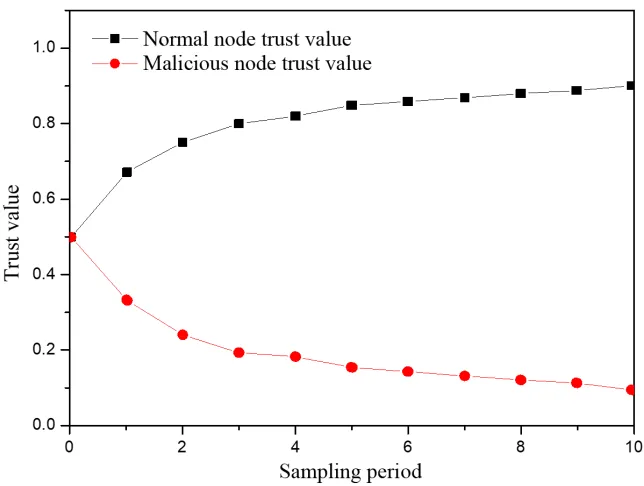
Trust value of nodes. Firstly, the node trust value with the change of the sampling period is analyzed, and the trend is shown in Figure 8. It can be seen from the figure that the trust value of normal node gradually increases and the trust value of malicious node gradually decreases, which indicates that normal node and malicious node can be effectively identified and detected in the area of experiment simulation.
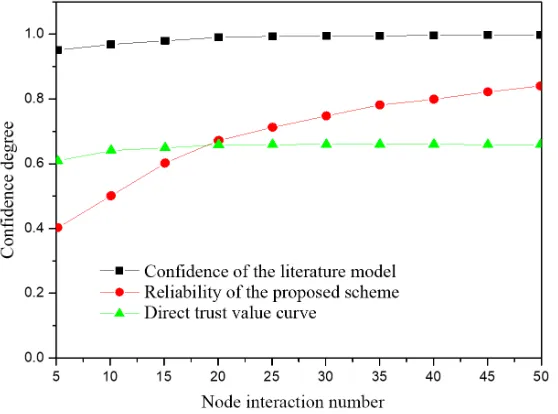
Confidence level. In order to investigate the rationality of this confidence level, the improved model is compared with the model in the literature (Denko, M.K., et al, 2011), and the results are shown in Figure 9. It can be seen from the figure that the direct trust value and the confidence level of the direct trust in the literature are basi-cally the same, but the confidence level of the direct trust in the improved model tends to increase as the number of node interactions increases. Therefore, compared with the model in the literature, the improved model can recognize the confidence level of nodes with the same trust value and distinguish nodes more effectively.
Fig. 9. The tendency of confidence to change under different number of interactions Detection rate and detection error rate. In order to identify malicious nodes in wireless sensor networks, trust quantization is performed on the nodes, and two in-dexes of detection rate and detection error rate are formed. The improved model is compared with the model without abnormal attenuation factor and the model in the literature [15], and the analytic results are shown in Figures 10 and 11.
As can be seen from Figure 10, the detection rate of malicious nodes in all three models decreases as the proportion of malicious nodes increases. Among them, the model in the literature [15] is the fastest, followed by the model without abnormal attenuation factor, and the improved model is relatively stable.
This is because only good reputation is considered in the model of trust fusion in literature, and the improved model makes use of information entropy and abnormal attenuation factor to compare and measure the information, so the detection rate is the highest.
error rate, which is because the abnormal attenuation factor eliminates the change of node trust due to abnormal behavior and realizes higher detection rate and lower de-tection error rate.
Fig. 10.Contrast diagram of detection rate
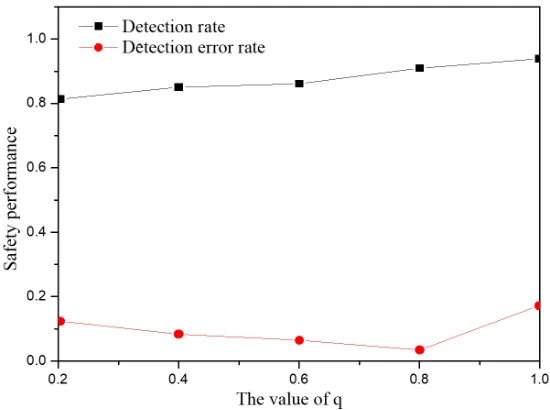
Influence of anomaly attenuation factors. In order to further study the influence of the attenuation factor on the detection rate and the detection error rate, it is verified by many experiments with the results shown in Figure 12.
Fig. 12.The effect of abnormal attenuation factor on detection rate and detection error rate As can be seen from Figure 12, as the abnormal attenuation factor increases, the detection rate gradually increases, and the detection error rate decreases first and then increases. This is because when the abnormal attenuation factor is lower, some mali-cious nodes cannot be recognized, while when the abnormal attenuation factor is higher, the abnormal nodes with non-intrusion factors are considered as malicious nodes. Therefore, it is necessary to take the value of the abnormal attenuation factor according to the specific environments. In this paper, when the abnormal attenuation factor is 0.8, the security performance of the network is the best.
Analysis of the energy consumption. At different ratios of malicious nodes, the
energy consumption of the network is analyzed and compared with the results of the RFSN model. The results are shown in Figures 13 and 14.
As can be seen from Figure 13, as the simulation cycle progresses, the energy of the entire network tends to decrease. However, the energy consumption of the im-proved model is smaller than that of RFSN model. And as the proportion of malicious nodes increases, the energy of the entire network decreases.
Fig. 13.Network energy consumption contrast diagram
4
Conclusions
With the development of Internet of Things and artificial intelligence technology, the demand of wireless sensor network technology is increasing. At present, the re-search on wireless sensor networks is not thorough enough, and the objectivity and accuracy of trust evaluation model for network nodes are not enough. Based on this, this paper proposes a trust evaluation model with multi-factor comprehensive consid-eration and Bayesian model, an improved trust evaluation model, which solves the problems of factor singleness and imprecise evaluation in the original model, realizes the dynamic adaptability of the model, improves the network security performance and reduces the network energy consumption.
1.A trust model of multi-factor comprehensive evaluation is proposed. The node trust calculation, fuzzy division and fusion are carried out by means of trust factor, fuzzy set and D-S evidence theory, with the information security improved.
2.This paper proposes an improved model based on Bayesian theory, which is modi-fied by abnormal attenuation factor, and updated by sliding window and adaptive forgetting factor, and the demand of indirect trust is judged by the confidence level of direct trust value, with allocated weights according to information entropy. 3.Experimental validation and analysis of the model show that the proposed model
has good dynamic adaptability, higher detection rate, lower detection error rate, and less consumption of network energy, and better network security.
5
References
[1]Singh, J. (2015). Security issues in wireless sensor networks (wsn). Lecture Notes in Engi-neering & Computer Science, 2170(1): 40-40.
[2]Govindan, K., & Mohapatra, P. (2012). Trust computations and trust dynamics in mobile adhoc networks: a survey. IEEE Communications Surveys & Tutorials, 14(2): 279-298. https://doi.org/10.1109/SURV.2011.042711.00083
[3]Mármol, F. G., & Pérez, G. M. (2012). Trip, a trust and reputation infrastructure-based proposal for vehicular ad hoc networks. Journal of Network & Computer Applications, 35(3): 934-941. https://doi.org/10.1016/j.jnca.2011.03.028
[4]Chen, I. R., Guo, J., Bao, F., & Cho, J. H. (2014). Trust management in mobile ad hoc networks for bias minimization and application performance maximization. Ad Hoc Net-works, 19: 59-74. https://doi.org/10.1016/j.adhoc.2014.02.005
[5]Komathy, K., & Narayanasamy, P. (2008). Trust-based evolutionary game model assisting aodv routing against selfishness. Journal of Network & Computer Applications, 31(4): 446-471. https://doi.org/10.1016/j.jnca.2008.02.002
[6]Duan, J., Gao, D., Yang, D., Foh, C. H., & Chen, H. H. (2017). An energy-aware trust der-ivation scheme with game theoretic approach in wireless sensor networks for iot applica-tions. IEEE Internet of Things Journal, 1(1): 58-69. https://doi.org/10.1109/JIOT. 2014.2314132
[8]Bao, F., Chen, I. R., Chang, M. J., & Cho, J. H. (2012). Hierarchical trust management for wireless sensor networks and its applications to trust-based routing and intrusion detection. IEEE Transactions on Network & Service Management, 9(2): 169-183. https://doi.org/10.1109/TCOMM.2012.031912.110179
[9]Li, X., Zhou, F., & Du, J. (2013). Ldts: a lightweight and dependable trust system for clus-tered wireless sensor networks. IEEE Transactions on Information Forensics & Security, 8(6): 924-935. https://doi.org/10.1109/TIFS.2013.2240299
[10]Tajeddine, A., Kayssi, A., Chehab, A., Elhajj, I., & Itani, W. (2015). Centera: a centralized trust-based efficient routing protocol with authentication for wireless sensor networks†. Sensors (Basel, Switzerland), 15(2): 3299-3333. https://doi.org/10.3390/s150203299 [11]Duan, J., Gao, D., Foh, C. H., & Zhang, H. (2013). Tc-bac: a trust and centrality degree
based access control model in wireless sensor networks. Ad Hoc Networks, 11(8): 2675-2692. https://doi.org/10.1016/j.adhoc.2013.05.005
[12]Ishmanov, F., Malik, A. S., Begalov, B., & Begalov, B. (2015). Trust management system in wireless sensor networks: design considerations and research challenges. Transactions on Emerging Telecommunications Technologies, 26(2): 107-130. https://doi.org/10.1002/ ett.2674
[13]Jadidoleslamy, H. (2015). Tms‐hcw: a trust management system in hierarchical clustered wireless sensor networks. Security & Communication Networks, 8(18): 4110-4122. https://doi.org/10.1002/sec.1327
[14]Qi, J., Yong, T. L., & Zhong, C. (2008). Trust management in wireless sensor networks. Journal of Software, 19(7): 1716-1730. https://doi.org/10.3724/SP.J.1001.2008.01716 [15]Denko, M. K., Sun, T., & Woungang, I. (2011). Trust management in ubiquitous
compu-ting: a bayesian approach. Computer Communications, 34(3): 398-406. https://doi.org/10.1016/j.comcom.2010.01.023
6
Author
Jinghua Zhu is with the Hunan Mechanical & Electrical Polytechnic, Changsha
410000, China, she is mainly focused on research direction intelligent algorithm and computer application technology, electronic commerce. Teachers from Hunan Me-chanical and Electrical Polytechnic have published more than ten papers on electronic commerce and computer application technology. (E-mail: [email protected])