Optimization and experiment of key components in pneumatic peanut pod
conveyor
Xuemei Gao
,
Huanxiong Xie
,
Fengwei Gu
,
Hai Wei
,
Minji Liu
,
Jianchun Yan
,
Zhichao Hu
* (Nanjing Research Institute for Agricultural Mechanization, Ministry of Agriculture and Rural Affairs, Nanjing 210014, China)Abstract: Research interest in pneumatic conveying technologies in processes such as peanut harvesting and shelling has
grown rapidly in recent years. However, the use of pneumatic conveyors in this application suffers from high pod damage rates and duct obstruction. To address these issues, we analyzed the critical speed of pneumatic transport for conveying the peanut pods and measured the angle of friction and coefficient of restitution of peanut pods on a variety of material surfaces. Based on the results of these tests, optimizations and improvements were made to the separator bowl, air supply duct, and conveying duct. A pneumatic conveying experiment was then performed using peanut pods. In the factorial experiment, it was found that increases in fan speed increase the pod damage rate and transport efficiency, while increases in the thickness of the cushioning/anti-obstruction layer decrease the rate of pod damage and transport efficiency. Pod damage rates were significantly affected by fan speed, the thickness of the cushioning/obstruction prevention layer, and interaction between these factors, while transport efficiency was only significantly affected by fan speed. It is proved by the machine verification test, the optimal parameters for the pneumatic transport of Baisha peanut pods with a moisture content of 7.24% was a fan speed of 2700 r/min and a cushioning/anti-obstruction layer thickness of 6 mm. A pod damage rate of 5.19% and transport efficiency of 92.03% were achieved using these parameters, which are sufficient for meeting the requirements of industrial applications.
Keywords: pneumatic transport; material properties of peanut pods; damage rate; transport efficiency DOI: 10.25165/j.ijabe.20201303.4609
Citation: Gao X M, Xie H X, Gu F W, Wei H, Liu M J, Yan J C, et al. Optimization and experiment of key components in
pneumatic peanut pod conveyor. Int J Agric & Biol Eng, 2020; 13(3): 100–107.
1 Introduction
When shelled materials such as peanuts are harvested and subjected to postharvest processes such as shelling and drying, these materials are generally transported using scraper conveyors and conveyor belts. However, these methods of transport are inflexible in their direction of transport and have low transport efficiencies. Pneumatic conveying systems, on the other hand, are capable of higher transport efficiencies than other conveying methods, and their directions of transport can be selected arbitrarily. Therefore, the application of these systems has become increasingly widespread and important. However, pneumatic conveying systems tend to result in high pod damage rates and are susceptible to duct obstruction, which leads to operational inefficiencies that ultimately reduce the transport efficiency[1-5].
Theoretical and experimental studies have yet to be performed in a systematic manner on the pneumatic transport of peanut pods. An experimental pneumatic conveying device for peanut pods was designed in which the pod damage rates were reduced through the
Received date: 2018-08-28 Accepted date: 2020-03-30
Biographies: Xuemei Gao, Assistant Professor, research interests: agricultural mechanization engineering, Email: [email protected]; Huanxiong Xie, Professor, research interests: agricultural products processing technology and equipment, Email: [email protected]; Fengwei Gu, Associate Professor, research interests: agricultural mechanization engineering, Email: [email protected];
Hai Wei, Assistant Professor, research interests: agricultural mechanization
engineering, Email: [email protected]; Minji Liu, Assistant Professor, research interests: agricultural mechanization engineering, Email: [email protected];
Jianchun Yan, Assistant Professor, research interests: agricultural products
processing technology and equipment, Email: [email protected].
*Corresponding author: Zhichao Hu, Professor, research interests: agricultural mechanization engineering. Nanjing Research Institute for Agricultural Mechanization, Ministry of Agriculture and Rural Affairs, No.100, Liuying, Xuanwu District, Nanjing 210014, China. Tel: +86-25-84346246, Email: [email protected].
use of an improved airlock system and the installation of silica gel as a cushioning material on the separator bowl’s inner walls[1,6]. However, silica gel is expensive, and peanut pods have a greater angle of friction on silica gel surfaces than on steel plates, which is detrimental to transport efficiency.
To address these issues, the angles of friction and the coefficient of restitution of peanut pods on steel plates were studied, silica gel, rubber, and Teflon tape. This study was conducted on the basis of previous research that considered the effects of peanut species and moisture content on pneumatic transport and the intrinsic physical properties of peanut pods in these transport processes[1]. The results of these experiments were then used to modify and optimize an experimental pneumatic conveyor for peanut pods. Finally, the operational efficacy of the improved pneumatic conveying system was validated. The findings of this study will serve as a useful reference for theoretical studies regarding the pneumatic transport of shelled agricultural materials such as peanut pods.
2 Structure and operational principles
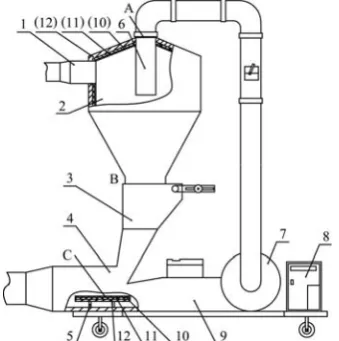
A schematic representation of our experimental pneumatic conveyor for peanut pods is shown in Figure 1. This system is composed of material feeding, conveying, and discharging devices, as well as air inlets and outlets and a wind speed controller. The pneumatic conveyor consists of a feed chute, separator bowl, airlock, discharge chute, fan, wind controller, air supply duct, and frequency converter. In particular, a centrifugal blower was selected as a fan of this conveyor system, and a single fan was used to perform material feeding and discharging.
of the air supply duct (6) is located below the feed inlet of the feed chute (1) and at a substantial distance from the feed inlet, the wind speeds at the feed inlet are relatively low. This allows the peanut pods to enter the separator bowl smoothly without being sucked away by the air supply duct.
During the pneumatic transport process, the pods mix and move with the airflow; the movement patterns of the pods are therefore similar to those of the airflow. After the pods have been sucked into the separator bowl, they move with the airflow in a spiral trajectory along the walls of the separator bowl. After the feed has reached a specified mass, the gravity gate of the gravity airlock (3) opens, and the peanut pods fall into the material discharge channel (4) under the effects of gravity.
The airflow of the system first enters the fan (7) through the air supply duct (6). The airflow from the fan then blows peanut pods through the discharge channel into the air-feed separator bowl. The air-feed separator bowl is a cylinder with numerous holes on its top, which allow part of the air to be ejected prior to material discharge. This reduces the amount of air entrained with the materials during the material receiving process, which allows the pods to be smoothly packaged or transported to a different location.
1. Feed chute 2. Separator bowl 3. Gravity airlock 4. Discharge chute 5. Material receiving plate 6. Air inlet 7. Fan 8. Electric control box 9. Air outlet 10. Smooth obstruction prevention layer 11. Cushioning layer 12. Steel plate
Figure 1 Structural diagram of experimental pneumatic conveyor
3 Analysis of evaluation indices and affecting factors
3.1 Determination of evaluation indices
Pod damage rate S and transport efficiency η are direct indicators of pod damage and duct obstruction during the pneumatic transport of peanut pods. The pod damage rate and transport efficiency were selected as evaluation indices in accordance with the findings of previous studies[1,7]. The values of these indicators are given by Equations (1) and (2):
Pod damage rate S:
1
2 100%
w S
w
= × (1)
In this equation, W1 is the mass of damaged pods in a sample (kg), while W2 is the total mass of the sample (kg).
Transport efficiency η:
3 100%
w w
η= × (2)
In this equation, W3 is the mass of pods (kg) that are received at the material receiving outlet within the sampling interval, while
W is the maximum rated mass of pod transport (kg) over the
sampling interval. The rated production rate of pneumatic peanut pod transport was set to 1.8 t/h. Based on actual industrial conditions, the sampling interval was set to 5 min, which yields a
W of 150 kg.
3.2 Analysis of causes of pod damage and low transport efficiency
After the peanut pods are sucked into the separator bowl of the pneumatic conveying system, they spiral downward along the inner walls of the separator bowl. The pods sink downward in the horizontal conveying duct owing to their weight, and then move toward the exit of the conveying system along the inner walls of the duct. Duct obstruction is caused either by low airflow speeds or excessive surface friction between the feed and components of the conveying system (the conveying duct, etc.). The flow of materials then becomes random and disorganized, which subsequently leads to blockages. These blockages usually occur around corners in the conveying duct or interfaces, i.e., at the discharge chute (4) in Figure 1.
Since the air inlet (6) was previously located above the separator bowl (location A in Figure 1, indicated with dotted lines) and was very close to the feed inlet, a screen was installed at the air inlet to prevent pods from entering the air supply duct. However, the screen can become blocked at high levels of transport efficiency; this is detrimental to the airflow and eventually leads to operational inefficiencies. Pod damage is caused by inter-pod collisions or collisions between pods and other hard objects when the pods move at high speeds during the pneumatic transport process. This mainly occurs in locations where the pods collide with the separator bowl and conveying duct[8].
Therefore, the angle of friction and coefficient of restitution of peanut pods on different material surfaces and airflow speeds in the pneumatic transport process are of significant importance, especially in the selection of inner-wall materials for the key components of peanut pod pneumatic conveyors and the design of fan parameters[9], as these factors have a direct impact on pod damage rates and the transport efficiency in pneumatic conveyors. The effects of the peanut pod shape, moisture content, and pod breaking force on pod damage rates have been studied in the past[1]. In this work, an experimental study was performed using peanut pods that were stored and prepared for postharvest processing, in which pneumatic transport-related factors such as the angle of friction, coefficient of restitution, and airflow speed were measured and analyzed.
3.3 Analysis of affecting factors
3.3.1 Angle of friction θ
The angle of friction indicates the ability of a material to slide on a surface. Peanut pods exhibit different levels of mobility on different material surfaces. If a pod has a large angle of friction on a certain material, the mobility of the pod on this material will be very poor, which will be detrimental to operational efficiency. A low angle of friction is thus desirable as this helps to prevent duct obstructions. The selection of materials in conveying components and the design of fan parameters for the pneumatic conveyor therefore have a direct impact on the transport efficiency.
Baisha peanuts, whose pods have a moisture content of 7.42%, were used as the experimental material of this study. Based on the testing methods of Lu et al.[10-15] for peanut kernels and pods, a bevel meter (shown in Figure 2) was used to measure the angle of friction θ of Baisha peanuts on a Q235 steel plate, silica gel, rubber, and Teflon tape, via Equation (3).
1 tan ( )H
L
θ= − (3)
In this equation, H is the height to which the test board was raised when the peanut pod began to slide on the test board, in units of mm. L is the corresponding length at the bottom of the test board when the pod began to slide, in units of mm. The H and L
parameters are illustrated in Figure 2.
1. Metal holder 2. Windlass string 3. Peanut pod 4. Test board 5. Base support 6. Winding handle
Figure 2 Structural diagram of bevel meter
Each scenario was tested five times, and the average value of θ
in these five tests was taken as the angle of friction of the peanut pods on the given test board. The results of this experiment are listed in Table 1.
Table 1 Physical properties of Baisha peanuts on various material surfaces
Measured indicator Q235 steel plate Silica gel Rubber Teflon tape
Angle of friction, θ/º 29.68 29.42 31.3 22.78 Coefficient of restitution, Cr 0.39 0.35 0.19 /
In Table 1, it is shown that the angle of friction (θ) of Baisha peanuts is greatest on rubber, while the difference in θ between silica gel and Q235 steel plate is minimal. Teflon tape has the smallest θ. Since Teflon tape is relatively thin, it can be fixed onto rubber and installed in the inner walls of the separator bowl and conveyor duct, which frequently come into contact with the peanut pods. This should help to improve transport efficiency. 3.3.2 Coefficient of restitution Cr
The coefficient of restitution Cr of a peanut pod is the ratio between the normal velocities of the pod before and after collision, which indicates the ability of the pods to maintain their precollision kinetic energy after a collision. Research into this aspect has been performed on granular agricultural materials such as wheat, rapeseed, and potatoes[6,16-22]. An understanding of Cr (which is mainly dependent on the material of the colliding object) allows the state of pod collisions (elastic or inelastic, etc.) in the separator bowl and conveyor duct to be determined during the design of the pneumatic peanut pod conveyor. These studies will therefore provide a useful reference for the selection of materials in pneumatic conveyors and the design of conveying duct dimensions. The greater the value of Cr, the greater the postcollision velocity of
the pod; hence, the probability of pod damage increases proportionally with Cr.
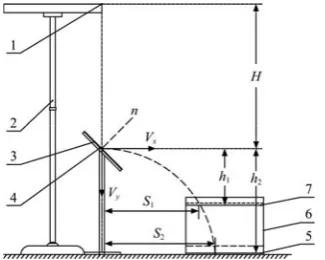
The Cr of peanut pods was tested using the same set of experimental materials (Baisha peanuts, Teflon tape, Q235 steel, silica gel, and rubber) that were used in the angle-of-friction experiment. Based on the methods of Lu, Yang, and Wang et al. for measuring the Cr of granular materials such as peanut pods[11,16-19], Cr was measured using a specialized device based on kinematic principles, as shown in Figure 3. A peanut pod falls freely from Point 1 (with an initial velocity of 0 m/s), and the height of the fall is H. After time t, the pod falls on the test board (3), which lies above the inclined supporting plate (4).
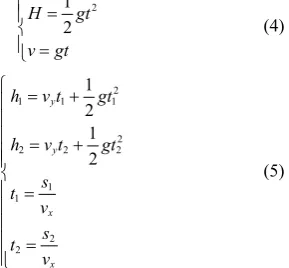
The speed of the pod prior to its collision with the test board (3) is v0, while the horizontal and vertical components of the postcollision velocity are vx and vy, respectively. Pod-receiving trays were placed at h1 and h2, which were below the collision point. A layer of yellow sand was placed on the trays to prevent the pods from rolling or moving after they fell onto these trays. If the pod falls onto h1, then the corresponding time of the pod’s fall from the test board to the receiving tray is t1; if the pod falls onto h2, then the time of the fall is t2. Based on kinematic theories, it may be inferred that
2 1 2
H gt
v gt
⎧ = ⎪ ⎨ ⎪ = ⎩
(4)
2
1 1 1
2
2 2 2
1 1
2 2
1 2 1 2
y
y
x
x
h v t gt
h v t gt
s t
v s t
v
⎧ = + ⎪
⎪
⎪ = +
⎪⎪ ⎨ ⎪ = ⎪ ⎪ ⎪ = ⎪⎩
(5)
Based on Equation (4), it may be deduced that the velocity of the pod prior to its collision with the inclined supporting plate, v0, is given by Equation (6), where g is the gravitational acceleration:
0 2
v = gH (6) Based on Equation (5), it may be inferred that the horizontal (vx) and vertical (vy) components of the pod’s velocity (v) after it collides with the inclined supporting plate are
1 2 1 2
2 1 1 2
2 2
1 1
1
( )
2( )
2 2
x
x y
x
gS S S S
v
S h S h
v h S g
v
v S
⎧ = −
⎪ −
⎪ ⎨
− ⎪ = ⎪⎩
(7)
Hence, the velocity of the pod after it collides with the inclined supporting plate is
2 2
x y
v= v +v (8) Based on the definition of Cr and Equations (7) and (8), the Cr of peanut pods is
2 2 cos[45 tan ( )]1
2 sin 45
y
x y
x r
v
v v
v C
gH
−
+ ⋅ ° ±
=
the Cr of peanut pods on the given test board. The results of this experiment are listed in Table 1.
In Table 1, it is shown that Baisha peanuts have lower Cr values on silica gel and high-elasticity rubber than on Q235 steel plate, with Cr being the lowest on high-elasticity rubber. Silica gel has a greater degree of wear resistance and hardness than rubber, but it is not as elastic as high-elasticity rubber. Hence, rubber has a stronger cushioning and energy-dissipating effect for falling peanut pods than silica gel, which is why rubber gives the lowest postcollision pod velocities[6]. Based on the mechanisms by which pods are damaged during pneumatic transport, high-elasticity rubber and Teflon tape can be installed in locations where pods often collide with the separator bowl and conveying duct. This will help to reduce pod damage rates without reducing transport efficiency.
1. Material dropping point 2. Telescoping shoring column 3. Test board 4. Inclined supporting plate 5. Layer of sand 6. Test box 7. Sand-containing tray
Figure 3 Apparatus for measuring coefficient of restitution, and method of measurement
3.3.3 Selection of airflow speed
Granular materials such as peanuts generally move in a floating state during the pneumatic transport process. The floating of these materials requires the weight of the material’s particles to be balanced by the sum of various forces. The most important factor in determining the state of flow of a material is the airflow speed. If the speed of the airflow is too low, then the materials will clog during the transport process and reduce the operational efficiency. However, an excessively high airflow speed will increase the rate of pod damage and waste energy[15]. During the pneumatic transport of peanut pods, airflow speeds can be regulated by altering the fan speed using a frequency converter since the speed of the airflow increases in proportion with the fan speed.
The speed of the airflow in material transport processes, vα,
may be calculated using Equation (10):
vα=φv1 (10)
In this equation, φ is the speed coefficient, which is usually 1.3-2.5 for loose materials in a vertical duct and 1.5-2.5 in horizontal ducts. v1 is the critical speed for material transport. Based on Equation (10), the airflow speeds used for material transport are much higher than the critical speeds of the materials themselves. The critical speed of peanut pods ranges from 12.50 m/s to 15.00 m/s.
In actual operations, vα must be jointly determined by
theoretical analysis and experimental results. Based on theoretical analyses and our previous experiments, pneumatic transport of peanut pod was carried out at an airflow speed of 18.00- 20.00 m/s[23,24]. The airflow speed may be adjusted for peanut species that exhibit large variations in external shape, using these
values as a reference.
4 Design and optimization analysis of key components
To address the high rates of peanut pod damage in pneumatic transport processes and the susceptibility of these processes to duct obstruction, the key components of the conveying system must be selected and optimized according to the intrinsic physical properties of peanuts. The most important aspects for optimization are the selection of the fan type and control of the airflow volume, selection of the airlock type, conveyor duct design, and the selection of materials that directly come into contact with peanut pods during the conveying process.
4.1 Selection of fan type and control of airflow volume
To lighten and simplify the construction of our pneumatic peanut pod conveyor, a centrifugal blower was selected as the fan of our system based on the results of previous experiments and the constraints given by the dimensions of the conveying duct[1]. In this system, material feeding and discharging can be performed using a single fan. The rated power rated rotational speed, and rated airflow speed of the fan are 5.5 kW, 3100 r/min, and 26 m/s, respectively. This fan is therefore capable of achieving the airflow speeds required for the pneumatic transport of peanut pods. The speed of the fan (and therefore the volume and speed of the airflow) can be adjusted using a frequency converter. In actual operations, the airflow speed must be selected and adjusted according to the moisture content, variety, and batch of materials being conveyed.
4.2 Selection of airlock type
Since the outer shells of peanut pods are more fragile than those of wheat and corn, a flapped gravity airlock was selected in this work[1]. With this type of airlock, the gravity doors open once a sufficient mass has been accumulated by the suction of pods into the separator bowl. The pods then fall into the conveying duct owing to their weight, and the fan blows the pods out of the conveyor system. The use of a gravity airlock prevents pod damage caused by the rotating blades of conventional rotary airlocks.
4.3 Optimization and improvement of conveyor duct
To prevent blockages in the transport of peanut pods, it is necessary to ensure that the airflow in the air supply duct is smooth and uninterrupted. Based on the mechanisms that cause the obstruction of material transport processes, the design of the air supply duct above the separator bowl was optimized and improved by extending the duct to the bottom of the feed inlet [as indicated by air inlet (6) in Figure 1].
The wind speeds at the inlet of the air supply duct are very high. Prior to this modification, the air inlet was too close to the feed inlet: although a screen was installed to prevent peanut pods from entering the duct, the air inlet became obstructed if the volume of airflow was large or if a large amount of feed or grime was present. This causes difficulties as low volumes of airflow will instead lead to obstructions in the conveying duct. To solve this problem, the air supply duct inside the separator bowl was extended to the middle-lower section of the separator bowl in order to increase the distance between its air inlet and the feed inlet.
material-free position in the middle of the separator bowl.
An experiment was conducted using our experimental pneumatic peanut pod conveyor to compare pod damage rates and transport efficiencies before and after improvements were made to the conveying duct. Baisha peanuts with a moisture content of
7.24% were used as the experimental material, while the rotational speed of the fan was set to 2700 r/min according to the results of a previous study[1]. A 5-mm-thick cushioning layer made from high-elasticity rubber was installed inside the separator bowl. The results of this experiment are listed in Table 2.
Table 2 Comparison of operational efficacy before and after conveying duct was improved
Before conveying duct was improved
After conveying duct was improved
Before separator bowl and conveying duct were improved
After separator bowl and conveying duct were improved
Pod damage rate S/º 5.51 5.49 7.31 5.45
Transport efficiency η/% 89.12 93.98 93.45 93.43
These results indicate that the improvements decreased the pod damage rates and increased the transport efficiency. This could be because the speed in which the pods enter the separator bowl was decreased by setting the air inlet farther away from the feed inlet. This reduces the force of the collisions between the pod and the inner walls of the pneumatic conveyor, and thus reduces the pod damage rates. The improvement in transport efficiency is the result of the air supply duct working more smoothly in the improved configuration.
4.4 Material selection and improved designs for separator bowl and conveying duct
In our previous experiments, it was found that the Cr of peanut pods is smaller with rubber than with Q235 steel plate, and it was also observed in the pneumatic conveyer experiments that the addition of a cushioning layer reduces the pod damage rates[1]. Silica gel is more wear resistant than rubber, but it is expensive and very hard. The substitution of silica gel with high-elasticity rubber reduces costs and also enhances the cushioning of peanut pods during the transport process, which is beneficial for reducing pod damage rates. Furthermore, high-elasticity rubber is fully capable of meeting the wear resistance requirements of peanut pod transport processes. Hence, high-elasticity rubber was used as the cushioning material in locations within the separator bowl and conveying duct where pods are susceptible to being damaged.
The angle of friction of peanut pods on rubber, silica gel, and Q235 steel plate are all much greater than that on Teflon tape. Hence, having Teflon tape on all contact surfaces is beneficial for improving the efficiency of the pod transport process. During production, the extension of the equipment service life can lead to rubber cushions becoming worn out without the wear being noticed, thus preventing these cushions from being replaced in a timely manner. By combining rubber cushions with Teflon tape, which has a much smaller angle of friction than rubber and a negligible thickness, it is possible to reduce pod damage and increase the transport efficiency in a single stroke.
Hence, rubber cushioning layers were installed on the inner walls of the separator bowl and the position where pods fall into the conveying duct, and a layer of Teflon tape was affixed to the rubber cushions to reduce duct obstruction. Small rectangular holes were cut out of the external metallic skin of the separator bowl in locations where the cushioning layers were installed in order to facilitate the observation of cushion wear and the replacement of these cushions in a timely manner.
At the instant when the gravity doors of the gravity airlock in the experimental pneumatic conveyor are opened, the amount of material that falls into the discharge chute increases dramatically, which may obstruct the discharge chute and air outlet. To avoid this problem, a material receiving plate was installed below the position where the discharge chute receives materials from the airlock lying above the chute [position (5) in Figure 1]. This plate
ensures that the airflow of the air outlet is always flowing smoothly, and it also prevents duct obstructions caused by excessive one-off discharges of material. A cushioning/anti-obstruction layer was also installed on the material receiving plate to reduce the incidence of pod damage.
An experiment was performed using our experimental pneumatic conveyor for peanut pods to compare the performance of the conveyor before and after improvements were made to the separating bowl and conveying duct. Baisha peanuts with a moisture content of 7.24% were used as the experimental material. The results of this experiment are listed in Table 2. From these results, it was found that the improvements reduced the pod damage rates and increased the transport efficiency. This demonstrates that the installation of obstruction-reducing Teflon tape on the rubber cushioning layer improves the smoothness of material flow, which subsequently enhances the transport efficiency.
5 Experiments and results analysis
A three-level two-factor (32) full factorial experiment was conducted based on the improvements the air supply duct, separator bowl, and conveying duct were studied, and the findings of previous studies. The experimental factors of this experiment were the fan speed and the thickness of the cushioning/ anti-obstruction layer, while the experimental indices were the transport efficiency and pod damage rate. Through this experiment, the patterns were analyzed in which the aforementioned evaluation indices were affected by the fan speed, thickness of the rubber cushioning layer, and interaction between these factors. On this basis, we determined the optimal combination of parameters for transport efficacy in our improved pneumatic conveyor.
5.1 Experimental preparations
A full factorial experiment was conducted concurrently with the previously described comparative experiments, in which the performance of the pneumatic conveyor before and after the improvements was made to its components was compared. As such, the experimental methods, conditions, and evaluation indices of the full factorial experiment are identical to those of the comparative experiments and require no further elaboration.
5.2 Experimental design and results
Table 3 Factors and levels of test
Levels Fan speed X1/r·min-1
Thickness of cushioning/ anti-obstruction layer X2/mm
1 X11(2600) X21(4)
2 X12(2700) X22(5)
3 X13(2800) X23(6)
Table 4 Experimental design and response values
X21 X22 X23
Pod damage
rate/%
Transport efficiency
/%
Pod damage
rate/%
Transport efficiency
/%
Pod damage
rate/%
Transport efficiency
/% X11 6.06 5.98 91.42 91.30 5.49 5.41 91.15 91.28 4.95 4.99 91.11 91.24
X12 5.84 5.80 92.20 92.05 5.54 5.48 92.07 92.03 5.02 5.40 91.96 92.00
X13 5.81 5.73 93.01 92.80 5.67 5.51 92.99 92.78 5.70 5.60 92.81 92.79
5.3 Analysis of experimental results
5.3.1 Significance of each factor with respect to evaluation indices
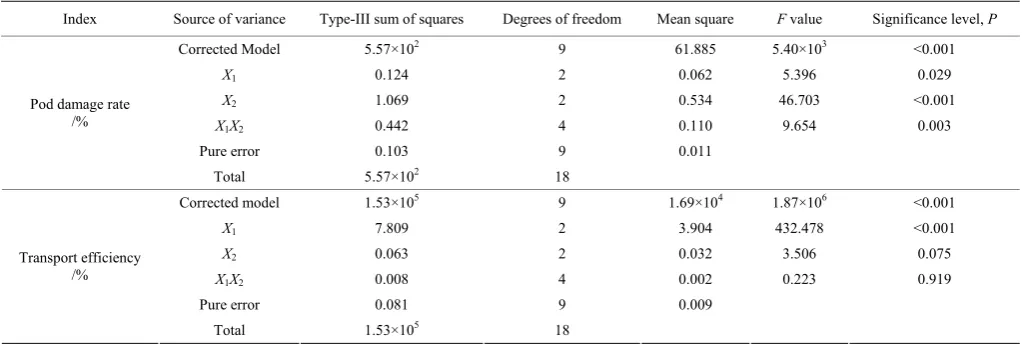
Analysis of variance (ANOVA) tests was performed on the experimental results using the SPSS 19.0 software suite[26-28], as shown in Table 5.
In Table 5, it is shown that the p-values of the ANOVA-corrected models for both evaluation indices are smaller than 0.05, which indicates that the models being used are statistically significant. In particular, the factors were found to significantly affect the pod damage rates with a descending order as thickness of the cushioning/anti-obstruction layer, fan speed, and the interaction between thickness of the cushioning/anti-obstruction layer and fan speed. Only the fan speed was found to have a statistically significant impact on the transport efficiency.
Table 5 ANOVA test on evaluation indices
Index Source of variance Type-III sum of squares Degrees of freedom Mean square F value Significance level, P
Corrected Model 5.57×10² 9 61.885 5.40×10³ <0.001
X1 0.124 2 0.062 5.396 0.029
X2 1.069 2 0.534 46.703 <0.001
X1X2 0.442 4 0.110 9.654 0.003
Pure error 0.103 9 0.011
Pod damage rate /%
Total 5.57×10² 18
Corrected model 1.53×10⁵ 9 1.69×10⁴ 1.87×10⁶ <0.001
X1 7.809 2 3.904 432.478 <0.001
X2 0.063 2 0.032 3.506 0.075
X1X2 0.008 4 0.002 0.223 0.919
Pure error 0.081 9 0.009
Transport efficiency /%
Total 1.53×10⁵ 18
To optimize both evaluation indices, it is necessary to perform pairwise comparisons between the levels of each factor in order to examine the significance of these levels with respect to the evaluation indices. The results of this comparison are listed in Table 6.
Table 6 Multiple comparisons
Pod damage rate Transport efficiency Factor Factor level
Std. Error Sig. Std. Error Sig. 2 0.062 0.603 0.055 0.000 1
3 0.062 0.013 0.055 0.000 1 0.062 0.603 0.055 0.000 2
3 0.062 0.032 0.055 0.000 1 0.062 0.013 0.055 0.000 Fan speed
3
2 0.062 0.032 0.055 0.000 2 0.062 0.000 0.055 0.179 1
3 0.062 0.000 0.055 0.027 1 0.062 0.000 0.055 0.179 2
3 0.062 0.004 0.055 0.266 1 0.062 0.000 0.055 0.027 Thickness of
cushioning/ anti-obstruction
layer
3
2 0.062 0.004 0.055 0.266 In Table 6, it is shown that the pod damage rates were significantly different between fan speeds of 2600 r/min and 2800 r/min, but insignificantly different between fan speeds of 2600 r/min and 2700 r/min. The transport efficiency was significantly different at all fan speeds. The pod damage rates were significantly different for all cushioning/anti-obstruction layer thicknesses. However, a significant difference in transport
efficiency was observed only between thicknesses of 4 mm and 6 mm.
5.3.2 Trends of evaluation indices with respect to each factor, and selection of optimal combination of parameters
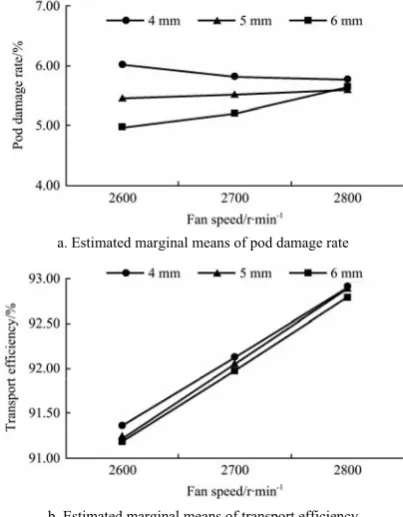
1) Trends of evaluation indices with respect to each factor The trends of the evaluation indices with respect to the fan speed, thickness of the cushioning/anti-obstruction layer, and interaction between these factors may be clarified by plotting the mean experimental values of the evaluation indices against each factor. Figure 4 and Table 7 show the mean values of each evaluation index in each experiment.
In Figure 4a, it is shown that the pod damage rates decrease significantly with increases in the thickness of the cushioning/anti-obstruction layer. As the fan speed increases, the pod damage rates gradually decrease, and the effects of the cushioning/anti-obstruction layer’s thickness on the pod damage rates also become less pronounced. At 2800 r/min, the thickness of the cushioning/anti-obstruction layer had no effect on the pod damage rates. The plots are not parallel to each other, implying that the fan speed and thickness of the cushioning/obstruction layer interact significantly in terms of the pod damage rates. This is consistent with the analysis of the results listed in Table 5.
between the fan speed and the thickness of the cushioning/ anti-obstruction layer in terms of the transport efficiency. This is consistent with the analysis of the results in Table 5.
a. Estimated marginal means of pod damage rate
b. Estimated marginal means of transport efficiency Figure 4 Effects of each factor on evaluation indices
Table 7 Mean experimental value of each evaluation index, and analysis for obtaining optimal combination of parameters
Mean experimental values of evaluation indices No.
Fan speed
X1
Thickness of cushioning/ anti-obstruction
layer X2 efficiency Transport Y 1/%
Damage rate of peanut Y2/%
Overall score
1 1 1 91.36 6.02 0.03
2 1 2 91.22 5.45 0.39
3 1 3 91.18 4.97 0.70
4 2 1 92.13 5.82 0.30
5 2 2 92.05 5.51 0.49
6 2 3 91.98 5.21 0.68
7 3 1 92.91 5.77 0.47
8 3 2 92.89 5.59 0.58
9 3 3 92.80 5.65 0.53
2) Selection of optimal combination of parameters
Table 7 shows that the optimal combination of factors to minimize the pod damage rate is X1X3, whereas the optimal combination of parameters to maximize the transport efficiency is
X3X1. Since the pod damage rates should be minimized while the transport efficiency should be maximized, the selection of the optimal combination of parameters should be treated as a factorial experiment.
A fuzzy comprehensive evaluation was used to calculate the final score of each combination; the combination that gives the highest score is the optimal experimental design (combination of parameters) that optimizes each evaluation index. Based on practical experience and actual analyses, the total score was set to 1, and the weights for the pod damage rate and transport efficiency were set to 0.7 and 0.3, respectively. The overall scores calculated using the methods of Du et al. are shown in Table 7[29].
Based on a comprehensive evaluation of the experimental results listed in Table 7, a fan speed of 2600 r/min and
cushioning/anti-obstruction layer thickness of 6 mm gave the highest score. This combination resulted in a pod damage rate of 4.97% and transport efficiency of 91.18%. The second highest scoring combination was a fan speed of 2700 r/min and cushioning/anti-obstruction layer thickness of 6 mm. This combination resulted in a pod damage rate of 5.21% and transport efficiency of 91.98%, thus improving the transport efficiency with a slight increase in the pod damage rate.
Based on the previously described experiments, it is known that the pod damage rates are significantly affected by the fan speed, the thickness of the cushioning/anti-obstruction layer, and the interaction between these factors. In general, if interactions between factors have a significant impact on an evaluation index, then the optimal combination of levels can be directly obtained from a multiple comparison of factor-level combination means (i.e., Table 6). In Table 6, it is shown that fan speeds of 2600 r/min and 2700 r/min are not significantly different in terms of the pod damage rate. Hence, a fan speed of 2700 r/min and cushioning/ anti-obstruction layer thickness of 6 mm were ultimately selected for the optimal experimental design.
5.3.3 Verification experiment
Based on the above results and optimizations that were made to the separator bowl, air supply duct, and conveying duct of the pneumatic peanut pod conveyor, a full factorial verification experiment was conducted using Baisha peanuts with a moisture content of 7.24% as the test material. The optimal combination of parameters was used with a fan speed of 2700 r/min and thickness of the cushioning/anti-obstruction layer of 6 mm. The pod damage rate and transport efficiency were used as evaluation indices for the full factorial experiment (Figure 5).
Figure 5 Verification experiment and sampling
The experimental results show that a pod damage rate of 5.19% and transport efficiency of 92.03% were achieved using the optimal parameters after optimizing the pneumatic peanut pod conveyor. The pod damage rate and transport efficiency obviously improved compared with the results before optimization under a fan speed of 2700 r/min, where the pod breakage rate was 5.51% and the transport efficiency was 89.12%.
6 Conclusions and discussion
(1) The critical speed of peanut pods in a pneumatic transport process was analyzed, and the physical properties of peanut pods (angle of friction and coefficient of restitution) in various conditions were measured. It was found that the angle of friction and coefficient of restitution of peanut pods with a moisture content of 7.24% differ significantly for steel, rubber, silica gel, and Teflon tape. In particular, the angle of friction of peanut pods was lowest on Teflon tape at 22.78º.
improving the operational efficiency. The coefficient of restitution of peanut pods was found to be smaller with rubber (0.19) than with steel (0.39). This indicates that the rubber has the best cushioning effect between the investigated materials, and it can be used as a cushioning material to reduce the incidence of pod damage during pneumatic transport processes.
(2) Based on the angle of friction and the coefficient of restitution of peanut pods on a variety of material surfaces, highly cost-effective high-elasticity rubber cushions were installed on the inner walls of the separator bowl and the conveying duct in locations where pod damage frequently occurs. Thin, wear-resistant, and smooth Teflon tape was then affixed to the high-elasticity rubber cushions to act as an anti-obstruction layer. This reduces the pod damage rates of pneumatic transport processes, and also increases the transport efficiency.
(3) Optimization and improvements were made to the key components of the pneumatic peanut pod conveyor, i.e., the air supply duct and conveying duct. The air inlet of the air supply duct was extended to a point below the feed inlet, which prevented materials from entering or clogging the air inlet and thus improved the transport efficiency. A material receiving plate was installed below the conveying duct, which ensured that the airflow in the air outlet was always smooth and flowing. The material receiving plate also prevented the duct from being clogged by excessive one-off discharges of material. A cushioning/anti-obstruction layer was also installed on the material receiving plate to reduce pod damage.
(4) By conducting a factorial experiment, it was found that the pod damage rates and transport efficiency increase with increasing fan speed, while increases in the thickness of the cushioning/anti-obstruction layer decrease the pod damage rates and transport efficiency. The pod damage rates are significantly affected by the fan speed, thickness of the cushioning/anti-obstruction layer, and interaction between these factors, whereas the transport efficiency is only significantly affected by the fan speed. Combined with the machine verification test, after optimizing the test bed, for Baisha peanuts with a pod moisture content of 7.24%, it was found that the transport efficiency was maximized at a fan speed of 2700 r/min and cushioning/anti-obstruction layer thickness of 6 mm. This combination of parameters resulted in a pod damage rate of 5.19% and transport efficiency of 92.03%.
Acknowledgements
This study is a special funding project of the Chinese Academy of Agricultural Sciences basic research business fee special, national modern agricultural peanut industrial technology system construction (CARS-14-postharvest processing mechanical equipment), and primary processing equipment for major grain cash crops of the innovation project of the Chinese Academy of Agricultural Sciences.
[References]
[1] Wei H, Xie H X, Hu Z C, Yan J C, Liu M J, Xu H B. Parameter optimization and test of pneumatic conveying equipment for peanut pods. Transactions of the CSAE, 2016; 32(2): 6–12. (in Chinese)
[2] Lu Y G. Research on peanuts pressure pneumatic transmission technology and parameter optimization. Nantong University, 2016. (in Chinese) [3] Zhang D G, Lu Y G, X H X. Overview and development of agriculture
particle pneumatic conveying technology. The Food Industry, 2016; 37(10): 200–203. (in Chinese)
[4] Xiang W B, Luo X W, Wang Y X, Xu Y J, Ou Z. Application of
pneumatic technology in agricultural engineering. Journal of Agricultural Mechanization Research, 2005; 20(4): 211–213. (in Chinese)
[5] Qin J W, Zhang X H, Jiang Z A, Liu J. Research on gas-based carrying technology and usage in agriculture. Agricultural Equipment & Technology, 2004; 3: 14–15. (in Chinese)
[6] Mangwandi C, Cheong Y S, Adams M J, Hounslow M J, Salman A D. The coefficient of restitution of different representative types of granules. Chemical Engineering Science, 2007; 62(1-2): 437–450.
[7] Gao X M, Hu Z C, Xie H X, Wang H O, Zhang H J. Experimental research on peanut sheller of blowing and knesding. Chinese Agricutural Mechanization, 2012; 4: 89–93, 27. (in Chinese)
[8] Yang J W, Zhang J L. Analysis of grain particles fragmentation factors when transporting in the pneumatic conveying system. Grain Storage, 2015; 2: 7–10, 51. (in Chinese)
[9] Naik V S, Veerapaga N, Rao S. Physical properties and milling characteristics of rice (oryza sativa L.). International Journal of Agriculture Sciences, 2016; 8(59): 3301–3305.
[10] Lv X L, Hu Z C, Yu Z Y, Shi X J. Experimental research on the geometerric dimensions and physical properties of peanut seeds. Journal of Yangzhou University (Agricultural and Life Science Edition), 2013; 3: 61–64. (in Chinese)
[11] Schwab C V. Apparent coefficient of friction of wheat on denim. Journal of Agricultural Safety & Health, 2017; 23 (3): 175–181.
[12] Singh K K, Goswami T K. Physical properties of cumin seed. Journal of Agricultural Engineering Research, 1996; 64(2): 93–98.
[13] Li J W, Ma Y H, Tong J, Ma Z C, Wang L D, Yu J T. Mechanical properties and microstructure of potato peels. International Journal of Food Properties, 2018; 21(1): 1395–1413.
[14] Wang B. Pod-picking mechanism and screening characteristic research for bottom-feeding four rows peanut combine harvester. Chinese Academy of Agricultural Sciences, 2018. (in Chinese)
[15] Zhou Z E. Agricultural material science. Beijing: Agricultural Publishing Press, 1994. (in Chinese)
[16] Wang C J, Li Y M, Ma L Z, Ma Z. Experimental study on measurement of restitution coefficient of wheat seeds in collision models. Transactions of the CSAE, 2012; 28(11): 274–278. (in Chinese)
[17] Huang X M, Li X T, Pan H B, Zong W Y, Chen H. Measurement and analysis of rapeseeds’ restitution coefficient in point-to-plate collision model. Transactions of the CSAE, 2014; 30(24): 22–29. (in Chinese) [18] Feng B, Sun W, Shi L R, Sun B G, Zhang T, Wu J M. Determination of
restitution coefficient of potato tubers collision in harvest and analysis of its influence factors. Transactions of the CSAE, 2017; 33(13): 50–57. (in Chinese)
[19] Yang M J, Yang L, Li Q D. Simple measurement of restitution coefficient of granular material and its application. Journal of Agricultural Mechanization Research, 2009; 24(10): 25–27. (in Chinese)
[20] Marinack Jr M C, Musgrave R E, Higgs C F. Experimental investigations on the coefficient of restitution of single particles. Tribology Transactions, 2013; 56(4): 572–580.
[21] Varnamkhasti M G, Mobli H, Jafari A, Rafiee S, Heidarysoltanabadi M, Kheiralipour K. Some engineering properties of paddy (var. Sazandegi). International Journal of Agriculture & Biology, 2007; 9(5): 763–766. [22] Nalladurai K, Alagusundaram K. Effect of variety and moisture content
on the engineering properties of paddy and rice. Africa and Latin America, 2003; 34(2): 47–52.
[23] Gao L X, Du X, Zhang W, Liu M G, Liu X, Yang J. Double-roller peanut sheller with pneumatic circulating. Transactions of the CSAM, 2011; 42(10): 68–73. (in Chinese)
[24] Hu Z C. Key technology of mechanization of peanut production. Zhenjiang: Jiangsu University Press, 2017. (in Chinese)
[25] Chen K. Experiment design and analysis. Beijing: Tsinghua University Press, 2005. (in Chinese)
[26] Feng G S, Liu R, Lv Z T, Hu B. Statistical analysis and application of SPSS. Beijing:China Machine Press, 2011. (in Chinese)
[27] Pranav P K, Patel T, Singh K P. Development of database and mathematical models for predicting engine performance parameters using biodiesel. Int J of Agric & Biol Eng, 2017; 10(3): 121–129.
[28] Cao S F, Song C B, Shao J R, Bian K, Chen W, Yang Z F. Exogenous melatonin treatment increases chilling tolerance and induces defense response in harvested peach fruit during cold storage. Journal of Agricultural and Food Chemistry, 2016; 64(25): 5215–5222.