Iranian Journal of Language Teaching Research 1(2), (July, 2013) 1-35 1
* Corresponding author: University of South Florida, US Email address: [email protected]
© Urmia University Press
Urmia University
Idiomaticity is central to linguistic theory. Despite the pervasiveness of idioms in language, pedagogical articles in professional journals have yet to pay attention to the benefits of idiom instruction in the second language (SL) classroom. Addressing this concern, this article reports the results of an exploratory qualitative research study conducted with sixteen SL university instructors and two Language Program Directors (LPDs) at two large universities in the Southwest (United States of America) that explored teachers’ own knowledge and theories about SL idiomaticity. Survey and interview data indicate that university instructors and LPDs share beliefs and assumptions about how best to teach idioms and assess students’ knowledge of SL idiomaticity. It was concluded that both university instructors and LPDs have an important role to play in the development of idiom pedagogy and that such pedagogy can be greatly enhanced through action research. Recommendations are included for further study of the issues surrounding SL idiomaticity, and teaching implications are considered for the development of meaningful pedagogical practices suitable for the promotion of idiomatic learning.
Keywords: SL idiomaticity and idiomatic competence; knowledge about language; beliefs and assumptions concerning SL idiomaticity; qualitative research; professional development and action research; reconstruction of a new public theory; linguistic and cultural training; development of idiom theory and pedagogy
© Urmia University Press
Received:
22 Dec. 2012
Revised version received:
24 Apr. 2013
Accepted:
27 Apr. 2013
Available online:
15 May 2013
Educating educators about second language idiomaticity
through action research
John I. Liontas
a, *a
University of South Florida, US
A B S T R A C T
A R T I C L E S U M M A R Y
Content list available at www.urmia.ac.ir/ijltr
Iranian Journal
of
2 John I. Liontas/Educationg educators about ….
The set of possible meanings of any given word is the
set of possible feelings, images, ideas, concepts,
thoughts, and inferences that a person might produce
when that word is heard and processed.
—Glucksberg and Danks (1975, p.50)
Introduction
For nearly a decade, there has been a change in emphasis in the professional preparation of (both accredited and experienced) second language (SL) teachers. Nearly all departments of second and foreign languages have been allocating more funds to teacher preparation, and even more to professional development and action research (i.e., research concerning one‘s own beliefs and assumptions about teaching, including students‘ learning). This change in emphasis within the organization of language teacher education programs has been so great that many departments now vigorously search for second language acquisition (SLA) specialists and applied linguists to spearhead the change in emphasis from teacher learning and teacher knowledge to action research (Allwright, 2003, 2006; Bailey & Nunan, 1996; Freeman & Richards, 1996; Woods, 1996). A quick glance at the MLA Job List alone will attest to this new emphasis. Frequently, SLA specialists are called upon to teach knowledge about language (KAL) courses; that is, courses in such things as Teaching Methodology, SLA Theory and Practice, SL Reading and Writing, Curriculum Program and Design, and Multimedia-Based Technology Learning. Despite this situation, however, few studies have investigated teachers‘ KAL and even fewer have shown KAL instruction to inform teachers‘ practices effectively (Andrews, 1997; Borg, 1998, 1999; Johnson, 1996; Morris, 1999; Pennington & Richards, 1997). In the area of SL idiomaticity, action research per se is nonexistent, although SL idiomaticity is an area of significant linguistic and cultural inquiry.
This study addresses this gap. It was anchored in the belief that idioms can and should be taught in the beginning phases of language instruction. Accordingly, it mapped out the underlying beliefs and assumptions of SL university instructors (i.e., teaching assistants, pre- and in-service teachers, professional specialists, and lecturers) and Language Program Directors (LPDs) regarding the place of idioms in the academic language curriculum. A further aim of this study was to document the professional training that university instructors in language-teacher education programs receive regarding SL idiomaticity. It was predicted that the findings would show that both university instructors and LPDs have very specific beliefs and assumptions about how best to teach idioms and assess their students‘ knowledge of SL idiomaticity. It was thought that their personal theories and knowledge bases shape how they organize, plan, and develop frameworks for thinking about and analyzing idiomatic input.
Iranian Journal of Language Teaching Research 1(2), (July, 2013) 1-35 3 The Study
Research Questions and Objectives
This study investigated the personal beliefs of SL university instructors and LPDs about the nature of idiom understanding (i.e., the process of comprehending and interpreting idioms) in second languages, and the importance of teaching idioms to SL learners. It sought to examine teachers‘ knowledge of SL idiomaticity and of the dynamics of idiom instruction both from the
emic (insiders‘) and the etic (the researcher‘s external) perspectives. To cite Johnson (1992), ―[A] high-quality analysis, whether quantitative, qualitative, or both, is one that (1) identifies important variables, issues, or themes; (2) discovers how these pattern and interrelate in the bounded system; (3) explains how these interrelationships influence the phenomena under study; and (4) offers fresh new insights‖ (p. 90). These were precisely the specific aims of this study. The following research questions guided this study:
1. Do SL teachers have private theories and knowledge bases regarding matters of idiomaticity (e.g., their role in teaching idioms, the students‘ role in learning idioms, the techniques used in idiom instruction)?
2. Are idioms treated systematically in the SL classroom and across the academic language curriculum?
3. Do LPDs include aspects of idiomaticity in the training and professional development of their SL teachers?
4. On what theoretical constructs do LPDs and SL teachers base their idiom-learning practices? In other words, what approaches, techniques, and/or (reference) materials are used toward developing students‘ knowledge of idiomaticity?
5. What knowledge and skills must LPDs and SL teachers have in order to promote idiomaticity effectively in the SL classroom?
Data Collection and Analysis
The data consists of qualitative case studies of 16 SL university instructors and 2 LPDs. Data was first collected using a survey (18 participants), and then a series of semi-structured interviews (3 participants). The aim of the Foreign/Second Language Idioms Survey was to ascertain to what extent SL university instructors and LPDs in general value the inclusion of idioms in their language curricula, their predisposition toward students‘ idiom acquisition in the language classroom, and the kinds of idioms they think should be taught in class (plus rationales and methods for such teaching). As Johnson (1992) states, ―Surveys, then, can be particularly useful for capturing the essence of trends and are useful for planning‖ (p. 128) because they can ―tackle questions dealing with representativeness‖ (Fetterman, 1989, p. 65).
4 John I. Liontas/Educationg educators about ….
university instructorsreceive with regard to reorganizing their own KAL and conceptions of SL idiomaticity. In the words of Fetterman (1989), ―The interview is the ethnographer‘s most important data gathering technique. Interviews explain and put into larger context what the ethnographer sees and experiences‖ (p. 47), and ―Ethnographers use interviews to help classify and organize an individual‘s perception of reality‖ (p. 50). If Fetterman is correct in his line of reasoning that the ―perception of reality is more important than so-called objective reality in shaping behavior‖ (p. 72), then the insights (i.e., ―perceptions of realities‖) obtained from this study could significantly shape future research and idiom pedagogy.
Data from both surveys and interviews (audiotaped and transcribed) was classified according to general emerging themes and then analyzed inductively for consistency regarding goals that are common among seasoned and less-seasoned SL teachers (Davis, 1995; Seidman, 1991; Stake, 1995). General emerging themes from the follow-up interviews were also used to triangulate and supplement understanding of the issues at hand. According to Fetterman (1989), ―Triangulation is basic in ethnographic research. It is at the heart of ethnographic validity, testing one source of information against another to strip away alternative explanations and prove a hypothesis‖ (p. 89) and, furthermore, that ―Triangulation works with any topic, in any setting, and on any level… the trick is to compare comparable items and levels during analysis‖ (p. 90).
The Foreign/Second Language Idioms Survey
Following a brief pilot test of survey question clarity, relevance, length, and format, a total of 137 surveys were recently distributed to the Departments of English, German, Spanish, Portuguese, Italian, Russian, and Bulgarian at a large university in the Southwest (United States of America) after obtaining the necessary permission from each department‘s chair. (See Appendix A for the complete questionnaire.) The surveys were distributed to first-, second-, and third-year ESL and SL university instructors, who were asked to provide their best answers based on their best judgment and accumulated language-teaching experience. Respondents were given approximately two weeks to complete and return the survey. In addition, all respondents were assured that they would remain anonymous and that any information provided in the survey would be used for data collection purposes only. A total of 18 surveys were returned (a 13.13% response rate).
Survey Participant Profile
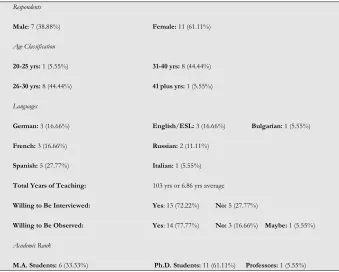
The respondents were 17 SL university instructors pursuing master‘s and doctoral degrees in English, ESL, and second and foreign languages at a large university in the Southwest (United States of America) and one professor of Russian and SLA. Of these, 39% (7) were male and 61% (11) were female. Thirty-three percent (6 participants) of the graduate students surveyed were working toward their M.A. degree, while 61.11% (11) were pursuing their doctoral degree. Participants‘ ages ranged from 20 to over 41 years: the majority (89% or 16 participants) were between 26 and 40 and only one person (5.55%) was between 20 and 25 years and another person (5.55%) was over 41 years.
Iranian Journal of Language Teaching Research 1(2), (July, 2013) 1-35 5 participants), however, indicated their willingness to be interviewed by the researcher on matters of SL idiomaticity (Question 13). Seventeen percent (3 participants) were unwilling to be observed in their classrooms, while 77.77% (14) were willing and only 5.55% (1) were unsure (Question 14). Table 1 presents a comprehensive profile of the eighteen respondents whose surveys were analyzed for general emerging themes.
Table 1
Foreign/Second Language Idioms Survey Profile
Respondents
Male: 7 (38.88%) Female: 11 (61.11%)
Age Classification
20-25 yrs: 1 (5.55%) 31-40 yrs: 8 (44.44%)
26-30 yrs: 8 (44.44%) 41 plus yrs: 1 (5.55%)
Languages
German: 3 (16.66%) English/ESL: 3 (16.66%) Bulgarian: 1 (5.55%)
French: 3 (16.66%) Russian: 2 (11.11%)
Spanish: 5 (27.77%) Italian: 1 (5.55%)
Total Years of Teaching: 103 yrs or 6.86 yrs average
Willing to Be Interviewed: Yes:13 (72.22%) No: 5 (27.77%)
Willingto Be Observed: Yes: 14 (77.77%) No: 3 (16.66%) Maybe: 1 (5.55%)
Academic Rank
M.A. Students: 6 (33.33%) Ph.D. Students: 11 (61.11%) Professors: 1 (5.55%)
Given the quantity of data provided by the Foreign/Second Language Idioms Survey, only a general overview of response types will be given in the section that follows. For purposes of representation, general comments of the group as a whole will be presented first before the individual responses of three participants are scrutinized in more depth in the Post-Survey Semi-Structured Interviews section.
Survey Responses
Muller-6 John I. Liontas/Educationg educators about ….
Schwefe, 1972, and Ricks, 1996.) As a result, without systematic idiom training, SL learners will translate the individual words of an L2 idiom into their respective L1, only to discover that the literal meaning cannot be entertained seriously. Nevertheless, one English instructor observed that ―Idioms aren‘t necessary for daily communication! When a co-conversationalist uses an unknown idiom, a [sic] L2 learner can always ask for clarification (except when reading, I suppose). So, it‘s more important to teach basic vocabulary and grammar first.‖ Similarly, a Spanish instructor noted that ―[Idioms] are important, but not as important as using other grammatically correct structures.‖
With the exception of one German instructor, who displayed a neutral attitude toward teaching idioms in beginning and intermediate language classes (―I don‘t regard them as much less or more important than most other aspects of the language.‖), the remaining 15 (83.33%) respondents welcomed the teaching and learning of idioms in the SL classroom. One German instructor noted, ―If they are an inherent part of speech, then it is important for someone to learn them in order to adapt to the culture.‖ A Russian instructor observed that ―I think it is very important to teach idioms to learners because native speakers use them a lot in their speech which may constitute a break of communication when learners are in contact with native speakers. It is also important to teach idioms in context.‖ Similarly, one ESL instructor commented that ―[Idioms] may provide cultural competence prior to active understanding,‖ while another stressed that―[Idioms] give students a greater sense of accomplishment to be able to use them fluently.‖
While some respondents noted the important role idioms play in everyday speech, others pointed out the frequent use of idioms by native speakers. Still others focused on the benefits that can be derived from learning idioms, including discourse enhancement (―I think teaching idioms can be justified because they add a degree of sophistication and color to one‘s discourse.‖) and development of strategic and cultural competence.
On a scale of 1 (lowest) to 5 (highest) in Question 7, participants‘ ratings of the importance of students acquiring idioms in the SL classroom ranged from a low of 2 (11.11% or 2 respondents) to a high of 5 (27.77% or 5 respondents). The majority of respondents, however, rated idioms between a 3 (27.77% or 5 respondents) and a 4 (33.33% or 6 respondents). The overall mean score was 3.77. The rationales behind their ratings are represented by the following quotes:
5- since one must learn both informal/formal and cultural aspects of language, teaching idioms is essential. It is part and parcel of a language system unique to each cultural group. To deny a language learner idioms is to not fully teach language.
5- because native speakers use them all the time. They are a common aspect of communication.
4- because native speakers use idioms on a constant basis—L2 learners must at least understand the nature of these conversations to fully participate… and understanding before production—hence 4.
Iranian Journal of Language Teaching Research 1(2), (July, 2013) 1-35 7 2- I think where students are most apt to need them (real-life outside the classroom)
is a richer source of input and meaning of idioms.
Regarding the kinds of idioms that should be taught in the SL classroom (Question 8), responses ranged from ―I really don‘t know. I guess that would depend on whether or not they appear in actual conversation frequently.‖ to ―All kinds—to give students the exposure.‖ The majority of respondents, however, indicated that they would teach the idioms most frequently used in a given target language. Consider the following representative comments:
Idioms used in everyday speech. Some idioms not used in everyday speech may be fun to teach or may demonstrate something unique about the language, but when focus is communicative competence, then they need to be commonly used.
Teach those most commonly used either in speech or writing. I guess I use frequency of occurrence as the yardstick.
The teacher should introduce idioms that occur frequently but which are not encountered in the course materials. Idioms the students may encounter in other materials may require teacher explanation.
I would try to choose high frequency idioms if one could come up with a data base for most commonly used idioms.
Respondents were less forthcoming and less sure, however, with respect to other reasons behind their selection of idioms to teach. Take, for example, the following answers:
It depends (for me) on the teaching situation and needs of the students. In an academic composition or reading course, literacy idioms are probably important. My (former) high school students often brought in questions about slang expressions.
It depends on the students and what they want to learn.
As for the role teachers need to play with regard to idiom instruction (Question 9), respondents‘ answers were grounded in well-accepted pedagogical practices and theoretical constructs about the development of SL idiomatic competence. Many of them saw the teacher‘s role as a ―facilitator,‖ ―motivator,‖ and ―communicator‖:
Teachers should both explicitly teach them and use them in class when interacting with students—this should be covered with in-depth and contextual information.
The teacher should introduce the concept and begin the acquisition process and encourage students to look out for idioms to bring to class for discussion.
8 John I. Liontas/Educationg educators about ….
Other respondents were concerned that the teaching of idioms had not yet been adequately addressed by their LPDs and felt unsure about how to proceed methodologically:
I am not sure. I would really have to do some serious research and give it more thought than I am prepared to do right now.
I really don‘t know. I guess that would depend on whether or not [idioms] appear in actual conversation frequently.
I don‘t know! I‘ve never done one [a teaching unit on idioms].
The final three open-ended survey questions (Questions 10, 11, and 12) in Part Two yielded responses that merit further scrutiny. Table 2 summarizes the most notable of these responses, categorized by four aspects of KAL and idiomaticity.
Table 2
Responses to Questions 10, 11, and 12
AREAS OF KAL AND IDIOMATICITY
Teaching and learning idioms in context.
Contextualized examples within students‘ schema. Using the dictionary and texts. I always use the gesture if one goes with the idiom. Students like this.
Sometimes comparing to an idiom in their 1st language is useful if they are somewhat similar.
Examine context closely—what place does the idiom have in the fuller picture. Examine content words in an idiom and what they might represent.
I do like to hypothesize the historical and/or semantic origins of the meaning of particular idioms. Personally I find it easier to remember the ―what,‖ if I have a ―why‖ to associate it with.
I would ask the students to each ask 3 NSs [native speakers] and to then report back to the class with examples from the NSs.
Perhaps a version of Celce-Murcia‘s contextual analysis, where students investigate by asking native/proficient speakers of the target language their own definition of target idioms (or situations in which they can be appropriately used).
Iranian Journal of Language Teaching Research 1(2), (July, 2013) 1-35 9 Empowering students to become responsible for their own idiomatic learning.
I would present a few examples of idioms and then ask students to collect some idioms they can find in daily life. I would make an idiom list in class and then work on contextualizing them within the course.
I would focus on specific situations that could be acted out, e.g., apologies, asking for favors, greetings, etc.
Guess at meanings in groups.
I would simply tell them to try to explore the meanings and connotations of individual words.
Enhancing idiom instruction with authentic audio, video, and print materials.
Books with illustrations as it will help them to remember. Drawing idioms ―out of a hat‖ and then students would role play and think of a situation as to when it will be used. Teaching it by coupling with similar idioms found in their 1st language.
Idioms should be taught in context through pictures and stories. Cartoons and comics are great for idiomatic expressions… a communicative approach with students, brainstorming in groups as to meaning.
Write down and ask about idioms s/he hears but can‘t make sense of. Practice using them.
I‘m very visually inclined, so I would use a lot of visual aids, video, pictures, etc. as part of my teaching objectives. For instance, by presenting authentic audio or video materials and get students to understand the deep meaning in context.
I would choose the appropriate approach, technique and materials on the basis of my students‘ level of the language and the available sources. The more variety of the above is presented, the better to accommodate students‘ individual differences and learning styles.
Curriculum Articulation
I think idioms are much better taught when integrated in other content.
Idioms need to be constantly incorporated throughout the course, otherwise it‘s an unnatural use of language.
10 John I. Liontas/Educationg educators about ….
(i.e., accommodation, adaptation, modification); (3) etymological associations; (4) community-based learning; (5) idiom collection; (6) role-plays and mnemonic devices; and, finally, (7) audio-, video-, and print-media based learning. Participants also indicated that SL students learn best if they figure out idioms for themselves (individually or in groups) and feel a sense of ownership of the language they produce. Empowering students to become responsible for their own idiomatic learning, by enabling students to develop a sense of belonging to a culture and helping them to gain a sense of accomplishment when learning idioms, is a common theme underlying respondents‘ notions of SL idiomaticity.
Furthermore, respondents see the development of SL idiomatic competence as involving more than simply learning the ―idiom code‖ (e.g., graphophonics, syntax, semantics, compositionality, etymology). It also involves the use of native speakers and authentic textual resources, especially when such resources are tailored to students‘ individual language knowledge, abilities, and interests.
Post-Survey Semi-Structured Interviews
Participation in the follow-up semi-structured interviews was voluntary. Three participants (2 SL university instructors and 1 LPD), who agreed to an interview with the researcher, were randomly chosen from the pool of 13 respondents willing to be interviewed. This sample is equivalent to 23% of the total population. Each of these three participants took part in a 60-minute interview session, which took place in the researcher‘s office. All questions were given in English and all participants were asked the same questions. Each individual session consisted of the following procedures:
1. Participant and researcher met at a mutually agreeable time in the researcher‘s office.
2. Researcher explained to participant the use of AIWA TP-M700 micro-cassette recorder and the operation of the microphone remote control. Recorder was equipped with an OLYMPUS XB60 microcassette for maximized recording (120 min @ 1.2 cm/sec).
3. Permission was sought from the participant to audiotape the session. All participants agreed to have their sessions audiotaped.
4. Equipment was checked for possible malfunctioning, and adjustments were made where needed.
5. At the end of the session the participant was thanked for his or her time and participation in this study. All recordings were then labeled for future identification and transcribed as a Word document for subsequent data analysis.
Interview Participants
Iranian Journal of Language Teaching Research 1(2), (July, 2013) 1-35 11 Lisa was teaching intermediate French courses while pursuing her M.A. in French at a large university in the Southwest. She hoped to be admitted upon graduation into the university‘s Ph.D. Program in SLA.
Theresa was in the Master‘s program in English-language linguistics at the same university as Lisa and was teaching beginning and intermediate Italian courses. Before that, she had taught ESL to elementary school students and also taught fifth grade. Upon graduation, she plannedto pursue an ESL teaching career overseas.
Grace1 was a professor of Russian and in charge of teacher preparation in Russian and Bulgarian at the same university as Lisa and Theresa. At the time of the interview, she was supervising six instructors and taught various SLA courses for the doctoral program.
The following are some representative points of view from these participants. Their responses to selected survey questions precede their follow-up interview comments in order to round their personal beliefs and assumptions. All quotes and other identifying details are used here with participants‘ explicit permission.
Survey Responses of Interviewees
Question 5: Idioms have been defined by researchers as formulaic speech, holophrases, prefabricated routines and patterns, lexical phrases, formulas, collocations and stock phrases, memorized sentences and lexicalized stems, and the like. How would you define idioms and why?
Teresa: Idioms are patterned routine utterances that are specific to a language or region. These are usually not readily understood by learners of the language as word-for-word translation would not yield the appropriate meaning.
Lisa: Phrases and expressions which are often culturally and linguistically specific to the language.
Theresa: Phrases that have meaning other than the literal meaning.
Grace: Idioms are in a sense grammaticalizations in that their meaning has become semantically fixed in specific collocations. I like this definition because it reflects both the development and current state of idioms.
Question 6: Do you think it is important to teach idioms? Why or why not?
Teresa: Yes! If a program‘s objective is to learn or teach language so that learners can function in an appropriate sociolinguistic context, idioms must be taught.
12 John I. Liontas/Educationg educators about ….
Lisa: Absolutely! They are a colorful aspect of the language and are important not only for the understanding of the TL (target language) culture but also in the practical understanding of native speakers, newspapers, advertisements, etc. which make use of the phrases and expressions.
Theresa: Yes! Conceptual fluency cannot be achieved without it—without conceptual fluency one cannot be truly fluent in the language.
Grace: Yes. Idioms are important not only for communicative function but also provide a window into the cultural mindset of native speakers.
Question 7: On a scale of 1 to 5 (with 1 being the least important and 5 the most important), how would you rate the importance of students acquiring idioms in the second language classroom? Please explain your rating.
Teresa: Rating of 3 because it would depend on the purpose and level of each course. If it were an advanced conversation course, I might select a rating between 4 and 5. In 101, it would be lower.
Lisa: Rating of 4 because I feel that it adds color to language learning, while also adding to cultural understanding. I think it is crucial to learn idioms in order to fully appreciate the TL, because they are in all facets of TL life. I would obviously tailor the difficulty level of the idioms to the level of my students.
Theresa: Rating of 5 because they are so important to understanding and communicating.
Grace: Rating of 3 because I think it is important but there should not be an overemphasis since there is already a lot of memorization involved in language study.
Question 8: Based on your pedagogical orientation and teaching experience, what kinds of idioms would you say should be taught and why?
Teresa: Idioms that would tend to come up in casual conversation or in writing that would come up in newspapers, ads, etc. And again, it would depend on the course.
Lisa: All kinds! I don‘t think that there should be a limit to the kinds of idioms that are presented. If they incorporate slang, the teacher simply needs to alert students to the appropriate time and place for their use (i.e., not in formal writing or formal speech).
Theresa: Idioms that go along with or might occur in the environment of a certain theme being taught.
Grace: Only the most common in the beginning but both colloquial and more formal idioms. The latter are often called ―turns of phrase.‖ Reason: Balance is what is required.
Question 9: What do you think the role of the teacher should be with regard to idioms and why?
Iranian Journal of Language Teaching Research 1(2), (July, 2013) 1-35 13 Lisa: (Teacher as facilitator) Present, allow students to guess (inductive approach), then either explain formally or have students explain their definitions before presenting a translation. I would like to design a classroom activity or two dealing with idioms as well.
Theresa: Constant supplier of authentic input—real idioms and contexts in which they are used.
Grace: The teacher should help students understand the cultural and (if possible) linguistic meaning of idioms. Otherwise, they are memorizing something with no real meaning.
Question 10: What do you think the role of the student should be with regard to idioms and why?
Teresa: To learn idioms introduced by the teacher and to find out what idioms mean that they come in contact with and to learn idioms they want to learn (likely these will be in comparison with the learner‘s native language).
Lisa: (Student as active learner) The students should use their own background knowledge to figure out what the idioms mean (if the teacher presents them). I am having my students use the idioms in a project that they are developing, so in this case, the students‘ role is to manipulate the idioms in a contextualized, communicative activity. I also would like to have the students go to the WEB or the library and locate idioms themselves. Teachers could have their students present the idioms to their peers.
Theresa: They should be eager to learn them and use them because they are so important.
Grace: They should learn them and try to incorporate them into their use of the language.
Question 11: If it was your job to teach a unit on idioms, what approach, techniques, and materials would you use to help your students and why?
Teresa: I would use a native speaker (as many as I could)!!! It would depend on the course! I might select some and work them into situations—conversational and in writing—so that students could use the idioms in situations they actually might come in contact some day. Interaction with native speakers (in conversation and/or writing—e-mail would also work) would serve as great feedback!
Lisa: Approach: Communicative activities, TPR [Total Physical Response] and gestures, paraphrase, contextualization to facilitate guessing. Materials: Book of idioms, song or text (newspaper) which incorporates idioms (realia), flash cards, overheads, visual aids, audio rendition of the idioms. Why? Students should see idioms in authentic contexts to realize their importance in TL.
Theresa: I would not just teach a unit—I would incorporate them into every theme or context/situation that I am teaching.
14 John I. Liontas/Educationg educators about ….
Question 12: How would you help your students “crack” the deep meaning of an opaque idiom and why?
Teresa: I would first ask NSs [native speakers] and NNSs [non-native speakers] who have learned a lot of idioms to find out how the NSs felt the meaning could be ―cracked‖ with NNSs to see how they succeeded (or didn‘t) in learning opaque idioms. From there, activities would be planned.
Lisa: If the deep meaning was linked to a culturally specific notion, I would prepare a pre-idiom activity (a la pre-listening) in which we would discuss the cultural phenomenon. If not specifically cultural (to the TL community in question), I guess I would attempt ―contextualized presentation and paraphrasing‖ (as mentioned above). I would reserve direct translation for the worst-case scenario because I want students to take responsibility for their own learning.
Theresa: Perhaps by relating it back to their L1—so that they can truly understand what the person wants to communicate.
Grace: I would use whatever I could to help them, since it will probably require a variety of approaches. However, if an idiom is truly opaque, I might just leave them to simply memorize it. I feel embarrassed since I‘ve never really thought about how I teach idioms before until I started talking to you!
Upon closer scrutiny of their answers, it becomes apparent that both LPDs (Teresa and Grace) and university instructors (Lisa and Theresa) agree that including idioms in the SL curriculum is important. Their answers (especially Theresa‘s and Lisa‘s responses to Questions 5 and 6) are often remarkably similar. There are, however, some notable differences when rating the importance of students‘ acquiring idioms in the SL classroom. Both LPDs gave the importance of idioms a 3 on a scale of 1 (lowest) to 5 (highest), whereas the two university instructors gave it ratings of 4 and 5. Another notable difference surrounds Question 8. While the two university instructors supported using a wide range of idiom types, both Teresa and Grace felt that a smaller variety of idioms should be taught, especially in the beginning phases of language instruction. In the post-survey interviews that followed with the first three interviewees here cited, the rationale behind their ratings and approaches to idiom instruction becomes clearer. Following Fetterman‘s (1989) advice, in order to ensure an adequate representation of the respondent‘s views, thick descriptions and verbatim quotations will be used in the remainder of this article instead of summaries. He states:
Verbatim quotations are … a sine qua non of ethnography. They are a permanent record of a person‘s thoughts and feelings. Verbatim quotations convey the fear, anger, frustration, exhilaration, and joy of a human being, and contain surface and deep, embedded meanings about a person‘s life…. Judicious use of such raw data in reports and ethnographies can provide the reader with sufficient data to determine whether the ethnographer‘s interpretations and conclusions are warranted. (pp. 115-116)
Interview Responses of Interviewees
Interviewer: Are you aware that you rated idioms a 4 out of 5 on your survey?
Iranian Journal of Language Teaching Research 1(2), (July, 2013) 1-35 15 excuse not to incorporate them. It‘s part of the language. It‘s just like teaching the subjunctive… it‘s just like teaching the present tense. And it‘s not a very complicated thing. There‘s just really no excuse for not teaching it.
Interviewer: I think that is very commendable on your part Lisa. Some survey respondents rated idioms a 2. They said that idioms are not important because you don‘t need them to communicate. You can just use words in order to describe something instead of an idiom. How would you respond to their thinking?
Lisa: I would almost like to do a manipulative thing on this person. I would want to bring in examples to this person, written, video, … I would like the person to see these and explain to me what it brings to the language. I mean, sure you could communicate with the words, but I can communicate with my hands, too, ... and facial expressions. I think that idioms are on a level of proficiency. If you want your students to have a minimal level of proficiency, then don‘t teach them these things. If you‘re willing to put in the extra effort though, I think it does add to conversation. I think it is a step above. I find using other discourse strategies equally important, but I don‘t see why you shouldn‘t allow students to discover the language fully.
Lisa‘s colleague, Theresa, had similar thoughts on the subject.
Interviewer: If you recall the survey, you rated idioms a 5 out of 5. Could you elaborate on this high rating?
Theresa: I think it‘s important because people use idioms constantly when they talk. You can learn all aspects of grammar, but real conversation, with real people, is different. Like, ―I‘m feeling blue.‖ If you don‘t know these kinds of expressions, you just can‘t be fluent in a language. It‘s not enough. I do think you need to learn grammar first, maybe you can learn idioms at the same time.
The responses of these two university instructors indicate their underlying belief regarding the importance of learning idioms in the SL classroom. Both Lisa and Theresa value the teaching of culture in the language classroom very highly and, furthermore, see the learning of idioms as a crucial step toward appreciating both the target language and the target culture. The interview with Theresa particularly revealed her underlying belief regarding the value of ―real communication‖ in another language, the pragmatic dimension of such communication, and the place of grammar and discourse strategies in the overall language curriculum.
Indeed, when asked the same question in the survey, participants responded in ways that enhanced the researcher‘s understanding of their ―perceptions of reality.‖ This rings particularly true when the reader considers the answers that interviewees gave to the questions concerning the subject of idiom importance and the need to teach idioms from day one:
Interviewer: Do you think that we, as language professionals, should encourage our teachers and students to learn idioms from day one, as they walk in?
Teresa: I don‘t know if from day one. I think that might be a little overwhelming. Especially because I think there are a lot of students who don‘t know what an idiom is. They might not even know that any exist in English. That might be something that would need to be addressed first.
16 John I. Liontas/Educationg educators about ….
Teresa: Some kind of phrase or a word used in a certain context that means something different than what the dictionary definition says. It might vary from region to region, or culture to culture with different dialects or whatever, but it doesn‘t mean what a dictionary says.
Interviewer: So, is there a cultural idiomatic variability from region to region and from culture to culture?
Teresa: Well, some idioms are included in dictionaries, but yeah that‘s not what it means, and a lot of times you need to understand the culture behind it to be able to understand what it means.
Interviewer: Speaking of culture, one of the respondents in the survey, which shall remain anonymous, said that idioms are not necessarily important to know because you can express the same idea using regular words. Do you agree?
Teresa: Not at all. Having lived in Germany, I guess it is true you can get around. The person who is speaking his second language can get around without that. But if you really want to understand what someone is saying… if they speak using idioms, you won‘t. I think you miss out on a lot of what they are trying to say. I still remember Germans explaining things to me. Different idioms that I think are great, and still, when I teach them now, I think about when I learned them and it kind of makes me happy.
Interviewer: Which idiom comes to your mind?
Teresa:Durch die Blume sprechen—that is one of my favorite ones because in English… [pause] I guess we would say it‘s like ―beating around the bush.‖ But ―speaking through the flowers?‖ You know? And the people said that to me and I thought: ―What does that mean?‖ After they explained it to me, I knew exactly what it was. We have a similar one in English so I could relate that.
Interviewer: So, context enhances idiom learning?
Teresa: Well, I think for context, a lot of the times, if it‘s that obvious, then people can figure them out, but see for me “Durch die Blume sprechen” I had no idea. Then when they [the German family with whom she was staying] said it, they made sense [long pause]. And then it‘s fun, because then I can use the idioms later too, and people think my German is pretty good. I think a lot of them [students] skip over it. Because we‘ve had a hard time at the university. It‘s probably the same everywhere. When people learn a new language and when they [students] start reading they want to understand word for word. We‘ve been trying to move away from that. Even though there are different approaches, they need to know every word to go on. It drives me crazy [makes a hand movement to indicate her frustration]. So now, they‘ve gone to the other extreme, where if they don‘t understand it, like if it is an idiomatic expression, they might skip over it. A lot of times, for pre-reading activities, if there are idioms, we‘ll discuss them first or after.
Interviewer: How do you explain idioms? Do you do the work? Do you let the students …. [interrupted]
Teresa: It depends. I‘ll ask them what they think the idiom means. We‘ll go through the words, we‘ll talk about them. Sometimes we‘ll look at the context of where it is.
Iranian Journal of Language Teaching Research 1(2), (July, 2013) 1-35 17 Teresa: I think context is extremely helpful. I also think that it sometimes requires more than just that. It may require explanations from different people.
Like Lisa and Theresa, the two university instructors, Teresa also stressed the point that understanding the culture behind idioms is important. Her notion of cultural idiomatic variability
(i.e., different micro-conventionalized denotations and connotations of words and phrases within different geographic regions and cultural groups) becomes central in her discussion of using idioms for everyday communication. Having lived in Germany for a long time, Teresa grounds her answer in her own experiences comprehending and using idioms with the very people who use them daily in intimate relationships (Bell, Buerkel-Rothfuss, & Gore, 1987; Hopper, Knapp, & Scott, 1981), in relationships of interpersonal solidarity in friends‘ relational cultures (Bell & Healey, 1992), and in topic termination/transition sequences in conversation (Drew & Holt, 1998) to mention some examples. Recounting her initial ―struggle‖ to understand the meaning of the idiom ―durch die Blume sprechen,‖ Teresa exposes not only her personal beliefs regarding the necessity of idioms for everyday communication, but she also reveals some of the shortcomings of the German language reading program (e.g., overreliance on graphophonics, heavy emphasis on translation and surface structure analysis, avoidance of idioms, and separation of idioms from communicative contexts) at her institution. She does so with a heightened degree of frustration, at which point both her posture and tone of voice change in a recognizable way. The spirit of her views is shared by the two language instructors, who both place importance on knowing idioms for pragmatic purposes.
From the interview with Theresa, the Italian instructor:
Interviewer: Would you suggest that idioms should be taught from Level 1 or after that level?
Theresa: I think they should be taught all along. I teach them from the first semester. I teach several expressions every day.
Interviewer: Speaking of teaching idioms in the classroom, how do you approach them on a regular basis?
Theresa: Each day I have 2 or 3 ―Expressions of the Day.‖ I put them into context. I also try to use idioms in situations that come up in class. The book teaches a few, but not enough.
Interviewer: Let‘s say I‘m a publisher, and I charge you with the responsibility of writing a new textbook for Italian. Knowing that idioms are an important subject to you, how would you organize the teaching of idioms in the textbook?
Theresa: I would prefer to do it thematically. Maybe, if each chapter was designed around a theme. Perhaps taking a train or going to the movies. Each chapter, I would have idioms that might come up.
Interviewer: Do you think the use of images would be helpful to the students?
Theresa: Yeah. Any kind of extra media that is added to the written is good.
18 John I. Liontas/Educationg educators about ….
Theresa: No, they seemed to enjoy them. Learning things they can use every day that are not in the text is fun for them. In fact, they use idioms the best whenever they have to do a skit. The problem is that they just don‘t get enough. The most difficulty they have is using them in their writing. I have found that they need more linguistic competence rather than more vocabulary.
Unlike Teresa, the German supervisor, Theresa appears to have no reservations teaching her students idioms on a daily basis, using context, thematic organization, imaging and media resources, role-plays, and the energy of her students as a guide. Upon closer examination of Theresa‘s ways of teaching idioms in the SL classroom, it becomes clear that her views and teaching techniques are shared by her French colleague Lisa but not by Teresa.
From the interview with Lisa, the French instructor:
Interviewer: How do you incorporate idioms into your classroom?
Lisa: I‘ve been isolating them, which I don‘t like, but I haven‘t found many materials which create a dialogue and show the idioms in the dialogue. I don‘t really have that, but lately I‘ve just been writing them on the board at the beginning of class and I‘ve asked the students to figure them out and try to comprehend whether it is cultural perhaps. We‘re also doing a video in which they have to do a news broadcast, or a dating game, or talk show, and I‘ve told them to use at least 1 proverb or idiom. I‘ve given them at least 20 or 30, and it‘s really interesting to see how they do.
Interviewer: That‘s very interesting stuff. I like the video idea especially. If I were to invite you into my department and ask you to give a workshop on idioms to returning language teachers and teaching assistants, do you have an idea about how you might structure it? Like a lesson plan?
Lisa: Off the top of my head … [pause] since I haven‘t really thought about this… [intense thinking] Since I like the communicative approach and like to use my students a lot, I would probably have everyone sit in little groups and give them a theme or scenario like: ―You friend just got into a new job and had this grueling interview process.‖ I would have to give them a scenario in which idioms were appropriate so I might have to tailor them a little bit. I‘d ask them to come up with idioms to describe the situation and then we would discuss why the idiom works and try to determine what an idiom is. How do they see these applied to their own lives? Do they see them in conversations or in newspapers? Where do they find them, and do they find them important? I would then give them some picture and tell them the idiom in French and ask them to tell what it means by looking at the picture. At the end, I would probably ask them to write their own dialogues in which they incorporate them. And maybe I‘d give them a list of resources that would help them incorporate them into their own classes. I think you can have the students do it, too.
Interviewer: Very nice Lisa. I think you‘re hired… [laughter] You mentioned that you would try to define an idiom with your students. Can you elaborate a bit on that? What‘s an idiom?
Iranian Journal of Language Teaching Research 1(2), (July, 2013) 1-35 19 Interviewer: If you had to write a French textbook, and you wanted to incorporate idioms, how would you go about it?
Lisa: I think as naturally as possible in an authentic text. I would search for texts that had them. I would put them in dialogues as authentically as possible. I‘d throw them into a vocabulary section… possibly an activity or two where you would match an idiom to a scenario.
Interviewer: How about the use of idioms?
Lisa: Absolutely!
Interviewer: Would you use that first, followed by the dialogue, or how would you do that?
Lisa: I think I‘d do variations. I think I‘d get bored doing the same thing. I think I‘d mix everything up. I think images are great. They will help the visually minded student. I think it‘s exciting to see how the words are put together to mean something totally different than what they mean separately.
Interviewer: That‘s what makes an idiom an idiom. You can only see it as a whole in order to capture its meaning. Is there anything else you would like to add?
Lisa: In my Master‘s exam, I said that it was really important to incorporate it into the tests as well. Because they need to realize it is part of the language and it is not something you can separate.
From the interview with Teresa, the German Supervisor:
Interviewer: Hypothetically speaking, if you had to write an article, or a chapter in a book, or do a mini- workshop on the pragmatic use of idioms, how would you structure the teaching of idioms?
Teresa: That‘s a really good question. I don‘t really know. I never thought about that. I think I would have to read about what‘s been said about teaching idioms and go from there.
Interviewer: Do you think it is important for students to acquire idioms while studying a second language?
Teresa: It depends if they‘re planning on interacting. Okay, we know ideally that the student will go to the target country and will interact with the other speakers, but if they don‘t, and a lot of them are in it to take their four semesters and be done, it‘s not as important for them. I don‘t think it is as important as it is for those who really want to integrate themselves into the target culture. I think that the higher the level is, the more important it is.
second-20 John I. Liontas/Educationg educators about ….
year students of French and Italian. Not only do they appear to have a knowledgeable approach to teaching idioms, but they also approach idioms in a fun and creative way by having their students create their own dialogues in which idioms taught could be incorporated. As Raz (1969) emphasized some three decades ago, student-created dialogs not only introduce new structures and idioms to the language student, but, even more importantly, involve the student emotionally and creatively.
In addition, the notion of ―authenticity,‖ much discussed in the literature of second and foreign languages as well as that from professional meetings (see, for example, García, 1991; Krashen, 1982; Liontas 1991a, 1991b, 1992; Liontas & Baginski, 1995; Moeller, 1990; Ono & Nyikos, 1992; Schulz, 1981), is central to their accounts of past teaching experiences, especially in Lisa‘s case. In response to the researcher‘s question regarding the writing of a French textbook that would incorporate idioms, Lisa uses such SLA concepts as naturalness and authenticity of language no less than three times in a very succinct response (5 sentences in all). It is worth noting that Lisa builds her own mental representations of effective teaching practices to ensure effective idiom learning. Her ability to activate her inert KAL and conceptions of SL idiomaticity leads to her willingness to question conventional ―structured lesson plans‖ (as she had stated earlier) that she had encountered in past teaching situations. In a similar vein, Theresa transfers her declarative research knowledge (i.e., general knowledge that can be explicitly stated) to her own teaching situation by remarking that what students need most is ―linguistic competence rather than more vocabulary.‖ The development of linguistic competence (including idiomatic competence) is well supported by research (Arnaud & Savignon, 1997; Canale & Swain, 1980; Cheng, 1985; Cook, 1993; Ellis, 1985, 1994; Irujo, 1986, 1993; Lafayette, 1988; Liontas, 1997, 1999; Nattinger & DeCarrico, 1992).
Without a doubt, issues of professional development and student idiom learning are closely linked together. One might even argue that one informs the other, and that one exists because of the other and vice versa. Notwithstanding the inherent link between the two, the following comments show that there is no systematic approach with regard to teaching idioms to SL learners. If teaching of idioms does take place, it does so sporadically, without clear goals, and with questionable results at best.
From the interview with Teresa, the German Supervisor:
Interviewer: How often do you meet with your TAs?
Teresa: Once a week.
Interviewer: What kinds of topics do you discuss?
Teresa: It depends on what the TAs feel that they need or if there is anything that has come up that needs to be discussed, then that‘s what we discuss. There is not a set pattern.
Interviewer: Have you already had a meeting this week?
Teresa: No, it‘s tomorrow.
Iranian Journal of Language Teaching Research 1(2), (July, 2013) 1-35 21 Teresa: Yes, it was professionalism.
Interviewer: Has the topic of idioms ever come up in discussions?
Teresa: Yes, it has.
Interviewer: How do you go about discussing them?
Teresa: It depends. All of the TAs have been teaching at least into their second semester, and we talked about it for the first time during their first month of teaching. We have some packets that have been made up by a professor at BYU [Brigham Young University] that have a lot of helpful things for Americans who are teaching German, and one of the sections is on idioms. There is no systematic approach to teaching idioms in our program to this point. We usually just go from those and it depends on what the TAs want to cover. It is pretty much up to them. There are also idioms that are in the books that we use, and there is a comprehensive vocabulary list at the end of each chapter: it will have nouns, verbs, and adjectives, but it will also have idioms. All of the idioms listed in the vocabulary list will have occurred in the chapter, so the TA has had to explain them at some point.
Interviewer: How do your students respond to idioms? Do they have difficulty grasping their meaning?
Teresa: A lot of them do and a lot of them are just like, ―Yeah, whatever.‖ But, if we keep bringing them up, then it helps them, and then they start thinking, ―Oh, I can see how that would be used here.‖ In fact, in one class I‘m teaching right now, it‘s the 202, I‘ve already taught the majority of the students because this is the fourth semester I‘ve taught them. So I know them pretty well and we have a lot of jokes and we have a lot of fun. It‘s a great class. And so when we learn idioms, they bring them up later. That happens all the time. And so they really like that.
From the interview with Lisa, the French instructor:
Interviewer: You have indicated in your survey that you are very interested in idioms, and that you often try to implement them in your lessons. When you talk to other TAs do they express a similar interest in teaching idioms?
Lisa: I haven‘t really addressed this topic with other TAs. I would be very interested in finding out what others do. I don‘t know if there is really a push for it. We‘ve never been trained or even given the idea in our orientations to incorporate phrases like idioms and proverbs.
Interviewer: Do you think TAs should be trained to teach idiomatic expressions and proverbs?
22 John I. Liontas/Educationg educators about ….
for the Italian and French departments to be so rigid by saying we‘re going to teach idioms, so you have to learn them.
From the interview with Theresa, the Italian instructor:
Interviewer: How many TAs are there in the French and Italian department?
Theresa: In the Italian there are six TAs. In the French there is something like twenty-five TAs.
Interviewer: It‘s a combined department, right?
Theresa: We are a combined department, but we have two language directors for both French and Italian.
Interviewer: Has the topic of idioms ever come up in the supervision of TAs?
Theresa: We don‘t really discuss, in detail, what we are teaching.
Interviewer: Do you think there is a need for language program directors to instruct you on how best to help your second language learners develop idiomatic competence?
Theresa: It could be helpful to mention some way to incorporate [idioms]into our teaching. Sure.
Interviewer: So, a systematic way to teach idioms in the classroom would be helpful?
Theresa: Yeah, I think so. If it was done right.
The fact that SL university instructors are offered ―no systematic approach to teaching idioms‖ (as Teresa attests) is disturbing. This is not to suggest that language instructors cannot or do not teach idioms adequately without being taught by their supervisors how to teach idioms in a contextual and pragmatic way. While some language teachers may perhaps view such help as an intrusion upon their own ways of teaching second languages and upon their classroom authority, others, such as Lisa and Theresa, including the three survey respondents who felt unsure about how to proceed methodologically, may indeed desire such guidance. Clearly, a systematic way to teach idioms in the SL classroom may be helpful to language instructors, provided, of course, that ―it was done right.‖ This assertion by Theresa, however, assumes that the SLA profession already knows what the best ways to teach idioms are. While several idiom-teaching proposals have already been suggested in the professional SLA literature (Burke, 1998; Cornell, 1999; Kabakchy, 1980; Lennon, 1998; May, 1979; Sugano, 1981), nevertheless, few of them are actually grounded in research findings with second or foreign language learners that can be replicated empirically. Therefore, any claims made need to be taken with caution pending future research. In the meantime, as Lisa points out, departments of Second and Foreign Languages do not have to become ―so rigid‖ as to mandate from above the teaching of idioms at all.
Iranian Journal of Language Teaching Research 1(2), (July, 2013) 1-35 23 everyday communicative interactions among native speakers. Moreover, idioms are ―very interesting [and] fun‖ as one Bulgarian instructor noted. To deny SL teachers a sound methodology for teaching idioms is thus to deny their students access to the most rewarding aspect of language study: a fascinating glimpse into the forms of thought unique to a particular language community. First- and second-year language textbooks in particular should make idiomatic forms of thought accessible. Here is what the three interviewees had to say on the subject of how their SL textbooks present idioms:
From the interview with Teresa, the German Supervisor:
Interviewer: Are you satisfied with the way the German textbook presents the idioms?
Teresa: Yes.
Interviewer: How is that usually done?
Teresa: It depends. It is usually in some kind of context. Usually in a cultural section, or in the video section, or in one of the listening comprehension sections.
From the interview with Lisa, the French instructor:
Interviewer: Are you aware if your French textbook uses idioms?
Lisa: Yes, it does.
Interviewer: Is it Level 1 or 2?
Lisa: Level 2. I would not automatically say that the 101-102 textbook did not. Not as frequently, but they are involved somewhat in the dialogue.
From the interview with Theresa, the Italian instructor:
Interviewer: How does the book teach the few idioms that it does teach?
Theresa: It presents them along with the theme. For example, weather and all of the things that go with that, like, ―It does cold,‖ rather than, ―It is cold.‖ It just doesn‘t talk about them enough!
24 John I. Liontas/Educationg educators about ….
use in both formal and informal settings are marks of sociolinguistic competence that make fuller treatment of idioms in SL textbooks and language curricula absolutely necessary.
Since SL idioms provide important insights into the customs, humor, and beliefs of a target culture, this researcher delved more deeply into interviewees‘ notions of idiom use by native speakers.
From the interview with Theresa, the Italian instructor:
Interviewer: Speaking of idiomatic competence, at the end of the preface in Barron’sGerman Idioms, Strutz [the author] says that you can tell one‘s competence by the way one uses, socially or culturally, the idioms. Do you agree with that?
Theresa: Yes. Because you can‘t just understand the vocabulary. You need to know how to use it in order to communicate.
Interviewer: There are some university instructors who say that there is no reason to teach idioms because you can always use regular vocabulary to express your thoughts. Do you agree with their position?
Theresa: No, because you can express yourself better with idioms. Second of all, natives use idioms all the time, and you won‘t be able to understand them if you don‘t know them.
Interviewer: So, there is a definite need to teach idioms?
Theresa: Yes. I think there‘s a need. It‘s easier to pick them up from communicating with native speakers, but I think teaching them will prepare you.
Interviewer: Speaking of teaching idioms, rumor has it that you and another colleague of yours are working on an idiomatic project that involves computers. Would you like to elaborate further on this undertaking?
Theresa: Yes, we are doing a small sample of a software program designed to teach Italian idioms and decided to do a thematic approach, such as food. We use images and pictures of the literal meaning and then you can see and hear how it is used in context. And then there is a test.
Interviewer: So, what you are saying is that there are three parts? The presentation, the practice, and the test?
Theresa: We don‘t have too much practice. I guess the practice is the listening to the context. I‘m not sure.
From the interview with Lisa, the French instructor:
Iranian Journal of Language Teaching Research 1(2), (July, 2013) 1-35 25 Lisa: I think it depends on what they define as idioms. I think if they are talking about elaborate phrases, you do have to be quite proficient.
The responses given above indicate that both university instructors place great value on accurate use of idioms and context for the comprehension and interpretation of idioms. The use of context for language learning, including the learning of idioms, is well supported by research (Ezell & Goldstein, 1992; Goodman, 1996; Levorato & Cacciari, 1992; Omaggio Hadley, 2001; Prabhu, 1987). Unfortunately, most empirical research to date has only involved first language learners, with studies by Abel (2003), Allen (1995), Bortfeld (2003), Charteris-Black (2002), Cieślicka (2002), Cooper (1999), Giora (1997), Irujo (1986, 1993), Liontas (1999, 2001, 2002a, 2002b, 2002c, 2002d, 2002e, 2003, 2007, 2008, 2009a, 2009b, 2013), Malt and Eiter (2004), Sprenger, Levelt, and Kempen (2006), and Vanlacker-Sidtis (2003) being notable exceptions. The notion of context (such as through multimedia computer software and artificial intelligence) for learning SL idioms requires more research in the years ahead (Liontas, 2009a). (For an account of theoretical and methodological approaches to phraseology, see Hallsteinsdóttir & Farø, 2006.)
In the interim, the insights gained from the post-survey interviews, when triangulated with the information revealed by the survey, offer some evidence showing that university instructors believe that developing SL students‘ idiomatic competence in the classroom is an important component of learning a second language. The LPD‘s and university instructors‘ comments highlighted in this exploratory qualitative research study indicate what kind of idioms they think should be taught in class, plus why and how they should be taught. In the words of Fetterman (1989), ―The level of understanding increases geometrically as the ethnographer moves up the conceptual ladder—mixing and matching patterns and building theory from the ground up‖ (p. 92; see also Berg, 1995, pp. 60-61).
As expected, both ethnographic instruments employed in this exploratory study—the
Foreign/Second Language Idioms Survey and the Post-Survey Semi-Structured Interviews—offered comprehensive information about the teaching of idioms and its place in the overall SL curriculum. The interview insights offered by the two university instructors and the one LPD shed much needed light on their private theories and knowledge bases regarding several matters of SL idiomaticity, including the assumptions behind idiom-learning practices, the value of learning idioms across the college-level language curriculum, and the instructional approaches taken (or envisaged) to analyze students‘ idiom acquisition patterns over time. Important information such as this did not come from the Foreign/Second Language Idioms Survey and would probably never have surfaced were the follow-up interviews not conducted. According to Merriam (1988),
An interview is a conversation—but a ―conversation with a purpose‖ (Webb and Webb, quoted in Burges, 1982, p. 107). In qualitative case study research, the main purpose of an interview is to obtain a special kind of information. The researcher wants to find out what is ―in and on someone else‘s mind.‖… Interviewing is necessary when we cannot observe behavior, feelings, or how people interpret the world around them…. In short, the decision to use interviewing … should be based on the kind of information needed and whether interviewing is the best way to get it. (p. 72)