http://www.sciencepublishinggroup.com/j/acm doi: 10.11648/j.acm.20170606.11
ISSN: 2328-5605 (Print); ISSN: 2328-5613 (Online)
Solving a Nonlinear Equation Using a New Two-Step
Derivative Free Iterative Methods
Alyauma Hajjah
Department of Informatics Technical, (Sekolah Tinggi Ilmu Komputer) STIKOM Pelita Indonesia, Pekanbaru, Indonesia
Email address:
To cite this article:
Alyauma Hajjah. Solving a Nonlinear Equation Using a New Two-Step Derivative Free Iterative Methods. Applied and Computational Mathematics. Vol. 6, No. 6, 2017, pp. 238-242. doi: 10.11648/j.acm.20170606.11
Received: August 8, 2017; Accepted: September 26, 2017; Published: November 7, 2017
Abstract:
In this paper, suggest anew two step iterative method for solving a nonlinear equation, which is derivative free by approximating a derivative in the iterative method by central difference with one parameter θ. The anew derivative free iterative method has a convergence of order four and computational cost the family requires three evaluations of functions per iteration. Numerical experiments show that the proposed a method is comparable to the existing method in terms of the number of iterations.Keywords:
Nonlinear Equation, Iterative Method, Derivative Free, Central Difference, Convergence of Order1. Introduction
Finding for a root of a nonlinear equations
( ) 0
f x = (1)
Where f: D ⊂R→R is most important problem in science and engineering. Analytical methods for solving such a equations are almost nonexistent and therefore it is only possible to obtain approximate solutions by relying on numerical techniques based on iteration procedures, so solving numerically becomes an alternative.
A numerical method used finding the solution of a nonlinear equation (1) is a one step iterative methods [1, 16], a two step iterative methods [4, 5, 7, 8, 12] and a three step iterative methods [2, 3, 9]. Some other paper have discuss about a two step iterative methods for solving a nonlinear equation, that is a methods proposed by Kingis call as King Method (KM), with convergence of order four and three evaluations of the function per iteration so it possesses 1.587 as the efficiency index, can express their formula as [12]:
( ) ( )
n
n n
n f x
y x
f x
= −
′ (2)
(
)
1
( ) ( ) ( )
( ) 2 ( ) ( )
n n n
n n
n n n
f x f y f y
x y
f x f y f x
+ = − + +ββ− ′ (3)
The other a two step iterative methods are is a combination of Newton method [1] and Helley method [16] with order of convergence three, in the form:
( ) ( )
n
n n
n f x
y x
f x
= −
′ (4)
(
)
(
)
1 2
2 ( ) '( )
2 '( ) ( ) "( )
n n
n n
n n n
f y f y
x y
f y f y f y
+ = − − (5)
The other a two step iterative methods are the iterative method proposed by Weerakon and Fernando [17], can express their formula as:
( ) ( )
n
n n
n f x
y x
f x
= −
′ (6)
1
2 ( ) '( ) '( )
n
n n
n n
f x
x y
f x f y
+ = − + (7)
Some other paper have discuss about a two step iterative methods free derivative for solving a nonlinear equation is a method proposed by Dehghan-Hajarian can be call as Dehghan Method (DM), with order of convergence three and four evaluations of the function per iteration, so it possesses 1.316 as the efficiency index, can express their formula as [5]:
2
2 ( )
( ( )) ( ( ))
n
n n
n n n n
f x
y x
f x f x f x f x
= −
+ − − (8)
(
)
2
1
2 ( ) ( ) ( )
( ( )) ( ( ))
n n n
n n
n n n n
f x f x f y
x y
f x f x f x f x
+
+ = −
+ − − (9)
and the one method proposed by Hajjah is call as Hajjah Method (HM), with order of convergence three and three evaluations of the function per iteration, so it possesses 1.442 as the efficiency index, can express their formula as [7]:
2
( )
( ( )) ( )
n
n n
n n n
f x
y x
f x f x f x
θ θ
= −
+ − (10)
1
( ) ( ) ( ) ( )
( ) ( 2) ( ) ( ( )) ( )
n n n n
n n
n n n n n
f x f y f x f y
x y
f x f y f x f x f x
+ = − + +ββ− θ+θ − (11)
Some other papers discuss the a two step type iterative methods for solving a nonlinear equation and their applications, these include in [4, 8, 10, 12]
In this paper will discuss a two step iterative method of proposed by King. This method is free from derivatives by approximating derivatives by central difference with one parameter
θ
. The new method is proved to be convergence of order four. Some examples are given to compare the new method with some benchmarked methods.2. Basic Definitions
In order to establish the order of convergence of the new derivative free methods, state some of the definitions:
Definition 1 (Order of Convergence). Let
α
∈ℜ , n=1,2,3,... then, the sequence{ }
xn is said to converge to α iflim n 0
n
x α
→∞ − =
If, in addition, there exists a constant c≥0, an integer
0
n ≥0, and p≥0 such that for all n≥n0,
1 ,
p
n n
x+ − ≤α c x −α (12)
Then
{ }
xn is said to converge to α with q-order at least p=2 or 3, the convergence is said to be q-quadratic or q-cubic, respectively [13].When en =xn−α is the error in the nth iterate, the relation
1
1 ( )
p p
n n n
e+ =ce +O e + , (13)
Is called the error of a equation. By substituting
n n
e =x −α for all n in any iterative method and after
simplifying, obtain the error equation for that method. The
value of p thus obtained is called the order of this method.
Definition 2 (Efficiency Index). Let r be the number of function evaluations of the new method. The efficiency of the new method is measured by the concept of efficiency index [6] and defined as:
r p,
where p is the order of the method.
Definition 3 (Computation Order of Convergence). Suppose that xn−1 , xn and xn+1 are three successive iterations closer to the root α of equation (1). Then the computational order of convergence [17] may be approximated by:
1
1
ln ( ) / ( ) ln ( ) / ( )
n n n n x x COC x x + − − − = − − α α
α α (14)
3. Proposed Methods
In this section will discussed twostep iterative method:
( ) ( ) n n n n f x y x f x = −
′ (15)
(
)
1
( ) ( ) ( )
( ) 2 ( ) ( )
n n n
n n
n n n
f x f y f y
x y
f x f y f x
+ = − + +ββ− ′ (16)
Use central difference with one parameter
θ
[1], to approximate f '(xn) in equation (15) and equation (16) by:(
( ))
( ( )) '( )( )
n n n n
n
n
f x f x f x f x
f x
f x
+ − −
≈
θ
θ
θ
(17)Substituting equation (17) into equation (15) and equation (16), can be change as:
2
2 ( )
( ( )) ( ( ))
n
n n
n n n n
f x
y x
f x f x f x f x
= −
+ − −
θ
θ θ (18)
1
( ) ( ) 2 ( ) ( )
( ) ( 2) ( ) ( ( )) ( ( ))
n n n n
n n
n n n n n n
f x f y f x f y
x y
f x f y f x f x f x f x
+ = − ++ββ− + θ − −θ (19)
Equation (18) and equation (19) are called Solving Nonlinear Equation Using A New Two Step Derivative Free Iterative Method.
sufficiently close to x* , then the new iterative method defined by equation (18) and equation (19) satisfies the following error equation:
(
3 2 2 3)
41 2 2 3 1 2 3 2 2
n n
e + = c −c c −θ F c c + βc e (20)
Where
( ) * *
1 *
1 ( )
'( ), , 1,
! '( )
j j
f x
F f x c j
j f x
= = > and en=xn−x*.
Proof. Let
x
* is be a simple root of f x( )=0 , then*
( ) 0
f x = and f x( n)≠0. Let en=xn−x*. With Taylor
expansion of f x( ) about xn =x* , can be obtain as following:
(
2 3 4)
51 2 3 4
( n) n n n n ( n)
f x =F e +c e +c e +c e +O e (21)
Where
( ) *
*
1 ( )
, 1. ! '( )
j
j
f x
c j
j f x
= >
Then, computing 2θf2(xn) using equation (21) then multiplied by2θ, can be obtain as following:
(
)
2 2 2 2 3 2 2 4 5
1 2 1 3 2 1
2θf (xn)= θ2 F en+ θ4 c F en+ θ + θ4 c 2 c F en+O e( n) (22)
Computing , can be get after simplifying:
2 2 2 3 2 2 2 2
1 1 2 1 1 2 1 2 3 1 3 1 2 1
(( n) ( n)) ( ) n ( 3 ) n ( 4 2
f x + θf x = F + θF e + c F + θF c + θ F c e + c F + θc F + θc F
3 4 2 2 3 2 3 3 4 5 3 4
3 1 2 2 1 3 3 1 ) n ( 4 1 4 1 3 2 3 1
c F c F c F e c F c F c c F
+θ + θ + θ + θ + + θ
3 4 2 2 2 3 2 3
4 1 2 3 1 4 1 2 3 1 4 1
4 c F 5 c c F 5 c F 8 c c F 6 c F
+ θ + θ + θ + θ + θ
2 3 3 4 5
2 1) n ( n)
c F e O e
+θ + (23)
Then, computing f((xn)− θf x( n)), can be have after simplifying:
2 2 2 3 2 2 2 2
1 1 2 1 1 2 1 2 3 1 3 1 2 1
(( n) ( n)) ( ) n ( 3 ) n ( 4 2
f x − θf x = F − θF e + c F − θF c + θ F c e + c F − θc F − θc F
3 4 2 2 3 2 3 3 4 5 3 4
3 1 2 2 1 3 3 1) n ( 4 1 4 1 3 2 3 1
c F c F c F e c F c F c c F
+θ + θ + θ + θ + − θ 3 4 2 2 2 3 2 3
4 1 2 3 1 4 1 2 3 1 4 1
4 c F 5 c c F 5 c F 8 c c F 6 c F
− θ − θ − θ + θ + θ
2 3 3 4 5
2 1) n ( n)
c F e O e
+θ + (24)
Using equation (23) and equation (24), compute f((xn)+ θf x( n))− f((xn)− θf x( n)). Then can be obtain after simplifying:
(( n) ( n)) (( n) ( n)) f x + θf x − f x − θf x
2 2 2 2 3 4 2 2 3 2
1 2 1 3 1 3 1 2 1 4 1
2 F en 6 c F en (8 c F 2 c F 4 c F )en (10 c F
= θ + θ + θ + θ + θ + θ 3 4 3 4 2 4 5
2 3 1 4 1 2 3 1
6 c c F 8 c F 10 c c F )en O e( n)
+ θ + θ + θ + (25)
Considering a geometric series and using equation (22) and equation (25) computing
2
2 ( )
(( ) ( )) (( ) ( ))
n
n n n n
f x
f x f x f x f x
θ
+ θ − + θ ,
can be obtain after simplifying:
2
2 2 2 2 3 2 2
2 2 3 3 1 2 3 1
2 ( )
(2 2 ) (
(( ) ( )) (( ) ( ))
n
n n n
n n n n
f x
e c e c c c F e c c F
f x f x f x f x
θ = − + − − θ + θ
+ θ − + θ
2 2 3 4 5
4 1 2 3 4 2
4 c F 7c c 3c 4c e) n O e( n).
− θ + − − + (26)
Then, substituting equation (26) into equation (18) and xn=x*+en, can obtain as following:
* 2 2 2 2 3 2 2 3 2 2
2 (2 3 3 1 2 2) (3 4 4 4 1 4 2 2 3 1
n n n
y =x +c e + c + θc F − c e + c + θc F + c − θ c c F −7c c e2 3) 4n+O e( n5) (27)
Applying Taylor expansion of f y( n) and using equation (27), can be obtain as following:
2 2 3 2 3 2 3 2 3
2 1 3 1 3 1 2 1 4 1 2 3 1 4 1
( n) n ( 2 2 ) n (4 3
f y =c F e + θ c F + c F − c F e + θc F − θ c c F + c F +5c F2 13 −7c c F e2 3 1) n4+O e( n5) (28)
From equation (19), by doing simple calculation for equation (21) and equation (28), end up with:
(
3 2 2 3)
41 2 2 3 1 2 3 2 2
n n
e + = c −c c − θ F c c + βc e (29)
From equation (29) can get that the new iterative method free derivative (PFDM) has four order of convergence. Thisends the proof.
4. Numerical Experiments
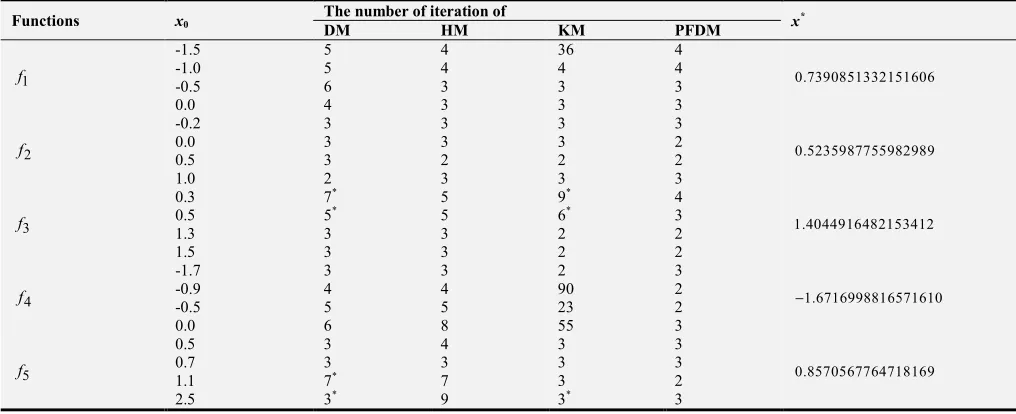
In this section will present five numerical examples, numerical simulation are performed in order to compare the number of iteration DM by equation (8) and equation (9), HM by equation (10) and equation (11), KM by equation (2) and equation (3) and PFDM by equation (18) and equation (19) for the solution of the nonlinear equation. In this comparison use the following test five functions:
1 cos( )
f = x −x,x*=0.7390851332151606 [10]
2 sin( ) 0.5
f = x − ,x*=0.5235987755982989[14, 15]
2 2
3 sin ( ) 1
f = x −x + ,x*=1.4044916482153412 [10]
3
4 3
f =x − +x ,x*= −1.6716998816571610 [14, 15]
5 tan( ) cos( ) 0.5
f = x − x − ,x*=0.8570567764718169 [14, 15]
All the computation is done in Maple 13, use tolerance is
15
1.0 10−
ε = × , and the maximum number of iteration allowed is100 iteration. Stop the iteration process by the following criteria:
1. xn+1−xn < ε,
2. f x( n+1) < ε.
Table 1. Comparisons of the discussed methods.
Functions x0 The number of iteration of x*
DM HM KM PFDM
1 f
-1.5 5 4 36 4
0.7390851332151606
-1.0 5 4 4 4
-0.5 6 3 3 3
0.0 4 3 3 3
2 f
-0.2 3 3 3 3
0.5235987755982989
0.0 3 3 3 2
0.5 3 2 2 2
1.0 2 3 3 3
3 f
0.3 7* 5 9* 4
1.4044916482153412
0.5 5* 5 6* 3
1.3 3 3 2 2
1.5 3 3 2 2
4 f
-1.7 3 3 2 3
1.6716998816571610
−
-0.9 4 4 90 2
-0.5 5 5 23 2
0.0 6 8 55 3
5 f
0.5 3 4 3 3
0.8570567764718169
0.7 3 3 3 3
1.1 7* 7 3 2
2.5 3* 9 3* 3
In Table 1, sign“*” on the number of iterations states that the methods converge to another root (not the same as the root). Based on numerical computations in Table 1, in general for all functions after comparison show that the PFDM is superior to the iteration methods such as DM, HM, and MK. This is evident from the number of iteration required to obtain an approximation of the root or solving a nonlinear equation.
5. Conclusion
Suggest and analyze a new two step iterative methods free derivative to solve a nonlinear equation. The new iterative method free derivative has four order of convergence and four evaluations of the function per iteration, so it possesses 1.414 as the efficiency index. Although the efficiency index of our method is worse than that of DM, KM and HM but numerical experiment show that it is comparable to the exiting method in terms of the number of iteration. So it can be state that the proposed method is superior in finding the success of roots from a nonlinear equation.
Acknowledgements
This work was supported by the Department of Informatics Technical STIKOM Pelita Indonesia. Also authors thanks to
Mr. M. Imran and M. D. H. Gamal the Department of Mathematics, University of Riau, Pekanbaru, Indonesia for their constant encouragement.
References
[1] K. E. Atkinson. Elementary Numerical Analysis, 2nd Ed. John Wiley, New York, 1993.
[2] M. S. M. Bahgat, and M. A. Hafiz, 2014. Three-Step Iterative Method with eighteenth order convergence for solving nonlinear equations, International Journal of Pure and Applied Mathematics. Vol.93, No.1, 85-94.
[3] W. Bi, H. Ren, and Q. Wu (2009). Three-step Iterative Methods with Eight-order Convergence for Solving Nonlinear Equations, Journal of Computation and Applied Mathmatics, 225, 105-112.
[4] A. Cordero, J. L. Hueso, E. Martinez, and J. R. Torregrosa, 2011. Steffensen type methods for solving nonlinear equations, Journal of Computational and Applied Mathematics, doi: 10.1016/j.cam. 2010.08.043.
[6] W. Gautschi, Numerical Analysis: an Introduction, Birkhauser, 1997.
[7] A. Hajjah, M. Imran and M. D. H. Gamal. A Two-Step Iterative Methods for Solving Nonlinear Equation, J. Applied Mathematics Sciences, Vol.8, 2014, No.161, 8021-8027. [8] M. Imran, Agusni, A. Karma, S. Putra. Two Step Methods
Without Employing Derivatives for Solving a Nonlinear Equation, Bulletin of Mathematics. Vol.04, 2012, No.01, 59-65.
[9] R. Intan, M. Imran, and M. D. H. Gamal. A Three-step Derivative Free Iterative Method for Solving a Nonlinear Equation, J. Applied Mathematics Scinces, Vol. 8, 2014, No. 89, 4425 – 4431.
[10] J. P. Jaiswal. A New Third-Order Derivative Free Method for Solving Equations, Univ. J. Appl. Math. Comput, 184 (2006), 471-475.
[11] K. Jisheng, L. Yetian and W. Xiuhui. A Composite
Fourth-Order Iterative Method for Solving, Appl. Math. 1 (2013), 131-135.
[12] R. F. King. A Family of Fourth Order Methods for Nonlinear Equations, SIAM J. Numer. Anal. 10 (1973), 876-879. [13] J. H. Mathews. Numerical Method for Mathematical Science
and Engineer, Prentice-Hall International, Upper Saddle River, NJ, 1987.
[14] D. Nerinckx and D. Haegenans. A Comparison of Non-linear Equation Solver, J. Comput. Appl. Math. 2 (1976), 145148. [15] J. R. Rice. A set of 74 test functions non-linear equation
solvers, Report Purdue University CSD TR 34 (1969). [16] R. Wait. The Numerical Solution of Algebraic Equation, Jhon
Wiley and Sons, New York, 1979.