Globalization and Self-Organization in the Knowledge-Based
Society
Christian Fuchs
Institute for Design and Technology Assessment, Vienna University of Technology Favoritenstr. 9-11, 1040 Vienna, Austria; [email protected]
Abstract: In this paper I suggest that a theory of self-organization can be used as a consistent background theory for explaining the dynamics and logics of globalization. Globalization is not confined to the human realm, it is an attribute of all complex, self-organizing systems. Globalization in a synchronous sense means a micro-macro-link where bottom-up-emergence of new qualities in the self-reproduction of complex systems takes place, it is accompanied by a macro-micro-link of top-down-localization. A dynamic interaction between a global and a local level (glocalization) results in the permanent overall self-reproduction of the system. Globalization in a diachronic sense means the emergence of a new, higher level of self-organization during a phase of instability and heavy fluctuations by order through fluctuation. Globalization is shaped by a dialectic of change and continuity: in the hierarchy that stems from emergent evolution there are both general aspects of globalization and aspects that are specific for each organizational level. Applying this general notion of globalization to society means that human globalization is both a general process that can be found in all societies and a specific process with emergent qualities in concrete phases of societal development. Globalization processes in modern society are based on structural antagonisms that result in uneven developments in the technosphere, the ecosphere, the
economy, polity, and culture. The transition to Postfordist, informational capitalism has been a consequence of the development of the structural antagonisms of Fordism and has been accompanied by a new phase of globalization that has transformed the subsystems of society and has resulted in new antagonism that are an expression of general antagonisms that shape modern societies. Hence we find antagonistic tendencies of contemporary globalization in all subsystems of society that result in both risks and opportunities. Human beings have the ability to actively shape society in such a way that an alternative sustainable form of globalization can be achieved.
Keywords: globalization, self-organization, society, knowledge-based society, informational capitalism, antagonism
Acknowledgement: This paper is based on research done within the framework of the project ‘Human Strategies in Complexity: Philosophical Foundations for a Theory of Evolutionary Systems’ (http://www.self-organization.org) funded by INTAS (#0298) and supported by the Austrian Federal Ministry of Education, Science and Culture.
1. Introduction1
In this paper I argue that globalization is an attribute of all complex, self-organizing systems and I point out major aspects of the globalization of the knowledge-based society. First, I will give an introduction to important methodological, epistemological, and ontological questions concerning theorizing globalization (section 2). I especially will consider existing literature that deals with the relationship of globalization and self-organization and will show that it doesn’t treat the topic in a sufficiently consistent and well-grounded manner. I will then consider the relationship of self-organization and globalization in more abstract terms
1 This paper is a theoretical expansion of ideas first developed together with Wolfgang Hofkirchner in a series of papers:
that apply for all complex systems in nature and society (section 3). Hence I will suggest that globalization is a process that doesn’t only take place in society, but also in nature. Based on this foundation it will be possible to describe the globalization of society in terms that apply to all forms of society (section 4). This will involve both a synchronous and a diachronic form of globalization. For considering globalization as an attribute of social self-organization, some foundations of a theory of social self-organization will be pointed out. The next step will be a discussion of globalization in modern, capitalist society (section 5). For doing so, general several antagonisms of modernity will be outlined. Based on these assumptions, the antagonistic relationship of globalization and knowledge-based society will be explained (section 6). I will end with a conclusion about agency in the global society (section 7).
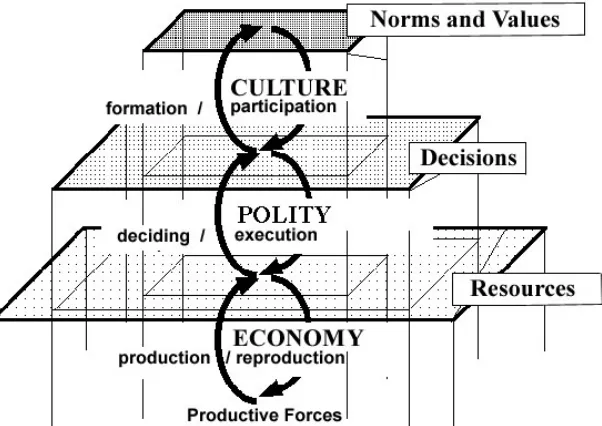
The structure of the sections 5 and 6 is based on assumptions about the structure of society. Society is made up by several interconnected, but relatively autonomous self-organizing subsystems (Fuchs 2002c, Fuchs/Hofkirchner/Klauninger 2002). The basic systems are the technosphere, the ecosphere, and the sociosphere. In the technosphere the human being makes use of tools as a means for achieving defined goals by transforming nature. In the ecosphere the human being transforms nature in order to organize natural resources in such a way that it can utilize these resources for its needs and goals. In the sociosphere the human being enters social relationships in order to make sense of the world, to give meaning to actions and existence, and to form individual and collective identities. The three realms – the technological, the ecological, and the social – are interconnected in the sense that in each situation in a social system human beings make use of tools, change their environment, and enter social relationships. The sociosphere can be further subdivided into three subsystems: the economy, polity, and culture (fig. 1). In the economic system the human beings make use of tools and natural resources in order to produce, distribute, allocate, and consume use-values that satisfy human needs. In the political system the human beings establish power structures in order to achieve collective decisions. In the cultural system the human being produces a set of norms and values that define living conditions and life-styles. Hence society consists of five interconnected self-organizing subsystems/levels: the ecological, the technological, the economic, the political, and the cultural realm.
Figure 1: The self-organization of the three interconnected subsystems of the sociosphere
Concerning the interconnections of different realms of society, Susantha Goonatilake (1997, 1998, 2002) argues that the “three lineages of information - the genetic, the cultural and the artefactual - will increasingly merge their constituent information contents through advances in biotechnology and information technology“ (ibid.: 715). He argues that historically first the genetic lineage, then the cultural, and finally the artefactual lineage, the latter in the form of computers, have emerged. I think that the three realms have been connected since the beginning of society because in each society we find the natural environment, human beings, and tools. The physical or natural information space is the oldest one, the living one has been produced as a result of the self-organization of matter, the social realm has been one result of the self-organization of living matter. Hence the historical sequence is physical, biological, social systems, the latter consists of human beings entering communicative relationships and in these relationships making use of tools in order to consciously and purposefully produce use values and change nature in a way that satisfies human needs. But Goonatilake is right in stressing that in the knowledge-based society, the genetic, the social, and the technological realm and their informational content increasingly merge as can be seen in the case of genetic engineering, the Humane Genome project, cyberspace, Virtual Reality. The interconnection and merging of all three realms as a dynamic unity indeed is a major dynamical force of globalization and hence a “future sociology must incorporate dynamics of all three realms“ (Goonatilake 1997: 724).
2. Epistemological and Ontological Aspects of Theorizing Globalization
There is much talk about globalization in the public, the media, and politics. For some globalization seems to be the ultimate remedy for the global problems we are facing today, for others it is a catchword for describing a phase of increased capitalistic exploitation. Globalization is a polarizing subject-matter, we find both radical optimists and radical pessimists in this discourse. The radical optimists argue that globalization is a new form of societal development that can only guarantee general wealth when the state retreats from social policy, the radical pessimists use the term globalization as a synonym for capitalism and argue that globalization should be reverted. Both positions are one-sided and don’t take the complexity of the emergence of a global information society into account. Globalization discourse is symptomatic for the increased complexity of society, the emergence of new discourses is characteristic for phases of rapid social change.
There is a lack of understanding of what globalization actually is, whether it is something new or something old, how its dynamics unfold, whether there is just one form or there are different alternative forms of globalization, and what its causal relationships are. A general theory of globalization seems to be necessary in order to answer these questions. This paper tries to introduce some foundations for such a theory and suggests that a general theory of globalization shall be based on a general theory of self-organization.
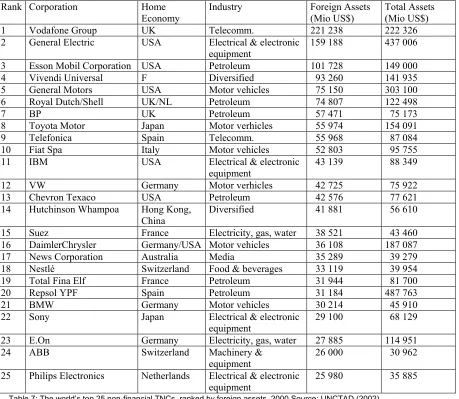
cables established in the middle of the 19th century that formed the first global system of communication2. Sceptics argue that globalization is a myth, that there are no fundamental novel qualities of society and that there is a continuity of an old social system. The sceptics say e.g. that what is called globalization today is just “a more extensive version of a much longer historical process” (Nicholson 1999: 31), a continuous historical expansion. The most well know globalization sceptics are Paul Hirst and Graham Thompson (1999). They argue that globalization is a myth because transnational companies would be rare, most would be based nationally and would trade multinationally; foreign direct investment (FDI) would be highly concentrated among the advanced industrial economies, the Third World would remain marginal both in investment and trade; trade, investment and financial flows wouldn’t be global, but concentrated in the Triad of Europe, Japan and North America.
Globalization is not an even process that affects and benefits all regions and groups to the same extent, it is highly uneven and segmented. Globalization “implies neither homogenisation nor equity” (Keohane/Nye 2000: 76). One of my main arguments in this paper is that globalization is indeed a tendency that can be found in all social systems and that hence it is nothing completely new, however we are today witnessing a new phase of globalization that results in new qualities of social systems. In order to speak of the existence of contemporary globalization, it is not necessary that all regions and groups are included or benefit from the current developments, the decisive factor is that their social situation and their lives are affected by these developments. The emergence of transnationalism e.g. doesn’t mean that all large companies are transformed into transnational corporations (TNCs), but that a new quality, a new tendency of capital accumulation is added that transforms the old situation. Besides TNCs there exist e.g. in the retail market “mainly regional MNEs [multinational enterprises] and their focus is local, home-triad market-oriented” (Rugman/Girod 2003: 24). However, this doesn’t imply that transnationalism as a new form of economic globalization is a myth3, it only shows that new tendencies don’t completely eliminate old ones.
Events in one part of the world today frequently shape social relationships in another far remote part of the world, there is a global scope of interdependence of social relationships. Today we find a massive increase of extensity, intensity, speed, and impacts of flows of resources, capital, commodities, information, technologies, people, lifestyles, and values, this quantitative increase has resulted in new qualities of societal development such as: global neoliberalism, a real-time interactive communication system that changes all areas of social life, a flexible regime of accumulation based on lean production and outsourcing, participatory management, strategic alliances and innovation networks, the network enterprise, competition states, the emergence of global governance that is based on complex relationships of nation states and private political actors such as NGOs and TNCs, the triadization of world trade and capital export, global mass media (such as the Internet and CNN), a new dimension of international conflicts (9/11, the two wars against Iraq, the “war against terror”, ethnic postcolonial and post-Soviet conflicts such as in Rwanda and former Yugoslavia, global problems that threaten the further existence of humankind, the shift from industrial society to global informational capitalism (i.e. the phenomenon and the important consequences of global flows of information) and along with it a bunch of new issues such as e-government, e-learning, electronic surveillance, etc. Hirst and Thompson consider (the non-existence of) globalization in quantitative terms, however it is not so relevant to compare the current phase of social development quantitatively with the phase of imperialistic development at the end of the 19th and the beginning of the 20th century, it is rather decisive to compare the new Postfordist mode
of capitalistic development with the post-war Fordist mode. If one does so, one will indeed find important quantitative changes that have resulted in new qualities of society. There is indeed a tendency to conceive globalization only in quantitative terms, e.g. Robert O. Keohane and Josep S. Nye Jr. (2000) argue in line
2 In 1864 a submarine cable was laid between Karachi and the Persian Gulf, in 1866 the first transatlantic submarine cable was laid
(it ran from Ireland to Newfoundland).
3 In e.g. the car industry, the electronics industry, or the textiles and clothing industries indeed a great deal of transnational
with Held et al. (1999) that contemporary globalization is characterised by a larger thickness, i.e. intensity and extensity of interdependence4: there are more flows that affect the lives more people to a larger extent. I argue that an equally important aspect is how these lives have been changed qualitatively. Hirst and Thompson (1999) say e.g. that “the startling feature is that trade to GDP ratios were consistently higher in 1913 than they were in 1973 (with the slight exception of Germany where they were near enough equal)” and that the expansion of the volume of world trade has since the 1970ies not been larger than in the period from 1870-1913. I will show later in this paper statistically that both world trade and capital export have in Postfordism increased in comparison to the Fordist era, that capital export mainly originates from OECD countries, that in the last decades Latin America and Asia have gained importance as targets of FDI, that the majority of imports and exports take place in North America and Europe, and that Asia has played an increasing important role in world trade during the last 50 years (due to Japan and the Southeast Asian countries), whereas Latin America and Africa have increasingly become more unimportant in world trade. These are both important quantitative and qualitative changes.
Another main problem besides the emphasis on long-term quantitative changes in Hirst and Thompson’s approach is that they consider globalization reductionistically as merely an economic process. I am arguing that a third kind of globalization theory is needed that considers a dialectic of change and continuity: there are general long-term patterns and tendencies of globalization that can be found in society (and indeed as I will argue in all self-organizing systems), but there are also qualities of globalization that are characteristic only for certain phases of systemic development. So globalization can be pictured as the unity of many long-term and short-term uneven processes that results in a step-like hierarchical emergent evolution where there are general patterns of globalization and localization as well as emergent qualities of globalization that arise as new order through fluctuation in phases of instability and constitute a new level and phase of development that has both novel qualities and is a continuation of older tendencies. One can say that globalization processes sublate (“aufheben”) themselves, develop in an uneven and asynchronous way and at each moment show both patterns of change and continuity.
The problem of globalization theory is that frequently one can find in it an “inversion of explanans and explanandum” (Rosenberg 2000), globalization is not considered as the explanandum that must be clarified within the framework of a more general theory, but it is seen as something that explains the world and the latter’s changes. Many globalization theories are “not terribly interested in discovering abstract principles of the observed realities” (Friedman 2000: 640). In order to avoid this mistake, I suggest that globalization is an attribute of self-organizing systems and that a theory of self-organization can serve as an adequate background theory for explaining globalization.
Explaining globalization is necessary for a foundation of a new worldview that allows the solution of the global problems. Wolfgang Hofkirchner (1994) argues that there are global problems that affect the whole humankind as an object and can only be solved by the whole humankind as subject. A new world order that can solve these planetary problems would need a new world picture as a foundation. Theories of self-organization would be suited for such a foundation because development would be their central aspect and a further step in development would be needed for solving the global problems. This further step would have to be an act of free self-determination of humankind and the creation of a noosphere where there is participation and awareness of all and the human being can develop into a homo creator in a creative universe.
The theory of self-organization has lead to a change of scientific paradigms: from the Newtonian paradigm to the approaches of complexity. There is a shift from predictability to non-predictability, from
4 “Globalism is a state of the world involving networks of interdependece at multi-continental distances. […] Globalization is the
order and stability to instability, chaos and dynamics; from certainty and determination to risk, ambiguity and uncertainty; from the control and steering to the self-organization of systems, from linearity to complexity and multidimensional causality; from reductionism to emergentism, from being to becoming and from fragmentation to interdisciplinarity. Self-organization theories seem to be particularly suited as a methodological foundation for a general theory of globalization because they have a strong emphasis on complexity, non-linearity, multidimensionality, ambiguity, and uncertainty, and societal globalization is inherently coupled with increased complexity and risks.
consistently, it is insufficient to argue either in a reductionistic or a relativistic manner, a dialectic of generality and specificity should be applied. Within a general theory of self-organization, the notion of emergent evolution can be applied in such a way that globalization can be conceived as both a general and a specific process with general as well as emergent, system-specific qualities. In short I am arguing that it is wrong to say that theories of globalization are either “monocausal” or “multicausal” (Held/McGrew/Goldblatt/Perraton 1999: 12) because there are many different uneven tendencies of globalization caused by different forces, but this difference does have a common ground. A dialectical theory of globalization tries to resolve this dichotomy.
Although globalization is a complex and multidimensional phenomenon, it can be the case that one subsystem of a global system is more influential than others and has a dominant position in the system. In the global information society, the economy has such a dominant character, the structural coupling between the economy and other subsystems of global society has an increasingly dense character, i.e. economic logic permeates other subsystems to an increasing extent (Fuchs 2003b). This doesn’t mean that the economy is a determining system, but that it is a dominant system (ibid.). Reductionist and relativistic analyses can’t take consistently into account the emergence of such a dominant logic. Hence Beck’s argument that Wallerstein’s theory of globalization is “monocausal and economic” (Beck 1997: 66) and Giddens’ argument that Wallerstein “continues to see only one dominant institutional nexus (capitalism) as responsible for modern transformations” (Giddens 1990: 69) don’t take into account that a certain subsystem of society can indeed acquire a dominant, but not determinant position and that such uneven relationships can nonetheless be explained within a theory that accounts for the multidimensionality and complexity of globalization as well as for the relative autonomy of social systems.
I agree with many Marxist analyses of globalization that the economy is a particularly important system involved in globalization that deserves special attention, that what is called globalization today results in increased polarization and fragility of society, that one must challenge “there is no alternative”-positions on globalization that argue that people can’t do anything about the global problems and simply have to adapt to and cope with the new global complexity and the problems it has produced, and that agency is a very important factor for establishing an alternative, democratic form of contemporary globalization. However, in many such analyses there are some assumptions that I don’t share:
• Globalization is a purely economic process: “In a sense one can say that such terms as globalization are simply codes for the retreat from Marxist notions like imperialism and a substitution of cultural and political issues for what is actually at stake in the changes taking place in the world – changes that are, above all, in the social relations of production” (Ebert 1999).
• Globalization is caused by capitalism and hence is a synonym for the expansion of class-based exploitation: “Globalization, I argue, is a struggle over the structured inequality in the world economy. […] Globalization begins with the commodification of labour power itself. […] Globalization is the process by which capitalists get access to cheap labour and maintain their competitive rate of profit. […] Globalization is […] the internationalisation of class structures” (Ebert 1999). “[Globalization is] a natural outcome of capitalist development. It is not the start of a new society, as alleged. It is a creature of capitalist society, bearing both the ingenuity and inner contradictions of capitalism” (Zeitlin 2001: 467).
more human labour and natural resources over most of the globe” (Zeitlin 2001: 469). Globalization “is another word for the reach of American imperialism, the power of financial markets, the spread of capitalist social relations, the intensification of exploitation and a vast growth in social inequality” (Panitch 2001).
Such assumptions can’t explain older, pre-capitalistic forms of globalization and they are based on undialectical conceptions of the relationship of change/continuity and quantity/quality. A dialectical-materialistic account of globalization must consider the latter as a set of processes that develop in such a way that in specific historic phases of development new tendencies emerge that transform older tendencies that nonetheless continue to exist. Globalization develops dialectically in such a way that new levels of organization emerge, old levels are eliminated and old tendencies are preserved. Hence in globalization one can find all three meanings of sublation (Aufhebung) that Hegel has outlined: uplifting, elimination, and preservation. Saying that globalization equals capitalism results in static, non-dialectical theories. Globalization operates on various levels, an intensification on one level results in new qualities on higher levels, hence we today find long-term, mid-term and short-term processes of globalization that interact complexly, contemporary globalization is on the one hand capitalistic and is an intensification of capitalist relationships, but this quantitative increase has resulted in new qualities, a new mode of capitalistic development that has emergent qualities and can at the same time be seen as a preservation of the overall capitalistic structure of society. One should also give attention to the fact that capitalistic globalization is the antagonistic continuation of a more general trend of human globalization that has both specific and general qualities. In order to avoid the reductionism and determinism of economistic accounts of globalization and the relativism of pluralistic multifactor analyses, I suggest with Pierre Bourdieu a more general notion of the economic as all sort of pure economic, political, cultural, and symbolic processes of production and (in modern society) accumulation (cf. Fuchs 2003a). There is a “whole universe of economies“ (Bourdieu 1990: 51) that differ in the composition of capital that is employed in specific fields. Contemporary globalization results from the antagonistic logics of accumulation of (purely) economic capital, political capital, and cultural capital. The subsystems of society have a relative autonomy which is not to deny that the logic of accumulating money and commodities has a dominant (but not determining) character in modern society that under neoliberal conditions has resulted in tight structural couplings and an increased penetration of all subsystems with (purely) economic logic. Contemporary antagonistic globalization is a result of the general logic of accumulation and heteronomy.
Self-organization theories put forward the idea that causes and effects can’t be mapped linearly in complex systems: similar causes can have different effects and different causes similar effects; small changes of causes can have large effects whereas large changes can also only result in small effects. Hence conceptualizing globalization as an aspect of self-organizing systems enables us to assume that in a globalizing world there are complex, non-linear causal relationships that are stretching across large spatio-temporal distances. In highly globalized systems, interactions in one system can have large effects on systems that are located far remotely, effects can stretch across large distances and be intensified or dampened by mediating systems, global interactions are to a certain extent unpredictable due to the complex relationships of the elements and subsystems of highly globalized systems. The more global a system, the more likely it will have a high complexity and a high level of networking among its elements. Human globalization doesn’t have clear-cut, determined effects because social systems are complex, self-organizing systems, globalization processes have a high degree of ambiguity. I suggest that in modern society this ambiguity is due to the antagonistic character of social systems, the accumulation of economic, political, and cultural capital (to use the terminology of Pierre Bourdieu, cf. Fuchs 2003a) results in uneven, conflicting patterns of societal development. Hence I will describe the globalization processes of modern society throughout this paper as antagonistic processes and tendencies.
self-organization seems particularly suitable for explaining globalization, there are only a few scientific works that have thus far considered the relationship of globalization and self-organization. These works all have an eclecticist character.
James N. Rosenau (2003) argues that as systems and their environments become ever more complex, feedback loops proliferate and nonlinear dynamics intensify. Contemporary globalization would be due to technological, organizational and economic revolutions that cause an increased fragmentation of society. Rosenau seems to be impressed by his new discovery of self-organization theory and lists many aspects of it. His main argument is that globalization results in an increasingly complex world where effects intensify in nonlinear ways. “With the advent of a bifurcation of global structures and a vigorous multi-centric world of diverse collectivities that is adding substantially to the density of actors on the global stage, it might seems as if the world is headed for increasing unrest and instability. The ever-widening interdependence of publics, economies, societies, and politics generated by a microelectronic revolution that has collapsed time and space would also seem to have rendered global structures vulnerable to instabilities in one part of the world spreading quickly to other parts” (Rosenau 2003: 217f). This argument is an important one and can best be explained within the framework of a general theory of social self-organization, however Rosenau doesn’t attempt to explain how self-organization and globalization are exactly interrelated and how the second can be considered as an attribute of the first.
John Urry (2003) argues in his book “Global Complexity” that the global is complex and systemic and “comprises a set of emergent systems possessing properties and patterns that are often far from equilibrium” (Urry 2003: 7). The increased networked character of society would result in openness and unpredictability. Globalization wouldn’t be reducible to a single process and it wouldn’t have a linear trajectory. Social space would be characterised today by fluids that flow across different borders, use diverse networks, combine together with each other, and are not solid or stable. Networks would amplify small inputs, global fluids would be unpredictable global flows that have uneven, emergent and unpredictable shapes. “Global fluids travel along these various scapes, but they may escape, rather like white blood corpuscles, through the ‘walls’ into surrounding matter and effect unpredictable consequences upon that matter. Fluids move according to certain novel shapes and temporalities as they break free from the linear, clock time of existing scapes – but they cannot go back, they cannot return, because of the irreversibility of time. […] They roam the globe, possessing the power of rapid movement, across over and under many apparent regions, disappearing and the reappearing, transmutating their form, cropping up like the islands of an archipelago, unexpectedly and chaotically” (ibid.: 60+73). The most important global fluids would be travelling peoples, the Internet, information, world money, global brands or logos, automobility, environmental and health hazards, the world’s oceans, and social movements. Global emergence would mean that “emergent effects are often produced by ‘small causes’ and these get relayed through the diverse and overlapping global networks and fluids that interact physically, and especially informationally, under, over and across the earth’s surface, stretching over hugely different temporal scales” (ibid.: 94). In search for a terminology that can adequately describe the complex, networked, to a certain extent decentralized and unpredictable character of globalizing society, Urry has come across self-organization theory and realized that self-organizing systems are essentially complex, interconnected, and unpredictable in character. However, he starts from a theory of globalization and uses the terminology of self-organization theory metaphorically to emphasise certain developments, he doesn’t adequately integrate the notions of self-organization and globalization, self-organization is considered an attribute of globalization, whereas I would suggest to start from a theory of self-organization and to consider globalization as an attribute of self-organization. Urry doesn’t consistently explain the dynamic of social self-organization that results in globalization, a precise notion of social self-organization is missing.
society (Luhmann 1997a; 1997b: 145-171). This would especially be true in a world of global media and global communication technologies that transcend all borders. There wouldn’t be a global system of regional societies, but only a single world society. He doesn’t adequately take into account that although today we find a single global economic system and global technological networks, there is no single global political and cultural system. There certainly is a global communication society and there are a lot of global communication flows today in all subsystems of society, but one should not deny that there is also much communication at national, regional, and local levels, the nation state has not disappeared, it is still important and a major unit of social and political self-organization. There is not only one society, the world society, rather there is the world society as global level of organization that is made up by the emergent results of communications between different transnational actors and national societies. Luhmann opposes globalization theories (Giddens, Robertson) that stress the importance of national societies in global processes (Luhmann 1997b: 158ff) Conceiving social self-organization as detached from human actors results in functionalistic relativism and dualism that doesn’t acknowledge the capacity of human actors to intervene into and consciously shape complex social systems although there is a great deal of uncertainty and unpredictability of social actions (Fuchs 2003a, 2003f). Luhmann (1997) rightly sees that exclusion and global neglect are major social problems today, but he doesn’t offer any possible solutions for this problem, it seems like this is for him a necessary side-effect of the autopoiesis of late capitalism. He argues that modern society is centreless and out of control, hence not all kinds of concern could be included (ibid.). “The world society has reached a higher level of complexity with higher structural contingencies, more unexpected and unpredictable changes (some people call this ‘chaos’) and, above all, more interlinked dependencies and interdependencies. This means that causal constructions, (calculations, plannings) are no longer possible from a central and therefore ‘objective’ point of view. […] [This] destroys the ontological and the logical assumptions of central guidance. We have to live with a polycentric, polycontextural society” (ibid.). Luhmann argues that in such a situation science can only describe situations, but not as act as ethical science and propose problem solutions. He concludes that “we shall have to face unresolvable indeterminacies” (ibid.). A functionalistic theory that bans agency and conscious participatory system design from its vocabulary leaves us with the dissatisfying assessment that there are problems, but no solutions.
account the importance and relative functional autonomy of nation states as self-organizing networks of self-organizing social systems, networks that are themselves nodes within the self-organizing social network we call global society.
In a more specific, economic context globalization and self-organization is explored in the papers of Voets/Biggiero (2000) and Rycroft (2003). Voets/Biggiero (2000: 73f) argue that in “a broad sense, globalization is the self-organizing process of constructing a world socio-economic community, with increasing degrees of interconnection between members. In a narrow sense we argue that globalization is the process of increasing the openness of local environments to the world community: that is, a process of growing interconnection between local contexts”. They argue that business networks that make use of decentralised, transnational forms of production involve a growing degree of self-organization. Rycroft (2003) points out that innovation networks of firms are self-organizing in the sense that they make use of distributed knowledge in order to achieve economic aims, are constantly learning through collaboration, and make productive use of “noise” and failure. “Because process and product innovation involves solving problems, self-organization is about a continual search for knowledge and procedures that will contribute to problem solving. […] Keeping pace with the complexity of technological progress requires that networks repeatedly learn about, integrate, and apply a wide variety of knowledge and know-how from a wide variety of locations around the globe. […] No single organization engaged in the innovation of complex technology, not even the largest and most sophisticated MNC is likely to succeed if it embarks on a ‘go it alone strategy’” (Rycroft 2003: 4+11). I strongly agree with Voets and Biggiero that the increasingly networked character of firms and the economy puts forward the idea of worker participation in decision making, financial results, and ownership, I also agree with these authors that the network economy should be described in terms of self-organization and that innovation networks are good examples for synergetical processes. However, the concepts of social self-organization employed in both papers are very vague, the exact relationship between organization and globalization remains unclear, self-organization is mainly used metaphorically, not as an integrated notion that explains the dynamic reproduction and globalization of social systems.
Taken together these works show that there are good reasons to argue that a theory of globalization shall be based on a general theory of self-organization, but they don’t show consistently how globalization can be explained as a central attribute of the dynamic of self-organizing system, how globalization is shaped by general and specific logics of self-organization and how uneven, stratified patterns of societal globalization emerge from antagonistic forms of social self-organization. The aim of this paper is to outline some foundations of a theory of self-organization that can explain these aspects of globalization processes. As a foundation for doing so, I will now outline a general model of globalization in complex, self-organizing systems that can be applied to all systems in nature and society.
3. Globalization as a General Quality of Self-Organization
A system is a totality that is comprised of elementary unity that are structurally related and that construct a border which delimits the system from its environment. One can describe a system by distinguishing between an elementary micro level and a structural macro level. The micro level is local in the sense that it is made up of single units, whereas the macro level is more global in the sense that the structural relationships transcend the singularity of the parts.
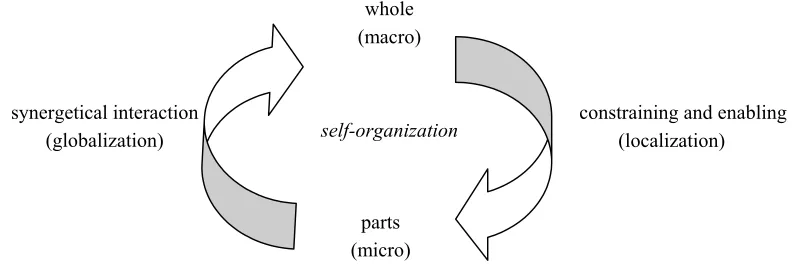
bottom-up process, bottom-up emergence means the productive sublation of the micro-level in a globalization process. The top-down-macro-micro-causation is a process of downward-localization in the sense that there is feedback from the global structures to the behaviour of the parts. The micro level is permanently re-constituted in a top-down process, top-down emergence means the productive sublation of the macro level in a localization process. Global structures are adapted and localized to the micro level. Fig. 2 shows the double-process that relates micro-level and macro-level by globalization and localization and forms a self-organizing loop.
whole (macro)
synergetical interaction (globalization)
parts (micro)
constraining and enabling (localization) self-organization
Figure 2: The dialectic of globalization and localization in self-organizing systems
Globalization is a general process characteristic of all complex, self-organizing systems. From time to time systems leave the phase of synchronic reproductive self-organization loops (self-reproduction) and enter phases of diachronic self-organization where a new system type or level emerges from instabilities and disorder. The result of diachronic self-organization (order through fluctuation, order from noise) is a hierarchy of systems where upper systems are more complex and global, they are characterized by emergent qualities that can’t be found on lower, more local levels. Each system is a local elementary part of a more global whole as well as a global whole made up of more local parts. This dialectic of globality and locality is the main characteristic of the material hierarchy that is typical for the self-organization of the universe.
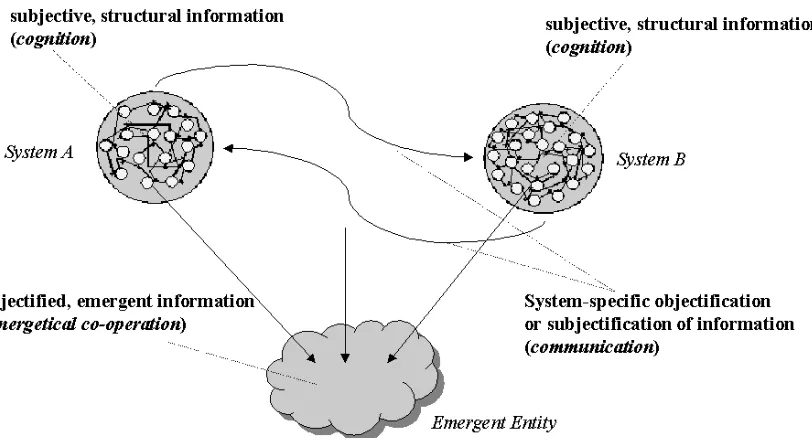
information in the shared environment of the involved systems). Co-operation is the general process of interaction between units that results in a globalization of local behaviour, i.e. productive relationships result in the emergence of new qualities.
Figure 3: A general model of the three aspects of information-generation (cognition, communication and co-operation) in self-organizing systems
Based on this general model of globalization in self-organizing systems, I will now show how the relationship of globalization and self-organization can be conceived in social systems.
4. Globalization and Social Self-Organization
Globalization is mainly a sociological topic, but there is much disagreement on the question since when society is characterized by massive phases of globalization. Immanuel Wallerstein argues that the capitalistic world-system is a global system ever since its emergence in the 16th century, Anthony Giddens argues that globalization has been increasingly taken place since the establishment of modern society in the 19th century, Roland Robertson argues that globalization is a very long term process, extending back through thousands of years and characterised by a phase of extreme rapidity and extensiveness from 1870-1920, for John Tomlinson globalization is a very recent characteristic of society since the 1960s. In contrast to these approaches, I argue that globalization is not only a social process, but one that takes places in all complex (i.e. also natural) systems as process of bottom-up-emergence. All social relationships are based on bottom-up-social-emergence and hence involve various forms of globalization. Whenever a social system faces large problems that it can’t cope with on existing spatio-temporal levels, it enlarges its borders spatio-temporally, i.e. new levels of social organization are created. In recent years we have been witnessing a massive increase of global problems as well as a massive increase of social levels and time-space distantiation of social relationships.
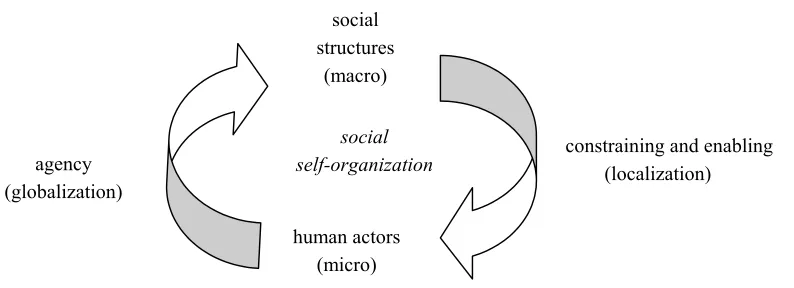
medium of social actions in localization processes and outcome of social actions in globalization processes (fig. 4)5.
.
Figure 4: The dialectic of globalization and localization in social self-organization social
structures (macro)
social self-organization
constraining and enabling (localization)
human actors (micro)
agency (globalization)
So one can say that all social relationships are coined by a dialectic of globalization and localization, each time we act socially, we refer to more global structures that transcend our singularity and enable and constrain our behaviour and interactions, social actions produce more global structures. The more global a social structure, the more it is detached from the permanent immediate control of single individuals/groups. The hierarchy of social globality reaches from the individual as starting point to local immediate relationships like family, friendships, or colleagues, to local intermediary structural relationships like local city council, transmediary (national) structural relationships like institutions of the state or national markets, to international structural relationships like international agreements or the European Union, and finally global or transnational structural relationships of worldwide reach like the Internet, the world market or human rights (at least by idea). For most of us the more local levels of this hierarchy are the environments of immediate permanent physical and social contact, whereas the more global levels are the environments of indirect contact that most mainly observe and come in contact with by the mass media. Certain actors like transnational corporations, NGOs, computer users, etc. frequently switch in a flexible way from one level to others.
Globalization can generally be defined as the stretching of social relationships in space-time, a globalizing social system enlarges its border in space-time, as a result social relationships can be maintained across larger temporal and spatial distances. Self-organizing social systems have the ability to create new realities that have a more global reach than previous realities, they can enlarge their borders. Anthony Giddens similarly defines globalization as “intensification of worldwide social relations which link distant localities in such a way that local happenings are shaped by events occuring many miles away and vice versa” (Giddens 1990: 64). Globalization is based on processes of disembedding, i.e. the production of time-space distanciation of social relationships. Processes of disembedding are accompanied by processes of reembedding that adapt the disembedded social relationships to local (temporal and spatial) conditions. Globalization involves the stretching of practices and actions that constitute self-organizing social systems in time-space, it is based on action at a distance, globalization results in an increase of the intensity, extensity, reach and velocity of social relationships, i.e. there is a faster and wider flow of more artefacts, people and symbols over networks across space-time. Disembedding and reembedding are interconnected processes that are an expression of the dialectic of the global and the local. The global is based on the interaction of localities, the global is adapted to local circumstances. Roland Robertson (1994) speaks in this context of “glocalization”. “From my standpoint the concept of globalization has involved the simultaneity and the inter-penetration of what are conventionally called the global and the
local, or – in more general vein – the universal and the particular. […] globalization – in the broadest sense, the compression of the world – has involved and increasingly involves the creation and the incorporation of locality, a process which itself largely shapes, in turn, the compression of the world as a whole” (Robertson 1994). “Our suggestion is that there are built-in brakes on globalization, namely those inherent in the unavoidable necessity of adaptation to (or production of) particular circumstances. Hence, the proposition that globalization is self-limiting” (Robertson/White 2003b: 17).
Taking a look at influential definitions of globalization from scientists like Giddens, Held/McGrew, and Robertson shows that their definitions concentrate on quite similar aspects. “Globalization may be thought of initially as the widening, deepening and speeding up of worldwide interconnectedness in all aspects of contemporary social life. […] Globalization can be taken to refer to those spatio-temporal processes of change which underpin a transformation in the organization of human affairs by linking together and expanding human activity across regions and continents. […] [It implies] a stretching of social, political and economic activities across frontiers such that events, decisions and activities in one region of the world can come to have significance for individuals and communities in distant regions of the globe. In this sense, it embodies transregional interconnectedness, the widening reach of networks of social activity and power, and the possibility of action at a distance” (Held/McGrew/Goldblatt/Perraton 1999: 2+15). “Globalization as a concept refers both to the compression of the world and the intensification of consciousness of the world as a whole” (Robertson 1992: 8). These definitions show that the central aspects of globalization are interconnection, intensification, time-space-distanciation, deterritorialisation/supraterritoriality6 of relationships; time-space-compression, action at a distance, and accelerating interdependence. Theories of globalization that see globalization as a general process seem to agree that these phenomena apply to all realms of society. I would like to add that they apply not only for society, but can be found in all self-organizing systems, i.e. all complex systems in nature and society. Globalization is a general process in the sense that emergence can result in an increase of interconnections, distanciation, compression and acceleration of the relationships between complex systems and elements of a complex system.
Also in the second sense, globalization is a general process of humankind. During the history of society the organization of social relationships has become more global in temporal and spatial scope. “Throughout recorded history, a trend can be observed toward the enlargement of the geographical scope of human communities; it has been one aspect of the increasing scale of social organization” (Modelski 1972). This tendency involves the increase of the networked character of human actions, the increase of the number of actors and complexity of society due to the latter’s enlargement and the increase of complexity of social relationships. All social action is a kind of problem-solving that is based on the human beings’ striving for achieving defined goals by entering social relationships and appropriating nature. In the material production of reality, human beings sooner or later encounter problems that are due to the limited local availability of resources, intelligence, solutions, and capacities and that they can’t solve on local levels. Hence they create new emergent levels of reality that are more complex and more global in reach. This new level will be the spatio-temporal foundation of action for some time, but practices within this system will sooner or later also reach certain limits. Social globalization in a synchronous sense takes place permanently in the sense that there are mutual productive, synergetical relationships between actors and structures that involve a double-process of globalization (micro-macro-link) and localization (macro-micro-link). In a diachronic sense social globalization refers to phases of crisis and heavy
6 Jan Aart Scholte (1999) argues in a very interesting article that contemporary globalization means “a proliferation of social
fluctuations that are due to conflicting patterns of development and escalating problems that can’t be solved on existing levels of organization, as a result new order arises through fluctuation (Ilya Prigogine’s principle of order through fluctuation), a new, more global level of organization, a new type of social system is created and the old system is incorporated into the new organization. Globalization in this sense means the diachronic, discontinuous emergence of new levels of self-organization. There is both a synchronous and a diachronic type of globalization, the synchronous one takes place permanently and results in emergence on existing levels, from time to time the system can’t cope with its own complexity and the emergence of a new level of self-organization takes place discontinuously.
Göran Therborn (2000, 2001) suggests that globalization takes place in historical waves that have multiple dimensions and consist of periods of intensive globalization followed by periods of de-globalization. This idea seems to be related to the concept of economical long waves and it shares certain deterministic assumptions with it7. There is no good reason to assume that there is a social law that results in sequences of globalization and de-globalization because the social world is one of human agency and hence one of conditioned chance where the future is relatively open and depends on human practices and struggles. Hence it is not determined if a phase of intensive globalization will be followed by another phase of globalization, a phase of stabile reproduction without the creation or destruction of levels, or by a phase of de-globalization. The phase of rapid economic development ranging from approx. 1870 until the First World War that was described by many as the phase of imperialism was a phase of economic globalization in the sense of capital export and world trade, it was followed by the Fordist phase of development that after the Great Depression was based on economic de-globalization with a primacy of protected, relatively self-sustaining national markets. Here globalization was followed by de-globalization. Concerning technological networks, the submarine cable networks used for telegraphy constituted a form of globalization of communication, with the rise of telephone, radio, TV, and finally fibre-optic cable networks used for Internet communication further phases of the globalization of communication followed. Hence here globalization wasn’t followed by de-globalization, but by further globalization. The two examples show that a phase of globalization can be followed by both de-globalization or another phase of globalization.
There are certain mechanisms of knowledge storage in society that allow time-space distanciation of social relationships. In non-literate societies the only “container” storing information were human memory, tradition and myths. Writing and notation have allowed a certain time-space distanciation of social relationships. Other forms of storing information that have followed and have caused further time-space distanciation are cities, lists, time-tables, money, money capital, nation-states, communication and transportation technologies in general and especially the rapid-transit transportation and electronic communication technologies (including electromagnetic telegraph, telephone and computer mediated communication). Tribal societies were high presence societies, their self-organization took mainly place on local levels without much time-space distanciation. The rise of more complex structural forms on the one hand was a medium of the globalization of social self-organization, on the other hand it is also an outcome of societies need of stretching its border if certain problems can’t be solved within an existing locale. Based on the duality of structure (cf. Fuchs 2003f), the self-organization of society generates and differentiates knowledge which can be stored and controlled across time and space by making use of certain structures. During the history of mankind these storage capacities and mechanisms have been improved and allowed an increase of time-space distanciation. During the last decades, information storage and usage has become a major factor in all aspects of modern life. Information and information technologies today are not only major economic factors, they have also gained massive importance in political life, science, culture, administration, art, education, health and media. Therefore we can also speak of the dominant mode of reproduction and self-organization of the modern world as the informational mode of capitalist development.
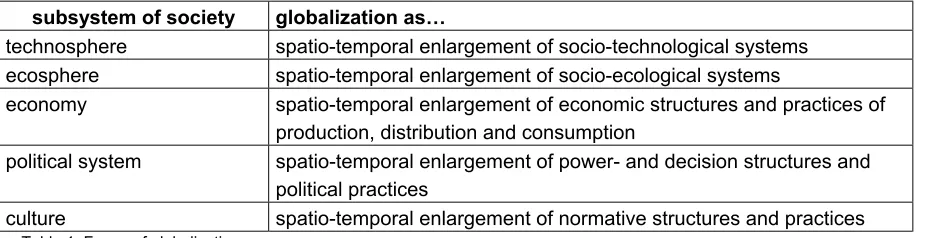
Globalization can be found in specific forms in the five subsystems of society. These are: the technosphere, the ecosphere, the economy, polity, and culture. In the technosphere the human being produces and uses tools that shall help him in achieving defined goals, in the ecosphere the human being appropriates natural resources and exchanges matter and energy with nature in order to survive, in the economy the human being produces property in order to satisfy his needs, in the political system the human being establishes and makes use of power structures in order to decide how his living conditions shall be designed, and in culture the human being constitutes definitions (norms, values, traditions, ideologies) in order to shape his living conditions and life-style properly. Globalization can be defined in respect to each of these subsystems of society.
subsystem of society globalization as…
technosphere spatio-temporal enlargement of socio-technological systems
ecosphere spatio-temporal enlargement of socio-ecological systems
economy spatio-temporal enlargement of economic structures and practices of
production, distribution and consumption
political system spatio-temporal enlargement of power- and decision structures and political practices
culture spatio-temporal enlargement of normative structures and practices
Table 1: Forms of globalization
In modern society these processes of globalization are based on a logic of accumulation of natural resources, tools, money capital, power, and hegemony. In comparison to premodernity the intensity, velocity, extensity, and impacts of globalization are much larger in modern society. The self-organization of the subsystems of modern society can be described as processes of antagonistic self-enlargement that produces dichotomies (between nature and culture, have and have-nots, economic classes, the more powerful and the less powerful, the knowing and the unknowing, the educated and the uneducated, men and women, young and old, rich and poor, etc.) that result in material and intellectual inequality. Due to this inherent logic of accumulation, modern society has transformed structures into (ecological, technological, economic, political, and cultural) capital that yields (material and symbolic) profit by being accumulated (see Fuchs 2003a, b). Hence modern society is a capitalistic society not solely in an economic, but a multidimensional sense of the word. The main problem that modern society tries to solve is how to accumulate ever more capital. Whenever an existing regime/mode of accumulation that shapes the self-organization of the subsystems reaches its inherent limits and enters crisis, new strategies and areas of accumulation are needed in order to revert to ordered processes of accumulation. Hence globalization is in modern society inherently driven by the logic of capital accumulation that results in the appropriation and production of new spaces and systems of accumulation.
In modern society, self-organization is controlled by certain classes, the social structures are alien powers opposed to the human being which enslave him instead of being controlled by him. Alienated or estranged structures are forces imposed on the individuals as an interest "alien" to them that are independent of them. Due to this lack of self-determination and self-control, one can speak of alienation or estrangement, modern social structures are estranged social structures. In modern society the dialectic of structures and actors that is basic for all social systems and their capacity to organize themselves becomes an antagonism which relates the two categories in materially colliding ways that produce separated interests and unequal distributions.
5. The Antagonisms of the Global Modern Age
The antagonism between structures and actors results in a clash of estrangement and self-determination that is characteristic for all subsystems of modern society. In respect to the increasing global character of modern society, several antagonisms can be found
subsystem faces on the way towards globality an antagonism between…
technosphere global alliance technology global megamachine
ecosphere global sustainability global degradation
economy global wealth global empire
polity global participation global control
culture global wisdom global imperialism
Table 2: Antagonisms of the Global Modern Age
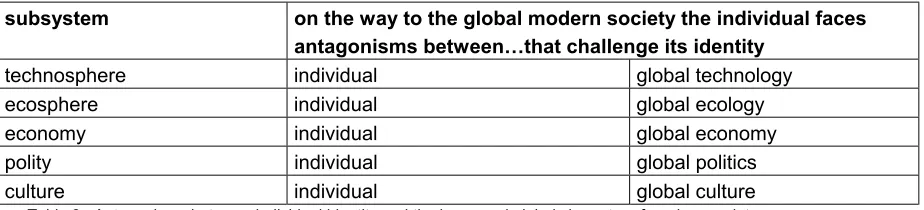
The basic conflict is that many people can’t cope with the increased complexity of the world because their lives are increasingly shaped by global alienated structures that are out of their reach and that they can’t participate in. They are not provided with much help for better understanding and participating in these structures, but are rather left alone and all on themselves. The increased feeling of powerlessness and alienation has resulted in identity conflicts and along with it in an aggravation of nationalism, racism, fundamentalism, ethnical conflicts, etc. Globalization is an ambivalent process that produces both new opportunities and risks in all subsystems of society. These conflicts can be described as antagonisms.
subsystem on the way to the global modern society the individual faces antagonisms between…that challenge its identity
technosphere individual global technology
ecosphere individual global ecology
economy individual global economy
polity individual global politics
culture individual global culture
Table 3.: Antagonisms between individual identity and the increased global character of modern society 5.1. Technosphere: Global Alliance Technology vs. Global Megamachine
In modern society, technology is both medium and outcome of capitalistic development. By establishing new technologies, productivity can be increased and hence economic capital organized more efficiently. Technology mediates capital accumulation. Economic capital accumulation requires a permanent increase of productivity and hence there is a need for permanently developing new, more productive technologies. Capital accumulation results in new technologies. Technology as such is a means for achieving defined goals efficiently and simplifying human existence. In modern society it is not a means that serves primarily human ends, but a means that serves only partial economic interests, hence it is a means of domination and control. Technology as such can increase human wealth and co-operation, but as a means of control it is a megamachine that serves as a medium of domination and alienation. In capitalism, technology is not only a means for increasing productivity, but also a means for reducing the turnover time of capital. The turnover time is the total time of production and circulation of capital. The faster capital can be produced and circulated, the higher the speed of accumulation. Technological progress in capitalism is a continuous effort to shorten turnover time.
and information. The Earth has been increasingly transformed into a technological network of communication and transport that affects all realms of society. There is both the capacity of network technology and new media to function as global megamachine or as global alliance technology. The first installs a worldwide system of domination, the second increases human wealth and well-being for all. The outcome of this conflict has not yet been decided, it depends on active human practice and struggles. Technology is not an end in itself, technological progress is due to social interests and conflicts.
Already the Romans made use of networks of postal communication, the invention of the printing press in the fifteenth century allowed a new efficient form of the distribution of written communication beyond closed local communities. With the rise of industrialism and modern society technological progress allowed communication to be dissociated from physical transportation (Thompson 1995). Submarine cable networks used for telegraphy were established and constituted the first global system of communication (ibid.). The 20th century has seen an unprecedented increase in intensity, extensity, and velocity of global
communication that is closely related to the rise of radio, television, satellite transmission, the microelectronic revolution and digital fibre-optic cable networks/digital data processing.
The transatlantic cable of 1866 reduced the time of transmission of information between London and New York by over a week, the telephone increased the velocity of messages by a few minutes, the Internet reduced it not much at all in comparison to the telephone (Keohane/Nye 2000: 80). This doesn’t imply that technological globalization is a myth, but that we should also stress qualitative aspects such as the reduction of the costs of information transport and new qualities of communication such as many-to-many-communication, interactivity, hyperlinking, multimedia, conversion, simulated virtual realities, the decontextualisation and derealization of communication, implications of computer mediated communicated for the formation of identities, etc.
5.2. Ecosphere: Global Sustainability vs. Global Degradation
Nature has prior to human existence been a global system in the sense that it produces processes that have global environmental impacts and massively change the material reality on Earth. Such global ecological processes are e.g. ice ages, natural disasters such as earthquakes, gales, typhoons, hurricanes, floods, volcanic eruptions, continental drift, etc. With the rise of industrialism and capitalism the man-nature-system has been massively transformed because natural resources play an essential role in the accumulation of commodities. The massive increase in material flows of non-renewable resources has resulted in global environmental degradation and a global ecological crisis. The ecosphere is global in the sense that its subsystems are highly mutually coupled, instabilities of some parts can have massive negative influences on the whole global ecosphere and its subsystems.
Environmental degradation takes place on a worldwide scale, all humans feel its effects. E.g. due to the depletion of the ozone layer global warming increases massively, this results in a massive transformation of the seasons, resulting e.g. in periods of extreme heat followed directly by periods of extreme coldness. In Austria we had 25 °C in early April 2003 and snow one week later, in early June 2003 the temperature rose to 36 °C. Global ecological problems are e.g. ozone depletion, loss of bio-diversity, climate change and global warming, depletion of natural resources, deforestation, desertification, water pollution, acid rain, nuclear catastrophe, greenhouse effect, hazardous wastes, soil exhaustion, etc. The recent deregulation of markets has resulted in a further increase of environmental degradation (Borghesi/Vercelli 2003). Whereas in premodern times the speed of environmental changes was very slow, modernization has resulted in a massive, human-caused artificial speed-up of these changes that nature can’t cope with.
on the other hand there are socially produced ecological risks (Giddens 1999). Most of the problems that constitute the ecological crisis are produced risks.
The global-local link can also be observed in the ecological crisis. The global ecological problems have local specificity and consequences, local environmental degradation can have more global impacts (e.g. oil tanker catastrophes, Chernobyl). Due to the fact that environmental risks affect all people worldwide, increased awareness and “ecological consciousness” can be observed globally. Many of the new social movements stem from the environmental sector. The need for a global sustainable society that doesn’t produce the risk of destroying the foundation of existence of future generations and where nature is preserved in order not to endanger the foundation of the existence of humankind has to a certain extent been realised. This increased awareness is due to the increased destruction of the ecosphere, characteristic of it is e.g. the rapid growth of international environmental treaties (Frank 1997) and international environmental organizations (Held/McGrew/Goldblatt/Perraton 1999: 388). Interestingly the number of such treaties has sharply declined in the 1990ies, this might be a manifestation of neoliberal ecological policies. The increased awareness poses the possibility for realising a global sustainable society, but this promise is scattered by the continued industrial advancement of ecological degradation (e.g. approx. 25% of the worldwide emitted carbon dioxide is produced in the USA, but President Bush has refused to sign the Kyoto treatment which would legally bind industrialised nations to reduce worldwide emissions of greenhouse gases). We are witnessing an antagonism between global ecological sustainability and global ecological degradation. Environmental globalization involves both the emergence of global ecological risks that threaten all people and the survival of humankind and the formation of global ecological consciousness. The risk society “shows a tendency toward the objective unification of those affected into global danger situations. In any case, friend and foe, east and west, above and below, city and countryside, black and white, south and north are exposed to the levelling pressure of intensifying civilization risks” (Beck 1999a: 269). Ecological risks affect all, but are unevenly spread in the sense that well-off social strata and regions can afford to reduce their exposure to threats. All are affected by global risks, but some can better escape them.
5.3. Economy: Global Wealth vs. Global Empire
Increased global economic productivity puts forward another antagonism. Due to the high development of the economic forces there would be the possibility for establishing global wealth and a world without hard work, starvation, a society with a maximum of free time (i.e. a leisure society). Technology is an important factor in this respect. But actually the global increase of productivity and wealth has only profited economic interests and a small elite, not all of humankind. There is increased total wealth, but also an increase of global inequality, unemployment, and poverty. The total fortune of the three richest men is larger than the total GNP of the 48 poorest countries. The income gap between the richest fifth of the world population and the poorest fifth has increased from 1990 to 1997 from 60 : 1 to 74 : 1. 1,2 billion people must survive with less than one dollar per day, 2,8 billion with less than 2 dollars per day (all data: UNDP 2002).
the “immanent necessity of this mode of production to produce on an ever-enlarged scale tends to extend the world-market continually“ (Marx 1894: 346). The development of the productive forces would “put world-historical, empirically universal individuals in place of local ones“ (Marx/Engels 1845/46: 36) and would establish a “universal intercourse between men“. The global character of capitalism would have produced a universal dependence and history as world history. It would have “produced world history for the first time, insofar as it made all civilised nations and every individual member of them dependent for the satisfaction of their wants on the whole world, thus destroying the former natural exclusiveness of separate nations“ (Marx/Engels 1845/46: 60). Marx stressed the relationship of economic globalization and technological progress: “Whereas on the one hand the improvement of the means of transportation and communication brought about by the progress of capitalist production reduces the time of circulation of particular quantities of commodities, the same progress and the opportunities created by the development of transport and communication facilities make it imperative, conversely, to work for ever more remote markets, in a word – for the world-market“ (Marx 1885: 254) Means of transport and communication would be “the weapons for conquering foreign markets“ (Marx 1867: 475).
Immanuel Wallerstein (1974a) has continued this tradition and has stressed that capitalism is a world system8 in the sense that it requires a global division of labour and a world market for achieving profit. The political structure of the capitalistic world system would be based on a hierarchical, segmented division between central states, semi-peripheral states and peripheral states. There would be unequal exchange in the capitalistic world system that results in the appropriation of surplus value of the whole economy by core areas.
Marx saw that globalization is a process immanent in capitalism, but he didn’t see that globalization always means glocalization due to the fact that territorial expansion of capital reflects and adapts to local conditions. Gilles Deleuze and Félix Guattari (1977) have described this relationship as a dialectic of deterritorialization and reterritorialization. “It may be all but impossible to distinguish deterritorialization from reterritorialization […] they are […] like opposite faces of one and the same process” (Deleuze/Guattari 1977: 333). They argue that capitalism is a schizophrenic system, in order to function it would collapse existing structures and territories, but on the other hand it would be in need for restructuring and regrouping structures and territories. The emergence of capitalism would have resulted in a massive deterriorialization of all realms of social life. Primitive accumulation would have resulted in the deterritorialization of private owners and peasants, resulting in the emergence of “double free” wage labour. Deterritorialization here means expropriation, but also territorial shifts in terms of the shift of the centres of production from the countryside to urban areas and from agriculture to industrial factories. Capitalism would have been the result of the meeting of the flow of decoded money (transformation of money into capital) and that of deterritorialized labour. Reterritorialization would also mean the reappearence of old forms in new forms. E.g. the despotic state would continue to reappear in its repressive form in the modern state. Capitalism means on the one hand a permanent revolution of the technological productive forces, but on the other hand and mutually coupled to the development of these forces it means economic crisis. The tendency of the rates of profit to fall (TRPF) that was described by Marx, Deleuze and Guattari argue, means the tendency that capitalism reaches certain inner limits and must try to overcome this limit by deterritorializing production. But by overcoming this limit it again sets a new inner limit that will be reached during the further development of the productive forces, hence there will again be crisis, deterritorialization, reterritorialization, etc. Capitalism deterritorializes and reterritorializes its own inner limit, in this respect deterritorialization has to do with the territorial expansion of capital. Decoding Deleuze’s and Guattari’s postmodern jargon shows that their theory reveals that
8 “It was only with the emergence of the modern world-economy in sixteenth-century Europe that we saw the full development and