VOLUME 37, ARTICLE 3, PAGES 25
,
52
PUBLISHED 11 JULY 2017
http://www.demographic-research.org/Volumes/Vol37/3/ DOI: 10.4054/DemRes.2017.37.3
Research Article
How does unrest affect migration?
Evidence from the three southernmost provinces
of Thailand
Aree Jampaklay
Kathleen Ford
Apichat Chamratrithirong
© 2017 Jampaklay, Ford & Chamratrithirong.
This open-access work is published under the terms of the Creative Commons Attribution NonCommercial License 2. 0 Germany, which permits use, reproduction & distribution in any medium for non-commercial purposes, provided the original author(s) and source are given credit.
1 Background 26 1.1 Migration and the unrest in prior research 26 1.2 The unrest in the three southernmost provinces of Thailand 28 1.3 Migration and the unrest in the three southernmost provinces of
Thailand
30
1.4 Conceptual framework – hypotheses 32
2 Data and methods 33
2.1 Data 33
2.2 Measurements of key variables 34
2.2.1 Dependent variable: Migration 34
2.2.2 Key independent variables 34
2.2.2.1 Exposure to the unrest 34
2.2.2.2 Potential confounders: Socioeconomic disadvantage 36
2.3 Analysis 36
3 Results 37
4 Discussion 44
How does unrest affect migration?
Evidence from the three southernmost provinces of Thailand
Aree Jampaklay1
Kathleen Ford2 Apichat Chamratrithirong3
Abstract
BACKGROUND
In the southernmost provinces of Thailand, despite the long-term unrest concurrent with migration, very limited research tackles the relationship between these two phenomena. OBJECTIVE
This analysis examines whether migration in the three southernmost provinces is associated with the ongoing unrest.
METHODS
We use a sample of 1,009 households from a household probability survey conducted in the three southernmost provinces in 2014. The analysis uses two measures of migration: all migration and destination-specific migration. The unrest is measured as 1) whether a violent incident occurred in the village in the most recent year and 2) the perceived effect of the unrest on the overall life of the household.
RESULTS
Households in villages where a violent incidence occurred in the past year and households that reported that the unrest affected overall life a lot are more likely to have a migrant. These effects are direct, net of other household and social network characteristics. The unrest is related to increased migration both within Thailand and to Malaysia. This result is stronger for migration to Malaysia compared to migration within Thailand. The destination of migrants is related to education.
1 Institute for Population and Social Research, Mahidol University, Thailand.
E-Mail:[email protected]
2 School of Public Health, University of Michigan, USA.
CONCLUSIONS
Unrest reaches certain levels and can outweigh the costs of migration, leading to an acceleration of migration. Findings address education as a potential counfounding variable of migration.
CONTRIBUTION
This is the first analysis in Thailand that addresses the relationship between the unrest and migration. We add to very few studies that examine differences in migrant destination and that use both objective and subjective measures of the unrest.
1. Background
1.1 Migration and the unrest in prior research
Previous studies have found that long-term instability and violence often bring about migration and produce significant displacement, both within and across national borders (Bohra-Mishra and Massey 2011; Castles 2003; Czaika and Kis-Katos 2009; Engel and Ibânez 2007; Morrison 1993; Tolnay and Beck 1992; Williams et al. 2012; Williams 2013). Threat of harm has been the most commonly cited reason for this migration (Bohra-Mishra and Massey 2011; Engel and Ibânez 2007; Williams et al. 2012). However, whether the effect is direct or indirect remains a debate. On the one hand, some aggregate-level studies concluded that the effect is indirect, pointing to other socioeconomic and demographic variables that have more influence than unrest on migration out of the area. This group of studies indicated that economic dislocation and turmoil due to the conflict and violence, rather than the violence per se, increased the level of migration (Jones 1989; Morrison and May 1994; Stanley 1987).
On the other hand, other aggregate studies showed that migration was strongly predicted by political violence, independent of the economic circumstances (Davenport, Moore, and Poe 2003; Melander and Öberg 2006; Moore and Shellman 2004; Morrison 1993; Morrison and Perez-Lafauri 1994; Schmeidl 1997; Shellman and Stewart 2007). Some studies at the household level also showed consistent results, suggesting that violence was strongly related to out-migration and remained so under a variety of controls (Engel and Ibânez 2007).
authors pointed out that their results support a threshold theory of migration and violence (Morrison and May 1994). The theory suggests that only high levels of violence are strong enough to drive people to leave for a new and unfamiliar destination. The risks of migration outweigh the risks associated with staying at home if violence is at lower levels.
Beyond conflict, prior research on this topic has pointed to other factors that provide competing explanations for migration or factors mediating the impact of the unrest on migration. First, economic opportunity, in which the aggregate-level analysis measured as the level of economic development and poverty in the countries of origin and destination, is argued to be associated with forced migration. Empirical results remain unclear, however. Some studies use GNP and GDP per capita as proxies for economic opportunity, but these variables did not significantly predict forced migration (Davenport, Moore, and Poe 2003; Melander and Öberg 2006). By contrast, other studies find that countries with higher levels of economic development tend to produce fewer refugees (Moore and Shellman 2004; Schmeidl 1997). These studies suggest that people are less likely to leave their homes if economic opportunities remain available. Some studies at the household and individual levels also reported that, beyond violence, important socioeconomic factors affect individuals’ migration decisions (Bohra-Mishra and Massey 2011; Engel and Ibânez 2007; Ibânez and Vêlez 2008). Another individual-level study in Nepal provided an insight that, beyond conflict, a number of significant economic, social, physical, and political factors affect individuals’ choice to flee (Adhikari 2013). The study applied the choice-centered approach, which suggests that people may decide to move or to stay even under highly adverse circumstances (Adhikari 2013; Moore and Shellman 2004).
In summary, while aggregate-level studies have been relatively abundant, apart from studies in Nepal (Bohra-Mishra and Massey 2011; Williams et al. 2012), there has been little research that examined the connection between violence and migration at the individual or household level (Engvall and Andersson 2014). Previous study indicates that new empirical research on civil war on the subnational scale is most promising (Blattman and Minguel 2010). While it is clear that violence and migration are connected, other shortcomings are noted in previous studies. The shortcomings include the degree to which this association is mediated through the effect of violence on economic conditions and whether the effects are similar for short versus long-distance moves and for internal versus international moves (Bohra-Mishra and Massey 2011). Also inconclusive is the scope and nature of conflict required to trigger forced migration (Adhikari 2013).
in the area. These moves could also be due to economic problems, which may also be related to the violence. Despite the long-term ongoing unrest in parallel with the migration that has continued in these areas for several decades – especially migration to the border country, Malaysia – very limited research directly tackles the relationship between these two phenomena.
1.2 The unrest in the three southernmost provinces of Thailand
The southern border provinces of Thailand are a majority Muslim area within a largely Buddhist state. The majority of the Thai population is Buddhist, while the largest minority group (about 5%) adheres to Islamic religion. About 80% of Muslims live in the southern region. Muslims are concentrated in the three southernmost provinces bordering Malaysia, including Pattani, Yala, and Narathiwat (also known as the Deep South), accounting for 47% (20%, 17%, and 10% in Narathiwat, Pattani, and Yala respectively) of the total Muslim population in Thailand. Within these three provinces, Muslims comprise more than 80% of the total population (Jampaklay 2012).
The provinces of Pattani, Yala, and Narathiwat were once part of the independent Malay Muslim kingdom Pattani, a center of Islamic learning and commerce. Pattani was an independent kingdom until 1786, when it was conquered by the King of Siam (Forbes 1982). The Malay Muslims had maintained their religious and language identity while the Bangkok government was content with conserving authority and central control over the area without integrating its population (Forbes 1982). The roots of the Malay Muslim dissatisfaction and perceived discrimination can be traced back to the establishment of the modern Thai state by the Chakri dynasty in the 18th century, when Pattani was brought under Siamese rule (Croissant 2005). During the 19th century, centralized bureaucratic structures were introduced into the South, where chieftains in Pattani became Thai civil servants, and the Thai legal system reduced the jurisdiction of Islamic law. A military-led nationalistic regime that came to power in the late 1930s changed the policy of cautious integration and attempted to forcibly assimilate the Malay Muslim population (Forbes 1982). The growing public resentment coincided with the emergence of Malay nationalism in Southeast Asia, which contributed to the emergence of a separatist movement in Southern Thailand (Engvall and Andersson 2014).
behavior (Rahimmula 2003). In the 1940s, a separatist movement emerged, and by the 1970s, more than 20 separatist organizations were operating on both sides of the border between Thailand and Malaysia (Chalk 2008). A shift in political power in 1947 further developed the government resistance to any form of cultural, linguistic, or religious autonomy in the south (Chalk 2008). The failure of the Thai integration policy may be due to the determination of the Malay Muslim population to maintain their way of life, which has been strengthened by the region’s corruption, lack of economic development, and harsh security measures (Chalk 2008).
In the last ten years, the unrest in the south has worsened and has been one of the prominent challenges of Thailand. Although the violence has occurred for many decades, the events were not numerous, and most of the victims were government officers. The violence has increased since April 2004, when security forces fought coordinated attacks in several provinces, followed by a serious incident in October 2004 in Tak Bai district, Narathiwat province. Both incidents took many local people’s lives. The reported number of deaths in the three provinces in 2004 was over 500, including 400 Muslims and more than 100 government officials (UNICEF n.d.). Since then the violence has quickly escalated into large-scale violence that continues to cover all areas in the three provinces. Deaths occur daily, and the victims include government officers, ordinary people, Muslims and Buddhists, and terrorists. From the beginning of 2004 to the end of 2012, the country witnessed more than 5,500 deaths and almost 10,000 injuries. During the first half of 2005, Muslim victims of political murders began to exceed Buddhist victims. The growth of Muslim-on-Muslim violence is one of the most important trends of the data (Jitpiromsri and Sobhonvasu 2006). Despite several government administrative teams with large budgets, a large number of security staff, and many strategies for problem solving, the chronic violence is ongoing today. While the frequency and intensity are stable, the cumulative number of civilians killed and injured has increased with each incident (Thai Health Project 2013; UNICEF n.d.).
The cause of the social unrest in the three southernmost provinces is complex, including not only religion or cultural reasons but also poverty, politics, illicit drug trafficking, smuggling, and nationalist separatists. In particular, the local population’s perception of injustice remains high. The fact that social, economic, and other development indicators in the far south are significantly below the national average has built resentment among local people for many years (UNICEF n.d.).
as discriminatory toward local minority languages is a source of conflict in this region (Engvall and Andersson 2014). Research indicates that, for southern insurgents, it is linguistic and religious identity rather than socioeconomic development that leads to mobilization (Engvall and Andersson 2014). Although the Thai government has maintained an inclusive policy toward religious minorities, the government’s policies regarding language are extremely conservative. The only accepted language used to communicate with government officials is the standard Thai. The policy leaves the southern Malay-speaking population feeling largely alienated. Nevertheless, as the region is among the poorest in the country, it has been acknowledged that economic inferiority also adds to the sense of exclusion. Other research suggests that while poverty may serve as a necessary condition behind the unrest, poverty cannot be identified as the root cause of the crisis because the relationship between poverty and violence is so ambiguous. Rather, the underlying force of the upsurge of violence is believed to be due to the movement’s ideological beliefs (Jitpiromsri and Sobhonvasu 2006).
1.3 Migration and the unrest in the three southernmost provinces of Thailand The unrest might affect the life of local people in many ways, including economic activity. Although most migration is voluntary, in the case of southernmost Thailand, the unrest may play a role. The ongoing havoc that threatens people’s well-being and gives them a sense of insecurity may drive them to move out. While in other contexts, investigators have found that long-term instability and violence often beget migration (Bohra-Mishra and Massey 2011; Castles 2003; Czaika and Kis-Katos 2009; Engel and Ibânez 2007; Morrison 1993; Tolnay and Beck 1992), in the case of the southernmost Thailand, the extent to which the experience of violence has affected movement out of the southernmost provinces is still unclear.
Malaysia (Nuansanong, Klanarong, and Salaebin 2009). Previous research, however, was not comprehensive because it was based on data collected from migrants in Malaysia, excluding information from those remaining in the place of origin, thus raising the question of whether results can be generalized to the overall picture of migration and the unrest in the three southernmost provinces.
Results from previous study indicate that understanding migration of Thai Muslims in these three border provinces and its association with the unrest remains inconclusive (Jampaklay et al. 2011). As a common way of life that has been occurring for several decades, migration to Malaysia of Thai Muslims in this area would occur even in the absence of the unrest. However, there are several potential explanations underlying the relationship between the unrest and migration to Malaysia. Among them, the stress resulting from the ongoing unrest may drive people to seek a safer environment. The reduced economic development with an associated decrease in job opportunities due to the unrest may also be a driving force for moving away. Thus, the need to migrate for economic well-being has increased. At the same time, authorities or villagers may suspect that migrants – particularly young Muslim men – become involved with groups responsible for the unrest. This perception may discourage some from migrating; they worry about being perceived as somehow involved in the unrest. Thus, the unrest may actually deter migration. We argue that studies on these issues need to be conducted not only to understand and help migrants but also to eradicate the rumors and the suspected association of migrants with the unrest in the border areas. The suspicion may become a dangerous barrier for the government and the border communities and add to the already complicated situation in obtaining a peaceful solution to the southern conflict.
While people in other areas of Thailand usually migrate to work in big cities, especially Bangkok, people in the southernmost provinces often cross the border and work in Malaysia, the more economically developed neighboring country. Many people have experienced working in Malaysia at least once in their lifetime.The historically close relationship between Malay Muslims in the southernmost provinces and the Malaysians sharing the same border, Islamic religion, as well as Malay culture has underpinned the movement from Thailand to Malaysia. Past research indicates that although Malay Muslims from Thailand working in Malaysialegally cross the border using a passport, they usually work without a work permit. Thus, most of them work in the nonformal sector, are not protected by Malaysia’s labor laws, and cannot access the government’s services (Klanarong, Pinsuwan, and Sinprachakpol 2009).
language skills may be needed for employment elsewhere in Thailand. It is expected that migration to other areas of Thailand may be selective for education.
In conclusion, the setting in these southernmost provinces in Thailand offers a good test case for estimating the direct influence of violence on migration. Since the violence has lasted more than a decade, its diverse volume, scope, and intensity has changed. The study will be able to shed light on the mechanism of how the scope and intensity of the conflict can produce substantial variation in migration.
1.4 Conceptual framework – hypotheses
Following previous research on the relationship between violence and migration, our study is guided by a conceptual framework illustrated in Figure 1 below.
Figure 1: Conceptual framework
We hypothesize that migration is related to two sets of factors: 1) the predictors of central importance to this study – exposure to the unrest, and 2) potential confounders referring to factors associated with poverty and disadvantage such as assets, education, and home ownership. Due to its importance in the migration literature, we also include social networks created through earlier household migration into this latter set of independent variables. We hypothesize that the conflict creates a threat to safety as well as economic stress in the community. The threat may be mediated by the socioeconomic status and the social networks of the household. Furthermore, when considering the choice of migration to Thai vs. Malaysian destinations, the language skills acquired through education may play a role. Migration to Thai destinations compared to Malaysian destinations may be strongly related to the strength of language skills acquired in Thai rather than Malay language.
Conflict,
violence Threat to safety Migration
2. Data and methods
2.1 Data
Our analysis is based on the baseline dataset from an ongoing, longitudinal project on
Women Migration and the Unrest in the Three Southernmost Provinces (2014–2016), conducted by the Institute for Population and Social Research at Mahidol University. The study is funded by Mahidol University. The overall objective of the project is to understand how migration in the three southernmost provinces is associated with the ongoing unrest and how gender plays a role. The survey was designed to capture a representative sample of the three southernmost provinces using a probability proportional to size (PPS) sampling strategy. In general, the three southernmost provinces are considered homogeneous in terms of level of socioeconomic status, culture, as well as the level of violence. Therefore, villages in all three provinces were included in the sampling frame without differentiating in which province a given village was located. Thirty villages in the three provinces were covered in the survey, 10 villages in Pattani, 9 in Yala, and 11 in Narathiwat. In each province, the study was designed to survey 80% of the sampled communities in the rural areas and 20% in the urban areas, which corresponds to the rural-urban composition of people in the three provinces. The survey completed Round 1 quantitative data collection in May 2014 and completed the qualitative data collection by the end of 2014. Round 2 of the survey is scheduled to be conducted by the end of 2016. The study sample included Muslim households with at least one woman aged 18–59 years old. For the baseline round, in total, 1,102 households were interviewed, covering 5,823 individuals of all ages listed in household rosters. After excluding households with some missing information, the number of households included in the analysis is 1,099.
2.2 Measurements of key variables
2.2.1 Dependent variable:Migration
Our analysis has two measures of migration:
1. Migrant household: This measure indicates whether a given household has at least one member currently a migrant, regardless of destination. We define migration as leaving the home of origin for at least one month. This measure of the dependent variable is dichotomous, 1) for migrant household and 0) for nonmigrant household.
2. Migrant status and destinations: This measure takes into account where the migrant moved to. This measure is coded as 1) migrant household – other country; 2) migrant household – within country; and 3) nonmigrant household. Note that if a given household has at least one migrant in another country, the household is coded as “1.” Descriptive analysis indicates that for “migrant household – other country” outcome, the destination is almost always Malaysia.
2.2.2 Key independent variables 2.2.2.1 Exposure to the unrest
occurrence of violence, thus, seems to be more reliable. Therefore, we applied a “yes” (the event occurred) answer from any household in a given village and used it as a “yes” for that village. We did this for all villages. A bivariate analysis (not shown) suggested that only whether an event occurred in the village in the past year was significantly related to migration of household members. Therefore, the only variable used in the multivariate analysis is whether an event occurred in the village in the past year. The validity of this variable is supported by statistically significant associations with several variables, including the reported effect of the unrest on the household, reports of neighbors moving away because of the unrest, and neighbors talking about moving away because of the unrest.
The other measurement of the unrest is more subjective. It assesses the level of the unrest’s effects on people’s lives by asking five questions. These effects were self-perceived and reported by the household respondent.
The questions read as follows: “Lots of people in the three southernmost provinces are affected by the ongoing unrest. For your family, how much does the unrest affect 1) your family overall; 2) the daily life of yourself or your family members; 3) the financial status of yourself or your family members; 4)the working of yourself or your family members; and 5) the schooling of children in your family?” The responses, which were assigned numeric values, were “not at all” (1), “a little” (2), “fairly” (3), and “a lot” (4).
We used these independent variables in two ways. First, each question was tested for its relationship with the dependent variable (whether a household has at least one member a current migrant) separately. Only the first question (overall effect of the unrest) showed a significant relationship with the dependent variable, while the effect on daily life, financial status, working, and schooling were not significant. Second, we tried using a sum of the five questions (score ranges from 5 to 20). However, this new variable was not significantly related to the dependent variable. It is possible that the perceived effect of the unrest on people’s lives may not be fully captured or measurable when they are asked to identify a single aspect (daily life, financial status, work, or school of children). Rather, the perceived effect of the unrest might be better expressed as an overall effect on people’s lives. It is also possible that perceiving that the unrest affects any aspect of life may not be a powerful driver of migration if life is not perceived to be affected by the unrest overall. Therefore, in our multivariate analysis, we included only the overall effect of the unrest.
2.2.2.2 Potential confounders: Socioeconomic disadvantage
We included variables representing the household socioeconomic status. Village and household-level variables included were whether a household was in an urban or rural area,4 whether a household was female-headed, household size, household
economic status (using a principle component analysis wealth index5), whether a
household owned land, whether a household member worked in a professional job, the household head’s secular and Islamic education, whether at least one member had more than secondary education, and whether at least one member had Islamic secondary education.
Lastly, we controlled for whether a household had one or more members who had ever moved before because previous migration experience of household members may lead to migration of other members (Soe et al. 2011). This relationship may be due to establishment of social networks from the previous migration.
2.3 Analysis
We begin with descriptive analysis, comparing households with current migrants and without current migrants by the main independent variables (had a violence event in the village in the past year, level of effects of the unrest) and other characteristics including residential area, sex of household head, household size, economic status (household’s wealth score/land ownership), education of members (household head’s education, anyone finished secondary school – both secular and Islamic), occupation of members (anyone working in a professional job), migration status of members (any return migrants). Secondly, a multivariate analysis using a logit model was used to explore whether the unrest was associated with migration, controlling for the household characteristics. Lastly, a multinomial logistic model was estimated, taking into account the destination of the migrant (whether outside or within the country). The multivariate analyses for both dependent variables (a dichotomous and a three-category variable) models were adjusted for within-village clustering. The multinomial model was also adjusted for within-household clustering to account for the lack of independence of the repeated migrants within the same household. However, adjusting for village and
4 Urban areas refer to municipal areas assigned by provincial administrative authority. Villages not designated
as municipal areas are categorized as rural areas.
5 Principal component analysis provides plausible and defensible weights for an index of assets to serve as a
household clustering did not significantly change the models. Therefore, only results from the original models are presented.
3. Results
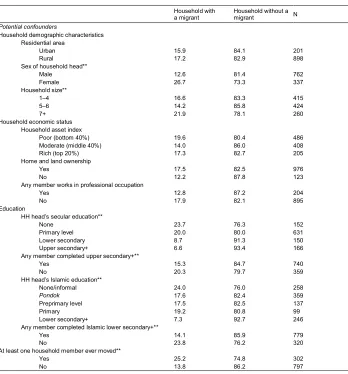
Table 1 presents the percentage of migrant and nonmigrant households by the unrest and by other demographic and socioeconomic household characteristics. About one fifth of the households have at least one member who is a current migrant for at least one month (17%). The bivariate analysis shows that households located in a village where a violent incident due to the unrest occurred in the year before the survey have a higher proportion of current migrants than their counterparts (19% vs. 12%), significant at the 0.05 level. The perceived effect of the unrest on household members’ overall life is also significantly related to the migration of household members at the 0.01 level. Households that reported that the unrest affected their overall life a lot have migrants in the highest proportion (29%). The proportion of migrants is similar across households that reported the effect of the unrest as fairly, a little, or not at all.
The bivariate analysis of the household’s migration status and other confounders of migration (household demographic and socioeconomic characteristics) shows that the proportion having a current migrant is higher among households with these characteristics: headed by a female, a large household size, headed by those with less education (both secular and Islamic), no highly educated members (both secular and Islamic), and members having previous migration experience. Residential area and economic status of households do not differ significantly in terms of the proportions having one or more migrants.
Table 1: Percentage of households with and without a migrant by exposure to the unrest and household characteristics
Household with
a migrant Household without amigrant N
Overall 16.9 83.1 1,099
Exposure to the unrest
Violence due to the unrest occurred in the village last year*
Yes 18.5 81.5 834
No 12.1 87.9 265
Effect of the unrest on overall life**
A lot 28.6 71.4 98
Fairly 17.5 82.5 257
A little 15.1 84.9 271
Table 1: (Continued)
Household with
a migrant Household without amigrant N
Potential confounders
Household demographic characteristics Residential area
Urban 15.9 84.1 201
Rural 17.2 82.9 898
Sex of household head**
Male 12.6 81.4 762
Female 26.7 73.3 337
Household size**
1–4 16.6 83.3 415
5–6 14.2 85.8 424
7+ 21.9 78.1 260
Household economic status Household asset index
Poor (bottom 40%) 19.6 80.4 486
Moderate (middle 40%) 14.0 86.0 408
Rich (top 20%) 17.3 82.7 205
Home and land ownership
Yes 17.5 82.5 976
No 12.2 87.8 123
Any member works in professional occupation
Yes 12.8 87.2 204
No 17.9 82.1 895
Education
HH head’s secular education**
None 23.7 76.3 152
Primary level 20.0 80.0 631
Lower secondary 8.7 91.3 150
Upper secondary+ 6.6 93.4 166
Any member completed upper secondary+**
Yes 15.3 84.7 740
No 20.3 79.7 359
HH head’s Islamic education**
None/informal 24.0 76.0 258
Pondok 17.6 82.4 359
Preprimary level 17.5 82.5 137
Primary 19.2 80.8 99
Lower secondary+ 7.3 92.7 246
Any member completed Islamic lower secondary+**
Yes 14.1 85.9 779
No 23.8 76.2 320
At least one household member ever moved**
Yes 25.2 74.8 302
No 13.8 86.2 797
Note: *, ** Chi2 test is significant at 0.05 and 0.01 level, respectively
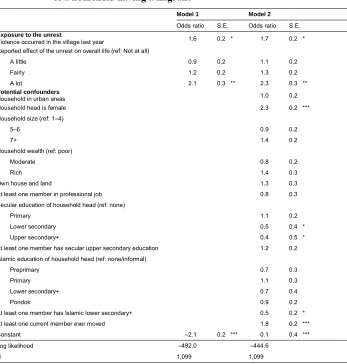
overall lives. Results show a significant effect of the unrest, measured at both the village and the household levels. Households in the village in which violence due to the unrest occurred in the past year are 1.6 times more likely to be migrant households, significant at 0.05 level. Households that reported that the unrest affected overall life a lot are more than twice as likely to be migrant households than are households that reported that the unrest did not affect overall life at all.
Model 2 controls for potential confounders, including household characteristics. Results confirm that, after taking into account other factors that might be related to migration of household members, effects of the unrest remain significant. The unrest has a positive effect on the migration of household members. Living in a village where the violence occurred encourages people to move out, regardless of how much the household perceived the effect of the unrest, and regardless of demographic and socioeconomic status of the household and migration experience of present household members. Likewise, perceiving the unrest as affecting their family’s overall life is also associated with a household sending one or more members to work elsewhere, net of other variables. While the significance levels of the unrest variables do not change, the size of the coefficients increases slightly after the other variables are controlled for, supporting an independent and direct association between the unrest variables and migration.
Table 2: Odds ratios from a multivariate logit model predicting the likelihood of a household having a migrant
Model 1 Model 2
Odds ratio S.E. Odds ratio S.E. Exposure to the unrest
Violence occurred in the village last year 1.6 0.2 * 1.7 0.2 * Reported effect of the unrest on overall life (ref: Not at all)
A little 0.9 0.2 1.1 0.2
Fairly 1.2 0.2 1.3 0.2
A lot 2.1 0.3 ** 2.3 0.3 **
Potential confounders
Household in urban areas 1.0 0.2
Household head is female 2.3 0.2 ***
Household size (ref: 1–4)
5–6 0.9 0.2
7+ 1.4 0.2
Household wealth (ref: poor)
Moderate 0.8 0.2
Rich 1.4 0.3
Own house and land 1.3 0.3
At least one member in professional job 0.8 0.3
Secular education of household head (ref: none)
Primary 1.1 0.2
Lower secondary 0.5 0.4 *
Upper secondary+ 0.4 0.5 *
At least one member has secular upper secondary education 1.2 0.2
Islamic education of household head (ref: none/informal)
Preprimary 0.7 0.3
Primary 1.1 0.3
Lower secondary+ 0.7 0.4
Pondok 0.9 0.2
At least one member has Islamic lower secondary+ 0.5 0.2 *
At least one current member ever moved 1.8 0.2 ***
Constant –2.1 0.2 *** 0.1 0.4 ***
Log likelihood –492.0 –444.6
N 1,099 1,099
Note: *, **, **** significant at 0.05, 0.01, and 0.001 level, respectively
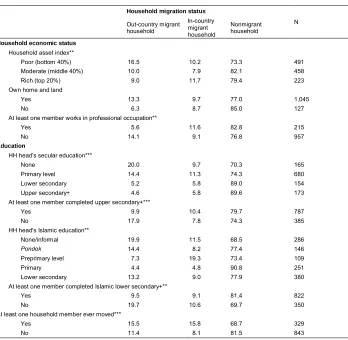
earlier. Both objective and subjective measurements of the unrest are significantly related to the migration status of the household, taking into account the destination of the current migrant. However, when looking at whether the unrest incident occurred in the village last year, a substantial difference is evident only for the proportion that has an out-of-country migrant. Households in the village where an incident occurred last year have a higher proportion of migrants currently working in another country, compared to those with an in-country migrant (14% vs. 8%). When the analysis is based on the self-reported effect of the unrest, the relationship with migration of household member, though significant, reveals unclear patterns. Households that reported that the unrest had affected their overall life “a lot” have out-of-country migrants in the highest proportions, as did those who reported that the unrest had affected their overall life “a little.” In contrast, the percentage having a domestic migrant increased directly with an increase in the perceived effect of the unrest.
Table 3: The percentage of households with an out-of-country migrant, an in-country migrant, and no migrantby exposure to the unrest and household characteristics
Household migration status
N Out-country migrant
household
In-country migrant household
Nonmigrant household
Overall 12.5 9.6 77.9 1,172
Exposure to the unrest
Violence due to the unrest occurred last year*
Yes 13.9 9.7 76.4 890
No 8.2 9.2 82.6 282
Effect of the unrest on overall life***
A lot 16.8 17.8 65.4 107
Fairly 11.1 10.7 78.2 271
A little 16.1 3.5 80.4 286
Not at all 10.4 10.6 78.9 508
Potential confounders
Household demographic characteristics Living in urban area
Yes 13.7 6.6 79.7 212
No 12.3 10.2 77.5 960
Household head is female***
Yes 24.1 10.3 65.5 337
No 7.0 9.2 83.8 795
Household size*
1–4 12.1 8.9 79.0 438
5–6 9.5 9.8 80.7 451
Table 3: (Continued)
Household migration status
N Out-country migrant household In-country migrant household Nonmigrant household
Household economic status Household asset index**
Poor (bottom 40%) 16.5 10.2 73.3 491
Moderate (middle 40%) 10.0 7.9 82.1 458
Rich (top 20%) 9.0 11.7 79.4 223
Own home and land
Yes 13.3 9.7 77.0 1,045
No 6.3 8.7 85.0 127
At least one member works in professional occupation**
Yes 5.6 11.6 82.8 215
No 14.1 9.1 76.8 957
Education
HH head's secular education***
None 20.0 9.7 70.3 165
Primary level 14.4 11.3 74.3 680
Lower secondary 5.2 5.8 89.0 154
Upper secondary+ 4.6 5.8 89.6 173
At least one member completed upper secondary+***
Yes 9.9 10.4 79.7 787
No 17.9 7.8 74.3 385
HH head's Islamic education**
None/informal 19.9 11.5 68.5 286
Pondok 14.4 8.2 77.4 146
Preprimary level 7.3 19.3 73.4 109
Primary 4.4 4.8 90.8 251
Lower secondary 13.2 9.0 77.9 380
At least one member completed Islamic lower secondary+**
Yes 9.5 9.1 81.4 822
No 19.7 10.6 69.7 350
At least one household member ever moved***
Yes 15.5 15.8 68.7 329
No 11.4 8.1 81.5 843
Note: *, **, *** Chi2 test significant at 0.05, 0.01, 0.001 level, respectively
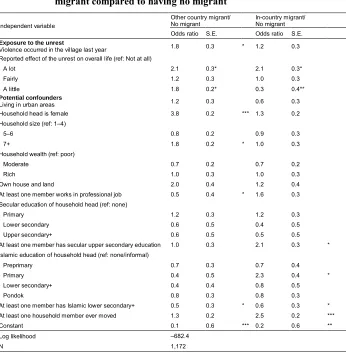
of the unrest as well as households that reported “a lot” of effect of the unrest are more likely to send a migrant out of Thailand. In contrast, for domestic migrants there was a direct relationship with the strength of the effect of the unrest and sending a migrant.
Table 4: Odds ratios from a multinomial logistic model predicting the likelihood of having an out-of-country migrant or an in-country migrant compared to having no migrant
Independent variable
Other country migrant/
No migrant In-country migrant/No migrant Odds ratio S.E. Odds ratio S.E. Exposure to the unrest
Violence occurred in the village last year 1.8 0.3 * 1.2 0.3 Reported effect of the unrest on overall life (ref: Not at all)
A lot 2.1 0.3* 2.1 0.3*
Fairly 1.2 0.3 1.0 0.3
A little 1.8 0.2* 0.3 0.4**
Potential confounders
Living in urban areas 1.2 0.3 0.6 0.3
Household head is female 3.8 0.2 *** 1.3 0.2
Household size (ref: 1–4)
5–6 0.8 0.2 0.9 0.3
7+ 1.8 0.2 * 1.0 0.3
Household wealth (ref: poor)
Moderate 0.7 0.2 0.7 0.2
Rich 1.0 0.3 1.0 0.3
Own house and land 2.0 0.4 1.2 0.4
At least one member works in professional job 0.5 0.4 * 1.6 0.3 Secular education of household head (ref: none)
Primary 1.2 0.3 1.2 0.3
Lower secondary 0.6 0.5 0.4 0.5
Upper secondary+ 0.6 0.5 0.5 0.5
At least one member has secular upper secondary education 1.0 0.3 2.1 0.3 * Islamic education of household head (ref: none/informal)
Preprimary 0.7 0.3 0.7 0.4
Primary 0.4 0.5 2.3 0.4 *
Lower secondary+ 0.4 0.4 0.8 0.5
Pondok 0.8 0.3 0.8 0.3
At least one member has Islamic lower secondary+ 0.5 0.3 * 0.6 0.3 *
At least one household member ever moved 1.3 0.2 2.5 0.2 ***
Constant 0.1 0.6 *** 0.2 0.6 **
Log likelihood –682.4
N 1,172
Results on potential confounders indicated that international migration is associated with lower socioeconomic status (if the household is headed by female, large household, no member in a professional job, and no member with at least Islamic lower secondary education). Internal migration is positively associated with higher socioeconomic status to some extent. Internal migration of people in the three southernmost provinces is increased by having a member with at least upper secondary secular education and having a household head with at least primary Islamic education. There is also a strong positive relationship between internal migration and previous migration experience of other household members. Surprisingly, the effect of Islamic education on internal migration is in the same direction as international migration; having at least one member who has Islamic lower secondary education reduces migration, both out of the country and within the country.
4. Discussion
Our study provides evidence that long-term instability and violence contribute to migration, both within and across national borders. The analysis is conducted in a unique setting of Thailand in provinces where Malay Muslims are the majority while being a minority in a Buddhist state. Although migration of Muslims in the area, especially to Malaysia, has long been a phenomenon, the unrest exacerbated the already difficult situation of people’s livelihood. After adjustment for mediating variables, both the perceived effect of the unrest on the household and the occurrence of an incident in the village in the last year are positively related to migration. These results from southern Thailand are consistent with other studies which find that long-term violence often brings about migration (Bohra-Mishra and Massey 2011; Engel and Ibânez 2007). Our study also shows that some measures of poverty and disadvantage are significant determinants of migration. Finally, as hypothesized, our research confirms that education is a significant determinant of migrant destination.
spatial proximity effect. The threshold theory is also supported by our findings that only when households perceived the unrest as affecting their family’s overall life “a lot” that the effect of the unrest is powerful enough to be a push factor for migration. As long as the unrest keeps its effect on the overall life of people at the level of “a little” or “fairly,” people still resist the need to move out.
The positive effect of the unrest is stronger for migration outside of the country than for migration to other Thai provinces. Rather than migrating to other regions in Thailand, people in this setting often move to work in Malaysia, mostly in unskilled sectors. This migration has been a long-time, well-known phenomenon. The stronger positive effect of the unrest on the flow of international migration than on domestic migration may reflect higher costs of moving within Thailand than to Malaysia. Moving within Thailand has higher costs than moving to Malaysia – both monetary costs due to distance and nonmonetary costs due to the sociocultural and psychological costs of moving to an area with large cultural differences. Thus, a higher threshold level of the unrest may be needed to push people to other Thai provinces than to Malaysia.
Previous analysis suggests that migrants from this area moving to other parts of Thailand possess a higher level of human capital than those moving to Malaysia (Jampaklay 2015). Similarly, another study among Muslim migrants in Bangkok (Ford and Jampaklay 2015) indicates that more than half of domestic Muslim migrants living in Bangkok have at least a university education. Results in this analysis also show that households having at least one household member with upper secondary level of education are more likely to have a domestic migrant. More-educated people, who usually have stronger Thai language skills than less-educated people, may find it easier to find employment in Thailand, while the residents with less secular education may find it easier to find employment in Malaysia. When the unrest is not prevalent, or still within a tolerable level, the less-educated residents may be less likely to move.
Our analysis shows that migration is associated with lower social status of the household, as migration occurs less among households with a more-educated household head. It reflects that education leads to more alternatives, thus being able to stay in their hometown rather than migrating out. This may be considered a form of “forced migration” (but by the lack of education rather than poverty). Therefore, on top of the unrest, what drives people to move out may not be the poverty per se, but the inability to make use of resources available at the local level due to low level of education.
Although both secular and Islamic education is associated with household economic status,6 their effect on migration is somewhat different. While higher secular education encourages domestic migration, higher Islamic education is associated with preference to remain at home. Households with at least one member with Islamic
6 Our descriptive analysis (results not shown) suggests that rich households are more likely than poor
secondary education are less likely to send a migrant to both domestic and international locations. We speculate that Islamic education may reflect the religiosity of the household, which in turn leads to a preference to remain in the southern provinces where there is a strong presence of Islam in everyday life, in addition to an attachment to one’s own community. Religious people may not feel comfortable living in other parts of Thailand where the surroundings are oriented to a Buddhist culture.
Why highly Islamic educated households are less likely to send members to Malaysia despite similar Islamic cultures between the three provinces and Malaysia is quite intriguing. In contrast to being the most attractive destination for unskilled laborers from the three provinces, Malaysia is not as popular a destination for Islamic education as countries in the Middle East, such as Saudi Arabia, the African continent including Egypt and South Africa, or south Asia including Pakistan and India. While we do not have evidence that the religiosity of Muslims in the three southernmost provinces is stronger than in Malaysia, existing data shows a similar level of religious practices between Malaysian and Malay Muslims in southern Thailand (Pew Forum On Religion In Public Life 2012). These practices include attending mosque at least once a week (57% Malaysia, 52% Thailand), stating that religion is very important in life (93% Malaysia, 95% Thailand), praying five times per day (72% Malaysia, 75% Thailand), displaying Quranic verses in the home (97% Malaysia, 95% Thailand), and fasting during Ramadan (99% Malaysia, 100% Thailand). Therefore, to acquire higher Islamic education, people in the three provinces would rather aim for other countries than Malaysia. Another reason, apart from having more resources at home reducing the need for them to move for work, may be that the employment prospects in Malaysia do not match well with Islamic-educated Thais.
Our results partially support the notion indicated in previous studies (e.g., Bohra-Mishra and Massey 2011; Soe et al. 2011) that previous migration experiences of other family members strongly predicted subsequent migration. The migration experience of other family members can be regarded as social capital that helps reduce the costs and risks associated with the act of migrating, thus increasing the probability of subsequent migration. Our analysis finds that the positive effect of a household member’s previous migration affects only internal migration, but not successive cross-border migration. This finding reflects the uniqueness of our study setting and indicates that the costs and risks of migrating internally may be greater than crossing the border to Malaysia where people share similar cultural aspects. Alternatively, since migration to Malaysia is so common, social networks from the community outside of the household may be available to facilitate migration. Thus, it seems that a different kind of social network is more necessary to move to other parts of Thailand than to migrate to Malaysia.
in migration. More analysis is needed regarding how migration is affected by the gender of the household head and by the changing roles of women.
Our analysis fills a gap in the analysis of migration and unrest because research on this topic has been rare in Thailand, despite the ongoing unrest. At the global level, we add to very few studies on this topic that have been done at the household and individual levels and to studies examining differences in destinations. In addition, while the measurement of unrest used in our analysis is still far from complete, we are at least able to include both objective and subjective measures of the effects of the unrest.
Our analysis provides evidence that while migration in this area, to Malaysia in particular, is a long-term phenomenon due to employment prospects at the destination, the ongoing unrest in fact increases migration, net of socioeconomic and social network factors. However, it is only when the unrest reaches certain levels (i.e., households felt that its effect is “a lot,” or the event happened in the village) that it has enough driving force for a household to send someone out to work elsewhere and that it can outweigh the costs of migration. Therefore, without conditions of extreme violence, people remain more willing to stay at their home of origin. A clear message to policy makers is that the unrest has intensified the already difficult situation of the people in the three southernmost provinces and must be considered a top priority for assistance as soon as possible.
References
Adhikari, P. (2013). Conflict-induced displacement, understanding the causes of flight. American Journal of Political Science 57(1): 82–89. doi:10.1111/j.1540-5907. 2012.00598.x.
Blattman, C. and Miguel, E. (2010). Civil war.Journal of Economic Literature 48(1): 3–57.doi:10.1257/jel.48.1.3.
Bohra-Mishra, P. and Massey, D.S. (2011). Individual decisions to migrate during civil conflict.Demography48(2): 401–424.doi:10.1007/s13524-011-0016-5.
Castles, S. (2003). Towards a sociology of forced migration and social transformation. Sociology 37(1): 13–34.doi:10.1177/0038038503037001384.
Chalk, P. (2008). The Malay-Muslim insurgency in southern Thailand: Understanding the conflict’s evolving dynamic. Santa Monica: Rand National Defense Research Institute (Rand Counterinsurgency Study, Paper 5). http://www.rand.org/ content/dam/rand/pubs/occasional_papers/2008/RAND_OP198.pdf
Croissant, A. (2005). Unrest in southern Thailand: Contours, causes, and consequences since 2001.Contemporary Southeast Asia 27(1): 21–43.doi:10.1355/CS27-1B. Czaika, M. and Kis-Katos, K. (2009). Civil conflict and displacement: Village-level
determinants of forced migration in Aceh. Journal of Peace Research 46(3): 399–418.doi:10.1177/0022343309102659.
Davenport, C., Moore, W.H., and Poe, S.C. (2003). Sometimes you just have to leave: Domestic threat and forced migration 1964–1989. International Interactions 29(1): 27–55.doi:10.1080/03050620304597.
Engel, S. and Ibânez, A.M. (2007). Displacement due to violence in Columbia: A household-level analysis. Economic Development and Cultural Changes55(2): 335–365.doi:10.1086/508712.
Engvall, A. and Andersson, M. (2014). The dynamics of conflict in southern Thailand. Asian Economic Papers 13(3): 169–189.doi:10.1162/ASEP_a_00303.
Filmer, D. and Pritchett, L.H. (2001). Estimating wealth effects without expenditure data – or tears: An application to educational enrollments in states of India. Demography 38(1): 115–132.
Ford, K. and Jampaklay, A. (2015). Segmented assimilation: A comparison of the factors related to the adjustment of domestic and international Muslim migrants to Bangkok.Journal of Population and Social Studies 23(1): 34–46.
Ibânez, A.M. and Vêlez, C.E. (2008). Civil conflict and forced migration: The micro determinants and welfare losses of displacement in Colombia. World Development 36(4): 659–676.doi:10.1016/j.worlddev.2007.04.013.
Jampaklay, A. (2012). Muslims in Thailand: General backgrounds. Nakhom Pathom: Institute for Population and Social Research, Mahidol University.
Jampaklay, A. (2015). The diversity of migration among Muslims in the three southernmost provinces: Who moved to Malaysia and who moved to other destinations (in Thai). In: Jampaklay, A., Vapatanawong, P., and Tangchonlatip, K. (eds.)Population and social diversity in Thailand. Nakhom Pathom: Institute for Population and Social Research, Mahidol University.
Jampaklay, A., Chamratrithirong, A., Ford, K., and Hayeete, C. (2011). Women’s migration and the unrest in the three southernmost provinces: A preliminary report submitted to Thailand Research Fund. Nakhon Pathom: Institute for Population and Social Research, Mahidol University.
Jitpiromsri, S. and Sobhonvasu, P. (2006). Unpacking Thailand’s southern conflict: The poverty of structural explanations. Critical Asian Studies 38(1): 95–117.
doi:10.1080/14672710600556478.
Jones, R.C. (1989). Causes of Salvadoran migration to the United States.Geographical Review 79(2): 183–194.doi:10.2307/215525.
Kemkunasai, P. and Pinsuwan, S. (2009). Malay Muslim women in the southern border provinces: The informal labor system in Malaysia (in Thai). Journal of Humanities and Social Sciences 3(2): 122-140.
Klanarong, N., Pinsuwan, S., and Sinprachakpol, S. (2009). Seasonal labor migration to the rice fields in Malaysia among people from the southern border provinces (in Thai).Journal of Humanities and Social Sciences 3(2): 98–121.
Melander, E. and Öberg, M. (2006). Time to go? Duration dependence in forced migration. International Interactions 32(2): 129–152. doi:10.1080/030506206 00574873.
Morrison, A.R. (1993). Violence or economics: What drives internal migration in Guatemala? Economic Development and Cultural Change 41(4): 817–831.
doi:10.1086/452049.
Morrison, A.R. and May, R.A. (1994). Escape from terror: Violence and migration in post-revolutionary Guatemala. Latin American Research Review 29(2): 111– 132.
Morrison, A.R. and Perez-Lafauri, M.D. (1994). Elites, guerillas and narcotroficantes: Violence and internal migration in Columbia. Canadian Journal of Latin American and Caribbean Studies 19(37/38): 123–154. doi:10.1080/08263663. 1994.10816708.
Nuansanong, K., Klanarong, N., and Salaebin, M. (2009). Development and trends of migration to Malaysia of people from the southern border provinces of Thailand (in Thai).Journal of Humanities and Social Sciences 3(2): 77–95.
Pew Forum on Religion in Public Life (2012). The world’s Muslims: Unity and diversity. Washington, D.C.: Pew Research Center.
Rahimmula, C. (2003). Peace resolution: A case study of separatist and terrorist movement in the southern border provinces of Thailand. Songkhlanakarin Journal of Social Science and Humanities 10(1): 98–112.
Schmeidl, S. (1997). Exploring the causes of forced migration: A pooled time series analysis, 1971–1990.Social Science Quarterly 78(2): 284–308.
Shellman, S.M. and Stewart, B.M. (2007). Political persecution or economic deprivation? A time-series analysis of Haitian exodus, 1990–2004. Conflict Management and Peace Science 24(1): 121–137.doi:10.1080/07388940701257 523.
Soe, K.K., Punpuing, S., Chamratrirong, A., and Guest, P. (2011). The impact of migration on mobility of other family members in Thailand. Asian Population Studies 7(2): 107–121.doi:10.1080/17441730.2011.576815.
Stanley, W.D. (1987). Economic migrants or refugees from violence? A time-series analysis of Salvadoran migration to the United States. Latin America Research Review 22(1): 132–154.
Tolnay, S.E. and Beck, E.M. (1992). Racial violence and black migration in the American South, 1910 to 1930.American Sociological Review 57(1): 103–116.
doi:10.2307/2096147.
UNICEF (n.d.). Children and young people in Thailand's southernmost provinces: UNICEF situation analysis. Bangkok: UNICEF.
Williams, N.E. (2013). How community organizations moderate the effect of armed conflict on migration in Nepal.Population Studies 67(3): 353–369.doi:10.1080/ 00324728.2012.754927.