DEMOGRAPHIC RESEARCH
VOLUME 33, ARTICLE 21, PAGES 589–610
PUBLISHED 17 SEPTEMBER 2015
http://www.demographic-research.org/Volumes/Vol33/21/ DOI: 10.4054/DemRes.2015.33.21
Descriptive Finding
Taylor’s power law in human mortality
Christina Bohk
Roland Rau
Joel E. Cohen
©2015 Christina Bohk, Roland Rau & Joel E. Cohen.
This open-access work is published under the terms of the Creative Commons Attribution NonCommercial License 2.0 Germany, which permits use, reproduction & distribution in any medium for non-commercial purposes, provided the original author(s) and source are given credit.
1 Introduction 590
1.1 Hypothesis 1 591
1.2 Hypothesis 2 591
2 Data and methods 592
3 Results 593
3.1 Temporal cross-age-scenarios 593
3.2 Temporal cross-country-scenarios 594
3.3 Statistical tests 598
4 Concluding remarks 601
5 Acknowledgements 602
References 603
Taylor’s power law in human mortality
Christina Bohk1
Roland Rau2
Joel E. Cohen3
Abstract
BACKGROUND AND OBJECTIVE
Taylor’s law (TL) typically describes a linear relationship between the logarithm of the variance and the logarithm of the mean of population densities. It has been verified for many non-human species in ecology, and recently, for Norway’s human population. In this article, we test TL for human mortality.
METHOD
We use death counts and exposures by single age (0 to 100) and calendar year (1960 to 2009) for countries of the Human Mortality Database to compute death rates as well as their rates of change in time. For both mortality measures, we test temporal forms of TL: In cross-age-scenarios, we analyze temporal variance to mean relationships at different ages in a certain country, and in cross-country-scenarios, we analyze temporal variance to mean relationships in different countries at a certain age.
RESULTS
The results reveal almost log-linear variance to mean relationships in both scenarios; exceptions are the cross-country-scenarios for the death rates, which appear to be clustered together, due to similar mortality levels among the countries.
CONCLUSIONS
TL appears to describe a regular pattern in human mortality. We suggest that it might be used (1) in mortality forecasting (to evaluate the quality of forecasts and to justify linear mortality assumptions) and (2) to reveal minimum mortality at some ages.
1 University of Rostock, Germany. E-Mail: [email protected]. 2 University of Rostock, Germany.
1. Introduction
Taylor (1961) established a power law that describes a pattern in ecology regarding the (spatial or temporal) variability of populations. For many species, it describes a linear relationship between the logarithms of the variance (Var) of population size or density (P) and its mean (E):
( ) ( ) (1)
Although the interpretation of the two parameters a and b is controversial, Taylor (1961: 735) calls the constant a a (less relevant) computing factor and suggests that the slope b is a species-specific index of aggregation. Kilpatrick and Ives (2003) report that many empirical analyses identify values between 1 and 2 for the slope b, due to environmental and demographic stochasticity as well as competitive interactions between species. Kendal (2004b) gives a detailed overview of the history of TL. He shows that TL has mostly been found for population densities in ecology, but that power laws have also been identified in other contexts, such as outbreaks of infectious diseases (Anderson and May 1988; Rhodes and Anderson 1996) and for physical distributions of gene structures within chromosomes (Kendal 2004a). In these non-ecological realizations of TL, Taylor’s interpretation of the exponent is obviously not viable.
In human demography, TL has been applied by Cohen, Xu, and Brunborg (2013), who verify a log-linear variance to mean relationship for Norway’s population (disaggregated in 19 counties) from 1978 to 2010; they suggest using TL as an evaluation criterion for population forecasts, i.e., to determine if such a linear relationship can be found in both observed population data and in forecasts.
1.1 Hypothesis 1
In our so-called cross-age-scenarios, we analyze temporal variance to temporal mean relationships of mortality in multiple countries on the logarithmic scale across ages. We hypothesize that these relationships are almost log-linear for all ages in each country. Such a finding might indicate that TL could be used to evaluate mortality forecasts and to justify linear assumptions in mortality forecasts on a logarithmic scale.
If TL were confirmed in observed mortality data, then TL could be tested in mortality forecasts, and the results of this consistency test would be available immediately after generating a forecast. In contrast, forecast errors can typically only be computed after the mortality of forecast years occurs. Of course, in the long run, the empirical usefulness of using TL as a consistency test would have to be evaluated post hoc.
Justifying linear assumptions in mortality forecasting with TL would be beneficial, since many models (Lee and Carter 1992; Renshaw and Haberman 2003, 2006) rely on linear predictors for death rates on a logarithmic scale. Tuljapurkar, Li, and Boe (2000) use the observed long-term linear mortality decline in the G7 countries on the logarithmic scale to justify the modeling of log-linear mortality forecasts. If we found support for our hypothesis of (almost) linear variance to mean relationships for death rates and their rates of change, TL might also justify linear assumptions for forecasting models relying on the change of mortality (Mitchell et al. 2013; Haberman and Renshaw 2012; Bohk and Rau 2014).
1.2 Hypothesis 2
In our so-called cross-country-scenarios, we compare temporal variance to temporal mean relationships of mortality at a given age on the logarithmic scale across countries. We hypothesize that these relationships are almost linear as long as mortality differs sufficiently among countries. If mortality is similar among the countries, we expect no clear variance to mean relationships.
2. Data and methods
We measure human mortality by death rates mx,t at age x in year t, where
(2)
The numerator dx,t is the density of deaths at age x in year t. The denominator Lx,t
is the number of person-years-lived. We also investigate the annual rate of change of mortality, defined as in Kannisto et al. (1994)
[
] (3)
Equation (3) gives positive or negative values if mortality declines or increases, respectively. The basic calculations of means (E) and variances (Var) for single ages x in a given country c in time period t= 1, …, N differ only marginally for both mortality measures. We have N observations for the death rates:
( ) ∑ (4)
( ) ∑ ( ( )) (5)
We have N−1 observations for the rates of mortality improvement:
( ) ∑
(6)
( ) ∑ ( ( ))
(7)
If mortality is improving, the temporal mean (6) will be positive and its logarithm will be defined.
To test for linearity, we fit the data on log mean and log variance with linear and quadratic regression models; if the coefficient of the quadratic term is not statistically significant, or if the linear model has a smaller Akaike information criterion (AIC) than the quadratic model, we conclude that a linear model is sufficient and that the variance to mean relationship is (approximately) linear.
including country or age as an additional categorical variable; if the interaction terms between mean mortality (change) and country or age are statistically significant, we conclude that the slopes are different and, therefore, country- or age-specific.
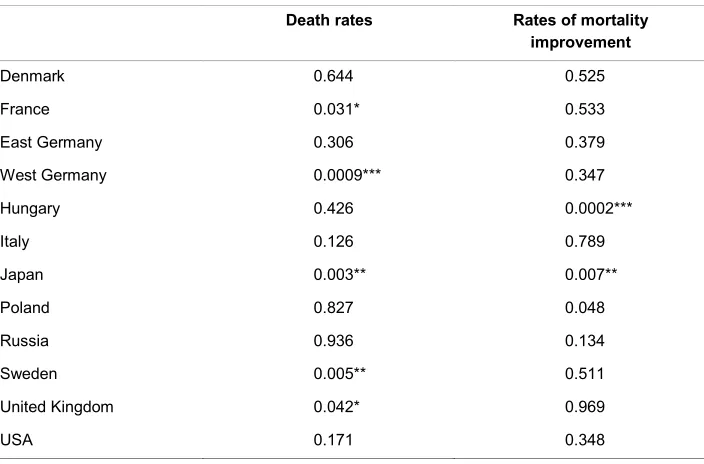
To conduct these analyses, we use the lm() function of the statistical software R (2014). Death counts and corresponding exposures by single age (from 0 to 100) and calendar year (from 1960 to 2009) were downloaded from the Human Mortality Database (2014). Parallel analyses for men gave results very similar to those for women. In some cases, however, the slopes b differed between men and women. These analyses have been deposited in the supplementary material.
3. Results
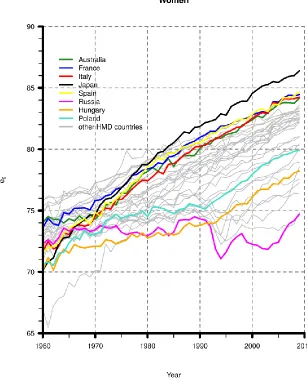
Figure 1 depicts how strongly female life expectancy at birth differs among countries (gray) of the Human Mortality Database (2014) between 1960 and 2009. Japan (black) is the current record life expectancy holder with 86.4 years for women in 2009, closely followed by France (blue), Spain (yellow), Italy (red) and Australia (green). In contrast, Russian life expectancy (magenta) lags far behind these values with 74.7 years for women in 2009. Other Eastern European countries like Hungary (orange) or Poland (turquoise) also experienced an irregular mortality development between 1960 and 2009, including periods of stagnating and increasing mortality, but their current life expectancy at birth is substantially higher than Russia’s.
3.1 Temporal cross-age-scenarios
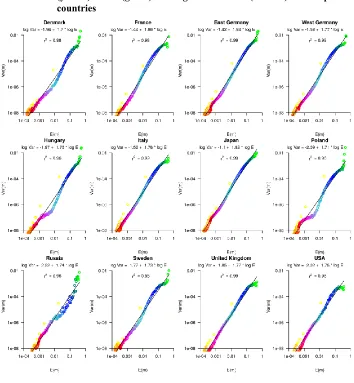
Despite these diverse mortality developments, Figure 2 depicts, for twelve selected countries, a relatively strong linear log10 variance to log10 mean relationship for the
temporal variation of female death rates at ages 0 to 100. Each circle represents the log mean and log variance (over time) at a certain age in a given country; younger ages are depicted in yellow and red, older ages are depicted in blue and green. All ages are on (almost) straight lines with slopes ranging between 1.7 and 1.86 and squared correlation coefficient r2 values ranging from 0.96 to 0.99. Adjacent ages are shown together on
monotonic and proportional relationship) between mean (mortality) and its variance on an absolute scale. Since older ages demonstrated higher death rates than younger ages, their variance also (often) happened to be larger.
Figure 3 depicts the log10 variance to log10 mean relationship for temporal
variation in the female rates of mortality improvement at ages 0 to 100. While the log variance to log mean relationship is almost linear in the twelve selected countries in both cases, Russia and Japan hold special positions: Russia has a smaller slope (1.44) and r2 value (0.67) than Japan with 2.62 (slope) and 0.9 (r2 value). Except for the
youngest (yellow) and oldest (green) ages, adjacent ages are also placed side by side for survival improvements, but higher ages (blue) usually have had smaller means and variances than younger ages (orange and red). In the future, this descending order of ages could change or reverse, if relatively large survival improvements advanced to higher ages.
3.2 Temporal cross-country-scenarios
Figure 3: Temporal cross-age variances (Var) and means (E) for female rates of mortality improvement (ϱ) over 1960−2009 show a linear
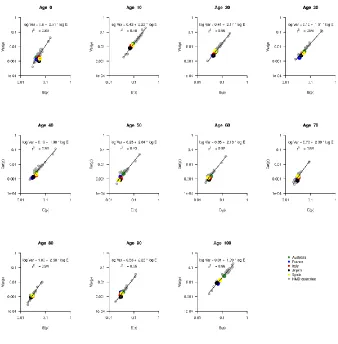
For every country in the cross-age-scenarios, the slope for death rates (Figure 2) is notably less than 2. The country with the highest slope, 1.86, is France. By contrast, in the cross-age-scenarios, the slope for rates of mortality improvement (Figure 3) is notably greater than 2 except for Russia with slope 1.44 and USA with slope 1.94. In the cross-country-scenarios, the slope for rates of mortality improvement (Figure 5) is likewise notably greater than 2 except for age 100. These differences in slopes indicate that a given proportional increase in the temporal mean rate of mortality improvement is generally associated with a greater proportional increase in the temporal variance of the rate of mortality improvement than the parallel in the case of death rates.
3.3 Statistical tests
Tests for linearity
Based on the statistical significance of linear and quadratic regression terms as well as on values for the Akaike information criterion and for r2, our tests reveal for rates of
mortality improvement that the linear regression models are more appropriate than the quadratic regression models. For death rates, the quadratic regression model performs marginally better than the linear model in the cross-age-scenario (Figure 2). However, both linear and quadratic models appear to be appropriate since, for instance, r2 values
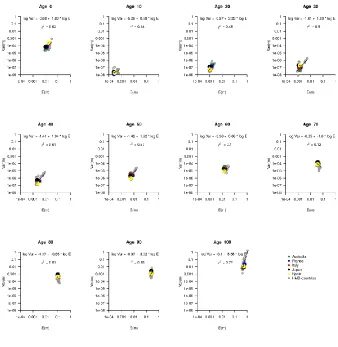
are very similar. In the cross-country-scenario, by contrast, neither the linear nor the quadratic regression models fit the clumped variance to mean relationships of the death rates (Figure 4).
Tests for different slopes
4. Concluding remarks
Studies of fundamental patterns of mortality often focus either on the mean or on the variation of mortality. Our analysis of the mean and the variance of mortality in combination detected a regular pattern, TL, not only for the level, but also for the change of mortality over time.
Mean of mortality
Average age profiles of human mortality are typically described by laws of mortality, but they also gained attention from a biodemographic perspective regarding theories of aging in recent years. Gompertz's (1825) law describes the profile of adult mortality with an exponential increase, whereas, e.g., Thiele (1871) and Siler (1983) added terms to model mortality for the young and the old. Burger, Baudisch, and Vaupel (2012) look at the evolution of the fundamental age schedule of human mortality, describing its progress from hunter-gatherers to present highly developed populations; although they state that human mortality levels dropped extraordinarily compared to other species, particularly since 1900, they also show that the shape of human mortality remains fairly stable. Bronikowski et al. (2011) show that this age profile of mortality is not only stable for humans over time, but also for primates, whereas Jones et al. (2014) emphasize the diversity in these age profiles across various species.
Variance of mortality
Fundamental patterns and trends in the variation of age at death are typically detected with indices of lifespan variability, which have been reviewed by, for example, van Raalte and Caswell (2013) and Wilmoth and Horiuchi (1999). Among these indices are, for instance, simple measures such as the variance, the standard deviation or the interquartile range, but also more complex measures such as e† (Vaupel and Canudas
Romo 2003). Engelman, Caswell, and Agree (2014) point out that the variation of longevity declined in highly developed countries, but they also show that the variability regarding the progress of relatively high survival improvements in older ages persists in those countries.
Mean and variance of mortality
slopes are comparable to those of ecological studies (Kilpatrick and Ives 2003) of population density. Cross-country-scenarios for death rates (Figure 4) show clustered variance to mean relationships on the logarithmic scale due to similar mortality levels among the countries at single ages. Our results support the two hypotheses in section 1 and suggest that TL could be used (1) to evaluate the quality of mortality forecasts immediately after their generation and to justify linear mortality assumptions on the logarithmic scale, as well as (2) to reveal minimum mortality at certain ages for countries with very low mortality − although our analyses do not bring such limits to light.
5. Acknowledgements
References
Anderson, R.M. and May, R.M. (1988). Epidemiological parameters of HIV transmission. Nature 333: 514–519. doi:10.1038/333514a0.
Bohk, C. and Rau, R. (2014). Probabilistic mortality forecasting with varying age-specific survival improvements. arXiv:1311.5380v2 [stat.AP].
Bronikowski, A.M., Altmann, J., Brockman, D.K., Cords, M., Fedigan, L.M., Pusey, A., Stoinski, T., Morris, W.F., Strier, K.B., and Alberts, S.C. (2011). Aging in the natural world: comparative data reveal similar mortality patterns across primates. Science 331: 1325–1328. doi:10.1126/science.1201571.
Burger, O., Baudisch, A., and Vaupel, J.W. (2012). Human mortality improvement in evolutionary context. Proceedings of the National Academy of Sciences 109(44): 18210–18214. doi:10.1073/pnas.1215627109.
Cohen, J.E., Xu, M., and Brunborg, H. (2013). Taylor’s law applies to spatial variation in a human population. Genus 69(1): 25–60.
Engelman, M., Caswell, H., and Agree, E.M. (2014). Why do lifespan variability trends for the young and old diverge? A perturbation analysis. Demographic Research 30(48): 1367–1396. doi:10.4054/DemRes.2014.30.48.
Gompertz, B. (1825). On the nature of the function of the law of human mortality, and on a new mode of determining the value of life contingencies. Philosophical Transactions of the Royal Society of London 115: 513–583. doi:10.1098/rstl. 1825.0026.
Haberman, S. and Renshaw, A.E. (2012). Parametric mortality improvement rate modelling and projecting. Insurance: Mathematics and Economics 50: 309–333.
doi:10.1016/j.insmatheco.2011.11.005.
Jones, O.R., Scheuerlein, A., Salguero-Gomez, R., Camarda, C.G., Schaible, R., Casper, B.B., Dahlgren, J.P., Ehrlen, J., Garcia, M.B., Menges, E.S., Quintana-Ascencio, P.F., Caswell, H., Baudisch, A., and Vaupel, J.W. (2014). Diversity of ageing across the tree of life. Nature 505: 169–173. doi:10.1038/nature12789. Kannisto, V., Lauritsen, J., Thatcher, A.R., and Vaupel, J.W. (1994). Reductions in
mortality at advanced ages: several decades of evidence from 27 countries. Population and Development Review 20(4): 793−810. doi:10.2307/2137662. Kendal, W.S. (2004a). A scale invariant clustering of genes on human chromosome 7.
Kendal, W.S. (2004b). Taylor’s ecological power law as a consequence of scale invariant exponential dispersion models. Ecological Complexity 1: 193–209.
doi:10.1016/j.ecocom.2004.05.001.
Kilpatrick, A.M. and Ives, A.R. (2003). Species interactions can explain Taylor’s power law for ecological time series. Nature 422: 65–68. doi:10.1038/nature01471. Lee, R.D. and Carter, L.R. (1992). Modeling and forecasting U.S. mortality. Journal of
the American Statistical Association 87(419): 659–671. doi:10.1002/for.3980110 303.
Mitchell, D., Brockett, P., Mendoza-Arriage, R., and Muthuraman, K. (2013). Modeling and forecasting mortality rates. Insurance: Mathematics and Economics 52: 275–285. doi:10.1016/j.insmatheco.2013.01.002.
Oeppen, J. and Vaupel, J.W. (2002). Broken limits to life expectancy. Science 296: 1029–1031. doi:10.1126/science.1069675.
R Core Team (2014). R: A Language and Environment for Statistical Computing. Vienna, Austria: R Foundation for Statistical Computing. http://www.R-project.org/.
Renshaw, A.E. and Haberman, S. (2003). Lee-Carter mortality forecasting with age-specific enhancement. Insurance: Mathematics and Economics 33: 255–272.
doi:10.1016/S0167-6687(03)00138-0.
Renshaw, A.E. and Haberman, S. (2006). A cohort-based extension to the Lee-Carter model for mortality reduction factors. Insurance: Mathematics and Economics 38: 556–570. doi:10.1016/j.insmatheco.2005.12.001.
Rhodes, C.J. and Anderson, R.M. (1996). Power laws governing epidemics in isolated populations. Nature 381: 600–602. doi:10.1038/381600a0.
Siler, W. (1983). Parameters of mortality in human populations with widely varying life spans. Statistics in Medicine 2: 373–380. doi:10.1002/sim.4780020309.
Taylor, L.R. (1961). Aggregation, variance and the mean. Nature 189: 732–735.
doi:10.1038/189732a0.
Thiele, T.N. (1871). On a mathematical formula to express the rate of mortality throughout the whole of life. Journal of the Institute of Actuaries and Assurance Magazine 16(5): 313–329.
University of California, Berkeley (USA) and Max Planck Institute for Demographic Research, Rostock (Germany) (2014). Human Mortality Database. www.mortality.org.
Vallin, J. and Meslé, F. (2010). Will life expectancy increase indefinitely by three month every year? Population & Societies 473: 1–4.
van Raalte, A.A. and Caswell, H. (2013). Perturbation analysis of indices of lifespan variability. Demography 50(5): 1615–1640. doi:10.1007/s13524-013-0223-3. Vaupel, J.W. and Canudas Romo, V. (2003). Decomposing change in life expectancy: a
bouquet of formulas in honour of Nathan Keyfitz’s 90th birthday. Demography 40(2): 201–216. doi:10.1353/dem.2003.0018.
Vaupel, J.W., Zhang, Z., and van Raalte, A.A. (2011). Life expectancy and disparity: an international comparison of life table data. BMJ Open 1(1): 1–6. doi:10.1136/
bmjopen-2011-000128.
Appendix: Supplementary material
Table A1: Cross-Age-Scenarios: Do the slopes of TL differ between women and men?
Death rates Rates of mortality improvement
Denmark 0.644 0.525
France 0.031* 0.533
East Germany 0.306 0.379
West Germany 0.0009*** 0.347
Hungary 0.426 0.0002***
Italy 0.126 0.789
Japan 0.003** 0.007**
Poland 0.827 0.048
Russia 0.936 0.134
Sweden 0.005** 0.511
United Kingdom 0.042* 0.969
USA 0.171 0.348