VOLUME 34, ARTICLE 29, PAGES 827
−
844
PUBLISHED 18 MAY 2016
http://www.demographic-research.org/Volumes/Vol34/29/ DOI: 10.4054/DemRes.2016.34.29
Research Article
The contributions of childbearing within
marriage and within consensual union to fertility
in Latin America, 1980–2010
Benoît Laplante
Teresa Castro-Martín
Clara Cortina
Ana Laura Fostik
© 2016 Laplante, Castro Martín, Cortina & Fostik.
This open-access work is published under the terms of the Creative Commons Attribution NonCommercial License 2.0 Germany, which permits use, reproduction & distribution in any medium for non-commercial purposes, provided the original author(s) and source are given credit.
1 Introduction 828
2 Data and methods 830
3 Results 832
4 Discussion 841
5 Acknowledgments 842
The contributions of childbearing within marriage and within
consensual union to fertility in Latin America, 1980–2010
Benoît Laplante1
Teresa Castro-Martín2
Clara Cortina3
Ana Laura Fostik4
Abstract
BACKGROUND
Research has shown that the prevalence of unmarried cohabitation has increased in most Latin American countries and that childbearing within consensual union, traditionally confined to low-income groups, is becoming socially acceptable among highly educated women.
OBJECTIVE
We focus on the increasing importance of childbearing within consensual union for overall fertility. We measure the relative contribution of births within marriage and births within consensual union to period fertility as a component of population change for 13 Latin American countries from 1980 to 2010.
METHODS
We use census data and the own-children method to estimate the contribution of marriage and consensual union to age-specific fertility rates, to cumulative fertility, and to the TFR.
RESULTS
In most Latin American countries the contribution of marriage to age-specific fertility rates has decreased over time, whereas the contribution of consensual union has increased steadily. In Argentina, Bolivia, Chile, Costa Rica, and Mexico the contribution of marriage to the TFR is still larger than the contribution of consensual union. In Ecuador and Uruguay they have become roughly similar. In Brazil, Colombia,
1 Institut national de la recherche scientifique, Montréal, Canada. E-Mail: [email protected]. 2 Spanish National Research Council (CSIC), Spain.
3
Universitat Pompeu Fabra, Spain.
Cuba, Panama, Peru, and Venezuela the contribution of consensual union to the TFR is larger than that of marriage.
CONCLUSIONS
In Latin America, fertility, as a component of population change, is less and less related to marriage and increasingly linked to consensual union instead.
1. Introduction
Latin America is known for its dual nuptiality regime. Marriage and consensual union have coexisted side by side in most countries of the region for centuries (Lavrin 1989; Quilodrán 1999; De Vos 2000; Castro-Martín 2002; Rodríguez Vignoli 2004; Esteve, Lesthaeghe, and López-Gay 2012). However, the prevalence of unmarried cohabitation has historically been heterogeneous in the region and it remains so nowadays: the share of consensual unions among all conjugal unions of women aged 15 to 49 currently ranges from about 20% in Chile to 74% in the Dominican Republic (Castro-Martín et al. 2011). An increase in the prevalence of consensual unions has been documented for most Latin American countries as of the 1970s and particularly from the 1990s onwards (Esteve, Lesthaeghe, and López-Gay 2012).
Due to its long-standing presence as a form of conjugal union and to the high level of social acceptance it enjoys, childbearing within consensual union is widespread in the region. This can be partly explained by the fact that consensual unions are not merely ‘trial marriages,’ typical of younger age groups. They are also prevalent in later stages of the life course. Moreover, childbearing within consensual union has undergone a remarkable increase in the past decades. The proportion of births to unmarried cohabiting parents has gone from 15% in 1970 to 39% in 2000 (Castro-Martín et al. 2011). Births from unpartnered mothers have also increased during this period, from 7% to 15%, which implies that nowadays nonmarital births are actually more common in the Latin American region than marital births.
observed among women aged 30 to 45. This study also found that, in most countries, childbearing within a consensual union had also become increasingly common for highly educated women. This is a clear indication that the similarities in reproductive behaviour between marital and nonmarital unions are not confined to the socially disadvantaged but apply as well to the better-off. According to these results, the authors conclude that in Latin America, at least since the 1980s, women’s childbearing patterns depend on their age and on their living in a conjugal relationship, but not on the legal nature of this relationship.
The approach used by Laplante et al. (2015) provides valuable insight into the social acceptability of childbearing within consensual unions. The conditional age-specific fertility rates (ASFRs), conditional cumulative fertility, and conditional TFR they use allow for comparing fertility patterns across conjugal status − i.e., for unpartnered, cohabiting, and married women − within a given social group − e.g., groups defined by education level. If the distributions of ASFRs, cumulative fertility, and TFR within marriage and within consensual union are similar for a specific social group, both conjugal states are likely to be acceptable for childbearing and childrearing among the individuals who belong to that group. According to their results, there is wide social recognition conferred on consensual unions and women apparently feel free to have children with their partner without being married. Highly educated women lag behind but follow the same tendency, although it is likely that the underlying motivations and meanings attached to cohabitation differ across social strata (Covre-Sussai et al. 2015).
2. Data and methods
In many Latin American countries, vital statistics suffer from under-registration (Harbitz, Benítez Molina, and Arcos Axt 2010). Furthermore, with some exceptions such as Costa Rica, they do not provide information on whether unmarried mothers are living with the father of the child. As a consequence, children born of a mother living in a consensual union are not reported separately from those born of a mother who does not have a coresidential partner. In order to distinguish births to cohabiting mothers from births to unpartnered mothers, researchers must resort to census data or surveys with retrospective birth histories. All Latin American census sources contain reliable information on current conjugal status and include a separate category for consensual union (Rodríguez Vignoli 2011). Unlike data from retrospective biographical surveys, they are available for a large number of Latin American countries. They provide a workable alternative to vital statistics or biographical surveys when used with the own-children method of fertility estimation.
The own-children method was designed to study fertility using census data so that fertility could be related to characteristics collected by the census but not recorded in vital statistics (Cho, Rutherford, and Choe 1986). Using the own-children method allows us to identify recent births in consensual couples and in married couples. The original form of the method uses the distribution of the number of children less than five years old in the household conditional on the age of mothers aged between 15 and 49, grouped into five-year classes. We use a somewhat modified form based on the distribution of the number of children less than one year old in the household conditional on the age of mothers aged between 15 and 49, ungrouped.5
We use data from the IPUMS collection of harmonised census microdata files from the four most recent census rounds available (Minnesota Population Center 2014). Our selection includes samples ranging from 1980 to 2010 for 13 Latin American countries: Argentina, Bolivia, Brazil, Chile, Colombia, Costa Rica, Cuba, Ecuador, Mexico, Panama, Peru, Uruguay, and Venezuela.
In this paper, we use two measures introduced in Laplante and Fostik (2015): the contribution of each conjugal status to age-specific fertility rates (CASFR) and the contribution of each conjugal status to cumulative fertility (CCF). The first measure, the contribution of each conjugal status to age-specific fertility rates (CASFR), is computed as the product of the within conjugal status age-specific rate and the proportion of women of the same age in a given type of conjugal status. The sum of the contributions
5 Since calculations are based on children aged up to one year, mothers’ conjugal status may have changed
of each conjugal status to age-specific fertility rates is the age-specific rate. The second measure, the contribution of each conjugal status to cumulative fertility (CCF), is the sum over age of the contributions of each conjugal status to age-specific fertility rates. The sum of the contributions of each conjugal status to cumulative fertility is the cumulative fertility. The sum of the contributions of all conjugal statuses to overall fertility is the Total Fertility Rate. The value of the contribution of each conjugal status to cumulative fertility at age 49 is the contribution of the conjugal status to the TFR. Interested readers will find a detailed presentation of the two measures in Laplante and Fostik (2015).
Substantively, the contributions to age-specific fertility rates provide a description of the fertility, over her life course, of a ‘synthetic woman’ – the average woman of the synthetic cohort – who would have spent her reproductive years moving between being unpartnered, cohabiting, and being married. The contributions to the TFR provide a decomposition of the cumulative fertility of this synthetic woman. Over her life course she would have had exactly the same number of children as the period TFR, but using the contributions of each conjugal status allows us to detail the proportion of these children she would have had while having no coresidential partner, while cohabiting, and while being married.
The method and data we use have known limitations. The most obvious difficulties of the own-children method are establishing the relationship between mother and child from census records, census undercoverage of children and women, infant mortality, and children who do not live with their mother (Grabill and Cho 1965). However, Rindfuss (1976) compared estimates of USA fertility based on vital statistics with estimates based on census data and the own-children method and he concluded that the own-children estimations reproduced the trends in fertility, despite not reproducing the levels of vital statistics. In this analysis, the TFR calculated with the own-children method also underestimates the TFR obtained by direct estimation, but there is no reason to suspect that the degree of underestimation varies by conjugal status. In other words, the levels of fertility associated with marriage, consensual union, and living without a partner may be underestimated, but the underestimation is likely to be systematic and, consequently, the relative contribution of marriage and consensual union to overall fertility can be assumed to be reasonably accurate.6
Results are reported in one table and several figures. Given the importance of the proportion of women who are in a marital union and a consensual union according to age in the computation of CASFR and CCF, we report these proportions first.
6 Using IPUMS data adds another limitation: the data do not allow taking multiple births into account. In the
3. Results
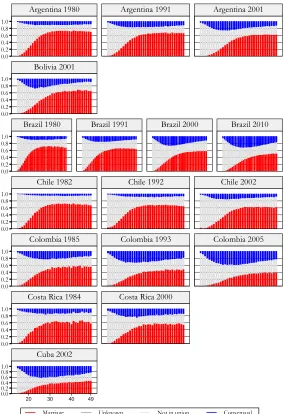
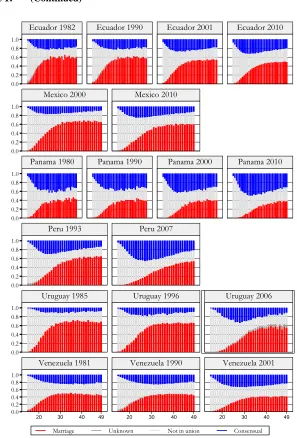
Figure 1 displays the distribution of conjugal status according to age for women aged 15−49. It shows that, in most countries for which data are available for more than one census, the proportion of women of reproductive age living in a consensual union has increased steadily over time. There are two notable exceptions to this general pattern, Ecuador and Panama, where this proportion remained relatively stable between the early 1980s and the early 2000s, although it did increase afterwards. Panama is more of an outlier, as the proportion of women living in a consensual union was already large in 1980 – actually larger than in most countries in their most recent censuses.
In nearly all countries, the proportion of married women first increases steadily with age and then reaches a plateau. By contrast, the proportion of cohabiting women first increases with age, reaches its maximum, and then decreases − slightly in most countries − with age. In most countries, the proportion of women living in a consensual union increases as the proportion of married women decreases over time. By contrast, the proportion of unpartnered women does not typically diminish as the proportion of cohabiting women increases; in fact, in some countries, such as Colombia and Ecuador, both the proportion of women without a coresidential partner and the proportion of women in consensual union increase across censuses.
Figure 1: Distribution of conjugal status according to age of women aged 15−49 living in selected Latin American countries, 1980−2010
0.0 0.2 0.4 0.6 0.8 1.0
Argentina 1980 Argentina 1991 Argentina 2001
0.0 0.2 0.4 0.6 0.8 1.0
Bolivia 2001
0.0 0.2 0.4 0.6 0.8 1.0
Brazil 1980 Brazil 1991 Brazil 2000 Brazil 2010
0.0 0.2 0.4 0.6 0.8 1.0
Chile 1982 Chile 1992 Chile 2002
0.0 0.2 0.4 0.6 0.8 1.0
Colombia 1985 Colombia 1993 Colombia 2005
0.0 0.2 0.4 0.6 0.8 1.0
Costa Rica 1984 Costa Rica 2000
0.0 0.2 0.4 0.6 0.8 1.0
20 30 40 49 Cuba 2002
Figure 1: (Continued)
Source: Census microdata, IPUMS-International. Weighted estimation. 0.0
0.2 0.4 0.6 0.8 1.0
Ecuador 1982 Ecuador 1990 Ecuador 2001 Ecuador 2010
0.0 0.2 0.4 0.6 0.8 1.0
Mexico 2000 Mexico 2010
0.0 0.2 0.4 0.6 0.8 1.0
Panama 1980 Panama 1990 Panama 2000 Panama 2010
0.0 0.2 0.4 0.6 0.8 1.0
Peru 1993 Peru 2007
0.0 0.2 0.4 0.6 0.8 1.0
Uruguay 1985 Uruguay 1996 Uruguay 2006
0.0 0.2 0.4 0.6 0.8 1.0
20 30 40 49 Venezuela 1981
20 30 40 49 Venezuela 1990
20 30 40 49 Venezuela 2001
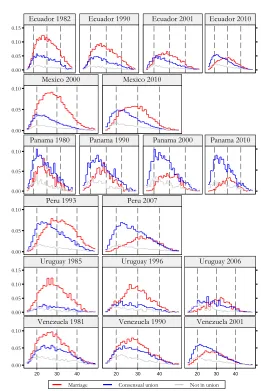
Figure 2: Estimates of the contribution of conjugal status to age-specific fertility rates of women aged 15−49 living in selected Latin American countries, 1980−2010
0.00 0.05 0.10 0.15
Argentina 1980 Argentina 1991
0 .05 .1 .15 Argentina 2001 0.00 0.05 0.10 0.15 Bolivia 2001 0.00 0.05 0.10 0.15
Brazil 1980 Brazil 1991 Brazil 2000
0 .05 .1 .15 Brazil 2010 0.00 0.05 0.10 0.15
Chile 1982 Chile 1992
0 .05 .1 .15 Chile 2002 0.00 0.05 0.10
Colombia 1985 Colombia 1993
0 .05 .1 Colombia 2005 0.00 0.05 0.10 0.15
Costa Rica 1984 Costa Rica 2000
0.00 0.05 0.10
20 30 40
Cuba 2002
Figure 2: (Continued)
Source: Census microdata, IPUMS-International. Weighted estimation.
Table 1 reports the estimates of the contribution of each conjugal status to the total fertility rate for women aged 15−49. Contributions are reported as actual numbers and as proportions. They show that in some countries’ most recent census − Argentina,
0.00 0.05 0.10 0.15
Ecuador 1982 Ecuador 1990 Ecuador 2001
0
.05
.1
.15
Ecuador 2010
0.00 0.05 0.10
Mexico 2000 Mexico 2010
0.00 0.05 0.10
Panama 1980 Panama 1990 Panama 2000
0
.05
.1
Panama 2010
0.00 0.05 0.10
Peru 1993 Peru 2007
0.00 0.05 0.10 0.15
Uruguay 1985 Uruguay 1996
0
.05
.1
.15
Uruguay 2006
0.00 0.05 0.10
20 30 40
Venezuela 1981
20 30 40
Venezuela 1990
0
.05
.1
20 30 40
Venezuela 2001
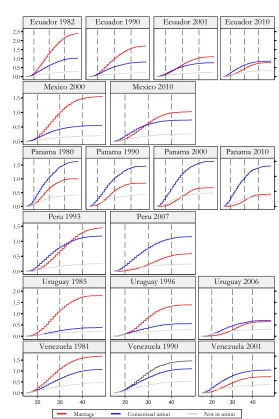
Bolivia, Chile, Costa Rica, and Mexico − the contribution of marriage to the TFR is still larger than the contribution of consensual union, although differentials have been narrowing steadily over recent decades. In Ecuador and Uruguay’s most recent censuses, the contributions of marriage and consensual union are roughly similar. On the other hand, in Brazil, Colombia, Cuba, Panama, Peru, and Venezuela the contribution of consensual union to the TFR is larger than that of marriage; in Panama it was already higher in the 1980 census.
Table 1: Estimates of the contribution of each conjugal status to the total fertility rate of women living in selected Latin American countries
Argentina Bolivia Brazil Chile
1980 1991 2001 2001 1980 1991 2000 2010 1982 1992 2002
Total Fertility Rate 2.90 2.71 2.30 2.84 3.64 2.38 2.02 1.57 2.36 2.21 1.58
Contribution to TFR
Marriage 2.24 1.72 1.11 1.61 2.97 1.54 0.89 0.56 1.87 1.60 0.86
Cohabitation 0.46 0.71 0.85 0.90 0.49 0.59 0.80 0.72 0.17 0.25 0.33
Not in union 0.21 0.27 0.34 0.33 0.18 0.25 0.33 0.29 0.31 0.36 0.39
Proportion of TFR
Marriage 0.77 0.64 0.48 0.57 0.82 0.65 0.44 0.36 0.80 0.72 0.54
Cohabitation 0.16 0.26 0.37 0.32 0.13 0.25 0.40 0.46 0.07 0.11 0.21
Not in union 0.07 0.10 0.15 0.12 0.05 0.11 0.16 0.18 0.13 0.16 0.25
Colombia Costa Rica Cuba Ecuador Mexico
1985 1993 2005 1984 2000 2002 1982 1990 2001 2010 2000 2010
Total Fertility Rate 2.27 1.87 1.89 3.02 2.23 1.51 3.70 2.73 2.11 1.98 2.30 1.96
Contribution to TFR
Marriage 1.25 0.74 0.45 1.97 1.11 0.52 2.39 1.70 1.11 0.78 1.55 0.99
Cohabitation 0.74 0.87 1.03 0.57 0.72 0.77 1.02 0.81 0.77 0.86 0.55 0.71
Not in union 0.28 0.26 0.41 0.48 0.40 0.21 0.28 0.22 0.24 0.33 0.20 0.25
Proportion of TFR
Marriage 0.55 0.39 0.24 0.65 0.50 0.35 0.65 0.62 0.52 0.40 0.67 0.51
Cohabitation 0.33 0.47 0.54 0.19 0.32 0.51 0.28 0.30 0.36 0.44 0.24 0.36
Not in union 0.12 0.14 0.22 0.16 0.18 0.14 0.08 0.08 0.11 0.17 0.09 0.13
Panama Peru Uruguay Venezuela
1980 1990 2000 2010 1993 2007 1985 1996 2006 1981 1990 2001
Total Fertility Rate 3.05 2.50 2.60 2.12 2.88 1.98 2.38 2.24 1.64 3.22 2.77 1.93
Contribution to TFR
Marriage 1.00 0.77 0.63 0.41 1.45 0.59 1.80 1.39 0.64 1.68 1.31 0.66
Cohabitation 1.63 1.34 1.52 1.35 1.17 1.15 0.38 0.56 0.69 1.07 0.99 0.93
Not in union 0.42 0.39 0.45 0.36 0.26 0.24 0.20 0.29 0.30 0.47 0.47 0.34
Proportion of TFR
Marriage 0.33 0.31 0.24 0.19 0.50 0.30 0.76 0.62 0.39 0.52 0.47 0.34
Cohabitation 0.54 0.53 0.58 0.64 0.41 0.58 0.16 0.25 0.42 0.33 0.36 0.48
Not in union 0.14 0.16 0.17 0.17 0.09 0.12 0.08 0.13 0.18 0.14 0.17 0.17
Interestingly, in most countries the increase in the proportion of fertility from cohabiting women goes hand in hand with an increase in the proportion of fertility from unpartnered women.
Figure 3: Estimates of the contribution of conjugal status to cumulative fertility of women aged 15−49 living in selected Latin American countries, 1980−2010 0.0 0.5 1.0 1.5 2.0
Argentina 1980 Argentina 1991
0 .5 1 1 .5 2 Argentina 2001 0.0 0.5 1.0 1.5 2.0 Bolivia 2001 0.0 0.5 1.0 1.5 2.0 2.5 3.0
Brazil 1980 Brazil 1991 Brazil 2000
0 .5 1 1 .5 2 Brazil 2010 0.0 0.5 1.0 1.5 2.0
Chile 1982 Chile 1992
0 .5 1 1 .5 2 Chile 2002 0.0 0.5 1.0 1.5
Colombia 1985 Colombia 1993
0 .5 1 1 .5 Colombia 2005 0.0 0.5 1.0 1.5 2.0
Costa Rica 1984 Costa Rica 2000
0.0 0.5 1.0
20 30 40
Cuba 2002
Figure 3: (Continued)
Source: Census microdata, IPUMS-International. Weighted estimation. 0.0 0.5 1.0 1.5 2.0 2.5
Ecuador 1982 Ecuador 1990 Ecuador 2001
0 .5 1 1 .5 2 2 .5 Ecuador 2010 0.0 0.5 1.0 1.5
Mexico 2000 Mexico 2010
0.0 0.5 1.0 1.5
Panama 1980 Panama 1990 Panama 2000
0 .5 1 1 .5 Panama 2010 0.0 0.5 1.0 1.5
Peru 1993 Peru 2007
0.0 0.5 1.0 1.5 2.0
Uruguay 1985 Uruguay 1996
0 .5 1 1 .5 2 Uruguay 2006 0.0 0.5 1.0 1.5
20 30 40 Venezuela 1981
20 30 40 Venezuela 1990 0 .5 1 1 .5
20 30 40 Venezuela 2001
4. Discussion
During the past three decades, the Latin American region not only has experienced a substantial fertility decline − the TFR dropped from 3.95 in 1980−1984 to 2.15 in 2010−2015 (United Nations 2015) − but the relative contribution of births within marriage and within consensual union to overall fertility has also changed markedly. Due to the increasing proportion of women of reproductive age living in a consensual union and the similarity of childbearing patterns of married and cohabiting women, the proportion of overall fertility attributable to births to cohabiting couples has risen in all countries.
In nearly all Latin American countries the proportion of women living in a consensual union first increases with age, reaches its maximum, and then decreases − slightly in most countries − with age. This shape of the distribution of women living in consensual union may suggest two different interpretations: cohabiting couples tend to formalize their relationship through marriage over the life course, or the rate of entry into consensual union is higher among the younger generations than among the older ones. There is no simple way to choose one interpretation over the other without longitudinal data, and probably both are accurate.
In all Latin American countries for which we have census microdata, the relative contribution of childbearing within consensual union to total fertility has increased considerably during the past three decades. It has already surpassed the contribution of childbearing within marriage in 8 out of the 13 countries under study: Brazil, Colombia, Cuba, Ecuador, Panama, Peru, Uruguay, and Venezuela. Among the countries for which data from the 2010 census round are available, Mexico is the only one where the contribution of marriage is larger than that of consensual union. To the extent that living in a consensual union rather than being married keeps becoming more common among the youngest cohorts, the contribution of births within consensual union might exceed that of marriage in nearly all countries of the region in the not so distant future.
The underlying causes of this unanticipated increase in unpartnered motherhood are worth investigating further.
5. Acknowledgements
References
Castro-Martín, T. (2002). Consensual unions in Latin America: Persistence of a dual nuptiality system. Journal of Comparative Family Studies 33(1): 35–55.
Castro-Martín, T., Cortina, C., Martín-García, T., and Pardo, I. (2011). Maternidad sin matrimonio en América Latina: un análisis comparativo a partir de datos censales. Notas de Población 93: 37–76.
Cho, L.-J., Rutherford, R.D., and Choe, M.K. (1986). The own-children method of fertility estimation. Honolulu: University of Hawaii Press.
Coale, A.J. and Watkins, S.C. (eds.) (1986). The decline of fertility in Europe: the Revised Proceedings of a conference on the Princeton European fertility project. Princeton: Princeton University Press.
Covre-Sussai, M., Meuleman, B., Botterman, S., and Matthijs, K. (2015). Traditional and modern cohabitation in Latin America: A comparative typology.
Demographic Research 32(32): 873−914. doi:10.4054/DemRes.2015.32.32.
De Vos, S. (2000). Nuptiality in Latin America. In: Browning, S.L. and Miller, R.R. (eds.). Till death do us part: A multicultural anthology on marriage. Stanford: JAI Press: 219−243.
Esteve, A., Lesthaeghe, R., and López-Gay, A. (2012). The Latin American cohabitation boom, 1970–2007. Population and Development Review 38(1): 55−81. doi:10.1111/j.1728-4457.2012.00472.x.
Grabill, W.H. and Cho, L.-J. (1965). Methodology for the measurement of current fertility from population data on young children. Demography 2: 50–73.
doi:10.2307/2060106.
Harbitz, M.E., Benítez Molina, J.C., and Arcos Axt, I. (2010). Inventario de los registros civiles e identificación de América Latina y el Caribe. Washington: Banco Interamericano de Desarrollo.
Lavrin, A. (ed.). (1989). Sexuality and Marriage in Colonial Latin America. Lincoln and London: University of Nebraska Press.
Laplante, B. and Fostik, A.L. (2015). Two period measures for comparing the fertility of marriage and cohabitation. Demographic Research 32(14): 421−442.
Laplante, B., Castro-Martín, T., Cortina, C., and Martín-García, T. (2015). Childbearing within marriage and consensual union in Latin America, 1980−2010. Population and Development Review 41(1): 85−108. doi:10.1111/j.1728-4457.2015. 00027.x.
Minnesota Population Center (2014). Integrated public use microdata series, international: Version 6.3 [Machine-readable database]. Minneapolis: University of Minnesota.
Quilodrán, J. (1999). L’union libre en Amérique Latine: aspects récents d’un phénomène séculaire. Cahiers Québécois de Démographie 28(1−2): 53−80.
doi:10.7202/010259ar.
Rindfuss, R.R. (1976). Annual fertility rates from census data on own children: Comparisons with vital statistics data for the United States. Demography 13(2): 235−249. doi:10.2307/2060803.
Rodríguez Vignoli, J. (2004). Cohabitación en América Latina: ¿Modernidad, exclusión o diversidad? Papeles de Población 40: 97−145.
Rodríguez Vignoli, J. (2011). La situación conyugal en los censos latinoamericanos de la década de 2000: relevancia y perspectivas. In: Ruiz Salguero, M. and Rodríguez Vignoli, J. (eds.). Familia y nupcialidad en los censos latinoamericanos recientes: una realidad que desborda los datos. Santiago: CELADE: 47−70.