Journal of Today’s Ideas – Tomorrow’s Technologies,
Vol. 4, No. 1, June 2016 pp. 15–32
DOI: 10.15415/jotitt.2016.41002
Student’s perception of effectiveness of a technology
enhanced problem based learning environment in
a Mechanical Engineering module
SANDEEP CHOWDHRY
School of Engineering, Edinburgh Napier University, Scotland, U.K. Email: [email protected]
Received: March 31, 2016 | Revised: April 30, 2016 | Accepted: May 31, 2016 Published Online: June 07, 2016
The Author(s) 2016. This article is published with open access at www.chitkara.edu.in/publications
Abstract
The main aim of this research is to improve the use of education technology inproblem based learning (PBL) environment in a Mechanical Engineering (ME) module. The research study adoptedthe quantitative and qualitative methods. The study sample comprised of 79 students from Edinburgh Napier University (ENU), Scotland. Thedata gathering instrument comprised of two quantitative and one qualitative student’s feedback questionnaires. The results shows that education technology integration into the PBL environment according to the students learning needs,toprovide students with an opportunities to collaborate and build new knowledge in a PBL environment. Finally, the study proposed an improved design of the learning task. It implies the need for the teaching institution to provide academic staff development to support tutors in carrying out PBL and to encourage the use of tools like 3E-Framework that help academic staff to meaningfully incorporate technology into learning and teaching.Keywords: problem based learning, education technology, instruction design
1. INtRODuCtION
Chowdhry, S. difficulties in completing the engineering design coursework and have needed study support. Thus, the final design coursework submissions are not of good quality about new knowledge construction, and suggested that students did not fully engage with the module content. This experience, encouraged to do research, to effectively used education technology in the PBL environment. To improve the students’ learning experience,the study will focus on the PBL approach and the education technology integration in the education.
1.1 Problem based learning
PBL is an instructional model that assumes the centrality of problems to learning such as illstructured and wellstructured, simple and complex (Jonassen & Hung, 2008). To achieve the full potential of PBL students should havethe opportunities to actively engage in the learning process and fully exploit the learner-centered design (Tambouris et al., 2012). Wiznia, Korom, Marzuk, Safdieh, & Grafstein (2012) have stated that PBL works best by engaging students’ in a dynamic way while working through a case. To achieve this, students should have opportunities to prepare for the topic in advance. Gallagher & Gallagher’s (2013) research hasinferred that awell-designed, engaging curriculum such as PBL can create learning content that encourages more students to reveal their academic potential and improve content delivery, skill development and strengthen engagement. In addition, there are certain unique characteristics of PBL such as guidance of a tutor, incorporation of problems, feedback control, collaborative efforts etc. that can raise the motivation of the students and self-regulated learning (Jolly & Jacob, 2012).
1.2 Technology in education
Student’s perception of effectiveness of a technology enhanced problem based learning environment in a Mechanical Engineering module of responsibilities for individuals to self and others in the construction of
knowledge. Donnelly (2005) hasrecommended three tutor roles for online PBL environment. They are: ‘1) the tutor should aim to create a learning environment that uses life, work and educational experiences as key elements in the learning process to make it meaningful, 2) the tutor should present the curriculum in a manner that allows participants easily to translate theories into application and provides participants with the proper tools to transcribe theory into practice, 3) it is tutor’s responsibility to help the group to probe more deeply. Therefore, the tutor can do it in several ways, including by raising exploratory questions, pointing out conflicting evidence or asking questions that would extend the inquiry in key direction’. In the present study, the education technology tools used are Power Point slides, VLE, Wiki, discussion boards, Elluminate Live, e-Resources and, simulations. The use of education technology tools helps to provide uniform learning opportunities to the students in large class sizes ranging from 100-150 students.
The above literature shows thatusing education technology in PBL environment has a potential to improve the students learning experience, and there is a need to consider them with the teaching practice and students’ learning needs. Kennedy, Judd, Churchward, Gray, & Krause (2008) argue that university educators should have awareness of the ever changing and often diverse characteristics of students. Understanding the students must remain an important factor in telling how to use the array of technological tools to design rich and engaging learning experiences for all students. However, despite such approvals there are still many unanswered questions about using education technology to actively engage students, providing learning opportunities, and to effectively integrate education technology in a PBL environment of different context (Schon, 1983).
Chowdhry, S. 2. BACKgROuND
The goal of this research includes the creation of an effective PBL environment by using different education technology media forms in the presentation and understanding of content. Added goals include rules for lecturers to meaningfully incorporate technology into learning and teaching. These goals will help the lecturers to effectively integrate education technology in teaching and to improve the students’ learning experience.
The findings of this study may prove useful to other lecturers, not only of “Engineering Application” module but of other discipline which are using PBL approach. This study did not considered all the variables present with technology aided and unaided activities and the assessment in the study.
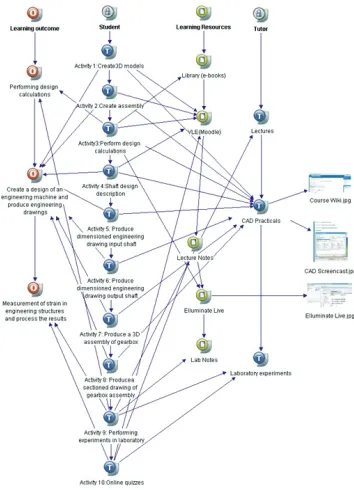
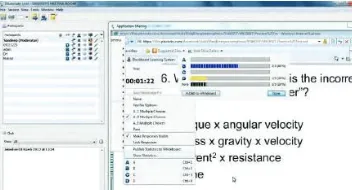
Figure 1 shows learning and teaching activities in the “Engineering Application” module. For instance, tutors conduct lectures, CAD practicals and laboratory experiments. Wiki (fig.1a) and the CAD screencasts (fig.1b) provide extra study support for the CAD practicals. Second, learning resources include library, VLE, study notes and “Elluminate Live” software (fig.1c). Third, VLE provides details on the each week’s learning activity. Students have to complete ten learning activities to achieve three learning outcomes.
Student’s perception of effectiveness of a technology enhanced problem based learning environment in a Mechanical Engineering module
Figure 1a: Screen shot of course Wiki
Figure 1b: Computer aided design (CAD) screencasts made using Camtasia software (education version)
Chowdhry, S. 3. RESEARCH MEtHOD
3.1 Design of study
The study used a case study design. Quantitative and qualitative anonymous students’ feedback questionnaires examinedthe contributing factors that have led to effective use of education technology in the PBL environment. While the qualitative data gathered hasexamined students’ perceptions, quantitative data hashelped in the triangulation and support the findings.
3.2 Participants
The study has included 79 university students enrolled in the “Engineering Application” module at Edinburgh Napier University (ENU) in Scotland. The course adopted a blended online approach. Before the study, all students have studied the course “Engineering Design and CAD” which covers engineering design process and CAD skills. The students’ were from various departments at the university and some students came as direct entry students through the international exchange program. The study lasted 13 weeks, the students met once a week for two hours CAD practical, and virtual learning environment (VLE) delivered the study material and the learning instructions.
3.3 Procedure of study
A blended online instructiondesign and development has helped to deliver the contentof the “Engineering Application” module by VLE and face to face interaction. Students gain familiarity with the different componentsof the module at the beginning of the trimester. This orientation has covered topics such as the number of lectures and practical sessions during the weeks, assessment criteria, teaching and learning strategy.
Students’ gain awareness about the expectations from them. In the design coursework, students design a gear box for any real-life application. VLE provides information on each week’s learning task. During the two hour CAD practical session, students’ work on the learning activities, and take on “Elluminate Live” softwarebasedonline multiple choice quizzesto check their understanding of the topic.
3.4 Data collection
Student’s perception of effectiveness of a technology enhanced problem based learning environment in a Mechanical Engineering module technology’slearning needs of the student. In week 5, a qualitative students’
feedback questionnaire comprised of the two open ended questions on the module’s ‘learning difficulties’ and the ‘study support needs’ (appendix B). It focuses on finding out whether there areenough learning opportunities for the students to study successfully in the PBL environment. In week 10, another quantitative student feedback data evaluated the effectiveness of educational technology tools used in the PBL environment online. The number of the students who gave the feedback 1, 2, 3 were45, 37 and 26 out of 79 students respectively. In descriptive statistics(withstatistical software SPSS 20.0),pie graph plots and the data summary in the tabular form helped in explaining thedata.
3.5 Research Design
The research work presented in this paper hasused thequantitative and qualitative analysis with three research questions. The quantitative analysis helps in settingup the boundaries around the picture the data has painted of the sampleswhile the qualitative method has provided richer insights into possible interpretations of these quantitative sketches (Scoles, Huxham, & McArthur, 2012, p 634). At first, attention focused on identifying the previous year’s student’s feedback problems in studying the module. Due to general nature of the feedback questions, it was difficult to gather evidence on the effectiveness of the integration of education technology in the module. During the trimester,questionnaires helped in collecting data onstudents’ learning experience on use of education technology in studying the module. As a result,research helped in proposing an improved learning task design to effectively use an education technology toolsto improve the students learning experience in the PBL environment. The research questions (RQ’s) are as follows:
RQ1: Whether education technology is used according to the students learning needs?
The aim of this RQ is to find ways of encouraging students’ to actively use education technology in their studies. To answer this RQ, the quantitative students’ feedback 1 on their familiarity and the experience of using the educational technology in the previous studies isanalysed.
RQ2: Whether students are provided enough opportunities to study successfully in the PBL environment?
Chowdhry, S.
the study support needs isanalysed. To find, whether the learning instructions designmeets the PBL assumptions, the learning activities are mapped against the PBL assumptions of constructivist learning in PBL.
RQ3: Whether the integration of the educational technology tools provided students with opportunities to study successfully in a PBL environment online?
The main aim of this RQ is to find students’ perception on whether the integration of the educational technology tools provided students with opportunities to study successfully in PBL environment online. To answer this RQ, the quantitative students’ feedback 3 helps in analysing the students’ learning experience of using education technology in the module.
3.6 Reliability
A reliability coefficient of Cronbach’s alphadetermined the reliabilityof the first and third quantitative students’ feedback questionnaires. Alpha reliability for the first questionnaire (appendix A) was 0.71 (mean (M) = 4.49, standard deviation (SD) =2.03). Alpha reliability for the second questionnaire (appendix C) was, 0.82 (M=20.54, SD=5.04). A lower limit of Cronbach’s alpha coefficient of 0.60 is acceptable (Hair, Black, Babin, and Anderson, 2009). Therefore, the reliability analysis shows a good consistency of the entire scale of the quantitative questions used for the data collection. In addition, for the questionnaire to be valid, it must be reliable (Gupta & Kapoor, 2007).
Figure 2: Research design diagram
table 1: Cronbach’s alpha coefficient values
Cronbach’s alpha
coefficient Number of items Feedback questionnaire
0.71 8 1
Student’s perception of effectiveness of a technology enhanced problem based learning environment in a Mechanical Engineering module
3.7 Content Validity
Content validity is a simple form of validity in which the researcher decides, if the questionnaire seems a suitablemeasuring instrument. This is not a technical measure but refers to the overt nature and superficial appearance of the questions (Chavan & Khandagale, 2014, p 30). There are satisfactory number of questions in each feedback questionnaire to collect all the relevant information needed to find the effectiveness of the use of education technology tools in improving the students learning experience in the module.
4. ANAlYSIS OF DAtA AND INtERPREtAtION OF tHE RESultS
4.1 RQ1: Whether education technology is used according to the students learning needs?
To answer this RQ, the first students’ feedback data ispresented using the pie graphs.
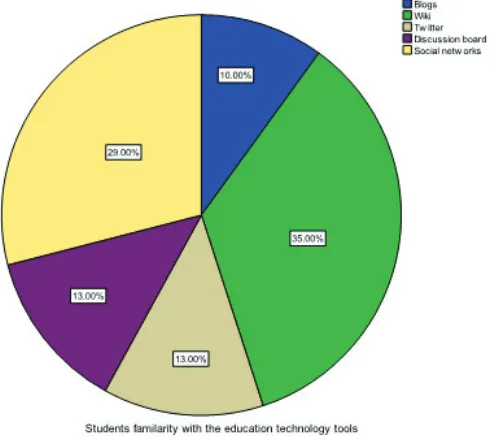
Figure 3 shows that students have some experience of using education technology tools such as blogs, wiki, twitter, discussion boards and social networks (Facebook). For instance, 35% of students are familiar with wiki
Chowdhry, S.
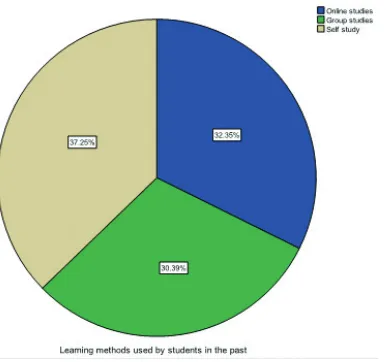
and 13% of students are familiar with the discussion board. Figure 4 shows that besides self-study (35% students), students also have experience of online studies (32.35% students) and group studies (30.39% students). It shows a variation in the students’ past learning experience of using the educational technology tools and the learning methods adopted in their studies. Presently, most of the design coursework instructions are provided on VLE. Students are not provided extra information on how to effectively use education technology in the learning tasksfor individual and group studies. It is inferred, the education technology is not adequately used according to the learning wants of the students.
4.2 RQ2:Whether students are provided enough opportunities to study successfully in the PBL environment?
To answer this RQ, analysis is performed on the secondqualitative students’ feedback on the learning difficulties and the study support needs. The data analysis involved careful reading of the students’ feedback responses to identify the main themes. Secondly, the information is assembled around specific themes and classifying information in specific terms. Finally, decisions and conclusions are drawn.
The students’ feedback data analysis shows that most of the students are having difficulty performing the engineering design calculations. One student commented:
Student’s perception of effectiveness of a technology enhanced problem based learning environment in a Mechanical Engineering module
‘Difficulty with calculations, having trouble understanding what todo?’
Secondly, some students also gave feedback on thedifficulty using the CAD software and in understanding the CAD coursework needs. As one student commented:
‘Difficulty in using CAD and what is expected of the CAD coursework.’
Finally, the students feedback on the study support needs is related to the design calculations, CAD software and improving the VLE instructions. Onestudent commented:
‘VLE support should be of high standards.’
Therefore, the analysis suggests that VLE instructions provided limited opportunities to study successfully in the PBL environment. To find whether learning instructions design considered the PBL assumptions, the learning instructions of theactivity 3 (on performing design calculations) are mapped with the assumptions of the constructivist learning in PBL assumptions as suggested bySavery & Duffy(1995), as shown in the table 2 below:
table 2: Mapping activity 3 learning activities with the PBL assumptions
Assumptions of constructivist learning in PBl by Savery & Duffy (1995)
Activity 3
learning activities for performing design calculation
Learning should engage learners Step1: Students are given description of the design calculations
Learning should be construction of knowledge
Learning should involve promote
self-directed learning Step 2: Students are provided access to the screencasts.
Learning should be based on
authentic or real-world situations Step 3: Students are provided opportunity to apply theory learned in the videos to the real world situation.
Learning should be collaborative
Chowdhry, S. opportunities to actively engage in the learning process. In step 2, access to screencasts help students to learn and understand the engineering concepts and encourage them to do self-directed learning (SDL) to understand there relevance to the gear box design coursework. In step 3, students have to design gear box for any application. As a result, they are provided opportunity to apply their knowledge to real world problem. Table 2, also shows the learning activities did not provide students with satisfactory opportunities in the PBL environment to study collaboratively and in the construction of knowledge. It settled that students do not haveenough opportunities to study successfully in the PBL environment.
4.3 RQ3: Whether the integration of the educational technology tools provided students with my opportunities to study successfully in a PBL environment online?
To answer this RQ, analysis is performed on the students’ quantitative
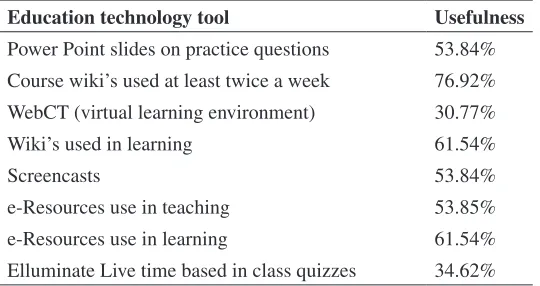
feedback 3 data. The results of the data analysis, as shown in the table
below:
table 3: Students experience of using education technology tools in the module
Education technology tool usefulness Power Point slides on practice questions 53.84% Course wiki’s used at least twice a week 76.92% WebCT (virtual learning environment) 30.77%
Wiki’s used in learning 61.54%
Screencasts 53.84%
e-Resources use in teaching 53.85%
e-Resources use in learning 61.54%
Elluminate Live time based in class quizzes 34.62%
Student’s perception of effectiveness of a technology enhanced problem based learning environment in a Mechanical Engineering module conception, students conception, students actions and teacher’s constructed
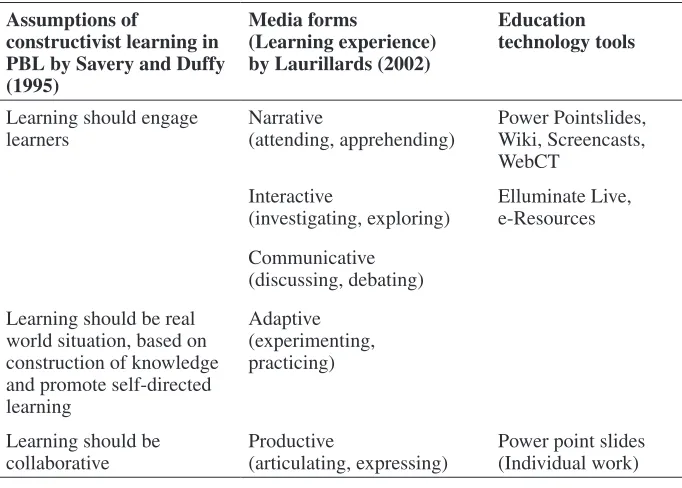
environment. Based on the activities performed in the conversational framework, the different education media forms are characterised as narrative, interactive, communicative, adaptive and productive, each identified with particular kinds of learning experience and delivery method. Whereas, the above results suggests an ineffective integration of the education technology in the PBL environment. For instance, wiki provides information on the learning activities and do not provide students with opportunities to study collaboratively online. To decide, whether the education technology integration is effective in the PBL environment, the uses of the education technology tools are mapped with the PBL assumptions as suggested by ‘Savery& Duffy (1995)’ and the different media forms suggested by Laurillards (2002) as shown in the table 4 below:
table 4: Students experience of using education technology tools in the module
Assumptions of
constructivist learning in PBl by Savery and Duffy (1995)
Media forms
(learning experience) by laurillards (2002)
Education technology tools
Learning should engage
learners Narrative(attending, apprehending) Power Pointslides, Wiki, Screencasts, WebCT
Interactive
(investigating, exploring) Elluminate Live, e-Resources Communicative
(discussing, debating) Learning should be real
world situation, based on construction of knowledge and promote self-directed learning
Adaptive (experimenting, practicing)
Learning should be
Chowdhry, S. 5. DISCuSSION
RQ1 result shows, there is a variation in the students past learning experience of using the educational technology tools and in the learning methods adopted in their studies. To improve the effectiveness of technology enhanced PBL environment on the students’ academic performance the teaching instructions may be designed to provide clear explanation of the purpose of the learning activity with the learning objectives. Information may also be provided on the structure of the learning activity and how the students should effectively use educational technology tools to actively take part in the learning. In addition, opportunities mayalso be provided to the students for feedback on the learning tasks. The RQ2 result from the second students’ feedback in week 5 shows that although the learning activities provided opportunities to work in a real world situation, for learner-content engagement and opportunities for self-directed learning, no opportunity is providedfor the students to learn collaboratively and to construct new knowledge. This situation shows that PBL environment is notpromoted suitably to encourage critical appraisal of the information, to support good interpersonal relationship in the group(Woods,1996) and to provide frequent task focused feedback (Huxham, 2007). Therefore, to improve the effectiveness of PBL environment on students’ achievement, the learning activitiesshould provide students with an opportunity to construct new knowledge, to encourage critical appraisal of the information, to support good interpersonal relationship in the group and to reflect on their learning experience. RQ3 results show that according to Laurillards cross media forms, the education technology tools are providing students with a learning experienceabout apprehension and investigation media forms. At the same time, education technology tools are not used to provide students with the opportunity to discuss, experiment and reflect on the learning. Backed by this piece of finding, it can be said that to integrate education technology successfully in the PBL environment, it should be used in the different media forms such as narrative, interactive, communicative, adaptive and productive. Previous studies have also underlined,the education technology tools are to be used to support communication, collaboration and knowledge building which are consistent with constructivist principles(Robertson, 2008)and by integrating multimedia into teaching and learning process the conventional PBL curriculum model is reinforced and strengthened and helps in moving towards the constructivist learning mode, which is student-centric.
Student’s perception of effectiveness of a technology enhanced problem based learning environment in a Mechanical Engineering module
It implies that to improve the effectiveness of the educational technology tools in PBL modules in ME, academic institutions should provide academic development support in recognition of the critical importance of the tutor role in facilitating the PBL learning experience (Savery, 2006). Similarly, educational institutions should encourage the use of the tools like 3E-Framework for using technology to effectively support learning, teaching and assessment across disciplines and level of study (Smyth, Bruce, Fotheringham, & Mainka, 2011). The framework has three stages, 1) Enhance: The stage focuses on adopting the technology to actively support students and increase their self-responsibility, 2) Extend: The stage focuses on facilitating key aspects of students individual and collaborative learning and assessment through increasing their choice and control, 3) Empower: The stage focuses on higher order individualand collaborative learning that reflect on the new knowledge creation and are used in professional environment. Therefore, such tools will assist academic staff to meaningfully incorporate technology into the learning and teaching and will help to translate pedagogical content knowledge into designing pedagogical sound, technology integrated lessons (So & Kim, 2009).
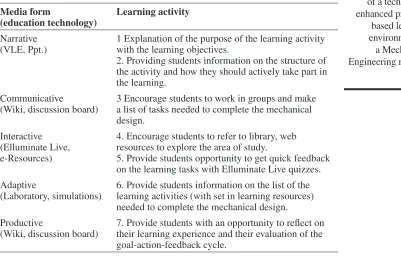
table 5: Improved design of the learning activities with the integration of the education technology tools
Media form
(education technology) learning activity Narrative
(VLE, Ppt.) 1 Explanation of the purpose of the learning activity with the learning objectives. 2. Providing students information on the structure of the activity and how they should actively take part in the learning.
Communicative
(Wiki, discussion board) 3 Encourage students to work in groups and make a list of tasks needed to complete the mechanical design.
Interactive (Elluminate Live, e-Resources)
4. Encourage students to refer to library, web resources to explore the area of study.
5. Provide students opportunity to get quick feedback on the learning tasks with Elluminate Live quizzes. Adaptive
(Laboratory, simulations) 6. Provide students information on the list of the learning activities (with set in learning resources) needed to complete the mechanical design. Productive
Chowdhry, S. CONCluSION
The aim of this research study is to effectively use education technology in a PBL environment about students’’ perceptions. In particular, the current study has three objectives: (1) to use education technology according to students learning needs; (2) to examine the effectiveness of PBL environment in providing learning opportunities to the students to study successfully; (3) to examine the effectiveness of integration of education technology in the PBL environment.
The study has found,there is avariation in the students’ past learning experience of using the education technology tools and the learning methods adopted in their studies. Students are not provided added information on how to effectively use education technology in the learning tasks for individual and group studies. SecondtheVLE instructions provided limitedopportunities to study successfully in the PBL environment and students did not had the opportunities to study collaboratively and to construct new knowledge. Third,the integration of the educational technology in the PBL environment did not take into consideration the communicative, adaptive and productive media characteristics of the Laurillards (2002) framework.
The main findings therefore are, firstto improve the effectiveness of technology enhanced PBL environment on the students’ academic performance the teaching instructions may be designed to provide clear explanation of the purpose of the learning activity with the learning objectives. Information may also be provided on the structure of the learning activity and how the students should effectively use educational technology tools to actively take part in the learning. In addition, opportunities mayalso be provided to the students for feedback on the learning tasks. Second, to improve the effectiveness of PBL environment on students’ achievement, the learning activities should provide students with an opportunity to construct new knowledge, to encourage critical appraisal of the information, to support good interpersonal relationship in the group and to reflect on their learning experience. Third,thedifferent media forms such as narrative, interactive, communicative, adaptive and productive may be used to integrate education technology successfully in the PBL environment.
The results implied that teaching institutions should provide academic staff development opportunities to support academic staff in effective facilitation of PBL. Similarly, the institution should encourage use of tools like 3E-Framework that assist academic staff to meaningfully incorporate technology into the learning and teaching
Student’s perception of effectiveness of a technology enhanced problem based learning environment in a Mechanical Engineering module REFERENCES
[1] Chavan, A. A., Khandagale, V. S. (2014). Development of Critical Thinking Skill Programme for the Student Teachers of Diploma in Teacher Education colleges. Issues and Ideas in Education,
2(1), 25–37.http://dx.doi.org/10.15415/iie.2014.21003
[2] Donnelly, R. (2005). Using Technology to Support Project and Problem-based Learning, 157– 177.
[3] Gallagher, S. A., & Gallagher, J. J. (2013). Using Problem-based Learning to Explore Unseen Academic Potential. Interdisciplinary Journal of Problem-Based Learning, 7(1), 3–15. Retrieved from http://docs.lib.purdue.edu/ijpbl/vol7/iss1/9/ http://dx.doi.org/10.7771/1541-5015.1322 [4] Gupta, S.C., Kapoor, V.K. (2007). Fundamentals of Applied Statistics. Sultan Chand & Sons. [5] Hair, J.F., Black, W.C., Babin, B.J., and Anderson, R. E., Hair, J.F., Black, W.C., Babin, B.J.,
and Anderson, R. E. (2009). Multivariate Data Analysis - A Global Perspective. New Jersey: Pearson Education Inc.
[6] Huxham, M. (2007). Fast and effective feedback: are model answers the answer? Assessment & Evaluation in Higher Education, 32(6), 601–611. http://dx.doi.org/10.1080/02602930601116946
[7] Jolly, J., & Jacob, C. (2012). A study of problem based learning approach for undergraduate students. Asian Social Science, 8(15), 157–164. http://dx.doi.org/10.5539/ass.v8n15p157
[8] Jonassen, D. H., & Hung, W. (2008). All Problems are Not Equal: Implications for Problem-Based Learning. Interdisciplinary Journal of Problem-Based Learning.http://dx.doi.org/ 10.7771/1541-5015.1080
[9] Kennedy, G. E., Judd, T. S., Churchward, A., Gray, K., & Krause, K. L. (2008). First year students’ experiences with technology: Are they really digital natives? Australasian Journal of Educational Technology, 24(1), 108–122.
[10] Laurillard, D. (2002). RETHINKING UNIVERSITY TEACHING. RoutledgeFalmer.
[11] Oliver, R., Herrington, J., Reeves, T.C. (2006). Creating Authentic Learning Environments Through Blended Learning Approaches. In THE HANDBOOK OF BLENDED LEARNING (pp. 502–515). Pfeiffer.
[12] Robertson, I. (2008). Learners’ attitudes to wiki technology in problem based, blended learning for vocational teacher education. Australasian Journal of Educational Technology, 24(4), 425–441.
[13] Savery, J. R. (2006). Overview of Problem-based Learning : Definitions and Distinctions.
Interdisciplinary Journal of Problem-Based Learning, 1, 13. Retrieved from http://dx.doi. org/10.7771/1541-5015.1002
[14] Savery, J. R., & Duffy, T. M. (1995). Problem based learning: An instructional model and its constructivist framework. Educational Technology, 35(16), 31–38. doi:47405-1006
[15] Schon, D.A., 1983. The reflective practitioner-how professionals think in action, USA: Basic Books, Inc.
[16] Scoles, J., Huxham, M., & McArthur, J. (2012). No longer exempt from good practice: using exemplars to close the feedback gap for exams. Assessment & Evaluation in Higher Education, (March 2015), 1–15. http://dx.doi.org/10.1080/02602938.2012.674485
[17] Smyth, K., Bruce, S., Fotheringham, J., & Mainka, C. (2011). Benchmark for the use of technology in modules designed and developed by Benchmark for the use of technology in modules.
[18] So, H., & Kim, B. (2009). Learning about problem based learning: Student teachers integrating technology, pedagogy and content knowledge. Australasian Journal of Educational Technology,
25, 101–116. http://dx.doi.org/10.1080/13502930802689012
Chowdhry, S. [20] Tambouris, E., Panopoulou, E., Tarabanis, K., Ryberg, T., Buus, L., Peristeras, V., … Porwol, L. (2012). Enabling Problem Based Learning through Web 2 . 0 Technologies : PBL 2 . 0.
Educational Technology & Society, 15, 238–251. http://dx.doi.org/10.1016/j.nedt.2014.10.006
[21] Tee, M. Y., & Lee, S. S. (2011). From socialisation to internalisation: Cultivating technological pedagogical content knowledge through problem-based learning. Australasian Journal of Educational Technology, 27(1), 89–104.
[22] Wiznia, D., Korom, R., Marzuk, P., Safdieh, J., & Grafstein, B. (2012). PBL 2.0: Enhancing problem-based learning through increased student participation. Medical Education Online,
17(1).http://dx.doi.org/10.3402/meo.v17i0.17375