www.geosci-model-dev.net/8/939/2015/ doi:10.5194/gmd-8-939-2015
© Author(s) 2015. CC Attribution 3.0 License.
A simple object-oriented and open-source model for scientific and
policy analyses of the global climate system – Hector v1.0
C. A. Hartin1, P. Patel1, A. Schwarber2, R. P. Link1, and B. P. Bond-Lamberty1
1Pacific Northwest National Laboratory, Joint Global Change Research Institute at the University of Maryland – College Park, 5825 University Research Court, College Park, MD 20740, USA
2University of Maryland, College Park, MD 20742, USA Correspondence to: C. A. Hartin ([email protected])
Received: 14 August 2014 – Published in Geosci. Model Dev. Discuss.: 24 October 2014 Revised: 26 February 2015 – Accepted: 6 March 2015 – Published: 1 April 2015
Abstract. Simple climate models play an integral role in the policy and scientific communities. They are used for cli-mate mitigation scenarios within integrated assessment mod-els, complex climate model emulation, and uncertainty anal-yses. Here we describe Hector v1.0, an open source, object-oriented, simple global climate carbon-cycle model. This model runs essentially instantaneously while still represent-ing the most critical global-scale earth system processes. Hector has a three-part main carbon cycle: a one-pool atmo-sphere, land, and ocean. The model’s terrestrial carbon cycle includes primary production and respiration fluxes, accom-modating arbitrary geographic divisions into, e.g., ecological biomes or political units. Hector actively solves the inorganic carbon system in the surface ocean, directly calculating air– sea fluxes of carbon and ocean pH. Hector reproduces the global historical trends of atmospheric [CO2], radiative forc-ing, and surface temperatures. The model simulates all four Representative Concentration Pathways (RCPs) with equiv-alent rates of change of key variables over time compared to current observations, MAGICC (a well-known simple cli-mate model), and models from the 5th Coupled Model Inter-comparison Project. Hector’s flexibility, open-source nature, and modular design will facilitate a broad range of research in various areas.
1 Introduction
Projecting future impacts of anthropogenic perturbations on the climate system relies on understanding the interactions of key earth system processes. To accomplish this, a hierarchy
of climate models with differing levels of complexity and res-olution are used, ranging from purely statistical or empirical models, to simple energy balance models, and fully coupled earth system models (ESMs) (Stocker, 2011).
Reduced-complexity or simple climate models (SCMs) lie in the middle of this spectrum, representing only the most critical global-scale earth system processes with low spatial and temporal resolution, e.g., carbon fluxes between the ocean and atmosphere, primary production and respira-tion fluxes on land. These models are relatively easy to use and understand and are computationally inexpensive. Most SCMs have a few key features: (1) calculating future con-centrations of greenhouse gases (GHGs) from given emis-sions while modeling the global carbon cycle, (2) calculat-ing global mean radiative forccalculat-ing from greenhouse gas con-centrations, and (3) converting the radiative forcing to global mean temperature (e.g., Wigley, 1991; Meinshausen et al., 2011a; Tanaka et al., 2007; Lenton, 2000).
FUND, and MERGE have a highly simplified carbon/climate system (Nordhaus, 2008; Anthoff and Tol, 2014; Manne and Richels, 2005). IAMs focusing more on the physical pro-cesses of the natural system and the economy employ more complex representations of the climate/carbon system. Mod-els like GCAM (Global Change Assessment Model) and MESSAGE use MAGICC as their SCM (Meinshausen et al., 2011a; Riahi et al., 2007; Calvin et al., 2011). Increasing in complexity, some IAMs include the climate/carbon system at gridded scales (e.g., IMAGE), and can be coupled to earth system models of intermediate complexity (e.g., MIT IGSM) or, more recently, coupled to a full earth system model (the iESM project) (Bouwman et al., 2006; Sokolov et al., 2005; Bond-Lamberty et al., 2014; Di Vittorio et al., 2014; Collins et al., 2015).
SCMs such as MAGICC, GENIE, and the climate em-ulation tool at RDCEP (Center for Robust Decision Mak-ing on Climate and Energy Policy) are also used as emu-lators of more complex ESMs (Meinshausen et al., 2011c; Schlesinger and Jiang, 1990; Challenor, 2012; Ratto et al., 2012; Lenton et al., 2009; Castruccio et al., 2014). The be-havior of SCMs can be constrained to replicate the overall behavior of the more complex ESM. For instance, the cli-mate sensitivity of a SCM can be made equal to that of an ESM by altering a single model parameter. In particular, the MAGICC model has been central to the analyses presented in the Intergovernmental Panel on Climate Change (IPCC) reports, and can be parameterized to emulate a large suite of ESMs (Meinshausen et al., 2011a).
Lastly, SCMs are computationally efficient and inexpen-sive to run. Therefore, they are used to run multiple simula-tions of future climate change emissions scenarios, param-eter sensitivity experiments, perturbed physics experiments, large ensemble runs, and uncertainty analyses (Senior and Mitchell, 2000; Hoffert et al., 1980; Harvey and Schnei-der, 1985; Ricciuto et al., 2008; Sriver et al., 2012; Irvine et al., 2012). MAGICC, the Bern CC model, and SNEASY are examples of a few models used for uncertainly analysis (Meinshausen et al., 2011c; Urban and Keller, 2010; Joos et al., 2001b). SCMs have been useful in reducing uncertain-ties in future CO2 sinks, quantifying parametric uncertain-ties in sea-level rise, ice-sheet modeling, ocean-heat uptake, and aerosol forcing (Ricciuto et al., 2008; Sriver et al., 2012; Applegate et al., 2012; Urban and Keller, 2009).
This study introduces Hector v1.0, an open-source, object-oriented, simple climate carbon-cycle model. Hector was de-veloped with three main goals in mind. First, Hector is an open-source model, an important quality given that the scien-tific community, funding agencies, and journals are increas-ingly emphasizing transparency and open source (White et al., 2013; Heron et al., 2013), particularly in climate change sciences (Wolkovich et al., 2012). A large community of scientists can access, use, and enhance open-source mod-els, with the potential for long-term utilization, improvement, and reproducibility (Ince et al., 2012). Second, a clean design
using an object-oriented framework is critical for Hector de-velopment and future use. This allows for new components to easily be added to Hector, i.e., the model’s functionality to be easily extended in the future. In addition, this framework allows for easy coupling into IAMs, in particular GCAM. Lastly, Hector is a stand-alone simple climate model used to answer fundamental scientific research questions, uncer-tainty analysis, parameter sensitivities, etc.
One of the fundamental questions faced in developing a SCM is how much detail should be represented in the climate system. Our goal is to introduce complexity only where war-ranted, keeping the representations of the climate system as simple as possible. This results in fewer calculations, faster execution times, and easier analysis and interpretation of re-sults. Sections 2, 3, and 4 describe the structure and compo-nents of Hector. Sections 5 and 6 describe the experiments, results and comparison of Hector against observational data and other models (MAGICC and CMIP5).
2 Model architecture
2.1 Overall structure and design
Hector is written in C++ and uses an object-oriented de-sign that enforces clean separation between its different parts, which interact via strictly defined interfaces. The separation keeps each software module self-contained, which makes the code easy for users to understand, maintain, and enhance. Entities in the model include a command-line wrapper, the model coupler, various components organized around scien-tific areas (carbon cycling, radiative forcing, etc.) and visitors responsible for model output. Each of these is discussed be-low.
2.2 Model coupler
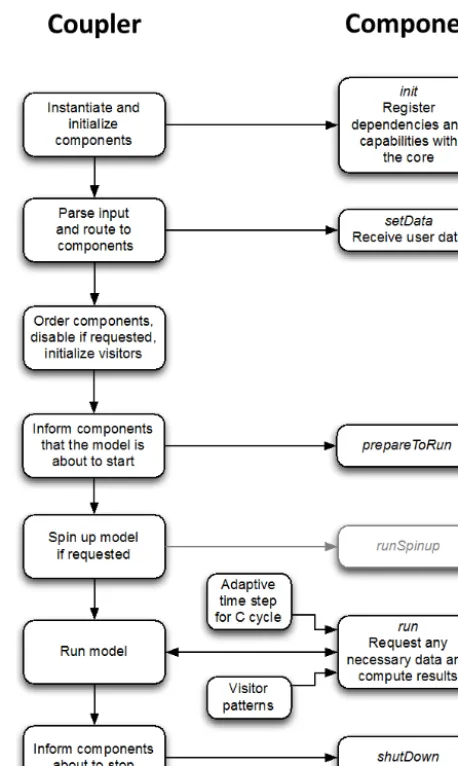
Hector’s control flow starts with the coupler, which is respon-sible for (1) parsing and routing input data to the model com-ponents; (2) tracking how the components depend on each other; (3) passing messages and data between components; (4) providing facilities for logging, time series interpolation, etc.; and (5) controlling the main model loop as it progresses through time. Any errors thrown by the model are caught by the wrapper, which prints a detailed summary of the error.
checking: e.g., if a component requests mean global temper-ature in degrees Celcius but the data are provided in kelvins, an error will be thrown (i.e., execution halts) unless the re-ceiving component can handle this situation.
Visitor patterns are units of code that traverse all model components and handle model output (Martin et al., 1997). Two visitors currently exist: one saves an easily readable summary table to an output file, while the other writes a stream of model data (both standard outputs and internal di-agnostics). After the model finishes, this “stream” file can be parsed and summarized by R scripts (R Development Core Team, 2014) included with Hector. Log files may also be written by any model entity, using facilities provided by the coupler. The full sequence of events during a model run is summarized in Fig. 1.
2.3 Components
Model components are submodels that communicate with the coupler. From the coupler’s point of view, components are fully defined by their capabilities and dependencies. At model startup, before the run begins, components inform the coupler of their capabilities, i.e., what data they can provide to or accept from the larger model system. The coupler uses this information to route messages, such as requests for data, between components. Components also register their depen-dencies, i.e., what results they require from other components in order to complete their computations. After initialization, but before the model begins to run, the coupler uses this de-pendency information to determine the order in which com-ponents will be called in the main control loop.
The model’s modular architecture and the capabil-ity/dependency systems described above allow swapping, en-abling and disen-abling of model components directly via the in-put without recompiling. For example, this means that a user can test two different ocean submodels and easily compare results without having to rebuild the model.
2.4 Time step, spinup, and constraints
The model’s fundamental time step is 1 year, although the carbon cycle can operate on a finer resolution when neces-sary (Sect. 3.1). When the model is on an integer date (e.g., 1997.0) it is considered to be the midpoint of that particular calendar year, in accordance with Representative Concentra-tion Pathway (RCP) data (Meinshausen et al., 2011b).
Like many models, Hector has an optional “spinup” step, in which the model runs to equilibrium in an a historical, perturbation-free mode (Pietsch and Hasenauer, 2006). This occurs after model initialization, but before the historical run begins, and ensures that the model is in steady state when it enters the main simulation. During spinup, the coupler re-peatedly calls all the model components in their dependency-driven ordering, using an annual time step. Each component signals whether it needs further steps to stabilize, and this
Figure 1. Model phases for the coupler (left) and a typical
com-ponent (right). Arrows show flow of control and data. The greyed spinup step is optional.
process repeats until all components signal that they are com-plete.
Currently only the model’s carbon cycle makes use of the spinup phase. Spinup takes place prior to land use change or industrial emission inputs, and the main carbon cycle moves from its initial, user-defined carbon pool values to a steady state in which dC/dt<εfor all pools. The convergence cri-terionεis user-definable; by defaultε=1 Tg C yr−1. From its default values the preindustrial carbon cycle will typically stabilize in 300–400 time steps.
over-Table 1. Initial model conditions prior to the spinup phase. Carbon values change slightly after spinning up to a steady state.
Variable Description Initial Value Units Notes
Catma Atmospheric carbon 588.1 PgC Murakami (2010) CDa Detritus carbon 55.0 PgC Denman et al. (2007)
Land carbon (detritus, soil and vegetation) totaling
∼2300 PgC CSa Soil carbon 1782.0 PgC
CVa Vegetation carbon 550.0 PgC
CDO Deep ocean 26 000.0 PgC Denman et al. (2007) Ocean carbon (deep, intermediate and surface) totaling∼3800 PgCb CHL Surface ocean high latitude 140.0 PgC
CIO Intermediate ocean 8400.0 PgC CLL Surface ocean low latitude 770.0 PgC FL Atmosphere–land carbon flux 0.0 PgC yr−1 FO Atmosphere–ocean carbon flux 0.0 PgC yr−1
NPP0 Net primary production 50.0 PgC yr−1 Approximate global value Nemani et al. (2003)
TG Global temperature anomaly 0.0 ◦C
THL Temperature of high-latitude surface ocean box 2.0 ◦C Lenton (2000) TLL Temperature of low-latitude surface ocean box 22.0 ◦C Lenton (2000)
aParameters appearing in the input file.bIn order to obtain a steady state in Hector, carbon values in the intermediate box are less than reported (Denman et al., 2007).
writing model-calculated values with user-supplied time se-ries data during the run. The atmospheric [CO2] constraint operates slightly differently, as the global carbon cycle is sub-ject to a continuous mass-balance check. As a result, when the user supplies a [CO2] record between arbitrary dates and orders the model to match it, the model computes [CO2] at each time step, and any deficit (surplus) in comparison with the constraint [CO2] is drawn from (added to) the deep ocean. The deep ocean holds the largest reservoir of carbon; there-fore, small changes in this large pool have a negligible effect on the carbon cycle dynamics. When the model exits the con-straint time period, atmospheric [CO2] again becomes fully prognostic.
2.5 Code availability and dependencies
All Hector code is open source and available at https://github. com/JGCRI/hector/. The repository includes model code that can be compiled on Mac, Linux, and Windows input files for the four RCPs cases discussed in Sect. 5, R scripts to pro-cess model output, and extensive documentation. Software dependencies are as limited as possible, with only the GNU Scientific Library (GSL; Gough, 2009) and the Boost C++ libraries (http://www.boost.org) required. HTML documen-tation can be automatically generated from the code using the Doxygen tool (http://www.doxygen.org). All these tools and libraries are free and open source.
In keeping with Hector’s emphasis on modern, robust soft-ware design, the code includes an optional (i.e., not needed to compile and run the model) unit testing build target. Unit testing allows individual units of source code to be tested in a standardized and automatic manner, ensuring that they be-have as expected after changes are made to the model source code. Current tests verify the behavior of the model coupler (message passing and dependency calculation), reading of in-put, time series, logging, and units checking. This functional-ity requires the “googletest” library (http://code.google.com/ p/googletest).
3 Carbon cycle
In the model’s default terrestrial carbon cycle, terrestrial veg-etation, detritus, and soil are linked with each other and the atmosphere by first-order differential equations (Fig. 2). Veg-etation net primary production is a function of atmospheric [CO2] and temperature. Carbon flows from the vegetation to detritus and then to soil, losing fractions to heterotrophic res-piration on the way. Land-use change emissions are specified as inputs. An “earth” pool debits carbon emitted as anthro-pogenic emissions, allowing a continual mass-balance check across the entire carbon cycle.
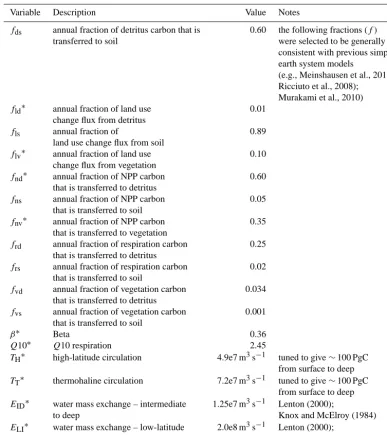
Table 2. Model parameters for the land and ocean carbon components.
Variable Description Value Notes
fds annual fraction of detritus carbon that is 0.60 the following fractions (f ) transferred to soil were selected to be generally
consistent with previous simple earth system models
(e.g., Meinshausen et al., 2011a; Ricciuto et al., 2008);
Murakami et al., 2010)
fld∗ annual fraction of land use 0.01 change flux from detritus
fls annual fraction of 0.89 land use change flux from soil
flv∗ annual fraction of land use 0.10 change flux from vegetation
fnd∗ annual fraction of NPP carbon 0.60 that is transferred to detritus
fns annual fraction of NPP carbon 0.05 that is transferred to soil
fnv∗ annual fraction of NPP carbon 0.35 that is transferred to vegetation
frd annual fraction of respiration carbon 0.25 that is transferred to detritus
frs annual fraction of respiration carbon 0.02 that is transferred to soil
fvd annual fraction of vegetation carbon 0.034 that is transferred to detritus
fvs annual fraction of vegetation carbon 0.001 that is transferred to soil
β∗ Beta 0.36
Q10∗ Q10 respiration 2.45
TH∗ high-latitude circulation 4.9e7 m3s−1 tuned to give∼100 PgC from surface to deep
TT∗ thermohaline circulation 7.2e7 m3s−1 tuned to give∼100 PgC from surface to deep
EID∗ water mass exchange – intermediate 1.25e7 m3s−1 Lenton (2000);
to deep Knox and McElroy (1984)
ELI∗ water mass exchange – low-latitude 2.0e8 m3s−1 Lenton (2000);
to intermediate Knox and McElroy (1984)
∗Parameters appearing in the input file.
(FLC), and the atmosphere–ocean (FO)and atmosphere–land (FL)carbon fluxes. The atmosphere is treated as a single well-mixed box whose rate of change is
dCatm
dt =FA(t )+FLC(t )−FO(t )−FL(t ). (1)
Note that the carbon cycle is solved under indeterminate time steps (represented in the text by equations with d/dt), while most other submodels of Hector are solved under a fixed time step of 1 year (equations with 1). Future versions of Hector will incorporate indeterminate time steps within all components of the model. The overall terrestrial carbon bal-ance (Eq. 2) excluding user-specified land-use change fluxes at time t is the difference between net primary production
(NPP) and heterotrophic respiration (RH). This is summed over user-specifiedngroups (each typically regarded as a lat-itude band, biome, or political unit), withn≥1:
FL(t )=
n
X
i=1
NPPi(t )−RHi(t ). (2)
Note that NPP here is assumed to include non-LUC distur-bance effects (e.g., fire), for which there is currently no sep-arate term. For each biomei, NPP is computed as a function of its preindustrial values NPP0, current atmospheric carbon Catm, and the biome’s temperature anomalyTi, while RH
Figure 2. Representation of Hector’s carbon cycle, land,
atmo-sphere, and ocean. The atmosphere consists of one well-mixed box. The ocean consists of four boxes, with advection and water mass exchange simulating thermohaline circulation (see Table 2 for de-scription of parameters). At steady state, the high-latitude surface ocean takes up carbon from the atmosphere, while the low-latitude surface ocean off-gases carbon to the atmosphere. The land consists of a user-defined number of biomes or regions for vegetation, detri-tus and soil. At steady state the vegetation takes up carbon from the atmosphere while the detritus and soil release carbon back into the atmosphere. The earth pool is continually debited with each time step to act as a mass balance check on the carbon system.
global temperatures:
NPPi(t )=NPP0×f (Catmβi)), (3)
f (Catm, βi)=1+βi
log
C atm C0
, (4)
RHs,d(t )=Cs,d×frs,rd×QT10i(t )/i 10, (5)
Ti(t )=TG(t )×δi. (6)
These are commonly used formulations: NPP is modified by a user-specified carbon fertilization parameter,β(Piao et al., 2013), that is constant in time but not necessarily in space. For example, users can define separate β values for differ-ent biomes. RH changes are controlled by a biome-specific
Q10 value. Biomes can experience temperature changes at rates that differ from the global mean TG, controlled by a user-specified temperature factorδI. Note that in Eq. (5), soil RH depends on a running mean of past temperatures, rep-resenting the slower propagation of heat through soil strata. Land carbon pools (vegetation, detritus, and soil) change as a result of NPP, RH, and land-use change fluxes, whose ef-fects are partitioned among these carbon pools. In addition, carbon flows from vegetation to detritus and to soil (Fig. 2). Partitioning fractions (f )control the flux quantities between pools (Table 2). For simplicity, Eqs. (7–9) omit the time t
and biome-specificinotations, but each pool is tracked
sep-arately for each biome at each time step: dCV
dt =NPPfnv−CV(fvd+fvs)−FLCflv, (7)
dCD
dt =NPPfnd+CVfvd−CDfds−RHdet−FLCfld, (8)
dCS
dt =NPPfns+CVfvs+CDfds−RHsoil−FLCfls, (9)
The ocean–atmosphere carbon flux is the sum of the ocean’s surface fluxes (Fi)(currentlyn=2, high- and low-latitude
surface box):
FO(t )=
n
X
i=1
Fi(t ) . (10)
The surface fluxes of each individual box are directly cal-culated from an ocean chemistry submodel described in de-tail by Hartin et al. (2015). We model the nonlinearity of the inorganic carbon cycle, calculatingpCO2, pH, and car-bonate saturations based on equations from Zeebe and Wolf-Gladrow (2001). The flux of CO2for each boxiis calculated by
Fi(t )=kα1pCO2, (11) wherek is the CO2 gas-transfer velocity, α is the solubil-ity of CO2in water based on salinity, temperature, and pres-sure, and1pCO2is the atmosphere–ocean gradient ofpCO2 (Takahashi et al., 2009). The calculation ofpCO2in each sur-face box is based on the concentration of CO2in the ocean and its solubility (a function of temperature, salinity, and pressure). At steady state, the cold high-latitude surface box (> 55◦, subpolar gyres) acts as a sink of carbon from the at-mosphere, while the warm low-latitude surface box (< 55◦) off-gases carbon back to the atmosphere. Temperatures of the surface boxes are linearly related to atmospheric global tem-peratures (see Sect. 4.1),THL=1T−13 andTLL=1T+7 (Lenton, 2000). The ocean model, modeled after Lenton et al. (2000) and Knox and McElroy (1984), circulates carbon through four boxes (two surface, one intermediate depth, one deep), via water mass advection and exchange, simulating a simple thermohaline circulation (Fig. 2). At steady state, ap-proximately 100 Pg of carbon are transferred from the high-latitude surface box to the deep box based on the volume of the box and transport (in Sv; 106m3s−1)between the boxes. The change in carbon of any boxi is given by the fluxes in and out, withFatm→ias the atmosphere–ocean carbon flux:
dCi
dt =
in X
j=1
Fj→i−
out X
j=1
Fi→j+Fatm→i. (12)
As the model advances, the carbon in PgC is converted to dissolved inorganic carbon (DIC) in each box. The new DIC values are used within the chemistry submodel to calculate
3.1 Adaptive time step solver
The fundamental time step in Hector is currently 1 year, and most model components are solved at this resolution. The carbon cycle, however, operates on a variable time step, en-suring accurate ODE solutions, even under high-emissions scenarios. This will also allow for future subannual appli-cations where desired. The adaptive time step accomplished using the gsl_odeiv2_evolve_apply solver package of GSL 1.16, which varies the time step to keep truncation error within a specific tolerance when advancing the model. Thus, all the carbon cycle components handle indeterminate time steps less than or equal to 1 year and can signal the solver if a too-large time step is leading to instability. The solver then retries the solution, using a series of smaller steps. From the coupler’s point of view, however, the entire model continues to advance in annual increments.
4 Other components
4.1 Global atmospheric temperature
Near surface global atmospheric temperature is calculated by
1T (t )=λ×RF(t )−FH(t ), (13)
where the user-specifiedλis the climate feedback parameter, defined as λ=S0/S,S0 is the climate sensitivity parameter (3 K) andSis the equilibrium climate sensitivity for a dou-bling of CO2(3.7 W m−2)(Knutti and Hegerl, 2008). RF is the total radiative forcing andFH is the ocean heat flux.FH is calculated by a simple sigmoidal expression of the ocean heat uptake efficiencyk(W m−2K−1)that decreases with in-creasing global temperatures) multiplied by the atmospheric temperature change prior to the ocean’s removal of heat from the atmosphere (TH)(Raper et al., 2002).
1FH(t )=k×1TH(t ) (14) As global temperatures rise, the uptake capacity of the ocean may diminish, simulating both a saturation of heat in the sur-face and a slowdown in ocean circulation with increased tem-peratures. Finally, the temperature effects from atmospheric [CO2] are lagged in time, as there are numerous real-world processes not simulated in Hector buffering the temperature effects of increasing atmospheric [CO2].
4.2 Radiative forcing
Radiative forcing is calculated from a series of atmospheric greenhouse gases, aerosols, and pollutants (Eqs. 15, 16, 18– 22, 25, 29 and 30). Radiative forcing is reported as the rel-ative radirel-ative forcing. The base year user-specified forcings are subtracted from the total radiative forcing to yield a forc-ing relative to the base year (1750).
4.2.1 CO2
Radiative forcing from atmospheric [CO2] (in W m−2) is cal-culated based on Meinshausen et al. (2011a):
RFCO2=5.35×log Ca
C0, (15)
where 5.35 W m−2 is a scaling parameter from Myhre et al. (1998), Ca is the current atmospheric [CO2] in ppmv and C0 is the preindustrial [CO2] in ppmv.
4.2.2 Halocarbons
The halocarbon component of the model can accept an arbitrary number of gas species, each characterized by a name, a lifetime τ(yr), a radiative forcing efficiency
α (W m−2pptv−1), an optional user-specified preindustrial concentration (pptv), and a molar mass (g). For each gas, its concentration (Ci)at timet is then computed based on
a specified emissions time seriesE, assuming an exponential decay from the atmosphere:
Ci(t )=C0×exp
−1
τ
+E×τ×
1−exp
−1
τ
. (16)
E is corrected for atmospheric dry air mole constant (1.8) and the molar mass of each halocarbon. The default model input files include these parameters and a time series of emissions for C2F6, CCl4, CF4, CFC11, CFC12, CFC113, CFC114, CFC115, CH3Br, CH3CCl3, CH3Cl, HCF22, HCF141b, HCF142b, HFC23, HFC32, HFC125, HFC134a, HFC143a, HFC227ea, HFC245ca, HFC245fa, HFC4310, SF6, halon1211, halon1301, and halon2402.
Radiative forcing by halocarbons and other gases con-trolled under the Montreal Protocol, SF6, and ozone are cal-culated via
RF=α[Ci(t )], (17)
where α is the radiative efficiency (input parameters; in W m−2ppbv−1) and [Ci] is the atmospheric concentration. 4.2.3 Ozone
Tropospheric ozone concentrations are calculated from the CH4 concentration and the emissions of three primary pol-lutants, NOx, CO, and NMVOCs (non-methane volatile or-ganic compounds), modified from Tanaka et al. (2007): O3t =(5.0×ln [CH4])+(0.125×ENOx)
+(0.0011×ECO)+(0.0033×EVOC) , (18) where the constants are the ozone sensitivity factors for each of the precursors (Ehhalt et al., 2001). The radiative forcing of tropospheric ozone is calculated from a linear relationship using a radiative efficiency factor (Joos et al., 2001a):
4.2.4 BC and OC
The radiative forcing from black and organic carbon is a function of their emissions (EBC and EOC).
RFBC=0.0743 W m−2Tg−1×EBC (20) RFOC= −0.0128 W m−2Tg−1×EOC (21) The coefficients include both indirect and direct forcings of black and organic carbon (fossil fuel and biomass) (Bond et al., 2013, Table C1).
4.2.5 Sulfate aerosols
The radiative forcing from sulfate aerosols is a combination of the direct and indirect forcings (Joos et al., 2001a). RFSOxDirect= −0.35 W m−2×
ESOxt
ESOxt0
(22)
RFSOxIndirect= −0.6 W m−2×
(ln(ESN)+ESOxt)
ESN (23)
·
lnESN+ESOxt0 ESN
−1
The direct forcing by sulfate aerosols is proportional to the anthropogenic sulfur emissions (Gg S yr−1) divided by the sulfate emissions from 2000. The indirect forcing by sul-fate aerosols is a function of the anthropogenic and natural sulfur emissions. Natural sulfur emissions, denoted by ESN, are equal to 42 000 Gg S. A time series of annual mean vol-canic stratospheric aerosol forcing (W m−2)is supplied from Meinshausen et al. (2011b) and added to the indirect and di-rect forcing for a total sulfate forcing.
4.2.6 Methane (CH4)
The change in [CH4] is calculated directly from CH4 emis-sions, and sinks of CH4 in the troposphere (based on the lifetime of OH), stratosphere, and soil based on Wigley et al. (2002).
1CH4=
E(CH4) 2.78 −
[CH4]
τOH
−[CH4]
τstrat
−[CH4]
τsoil
, (24) whereE is total CH4emissions (Tg yr−1)from both natu-ral and anthropogenic sources, 2.78 (Tg ppb−1)is the con-version factor, and τ are the lifetimes of the tropospheric sink (τOH), the stratospheric sink (τstrat=120 years), and the soil sink(τsoil=160 years). Note that within Hector, natural emissions are held at a constant 300 Tg yr−1.
The lifetime of OH is a function of [CH4] and the emis-sions of NOx, CO and VOC, based on Tanaka et al. (2007).
ln(OH)t= −0.32(ln[CH4]t−ln[CH4]t0) (25) +0.0042(E(NOx)t)−(E(NOx)t0)−0.000 105(E(CO)t)
−(E(CO)t0)−0.00315(E(VOC)t)−(E(VOC)t0) The radiative forcing equation for CH4 (Joos et al., 2001a) is a function of the concentrations (ppbv) of both CH4and
N2O:
RFCH4=0.036 W m
−2hp[CH 4](t )
p
[CH4](t0) i
−f[CH4(t ) ,N2O(t0)]−f[CH4(t0) ,N2O(t0)]. (26) The functionf accounts for the overlap in CH4and N2O in their bands is
f (M, N )=0.47×ln1+
2.01×10⁻⁵×(MN )0.75
+5.31×10⁻¹⁵×M×(MN )1.52 (27) 4.2.7 N2O
The change in [N2O] is a function of N2O emissions and the lifetime of N2O based on Ward and Mahowald (2014).
1N2O=
E(N2O) 4.8 −
[N2O]
τN2O
, (28)
whereE is total N2O emissions (Tg N yr−1), both natural and anthropogenic, 4.8 (Tg N ppbv−1)is the conversion fac-tor, andτN2Ois the lifetime of N2O. We set natural emissions of N2O to linearly decrease from 11 Tg N yr−1in 1765, to 8 Tg N yr−1in 2000 and are then held constant at 8 Tg N yr−1 to 2300. The lifetime of N2O is a function of its initial life-time (τ0)and concentration ([N2O]t0).
τN2O=τ0× [N
2O]t
[N2O]t0 −0.05
(29) The radiative forcing equation for N2O (Joos et al., 2001a) is a function of the concentration (ppbv) of both CH4and N2O: RFN2O=0.12 Wm
−2hp[N 2O]t−
p [N2O]t0
i
−f[CH4(t0) ,N2O(t )]−f[CH4(t0) ,N2O(t0)]. (30) The functionf accounts for the overlap in CH4and N2O in their bands is the same as Eq. (27).
4.2.8 Stratospheric H2O from CH4oxidation
The radiative forcing from stratospheric H2O is a function of the [CH4] (Tanaka et al., 2007). The coefficient 0.05 is from Joos et al. (2001a) based on the fact that the forcing contri-bution from stratospheric H2O is about 5 % of the total CH4 forcing (IPCC, 2001). The 0.036 value of the coefficient cor-responds to the same value used in the CH4radiative forcing equation.
RFstratH2O=0.05× n
0.036W m−2 ×p[CH4]t−
p [CH4]t0
o
5 Model experiments and data sources
A critical test of Hector’s performance is to compare the ma-jor climatic variables calculated in Hector, e.g., atmospheric [CO2], radiative forcing, and atmospheric temperature, to ob-servational records and both simple and complex climate models. Within this study, Hector is run under prescribed emissions from 1850 to 2300 for all four RCPs, freely avail-able at http://tntcat.iiasa.ac.at/RcpDb/ (Moss et al., 2010; van Vuuren et al., 2007; Clarke et al., 2007; Wise et al., 2009; Riahi et al., 2007; Fujino et al., 2006; Hijioka et al., 2008; Smith and Wigley, 2006). The RCPs are plausible future sce-narios that were developed to improve our understanding of the coupled human climate system. RCPs by definition are concentration pathways; however, for all experiments within this study we use the corresponding emissions trajectories from each RCP as input for Hector.
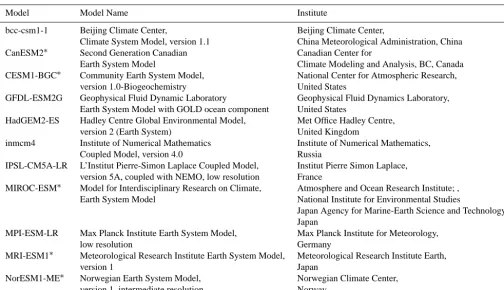
Comparison data was obtained from a series of models. We compared Hector results to MAGICC, a SCM widely used in the scientific and IAM communities, for global vari-ables such as atmospheric CO2, radiative forcing, and tem-perature (e.g., Raper et al., 2001; Wigley, 1995; Meinshausen et al., 2011a). We also compare Hector to a suite of 11 earth system models included in the 5th Coupled Model Inter-comparison Project (CMIP5) archive (Taylor et al., 2012) (Table 3). All CMIP5 data were converted to yearly global averages from the historical period through the RCPs and their extensions. One standard deviation of the annual global averages and the CMIP5 model range were calculated for each variable using the RCMIP5 (http://github.com/JGCRI/ RCMIP5) package in R. All CMIP5 variables used in this study are from model runs with prescribed atmospheric con-centrations, except for comparisons involving atmospheric [CO2] which are from the emissions-driven scenario (es-mHistorical and esmrcp85) (Figs. 3, 5). We acknowledge that this comparison, between an emissions-forced model (Hec-tor) and concentration-forced models (CMIP5), is not per-fect. However, very few CMIP5 models were run under pre-scribed emissions scenarios.
We compare Hector to observations of atmospheric [CO2] from Law Dome (1010–1975) and Mauna Loa (1958–2008), (Keeling and Whorf, 2005; Etheridge et al., 1996). Global temperature anomalies are from HadCRUT4 (Morice et al., 2012). Observations of air–sea and air–land fluxes are from the Global Carbon Project (GCP) (Le Quéré et al., 2013). Lastly, observations of surface ocean pH are from Bermuda Atlantic Time Series (BATS) and Hawaii Ocean Time Series (HOTS) (Bates, 2007; Fujieki et al., 2013).
Figure 3. Historical atmospheric [CO2] from 1850 to 2005 for Hec-tor (blue); CMIP5 median, standard deviation, and model range (pink,n=4); MAGICC6 (green); Law Dome (teal); and Mauna Loa (brown). Note CMIP5 data are from the prescribed emissions historical scenario (esmHistorical). MAGICC6, however, is con-strained to match the observational record. Although Hector can be run with similar constraints, in this study Hector was unconstrained to highlight the full performance of the model.n=4 is the number of CMIP5 models used to produce this figure.
6 Results and discussion 6.1 Historical
A critical test of Hector’s performance is how well it com-pares to historical and present day climate from observations, MAGICC, and a suite of CMIP5 models. Rates of change and root mean square errors were calculated for Hector’s primary outputs, which are summarized in Table 4. After spinup is complete in Hector, atmospheric [CO2] in 1850 is 286.0 ppmv, which compares well with observations from Law Dome of 285.2 ppmv. Hector captures the global trends in atmospheric [CO2] (Fig. 3) with an average root mean square error (RMSE) of 2.85 ppmv (Table 4a), when com-pared to observations, MAGICC6, and CMIP5 data from 1850 to 2005. The rate of change of atmospheric [CO2] from 1850 to 2005 is slightly lower than the observations, MAG-ICC6, and CMIP5. Hector can be forced to match atmo-spheric [CO2] records (Sect. 2.4), but we disabled this fea-ture to highlight the full performance of the model. Note, however, that in the MAGICC6 results a similar feature was used to force the output to match the historical atmospheric [CO2] record.
cap-Table 3. CMIP5 ESM models used within this study. We use the same suite of models as found in Friedlingstein et al. (2014). Note, not all
variables are reported for each model under all scenarios.
Model Model Name Institute
bcc-csm1-1 Beijing Climate Center, Beijing Climate Center,
Climate System Model, version 1.1 China Meteorological Administration, China CanESM2∗ Second Generation Canadian Canadian Center for
Earth System Model Climate Modeling and Analysis, BC, Canada CESM1-BGC∗ Community Earth System Model, National Center for Atmospheric Research,
version 1.0-Biogeochemistry United States
GFDL-ESM2G Geophysical Fluid Dynamic Laboratory Geophysical Fluid Dynamics Laboratory, Earth System Model with GOLD ocean component United States
HadGEM2-ES Hadley Centre Global Environmental Model, Met Office Hadley Centre, version 2 (Earth System) United Kingdom
inmcm4 Institute of Numerical Mathematics Institute of Numerical Mathematics, Coupled Model, version 4.0 Russia
IPSL-CM5A-LR L’Institut Pierre-Simon Laplace Coupled Model, Institut Pierre Simon Laplace, version 5A, coupled with NEMO, low resolution France
MIROC-ESM∗ Model for Interdisciplinary Research on Climate, Atmosphere and Ocean Research Institute; , Earth System Model National Institute for Environmental Studies
Japan Agency for Marine-Earth Science and Technology, Japan
MPI-ESM-LR Max Planck Institute Earth System Model, Max Planck Institute for Meteorology,
low resolution Germany
MRI-ESM1∗ Meteorological Research Institute Earth System Model, Meteorological Research Institute Earth,
version 1 Japan
NorESM1-ME∗ Norwegian Earth System Model, Norwegian Climate Center, version 1, intermediate resolution Norway
∗Models used in emissions-forced scenarios (esmHistorical and esmrcp85).
Figure 4. Historical global temperature anomaly relative to 1850
for Hector (blue); MAGICC6 (green); CMIP5 median, standard de-viation and model range (pink,n=8); and historical observations from HadCRUT4 (purple). Hector is running without the effects of volcanic forcing, leading to a smoother representation of tempera-ture with time.
ture temperature variations due to interannual/decadal vari-ability found in ESMs or the real world; instead, they simu-late the overall trends in global mean temperature change.
6.2 Future projections
Table 4. Root mean square error (RMSE) for Hector versus observations, CMIP5, and MAGICC for atmospheric [CO2], surface temperature anomaly, radiative forcing, fluxes of carbon (ocean and land), and low-latitude surface ocean pH and change (1)in atmospheric [CO2], surface temperature anomaly and radiative forcing for Hector, CMIP5, observations, and MAGICC6.
Historical 1850–2005
(a) Variable Hector Observations MAGICC CMIP5 Units
[CO2]1 RMSE – 2.85 2.95 2.21 ppmv 1 85.78 94.47 95.0 103.30
Temperature RMSE – 0.15 0.13 0.15 ◦C
1 0.98 0.91 0.76 1.01
Forcing RMSE – – 0.39 – W m−2
1 2.16 – 1.75 –
Ocean flux RMSE – – – 0.25 PgC yr−1 Land flux RMSE – – – 1.27 PgC yr−1
pH RMSE – – 0.004 unitless
RCP 8.5 1850–2300
(b) Variable Hector MAGICC CMIP5 Units
[CO2]2 RMSE – 10.41 7.54 ppmv
1 1557.91 1695.0 –
Temperature RMSE – 0.12 0.52 ◦C
1 9.58 8.05 10.57
Forcing RMSE – 0.26 – W m−2
1 12.80 12.24 –
Ocean flux RMSE – 1.39 PgC yr−1 Land flux RMSE – – 3.86 PgC yr−1
pH RMSE – – 0.003 unitless
RCP 8.5 2005–2300
(c) Variable Hector MAGICC CMIP5 Units
[CO2]2 RMSE – 10.07 7.23 ppmv
1 1472.13 1600.0 –
Temperature RMSE – 0.09 0.58 ◦C
1 8.59 7.30 9.57
Forcing RMSE – 0.03 – W m−2
1 10.65 10.49 –
Ocean flux RMSE – – 1.41 PgC yr−1 Land flux RMSE – – 4.59 PgC yr−1
pH RMSE – – 0.001 unitless
1[CO
2] observations are an average of Law Dome and Mauna Loa.2CMIP5 [CO2] only to 2100.
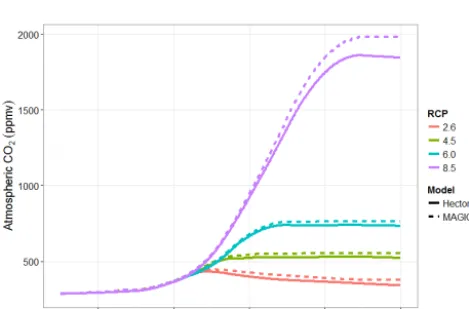
MAGICC6 (1600.0 ppmv) for RCP 8.5. This is most likely due to different representations of the global carbon cycle. We compare Hector to MAGICC6 for changes in radiative forcing under the four RCPs (Fig. 7). Radiative forcing was not provided within the CMIP5 archive and therefore we can only compare Hector and MAGICC6. Over the period 1850– 2300 Hector (12.80 W m−2)and MAGICC6 (12.24 W m−2)
are comparable in their change in radiative forcing, with a RMSE of 0.26 W m−2. One noticeable difference between MAGICC6 and Hector during the historical period is the de-creases in radiative forcing. This is due to the effects of vol-canic emissions on radiative forcing. For simplicity, we have chosen to run Hector without these effects.
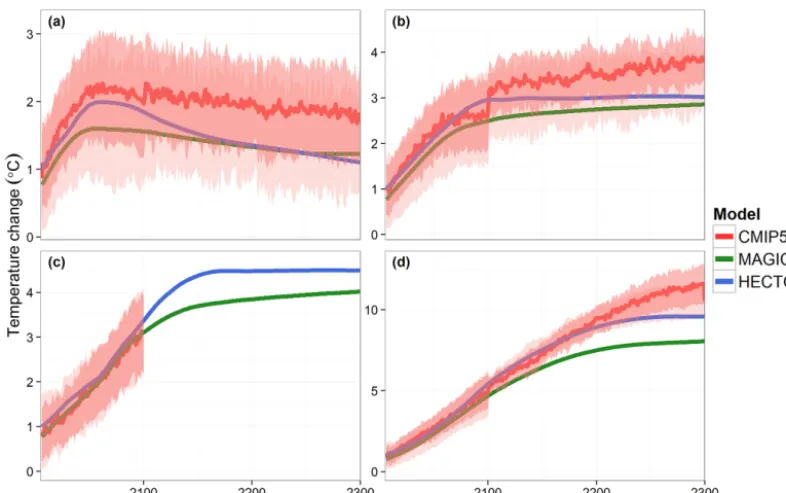
Figure 8 compares global temperature anomalies from Hector to MAGICC6 and CMIP5 over the four RCPs, from 2005 to 2300. Hector simulates the CMIP5 median more closely than MAGICC6 across all four RCPs, with a temper-ature change under RCP 8.5 for Hector of 8.59◦C, compared to MAGICC6 of 7.30◦C, while the temperature change for CMIP5 is 9.57◦C (Table 4c). To highlight this close com-parison, temperature change over the entire record (1850– 2300) for Hector is 9.58◦C, which is within 1.0◦C of the CMIP5 median, while MAGICC6’s temperature change is greater than 2.5◦C away from the CMIP5 median.
Figure 5. Atmospheric [CO2] from 1850 to 2100 under RCP 8.5 for Hector (blue), MAGICC6 (green), Mauna Loa (brown), Law Dome (teal) and esmRCP 8.5 (prescribed emissions scenario) CMIP5 me-dian, one standard deviation and model range (pink,n=4 (1850– 2000) andn=5 (2001–2100)). Note that the CMIP5 models run under esmrpc85 do not extend to 2300.
Figure 6. Atmospheric [CO2] from 1850 to 2300 for RCP 2.6 (red), RCP 4.5 (green), RCP 6.0 (blue), RCP 8.5 (purple), Hector (solid) and MAGICC6 (dashed).
sink of carbon through 2100, becoming less effective with time in both Hector and the CMIP5 models. MAGICC6 does not include air–sea fluxes in its output, and because it is not open source we were unable to obtain these values. There-fore, we compare air–sea fluxes of CO2to MAGICC5.3, up-dated with explicit BC and OC forcing as described in Smith and Bond (2014). Hector’s calculation of air–sea fluxes is within the large CMIP5 model range up to 2100. However, after that Hector peaks close to 2150, while the CMIP5 mod-els are beginning to decline. One potential reason for this discrepancy after 2100 is that in this version of Hector we do not simulate changes in ocean circulation, potentially bias-ing fluxes too high after 2100. Most ESMs in CMIP5 show a weakening of the Atlantic meridional overturning circulation by 2100 between 15 and 60 % under RCP 8.5 (Cheng et al., 2013). A slowdown in ocean circulation may result in less
Figure 7. Relative radiative forcing from 1850 to 2300 for
Hec-tor (solid) and MAGICC6 (dashed) for all four RCP scenarios: 2.6 (red), 4.5 (green), 6.0 (blue), and 8.5 (purple). Hector has the option to enable or disable radiative forcing from historical volcanic emis-sions. We have opted to disable this for ease of comparison across all RCPs.
carbon uptake by the oceans. Another potential reason for this bias is Hector’s constant pole to Equator ocean temper-ature gradient. Studies show that the Artic is warming faster than the rest of the globe (e.g., Bintanja and van der Lin-den, 2013; Holland and Bitz, 2003; Bekryaev et al., 2010). A warmer high-latitude surface ocean in Hector would sup-press the uptake of carbon, potentially bringing the air–sea fluxes closer to the CMIP5 median after 2100.
CMIP models tend to show huge divergences in their land responses to changing climate (e.g., Friedlingstein et al., 2006), which is evident by the large range in CMIP5 models (Fig. 10). Hector simulates the general trends of the increas-ing carbon sink and then a gradual decline to a carbon source after 2100. Both land and ocean fluxes within Hector agree well the observations from Le Quéré et al. (2013).
One feature in Hector that is unique amongst SCMs is its ability to actively solve the carbonate system in the upper ocean (Hartin et al., 2015). This feature allows us to predict changes ocean acidification, calcium carbonate saturations and other carbonate system parameters. Figure 11 shows low-latitude (< 55◦) pH for Hector compared to CMIP5 and observations from 1850 to 2100 under RCP 8.5. The model projects a significant drop in pH from present day through 2100, which may lead to detrimental effects on ma-rine ecosystems (e.g., Fabry et al., 2008).
7 Conclusions
Figure 8. Global temperature anomaly relative to 1850 for (a) RCP 2.6 (b) RCP 4.5 (c) RCP 6.0 and (d) RCP 8.5, comparing Hector (blue),
MAGICC6 (green), and CMIP5 median, standard deviation and model range (pink). The CMIP5 models under RCP 6.0 used in this study do not extend to 2300. Note the change in scales between the four panels. Number of CMIP5 models in (a)n=7 (2006–2100) andn=5 (2101–2300), (b)n=9 (2006–2100) andn=6 (2101–2300), (c)n=6 (2006–2100), (d)n=9 (2006–2100) andn=3 (2101–2300).
Figure 9. Global air–sea fluxes of carbon under RCP 8.5; Hector
(blue); MAGICC5.3 (purple, note that this is not the current ver-sion of MAGICC); CMIP5 median, standard deviation, and model range (pink,n=9 (1850–2100) andn=4 (2101–2300)); and ob-servations from GCP (green) (Le Quéré et al., 2013). The break in the graph at 2100 signifies a change in the number of models that ran the RCP 8.5 extension.
but instead represents the most critical global processes in a reduced-complexity form. This allows for fast execution times, ease of understanding, and straightforward analysis of the model output.
Two of Hector’s key features are its open-source nature and modular design. This allows the user to edit the input
Figure 10. Global air–land fluxes of carbon under RCP 8.5; Hector
(blue); CMIP5 median, standard deviation, and model range (pink,
n=8 (1850–2100) andn=2 (2101–2300)); and observations from GCP (green) (Le Quéré et al., 2013). The break in the graph at 2100 signifies a change in the number of models that ran the RCP 8.5 extension.
Figure 11. Low-latitude (< 55) ocean pH for RCP 8.5, from 1850
to 2100, Hector (blue), CMIP5 median, standard deviation, and model range (pink, n=6); and observations from BATS (green) and HOTS (purple).
community. Because of these critical features, Hector has the potential to be a key analytical tool in both the policy and sci-entific communities. We welcome user input and encourage use, modifications, and collaborations with Hector.
While Hector has many strengths, the current 1.0 version has some limitations. For example, Hector does not currently simulate terrestrial gross primary production, a key metric of comparison to e.g., the FLUXNET database. Also, Hec-tor does not have differential radiative forcing and atmo-spheric temperature calculations over land and ocean. This may be a problem, as land responds to changes in emis-sions of greenhouse gases and aerosols much quicker than the ocean (Hansen et al., 2005). Hector does not explicitly deal with oceanic heat uptake, except via a simple empiri-cal formula. Surface temperatures are empiri-calculated based on a linear relationship with atmospheric temperature and we as-sume a constant pole to Equator temperature gradient. We acknowledge that this assumption may not hold true if the poles warm faster than the Equator.
Future plans with Hector include addressing some of the above limitations and conducting numerous scientific ex-periments, using Hector as a stand-alone simple climate carbon-cycle model. It is also being incorporated into Pacific Northwest National Laboratory’s Global Change Assessment Model for policy-relevant experiments. Hector has the abil-ity to be a key analytical tool used across many scientific and policy communities due to its modern software architecture, open-source, and object-oriented structure.
Code availability
Hector is freely available at https://github.com/JGCRI/ hector. The specific Hector v1.0 referenced in this paper, as well as code to reproduce all figures and results shown here, is available at https://github.com/JGCRI/hector/releases/tag/ v1.0
Author contributions. C. A. Hartin and B. P. Bond-Lamberty devel-oped the ocean and terrestrial carbon models, respectively, and led the overall development of Hector. R. P. Link and P. Patel wrote crit-ical code for Hector’s coupler and carbon cycle solver. A. Schwar-ber helped with the development of the atmospheric forcing com-ponents. C. A. Hartin wrote the manuscript with contributions from all co-authors.
Acknowledgements. This research is based on work supported by the US Department of Energy, Office of Science, Integrated Assessment Research Program. The Pacific Northwest National Laboratory is operated for DOE by Battelle Memorial Institute under contract DE-AC05-76RL01830.
Edited by: C. Sierra
References
Anthoff, D. and Tol, R. S. J.: The income elasticity of the impact of climate change, Is the Environment a Luxury? An inquiry into the relationship between environment and income, edited by: Tiezzi, S., and Martini, C., 34–47, Routledge, 2014.
Applegate, P. J., Kirchner, N., Stone, E. J., Keller, K., and Greve, R.: An assessment of key model parametric uncertainties in projec-tions of Greenland Ice Sheet behavior, The Cryosphere, 6, 589– 606, doi:10.5194/tc-6-589-2012, 2012.
Archer, D.: Fate of fossil fuel CO2in geologic time, J. Geophys. Res.-Oceans, 110, C09S05, doi:10.1029/2004JC002625, 2005. Archer, D., Kheshgi, H., and Maier-Reimer, E.: Multiple timescales
for neutralization of fossil fuel CO2, Geophys. Res. Lett., 24, 405–408, doi:10.1029/97GL00168, 1997.
Bates, N. R.: Interannual variability of the oceanic CO2 sink in the subtropical gyre of the North Atlantic Ocean over the last 2 decades, J. Geophys. Res.-Oceans, 112, C09013, doi:10.1029/2006JC003759, 2007.
Bekryaev, R. V., Polyakov, I. V., and Alexeev, V. A.: Role of Po-lar Amplification in Long-Term Surface Air Temperature Varia-tions and Modern Arctic Warming, J. Climate, 23, 3888–3906, doi:10.1175/2010JCLI3297.1, 2010.
Bintanja, R. and van der Linden, E. C.: The changing seasonal cli-mate in the Arctic, Sci. Rep., 3, 1556, doi:10.1038/srep01556, 2013., 2013.
Bond-Lamberty, B., Calvin, K., Jones, A. D., Mao, J., Patel, P., Shi, X., Thomson, A., Thornton, P., and Zhou, Y.: Coupling earth system and integrated assessment models: the problem of steady state, Geosci. Model Dev. Discuss., 7, 1499–1524, doi:10.5194/gmdd-7-1499-2014, 2014.
Bouwman, A. F., van der Hoek, K. W., Drecht, G. V., and Eickhout, B.: World Livestock and crop production systems, land use and environment between 1970 and 2030, Rural Lands, Africulture and Climate beyond 2015: A new prespective on suture land use patterns, edited by: Brouwer, F., and McCarl, B., Springer, Dor-drecht, 2006.
Calvin, K., Clarke, L., Edmonds, J., Eom, J., Hejazi, M., Kim, S., Kyle, G., Link, R., Patel, P., Smith, S., and Wise, M.: GCAM Wiki Documentation, PNNL-20809, Pacific Northwest National Laboratory, Richland WA, 2011.
Castruccio, S., McInerney, D. J., Stein, M. L., Crouch, F. L., Jacob, R. L., and Moyer, E. J.: Statistical Emulation of Climate Model Projections Based on Precomputed GCM Runs, J. Climate, 27, 1829–1844, doi:10.1175/JCLI-D-13-00099.1, 2014.
Challenor, P.: Using emulators to estimate uncertainty in com-plex models, Uncertainty Quantification in Scientific Comput-ing, edited by: Dienstry, A. M., and Boisvert, R. F., Springer, IFIP AICT 377, 151–164, 2012.
Cheng, W., Chiang, J. C. H., and Zhang, D.: Atlantic Merid-ional Overturning Circulation (AMOC) in CMIP5 Models: RCP and Historical Simulations, J. Climate, 26, 7187–7197, doi:10.1175/JCLI-D-12-00496.1, 2013.
Clarke, L., Edmonds, J., Jacoby, H., Pitcher, H., Reilly, J., and Richels, R.: Scenarios of Greenhouse Gas Emissions and Atmo-spheric Concentrations. Sub-report 2.1A of Synthesis and As-sessment Product 2.1, edited by: US, Climate Change Science Program and the Subcommittee on Global Change Research, De-partment of Energy, Office of Biological & Environmental Re-search, Washington, 7 DC., USA, 2007.
Collins, W. D., Craig, A. P., Truesdale, J. E., Di Vittorio, A. V., Jones, A. D., Bond-Lamberty, B., Calvin, K. V., Edmonds, J. A., Kim, S. H., Thomson, A. M., Patel, P., Zhou, Y., Mao, J., Shi, X., Thornton, P. E., Chini, L. P., and Hurtt, G. C.: The integrated Earth System Model (iESM): formulation and functionality, Geosci. Model Dev. Discuss., 8, 381–427, doi:10.5194/gmdd-8-381-2015, 2015.
Denman, K. L., Brasseur, G., Chidthaisong, A., Ciais, P., Cox, P. M., Dickinson, R. E., Hauglustaine, D., Heinze, C., Holland, E., Jacob, D., Lohmann, U., Ramachandran, S., da Silva Dias, P. L., Wofsy, S. C., and Zhang, X.: Climat Change 2007: The Physi-cal Science Basis., edited by: Contribution of Working Group I to the Fourth Assesment Report on the INtergovernmental Panel on Climate Change, Cambridge University Press, Cambridge , United Kingdom and New York, USA, 2007.
Di Vittorio, A. V., Chini, L. P., Bond-Lamberty, B., Mao, J., Shi, X., Truesdale, J., Craig, A., Calvin, K., Jones, A., Collins, W. D., Edmonds, J., Hurtt, G. C., Thornton, P., and Thomson, A.: From land use to land cover: restoring the afforestation signal in a coupled integrated assessment-earth system model and the implications for CMIP5 RCP simulations, Biogeosciences, 11, 6435–6450, doi:10.5194/bg-11-6435-2014, 2014.
Edmonds, J. and Smith, S. J.: The Technology of Two Degrees. Avoiding Dangerous Climate Change, edited by: Schellnhuber, H. J., Cramer, W., Nakicenovic, N., Wigley, T., and Yohe, G., 385–392, Cambridge University Press, Cambridge, UK, 2006. Ehhalt, D., Prather, M. J., Dentener, F. J., Derwent, R.,
Dlugo-kencky, E. J., Holland, E. A., Isaksen, I. S., Katima, J., Kirchoff, V., Matson, P. A., and Wang, M.: Atmospheric chemistry and greenhouse gases, in: Climate Change 2001: The Scientific
Ba-sis, edited by: Houghton, J. T., Ding, Y., Griggs, D. J., Noguer, M., van der Linden, L., Dai, X., Maskell, K., and Johnson, C. A., 239–287, Cambridge University Press, Cambridge, UK, 892, 2001.
Etheridge, D. M., Steele, L. P., Langenfelds, R. L., Francey, R. J., Barnola, J. M., and Morgan, V. I.: Natural and anthropogenic changes in atmospheric CO2over the last 1000 years from air in Antarctic ice and firn, J. Geophys. Res.-Atmos., 101, 4115– 4128, doi:10.1029/95JD03410, 1996.
Fabry, V. J., Seibel, B. A., Feely, R. A., and Orr, J. C.: Impacts of ocean acidification on marine fauna and ecosystem processes, ICES J. Mar. Sci., 65, 414–432, doi:10.1093/icesjms/fsn048, 2008.
Friedlingstein, P., Cox, P., Betts, R., Bopp, L., von Bloh, W., Brovkin, V., Cadule, P., Doney, S., Eby, M., Fung, I., Bala, G., John, J., Jones, C., Joos, F., Kato, T., Kawamiya, M., Knorr, W., Lindsay, K., Matthews, H. D., Raddatz, T., Rayner, P., Reick, C., Roeckner, E., Schnitzler, K. G., Schnur, R., Strassmann, K., Weaver, A. J., Yoshikawa, C., and Zeng, N.: Climate-Carbon Cycle Feedback Analysis: Results from the C4MIP Model Intercomparison, J. Climate, 19, 3337–3353, doi:10.1175/JCLI3800.1, 2006.
Friedlingstein, P., Meinshausen, M., Arora, V. K., Jones, C. D., Anav, A., Liddicoat, S. K., and Knutti, R.: Uncertainties in CMIP5 Climate Projections due to Carbon Cycle Feedbacks, J. Climate, 27, 511–526, doi:10.1175/JCLI-D-12-00579.1, 2014. Fujieki, L., Santiago-Mandujano, F., Fumar, C., Liukas, R., and
Church, M.: Hawaii Ocean Time-series Program Data Report, 2013.
Fujino, J., Nair, R., Kainuma, M., Masui, T., and Matsuoka, Y.: Multi-gas mitigation analysis on stabilization scenarios using AIM global model, The Energy Journal, Multigas Mitigation and Climate Policy, 343–354, 2006.
Hansen, J., Sato, M., Ruedy, R., Nazarenko, L., Lacis, A., Schmidt, G. A., Russell, G., Aleinov, I., Bauer, M., Bauer, S., Bell, N., Cairns, B., Canuto, V., Chandler, M., Cheng, Y., Del Genio, A., Faluvegi, G., Fleming, E., Friend, A., Hall, T., Jackman, C., Kel-ley, M., Kiang, N., Koch, D., Lean, J., Lerner, J., Lo, K., Menon, S., Miller, R., Minnis, P., Novakov, T., Oinas, V., Perlwitz, J., Rind, D., Romanou, A., Shindell, D., Stone, P., Sun, S., Tausnev, N., Thresher, D., Wielicki, B., Wong, T., Yao, M., and Zhang, S.: Efficacy of climate forcings, J. Geophys. Res.-Atmos., 110, D18104, doi:10.1029/2005JD005776, 2005.
Hartin, C. A., Bond-Lamberty, B., and Patel, P.: Projections of ocean acidification over three centuries using a carbonate chem-sitry box model, Biogeosciences, in preparation 2015.
Harvey, L. D. D. and Schneider, S. H.: Transient climate response to external forcing on 100–104 year time scales part 1: Exper-iments with globally averaged, coupled, atmosphere and ocean energy balance models, J. Geophys. Res.-Atmos., 90, 2191– 2205, doi:10.1029/JD090iD01p02191, 1985.
Heron, M., Hanson, V., and Ricketts, I.: Open source and accessi-bility: advantages and limitations, Journal of Interaction Science, 1, 1–10, doi:10.1186/2194-0827-1-2, 2013.
Geophys. Res., 85, 6667–6679, doi:10.1029/JC085iC11p06667, 1980.
Holland, M. M. and Bitz, C. M.: Polar amplification of climate change in coupled models, Climate Dynamics, 21, 221–232, doi:10.1007/s00382-003-0332-6, 2003.
Ince, D. C., Hatton, L., and Graham-Cumming, J.: The case for open computer programs, Nature, 482, 485–488, 2012.
IPCC: Climate Change 2001: The Science of Climate Change, Con-tribution of Working Group I to the Second Assessment Report of the Intergovernmental Panel on Climate Change, Cambridge University Press, Cambridge, 2001.
Irvine, P. J., Sriver, R. L., and Keller, K.: Tension between reducing sea-level rise and global warming through solar-radiation management, Nature Clim. Change, 2, 97–100, doi:10.1038/nclimate1351, 2012.
Joos, F., Prentice, I. C., Sitch, S., Meyer, R., Hooss, G., Plattner, G.-K., Gerber, S., and Hasselmann, K.: Global warming feed-backs on terrestrial carbon uptake under the Intergovernmental Panel on Climate Change (IPCC) Emission Scenarios, Global Biogeochem. Cy., 15, 891–907, doi:10.1029/2000GB001375, 2001a.
Joos, F., Prentice, I. C., Sitch, S., Meyer, R., Hooss, G., Plattner, G.-K., Gerber, S., and Hasselmann, K.: Global warming feedbacks on terrestrial carbon uptake under the Intergovernmental Panel on Climate Change (IPCC) emission scenarios, Global Biochem. Cy., 15, 891–907, 2001b.
Keeling, C. D. and Whorf., T. P.: Atmospheric CO2records from sites in the SIO air sampling network. In Trends: A Compendium of Data on Global Change. Carbon Dioxide Information Analysis Center, Oak Ridge National Laboratory, Oak Ridge, Tenn., USA, 2005
Knox, F. and McElroy, M. B.: Changes in Atmospheric CO2: Influ-ence of the Marine Biota at High Latitude, J. Geophys. Res., 89, 4629–4637, doi:10.1029/JD089iD03p04629, 1984.
Knutti, R. and Hegerl, G. C.: The equilibrium sensitivity of the Earth’s temperature to radiation changes, Nature Geosci., 1, 735– 743, 2008.
Le Quéré, C., Andres, R. J., Boden, T., Conway, T., Houghton, R. A., House, J. I., Marland, G., Peters, G. P., van der Werf, G. R., Ahlström, A., Andrew, R. M., Bopp, L., Canadell, J. G., Ciais, P., Doney, S. C., Enright, C., Friedlingstein, P., Huntingford, C., Jain, A. K., Jourdain, C., Kato, E., Keeling, R. F., Klein Gold-ewijk, K., Levis, S., Levy, P., Lomas, M., Poulter, B., Raupach, M. R., Schwinger, J., Sitch, S., Stocker, B. D., Viovy, N., Zaehle, S., and Zeng, N.: The global carbon budget 1959–2011, Earth Syst. Sci. Data, 5, 165–185, doi:10.5194/essd-5-165-2013, 2013. Lenton, T. M.: Land and ocean carbon cycle feedback effects on global warming in a simple Earth system model, Tellus B, 52, 1159–1188, doi:10.1034/j.1600-0889.2000.01104.x, 2000. Lenton, T. M., Myerscough, R. J., Marsh, R., Livina, V. N., Price,
A. R., and Cox, S. J.: Using GENIE to study a tipping point in the climate system, Phil. Trans. R. Soc. A, 367, 871–884, doi:10.1098/rsta.2008.0171, 2009.
Manne, A. S. and Richels, R. G.: Merge: an integrated assess-ment model for global climate change, Energy and environassess-ment, edited by: Loulou, R., Waaub, J.-P., and Zaccour, G., 175–189, Springer, New York, 2005.
Martin, R. C., Riehle, D., and Buschmann, F.: Pattern Languages of Program Design 3, Addison-Wesley, Boston, MA, USA, 672 pp., 1997.
Meinshausen, M., Raper, S. C. B., and Wigley, T. M. L.: Emulat-ing coupled atmosphere-ocean and carbon cycle models with a simpler model, MAGICC6 – Part 1: Model description and cal-ibration, Atmos. Chem. Phys., 11, 1417–1456, doi:10.5194/acp-11-1417-2011, 2011a.
Meinshausen, M., Smith, S. J., Calvin, K., Daniel, J. S., Kainuma, M. L. T., Lamarque, J. F., Matsumoto, K., Montzka, S. A., Raper, S. C. B., Riahi, K., Thomson, A., Velders, G. J. M., and Vuuren, D. P. P.: The RCP greenhouse gas concentrations and their ex-tensions from 1765 to 2300, Climatic Change, 109, 213–241, doi:10.1007/s10584-011-0156-z, 2011b.
Meinshausen, M., Raper, S. C. B., and Wigley, T. M. L.: Emulat-ing coupled atmosphere-ocean and carbon cycle models with a simpler model, MAGICC6 – Part 1: Model description and cal-ibration, Atmos. Chem. Phys., 11, 1417–1456, doi:10.5194/acp-11-1417-2011, 2011c.
Morice, C. P., Kennedy, J. J., Rayner, N. A., and Jones, P. D.: Quantifying uncertainties in global and regional tempera-ture change using an ensemble of observational estimates: The HadCRUT4 data set, J. Geophys. Res.-Atmos., 117, D08101, doi:10.1029/2011JD017187, 2012.
Moss, R. H., Edmonds, J. A., Hibbard, K. A., Manning, M. R., Rose, S. K., van Vuuren, D. P., Carter, T. R., Emori, S., Kainuma, M., Kram, T., Meehl, G. A., Mitchell, J. F. B., Nakicenovic, N., Ri-ahi, K., Smith, S. J., Stouffer, R. J., Thomson, A. M., Weyant, J. P., and Wilbanks, T. J.: The next generation of scenarios for climate change research and assessment, Nature, 463, 747–756, available at: http://www.nature.com/nature/journal/v463/n7282/ suppinfo/nature08823_S1.html, 2010.
Murakami, K., Sasai, T., and Yamaguchi, Y.: A new one-dimensional simple energy balance and carbon cycle coupled model for global warming simulation, Theor. Appl. Climatol., 101, 459–473, doi:10.1007/s00704-009-0232-8, 2010.
Myhre, G., Highwood, E. J., Shine, K. P., and Stordal, F.: New es-timates of radiative forcing due to well mixed greenhouse gases, Geophys. Res. Lett., 25, 2715–2718, doi:10.1029/98GL01908, 1998.
Nemani, R. R., Keeling, C. D., Hashimoto, H., Jolly, W. M., Piper, S. C., Tucker, C. J., Myneni, R. B., and Running, S. W.: Climate-Driven Increases in Global Terrestrial Net Pri-mary Production from 1982 to 1999, Science, 300, 1560–1563, doi:10.1126/science.1082750, 2003.
Nordhaus, W. D.: A question of balance weighing the options on global warming policies, 1–30, Yale University Press, New Haven, 2008.
Piao, S., Sitch, S., Ciais, P., Friedlingstein, P., Peylin, P., Wang, X., Ahlström, A., Anav, A., Canadell, J. G., Cong, N., Huntingford, C., Jung, M., Levis, S., Levy, P. E., Li, J., Lin, X., Lomas, M. R., Lu, M., Luo, Y., Ma, Y., Myneni, R. B., Poulter, B., Sun, Z., Wang, T., Viovy, N., Zaehle, S., and Zeng, N.: Evaluation of terrestrial carbon cycle models for their response to climate vari-ability and to CO2trends, Glob. Change Biol., 19, 2117–2132, doi:10.1111/gcb.12187, 2013.
Raper, S. C., Gregory, J. M., and Stouffer, R. J.: The Role of Cli-mate Sensititivity and Ocean Heat Uptake on AOGCM Transient Temperature Response, J. Climate, 15, 124–130, 2002.
Raper, S. C. B., Gregory, J. M., and Osborn, T. J.: Use of an upwelling-diffusion energy balance climate model to simulate and diagnose A/OGCM results, Climate Dynamics, 17, 601–613, 2001.
Ratto, M., Castelletti, A., and Pagano, A.: Emulation techniques for the reduction and sensitivity analysis of complex environmental models, Environ. Modell. Softw., 34, 1–4, 2012.
Riahi, K., Grubler, A., and Nakicenovic, N.: Scenarios of long-term socio-economic and environmental development under climate stabilization, Technol. Forecasting Soc., 74, 887–935, 2007. Ricciuto, D. M., Davis, K. J., and Keller, K.: A Bayesian calibration
of a simple carbon cycle model: The role of observations in es-timating and reducing uncertainty, Global Biogeochem. Cy., 22, GB2030, doi:10.1029/2006GB002908, 2008.
Rogner, H. H.: An assessment of world hydrocarbon resources, Annu. Rev. Energ. Env., 22, 217–262, doi:10.1146/annurev.energy.22.1.217, 1997.
Schlesinger, M. E. and Jiang, X.: Simple Model Representation of Atmosphere-Ocean GCMs and Estimation of the Time Scale of CO2-Induced Climate Change, J. Climate, 3, 1297–1315, doi:10.1175/1520-0442(1990)003<1297:SMROAO>2.0.CO;2, 1990.
Senior, C. A. and Mitchell, J. F. B.: The time-dependence of climate sensitivity, Geophys. Res. Lett., 27, 2685–2688, doi:10.1029/2000GL011373, 2000.
Smith, S. J. and Bond, T. C.: Two hundred fifty years of aerosols and climate: the end of the age of aerosols, Atmos. Chem. Phys., 14, 537–549, doi:10.5194/acp-14-537-2014, 2014.
Smith, S. and Wigley, T.: Multi-Gas Forcing Stabilization with the MiniCAM, Energy Journal Special Issue 3, 373–391, 2006. Sokolov, A. P., Schlosser, C. A., Dutkiewicz, S., Paltsev, S.,
Kick-lighter, D. W., Jacoby, H. D., Prinn, R. G., Forest, C. E., Reilly, J. M., Wang, C., Felzer, B., Sarofim, M. C., Scott, J., Stone, P. H., JM, M., and Cohen, J.: The MIT Integrated Global System Model (IGSM) version 2: model description and baseline evalu-ation, MIT, Cambridge, 2005.
Sriver, R., Urban, N., Olson, R., and Keller, K.: Toward a phys-ically plausible upper bound of sea-level rise projections, Cli-matic Change, 115, 893–902, doi:10.1007/s10584-012-0610-6, 2012.
Stocker, T.: Model Hierarchy and Simplified Climate Models, in: Introduction to Climate Modelling, Advances in Geophys-ical and Environmental Mechanics and Mathematics, Springer Berlin, Heidelberg, 25–51, 2011.
Takahashi, T., Sutherland, S. C., Wanninkhof, R., Sweeney, C., Feely, R. A., Chipman, D. W., Hales, B., Friederich, G., Chavez, F., Sabine, C., Watson, A., Bakker, D. C. E., Schuster, U., Metzl, N., Yoshikawa-Inoue, H., Ishii, M., Midorikawa, T., Nojiri, Y., Körtzinger, A., Steinhoff, T., Hoppema, M., Olafsson, J., Arnar-son, T. S., Tilbrook, B., Johannessen, T., Olsen, A., Bellerby, R., Wong, C. S., Delille, B., Bates, N. R., and de Baar, H. J. W.: Cli-matological mean and decadal change in surface oceanpCO2, and net sea–air CO2flux over the global oceans, Deep-Sea Res. II, 56, 554–577, doi:10.1016/j.dsr2.2008.12.009, 2009.
Tanaka, K., Kriegler, E., Bruckner, T., Hooss, C., Knorr, W., and Raddatz, T.: Aggregated Carbon Cycle, Atmospheric Chemistry, and Climate Model (ACC2) – description of the forward and inverse models, 1–188, Max Planck Institute for Meteorology, Hamburg, Germany, 188, 2007.
Taylor, K. E., Stouffer, R. J., and Meehl, G. A.: An Overview of CMIP5 and the Experiment Design, B. Am. Meteorol. Soc., 93, 485–498, doi:10.1175/BAMS-D-11-00094.1, 2012.
Urban, N. M. and Keller, K.: Complementary observational con-straints on climate sensitivity, Geophys. Res. Lett., 36, L04708, doi:10.1029/2008GL036457, 2009.
Urban, N. M. and Keller, K.: Probabilistic hindcasts and projections of the coupled climate, carbon cycle and Atlantic meridional overturning circulation system: a Bayesian fusion of century-scale observations with a simple model, Tellus A, 62, 737–750, doi:10.1111/j.1600-0870.2010.00471.x, 2010.
van Vuuren, D., Elzen, M. J., Lucas, P., Eickhout, B., Strengers, B., Ruijven, B., Wonink, S., and Houdt, R.: Stabilizing green-house gas concentrations at low levels: an assessment of re-duction strategies and costs, Climatic Change, 81, 119–159, doi:10.1007/s10584-006-9172-9, 2007.
van Vuuren, D., Lowe, J., Stehfest, E., Gohar, L., Hof, A., Hope, C., Warren, R., Meinshausen, M., and Plattner, G.-K.: How well do integrated assessment models simulate climate change?, Climatic Change, 104, 255–285, doi:10.1007/s10584-009-9764-2, 2011. Ward, D. S. and Mahowald, N. M.: Contributions of
devel-oped and developing countries to global climate forcing and surface temperature change, Environ. Res. Lett., 9, 074008, doi:10.1088/1748-9326/9/7/074008 2014.
White, E. P., Baldrige, E., Brym, Z. T., Locey, K. J., McGlinn, D. J., Supp, S.: Nine simple ways to make it easier to (re)use your data, PeerJ PrePrints, 1:e7v2, doi:10.7287/peerj.preprints.7v2, 2013. Wigley, T. M. L.: A simple inverse carbon cycle model, Global
Bio-geochem. Cy., 5, 373–382, doi:10.1029/91GB02279, 1991. Wigley, T. M. L.: Global-mean temperature and sea level
conse-quences of greenhouse gas concentration stabilization, Geophys. Res. Lett., 22, 45–48, doi:10.1029/94GL01011, 1995.
Wigley, T. M. L., Richels, R., and Edmonds, J. A.: Economic and environmental choices in the stabilization of atmospheric CO2 concentrations, Nature, 379, 240–243, 1996.
Wigley, T. M. L., Smith, S. J., and Prather, M. J.: Radiative Forcing Due to Reactive Gas Emissions, J. Climate, 15, 2690–2696, doi:10.1175/1520-0442(2002)015<2690:RFDTRG>2.0.CO;2, 2002.
Wise, M., Calvin, K., Thomson, A., Clarke, L., Bond-Lamberty, B., Sands, R., Smith, S. J., Janetos, A., and Edmonds, J.: Implica-tions of Limiting CO2Concentrations for Land Use and Energy, Science, 324, 1183–1186, doi:10.1126/science.1168475, 2009. Wolkovich, E. M., Regetz, J., and O’Connor, M. I.:
Ad-vances in global change research require open science by individual researchers, Glob. Change Biol., 18, 2102–2110, doi:10.1111/j.1365-2486.2012.02693.x, 2012.


![Figure 3. Historical atmospheric [CO2] from 1850 to 2005 for Hec-tor (blue); CMIP5 median, standard deviation, and model range(pink, n = 4); MAGICC6 (green); Law Dome (teal); and MaunaLoa (brown)](https://thumb-us.123doks.com/thumbv2/123dok_us/9060141.1898560/9.612.312.546.65.215/figure-historical-atmospheric-median-standard-deviation-magicc-maunaloa.webp)
![Table 4. Root mean square error (RMSE) for Hector versus observations, CMIP5, and MAGICC for atmospheric [CO2], surface temperatureanomaly, radiative forcing, fluxes of carbon (ocean and land), and low-latitude surface ocean pH and change (�) in atmospheric [CO2],surface temperature anomaly and radiative forcing for Hector, CMIP5, observations, and MAGICC6.](https://thumb-us.123doks.com/thumbv2/123dok_us/9060141.1898560/11.612.128.467.105.519/observations-atmospheric-temperatureanomaly-radiative-atmospheric-temperature-radiative-observations.webp)