AppNote 3/1994
Trace Analysis of PAH´s and PCB´s in
Soil through On-Line Direct Thermal
Desorption
Horst Wörmann
RWE-Gesellschaft für Forschung und Entwicklung mbH, Ludwigshafener Straße, D-50389 Wesseling, Germany Andreas Hoffmann
Gerstel GmbH & Co.KG, Eberhard-Gerstel-Platz 1, D-45473 Mülheim an der Ruhr, Germany
K
EYWORDSDirect Thermal Desorption, Volatiles in Soil, PCB´s and PAH´s, Trace Analysis, Capillary GC-MS, Cooled Injection System CIS
A
BSTRACTThermodesorption is a well known technique for the analysis of volatile organic contaminants in air and normally employs adsorption on porous polymeres. This operation principle can also be adapted for the direct thermal desorption of volatiles within a wide boiling range directly from soil samples.
In this paper the potential of a newly developed thermodesorption system for direct desorption and analysis of volatiles from soil samples is discussed and demonstrated.
It will be shown that the combination of thermal desorption with an intermediate cryofocusing step in the insert liner of a cooled injection system (CIS) is a reliable and fast method for the determination of volatiles even with such high boiling points associated with PAHs and PCBs.
I
NTRODUCTIONDue to the hazards deriving from contaminated industrial sites, gaining an overview of the degree of contamination is a substantial need in modern environmental analysis. The complexity of the matrix soil requires difficult and time consuming sample preparation, clean-up and enrichment procedures, which can even nowadays not be automated and so have to be done manually. High quality results, concerning accuracy and precision, are obtained through the classical, especially the standardized methods, but often require a day of work. In many cases it is sufficient to know the magnitude of the contaminant´s concentration, so that a simpler and faster, but nevertheless accurate screening method would be of great interest.
Currently used methods are the following [1]: Soxhlet-extraction, which requires a minimum of 3, usually 12 hours [2]; supercritical fluid extraction (SFE), which needs 1.5 hours [3] and ultrasonic extraction (30 minutes, [4]), which is not always reliable.
With the fully automated thermodesorption unit (TDS 2) described in this paper these samples can now be analyzed directly, without any other sample preparation than crushing to a particle size of <4mm. The compounds of interest are vaporized and subsequently trapped and cryofocused at subambient temperatures in the insert liner of a temperature programmable split/splitless injector (a cooled injection system , CIS), followed by direct transfer to the analytical column, whereas the matrix remains in the thermodesorption unit. This technique was tested as a screening method for the direct determination of PAH´s, PCB´s and mineral oil hydrocarbons in soils.
E
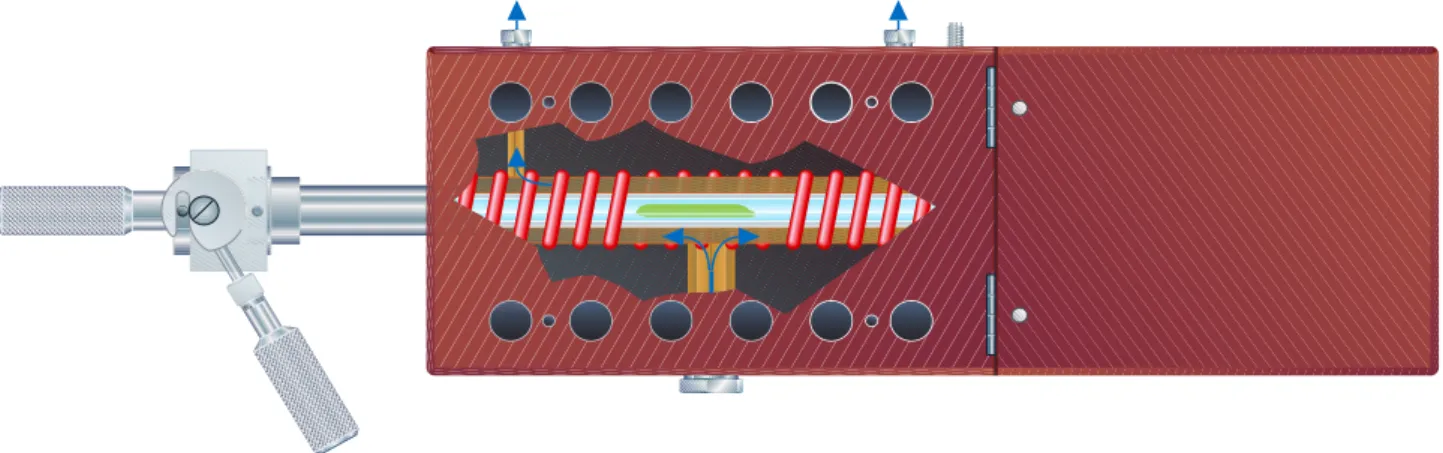
XPERIMENTALInstrumentation. The system consists of a thermodesorption system (TDS 2, Gerstel GmbH, Mülheim an der Ruhr, Germany, Figure 1), a temperature programmable cooled injection system (CIS 3, Gerstel GmbH, Mülheim an der Ruhr, Germany), a gas chromatograph (HP 5890 series II, Hewlett-Packard, Waldbronn, Germany) and a mass selective detector (HP 5972, Hewlett-Packard, Waldbronn, Germany).
Figure 2. Desorption principle, TDS in split-mode.
Figure 3.Desorption principle, TDS in splitless-mode.
Figure 1.Thermodesorption system TDS 2 (topview).
Operation. A blank glass tube is filled with the sample and then inserted into the TDS 2 desorption chamber which is cooled down to subambient temperatures in order to prevent premature desorption. After purging the air out of the system, the tube is then heated to the 350°C , while the carrier gas flowing through the tube transferres the volatiles in split- or splitless-mode (Figure 2 and 3) into the pre-cooled CIS, where they are cryofocused and concentrated.
CIS
TDS
CIS
TDS
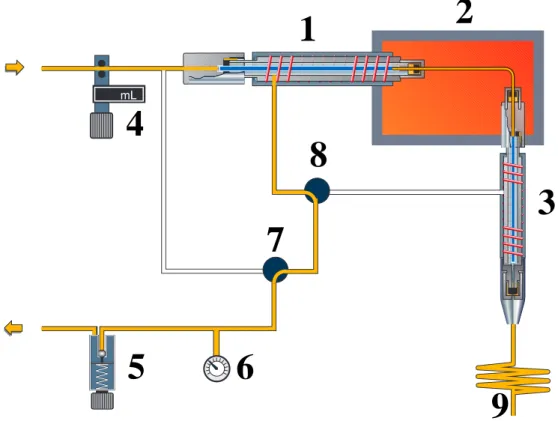
After the desorption has finished the CIS is heated to the 400°C to allow split- or splitless transfer of the trapped compounds to the analytical column and further mass spectrometric detection. Figure 4
describes the operation principle.
Figure 4. Schematic of the applied system which consists of a thermodesorption system (1), a temperature controlled transfer capillary (2), a cooled injection system (3), standard backpressure Pneumatics with mass-flow controller (4), backpressure regulator (5), pressure gauge (6) and split/ splitless valve (7), including an additional 3/2-way solenoid (8) to switch the splitflow between TDS and CIS. The analytical column (9) is directly connected to a mass selective detector.
In order to avoid a drying step, the soil samples are analysed with their original humidity. Previous approaches could only handle predried samples [5,6], because water would also be thermally desorbed and clog the cryotrap. A preliminary drying step at 100°C failed due to water of hydration set free during the subsequent thermal desorption.
For that reason the TDS unit was operated in split mode. Therefore clogging of the CIS could be avoided, whereas the amount of sample transferred into the CIS was sufficient to guarantee the desired sensitivity.
Materials. The properties of the tested samples are listed in Table I.
2
3
1
8
7
9
6
5
4
5
Arable soil, para-brown earth 99.3 % < 10 mg/kg - - -1.33 mg/kg 1.5 mg/kg 1 13 %4
Loam, slightly sandy
,
residuum of weathered rocks (Devon?). Or
ganic
matter invisible. Cohesive soil. high clay content
85.4 % 31 mg/kg < 0.05 mg/kg < 0.05 mg/kg -189 mg/kg 32 mg/kg 17 %
3
Gravelly sand with plant
remains, clayish,
uncohesive soil. Single
grain structure. low clay content
96.1 % 1 140 mg/kg 38.3 mg/kg 16.6 mg/kg 43 % 9.74 mg/kg 9.85 mg/kg 102 %
2
Loam, sandy , gravelly , stony . Aggradation?medium clay content
88.1 % 400 mg/kg 6.37 mg/kg 1.33 mg/kg 21 % 137 mg/kg 69 mg/kg 50 %
1
Paddy field loam, gravelly
,
gray-brown. Or
ganic
matter invisible.
medium clay content
87.4 %
1
120 mg/kg 5.56 mg/kg 2.81 mg/kg 50 % 239 mg/kg 227 mg/kg 95 %
Sample No.
Description Clay content in comparison Dry residue Hydrocarbons, total PCB, total - extraction - thermal desorption - recovery rate PAH, total - extraction - thermal desorption - recovery rate
Table I.
All soil samples were designated to be decontaminated by pyrolysis. One sample is cohesive due to a comparably high clay content; two samples are of medium clay content, while the fourth is an uncohesive soil with single grain structure. As a reference, a para-brown earth (arable soil) with a very low PAH and hydrocarbon content was analyzed.
Sample preparation. No other sample preparation than crushing the material with a jaw crusher to a maximum grain size of 4 mm was necessary.
Reference methods. PAH´s, PCB´s and Hydrocarbons were determined according to the established standard methods and used for comparison with the thermodesorption results.
(a) PAH-method [9, modified] : 10 g of sample are mixed with calcinated sodium sulfate and soxhlet extracted with toluene for 15 hours. The reconcentrated extract was cleaned through column chromatography on silica gel, spiked with 9,10-Diphenylanthracene as internal standard and analyzed via GC/MS. The determination limit is established at 0.01 mg/kg dry sample.
(b) PCB-method according to Klärschlamm-Verordnung [10], but sample preparation as described under (a).
(c) Mineral oil hydrocarbons according to [2], No. 58 (IR-spectroscopic, after extraction with 1,1,2-Trichlortrifluoroethane.
Analysis conditions.
Column: 50 m DB 5 (J&W) di = 0,25 mm df = 0,25 µm Pneumatics: Carriergas He pi = 210 kPa split x:100
Temperatures: TDS -50°C; 350°C; 60°C/min
CIS -150°C; 400°C; 12°C/s
Oven 60°C; 250°C; 10°C/min;
320°C; 5°C/min
MSD 300°C
R
ESULTSANDD
ISCUSSIONDetermination of recovery rates of PAH´s with an artificial sample. For performance testing an empty TDS glass tube was filled with purified quartz sand and then spiked with a standard solution of 16 EPA PAH´s [7] . The quartz sand was used to avoid adsorption effects and hindering of the gas flows due to sintering of the sample, an often observed effect with real life samples.
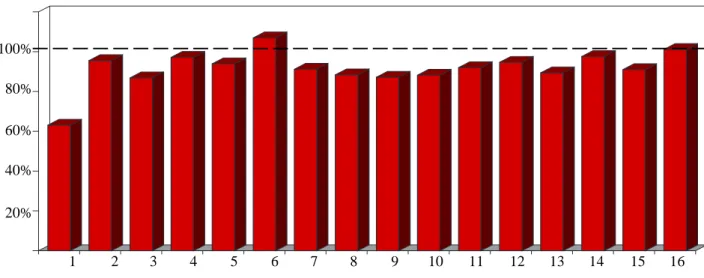
The recoveries were determined through calibration and comparison with the liquid injection of the same standard solution. Figure 5 and Table II reveal that even high boilers like Dibenzo[a,h]anthracene (b.p. 535°C, [8]) are desorbed quantitatively. The standard deviation is not much higher than with liquid injection.
Ê Ê Ê Ê
Figure 5.Recoveries of PAH´s (mean) compared to liquid injection (see also Table II). 60% 40% 20% 100% 80% 16 15 14 13 12 11 10 9 8 7 6 5 4 3 2 1 Compound 1. Naphtalene 2. Acenaphtene 3. Acenaphtylene 4. Fluorene 5. Anthracene 6. Phenantrene 7. Fluoranthene 8. Pyrene 9. Benzo[a]anthracene 10. Chrysene 11. Benzo[b]fluoranthene 12. Benzo[k]fluoranthene 13. Benzo[a]pyrene 14. Indeno[1,2,3-c,d]pyrene 15. Benzo[ghi]perylene 16. Dibenz[a,h]anthracene mean 63.1 95.6 86.9 97.2 93.9 107.0 91.2 88.4 87.2 88.2 92.0 94.7 89.4 97.6 91.0 101.1 run 4 133.4 105.5 105.8 102.9 97.9 102.0 86.2 85.6 86.2 86.2 90.9 94.7 89.7 108.4 97.8 113.6 run 3 22.4 84.9 70.9 91.8 94.0 99.8 97.9 94.2 88.2 89.7 92.6 95.2 88.4 91.0 84.3 93.3 run 2 51.4 92.9 89.7 94.8 92.9 106.1 91.5 87.6 90.3 90.3 93.1 94.9 87.7 90.8 85.6 96.3 run 1 45.2 98.9 81.0 99.2 90.8 119.9 89.1 86.2 84.0 86.6 91.4 93.9 91.7 100.2 96.4 101.3
Table II.Recoveries (in %) of PAH´s compared to liquid injection.
Determination of PAH´s and PCB´s in real soil samples. The method used in this application provides all qualitative and quantitative information about the volatile compounds in the sample. The total ion chromatogram (Figure 6) clearly reveals that a mass spectrometer is absolutely essential for that purpose, because only in extracted ion chromatogram- (Figure 7) or selected ion chromatogram-mode (Figure 8) respectively, the necessary selectivity can be achieved.
Figures 6 to 8.Direct thermal desorption of a contaminated soil (sample 1): Total ion chromatogram (top), exctracted ion chromatogram (middle) and selected ion monitoring chromatogram (bottom).
Abundance 35.00 30.00 25.00 20.00 15.00 Time--> 0 5000 10000 15000 0 500000 1000000 1500000 2000000 2500000 3000000 3500000 0 2000000 4000000 6000000 8000000 1e+07
Total Ion Chromatogram
Extracted Ion Chromatogram: PAH-traces
Selected Ion Monitoring: PCB-traces
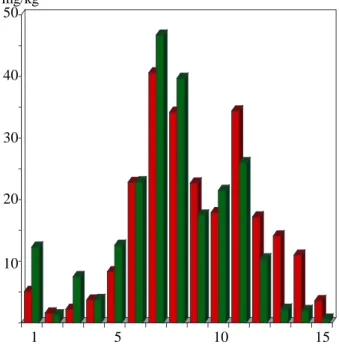
Recovery and detection limits. The recovery decreases with increasing boiling temperature possibly due to adsorption effects to values of about 20% (above 500°C, Figures 9 to 12) . It can be estimated that the results for the lower boiling compounds, especially Naphtalene, are closer to the real amount in the sample because losses due to evaporation during sample pretreatment, are here minimized.
Samples 1, 3 and 5 show excellent total recoveries, whereas the samples 2 and 4 decrease in recovery (Table I). A correlation with the clay content or organic matter could not be found.
Detection limits are comparable to the established methods, even the low PAH amounts found in a sample from uncontaminated arable land could be confirmed (Table I, sample 5).
Figure 11.Comparison between extraction (light grey) and thermodesorption (dark grey), sample 3.
Figure 12.Comparison between extraction (light grey) and thermodesorption (dark grey), sample 4.
Figure 9.Comparison between extraction (light grey) and thermodesorption (dark grey), sample 1.
Figure 10.Comparison between extraction (light grey) and thermodesorption (dark grey), sample 2. 10 20 30 40 50 5 10 15 20 25 10 20 30 40 0.2 0.8 1.2 1.4 mg/kg mg/kg mg/kg mg/kg 1 5 10 15 1 5 10 15 1 5 10 15 1 5 10 15
C
ONCLUSIONThe combination thermodesorption/cooled injection/GC/MS offers for the first time a technique for semi-quantitative trace analysis of volatile contaminants in soils. In contrast to other screening methods also medium and high boiling compounds even in coherent, clay and humus containing soils can be analyzed.
Thermodesorption has proven to be a time saving extraction method. This extraction step can now be reduced to 30 minutes.
Low sample amount (approx. 500 mg) and the necessity to crunch the sample have to be regarded as slight disadvantages.
R
EFERENCES[1] I. Blankenhorn, D. Meijer und R.J. van Delft, Fresenius J. Anal. Chem., 343,497-504 (1992).
[2] Analysenverfahren für Untersuchungen im Zusammenhang mit der Abfallentsorgung und mit Altlasten. Lfd. Nr. 76: PAK. RdErl. d. Ministers für Umwelt, Raumordnung und
Landwirtschaft - III A 5 - 567 vom 25.3.1988. [3] z.B. DIONEX-Applikation 1992.
[4] J. Bundt und R. Stegmann, GIT Spezial, Chromatographie 2/1993, 64-69.
[5] W. Püttmann, C.B. Eckardt und R.G. Schaefer, Chromatographia25, 279-287 (1988).
[6] W. Püttmann und W. Goßel, Wissenschaft und Umwelt3 (1988), 123-130.
[7] Environmental Protection Agency, Part VIII, Vol. 49, No. 209, Method 610 (1984).
[8] z.B. VDI-Richtlinie 3872 Blatt 2.
[9] Landesamt für Wasser und Abfall, Schriftenreihe Abfallwirtschaft Nr. 13, 12/1987.
GERSTEL Worldwide
GERSTEL GmbH & Co. KG
Eberhard-Gerstel-Platz 1 45473 Mülheim an der Ruhr Germany +49 (0) 208 - 7 65 03-0 +49 (0) 208 - 7 65 03 33 [email protected] www.gerstel.com GERSTEL, Inc.
701 Digital Drive, Suite J Linthicum, MD 21090 USA +1 (410) 247 5885 +1 (410) 247 5887 [email protected] www.gerstelus.com GERSTEL AG Wassergrabe 27 CH-6210 Sursee Switzerland +41 (41) 9 21 97 23 +41 (41) 9 21 97 25 [email protected] www.gerstel.ch GERSTEL K.K. 1-3-1 Nakane, Meguro-ku Tokyo 152-0031 SMBC Toritsudai Ekimae Bldg 4F Japan +81 3 5731 5321 +81 3 5731 5322 [email protected] www.gerstel.co.jp GERSTEL LLP
Level 25, North Tower One Raffles Quay Singapore 048583 +65 6622 5486 +65 6622 5999 [email protected] www.gerstel.com GERSTEL Brasil
Av. Pascoal da Rocha Falcão, 367 04785-000 São Paulo - SP Brasil +55 (11)5665-8931 +55 (11)5666-9084 [email protected] www.gerstel.com.br ISO 9 001:2008 ISO 9001 C ER
TIFICATE NO. 0086 D CERT
IFIED QM-SYSTEM
Awarded for the active pursuit of environmental sustainability Information, descriptions and specifications in this
Publication are subject to change without notice. GERSTEL, GRAPHPACK and TWISTER are registered trademarks of GERSTEL GmbH & Co. KG. © Copyright by GERSTEL GmbH & Co. KG