Open Access
R E S E A R C H
© 2010 Sakkalis et al; licensee BioMed Central Ltd. This is an Open Access article distributed under the terms of the Creative Commons Attribution License (http://creativecommons.org/licenses/by/2.0), which permits unrestricted use, distribution, and reproduction in any medium, provided the original work is properly cited.
Research
A decision support framework for the
discrimination of children with controlled epilepsy
based on EEG analysis
Vangelis Sakkalis*
1, Tracey Cassar
2, Michalis Zervakis
3, Ciprian D Giurcaneanu
4, Cristin Bigan
5, Sifis Micheloyannis
6,
Kenneth P Camilleri
2, Simon G Fabri
2, Eleni Karakonstantaki
6and Kostas Michalopoulos
3Abstract
Background: In this work we consider hidden signs (biomarkers) in ongoing EEG activity expressing epileptic tendency, for otherwise normal brain operation. More specifically, this study considers children with controlled epilepsy where only a few seizures without complications were noted before starting medication and who showed no clinical or electrophysiological signs of brain dysfunction. We compare EEG recordings from controlled epileptic children with age-matched control children under two different operations, an eyes closed rest condition and a mathematical task. The aim of this study is to develop reliable techniques for the extraction of biomarkers from EEG that indicate the presence of minor neurophysiological signs in cases where no clinical or significant EEG abnormalities are observed.
Methods: We compare two different approaches for localizing activity differences and retrieving relevant information for classifying the two groups. The first approach focuses on power spectrum analysis whereas the second approach analyzes the functional coupling of cortical assemblies using linear synchronization techniques.
Results: Differences could be detected during the control (rest) task, but not on the more demanding mathematical task. The spectral markers provide better diagnostic ability than their synchronization counterparts, even though a combination (or fusion) of both is needed for efficient classification of subjects.
Conclusions: Based on these differences, the study proposes concrete biomarkers that can be used in a decision support system for clinical validation. Fusion of selected biomarkers in the Theta and Alpha bands resulted in an increase of the classification score up to 80% during the rest condition. No significant discrimination was achieved during the performance of a mathematical subtraction task.
Background
Epilepsy is one of the most common neurological disor-ders in childhood [1]. There are many epidemiological studies referring to the incidence of seizures. The average annual rate of new cases per year (incidence) of epilepsy is approximately 5-7 cases per 10,000 children from birth to 15 years of age [2] and despite the differences across studies, it is possible to rate the prevalence of epilepsy in children as 4-5/1,000. Epilepsy is a complex condition caused by a variety of pathological processes in the brain.
It is characterized by occasionally (paroxysmal), exces-sive, and disorderly discharging of neurons that can be detected by clinical manifestations, EEG recording, or both.
The diagnosis of epilepsy is mainly clinical. The use of EEG is also requisite for the diagnosis and the classifica-tion of epilepsy. Pathophysiologically, there are many the-ories, based on animal models, about the generation of the seizures that implicate the excitation and inhibition of neuronal membranes and the role of some neurotrans-mitters (i.e. GABA). Generally the prognosis of epilepsy for remission is good but depends on the underlying cause. Antiepileptic drugs and surgery can control many types of epilepsy, but 20-30% of people with epilepsy have
* Correspondence: [email protected]
1 Biomedical Informatics Lab, Institute of Computer Science, Foundation for Research and Technology, Heraklion, Greece
the benign genetic epilepsies that remit without treat-ment. Although most seizures in children are benign and result in no long-term consequences, increasing experi-mental animal data strongly suggest that frequent or pro-longed seizures in the developing, immature brain result in long-lasting sequel [3].
Anti-epileptic drug treatments can result in significant power spectral differences of the epileptic patients when compared to a control group. Salinsky et. al. [4] and Tuu-nainen et. al. [5] have both analyzed spectral EEG changes in adult patients taking AEDs. Salinsky in partic-ular has considered four occipital EEG measures includ-ing the peak frequency, median frequency and relative theta and delta power to analyze a group of patients with low seizure frequency who were either starting or stop-ping AED therapy. A set of cognitive tests and a struc-tured EEG were performed before the change in AED consumption and 12-16 weeks after. When compared with a control group, the peak frequency captured differ-ences in patients stopping or starting AEDs. For those stopping AEDs, the median frequency and the percentage theta power also gave significant differences. Similarly, Tuunainen et. al. captured differences in AED patients and control subjects. In this case they used the absolute and relative power as well as the peak power frequency at left occipital brain lobes as features extracted from a four second, eyes open, experimental setting. Results showed that the occipital peak alpha frequency was significantly lower in patients than in controls. Furthermore, the abso-lute power of the patient group was significantly higher at baseline in the control group, over all channels for the delta, theta, beta and total activity. Absolute alpha power was also found to be higher but this result was not signifi-cant.
Cognitive and behavioral changes in children with epi-lepsy are often encountered and these may be related to the epilepsy itself, the necessary use of antiepileptic drugs or a possible surgery, the probable brain dysfunction or damage associated with the seizures and social and family reasons [6]. Specifically, there is an association between attention-deficit/hyperactivity disorder (ADHD) and epi-lepsy revealed by many studies [7,8] but there are also other psychiatric disorders more commonly associated with epilepsy. Depression is considered to be the most frequent psychiatric disorder in patients with epilepsy and it is reported that children with epilepsy examined with the Child Depression Inventory showed elevated scores for depression [9]. Pellock estimated the preva-lence of anxiety in children with epilepsy at 16% [10]. There also seems to be an association between autism and epilepsy in children, but a strong relation between epilepsy in childhood and aggressive or oppositional behavior has not been established [11]. Due to the poten-tial long-lasting effects of epilepsy, it is important to
detect and deal with symptoms as early as possible. To address this issue, we consider the diagnosis of children who experienced very few seizures in the past but who have no psychological findings or notable symptoms and whose EEG is visually diagnosed by a clinician as being normal. These children are highly probable to experience epilepsies in the future. Thus, the aim of this study is to develop reliable techniques for the extraction of biomark-ers from EEG that indicate the presence of such con-trolled epileptic patterns. We compare two different approaches of localizing activity differences and retriev-ing relevant information to identify young children hav-ing controlled epilepsy from their non-epileptic counterparts. The first approach focuses on power spec-trum analysis techniques using a signal representation approach such as Wavelets to elaborate on the differences in classification results. The second approach focuses on analyzing the functional coupling of cortical assemblies using the widely used magnitude squared coherence (MS-COH) measure and the bivariate autoregressive (AR) coherence (AR-COH) measure on the actual EEG signal
Methods Subjects
Recordings
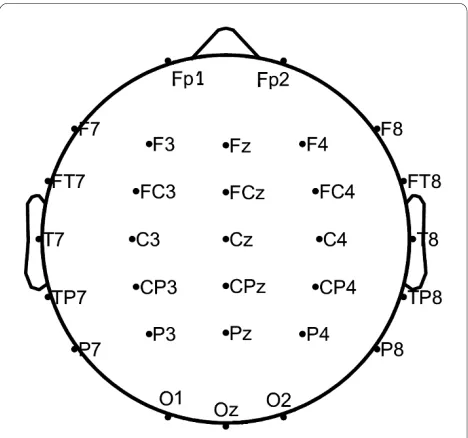
Continuous EEGs were recorded in an electrically shielded, sound and light attenuated room while partici-pants sat in a reclined chair. The EEG signals were recorded from 30 electrodes placed according to the 10/ 20 international system, referred to linked A1+A2 elec-trodes. This electrode montage is shown in Figure 1. The signals were amplified using a set of Contact Precision Instrument amplifiers (Cambridge, MA, USA--http:// www.psylab.com), filtered on-line with a band pass between 0.1 and 200 Hz, and digitized at 400 Hz. Off-line, the recorded data were carefully reviewed for technical and biogenic artefacts, so that only artefact free epochs of 10.24s duration are investigated. Artefacts were treated visually by an expert, since many automated artefact removal algorithmic methodologies, even if they are suc-cessful in removing certain types of artefacts, fail to leave physiological EEG intact. Thus, only pieces without visi-ble artefacts (EOG, EMG, movements) were preserved. For each subject only one representative 10.24s epoch is included in the data. The selection of EEG epochs was performed blindly by an expert without knowing the group of each subject. Also the length of the epoch was chosen as it is short enough to assume stationarity and from the experience of our clinical lab, this period is enough for the analysis required [12,13]. The procedures used in the study had been previously approved by the University of Crete Institutional Review Board.
Test description
In this study, two different tasks were analyzed. During the control (passive viewing) task (Task 1) subjects were at rest and had their eyes fixed on a on a small star dis-played at the centre of a computer screen to reduce eye artefacts. The second task was a mathematical task (Task 2) involving the subtraction of two-digit numbers (e.g. 34 - 23, 49 - 32) [14], displayed on an LCD screen located in front of the participants at a distance of approximately 80 cm, subtending 2-4 degrees of horizontal and 2-3 degrees of vertical visual angle. Such a mental task is considered to be difficult for the studied age group. Vertical/horizon-tal eye movements and blinks were monitored through a bipolar montage from the supraorbital ridge and the lat-eral canthus. The analyzed epochs were acquired during the intensive calculation phase.
Analysis
In this study two different approaches of localizing activ-ity differences and retrieving relevant information for classifying the two children groups are compared. Section (4.1) focuses on power spectrum analysis techniques. In particular, we elaborate on the differences in classifica-tion results obtained when using Wavelets, which is a non-parametric approach that actually achieves an alter-native signal representation [13]. Section (4.2) focuses on analyzing the functional coupling of cortical assemblies using the traditionally formulated but widely used magni-tude squared coherence (MS-COH) and the coherence measure applied on a bivariate autoregressive (AR) pro-cess (AR-COH). Coherence is a normalized measure of linear dependence between two signals and is capable of identifying linear synchrony on certain frequency bands [15,12].
Univariate power spectrum analysis
Features extracted from the time-frequency spectrum when using Wavelets are compared and their effect on the classification of the two groups is analyzed, while the subjects performed the control (rest) task (Task 1) and math task (Task2). Wavelets derive significant features encoding brain activity throughout the test period, which can also be localized in time for the study of abrupt or transient responses.
Biomarkers are constructed for specific brain regions (lobes) assuming a preselected lobe scheme that covers the entire head and is separated in groups of channels that are expected to function in a similar manner. The lobes (channel groups) considered are: FL (FP1, F3, F7), FR (FP2, F4, F8), CL (C3, CP3), CR (C4, CP4), PL (P3, P7), PR (P4, P8), TL (FT7, T3, TP7), TR (FT8, T4, TP8) and OL (O1, P7), OR (O2, P8). Furthermore six sequential
quency bands were considered in this analysis: delta (0-4 Hz), theta (4-8 Hz), alpha (8-13 Hz), beta (13-30 Hz), gamma1 (30-45 Hz) and gamma2 (45-90 Hz).
Wavelet transform (WT)
The WT has developed into an important tool for analy-sis of time series that contain non-stationary power at many different frequencies (such as the EEG signal), and it has proved to be a powerful feature extraction method [16]. The epileptic recruitment rhythm during seizure development is well described in terms of relative wavelet energies [17]. The WT as compared to the FFT is more suitable for analyzing transient signals because both fre-quency (scales) and time information can be obtained in good resolution.
The continuous wavelet transform (CWT) was pre-ferred in this work, so that the time and scale parameters can be considered as continuous variables. In the CWT the notion of scale s is introduced as an alternative to fre-quency, leading to the so-called time-scale representa-tion. The CWT of a discrete sequence xn with time spacing δt and N data points (n = 0,1, ..., N-1) is defined as the convolution of xn with consecutive scaled and trans-lated versions of the wavelet function ψ0(η):
where s, η and ω0 indicate scale, non-dimensional "time"
and "frequency" parameters, respectively and . In
our application, ψ0(η) describes the most commonly used
wavelet type for spectral analyses, i.e., the normalized
complex Morlet wavelet as given in (2). The frequency
parameter ω0 is selected equal to 6 since it is a good
trade-off between time and frequency localization for the
Mor-let waveMor-let. The waveMor-let function ψ0 is a normalized
ver-sion of ψ that has unit energy at each scale, so that each
scale is directly comparable to each other. There exists a
concrete relationship between each scale s and an
equiva-lent spectral frequency f, which for the Morlet wavelet is
given by f = 1/(1.03 s) [18], so that scales can be mapped
to frequency bands [13]. Thus, we can obtain the power
spectrum of WT at specific frequency-scale s for each
channel c, through the time-scale-averaged power
spec-trum . The corresponding biomarkers for each
sub-ject are obtained for each brain lobe l (which includes
specific channels) and band B (which includes several
scales), can then be computed as:
where cl represents the set of channels within each lobe l and sB the number of frequency bins in band B. Notice that in the power measure we use the dB value.
Bivariate synchronization analysis
In this study we also employ a methodology towards investigating the capabilities of linear measures in reveal-ing the couplreveal-ing between EEG channels in real band-lim-ited signals. Synchronous oscillations of certain types of such assemblies in different frequency bands relate to dif-ferent perceptual, motor or cognitive states and may be indicative of a wider range of cognitive functions or brain pathologies [19,20]. Hence, in the bivariate case we con-sidered the MS-COH and the AR-COH measures and applied them in classifying the two subject groups, in the same analysis scheme as described in Section 3.1 for the univariate case. In this case a synchronization value is calculated between a selected pair of electrodes resulting in bivariate measures that can be treated similarly to the ones in the univariate case. Once the additional synchro-nization features are calculated they are fed to the classi-fier to discriminate between the two subject groups.
Magnitude squared (MS-COH) and AR coherence (AR-COH) For the time series xn and yn, n = 1 ... N, where x, y repre-sent pairs of channels, the well-known expression of the Magnitude Squared Coherence (MS-COH) is given by:
where f denotes frequency, Sxy denotes the cross spec-tral density function, while Sxx and Syy are the individual autospectral density functions for x and y, respectively [15]. To compute the MS-COH with nonparametric methods, we use the Welch's periodogram smoother, with a non-overlapping Hamming window of 1024 sam-ples length. In the formula above, we employ the notation 冬·冭 to emphasize that window averaging is applied. Note that MS-COH for a given frequency f ranges between 0
W sn xn t s n n t s
n N
( )= ′( / ) *[( ′ − ) / ]
′= −
∑
d y d1 2 0 0 1 (1)
y h0 p 1 4 w0h h 2
2
( )= − / e−i e− / (2)
i= −1
Ws c,2
wB l
cl sB s Ws c
s
c
cl B
,
=
log
+
,=
∑
∑
⎛⎝⎜ ⎜ ⎞ ⎠ ⎟ ⎟ = 1 110
1
21 1
(3)
gxy f Sxy f
Sxx f Syy f
(no coupling) and 1 (maximum linear interdependence). For each brain lobe l and band B the MS-COH (γB, l) can be defined as the average of eq. 4, for x, y within the spe-cific lobe and f within the spespe-cific band.
The linear dependence between the signals x and y can be modeled by a bivariate autoregressive (AR) process of order m. Let Zn = [xn yn]T for 1 ≤ n ≤ N and z
n = [0 0]T for n < 1, with the convention that T denotes transposition.
Then we have zn = -A1zn-1 - 傼- Amzn-m + en where the entries of the 2 × 2 matrices A1, ..., Am are real-valued. The residuals en are temporally uncorrelated and their covariance matrix is denoted Qm. The bivariate AR model leads to the following factorization of the spectral matrix [21]:
where i2 = -1, A
0 is the identity matrix and the symbol *
is used for conjugate transpose. For example, MS-COH can be readily computed, and we use the name AR-COH whenever the evaluation of the MS-COH is based on the spectral matrix factorization. A detailed description of algorithms for estimating A1, ..., Am and Qm, which are defined for specific x, y and f from EEG data, can be found [22]. The results reported in Section 4.2 have been obtained with the Whittle-Wiggins-Robinson estimation method [23,24]. The order of the autoregressions was selected from {1, ..., 50} by applying the Minimum Description Length criterion [25]:
The band and lobe specific measure is defined similar to the corresponding MS-COH measure (i.e. γB, l). The MS-COH and AR-COH synchronization values ranging from 0 to 1 are used as biomarkers in the bivariate case and are calculated for each brain region (lobe) assuming again a preselected lobe scheme that contain grouped channel pairs instead of single channels. The lobes (chan-nel pair groups) for the bivariate case are: OPL (O1-P3, O1-P7, P7-P3), OPR (O2-P4, O2-P8, P8-P4), CPL (CP3-P3, C3-C(CP3-P3, P3-P7), CPR (CP4-P4, C4-CP4, P4-P8) FTL (FP1-F7, FP1-F3, FT7-T3, FT7-TP7, T3-TP7), FTR (FP2-F8, FP2-F4, FT8-T4, FT8-TP8, T4-TP8), TL (FT7-T3, T3-TP7, FT7-TP7), TR (FT8-T4, T4-TP8, FT8-TP8).
Feature Selection and Classification
This study proposes a statistical method for mining the most significant lobes using the available biomarkers,
resembling the way many clinical neurophysiological studies evaluate the brain activation patterns. Since the goal is to find significant differences between two groups, the independent two-sample t-test is used to assess whether the means of the two groups are statistically dif-ferent from each other. As a parametric test it assumes that: i) data comes from normally distributed popula-tions, ii) data is measured at least at the interval level, iii) variances of the populations involved are homogenous and iv) all observations are mutually independent [26]. In this analysis, the feature vectors for control subjects (FC) and for epileptic subjects (FE) consist of the biomarkers MB, l which are the log-transformed values of the power (univariate case) or the synchronization values (bivariate case) within a specific frequency band B for a particular lobe l. Thus, the feature vectors are formed as:
where or represents the set of biomarker for
control or epilepsy subject i (Ci or Ei), within frequency
band B, and for a particular lobe l. In our application, the
number of bands B ranges from one to six and the
num-ber of lobes l ranges from one to ten. These feature
vec-tors can be defined for the various forms of biomarkers
(wavelet power, MS-COH and AR-COH) defined above,
or for combinations of measures. By using the D'Agostino
Pearson test [26] or Kolmogorov-Smirnov's test [26], the
features were found to have a normal distribution, thus
satisfying assumption (i). Distance between points along
the scale of the possible feature values was equal at all
parts of the scale, thus ensuring that data is measured at
least at the interval level (assumption (ii)). Homogeneity
of variances was tested using Levene's test based on the
F-statistic [26] and in this case it was found that the fea-tures from the two groups did not have equal variances.
As this violates one of the above assumptions, the t-test
had to be applied assuming unequal variances
(Behrens-Fisher problem). Finally, since the biomarkers in FC and FE
are coming from two independent groups (controls and
epileptics) assumption (iv) is reasonable. S xx f S xy f
S yx f S yy f k k m ikf m e ( ) ( ) ( ) ( ) ⎡ ⎣ ⎢ ⎤⎦⎥ ⎛ ⎝ ⎜⎜ ⎞⎠⎟⎟ = = − −
∑
A Q A0 2 1 p kk k m ikf e = − −
∑
⎛ ⎝ ⎜⎜ ⎞⎠⎟⎟ ⎡ ⎣ ⎢ ⎢ ⎤ ⎦ ⎥ ⎥ 0 2 1 p * (5)m f N
N xy m m m ∧ = ⎡
(
)
+ ⎣⎢ ⎤⎦⎥( ) arg min ln det Q 4 ln (6)
FC = ⎡⎣MB lC,1,MB lC,2,…,MCB l,20⎤⎦ (7)
FE = ⎡⎣MB lE1,,MB lE,2,…,MEB l,20⎤⎦ (8)
M B l Ci
, MB l
Ei
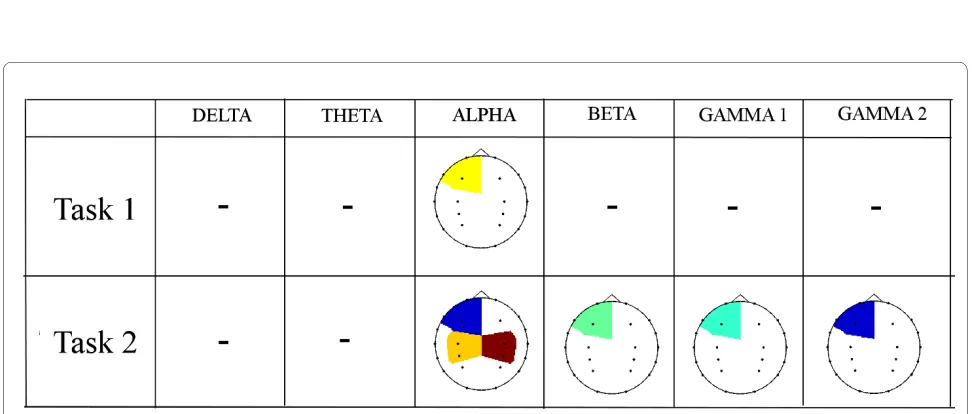
Figure 2 Topographic maps showing the p-values of WT power differences between control and epilepsy subjects for Task 1 and Task 2. The black dots in each image represent the channel locations. Lower p-values are indicated in shades of blue while p-values close to the threshold of 0.1 are indicated in shades of red. Blank areas within each topographic map indicate that the features extracted from that particular lobe do not give significant differences between the two populations (p > 0.1).
This statistical analysis technique was used to identify which lobes and frequency bands give significant differ-ences between the epileptic subject group and the control group for both the signal representation approach and the signal modelling approach in the univariate and bivariate cases.
Once the features were available, classification was per-formed using a simple linear discriminant analysis (LDA) classifier with the leave-one-out validation approach. This means that one subject was tested while all the rest were used for training. In the results section we give the classification scores for the respective frequency bands and brain lobes to identify the number of correctly classi-fied subjects out of the total population of 40 children. Apart from this the corresponding sensitivity and speci-ficity measures are provided.
Results
Univariate power spectrum analysis
The WT was applied to the real EEG data, where each signal was initially set to zero mean and unit variance. In each case, we compute the lobe/band significance, as well as the corresponding classification scores with sensitiv-ity-specificity measures. Figure 2 illustrates the topo-graphic maps of the p-values between the two groups, obtained for each task and frequency band. Cells which have been left blank indicate no significant difference at the 90% confidence interval (p > 0.1). Shaded brain lobes represent a p-value ranging from 0.01 to 0.1, with shades of blue indicating the lowest p-values. These topographic maps show clearly that for the control task (Task 1) few brain areas have been identified by Wavelets to give sig-nificant differences between the two groups. The Wavelet approach detected significant differences in the left fron-tal lobe of the Alpha band only. Since fronfron-tal channels may easily be affected by eye movements, this result may be purely sporadic. Differences in the Alpha band are expected, since the Rolandic EEG rhythms at rest are dominated by Alpha and Beta activity [27].
However, for Task 2 the WT succeeds in identifying significant spectral differences within the frontal left lobes of Alpha and Gamma2 band and central lobes of the Alpha band. Alterations in the Alpha band are also expected since they are generally associated with prob-lems in attention and episodic memory [28]. For higher frequency bands WT found low significant differences in left frontal areas. Differences at higher frequencies, par-ticularly in the gamma bands, for such a cognitive task is probably related to the task complexity itself [29].
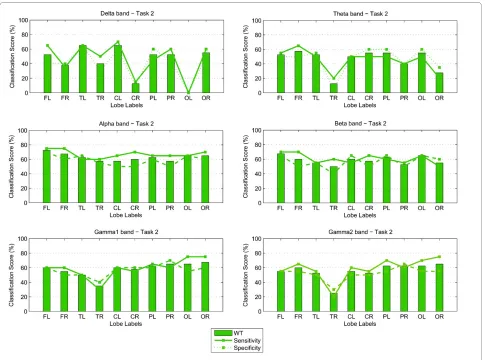
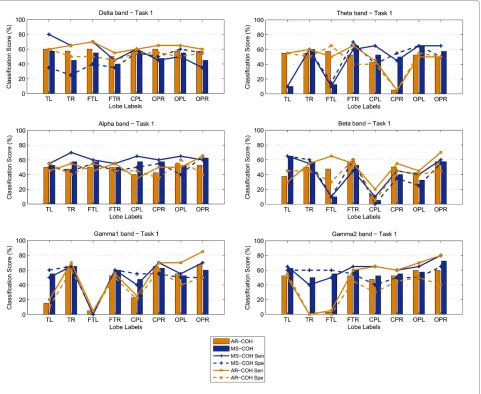
The classification scores (percentage correct) and sen-sitivity-specificity measures for both Task 1 and 2, are shown in the form of bar graphs in Figures 3 and 4. A lin-ear discriminant analysis (LDA) classifier with the
leave-one-out evaluation scheme was implemented to derive the number of correctly classified subjects. In this case 39 out of a total of 40 children available were used for train-ing while the remaintrain-ing subject was then used in the test-ing process. The plots show that the spectral biomarkers for Task 1 result in classification scores close to 60%. The most consistent result across the different brain regions, for WT, occurred for the Theta and Alpha bands with the exception of the score over the right temporal brain region which fell well below chance level. The bar graphs also show that overall the Gamma1 band was consistent, as well.
For Task 2, the classification scores are more sporadic than those obtained for Task 1. The most stable result across the different brain lobes was obtained for the Alpha band (where the highest score of 72.5% was achieved) and the Beta band over the frontal lobe. For the Gamma bands, WT also obtained relatively stable scores over the parietal and occipital brain areas, but as shown in the topographic maps earlier, the occipito-parietal dif-ferences at these sites were not significant.
Bivariate synchronization analysis
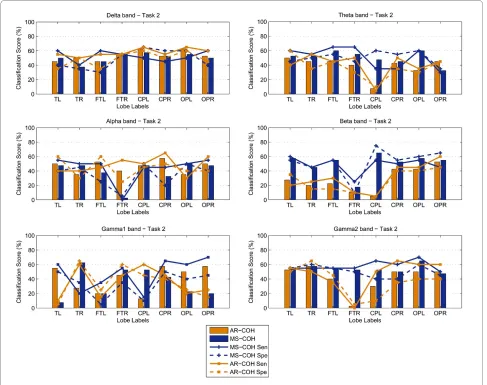
The MS-COH and AR-COH measures are computed on both "normal" and "controlled-epileptic" band-filtered data (using a fourth order zero-phase shift bandpass But-terworth filter). Similar to the results of the previous sec-tion, the classification scores and sensitivity-specificity measures for MS-COH and AR-COH, for Tasks 1 and 2 are shown in the form of bar graphs in Figures 5 and 6, respectively. The plots show that the maximum classifica-tion score achieved for Task 1 was in the Gamma2 band for the occipito-parietal lobes (OPL, OPR), where 72.5% classification was reached (MS-COH). For Task 2, the maximum classification score achieved was 65% (MS-COH) in CPL - Beta band and OPL - Gamma2 band. Even if this score is low, a general trend observed in Fig-ures 5 and 6 is that the central-parietal (CPL-CPR) and occipito-parietal (OPL-OPR) lobes achieve overall better scores. As a final step towards a better classification result for Task 2, we considered fusing selected biomark-ers from the univariate and the bivariate case (see section 3.3.3). Finally, it should be noted that nonlinear measures (phase and generalized synchronization) were also tested but not included in this paper since they were not able to identify any statistically significant differences.
Selection of biomarkers
Biomarkers based on WT
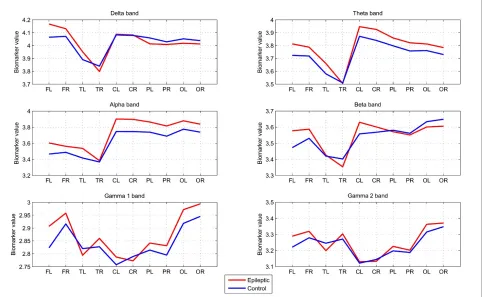
epilep-tic and 20 control children respectively across different frequency bands and brain regions.
For controlled epileptic children our analysis derives consistent higher energy in the Theta and Alpha bands, as well as a symmetrical energy variation pattern in Delta, Theta, Alpha and Beta bands. This result is in line with earlier studies [19,30], which found an increase in delta-theta ranges (3-7 Hz) and upper Alpha-lower Beta ranges (15-17 Hz) in patients with partial and generalized epi-lepsies. From this relation and the significant areas derived by WT analysis, we select Theta-Alpha band activity on central and temporal channels (TL, TR, CL and CR) for further analysis of our results from univariate analysis. In Table 1 we analyze the spectral biomarkers of the two groups for Task 1. Specifically, the table presents the average and the standard deviation values of the bio-markers across the analyzed brain lobes, for the epileptics and controls, respectively. Results for each of the six fre-quency bands are tabulated. These results verify that on average, the epileptic children had significantly higher spectral biomarkers, especially on the Theta and Alpha
bands where the difference is shown to be the most sig-nificant (p < 0.5).
The largest difference occurred within the Alpha band, as was expected for a child group where the spectral peak may also spread into the theta band, since in children dif-ferent frequency bands are not yet functionally difdif-ferenti- differenti-ated and separdifferenti-ated from the broad alpha frequency range and, thus responds more in an alpha-like way [31]. Rela-tive to an age matched control group, epileptic patients between 9 and 11 years analyzed in [32] have also shown an increase in theta and alpha power.
When considering the mathematical subtraction Task 2 the most significant bands (Table 2) are Theta, Beta and Gamma2. In comparison with the rest Task 1 in each group, we would expect to find increased power activity in Gamma as well as Alpha frequency bands. There is extensive evidence that neural oscillations increasing power in the Gamma band are involved in the visual per-ception of objects and correlate with cognitive task assignments [29,33]. Furthermore, children with epilepsy have been reported to reflect alterations in the Theta
band in tasks associated with attention and episodic memory [28]. Considering the derived classification esti-mates for Task 2, we also find evidence of differences in these bands through the WT analysis. In Section 3.3.3 we further consider fusion of biomarkers in an attempt to increase the overall discrimination ability.
Biomarkers based on synchronization measures
For both tasks the synchronization measures lead to slightly inferior classification estimates compared with the univariate (power) measure. Thus, the selection of synchronization measures for further consideration has been associated with that of power measures and also directed by the existing literature. In general MS-COH appears more efficient than AR-COH in exemplifying small differences. Task 1 does not indicate any significant difference between the two studied groups, based on MS-COH. In association with the selection of WT features in Section 3.3.1, we further consider synchronization
mea-sures in the Theta and Alpha bands (Table 1, p < 0.5), with the aim of exploring the fusion of both power and synchronization biomarkers in enhancing classification scores (Section 3.3.3).
For the cognitive (subtraction) process in Task 2, we would expect some increased synchronization especially in the gamma band, where synchronous localized and/or broadband rhythmic bursting in assemblies of neurons are associated with several consciousness processes [29] and present increased activity in people with partial or generalized epilepsy [19]. In our analysis (Figure 6), dif-ferences in classification scores based on synchronization are low and insignificant. Further analysis based on aver-age measures per group has been performed on lobes expressing the highest classification scores. More specifi-cally, Table 2 summarizes the average biomarkers for both the epileptic and control groups in all six frequency bands for a lobe subset consisting of CPL, CPR, OPL and
OPR. The results show that the biomarker values for the two groups are close to each other and hence not signifi-cant. From Table 2, the highest p-value for discrimination is achieved in the higher Gamma band, followed by the Beta band. The latter also gives better overall classifica-tion scores in Figure 6. There is further evidence of the involvement of the Beta band in cognitive tasks in a way similar to that of Gamma band, however with weaker enhancement of activity [29]. Thus, even though on its own MS-COH fails to distinguish between the epileptic and control children, we further consider the Beta band at lobes CPL, CPR, OPL and OPR for further consider-ation in a fusion strategy along with power measures, as described in the next section.
Decision support for controlled epilepsy based on EEG biomarkers
In order to summarize the above results in the decision framework and use potential biomarkers in such a way as
to increase differentiation between the two groups, we consider a fusion scheme for the available features. Task 1 and Task 2 were considered separately, in order to involve the most prominent features as biomarkers in each case.
Fusion tests were performed on three sets of features: power (WT) features only, MS-COH features only and a combination of power and MS-COH features. Four sim-ple fusion operators were tested as follows:
1 A Linear Discriminant Classifier (LDC) applied to the average of all selected features
2 A majority vote function applied on the classifica-tion outcomes of selected biomarkers. This decision function selects the class label based on which of the available classes (epileptic or normal) gets more than half the votes.
3 A weighted sum of individual classification scores. 4 The MINDIST Algorithm which calculates the least squares distance to the average of features inside each
known class, i.e. epileptic or normal and assigns a label based on that class with the minimum distance. For Task 1, the individual classification scores obtained from specific lobes and frequency bands are not satisfac-tory. Across all lobes, the best results obtained are those for WT, with an average classification score of 54.5%, 54.3% and 49% across the Alpha, Gamma1 and Theta bands respectively. Over the same bands MS-COH obtained classification scores of 46.6% and 56%. Based on
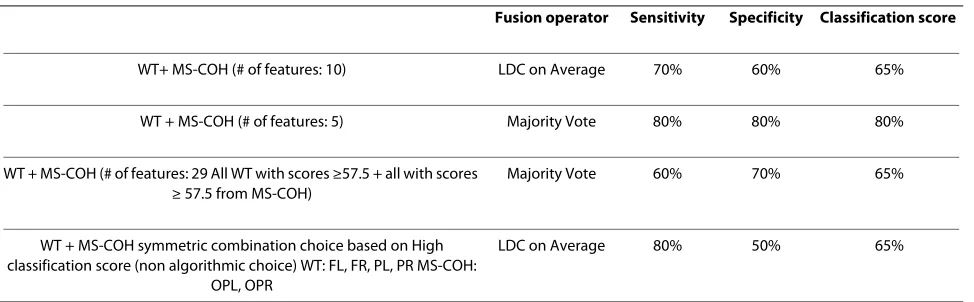
these results and in an attempt to also relate with the widespread distribution of differences derived in [19] between epileptics and controls during the eyes-open, rest state, we included in a fusion scheme features from WT and MS-COH analysis related to the theta and alpha bands. When considering a total of 10 features, 7 from the WT approach (FL, FR, CR, OL from the theta band and FL, PL, OL from the alpha band) and 3 features from the MS-COH approach (FTR, OPL from the Theta band
Figure 7 Averaged WT biomarkers across the 20 epileptic and 20 control subjects, for each frequency band and brain lobe considered.
Table 1: Average WT Biomarker Values of lobes (TL, TR, CL, CR) for Task 1.
Epileptics Controls p-values
Delta 3.98 ± 0.24 3.97 ± 0.31 0.94
Theta 3.76 ± 0.28 3.70 ± 0.20 0.45
Alpha 3.68 ± 0.29 3.57 ± 0.24 0.20
Beta 3.50 ± 0.19 3.49 ± 0.19 0.80
Gamma1 2.80 ± 0.22 2.80 ± 0.21 0.94
and OPR from the Alpha band), the best classification score reached 65% with a sensitivity and specificity mea-sure of 70% and 60% respectively (Table 3). The choice of features was based on the criteria of highest individuals and specificity/sensitivity measures higher than 50%. Although this fusion result shows a slight improvement over individual features, the classification is still reason-ably low. A further rigorous feature selection process resulted in five specific features to be fused, two WT fea-tures (FL and PL from the Alpha band) and three MS-COH (FTR, OPL from the Theta band and OPR from the Alpha band. These gave a score of 80% (Table 3) which is now superior to the 65% obtained earlier. This result shows that fusion of features in the Theta-Alpha bands can yield significant improvements in classification scores over individual scores. Hence, this is our proposed strategy for designing a decision support system that can efficiently detect particular characteristics of children with epilepsy.
For Task 2, the individual classification scores obtained from specific lobes and frequency bands are even lower. Across all lobes and frequency bands, the best results obtained are those for Wavelets, with an average
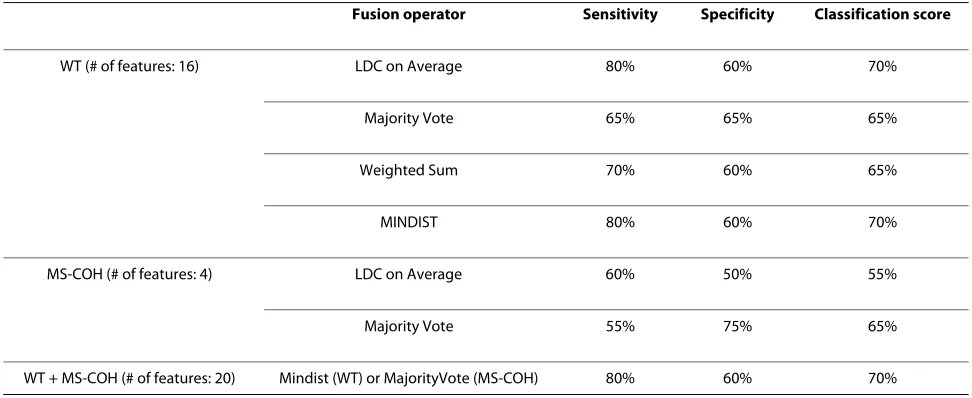
classifi-cation score of 54% and those for MS-COH with an aver-age classification score of 47%. We further explored the potential of fusing biomarkers in order to increase the discrimination ability. A total of 20 features were selected, 16 features from the WT approach (alpha: PL, OL, OR; beta: CL, PL, OL; gamma1: CL, CR, PL, PR, OL, OR; gamma2: PL, PR, OL, OR) and 4 features from the MS-COH approach (beta: CPL, CPR, OPL, OPR). The selec-tion of these features was based on the best classificaselec-tion scores and sensitivity or specificity measure higher than 50%. The results obtained when applying these operators to the various feature sets for Task 2 are shown in Table 4. The highest classification scores for the WT features reached 70% which is still lower than the 72.5% score obtained by WT over lobe FL for the alpha band. The results for the MS-COH features yield even lower scores. Finally, when univariate and bivariate features were com-bined a score of 70% was once again achieved. Overall, fusion of features did not result in any significant improvement in classification scores over the individual scores achieved for Task 2. Thus no biomarker was found to reliably discriminate between the two groups while the subjects are performing this mathematical task.
Never-Table 2: Average MS-COH Biomarker Values of lobes (CPL, CPR, OPL, OPR) for Task 2.
Epileptics Controls p-values
Delta 0.76 ± 0.10 0.74 ± 0.11 0.57
Theta 0.71 ± 0.12 0.68 ± 0.11 0.44
Alpha 0.69 ± 0.12 0.69 ± 0.09 0.89
Beta 0.69 ± 0.10 0.66 ± 0.13 0.34
Gamma1 0.72 ± 0.15 0.72 ± 0.10 0.97
Gamma2 0.73 ± 0.11 0.77 ± 0.07 0.16
Table 3: Task 1: Best Results of fusion based on selected features from WT + MS-COH.
Fusion operator Sensitivity Specificity Classification score
WT+ MS-COH (# of features: 10) LDC on Average 70% 60% 65%
WT + MS-COH (# of features: 5) Majority Vote 80% 80% 80%
WT + MS-COH (# of features: 29 All WT with scores ≥57.5 + all with scores ≥ 57.5 from MS-COH)
Majority Vote 60% 70% 65%
WT + MS-COH symmetric combination choice based on High classification score (non algorithmic choice) WT: FL, FR, PL, PR MS-COH:
OPL, OPR
theless, a related work reported during the review process of this paper reveals that other auditory tasks related to episodic memory have shown potential in classifying a group of children with mild signs of epilepsy [28]. Thus, a more rigorous consideration of various tasks should be performed towards the design of a decision support sys-tem, which can reflect wider aspects on the performance of children with epilepsy.
Discussion and Conclusion
This work considers methods for the discrimination of a controlled epileptic child group and an age-matched con-trol group. The children considered in this analysis are at an age range where maturing is not drastic and education is not significantly different. Thus, we expect only small differences due to age. The experiment is in a matched controls scheme where we have same numbers in the two groups in terms of age, sex and education. The studied population of controlled epileptic children does not show clinical dysfunction or other EEG abnormalities. We are using sensitive methods of analysis in order to search for signs of differences from age-matched controls. Such signs are indicative of slight neurophysiological distur-bances that are not obvious in usual neuropsychological tests and electrophysiological EEG recordings. Even though these disturbances are not considered serious, the children need to follow a certain course of therapy and follow-up in order to restrict their effects.
Our first aim was to check whether controlled-epileptic children exhibit spectral differences in their EEGs in comparison to an age-matched control group during a control situation and while performing a mental task. Secondly, we address the development of sensitive and reliable measures for discrimination between the two groups by means of either power spectrum univariate
measures or bivariate synchronization measures of dif-ferent brain regions or both. The latter stems from the fact that neuronal dynamics and synchronization phe-nomena have been increasingly recognized to be impor-tant mechanisms by which specialized cortical and sub-cortical regions integrate their activity to form distrib-uted neuronal assemblies that function in a cooperative manner [34]. According to our knowledge, such an inte-grated analysis has not been carried out so far.
Clinical and psychological examinations, as well as visual EEG inspection, do not provide any information leading to differences. On the original EEG data we apply two types of methodologies, one based on the power spectrum using direct signal representation (through wavelets), and the other on capturing the coupling of dif-ferent lobes using linear synchronization indexes (MS-COH and AR-(MS-COH). The extracted features in each lobe and band are examined through significance tests, classi-fication accuracies and statistical distributions of bio-markers.
The results of this paper indicate that univariate Wave-let analysis, as well as bivariate synchronization analysis based on MS-COH, can provide different features for dis-crimination. Thus, such methods could be used in a com-plementary manner towards the design of a decision support system aimed at detailed neurophysiological assessment. Fusion of selected biomarkers in the Alpha bands resulted in an increase of the classification score up to 80% (Table 3) during the rest condition. No better dis-crimination (70%-Table 4) was achieved during the per-formance of a cognitive subtraction task. Other recent studies have illustrated discrimination during tests trig-gering episodic memory. These results, however, need further investigation, particularly on a larger dataset and follow-up of many years, to be able to state concretely
Table 4: Task 2: Best Results of fusion based on selected features from WT, MS-COH and WT + MS-COH.
Fusion operator Sensitivity Specificity Classification score
WT (# of features: 16) LDC on Average 80% 60% 70%
Majority Vote 65% 65% 65%
Weighted Sum 70% 60% 65%
MINDIST 80% 60% 70%
MS-COH (# of features: 4) LDC on Average 60% 50% 55%
Majority Vote 55% 75% 65%
which brain areas and frequency bands can best assess slight brain dysfunction in cases of controlled epilepsy and perhaps in other disturbances of neurophysiological origin.
Competing interests
The authors declare that they have no competing interests.
Authors' contributions
VS, TC and MZ were responsible for the design of the study and writing down the manuscript. VS, TC and MZ, CDG conducted the univariate and bivariate analysis, respectively. VS, TC and CB conducted the feature selection, classifica-tion and classifier fusion processes, respectively. SM and EK conducted data acquisition and interpretation. KPC and SGF helped to draft the manuscript. TC and KM worked on the charts and illustrations creation. All authors read and approved the final manuscript.
Acknowledgements
This work was supported in part by the EC-IST project Biopattern, contract no: 508803, by the EC ICT project TUMOR, contract no: 247754, by the University of Malta grant LBA-73-695, by an internal grant from the Technical University of Crete, ELKE# 80037 and by the Academy of Finland, project nos: 113572, 118355, 134767 and 213462.
Author Details
1Biomedical Informatics Lab, Institute of Computer Science, Foundation for Research and Technology, Heraklion, Greece, 2iBERG, Department of Systems and Control Engineering, Faculty of Engineering, University of Malta, Msida, Malta, 3Department of Electronic and Computer Engineering, Technical University of Crete Chania, Greece, 4Department of Signal Processing, Tampere University of Technology, Tampere, Finland, 5Ecological University of Bucharest, Romania and 6Clinical Neurophysiology Laboratory (L. Widen), Faculty of Medicine, University of Crete, Heraklion, Greece
References
1. Shinnar S, Pellock JM: Update on the Epidemiology and Prognosis of Pediatric Epilepsies. J Child Neurol 2002, 17(1):S4-17.
2. Cowan LD: The epidemiology of the epilepsies in children. Ment Retard Dev Disabil Res Rev 2002, 8:171-81.
3. Ben-Ari Y, Holmes GL: Effects of seizures on developmental processes in the immature brain. The Lancet Neurology 2006, 5:1055-63.
4. Salinsky MC, Oken BS, Storzbach D, Dodrill CB: Assessment of CNS effects of antiepileptic drugs by using quantitative EEG measures. Epilepsia 2003, 44(8):1042-1050.
5. Tuunainen A, Nousiainen U, Pilke A, Mervaala E, Partanen J, Riekkinen P: Spectral EEG during short term discontinuation of antiepileptic medication in partial epilepsy. Epilepsia 1995, 36(8):817-823. 6. Cornaggia CM, Beghi M, Provenzi M, Beghi E: Correlation between
Cognition and Behavior in Epilepsy. Epilepsia 2006, 47(Suppl 2):34-39. 7. Semrud-Clikeman M, Wical B: Components of attention in children with
complex partial seizures with and without ADHD. Epilepsia 1999, 40:211-215.
8. McDermott S, Mani S, Krishnaswami S: A population-based analysis of specific behavior problems associated with childhood seizures. J Epilepsy 1995, 8:110-118.
9. Ettinger AB, Weisbrot DM, Nolan EE, Gadow KD, Vitale SA, Andriola MR, Lenn NJ, Novak GP, Hermann BP: Symptoms of depression and anxiety in pediatric epilepsy patients. Epilepsia 1998, 39:595-599.
10. Pellock J: Understanding co-morbidities affecting children with epilepsy. Neurology 2004, 62:S17-23.
11. Dunn DW: Neuropsychiatric aspects of epilepsy in children. Epilepsy & Behavior 2003, 4:101-106.
12. Micheloyannis S, Sakkalis V, Vourkas M, Stam CJ, Simos PG: Cortical networks involved in mathematical thinking: Evidence from linear and non-linear cortical synchronization of electrical activity. Neuroscience Letters 2005, 373:212-217.
13. Sakkalis V, Cassar T, Zervakis M, Camilleri KP, Fabri SG, Bigan C, Karakonstantaki E, Micheloyannis S: Time-Frequency Analysis and Modelling of EEGs for the evaluation of EEG activity in Young Children with controlled epilepsy. Comput Intel Neurosc (CIN) 2008. doi: 10.1155/ 2008/462593
14. Von Aster M, Weinhold M: Neuropsychologische Testbatterie für Zahlenverarbeitung und Rechnen bei Kindern (ZAREKI). Mannedorf: Swets Test Services 2002.
15. Ford M, Goethe J, Dekker D: EEG coherence and power changes during a continuous movement task. Int J Psychophysiol 1986, 4:99-110. 16. Sakkalis V, Zervakis M, Micheloyannis S: Significant EEG features involved
in mathematical reasoning: evidence from wavelet analysis. Brain Topography 2006, 19:53-60.
17. Rosso OA, Martin MT, Figliola A, Keller K, Plastino A: EEG analysis using wavelet-based information tools. J Neurosci Methods 2006, 153:163-182. 18. Torrence C, Compo GP: A practical Guide to Wavelet Analysis. Bull Am
Meteorol Soc 1998, 79:61-78.
19. Willoughby JO, Fitzgibbon SP, Pope KJ, Mackenzie L, Medvedev AV, Clark CR, Davey MP, Wilcox RA: Persistent abnormality detected in the non-ictal electroencephalogram in primary generalised epilepsy. Journal of Neurology, Neurosurgery, and Psychiatry 2003, 74(1):51-55.
20. Larsson PG, Kostov H: Lower frequency variability in the alpha activity in EEG among patients with epilepsy. Clinical Neurophysiology 2005, 116:2701-2706.
21. Brovelli A, Ding M, Ledberg A, Chen Y, Nakamura R, Bressler SL: Beta oscillations in a large-scale sensorimotor cortical network: directional influences revealed by Granger causality. Proc Natl Acad Sci USA 2004, 101(26):9849-9854.
22. Sakkalis V, Giurcăneanu CD, Xanthopoulos P, Zervakis M, Tsiaras V, Yang Y, Micheloyannis S: Assessment of linear and nonlinear synchronization measures for analyzing EEG in a mild epileptic paradigm. IEEE Trans Inf Tech 2009, 13(4):433-441. (DOI: 10.1109/TITB.2008.923141)
23. Whittle P: On the fitting of multivariate autoregressions and the approximate canonical factorization of a spectral density matrix. Biometrika 1963, 50:129-134.
24. Wiggins R, Robinson E: Recursive solution to the multichannel filtering problem. J Geophysical Research 1966, 70:1885-1891.
25. Rissanen J: Modeling by shortest data description. Automatica 1978, 14:465-471.
26. Zar JH: Biostatistical Analysis. New Jersey USA: Prentice-Hall; 1999. 27. Lee PL, Wu YT, Chen LF, Chen YS, Cheng CM, Yeh TC, Ho LT, Chang MS,
Hsieh JC: ICA-based spatiotemporal approach for single-trial analysis of postmovement MEG beta synchronization. Neuroimage 2003, 20:2010-1030.
28. Krause CM, Boman PA, Sillanmäki L, Varho T, Holopainen IE: Brain Oscillatory EEG eventrelated desynchronization (ERD) and -synchronization (ERS) responses during an auditory memory task are altered in children with epilepsy. Seizure 2008, 17:1-10.
29. Fitzgibbon SP, Pope KJ, Mackenzie L, Clark CR, Willoughby JO: Cognitive tasks augment gamma EEG power. Clinical Neurophysiology 2004, 115:1802-1809.
30. Miyauchi T, Endo K, Yamaguchi T, Hagimoto H: Computerized Analysis of EEG Background Activity in Epileptic Patients. Epilepsia 1991, 32(6):870-881.
31. Klimesch W: EEG alpha and theta oscillations reflect cognitive and memory performance: a review and analysis. Brain Research Reviews 1999, 29:169-195.
32. Martin-Fiori EM: Thalamo-cortical oscillation during brain development and in epilepsy. Web presentation of a project funded by University Children's Hospital, Olga-Mayenfisch Foundation [http:// www.forschungsportal.ch/unizh/media/pdf/p8421.pdf].
33. Keil A, Müller M, Ray WJ, Gruber T, Elbert T: Human Gamma Band Activity and Perception of a Gestalt. The Journal of Neuroscience 1999, 19(16):7152-7161.
34. Olesen J, Baker MG, Freund T, Di Luca M, Mendlewicz J, Ragan I, Westphal M: Consensus document of European brain research. J Neurology, Neurosurgery, Psychiatry 2006, 77:1-49.
doi: 10.1186/1743-0003-7-24
Cite this article as: Sakkalis et al., A decision support framework for the dis-crimination of children with controlled epilepsy based on EEG analysis Jour-nal of NeuroEngineering and Rehabilitation 2010, 7:24
Received: 24 August 2009 Accepted: 2 June 2010 Published: 2 June 2010
This article is available from: http://www.jneuroengrehab.com/content/7/1/24 © 2010 Sakkalis et al; licensee BioMed Central Ltd.