Journal of Applied Linguistics and Language Research Volume 4, Issue 6, 2017, pp. 183-191
Available online at www.jallr.com ISSN: 2376-760X
* Correspondence: Mitra Taghinezhad Vaskehmahaleh, Email: mitra_vaskeh yahoo.com © 2017 Journal of Applied Linguistics and Language Research
Task-Based Activities on EFL Learners Argumentative
Writing with a Focus on Introvert vs. Extrovert Learners
Hanieh Davatgari Asl
Department of Foreign Languages, Islamic Azad University, Ahar Branch, Iran
Seyed Davoud Razavi
Department of English language, Tabriz Branch, Islamic Azad University, Tabriz, Iran
Mitra Taghinezhad Vaskehmahaleh *
Young Researchers and Elite Club, Ahar Branch, Islamic Azad University, Ahar, Iran
Abstract
The present research is an attempt to find out the efficacy of Task-Based Activities on argumentative writing performance of Introvert vs. Extrovert Iranian EFL Learners. For this purpose, 100 female upper-intermediate Iranian EFL learners were chosen from a total number of 168 and assigned into three groups (2 experimental and 1 control groups) through their performance on a Nelson (Homogeneity Test). The target learners of this research are learners of Vaskeh Institutes, in Iran. Data were collected through pre and post-test. Data were analyzed through Paired Samples t-tests. The results of the statistical analysis demonstrated that the task-based activities has significant effect on experimental groups performances but it has more impact on extrovert than introvert learners.
Keywords: extrovert, introvert, personality type, task-based activities, writing
INTRODUCTION
Writing today has become very important in the daily lives of much of the world’s population and speakers of globally dominant languages are surrounded by written materials. Writing is an important and, at the same time, demanding activity, particularly in a foreign language context in which learners are exposed to language just for few hours a week (Kim & Kim, 2005). Question arises on the need of making language classrooms a place where genuine and meaningful communication takes place and not simply one where students “practice” language for its own sake. This emphasis on making meaning the priority in syllabus design and methodology underlies many aspects of contemporary approaches to language teaching, e.g., CLT, Task-based language teaching, and Content-based instruction. Task-based language teaching is an approach seeking to provide learners with a natural context for language use. As learners work to complete a task, they have abundant opportunity to interact. Such interaction is thought to facilitate language acquisition as learners have to work to understand each other and to express their own meaning (Larsen- Freeman, 2000). On the other hand for second language learners to make maximum progress with their own learning styles, their individual differences must be recognized and attended to. A number of theories hold that personality factors significantly influence the degree of success that individuals achieve in learning a second language (Gass & Selinker, 1994) based on the assumption that some features of the learner's personality might encourage or inhibit second language learning (Cook, 1996) by enhancing certain facets of language learning while impeding others (Larsen-Freeman & Long, 1991). In order to provide effective sensitive instruction, teachers of second or foreign languages need to learn to identify and understand their students‟ significant individual differences (Ehrman, 1993). Among personality factors, Extroversion and, its counterpart introversion, are also potentially important factors in the learning of a second language. This study will deal with Iranian EFL learners writing assignments specifically both personality types i.e. extrovert vs. Introvert. It will focus on the influence of task-based language learning on the growth of their productive skill of writing in both studied groups.
RESEARCH QUESTIONS
The following research questions have been addressed in this study:
1. Do Task-based activities have any effect on argumentative writing performance of Iranian EFL learners?
2. Do task-based activities have any effect on argumentative writing performance of introvert learners?
3. Do task-based activities have any effect on writing performance of extrovert learners?
4. If there is an effect, which of introvert vs. Extrovert learners benefit more?
METHOD
In this study, 100 EFL students in six classes were conveniently sampled from among 133 intermediate, male and female EFL learners aged from 15 to 29 at Vaskeh Language Institutes in Talesh, Iran. The homogeneity of the participants was assured as they had been placed in that level through administration of Nelson Test (Homogeneity Test) after that by administering Questionnaire of Extroverts vs. Introverts. These 120 students were assigned into three classes base on their personality: two experimental groups and one control groups.
Instruments
In this study four instruments were used:
Nelson Test (Homogeneity Test)
Questionnaire of Extroverts vs. Introverts Writing pre-test and post-test
Material
In this study the course book ‘College Writing’ (Zemach & Rumisek, 2003) used as the material. The aim of the book was to develop the students’ ability to write a cohesive paragraph that has a topic sentence and supporting details with minimal grammatical, spelling, punctuation, and indentation errors. Class discussion, mind mapping and information-gap tasks (jigsaw) were practiced by the experimental students in the classroom during the course of the study. The first and the last composition written by the participants regarded as pre-test and post-test. At the end of the course, the students in both control and experimental groups took a post-test and answered 10 questions. They were asked and scored by two raters.
Procedure
group students. In addition to it, they did an activity considered as post-task after each writing task. The duration of treatment in experimental group was 12 sessions. At the end of the course, the students in both control and experimental groups took a post-test and wrote a same topics as like pre-test. They were scored by two raters.
RESULTS
The abovementioned hypotheses were analyzed using the paired-samples t-test. The analyses assume normality of the data.
Table 1. Normality Assumption Descriptive Statistics
Group Personality
N Skewness Kurtosis
Statistic Statistic Error Ratio Statistic Std. Std. Error Ratio
Experimental
Extrovert Posttest Pretest 26 26 -.251 .033 .464 -0.54 -.491 .464 0.07 -1.026 .902 .902 -0.54 -1.14
Introvert Pretest 27 -.451 .464 -0.97 -.537 .902 -0.60
Posttest 27 -.084 .464 -0.18 -.461 .902 -0.51
Control
Extrovert Pretest 24 -.206 .464 -0.44 -1.297 .902 -1.44
Posttest 24 -.132 .464 -0.28 -.704 .902 -0.78
Introvert Pretest 23 .050 .464 0.11 -.806 .902 -0.89
Posttest 23 .698 .464 1.50 -.025 .902 -0.03
Pretest of Writing
A t-test was run to compare the experimental (task-based group) and control groups’ performance on the pretest of writing in order to prove that they were homogenous in terms of their writing ability prior to the main study.
Table 2. Descriptive Statistics; Pretest of Writing by Groups
Group Mean Std. Error Lower Bound 95% Confidence Interval Upper Bound
Experimental 14.400 .237 13.930 14.870
Control 14.080 .237 13.610 14.550
Table 3. Descriptive Statistics; Pretest of Writing by Groups by Personality Types
Group Personality Mean Std. Error Lower Bound 95% Confidence Interval Upper Bound
Experimental Extrovert Introvert 14.280 14.520 .335 .335 13.615 13.855 14.945 15.185
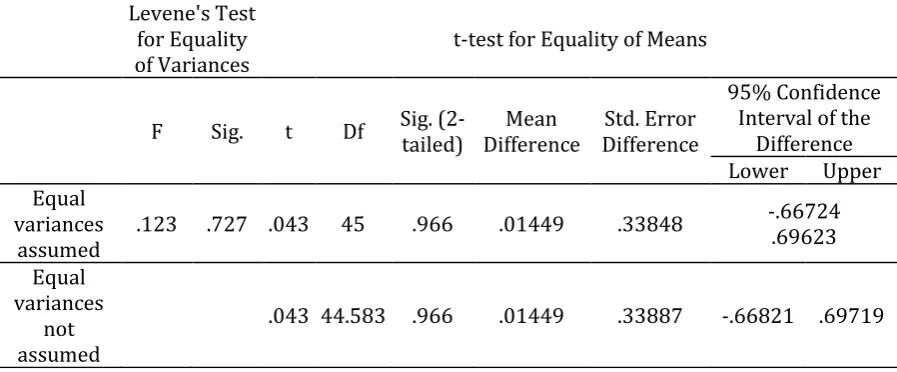
Table 5. Independent Sample t-test, Pre-test by Groups
Levene's Test for Equality of Variances
t-test for Equality of Means
F Sig. t Df Sig. (2-tailed) Difference Mean Difference Std. Error
95% Confidence Interval of the
Difference
Lower Upper
Equal variances
assumed
.123 .727 .043 45 .966 .01449 .33848 -.66724 .69623
Equal variances
not assumed
.043 44.583 .966 .01449 .33887 -.66821 .69719
As the results indicate there was not any significant difference between the experimental and control groups on the Nelson proficiency test (F (.123) = .72, p > .05 (Table 5). Thus it can be concluded that the experimental and control groups enjoyed the same level of general language proficiency prior to the main study.
Testing Research Hypotheses
H01. Task-based activities do not have any significant effect on Iranian learners’ argumentative writing performance.
Table 6. Descriptive Statistics; Posttest of Writing by Groups
Group Mean Std. Error Lower Bound 95% Confidence Interval Upper Bound
Experimental 16.120 .227 15.669 16.571
Control 13.960 .227 13.509 14.411
Table 7. The Results of t-test of the Effect of task-based activities on writing
Levene's Test for Equality
of Variances t-test for Equality of Means
F Sig. T df Sig. (2-tailed) Difference Mean Difference Std. Error
95% Confidence Interval of the
Difference
Lower Upper
Equal variances
assumed
.214 .645 11.032 - 75 .000 -3.63333 .32934 -4.28942 -2.97725
H02. Task-based activities do not have any significant effect on argumentative writing performance of Iranians introvert learners.
Table 8. Descriptive Statistics; Posttest of Writing by Groups by Personality Types
Group Personality Mean Std. Error Lower Bound 95% Confidence Interval Upper Bound
Experimental Extrovert Introvert 16.920 15.320 .321 .321 16.282 14.682 17.558 15.958
Control Extrovert Introvert 14.480 13.440 .321 .321 13.842 12.802 15.118 14.078
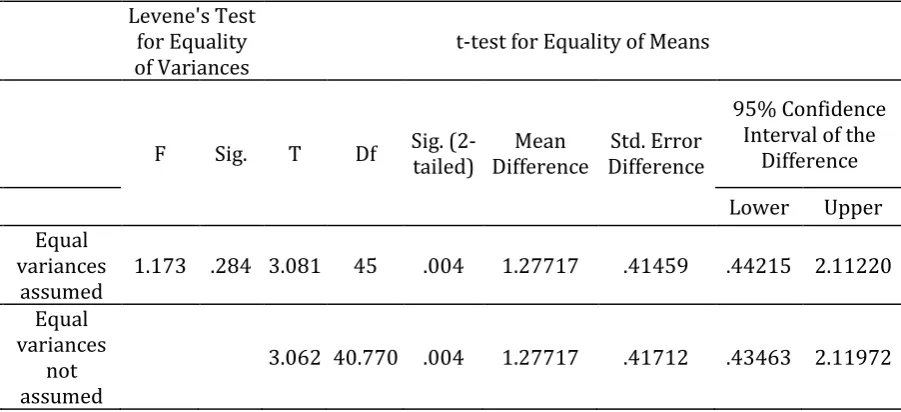
An independent-samples t-test was run to compare the experimental and control groups introvert learners’ means on the post-test of writing in order to probe the second null-hypothesis. Based on the results displayed in Table 8, it can be concluded that the experimental introvert learners had a higher mean (M = 15.320, SD = .321) on
the posttest of writing than control introvert (M = 13.440, SD = .321). Table 9. The Results of Independent Samples Test between Experimental and Control
Introvert learners
Levene's Test for Equality
of Variances t-test for Equality of Means
F Sig. T Df Sig. (2-tailed) Difference Mean Difference Std. Error
95% Confidence Interval of the
Difference
Lower Upper
Equal variances
assumed 1.173 .284 3.081 45 .004 1.27717 .41459 .44215 2.11220
Equal variances
not assumed
3.062 40.770 .004 1.27717 .41712 .43463 2.11972
The results of Table 9 indicated that the experimental introvert learners had a significantly higher mean on the posttest of writing than control introvert learners.
Thus, the second null-hypothesis was rejected. H03. Task-based activities do not have any significant effect on argumentative writing
performance of Iranians extrovert learners.
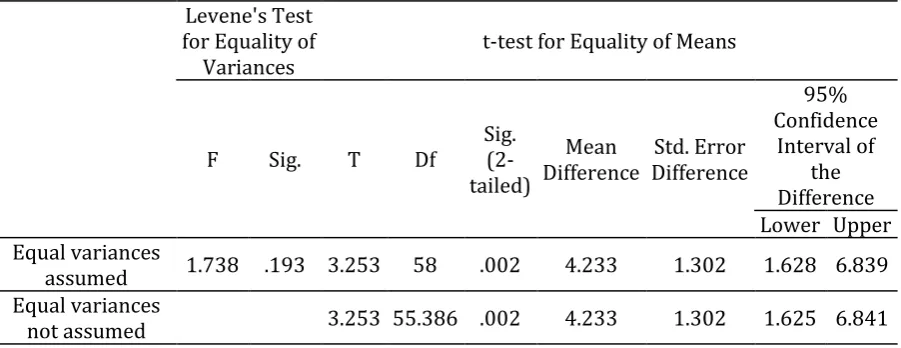
The results of independent-samples t-test (Table 10) indicated that the experimental extrovert learners had a significantly higher mean on the posttest of writing than
control extrovert learners. Thus the third null-hypothesis was rejected. Table 10. Independent-Samples t-test; Posttest by Experimental and Control Extrovert
Learners Levene's Test
for Equality of
Variances t-test for Equality of Means
F Sig. T Df Sig.
(2-tailed)
Mean
Difference Difference Std. Error
95% Confidence
Interval of the Difference Lower Upper Equal variances
assumed 1.738 .193 3.253 58 .002 4.233 1.302 1.628 6.839
Equal variances
not assumed 3.253 55.386 .002 4.233 1.302 1.625 6.841
Table 10 indicated that there was a significant difference between the two groups’ mean scores on the posttest of writing. Thus the third null-hypothesis was rejected. The experimental extrovert group significantly outperformed the control extrovert group on the posttest of writing.
H04.Task-based activities do not have any significantly different effect on argumentative writing performance of Iranian extrovert and introvert learners.
Table 11. Independent-Samples t-test; Posttest by Experimental Introvert and Extrovert Learners
Levene's Test for Equality of
Variances
t-test for Equality of Means
F Sig. T Df
Sig. (2-tailed)
Mean Difference
Std. Error Difference
95% Confidence Interval of the
Difference Lower Upper Equal variances
assumed 2.935 093 7.832 48 .000 3.16667 .40433 2.35370 3.97963
Equal variances
not assumed 8.232 46.724 .000 3.16667 .38465 2.39272 3.94061
Inter-Rater Reliability
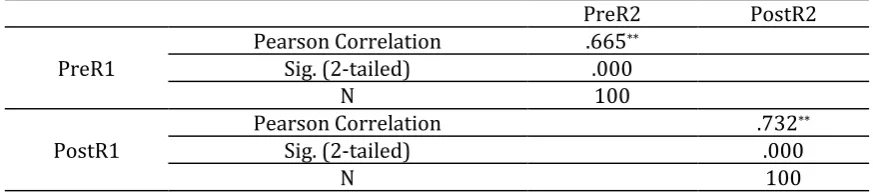
The subjects’ performance on the pretest and posttest of writing were rated by two raters. Based on the results displayed in Table 12 it can be claimed that there were significant agreement between the two raters on pretest (r (98) = .66, p = .000 representing a large effect size) and posttest of writing (r (98) = .73, p = .000 representing a large effect size).
Table 12. Pearson Correlations; Inter-Rater Reliability
PreR2 PostR2
PreR1
Pearson Correlation .665**
Sig. (2-tailed) .000
N 100
PostR1
Pearson Correlation .732**
Sig. (2-tailed) .000
N 100
**. Correlation is significant at the 0.01 level (2-tailed). DISCUSSION AND CONCLUSION
difference between extroverts and introverts and their probable effect on language skills like writing, teachers can predict what kinds of activities and tasks students will enjoy, what sort of teaching methods they require and what their learning styles are. Therefore it can be concluded that using tasks for teaching writing to extrovert students is a useful approach but it does not mean that using these tasks for instructing writing to extroverts is not useful. Thus, it is felt that this study has made some important contributions towards a better understanding of the extroversion-introversion personality variable and its relationship to some learning outcomes (i.e., performance on writing tasks).
REFERENCES
Astika, G., Carrell, P., & Moneta, P. (1996). Personality types and language learning in an EFL context. Language Learning, 46 (1), 75-99.
Cheng, F.H. (2011). Effect of Post-task Activity on EFL writing performance. Proceedings of the 16th Conference of Pan-Pacific Association of Applied Linguistics.
Cook, V. (1996). Second Language Learning (2nd ed.). New York: Arnold
Gass, S. & Selinker, L. (1994). Second language acquisition: An introductory course. Hillsdale, NJ: Lawerance Erlbaum.
Ghavamnia, M, Tavakoli, M. & Esteki, M. (2013).The effect of Pre-Task and online planning conditions on complexity, accuracy, and fluency on EFL learners’ written production. Porta Linguarum Junio, 6(2), 31-43.
Khodabakhshizadeh, H., & Mousavi, S. (2012). The effect of different types of repeated performance (Private vs. Public) as Post-Task Activities on the English students’ accuracy and fluency in L2 oral production. Modern Education and Computer Science, 5, 53-62.
Kim, Y., & Kim, J. (2005). Teaching Korean university writing class: balancing the process and the genre approach. Asian EFL Journal, 7(2), 1-15.
Larsen-Freeman, D. (2000). Techniques and Principles in Language Teaching. Oxford: Oxford University Press.
Marashi, H. & Didari, L. (2012).The impact of using Task-based writing on EFL learners’ writing performance and creativity. Theory and Practice in Language Studies, 2 (12), 2500-2507.
Rahimpour, M., & Safarie, M. (2011).The Effects of on-line and Pre-task Planning on descriptive writing of Iranian EFL learners. International Journal of English Linguistics, 11(2), 274-280.
Rezaei, A. (2014). Writing in Task-based class for EFL learners. International Journal on Studies in English Language and Literature (IJSELL), 2(2), 47-65.
Samuda, V., & Bygate, M. (2008). Tasks in second language learning. Basingstoke, England: Palgrave Macmillan.
Vehar, M. A. (1968). Extraversion, introversion and reading ability. The Reading Teacher, 21, 357-360.
Wright, D. & Taylor, A. (1970). Introducing psychology. Harmondsworth: Penguin Books. Zemach, D. E., & Rumisek, L. A. (2003). Academic Writing from paragraph to essay.
Macmillan.