A comparative analysis of metadiscourse features in
knowledge management research articles written in English
and Persian
Salar, Sara
English Language Teaching Department, Imamreza International University, Iran ([email protected])
Ghonsooly, Behzad
English Language Teaching Department, Fedowsi University of Mashad, Iran ([email protected])
Received: 22 March 2015 Revised: 3 May 2015 Accepted: 4 May 2015 Available Online: 3 June 2015 DOI: 10.5861/ijrsll.2015.1154
ISSN: 2243-7754 Online ISSN: 2243-7762
OPEN ACCESS
Abstract
This paper aims to cross-culturally inspect the interpersonal and textual features in research
articles within a single discipline, Knowledge Management. The purpose of this study is to
examine the two groups of context (Persian and English research articles) in order to analyze
the metadiscourse features used in the introduction sections within this field. 20 research
articles from Knowledge Management discipline were selected for this analysis: 10 of them
from English-written articles published in international journals, and 10 from Persian-written
articles published in national journals. The findings of this research reveal that the English
and Persian sub-corpora show a significant difference only in one of the two types of
metadiscourse proposed by Hyland, the interactional metadiscourse, and not a remarkable
difference in the interactive incidence. It can be inferred from the research that linguistic and
cultural differences as well as the paper writing format in general influence the writers’
choices in the use of metadiscourse features when writing their texts.
A comparative analysis of metadiscourse features in knowledge management research
articles written in English and Persian
1. Introduction
Written language has always played vital roles in entire aspects of our lives. To name a few, written language has always been proved decisive in varying academic, social, professional contexts which are of great significance to a great number of professionals. According to Widdowson (2007, as cited in Khajavy, Asadpour, & Yousefi, 2012), texts serve as the evident traces of the process of relaying a message. However, these traces are not much organized in conversation. Different genres are regarded to accomplish language choices to outline particular purposes, assumptions about the audience and portray interpersonal relations with receivers. Hence, different genres tend to impact on their readers differently.
Accordingly, a considerable number of researchers have recently paid special attention to the field of academic writing over the past two decades, focusing especially on the genre of the research articles (RA) written and published in miscellaneous disciplines. There used to be a long-standing belief according to which the searchers were supposed to be unbiased while reporting their findings in academic writing. Nevertheless, this view has been attacked by several researchers (like Swales, 1990; Tang & John, 1999; Hyland, 2001b; Vassileva, 2001; Harwood, 2005). Scholars (Thetela, 1997; Hoey, 2001; Hyland, 2005, as cited in Firouzian, Khajavi, & Vahidnia, 2012), claiming that interaction in written texts can be dealt with in the same way as in the spoken texts. This view has gradually disseminated its dominance in academic writing as social engagement, comprising interaction between writers and readers.
According to Hyland (2004), academic writers are not supposed to write texts to represent an external reality, but they rather use language as a means of expressing themselves and their work, and acknowledging as well as negotiating social relations with readers. As for this reason, not only the structures of RAs have been examined by scholars, but also other aspects have been focused on as well, such as the social construction and historical evolution--some of the lexico-grammatical features of RAs including: tense choice, transitivity structures (Martinez, 2001) and citation practices (Hyland, 1999a), appearing with the use of metadiscoursal elements from a cross-linguistic/cultural perspective, and the overall organization of the different sections that integrate it (Firouzian, Khajavy, & Vahidnia, 2012; Khajavy, Asadpour, & Yousefi, 2012).
On the basis of people’s expectation and norms, metadiscourse as an under-research field of investigation contribute to producing influential writing. It firmly believes that writing and speaking are simply something beyond the transmission of ideas. Rather, they are viewed as social elements in which writers, readers, speakers and listeners interact with each other to influence the ways they present and realize different ideas (Hyland & Tse, 2004; Hyland, 2004; Hyland, 2005 as cited in Firouzian, Khajavy, & Vahidnia, 2012). The concept of metadiscourse is of great importance in academic writing, therefore, this field of investigation requires to receive due attention in order to know more about how they function within different genres and in distinct communities. Consequently, we seek to address this gap in this study and primarily aim to comparatively analyze a selective corpus of RAs written and published in the discipline of Knowledge Management in two different languages (i.e. English and Persian) regarding the use of interactive and interactional metadiscourse features.
2. The Concept of Metadiscourse
metadiscourse. He notes that metadiscourse allows authors and speakers to linguistically manifest themselves in their texts and speeches as well as build a relationship with their receivers. Hyland (2005) regards metadiscourse as beyond conveying information, in fact, it also indicates what the personalities of those who are communicating are like, and involves their viewpoints and inferences as well. Most linguists agree on this fact that metadiscourse not only arranges discourse into a structured whole but also organizes the comments given on it (as cited in Yousefi & Eslami-Rasekh, 2010) ; it enables the author to show the relation of different parts of the text and the way they should be interpreted; allows the author to express their attitudes towards the propositional content of the text and towards the readers as it is beyond the propositional content (Blagojevic, 2004, as cited in Yousefi & Eslami-Rasekh, 2010).
2.1 The Features of Metadiscourse
As already mentioned, according to Crismore et al. (1993), metadiscourse is classified into two sub-categories: textual and interpersonal--through the use of textual functions writers connect the ideational material parts within a text so that readers will find the meaning in context both logical and explicit (Conner, 1996; Crismore & Abdollahzadeh, 2010; Enkvist, 1990; Grabe, 1985; Halliday & Hasan, 1976 as cited in Kim & Limi, 2013). On the other hand, interpersonal functions help writers make their personalities known; convey their attitudes toward the ideational material and also show their assumptions about how readers will respond to the ideational material (Vande Kopple, 1985 as cited in Kim & Lim, 2013). The focus of early studies of metadiscourse was mainly on textual meaning, which takes coherence and cohesion into consideration (Connor, 1984; Enkvist, 1990, Kaplan, 1966; Scollon, 1991, as cited in Kim & Limi, 2013), as well as concerns the schematic structure of the text, while the interpersonal functions of metadiscourse refer to interaction between author and reader in texts, expressing the writer’s individual persona. It is therefore clear that it involves more intimacy with readers (Halliday, 1973 as cited in Toumi, 2009). Hyland (1998) argues that interpersonal meanings are non-linguistic oriented (Farokhi & Ashrafi, 2009).
2.2 The Significance of Metadsicourse in Academic Writing
Many researches on this field (significance of metadiscourse), focus on writer’s responsibility on effective communication (Blagoyovic, 2004). Academic communication is characterized as a social activity which facilitates the production of knowledge. Academic competence requires familiarity with the typical discursive practices within a particular disciplinary community by organizing data and observations into meaningful patterns for the receivers—the appropriate use of metadiscourse indicates this competence (Swalos, 1990, 1996, as cited in Hyland, 1998). Metadiscourse in academic texts are distinct from non-academic ones in the way that they attempt to impart information to readers with a specific purpose, or aim to support and actively encourage the writer’s academic claims (Hyland & Tse, 2004). Both textual and interpersonal features of metadisocurse contribute to effective communication. For instance, by using textual metadiscourse, the writer may transit the statements appropriately, through making relationships between the parts of the text in order that the uncertainties of readers about the writer’s intentions will be removed (Hindi, 1987, as cited in Blagojevic, 2004). Furthermore, the author uses the interpersonal metadiscourse to allow readers to understand the authors’ perspective toward the content (Crismore & Fransworth, 1990, as cited in Blagojevic, 2004).
2.3 Metadiscourse Models
Crismore et al. (1993) revised the two subcategories of textual and interpersonal metadiscourse. He divided the textual metadiscourse into two categories of “textual” and “interpretive” markers. Textual markers help readers organize the discourse, and interpretive markers assist them in making inferences from the text and perceive the intended meaning of the author as well as writing strategies (Khajavi, Asadpour, & Yousefi, 2012). The models mentioned result from Halliday’s notion of metafunctions. He (1994) proposed three functions of metadiscourse; ideational (the use of language as a means of representing experience and ideas), interpersonal (the use of language for interaction), and textual (the use of language to arrange the text as a whole and relate the content to readers) (Khajavi, Asadpour, & Yousefi, 2012). While, Adel (2006) proposed a model which does not follow Halliday’s functions; She divides metadiscourse into two types, “metatext” and “writer-reader interaction” (Khajavi, Asadpour, & Yousefi, 2012).
2.4 Hyland’s Model
Since Hyland and Tse claim that all metadiscoursal categories are interpersonal, they classify metadiscourse into two sub-divisions: Interactive resources and interactional resources (Esmaili & Sadeghi, 2012). According to Hyland, metadisourse is not only discourse about discourse, believing that interaction plays a significant role. The interactive part of metadiscourse contributes to the flow of information, and helps readers through the text to gain a better understanding. Through the use of interactive resources, writers attempt to make their arguments acceptable and reasonable to readers. On the other hand, the interactional part, which Hyland (2005) considers to be more personal, involves writers’ efforts to make their ideas transparent in such a way that receivers respond to what they read (Firoozian, Khajavy, &Vahidnia, 2012). It allows writers to express their opinions and associations as well as helps in establishing interaction with readers. The categories of interactive and interactional resources of metadiscourse suggested by Hyland are as follow:
Table 1
The interactional resources (Hyland & Tse, 2004)
function examples
1: Hedges Show writer’s full commitment to proposition
might / perhaps / about/ maybe
2: Boosters Indicate writer’s certainty in proposition or close dialogue
in fact / definitely/ it is clear that
3: Attitude Markers Express writer’s attitude to proposition
I agree/ surprisingly
4: Self-mentions Explicit reference to author I/ we/ my/ me/ our
5: Engagement markers Build relationship with reader you can see that/ note that/ you can see that/ consider
Table 2
The interactive resources (Hyland & Tse, 2004)
function examples
1: Transition markers: Express semantic relations between main clauses
in addition/ but/ thus/ and
2: Frame markers: Refer to discourse acts, stages and sequences
To conclude/ finally/ my purpose is to
3: Endophoric markers: Refer to information in other parts of the text
as noted above/ see Fig./
4: Evidentials: Refer to source of information from other texts
Z states/ X states/ according to Y
5: Code glosses: Help readers grasp meanings of ideational material
3. Empirical section
Yipei and Lingling (2013) explored the interpersonal and textual meaning of Steve Job’s famous Stanford speech according to Hyland’s theory of metadiscourse (2005). This article exhibits how Steve Job successfully achieves interpersonal meaning by the use of interactional metadiscourse resources in his speech. Based on this paper he uses self- mentions the most, which implies his self-affirmation; 39 boosters used in his speech reflect his confidence and commitment to what he is saying; in terms of engagement markers, Job involves the audience into the discourse by using a question; he also benefits the use of attitude markers in his speech; hedges are not used frequently as other interactional resources in Job’s speech since Job’s main purpose is to convince and persuade. This study argues that Job skillfully expresses textual meaning by the use of interactive metadiscourse resources. It is stated that the most frequent interactive resources used in his speech are transitions which make the sentences well-knitted; he uses frame markers to set the theme of his speech; evidentials used by Job support for his argument; Job supplies additional information by rephrasing or elaborating, which indicates how much he benefits by the use of code glosses in his speech. This study concludes that Job builds a good relationship with the audience.
Gillaerts and Van de Velde (2010) conducted a study dealing with interpersonality in research article (RA) abstracts. They analyzed the abstracts in terms of interactional metadiscourse. This paper aimed at supporting the idea that the abstract is a separate genre from its associated article. They investigated the distribution of the three interactional metadiscourse categories as interpersonality markers. They observed that RA abstracts display differential use of various subcategories of interactional metadiscourse, while research articles (RAs) exhibit a greater number of hedges than boosters and attitude markers. According to this study RA abstracts are considered to have more affinity with boosting rather than with hedging. Furthermore, this research argued that the generic differences between RAs and RA abstracts have become smaller in recent years; the average length of RA abstracts has increased; the interactional features in RA abstracts have decreased. Based on this paper, the longer, recent RA abstracts compromise more ‘factual’ material and less metadiscourse. Gillaert and Van de Velde (2010) concluded that the use of interactional metadiscourse has dropped in RA abstracts.
Farokhi and Ashrafi (2009) studied how textual metadiscourse resources (TMRs) are used in research articles. They examined TMRs in research articles of three disciplines of Mechanical Engineering (ME), Medicine (MED), and applied Linguistics (AL). They observed a significant difference in the distribution of TMRs in three disciplines and also between the texts written by native and non-native writers. Based on the findings of this study, the frequency of TMRs across three rhetorical sections of MED articles (60.68 per 1,000 words) is higher than AL articles (57.65 per 1,000 words). This study shows that the distribution of TMRs across rhetorical sections of Abstract, Introduction, and Result & Discussion sections is different. In three ME, MED and AL research articles more TMRs were identified in the introduction sections than in Abstract and Result & Discussion sections, suggesting that the introduction section is considered as a major section for establishing the purpose of articles. The results of this study also indicate that TMRs across three sections occur more in the ME articles written by native speakers (55.80 per 1,000 words) than in articles written by non-native ones (51.99 per 1,000 words). The use of TMRs in MED research articles is different between native and non-native writers in three sections. There is a higher use of TMRs in the introduction sections in the research articles of native speakers and result & discussion sections in the research articles of non-native writers. In AL research articles the result & discussion sections in the articles of native writers and introduction sections in non-native articles display a greater use of TMRs.
understandings of the audience. It is stated in this study that differences in metadiscourse patterns help distinguish discourse communities and explain the ways writers specify the inferences they expect from their readers. And metadiscourse explicates a context for interpretation suggesting one way for defining and maintaining social groups by participants of communication.
Blajogevic (2004) conducted a study to contrast academic articles written in English by English and Norwegian native writers. According to the obtained data, he concluded that Norwegian writers when writing in English use a high score of metadiscoursal items as a whole, (44%) which is 3% lower than the sum total of the metadiscoursal items used by English native speakers. Blajogevic observed that the Norwegian authors are less willing to announce their presence in the texts than the English authors since the greater use of hedges, emphatic items and attitude markers was identified in the texts written by the English writers than in the texts written by the Norwegian ones.
Pilar Mur-Dueñas (2011) did a study to analyze interactional metadiscourse features in research articles written in English and Spanish. International research articles (RAs) in English represent more metadscourse features than RAs in Spanish, regarding Hyland’s (2005) and Hyland and Tse’s (2004) findings which concern RAs in eight different disciplines. In comparison to interactive metadiscourse features, the international ones are used more in the RAs of both American-based and Spanish scholars. The English sub-corpus presents a higher inclusion of both interactive and interactional metadiscourse features than the Spanish sub-corpus. The results display a greater use of hedges and self-mentions in the English texts than in the Spanish ones. Furthermore, the English Texts contain a higher number of logical markers and code glosses in comparison to the Spanish texts. Spanish Business Management RAs compromise fewer interactive and interactional metadiscourse features than the English RAs. All these findings imply a stronger interaction with the reader and more relationship between the ideas and organization of ideational material on the part of the American-based writers than the Spanish scholars.
Kim and Lim (2013) conducted a research on the metadiscourse used in English and Chinese research article introductions. They took Hyland’s (2004) model in academic texts as a starting point to analyze this study. As presented in this study, both English and Chinese RA introductions use far more interactive than interactional forms. The most frequent metadiscourse used in English introductions are evidentials and transitions (58.6% and 18.5% of all interactive uses respectively). In Chinese introductions these metadiscourse features are also found largely (56% and 17.4% of all interactive uses respectively). Hedges are found greatly both in English and Chinese introductions; however, they are identified more frequently in English introductions than Chinese ones (55% versus 58.5% respectively from the interactional form of each language). English introductions use less attitude markers while Chinese introductions benefit the greater use of endophorics, attitude markers and engagement markers. Kim and Lim (2013) concluded that Chinese RA introductions share more similarities in the use of metadsicourse with English ones. Their difference lies in the use of density of metadisocurse in the introductions. Chinese introductions present lower use of density of metadiscourse than English ones.
Khajavy, Asadpour, and Yousefi (2012) did a research examining the interactive metadiscourse features in the discussion section of the English and Persian sociological research articles. Based on their findings, a stronger interaction between the writer and the reader is established in the texts written by English writers in comparison to Persian writers. The results of their study suggest that English texts contain a greater occurrence of transitional markers, frame markers and code glosses and evidentials than Persian texts. On the other hand, endophoric markers occur more frequently in RAs in Persian than those in English.
4. Corpus and Method
selected from international journals (3712 words), were written by first-language English speakers. And the 10 Persian RAs were selected from national journals (3782 words), written by Iranians.
This paper attempts to analyze the interactional and interactive metadiscourse features of Business RAs written in English and Persian according to Hyland’s model.
The questions to be addressed in this study are as follows:
What is the frequency of interactive and interactional metadsicourse in RAs written by English native writers writing Knowledge Management RAs?
What is the frequency of interactive and interactional metadiscourse in RAs written by Iranians within Knowledge Management RAs?
Is there any significant difference between English and Persian writers’ use of interactive and interactional metadiscourse within Knowledge Management RAs?
5. Results
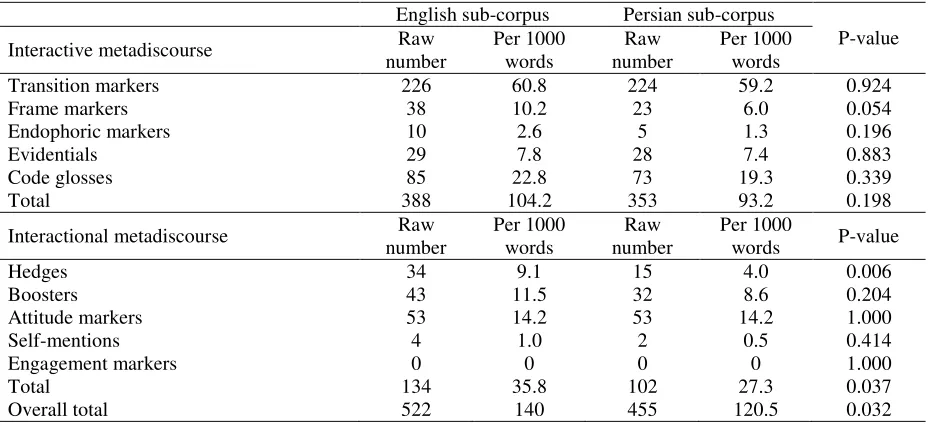
Initially, we scrutinized the RAs in order to identify the potential metadiscourse features. Having verified a given feature qualified as metadiscourse, we set it to one of the classifications defined above. We analyzed the frequency of use of metadiscourse in the two sub-corpora. Table 3 and table 4, display the frequency analysis of each of the categories of both interactive and interactional metadiscourse features in both groups of texts.
Table 3
Frequency of use of metadiscourse features in the two sub-corpora.
English sub-corpus Persian sub-corpus
P-value Interactive metadiscourse Raw
number Per 1000 words Raw number Per 1000 words
Transition markers 226 60.8 224 59.2 0.924
Frame markers 38 10.2 23 6.0 0.054
Endophoric markers 10 2.6 5 1.3 0.196
Evidentials 29 7.8 28 7.4 0.883
Code glosses 85 22.8 73 19.3 0.339
Total 388 104.2 353 93.2 0.198
Interactional metadiscourse Raw number Per 1000 words Raw number Per 1000
words P-value
Hedges 34 9.1 15 4.0 0.006
Boosters 43 11.5 32 8.6 0.204
Attitude markers 53 14.2 53 14.2 1.000
Self-mentions 4 1.0 2 0.5 0.414
Engagement markers 0 0 0 0 1.000
Total 134 35.8 102 27.3 0.037
Overall total 522 140 455 120.5 0.032
Below, we will comparatively elaborate on the results for each category in details:
5.1 Trandition markers
As revealed by table 3, the observed p-value is not crucial (0.924), which demonstrates that there is no significant difference between these two groups in their amount of transitional markers used in the English and Persian RAs ( respectively, 60.8 & 59.2 tokens per 1000 words). A slight difference lies indeed in the types of the transition markers which the English and Persian writers tend to use; English writers prefer to make a somewhat greater use of adversative markers (e.g. but, on the other hand, in contrast, however), in order to build their arguments through contrasting the pros and cons of an idea. Whereas, there is a Persian tendency to link ideas by means of the additive marker “و/and”. Furthermore, transition markers are the most frequent metadiscourse features used in the two sub-corpora.
5.2 Frame markers
As demonstrated by table 3, no statistically significant differences have been found in the inclusion of frame markers between the English and Persian RAs—with the estimated P-value (0.054) .This, implies that English and Persian knowledge Management scholars similarly use frame markers (10.2 tokens per 1000 English words & 6.0 tokens per 1000 Persian words) in order to sequence parts of their texts, order their arguments, label stages, shift topics and announce their goals. Below, you will find two examples of how frame markers are used in two English and Persian sentences, respectively:
Consequently the aim of this research was to answer the following question:
a)
و تاطابترا یاھ هنيمز رد هژيو هب ،ناھج رد رترب یاھ یروانف عيرس تفرشيپ اب یدلايم
1970
هھد زا
هب شناد یدلايم
1990
ی هھد زا ،نآ لابند هب و درک رييغت یساسا روط هب ناھج یداصتقا دشر یوگلا ،هنايار
يامرس نيزگياج هيامرس نيرت مھم ناونع
. .دش یکيزيف و یلوپ یاھ ه
5.3 Endophoric markers
The statistical figure with p-value (0.196) in table 3 suggests that there is no crucial difference between these two groups in their amount of endophoric markers used in the both English and Persian RAs ( 2.6 tokens per 1000 English words & 1.3 tokens per 1000 English words). Endophoric markers are used to direct the reader’s attention to information in other parts of the text. The examples (a) and (b) will present how these markers function in English and Persian sentences, respectively:
The next section details the theory and the hypotheses, the research method is explained in the following section, result, analysis and discussion follow, and the paper concludes with summary, limitations, and avenues for future research.
a)
ات دودحم زا ،فدھ رظن زا و یفسلف و یمومھفم ات یدربراک زا شناد ی هرابرد هدش هئارا فيراعت ی هنماد
:تسا ريز حرش هب شناد هب طوبرم فيراعت یخرب .دوش یم لماش ار هدرتسگ
5.4 Evidentials
the disciplinary knowledge based on other sources.
However recent research reveals great interest to introduce Knowledge Management system (KMS) ideas to e-learning.
a)
، (هريغ و تلاآ نيشام ،نيمز ،لوپ لثم )یتنس عبانم یھدزاب شھاک فلاخ رب هک ،تسا هداد ناشن تاعلاطم
.تسا راک و بسک شيازفا یارب یعبنم ،ینامزاس سوملمان یاھ یياراد
5.5 Code glosses
Code glosses are notably among the most common metadiscourse features used in both sub-corpora. As it is clear from the table3, the P-value (0.339) suggests that the difference between the two sub-corpora is insignificant in their amount of code glosses as well. According to the results, English and Persian authors have made a greater use of code glosses in comparison to other interactive matediscourse markers (22.8 token per 1000 English words & 19.3 token per 1000 Persian words). Both English and Persian authors more tend to supply additional information by rephrasing, explaining or elaborating what has been said. By means of exemplification code glosses (e.g.
ليبقزا ،دننام ،لاثم ناونع هب/ like, as an example, such as), the writers of both
groups have attempted to help their readers recover their intended meanings.5.6 Hedges
Among all metadiscourse markers belonging to each category, only hedges have been found to present a frequency difference in both sub-corpora--with P-value (0.204). Hedges are significantly more frequent in the RAs in English than those in Persian ones (respectively, 9.1 & 4.0 tokens per 1000 words). Indeed, the results reveal there is an English tendency to show the degree of confidence in position to the reader. English writers are more likely to allow their readers to recognize the alternative viewpoints and voices by means of hedges, as hedges indicate their decisions. On the other hand, Persian writers show less emphasis on the subjectivity of a position through opinion. This lower use of hedges in Persian texts indicates that Persian writers build less interaction with their readers than their English peers. The underline examples below indicate the use of hedges in both English and Persian aricles:
As a result of this observation, one could enquire whether an organization’s culture could persuade or discourage individuals to make use of KM techniques and technologies to create, codify and share knowledge.
a)
رد ،ینامرد تامدخ تيعضو دوبھب بجوم
دناوت یم یکشزپ یاھ هزوح رد شناد تيريدم یريگراک هب
تشيب یعاسم کيرشت ثعاب یگنھرف یاھ هزوح رد ،رتشيب و رتھب تلاوصحم ديلوت یزرواشک یاھ هزوح
،ر
یاھ هطيح رد اقترا ،هعماج کي رتسب رد و رتلااب یعامتجا تينما تمس هب تکرح یعامتجا یاھ هزوح رد
.دشاب هتشاد هارمھ هب ار فلتخم
5.7 Booster
The model makes clear how new knowledge developed by individuals in an organization must navigate each of of the five learning Cycles to become accepted by other people in the organization.
a)
.تسا ینونک رصع شناد تيمھا نآ و دنتسھ کرتشم زيچ کي رد
امامت ،هتفر راک هب ناگژاو و تاحلاصا
5.8 Attitude markers
After transition markers and code glosses, attitude markers have been observed among the most frequent metadiscourse markers occurred in both groups. Interestingly, table3 displays the same results for both sub-corpora,with P-value (1.000) (14.2 tokens per 1000 words), therefore, there is no statistically significant difference. The entities and aspects which are attitudinally evaluated are the same in both English and Persian texts. The authors of both groups seem to express their opinion and assessment of a position in the same manner. The underlined words below are examples of attitude markers observed in both sub-corpora:
However, technology itself does not necessarily produce competitive advantages unless it aligns with organization’s human and business resource properly.
a)
.تسا رادروخرب
یا هداعلا قوف تيمھا زا ینامزاس یرو هرھب و یروآ ون یارب هدمع عبنم ناونع هب شناد
5.9 Self-mentions
Self-mentions are the least common metadiscourse features in both English and Persian texts (respectively, 0.4 & 0.5 tokens per 1000 words). As the P-value (0414) in table3 demonstrates, no difference has been observed between the two groups. Neither English nor Persian authors have shown explicit authorial presence very often, and give a lot of information about their own characters and stances in the two groups of observed RAs. Self-mentions in English texts are the pronouns (we & I), and the sentence below shows how self-mentions have been used in the Persian sub-corpora:
.
ميزادرپ یم مويلورتپ شيتيرب رد شناد تيريدم ماظن هعسوت ی هوحن یسررب هب ،رضاح یدروم ی هعلاطم رد
5.10Engagement markers
As can be seen in table3, neither of the two groups have made use of engagement markers. The authors of neither groups have explicitly addressed their readers to draw them into discourse.
6. Discussion
Several studies have reported cross-cultural distinctions in writing styles used by authors from different nationalities. Such distinctions are observed in various academic and non-academic RAs. Interpersonal features found in the RAs examined by researchers lead us to believe that writing involves interaction between reader and writer within a particular disciplinary area or a scholarly community. Thus, we view the nature of writing as inherently interactive and social, for which, authors use metadiscourse features in their writing pursuant to the languages they speak as well as the cultures of the communities in which they publish their writing. In other words, writing depends on the genre and the discourse community it is addressing and the way it is organized may vary within different disciplines. This is then the case with Knowledge Management which can be applied to many areas of organization. The interdisciplinary discourse of Knowledge Management may have social and interpersonal aspects which are to be considered.
than those written in other languages, implying that English writers tend to achieve a stronger bond with their readers than writers from other nationalities. This result is also in agreement with former relevant scholars (e.g Crismore et al., 1993; Markkanen et al., 1993; Valero Garces, 1996; Mauranen., 1993a; Dafouz, 2003, 2008), suggesting that writing is situated in socio-cultural context. Therefore, as already mentioned, the writing styles adopted by writers are reflective of the societies and cultures in which they live. This could be related to the total number of interactional metadiscourse features than interactive ones, as observed in this study.
Persian and English Knowledge Management introduction sections represent a similar amount of interactive metadiscourse markers with an insignificant difference (a slightly higher amount of interactive metadiscourse markers in English texts than in Persian ones); this could be due to the fact that introduction sections—either in English or Persian, are limited in sort and amount of information which they attempt to convey. Regarding our findings and the results of a previous study (carried out by Khajavy, Asadpur, & Yousefi, 2012), we conclude that statistical data and generally the sort of information included, have allowed the use of more interactive markers in the results and discussion sections than in the introduction parts. For instance, the use of endophoric markers (as noted above, see Fig. & etc.) is almost limited to the results and discussion sections since such markers follow an amount of data-- displayed through tables, diagrams, charts, graphs & alike, thus, they refer to information in other parts of the text. Whereas, the introduction parts usually do not involve such statistical information. The Knowledge Management RAs written in English and Persian encompass a similar incidence in terms of transition markers, code glosses and evidentials as well.
In an introduction part as the beginning section, the writer rather aims to state the purpose and the goals of the rest of the writing and gives a summary of the present document than argue about his own ideas, bring examples and evidence to support his findings or come to a conclusion (as in an results & discussion section). Hence, the introduction genre requires the writers of both languages (Persian & English) to similarly use such interactive markers in order to build a relationship between ideas and the organization as well as clarification of ideational materials. Among all interactive metadiscourse resources, the amount of frame markers (finally, to conclude & etc.) have been found to show a significant difference in the two sub-corpora, with an overall higher inclusion of frame markers in the English texts than in the Persian ones; that is probably, a sign of distinction in language features which enables the English writers to provide links between different parts of the discourse and the text sequences in general, and clarify their arguments and meanings to a greater extent. Additionally, English writers may feel more responsible to assist the readers in interpreting as intended so that they can respond to the readers’ needs in accordance with the context where the text is to be embedded.
needs language support in order to be able to explicitly establish attitudes and points of view. It seems that the English and Persian writers have shown no difference in expressing and portraying themselves, since as native speakers, their attitudinal language repertoires are not limited.
The present study is based upon an investigation of English and Persian RA introductions in the field of Knowledge Management with the aim of comparing their use of interactional and interactive metadiscourse features. Therefore, the limitations to this study do not allow generalizations neither about all the sections included in the RAs nor about all disciplinary fields. Hence, further research is required to examine the use of metadiscourse features used in other disciplinary areas or even the other sections of the RAs within the same discipline.
Conducting studies in this field can help developing competency in writing which has always been a goal of education. As many students may be able to write but not all of them can succeed to write well enough to meet the demands of higher education and the increasing demands of the work environment. We believe that writing skills are not just an option for young people; they are a necessity. Teachers need to make students aware of the fact that metadiscourse elements can affect their writing styles. Writing is to be taught as a social and communicative interaction between reader and writer whereas metadiscourse as the tool that writers use to influence their audience. Thus, students must master the matadiscourse markers in order to be able to use them in their texts properly. The writer must demonstrate respect to the reader by using the appropriate type and amount of metadiscourse as demonstrated in the presented research. This is a skill which needs to be required by students. Therefore, the results and findings of such studies can be used in writing courses in order to assist teachers in developing students’ awareness of effective and appropriate writing.
7. References
Amiryousefi, M., & Eslami-Rasekh, A. (2010). Metadiscourse: Definitions, issues, and its implications for English teachers. English Language Teaching, 3, 159-167. http://dx.doi.org/10.5539/elt.v3n4p159 Blagojevic, S. (2004). Metadiscourse in academic prose: A contrastive study of academic articles written in
English by English and Norwegian native speakers. Studies about Languages, 5, 60-67.
Crismore, A., & Abdollahzadeh, E. (2010). A review of recent metadiscourse studies: the Iranian context. NJES, 9(2), 195-219.
Farrokhi, F., & Ashrafi, S. (2012). Textual metadiscourse resources in research articles. Journal of English Language Teaching and Learning, 212, 39-75.
Firoozian, A., Khajavy, H., & Vahidnia, F. (2012). A contrastive study of metadiscourse elements in research articles written by Iranian applied linguistics and engineering writers in English. English Linguistics Research, 1, 88-96.
Gillaerts, P., & Van de Velde, F. (2010). Interactional metadiscourse in research article abstracts. Journal of English for Academic Purposes, 9, 128-139. http://dx.doi.org/10.1016/j.jeap.2010.02.004
Hyland, K. (1998). Persuasion and context: The pragmatics of academic metadiscourse. Journal of Pragmatics, 30, 437-455. http://dx.doi.org/10.1016/S0378-2166(98)00009-5
Hyland, K., & Tse, P. (2004). Meatadiscourse in academic writing: A reappraisal. Applied Linguistics, 25, 156-177. http://dx.doi.org/10.1093/applin/25.2.156
Khajavy, H., Asadpour, F., & Yousefi, A. (2012). A comparative analysis of interactive metadiscourse features in discussion sections of research articles written in English and Persian. International Journal of
Linguistics, 4, 147-159. http://dx.doi.org/10.5296/ijl.v4i2.1767
Kim, L. C., & Min-Hwa Lim, J. (2013). Metadiscourse in English and Chinese research articles introduction. Discourse Studies, 15, 129-146. http://dx.doi.org/10.1177/1461445612471476
Liu, N. Y. (2013). Investigating the interpersonal and textual meaning of Steve Job’s Stanford speech in terms of Hyland’s metadiscourse theory. International Journal of Language and Linguistics, 1, 90-96.
http://dx.doi.org/10.11648/j.ijll.20130104.12
English and in Spanish. Journal of Pragmatics, 43, 3068-3079. http://dx.doi.org/10.1016/j.pragma.2011.05.002
Rashidi, N., & Alihosseini, F. (2012). A contrastive study of metadiscourse markers in research article abstracts across disciplines. Bulletin of the Transylvania University of Brasov Series IV: Philosophy and Cultural Studies, 5, 17-23.
Sadeghi, K., & Smaili, S. (2012). Frequency of metadiscourse resources (MTRs) in two original and simplifies novels. Journal of Language Teaching and Research, 3, 647-652.
http://dx.doi.org/10.4304/jltr.3.4.647-652