Provisioning of QoS Routing based on Bandwidth
Estimation in Mobile Ad-Hoc Network
M. R. Rajput, V. S. Jadhav, Dr. P. Malathi
Abstract–Mobile adhoc network (MANET) is very much popular due to the fact that these networks are dynamic, infrastructure less and scalable. Most of the routing protocols focus on obtaining a workable route without considering the quality of service (QoS). QoS is not easily achieved by the real time or multimedia applications due to node mobility, distributed channel access, and fading radio signal effects. Proposed mechanism makes the resource consumption more efficiently by minimizing the unnecessary signaling and stopping the session that cannot meet the demanded QoS requirement. Mechanism describes the QoS extension for Ad-hoc on-demand distance vector (AODV) routing. Our scheme does not modify the MAC protocol, but judge the effect of phenomena such as medium contention, channel fading and interference, from which gi the available bandwidth, on it. Based on this phenomenon the available bandwidth is estimated of a wireless host to each of its neighbors. QoS AODV shows a significant improvement in performance matrix such as throughput, available bandwidth, probability of packet loss and so on. An implementation and simulation study in NS-2 for above algorithm is for improvement in overhead, packet delivery ratio and delay over the standard AODV for high work load scenario.
Keywords – Ad hoc on-demand distance vector (AODV), Mobile Ad Hoc networks (MANET), performance matrix, Quality of service (QoS), routing algorithm.
I. I
NTRODUCTIONMobile Ad-hoc network is a set of wireless devices called wireless nodes, which dynamically connect and transfer information. Wireless nodes can be personal computers (desktops/laptops) with wireless LAN cards, Personal Digital Assistants (PDA), other types of wireless, mobile communication devices any computing equipment that employs the air as the transmission medium. In Ad-hoc wireless networks nodes communicate with each other using multi-hop links. There is no stationary infrastructure or base station for communication. Each node itself acts as a router for forwarding and receiving packets to/from other nodes. Routing in MANET is challenging due to the constant change in network topology because of high degree of node mobility. With the popularity of ad hoc networks, many routing protocols have been designed. They are mostly designed for best effort transmission without any guarantee of quality of transmissions. By considering QoS in terms of bandwidth and delay will help to ensure the quality of the transmission of real time media.
QoS is a set of service requirements that needs to be met by the network while transporting a packet stream from a source to its destination. The network needs are governed by the service requirements of end user applications in terms of end-to-end performance, such as delay, bandwidth, probability of packet loss, etc. Power
consumption is another QoS attribute which is more specific to MANETs.
II. B
RIEFL
ITERATURER
EVIEWQoS models specify an architecture in which some kinds
of services could be provided. It is the system goal that has to be implemented. QoS Adaptation hides all environment-related features from awareness of the multimedia-application and provides an interface for multimedia-applications to interact with QoS control. Above the network layer QoS signaling acts as a control center in QoS support. QoS MAC protocols are essential components in QoS for MANETs. QoS supporting components at upper layers, such as QoS signaling or QoS routing assume the existence of a MAC protocol, which solves the problems of medium contention, supports reliable communication [1].
QoS support is required to satisfy the growing need for multimedia over IP, like video streaming or IP telephony. The existing QoS model provides a reservation-based QoS architecture with feedback signaling. It uses the technology of actual resource or bandwidth sharing among flows [1].
MANET routing protocol controls how nodes decide which way to route packets between computing devices in a mobile ad-hoc network .In ad hoc networks, the basic idea is that a new node may announce its presence and should listen for announcements broadcast by its neighbors. Each node learns about nodes nearby and how to reach them, and may announce that it, too, can reach them. Many routing protocols have been developed for MANETS, i.e. AODV, OLSR, DSR, DSDV, ZRP, GPSR etc but the AODV is selected because of the following reason:
Minimizes the number of broadcasts by forming routes on an on-demand basis.
It doesn’t maintain any routing tables. Less overhead and more bandwidth.
All routes are loop-free and comprise the most reorganized route details.
Therefore, we propose a QoS-aware routing protocol, which is based on Listen bandwidth estimation during route set up. Our QoS-aware routing protocol is built in AODV, in which the routing table is used to forward packets, “Hello” messagesare used to detect broken routes and “Error” messages are used to inform upstream hosts about a broken route.
II. Q
OS A
WARER
OUTINGQoS routing problem complete [9]. Therefore, here consider only the bandwidth constraint when studying QoS-aware routing for supporting real-time video or audio transmission. Propose a QoS-aware routing protocol provides feedback about the available bandwidth to the application. This requires knowledge of the end-to-end bandwidth available along the route from the source to the destination.
Work focuses on exploring the ways to estimate the available bandwidth, incorporating a QoS-aware scheme into the route discovery procedure and providing feedback to the application.
A. AODV protocol Overview
The protocol consists of two phases: Route Discovery and Route Maintenance.In routs discovery when a source has data to transmit to an unknown destination, it broadcasts a Route Request (RREQ) for that destination. At each intermediate node, when a RREQ is received a route to the source is created. If the receiving node has not received this RREQ before, is not the destination and does not have a current route to the destination, it rebroadcasts the RREQ. If the receiving node is the destination it generates a Route Reply (RREP). The RREP is unicast in a hop-by-hop fashion to the source. As the RREP propagates, each intermediate node creates a route to the destination. When the source receives the RREP, it records the route to the destination and can begin sending data. If multiple RREPs are received by the source, the route with the shortest hop count is chosen.
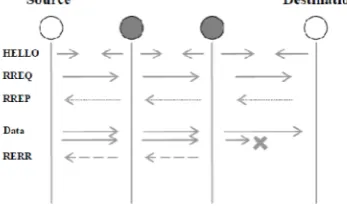
As data flows from the source to the destination, each node along the route updates the timers. If a route is not used for some period of time, a node cannot be sure whether the route is still valid; consequently, the node removes the route from its routing table. If data is flowing and a link break is detected, a Route Error (RERR) is sent to the source of the data in a hop-by-hop fashion. As the RERR propagates towards the source, each intermediate node invalidates routes to any unreachable destinations. When the source of the data receives the RERR, it invalidates the route and reinitiates route discovery if necessary. The following fig. 1 summarizes the action of an AODV routing protocol, HELLO messages are excluded from the diagram for brevity.
The second phase i.e. route maintenance is performed by the source node and can be subdivided into: i) source node moves: source node initiates a new route discovery process, ii) destination or an intermediate node moves: a route error message (RERR) is sent to the source node.
Fig.1. AODV protocol review
Intermediate nodes receiving a RERR update their routing table by setting the distance of the destination to infinity. If the source node receives a RERR it will initiate a new route discovery. To prevent global broadcast messages AODV introduces a local connectivity management. This is done by periodical exchanges of so called HELLO messages, which are small RREP packets containing a node's address and additional information
B. QoS routing for AODV
To offer bandwidth-guaranteed QoS, the available end-to-end bandwidth along a route from the source to the destination must be known. The end-to-end throughput is a concave parameter, which is determined by the bottleneck bandwidth of the intermediate hosts in the route. Therefore, estimating the end-to-end throughput can be simplified into finding the minimal residual bandwidth available among the hosts in that route. However, how to calculate the bandwidth using the IEEE 802.11 MAC is still a challenging problem, because the bandwidth is shared among neighboring hosts, and an individual host has no knowledge about other neighboring hosts’ traffic status.
C.
Available bandwidth estimation
Fig 2 shows the stages in the transmission of a single packet using the IEEE 802.11 DCF MAC protocol.
Fig.2. IEEE 802.11 packet transmission
Throughput can be measure by transmitting a packet
as-TP = --- (1)
Where, TP is Throughput, S is size of the packet, tris
the time the ACK received, ts is the time the packer is
ready for transmission.
The time intervalt − t includes the channel busy and contention time. Separate throughput estimates should be kept to different neighbors because the channel conditions may be very different to each one [16].
It is clear that the measured throughput of a packet depends on the size of a packet. Larger packet has higher measured throughput because it sends more data once it grabs the channel. To make the throughput measurement independent of packet size, we normalize the throughput of a packet to a pre-defined packet size. In Fig 2,
Td= ----(2)
Where Tdis the actual time for the channel to transmit
the data packet and is the channel’s bit-rate. Here we assume the channel’s bit-rate is a pre-defined value. The transmission times of two packets should differ only in their times to transmit the DATA packets. Therefore, we have:
(t − t ) − = (t − t ) − ---(3)
= − ---(4)
where is the actual data packet size, and s a pre-defined standard packet size. By Equation (4), we can calculate the normalized throughput TP2from the standard
size packet.
Obviously, the raw throughput depends on the packet size; larger packet size leads to higher measured throughput. The normalized throughput, on the other hand, does not depend on the data packet size. Hence, we use the normalized throughput to represent the bandwidth of a wireless link, to filter out the noise introduced by the measured raw throughput from packets of different sizes. We measure the bandwidth of a link in discrete time intervals by averaging the throughputs of the recent packets in the past time window and use it to estimate the bandwidth in the current time window. This estimation may not be accurate because the channel condition may have changed.
We measure and normalize the throughput for every 2 seconds using the average of packet throughputs in the past time window. Results show 15% error due to environment condition, channel errors due to physical object. Thus conclusion can be made that using average throughput of past packets to estimate current bandwidth is feasible and robust.
This algorithm is implemented in C++ and available to OTCL through an OTCL linkage that is implemented using tclcl. The whole thing together makes NS, which is a OO extended TCL interpreter with network simulator libraries.
D.
Establishing a route with QOS parameter
The proposed scheme for QoS-aware routing protocol is based on bandwidth estimation during route set up. Here when host want to send the data it has to listen to the channel and estimate the available bandwidth based on the ratio of free and busy times (“Listen” bandwidth estimation). The main idea is to establish AODV routing with the QoS parameters. Performance matrix as a extension is added to the route message during route discovery. In order to handle QoS extension some new
fields are added in routing tables. They are: i) Available bandwidth ii) Required bandwidth iii) Throughput iv) Energy consumption.
A node may be the destination of different sessions with different level of QoS, the routing tables should be maintaining per session and updated according to the respective value [1].
To estimate the available bandwidth, each host can listen to the channel to track the traffic state and determine how much free bandwidth it has available. Hosts are allowed to access the wireless channel when the media is free. The media can be free if no hosts are transmitting packets.
The IEEE 802.11 MAC utilizes both a physical carrier sense and a virtual carrier sense [via the network allocation vector (NAV)], which can be used to determine the free and busy times. A host estimates its available bandwidth for new data transmissions as the channel bandwidth times the ratio of free time to overall time, divided by a weight factor. The weight factor is introduced due to the nature of IEEE 802.11. The DIFS, SIFS, and back-off scheme represent overhead, which must be accounted for in each data transmission. This overhead makes it impossible in a distributed MAC competition scheme to fully use the available bandwidth for data transmission.
Minimum bandwidth is a field which indicate requested amount of bandwidth for a specific route. When an intermediate host receives the RREQ packet, it first calculates its residual bandwidth. The host compares its residual bandwidth with the requested bandwidth.
If its residual bandwidth is greater than the requested bandwidth, it forwards this RREQ. Otherwise, it discards this RREQ. The host compares its residual bandwidth with the min-bandwidth field in the RREQ. If its residual bandwidth is greater than the min-bandwidth, it forwards the RREQ. Otherwise, it updates the min-bandwidth value using its residual bandwidth. When the destination host receives the RREQ, it also checks as described above. However, after completing this checking procedure, we can’t say that the network can offer the min-bandwidth indicated in the RREQ packet. Therefore, one final check procedure is required before sending the RREP packet back to the source host. We directly use the relation of the end-to-end throughput with the no. of hops and the bottleneck bandwidth in the route as follows:
Total BW= .
This equation offers the upper bound of the available bandwidth. Finally, the destination host sends the RREP with a modified min-bandwidth to the source host. Once intermediate hosts receive the RREP, they enable the route and also record the min-bandwidth in their routing table. E.
Algorithm for QOS-AODV:
If a node (source node) wants to send packets it starts route discovery. For route discovery the following steps are involve:
1. Broadcast the RREQ packet.
3. If intermediate node then check whether enough bandwidth is available if N Drop the RREQ (END). 4. If Bandwidth is available check if reverse route in
routing table if N create entry in routing table. 5. If route is available update expire time of the reverse
route.
6. Is RREQ’s route is fresh if Y update the route entry. 7. If previous route (indicated by route cache timer) then
check any packet in buffer or queue send that packet and goto step 1
8. If destination Increase the sequence no 9. Create the entry for flow ID
10. Update the routing table and timer.
11. Send the RREP by the reverse route created.
12. Is route for the data packet to the destination in routing table? If N then create entry in routing table 13. If Y update the route expire timer in routing table. 14. Check whether the receiving node is source If N
check the buffer and sent packet.
15. If Y then check for available bandwidth, if bandwidth is available then again forward the RREP and goto step11.
16. If bandwidth is not available then drop the RREP and again start route discovery i.e. goto step 1.
Using this method to estimate residual bandwidth is straightforward. However, using this approach, the host cannot release the bandwidth immediately when a route breaks, because it does not know how much bandwidth each node in the broken route consumes. “Listen” only counts the used bandwidth but does not distinguish the corresponding bandwidth cost for each flow. This greatly affects the accuracy of bandwidth estimation when a route is broken. A simple overview of all this operation can be understood by algorithm as stated above. Here these steps or operations all added in normal AODV protocol as shown in fig. 1 or we can say these are the extension added to normal AODV protocol.
In the MAC layer, ready-to-send (RTS), clear-to-send (CTS), and acknowledgment (ACK) packets consume bandwidth, the back-off scheme cannot fully use the entire bandwidth, and packets can collide, resulting in packet retransmissions. Furthermore, the routing protocol needs some overhead to maintain or discover the routes.
III. S
IMULATION ANDR
ESULTTo test the performance of our QoS-aware routing protocol, we will perform simulations using NS-2(version 2.34). We use the IEEE 802.11 MAC protocol in CSMA/CA mode with a channel data rate of 2 Mbps. 25 mobile nodes are moving in 600 by 600 meter flat space. Attach CBR (Constant Bit Rate) application that generates constant packets through the TCP connection. Packet size is chosen to be 512 bytes, data rate is set to 1 Mbps. Duration of the scenarios is 100 seconds. Appropriate positions of the nodes are defined manually. During simulation 5 different source nodes want to send data to five different destinations.
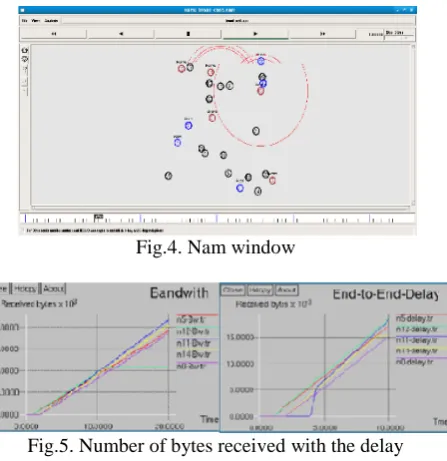
Fig.4. Nam window
Fig.5. Number of bytes received with the delay Fig.4. shows the nam window consists of 25 nodes. Blue nodes are sources and red nodes are destination. All the above approaches do not consider that the supported bandwidth should be less than the bandwidth available during the route discovery, which is caused by the potential bandwidth sharing brought by the new routes.
Fig 5 shows the screenshots for no of bytes received and delay in receiving bytes. No. of experiment had been performed to obtain the best condition for the network. Following result shows the bytes received and throughput for different weight factor.
Fig.6. Received bytes for different load scenarios As we goes on increase the packet size throughput decrease so to get best result keep the packet size as 1024 bytes
As packet size increases initially it take more time to route discovery process. Once route is discovered then data can be received normally. So choose optimal value of packet size.
IV. F
UTUREW
ORKHere we have developed a algorithm for bandwidth estimation which is based on one hop method. But the listen bandwidth estimation based on two-hop method will give better result. So same algorithm can be implemented by knowing the value of bandwidth for both one and two hop neighbors From the perspective of overhead, it will add extra overhead and may delay will increase for route discovery but guaranteed data will be received without any delay.
In our protocol, we have not incorporated any predictive way to foresee a route break, which causes performance degradation in mobile topologies. Therefore, some methods such as preemptive maintenance routing and route maintenance based on signal strength might help to reduce the transient time when the required QoS is not guaranteed due to a route break or network partition, so that the routing protocol can react much better to mobile topologies [3]. In a real scenario, shadowing will cause a node’s transmission range to vary, and it will not be the ideal circle that is assumed here. How to incorporate these no idealities into our protocol is the subject of our future research.
R
EFERENCES[1] De Renesse R, Ghassemian M, Friderikos V, Aghvami A.H“QoS enabled routing in mobile ad hoc networks” Dept. of Electr. Eng., King's Coll., London, UK 3G Mobile Communication Technologies, 2004. Fifth IEE International Conference on
Publication Date: 2004 On page(s): 678- 682
[2] Chenn-Jung Huang,1,4 Wei Kuang Lai,2 Yi-Ta Chuang,3 and Sheng-Yu Hsiao2 “A Dynamic Alternate Path QoS Enabled Routing Scheme in Mobile Ad hoc Networks” vol. 14, No. 1,
march 2007, 1-16
[3] L. Chen and W. B. Heinzelman, “QoS-aware routing based on bandwidth estimation for mobile ad hoc networks,”IEEE J. Selected Areas in Comm., vol.23, no. 3, pp. 561-572, Mar, 2005.
[4] Tung-Shih Su, Chih-Hung Lin, Wen-Shyong Hsieh “A Novel
QoS-Aware Routing for Ad Hoc Networks”Department of
Computer Science and Engineering National Sun Yat-Sen University
[5] Ian D. Chakeres and Elizabeth M. Belding-Royer, “AODV
Routing Protocol Implementation Design”Dept. of Electrical & Computer Engineering. University of California, Santa Barbara, [email protected] and Dept. of Computer Science University of California, Santa Barbara [email protected] [6] Chengyong Liu, Kezhong Liu, Layuan Li; “Research of QoS
-Aware Routing Protocol with Load Balancing for Mobile Ad
Hoc Networks”, Wireless Communications, Networking and Mobile Computing, 2008. WiCOM '08. 4th International
Conference on Digital Object Identifier:
10.1109/WiCom.2008.647, 2008, Page(s): 1–5
[7] Hannan Xiao, Seah W.K.G., Lo A., Chua, K.C.; “A flexible quality of service model for mobile ad-hoc networks”, Vehicular Technology Conference Proceedings, 2000. VTC 2000-Spring Tokyo. 2000 IEEE 51st Volume: 1, Digital Object Identifier: 10.1109/VETECS.2000.851496, 2000, Page(s): 445 - 449 vol.1 [8] Georgy Sklyarenko, “AODV Routing Protocol” Institut f¨ur
Informatik, Freie Universit¨at Berlin, Takustr. 9, D-14195 Berlin, Germany
[9] Shan Gong, The master thesis on “Quality of Service Aware Routing Protocols for Mobile Ad Hoc Networks, August, 2006”
Department of Electrical and Communications Engineering, HELSINKI UNIVERSITY OF TECHNOLOGY Aug 2006. [10] F.De Rango, M.Tropea, S.Marano; “Call Admission Control for
Integrated Diff-Serv Terrestrial and Int-Serv Satellite Network”,
D.E.I.S. department, University of Calabria, Rende, Italy. [11] Kevin Fal and Kannan Varadhan, The ns Manual, The VINT
Project, A Collaboration between researchers at UC Berkeley, LBL, USC/ISI, and Xerox PARC. [email protected], [email protected], January 6, 2009.
[12] Dhurandher S K, Misra S, Obaidat M S, Bansal V, Singh P,
Punia V; “An Energy-Efficient On-Demand Routing algorithm for Mobile Ad-Hoc Networks”, Electronics, Circuits and Systems, 2008. ICECS 2008. 15thIEEE International Conference on Digital Object Identifier: 10.1109/ICECS.2008.4675014, 2008, page(s): 958–961
[13] Samarth Shah, Kai Chen, Klara Nahrtedt;“Available Bandwidth
Estimation in IEEE 802.11-based Wireless Networks” Dept of
Comp science, Univ of Illinois at urbana-Champaign .
[14] C. T. Calafate, M. P. Malumbres, Member, IEEE, J. Oliver, J. C.
Cano, P Manzoni, Member IEEE;”QoS Supportin MANETs: A Modular Architecture Based on the IEEE 802.11e Technology”,
IEEE transactions on Circuits and Systems for Video Technology, Vol 19, No-5, May 2009, Page(s): 678-692. [15] Cheikh Sarr, Claude Chaudet, Guillaume Chelius, and Isabelle
Lassous;”Improving Accuracy in Available Bandwidth
Estimation for IEEE 802.11-based Ad Hoc Networks”, IEEE ISSN No:4244-0507-6/06, 2006, Page(s)-517-520
[16] Samarth Shah, Kai Chen, Klara Nahrstedt, “Available Bandwidth Estimation in IEEE 802.11-based Wireless Networks,” inProceedings of The first ISMA/CAIDA Bandwidth Estimation Workshop (BEst 2003), San Diego, Californie, USA,