Development of Abandoned Object Detection
Based on Region of Interest Method
Dr.V.Vivek1, Dr.P.Senthil Pandian2, S.Durai Pandi3, B.Sivananthan4, K.Peer Mohammed5 1
Assistant Professor(SG), Department of Computer Science and Engineering, Sethu Institute of Technology,
Kariapatti. Tamilnadu, India.
2
Associate Professor, Department of Computer Science and Engineering, Sethu Institute of Technology,
Kariapatti, Tamilnadu, India.
3,4,5
Assistant Professor, Department of Computer Science and Engineering, Sethu Institute of Technology,
Kariapatti. Tamilnadu, India.
Abstract
Abandoned object detection is a vital demand in several video police work contexts. This implementation is easy beside reusable in contrast to existing techniques. Video segmentation is completed that converts the input video into range of frames. Objects foreign to a usual surroundings are extracted victimisation background subtraction. The Region of Interest (ROI) is extracted, so eliminating video are that are unlikely to contain abandoned objects. The method of blob detection computes statistics of the thing. Morphological shut system is formed to fill in tiny gaps within the detected objects. This paper is employed to observe abandoned and purloined objects. the main target is to work out static regions that have recently modified within the prospect by activity background subtraction. The projected work will observe abandoned objects beside is capable of activity this in period of time and provides additional correct results.
Keywords - Object Detection, Video Surveillance, Video Event Detection, Region of Interest (ROI).
I. INTRODUCTION
Abandoned objects are the objects that manufacture damage to the kinsfolk. The demand for reliable police investigation systems is increasing, particularly public areas like airports, railway and subway stations, sports and event venues. For all this reason, the video police investigation systems that, through the analysis of video sequences, perform automatic detection of security connected events or aid human personnel in watching a foothold are gaining increasing interest. a crucial facet for current video police investigation systems is that the capability of faithfully police investigation common events like abandoned or removed object among a scene.
A person exploit a bag behind may be a unremarkably ascertained state of affairs publicly places. it's terribly helpful to spot these things in time, in order that the writer will attend thereto straight off. There are various police investigation cameras already watching public areas. Most of those police investigation camera systems are tiny scale, owned and employed by non-public homeowners for security functions, and with none sensible police investigation capabilities.
In recent years thanks to the ever-present presence of cameras, the planning of automatic police investigation systems for event recognition in jammed public areas has received a lot of attention. The goal is to equip intelligent systems with the power to faithfully notice the chance of danger. Here, we have a tendency to tackle the particular threat posed by baggage abandoned publicly areas. once an unusually unattended object becomes visible, the operator is probably going to review the tape closely to work out however it came to be left there and to determine whether or not it's been abandoned or if its owner has merely stepped away momentarily. If the owner remains there within the scene, there might not be a reason to agonize, however if he or she can't be establish, it's definitely a cause for the alarm.
Similarly, during this framework, if a lone object is discovered within the scene, the system tracks it backwards through recent video to appear for its owner. The owner of the luggage is assumed to be the individual World Health Organization brings the item into the scene and sets it down at the placement it's found. By inspecting the frames once the item was up-to-date with an individual's entity, distinctive options of its candidate owner(s) are non-heritable. These options are then accustomed pursuit for the owner in succeeding frames. If no appropriate match is found for a predefined amount of your time, the item is deemed as abandoned and an alarm is raised. If a match is eventually found (i.e. if the owner returns to the suspicious object), the alarm is defused.
In this paper, the abandoned object is detected victimisation the Region Of Interest each in period and from recorded video feeds. This video closed-circuit television is ready to notice objects abandoned or removed in each indoors and out of doors environments.
II. RELATEDWORK
package which will be accustomed introduce sensible police work capabilities to existing and new police work systems, with low price and process overhead. In [2], the vital method of parameter estimation is performed by approximating the size of foreground activities underneath multiple resolutions. [3] during this paper a replacement formula is delineate centered on getting stationary foreground regions; this can be helpful for applications just like the detection of abandoned or purloined objects and place vehicles. [4] This paper provides a review of the most background subtraction ways and an explicit categorization supported speed, memory needs and accuracy in an exceedingly principled manner.[5] proposes the simplest way to represent AN anomaly employing a goal driven programming language reality base. In paper [6], this identifies stable intervals of intensity values at each element, and determines that interval is presumably to show actuality background supported native optical flow data. Lv et al. [7] mix a Kalman filter-based blob huntsman with a shape-based human huntsman to observe folks moreover object in motion. Event detection is ready up in an exceedingly Bayesian reasoning framework. Stauffer and Grimson [8] gift an incident detection module that classifies objects, together with abandoned objects, employing a neural network,
However is proscribed to police investigation just one abandoned object at a time. The probabilistic trailing model planned by Smith et al. [9] is constructed of a mixed state dynamic Bayesian network and a trans-dimensional Markov chain town (MCMC) technique. Bhargava et al. [10] characterize the event of object abandonment by its constituent sub-events. Their formula verifies the progression of foreground observations by pre-defined event illustration and temporal constraints.
Adaptive background subtraction (ABS) has been a rather in style option to observe unknown, modified or removed articles within the foreground. ABS ways, like those delineate in [11,12], build and maintain a applied math model of the background, sometimes enforced in conjunction with AN object huntsman. Porikli [13] demonstrates static object detection victimisation long-run and short backgrounds created victimisation totally different adaptation rates. Abundant work has conjointly been done on multi-video police work systems [14]. though such systems have been for the most part eminent, the readying of multiple cameras per location is typically not sensible in wide unfold public areas like the railways.
III. SYSTEMARCHITECTURE
In this paper background subtraction based mostly technique is chosen thanks to the simplicity of implementation and low process power. the main focus of this paper is on the detection of abandoned objects publically places. The projected approach isn't
supported individual pursuit of all folks and objects; instead, the system solely searches for objects left by them. During this paper we tend to merely outline the stationary object to be AN abandoned object that has not been within the scene before.
Our methodology is meant to capture Associate in Nursing exploit the temporal flow of events associated with the abandonment of an object. within the planned formula, initial Region of interest is chosen, then video is segmental into frames, shots or pictures for process background subtraction is performed to notice any new object that will have entered the scene. at that time the determination or extraction of foreground image objects area unit half-track by blob analysis and at last abandoned objects area unit detected.
Figure 1: Outline of the proposed work
Our technique is intended to capture Associate in Nursing exploit the temporal flow of events associated with the abandonment of an object. within the planned algorithmic rule, initial Region of interest is chosen, then video is segmental into frames, shots or pictures for process background subtraction is performed to cite any new object which will have entered the scene. Afterward the determination or extraction of foreground image objects are half-tracked by blob analysis and at last abandoned objects are detected.
Our methodology involves the subsequent steps:
Step 1: Get input video and choose a vicinity of interest (ROI);
Step 2: Perform video segmentation mistreatment background subtraction;
Background Subtraction
Region of Interest
Abandoned Object Detection Input Video
Step 3: Calculate object statistics mistreatment blob analysis;
Step 4: Detect stationary objects supported their space and centre of mass statistics;
Step 5: Show output video with boundary box round the detected objects.
In the following we tend to describe every step in additional detail.
A. Video Segmentation
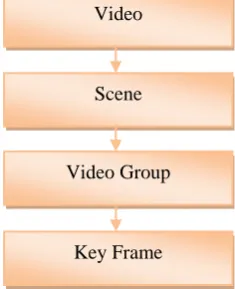
Video segmentation, the primary step in any video information management system is invariably the segmentation of the video track into smaller units. Videos are often metameric like scenes, images, shots and frames at totally different levels. Video Segmentation involves modulating the police work video for straightforward process of video at varied levels. In common, Frame is that the least of segmentation potential, wherever every frame contains solely the static objects.
In this projected system frames square measure taken into thought for detective work the objects and shots for object detection. initial the video is metameric into varied sorts of scenes, shots and frames. Here the video is modulated as shots. Shots square measure the set of frames freelance of every alternative. Shot boundaries square measure detected by comparison the frames that square measure freelance of every alternative.
Figure 2: Hierarchy of video segmentation
B. Region of Interest
Region of interest is outlined as most range of objects to be track. Region of interest differs from one setting to a different setting. For a specific purpose region of interest may be a selected as a set of given dataset, and it provides boundary of range of objects to be track. during this planned system, the primary frame that is captured from camera is taken because the sample to find the region of interest. the primary frame detected is taken into account as a background scheme from that individual static objects are detected and keep within the scheme as region of interest. So, region of interest follows 2 completely
different phases. First, the system can find the region of interest from the background system and so store it during a separate scheme. Supported the region of interest the system performs each the background subtraction and therefore the detection of abandoned object.
C. Store Background Image
This paper uses the primary frame of the video because the background. The RGB image frames square measure reborn to YCbCr color house. Later for the background subtraction operation each intensity and color info square measure used. For Blob Analysis it's reborn to binary pictures exploitation motor vehicle Threshold multiplier.
D. Segmentation victimization Background Subtraction
Static background subtraction is employed to make a mask for the foreground of a picture frame captured from the video feed. As a noise reduction technique, many dilation and erosion operations area unit done. The ensuing mask is then used as associate input to spot a collection of blobs for every frame. To fill the gaps of the article, morphological closing is performed victimization near pixels because the structural part.
The basic technique of background subtraction is to check frame and also the background with a pre-defined threshold. If the distinction of a picture element is larger than Threshold then classify it as foreground; otherwise, claim that it's background.
Figure 3: Background subtraction
The figure three is associate example for background subtraction technique.
E. Morphological Operations
Morphological image process may be a assortment of non-linear operations associated with the form or morphology of options in a picture, morphological operations bank solely on the relative ordering of constituent values, not on their numerical values, and so ar particularly suited to the process of binary pictures. Morphological closing operation is Video
Scene
Video Group
performed to fill in little gaps within the detected objects.
Closing - structured filling in of image region boundary pixels, the closing of A by B is obtained by the dilation of A by B, followed by erosion of the ensuing structure by B.
B
B A B
A (1)
Morphological Close operation is performed to fill in small gaps in the detected objects.
Figure 4: Example of Dilation
Figure 5: Example of Erosion
F. Blob detection
The Blob Analysis block computes statistics of the objects gift within the scene. It computes statistics for tagged regions, together with space, centric, count, most range of tracks, and feeds them to the core object detection operate scheme.
IV. SYSTEM PROTOTYPE
The Abandoned Object hunter system uses the article statistics to see that objects square measure stationary. This perform gets the count, area, centroid, etc. from the Blob detection, checks whether or not the realm and centre of mass of the blob has modified but a quantitative relation, and so determines that objects square measure stationary.
A. Abandoned object detection
The focus of this paper is on the detection of abandoned baggage publically places. Baggage could
embody suitcases, sports baggage, boxes, etc. The algorithmic program is also fittingly tailored to spot other forms of objects additionally. it's assumed that unattended baggage is also any baggage- like foreground blob which will be seen as clearly separate one from near blobs for a minimum of a brief amount of your time.
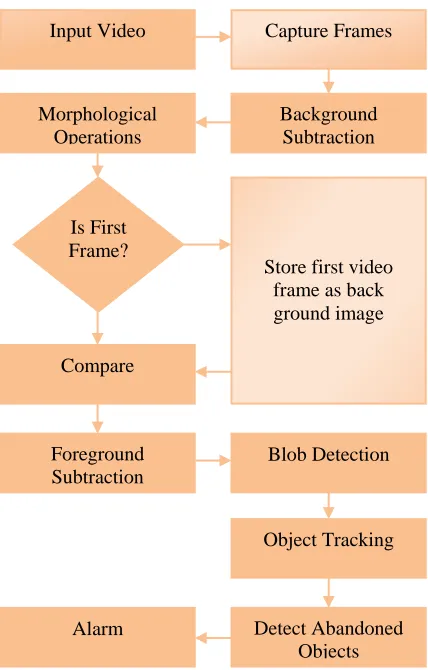
Likewise, we have a tendency to outline the activity of abandonment of associate object in terms of 3 sub-events: the entry of the owner with the article, departure of the owner while not the article, detection of the abandoned object if the owner isn't within the scene over a specific amount of your time. the method is preceded by a basic preprocessing stage which will vary looking on the dataset. to make sure clarity, the algorithmic program is represented in terms of 1 abandoned object and one rightful owner. It should be noted that the framework are often extended to handle at the same time multiple abandoned objects and their corresponding homeowners.
Figure 6: Outline of the proposed work
Object chase system uses the item statistics to work out that objects ar stationary. This perform gets the count, area, center of mass from the Blob detection, checks whether or not the world and center of mass of the blob has modified but a quantitative relation, and determines the stationary object.
Input Video Capture Frames
Morphological Operations
Background Subtraction
Store first video frame as back ground image
Compare
Foreground Subtraction
Blob Detection
Object Tracking
Detect Abandoned Objects Alarm
V. EXPERIMENTAL RESULTS
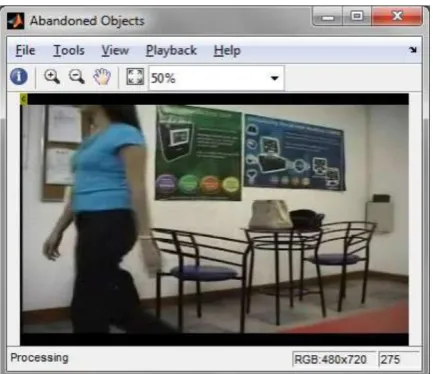
This paper presents some experimental results. the subsequent figures show Associate in Nursing example of detection of Associate in Nursing abandoned object in an exceedingly video.
Figure 7: Person lefts an object
The figure 7 is the abandoned object frame window. In this frame the person lefts an object in the scene.
Figure 8: Abandoned object in the table
The figure 8 shows the abandoned object within the table. once process within the Abandoned Object frame window, the bag is marked as red which suggests that this object wasn't within the initial frame.
The figure nine shows the situation of objects within the frame. As before long because the bag was placed and therefore the person left the scene, the window starts showing the bag as inexperienced box which suggests it's ablated the present frame from the background frame, that is that the 1st frame of the video. The window marks the region of interest (ROI) with the yellow box and
therefore the detected object with the inexperienced box.
Figure 9: Location of objects
The figure ten is that the Threshold window that shows the results of the background subtraction within the region of interest (ROI) and therefore the abandoned object is detected with a inexperienced box round the object. so the demonstration of the system is with success completed.
Figure 10: Detected abandoned object
Advantages
Detecting the abandoned objects is incredibly necessary to stop attacks on indoor and outside landmarks, public transportation.
In automatic video police investigation, whereas observation a scene it's ready to discover suspicious activities or unlikely events.
Object detection and trailing may be extended for animation.
In Vehicle navigation for video-based path designing and obstacle turning away capabilities.
V. CONCLUSION
Among several analysis makes an attempt on police investigation video process, our approach provides a quickly deployable, interactive and user friendly answer to attain abandoned object detection. During this paper, associate in nursing an abandoned object detection system supported comparatively straightforward operation are enforced and is therefore ready to run in time period. The planned work additionally tested for own dataset and therefore the system detects the objects also beneath low lightweight condition. Our methodology will handle occlusions in complicated environments with crowds. The testing results, that square measure supported totally different situations, have well-tried that our approach may be with success applied in real-world police investigation applications. And that we encourage additional analysis on increasing the configurability of video police investigation systems.
REFERENCES
[1] C.Hettiarachchi, Asitha Nanayakkara, Ayesha Dissanayaka, Charith Wijenayake, Chathura De Silva, “Abandoned object detection with logical reasoning” IEEE International Advance Computing Conference (IACC) 2014.
[2] Chen, C.-C., Aggarwal, J.K.: An adaptive background model initialization algorithm with objects moving at different depths. In: IEEE International Conference on Image Processing (ICIP), (2008).
[3] Álvaro Bayona, Juan C. SanMiguel, José M.Martinez, “Stationary foreground detection using background subtraction and temporal difference in video surveillance” 17th IEEE International Conference on Image Processing, ICIP 2010, IEEE 2010.
[4] Massimo Piccardi, “Background Subtraction technique- a review” IEEE International Conference on Systems, Man and Cybernetics,2004.
[5] V.D.Shet, . D. Harwood and L. S. Davis, "VidMAP: Video Monitoring of Activity with Prolog," in IEEE Conference on Advanced Video and Signal Based Surveillance, 2005. [6] Gutchess, D., Trajkovic, M., Kohen-Solal, E., Lyons, D.,Jain,
A.K.: A Background model initialization algorithm for video surveillance. In: Proceedings of IEEE International Conference on Computer Vision (ICCV), pp. 733–740 (2001) [7] Lv, F., Song, X., Wu, B., Singh, V.K., Nevatia, R.: Left-luggage detection using Bayesian inference. In: Proceedings of IEEE International Workshop on Performance Evaluation of Tracking and Surveillance (PETS), New York, pp. 83–90 (2006)
[8] Stauffer, C., Grimson, W.E.L.: Learning patterns of activity using real-time tracking. IEEE Trans. Pattern Anal. Mach. Intell. (PAMI) 22(8), 747–757 (2000)
[9] Smith, K., Quelhas, P. Gatica-Perez: Detecting abandoned luggage items in a public space. In: Proceedings of IEEE International Workshop on Performance Evaluation of Tracking and Surveillance (PETS), New York, pp. 75–82 (2006)
[10] Bhargava,M., Chen, C.-C., Ryoo, M.S., Aggarwal, J.K.: Detection of abandoned objects in crowded environments. In: Proceedings of 2007 IEEE International Conference on
Advanced Video and Signal based Surveillance (AVSS), London (2007)
[11] Grabner, H., Roth, P., Grabner, M.: Autonomous learning of a robust background model for change detection. In: Proceedings of IEEE International Workshop on Performance Evaluation of Tracking and Surveillance (PETS), New York, pp. 39–54 (2006)
[12] Li, L., Luo, R., Huang, W., Eng, H.: Context-controlled adaptive background subtraction. In: Proceedings of IEEE International Workshop on Performance Evaluation of Tracking and Surveillance (PETS), New York, pp. 31–38 (2006)
[13] Porikli, F: Detection of temporal static regions by processing video at different frame rates. In: Proceedings of IEEE International Conference on Advanced Video and Signal based Surveillance (AVSS), London (2007)