A Deep Dive into Blockchain Selfish Mining
Qianlan Bai
+, Xinyan Zhou
+, Xing Wang
†, Yuedong Xu
+, Xin Wang
†, Qingsheng Kong
+ + School of Information Science and Engineering, Fudan University† School of Computer Science and Technology, Fudan University
Abstract—This paper studies a fundamental problem regard-ing the security of blockchain on how the existence of multiple misbehaving pools influences the profitability of selfish mining. Each selfish miner maintains a private chain and makes it public opportunistically for the purpose of acquiring more rewards incommensurate to his Hashrate. We establish a novel Markov chain model to characterize all the state transitions of public and private chains. The minimum requirement of Hashrate together with the minimum delay of being profitable is derived in close-form. The former reduces to 21.48% with the symmetric selfish miners, while their competition with asymmetric Hashrates puts forward a higher requirement of the profitable threshold. The profitable delay increases with the decrease of the Hashrate of selfish miners, making the mining pools more cautious on performing selfish mining.
I. INTRODUCTION
Bitcoin has gained tremendous concerns as the first fully decentralized cryptocurrency since its advent in 2008. All historical transactions between Bitcoin clients are recorded in a global and public data structure known as the blockchain. The security of the blockchain is established by a chain of cryptographic Hash puzzles, addressed by a large-scale net-work of pseudonymous participants calledminers[1]. Solving a Hash puzzle is deemed as a way to generate Proof-of-Work (PoW) of reaching global consensus. The PoW of Bitcoin de-mands intensive computations, thus consuming a lot of energy. Each miner competes for this “game”, and is rewarded by cryptocurrencies (i.e. bitcoins) if he is the first acknowledged miner to find a valid block. When the population of miners is large, the aggregate Hash power is sufficiently high such that a malicious miner can hardly accumulate enough Hash power to perform Sybil attacks. The PoW consensus of Bitcoin has been employed in almost 90% of public blockchains, serving as the cornerstone of current cryptocurrencies.
The security of PoW is challenged by the trend of cen-tralization of Hash power. Mining a Bitcoin block is random and it needs more than 10 years on average with a latest-generation ASIC chip. Therefore, blockchain miners operate strategically to form pools that have a much larger chance of solving puzzles in each round. By splitting the mining reward appropriately, they acquire a stable income rate. As a side effect, a small number of mining pools occupy a vast majority of global Hash power, placing blockchain systems at the risk of being overthrown by a gigantic pool or colluding pools. The conventional wisdom believes that PoW is secure as long as no miner controls 51% of total Hash power. However, a miner can choose a selfish mining scheme instead of conforming to the standard Bitcoin protocol. Eyal and Sirer pointed out that the
selfish mining is profitable (i.e. more rewards than the honest mining) if the Hash power of a miner is larger than 25% [2]. A more intelligent selfish miner using Markov Decision Process (MDP) can lower down this threshold to around 23.21% [8]. Note that the both studies assume the existence of a single selfish miner while multiple (colluding) pools might be close to this profitable threshold.
In this paper, we study a fundamental question regarding the blockchain security: Will selfish mining become more easily profitable when there exist more than one selfish miners, and how many rounds should a selfish miner wait until being profitable? The former subquestion aims to unravel whether each selfish miners needs a smaller threshold of Hashrate to gain more rewards than mining honestly. The latter pays atten-tion to the transient behavior in the process of selfish mining that takes into account the mining difficulty adjustment. The transient analysis is also crucial for a selfish miner is inclined to waiting for a long period to gain more rewards, especially when the global Hashrate increases rapidly. We establish the selfish mining model for an honest pool that represents all honest miners, and two selfish mining pools who are not aware of each other’s misbehaving role. By dissecting all the possible events that trigger the change of private and public chains, we formulate a set of Markov chains to capture all the state transitions. In contrast to a very recent experimental study [3] that analyzes the profitable threshold of selfish mining with two miners, our work presents a mathematical model that yields close-form expression of such a threshold. In the transient analysis, the selfish mining is found of wasting computing power and thus is definitely unworthy without the subsequent difficulty adjustment of puzzle-solving.
The major contributions and observations are summarized as below.
• We establish a set of Markov chain models to characterize
the state transition of public and private chains in selfish mining and compute the steady state distributions.
• The minimum threshold of Hashrate is symmetric around 21.48% if two selfish miners are both profitable. While the profitable selfish mining becomes more difficult when one of the selfish miner increases his Hashrate, arousing a more furious competition.
II. SYSTEMMODEL
In this section, we describe the basic model of blockchain mining in the presence of two adversarial pools.
A. System Description
Consider a blockchain mining system with two misbehaving mining pools Alice and Bob, as well as an honest mining pool, Henry1. They compete to solve cryptographic puzzles to mine a valid block for the purpose of acquiring bitcoin-like rewards. The proof-of-work (PoW) consensus is adopted and the mining of blocks is stateless: the probability of discovering a block by a miner is proportional to his current Hashrate, but inversely proportional to the current aggregate Hashrate of the entire blockchain network. The blockchain system dynamically adjusts the difficulty of cryptographic puzzles such that new blocks are generated at a fixed average rate(e.g. one block per 10 minutes on average in Bitcoin). We define a “round” as the time to process one attack. The miners maintain a globally-agreed ordered set of transactions via the adoption and the mining on the longest chain. The revenue of a miner is the expected fraction of blocks mined by him out of all the blocks in the longest chain
For the simplicity, we make the following assumptions that are consistent with the literature [2].
• The total Hashrate of the blockchain system is normal-ized as a unit. Then, the Hashrate of a mining pool is represented as a fraction of the total.
• The block discovery time by a mining pool is exponen-tially distributed when his Hashrate is large.
• The reward of each valid block is normalized as one cryptographic coin.
Denote by α1,α2 andαh the Hashrates of Alice, Bob and
Henry respectively, i.e.α1+α2+αh= 1. Denote byγ1(resp.
γ2) the probability that honest miners mine after Alice’s (resp. Bob’s) released chain in the tie-breaking between Alice (resp. Bob) and Hence. Denote by θ1 and θ2 the probabilities that honest moners choose to mine after Alice’s and Bob’s chains in the three-party tie-breaking, respectively. When the blockchain system creates a new block, it is mined by pool i with the probability αi ,∀i∈ {1,2, h}, owing to the memorylessness
of exponentially distributed mining intervals.
Alice (resp. Bob) may release her blocks strategically by forcing Henry into wasting his computations. When Alice and Bob are both selfish miners, the interaction between two private chains becomes more complicated because none of them know other’s behaviour. In what follows, we capture all the different states that each miner may encounter.
B. Selfish Mining Mode
Alice maintains a private chain, so does Bob, while Henry operates on the public chain. Alice and Bob are not aware of each other’s role. We suppose that all the miners work on the same public chain in the beginning where the starting point is
1Multiple honest miners can be boiled down to a single miner for the sake of their linear additivity of Hashrates.
expressed as “0”. The length of the private chain is kept as a private information by Alice and Bob, and the length of the public chain is observed by all of them. We consider the selfish mining method proposed by [2], and our analytical approach can be generalized to a variety of other methods.
Themining procedure consists of two cases as follows.
• (Public-chain mining case)Henry always mines after the public chain. Alice or Bob also mines on the public chain if it is longer than his private chain.
• (Private-chain mining case) Alice (resp. Bob) continues to mine on her (resp. his) private chain if she (resp. he) discovers a new block and the private chain is now longer than the public chain.
Therelease procedureis more complicated than the mining procedure. Henry broadcasts his mined block as soon as it is discovered, while Alice and Bob will decide whether to release their mined blocks depending on the length of the public chain.
• (Forfeit case)Alice (resp. Bob) abandons her (resp. his) private chain and conforms to mining after the public chain if the latter is longer. Henry also abandons his public chain if Alice or Bob publishes a longer chain.
• (Risk-avoiding release case) Alice (resp. Bob) releases her (resp. his) privately mined blocks to the public because of the fear of loss if the new block is mined by the others and the leading advantage of her private chain is no more than two blocks.
• (Chain reaction case) When Alice (resp. Bob) releases
her (resp. his) blocks to the public chain and updates its length, the release of Bob’s (resp. Alice’s) private blocks is triggered immediately.
The chain reaction case is the combination of the forfeit and the risk-avoiding cases, whereas the existence of chain reaction complicates evolution of the public chain. Suppose that Alice publishes her private blocks to obsolete the current public chain. After the construction of new public chain, Bob may release his private chain to forfeit it immediately.
C. Release procedure and tie-breaking Logics
The consensus on the public chain requires that it is the longest. A crucial question is how the public chain evolves when it is of the same length as Alice or Bob. In general, each miner works on his own chain, and the release behavior of Alice and Bob is triggered when Henry mines a new block. We hereby illustrate the evolution of private and public chains where Ak, Bk, and Hk denote that the kth blocks belong
to Alice, Bob and Henry respectively. The blocks of private chains are in grey and those of public chains are in white.
Risk-avoiding release caseWe show the risk-avoiding release of Alice’s private chain in Figure 1. Alice is only one block ahead of Henry after the latter mines a new block for the public chain. Because Alice fears of losing the competition, she publishes her private blocks, obseleting Henry’s public chain, so that both Alice and Henry mine on the new longest chain afterwards.
Fig. 1: Alice’s risk-avoiding release and Henry’s abandonment.
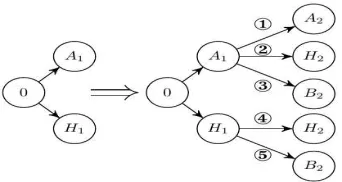
it happens, Alice publishes her private blocks immediately to compete with Henry. Thus, two public chains of the same length exist in Figure 2. Since only one public chains prevails, a tie-breaking rule needs to be taken into account. The first case is that the public chains of Alice and Henry have the same length, and Bob’s private chain is either 0 or very long. Hence, we only need to resolve the tie between Alice and Henry. All the miners are possible to mine after block A1, while Bob and Henry may mine after H1. There are five possibilities of extending the longest public chain, and the shorter one will be obsoleted. We omit the tie-breaking between Bob and Henry because this can be analyzed in the same way.
Fig. 2: Tie-breaking case of two public chains.
For the situation that each of Alice and Bob hides one private block, they will publish their private chains instantly after Henry finds a new block. As shown in Figure 3, there exists three competing public chains. Alice will mine after A1 and Bob will mine afterB1 for sure; Henry is not aware of which chain is maliciously forked so that he may mine on each public chains. There are also five possible situations. The risk-avoiding release, together with two tie-breaking solutions, constitutes all the dynamics of private and public chains.
Fig. 3: Tie-breaking case of three public chains.
Chain reaction release.We next introduce the chain reaction release that complicates the evolution of the private and public chains. Note that the chain reaction release consists of a sequence of risk-avoiding releases and tie-breaking resolvings. Figure 4 illustrates an example on how the chain reaction phenomenon is triggered. At stage 1, Alice’s private chain contains four blocks while the lengths of Bob’s private chain
Fig. 4: Chain reaction case.
and Henry’s public chain are 0. After a tie-breaking resolving at stage 2, the longer public chain contains two blocksB1and H2, and the shorter is orphaned. Bob construct a new private chain starting fromB3 toB8, while Henry continues to mine one block afterH2 at stage 4. From Alice’s perspective, her private chain is merely one block ahead of the public chain. She releases her private blocks in order to avoid the risk of losing the race with Henry. The new public chain now starts from blockA4. Next, stage 5 and 6 constitute a new round of tie-breaking resolving between Alice and Henry, extending the public chain to blockA7. However, the release ofA7 triggers Bob to release all of his private blocks starting fromB3toB8. When retrospecting all the mining stages, we observe that the winning branch switches back and forth, making the analysis of selfish mining extremely complicated.
III. FINITESTATEMACHINE
In this section, we construct the state machine of blockchain selfish mining and present the steady-state and transient anal-ysis of the profitable threshold.
A. Steady-state Analysis
Fig. 5: State machine withN=2.
We hereby formulate a finite state machine to characterize the evolution of private and public chains. Figure 5 illustrates the state machine when the maximum length of private chain is two (i.e.N=2). We define the state as a three-tuple consisting of the lengths of Alice, Bob and Henry. The arrows indicate the corresponding state transitions and the associated values represent the transition probabilities. For instance, all the transitions to(0,0,0)mean that the forked chains boil down to the unanimous public chain and a new round of selfish mining starts. Denote byPijk the steady state distribution of(i, j, k).
blocks mined by Alice (resp. Bob, Henry). Using the standard approach, we obtainRi as follows [5].
P000−1= 1+α1+α2+α1αh+2α1α2+α2αh+2α1α2αh; (1)
R1 P000 = 2α
2
1(1 +αh) + (α2+αh)α1αhγ1+α1α2αh
+4α21α2(1 +αh) + 2α1α2α2hθ1; (2)
R2 P000 = 2α
2
2(1 +αh) + (α1+αh)αhα2γ2+α1α2αh
+4α22α1(1 +αh) + 2α1α2α2hθ2; (3)
Rh
P000 =α1α 2
h(2−γ1) + 2α1α2α2h(2−θ1−θ2) +αh
+α2α2h(2−γ2) +α1α2αh(2−γ1−γ2). (4)
WhenN is large (e.g. three or four), the finite state machine becomes more complicated. Due to limite space, we leave the detailed analysis in the technical report [6], while only presenting the close-form results withN=4.
R1 P000 = 4α
4
1(1 +αh) + 3α
3 1α
2
h+ 16α
4
1α2+ 4α 2 1αh
+40α41α22(1 + 2α2) +α1α2αh(1 +γ1+ 2θ1αh)
+10α21α2αh+ 20α31α2αh(3α2+α1) + 15α31α2α2h +4α41α22αh(1 +αh) + 4α41α32α2h(β1+ 20) +5α51α32αh+ 4α41α
3
2αh(α2+ 21) + 3α31α
4 2α
2
hβ1 +α1α2hγ1+ 12α21α
2 2α
2
hβ1+α21α 2 2α
3
hβ1(3α1+ 2α2)
+6α31α32α2h(10αhβ1+ 1) ; (5)
R2 P000 = 4α
4
2(1 +αh) + 3α32α
2
h+ 16α1α42+ 4α
2 2αh +40α21α42(1 + 2α1) +α1α2αh(1 +γ2+ 2θ2αh)
+10α1α22αh+ 20α1α32αh(3α1+α2) + 15α1α32α
2
h +4α21α42αh(1 +αh) + 4α31α
4 2α
2
h(β2+ 20)
+5α31α 5
2αh+ 4α31α 4
2αh(α1+ 21) + 3α41α
3 2α
2
hβ2 +α2α2hγ2+ 12α21α22α2hβ2+α21α22α3hβ2(2α1+ 3α2)
+6α31α32α2h(10αhβ2+ 1) ; (6)
Rh
P000 =α1α 2
h(2−γ1) +α2αh2(2−γ2) +α21α 3 2α
3
h(2β1+β2)
+2α1α2α2h(2−θ1−θ2) +α21α 2 2α
2
h(6 + 4α1α2)
+α31α22α3h(β1+ 2β2) +α1α2αh(2−γ1−γ2) +α31α32αh(α1+α2) +α31α
4 2α
2
h(2β1+β2) +αh
+α41α32α2h(β1+2β2)+20α31α 3 2α
3
h+2α
4 1α
4
2αh (7)
β1=γ1/(γ1+γ2) β2=γ2/(γ1+γ2). (8)
Note that the cases with N >4 are not considered in the modeling. Apart from their complexity, a largeNmay cause a lot of consecutively orphaned blocks so that the selfish mining can be easily detected. Later on, our simulation confirms convergence of profitable threshold atN=4, i.e. the difference betweenN=4and a large enoughN is very small.
B. Transient State Analysis
According to the data from [4], the Hashrate of the Bitcoin system grows exponentially. It is necessary to study the
transient behavior of an attack. We model the action during one difficulty adjustment period and explore the relationship between the number of periods and the attackers’ Hashrate.
For a better description, we define the concept ofabsolute revenueandrelative revenue. First, Alice’s, Bob’s and Henry’s relative revenue are the proportion of their revenue to total revenue, which are
RA=R1/(R1+R2+Rh) (9)
RB=R2/(R1+R2+Rh) (10)
RH=Rh/(R1+R2+Rh) (11)
Since we ignore the influence of transaction fee and other factors, miners can only get revenue from published blocks. Based on this, we define absolute revenue as the number of valid blocks obtained per unit of time. In Bitcoin system, we take 10 minutes as unit time.
Through the state machine, in the ith adjustment interval
(eg. difficulty adjustment period),niblocks will appear on the
longest public chain and mi blocks are mined totally during
one attack round (eg. from stage(0,0,0) back to stage (0,0,0)). In addition, we useTito represent the total time spented in the
ithadjustment interval. Considering the change of computing
power, theSiis used to represent the Hashrate of total system,
the mathi and the ti represent the theoretical time and the
actual time that is spent mining one block during the ith
adjustment interval respectively. Take Alice as an example, we can obtain the following equations:
ni=R1+R2+Rh mi= 1 (12)
Eq. (12) give us that it costs T1 during the first difficulty adjustment period.
T1= 2016∗m1∗t1/n1 math1= 1unit time (13)
t1=math1∗S0/S1 S0= 1; (14) After the first period, the system will adjust the difficulty to satisfy mining one block per ten minutes. We can obtain the new average time of blocks generation during the ith period.
Alice’s absolute revenuecan be expressed as Eq. (15):
Rabsolute=
k X
i=1
2016∗R1
ni
/
k X
i=1
Ti (15)
Ti= 2016∗mi∗ti/ni n0= 1 (16)
mathi=mathi−1∗2016/Ti−1 t0=math0 (17) ti=mathi∗Si−1/Si math0=math1 (18)
IV. SIMULATION RESULTS
In order to verify the validity of theoretical analysis, we compare them with the results of a Bitcoin system simulator in this section. We set the block generation process to be exponentially distributed and run the simulator a million times. Based on the simulation results and theoretical results, we phrase the following observations:
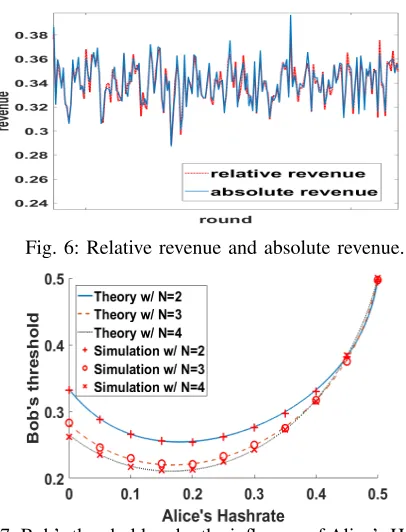
Fig. 6: Relative revenue and absolute revenue.
Fig. 7: Bob’s threshold under the influence of Alice’s Hashrate.
When there is only one attacker in system, [2] proposed that when there are branches, if γ1=γ2=1/2, the profitable threshold for attacker is 25% . [3] shows when there are two attackers with same Hashrate, the profit threshold will be lower than 25% and it is easier to launch selfish-mining. We model this process with state machine shown in section III and the mathematical model verify this conclusion well.
We consider the situation thatγ1=γ2=1/2andθ1=θ2=1/3. Driving Eq. (10), we can obtain that when Alice’s Hashrate is 16%, Bob’s profitable threshold can reach the minimum: 21.06%. When Alice’s Hashrate is less than 16%, the deriva-tive of Eq. (10) is greater than 0, which means that Bob’s threshold relative to Alice’s Hashrate is monotonically de-creasing. When Alice’s Hashrate is more than 16%, the derivative of Eq. (10) is less than 0, which means that Bob’s threshold relative to Alice’s Hashrate is monotonically increas-ing. In Figure 7, the blue curve represents the theoretical result and the red dots represent the simulation results. Three blue curves represent three cases:N is 2, 3 and 4. We can observe that when Alice’s Hashrate is around 16%, Bob’s threshold can be minimum. Through calculation and simulation, attackers’ profitable threshold is 27%, 23% and 22% when N is 2, 3 and 4 respectively if Alice and Bob own the same Hashrate. It shows that when there are two attackers, they can adopt strategies to successfully attack with less than 25% of total Hashrate.
Figure 11 also proves this result. The blue curve and the red curve represent that when there is only one attacker(we call it situation 1) and two attackers(we call it situation 2) in Bitcoin system, the relationship between N and threshold. It shows that under same condition, the threshold of situation 1 is always higher than the threshold of situation 2.
After [2] published, people realized that the mining pool with more than 25% of the Hashrate can successfully attack, so the system constrains the Hashrate of the mining pool to defend against the attack. We prove that this is not enough through the state machine model. In fact, it’s much easier to attack than our current cognition. The Bitcoin system is easier to be attacked and its security is much more fragile.
Observation2: IfN is no larger than 4, there is a negative correlation between Bob’s lowest profitable threshold and N while his revenue and N are positively correlated. In the Bitcoin system, whether there is one attacker or two attackers, the profitable threshold will converge with the growth ofN.
The lowest threshold is decreasing as N becomes larger. We use Figure 8, Figure 9 and Figure 10 to describe the revenue situations. Those three images represent Bob’s revenue when two attackers’ Hashrate are changing separately. Since we consider γ1 =γ2 = 1/2 andθ1 =θ2 = 1/3 in this current situation, Alice’s and Bob’s revenue are symmetrical. In these figures, blue part is the revenue and purple part highlights the moment Bob can gain additional income from the attack, in other words, the intersection of the blue and the purple parts is the threshold curve in Figure 7.
In Figure 11, situation 1 shows that when there is only one attacker, with the increase of N, the threshold convergences to 25%. The convergence process tends to be smooth when attacker can own more than 5 private blocks. Situation 2 shows that when there are two attackers in system, the relationship betweenN and threshold is consistent with one attacker, also a convergence process and its convergence speed is much faster. WhenN is 4, it reaches the convergence balance, with threshold at 21.48%. Situation 3 and situation 4 show that when Alice owns 25% and 30% Hashrate, Bob’s threshold will also be a convergence process.
Fig. 8: Alice’s revenue w.r.t. Alice and Bob’s Hashrate with N=2.
Fig. 9: Alice’s revenue w.r.t. Alice and Bob’s Hashrate withN=3.
Fig. 10: Alice’s revenue w.r.t. Alice and Bob’s Hashrate withN=4.
3 7 11 15 19 23 26
N 0.2
0.25 0.3 0.2 0.25 0.3 0.2 0.25 0.3
threshold
situation 1 situation 2 situation 3 situation 4
Fig. 11: Threshold convergence process.
0 50 100 150 200 250
N 0.4
0.45 0.5 0.55 0.6 0.65 0.7 0.75 0.8 0.85 0.9
revenue
situation1 situation2
Fig. 12: Upper limit.
0.22 0.24 0.26 0.28 0.3
Hashrate
0 20 40 60
Profitable T
Simulation Theory
Fig. 13: Profitable time and Hashrate.
threshold can reach convergence before six blocks.
Observation 3: In order to ensure the attack can proceed normally, αh>max{α1, α2} must be satisfied
As a counterexample, if Alice has the highest Hashrate, and there is no limit to the length of private chain, Alice can hide her private chain as long as possible. She can stay in the lead in most cases during the attack, which will lead to Alice’s private chain becoming the only valid chain. In this case, Bob and Henry will choose to stop mining to reduce losses. We can speculate that under this circumstance, Alice’s revenue can be close to 100% and her attack actually becomes meaningless. This kind of attack is similar to 51% attack. Simulation results also prove this. In Figure 12, when Alice’s Hashrate is 45%, Bob’s Hashrate is 25% and Henry’s Hashrate is 35%, we obtained situation 1. When Alice’s Hashrate is 45%, Bob’s Hashrate is 35%, and Henry’s Hashrate is 25%, we obtained situation 2. It shows that the longer attacker’s private chain is, the more he can gain. As long as one attacker has the highest Hashrate, this situation could happen, regardless of how many Hashrate other miners have. According to this analysis, it is very meaningful to stipulate that Henry should have the highest Hashrate in the attack model.
Observation4: The attackers will fail during the first diffi-culty adjustment period regardless of the attackers’ Hashrate. However, he might gain profit after several periods, which is related to the attackers’ Hashrate.
Assuming two attackers have the same Hashrate, we sim-ulated and obtained Figure 6. relative revenue and absolute revenueare equal within the allowable range of error. There-fore, we can believe that the relative revenue and absolute revenueplay the same role in representing benefit.
As Eq. (15) shows, when Alice has more Hashrate, she can get illegal revenue earlier. Figure 13 shows the simulation
results match well with the theoretical result. The horizontal axis represents the attack round and the ordinate represents the attackers’ revenue, also the blue curve is theoretical result and the red dots are simulation results. It shows that when attackers’ Hashrate is relatively small, it takes a rather long period to gain profit. That means in the real system, it is a little bit hard to perform attack. If the global Hashrate increase, we can also use this formula to calculate when to stop the attack before we can benefit the most.
V. CONCLUSION
In this paper, we study how the existence of multiple misbe-having pools influences the profitability of selfish mining. By establishing the Markov chain model to describle the action of attackers and honest miners, we can obtain the minimum profitable threshold is symmetric 21.48%. Considering the difficulty adjustment, we model the transient process and discover the negative correlation between the profitable time and the attackers’ mining power.
REFERENCES
[1] S. Nakamoto. “ Bitcoin: A peer-to-peer electronic cash system” , 2008. [2] I. Eyal and E. G. Sirer. “Majority is not enough: Bitcoin mining is
vulnerable”. In Financial Cryptography and Data Security. Springer, 2014, pp. 436-454.
[3] Q.H. Liu, N. Ruan, et al. “On the Strategy and Behavior of Bitcoin Mining with N-attackers”. Proc. of the Asia Conference on Computer and Communications Security, pp. 357-368, 2018.
[4] https://bitinfocharts.com/comparison/bitcoin-hashrate.html
[5] A. Papoulis, S. U. Pillai. Probability, random variables, and stochastic processes[M]. Tata McGraw-Hill Education, 2002.
[6] Technical report. http://medianet.azurewebsites.net/new-page/
[7] R. Pass, E. Shi “Fruitchains: A fair blockchain”.Proc. of the Asia Con-ference on Computer Symposium on Principles of Distributed Computing, pp. 315-324, 2017.