Universal Proxy Re-Encryption
Nico Döttling
1Ryo Nishimaki
21CISPA Helmholtz Center for Information Security, Saarbrücken, Germany [email protected]
2NTT Secure Platform Laboratories, Tokyo, Japan [email protected]
Abstract
We put forward the notion of universal proxy re-encryption (UPRE). A UPRE scheme enables a proxy to convert a ciphertext under a (delegator) public key ofany existing public-key encryption (PKE) schemeinto another ciphertext under a (delegatee) public key ofany existing PKE scheme (possibly different from the delegator one). The proxy has a re-encryption key generated from the delegator’s secret key and the delegatee public key. Thus UPRE generalizes proxy re-encryption by supporting arbitrary PKE schemes and allowing to convert ciphertexts into ones ofpossibly different PKE schemes. In this work, we
• provide syntax and definitions for both UPRE and a variant we call relaxed UPRE. The relaxed variant means that decryption algorithms for re-encrypted ciphertexts are slightly modified but still only use the original delegatee secret keys for decryption.
• construct a UPRE based on probabilistic indistinguishability obfuscation (PIO). It allows us to re-encrypt ciphertexts polynomially many times.
• construct relaxed UPRE from garbled circuits (GCs). We provide two variants of this construction, one which allows us to re-encrypt ciphertexts polynomially many times, and a second one which satisfies a stronger security requirement but only allows us to re-encrypt ciphertexts a constant number of times.
Contents
1 Introduction 1
1.1 Background . . . 1
1.2 Our Contributions . . . 2
1.3 Technical Overview . . . 3
1.4 Related Work . . . 5
2 Preliminaries 5 2.1 Notations and Basic Concepts . . . 6
2.2 Basic Cryptographic Tools . . . 6
2.3 (Probabilistic) Indistinguishability Obfuscation . . . 8
3 Definition of Universal Proxy Re-Encryption 9 3.1 Unidirectional UPRE . . . 9
3.2 Unidirectional Multi-Hop UPRE . . . 12
3.3 Security against Corrupted-Delegator Re-Encryption Attacks . . . 14
3.4 On Re-Encryption Simulatability . . . 15
3.5 UPRE for More Advanced Encryption . . . 15
4 Multi-Hop Construction based on Indistinguishability Obfuscation 15 4.1 Trapdoor Encryption . . . 16
4.2 Our Multi-Hop Scheme from PIO . . . 17
4.3 Security Proof . . . 18
4.4 Instantiation of UPRE scheme based on PIO . . . 20
5 Multi-Hop Construction based on Garbled Circuits 21 5.1 Weak Batch Encryption . . . 21
5.2 Our Multi-Hop Scheme from GC . . . 23
5.3 Security Proof . . . 24
6 Constant-Hop Construction Secure against CRA 28 6.1 Our Constant-Hop Scheme from GC . . . 28
6.2 Security Proof . . . 30
A Re-Encryption Simulatability 34 A.1 Our Relaxed UPRE schemes are not Re-Encryption Simulatable . . . 35
1
Introduction
1.1
Background
Constructing cryptographic systems from scratch is a challenging task. When migrating from a legacy cryptosystem to a new one with better security and functionality, it would be desirable to reuse existing public key infrastructures (PKI) to reduce the cost of migration. In this work, we explore auniversalmethodology to construct a new and easily deployable cryptographic system from existing cryptographic systems and PKI.
As a particular example of cryptographic systems, we consider proxy re-encryption (PRE) [BBS98]. PRE allows to convert a ciphertext under public keypkf (we call delegator public key and f denotes “from”) into another ciphertext under public keypkt(we call delegatee public key andtdenotes “to”) by using a re-encryption keyrkf→twithout decrypting the original ciphertext byskf (we call delegator secret key). A third party, called
proxy, owns the re-encryption keyrkf→tand executes the re-encryption procedure. PRE thus enables delegation of
re-encryption and several useful applications. It can be used to achieve encrypted email forwarding [BBS98,Jak99], key escrow [ID03], encrypted file storage [AFGH05], secure publish-subscribe operation [PRSV17], and secure payment systems for credit cards [GSL19].
However, all known PRE schemes only support conversions from ciphertexts under a public key generated by their key generation algorithminto other ones under another key generated bythe same key generation algorithm with the same parameter. Theycannotconvert ciphertexts into ones under another key generated byanother key generation algorithm of another encryption scheme. Moreover, almost all known PRE schemes were constructed from scratch by using specific cryptographic assumptions such as the decisional Diffie-Hellman (DDH) assumption and the learning with errors (LWE) assumption. The formats of their keys and ciphertexts are fixed in advance at the setup and can never be changed. Only a few PRE schemes use public-key encryption (PKE) schemes generically [HKK+12]. However, in such schemes, we cannot use a PKE scheme as it is (some additional conversion
is needed). Moreover, only delegatees (receivers of converted ciphertexts) can select any PKE scheme and delegators (senders of original ciphertexts) cannot. From a practical point of view, this is unsatisfactory as we need to build a new system using a PRE scheme from scratch if we want to use applications of PRE described above. When we use a PRE scheme, we cannot use existing and widely used public-key cryptosystems to achieve the applications of PRE. Ideally, we would like to achieve a re-encryption mechanism that works for any pair of PKE schemes without any modification and setup.
Universal Proxy Re-Encryption. To resolve the problems above, we put forward the concept ofuniversal proxy
re-encryption (UPRE). UPRE enables us to convert ciphertexts under a public key of a schemeΣf (delegator scheme) into ciphertexts under another public key ofanother schemeΣt(delegatee scheme).We can select arbitrary secure PKE schemes forΣf,Σt. For example, we can use Goldwasser-Micali PKE [GM84] asΣf and ElGamal
PKE [ElG85] asΣt. If a delegator and delegatee have key pairs(pkf,skf)and(pkt,skt)of schemesΣf andΣt, respectively, then a re-encryption key generation algorithm of UPRE can output a re-encryption keyrkf→tfrom
(Σf,Σt,skf,pkt). A proxy can generate a re-encrypted ciphertextrctfromrkf→tandEncf(pkf,m)whereEncf
is the encryption algorithm ofΣf. Of course, the re-encrypted ciphertextrctcan be correctly decrypted tomby
usingskt.
Ideally, a re-encrypted ciphertext should be decrypted by the original decryption algorithm of the delegatee scheme (i.e.,Dect(skt,·)). However, we can also consider a relaxed variant where a re-encrypted ciphertext can be decrypted via a slightly modified decryption algorithmwith the original delegatee decryption keyskt. We call this
variantrelaxed UPRE. Here, we emphasize that the delegator uses onlypkf andEncf to encrypt a message and
the delegatee uses onlysktto decrypt a re-encrypted ciphertext (they do not need any additional keys) even if its
decryption procedure is slightly modified. Our work is the first to explore such a universal methodology for proxy re-encryption.
UPRE enables us to build a re-encryption mechanism dynamically by using currently deployed cryptosystems. Users who have already used PKE schemes can convert ciphertexts into other ones by using a UPRE scheme. They do not need to setup a proxy re-encryption system from scratch. Therefore, UPRE offers more flexibility than standard PRE. In addition, UPRE has applications that PRE does not have, e.g. the following. UPRE enables us to delegate migration of encryption systems to a third party such as cloud-servers with many computational resources when an encryption scheme with some parameter settings becomes obsolete, or vulnerability is found in an encryption system. That is, we can outsource renewing encrypted storage to a third party.
and bidirectional, which means that a re-encryption key betweenpkf andpktcan be used for only one-way from
f totand both ways, respectively. For the number of hops, there are single-hop and multi-hop, which mean a re-encrypted ciphertext cannot be converted anymore and can be converted polynomially-many times, respectively. In particular, when only a constant number of conversions is possible, we call it constant-hop. We consider unidirectional single/constant/multi-hop but do not focus on bidirectional since the functionality of a bidirectional re-encryption key is simulated by two unidirectional re-encryption keys.
The main question addressed in this work is how to achieve UPRE. Regarding feasibility, it seems plausible that UPRE can be achieved from indistinguishability obfuscation (IO) [BGI+12, GGH+16] or multilinear
maps [GGH13,CLT13,GGH15].1. And in fact, we present a construction based on IO as an initial step, though we emphasize that formally proving security is not a trivial task even if we use IO. Consequently, the main focus of this work is concerned with the following question.
Is it possible to achieve a UPRE scheme without IO and multilinear maps? We give a positive answer to this question.
1.2
Our Contributions
The main contributions of this study are the following.
1. We introduce the notion of UPRE and formally define its security.
2. We present a general construction of multi-hop UPRE for some class of PKE by using probabilistic IO (PIO). 3. We present a general construction of multi-hop relaxed UPRE for any PKE by using only garbled circuits
(GC) and therefore need no additional assumptions.
4. By using our general constructions and known instantiations of tools above, we can obtain multi-hop (relaxed) UPRE schemes from IO, or generic standard assumptions.
The third contribution is notable since we introduce a new design idea and use only weak assumptions. We explain more details (tools, security levels, and so on) of these contributions below.
For UPRE, we can consider a natural analog of security against chosen plaintext attacks (CPA) for PRE (PRE-CPA), where adversaries execute CPA attacks with oracles that give re-encryption keys and re-encrypted ciphertexts. However, we do not focus on the definition of CPA-security for UPRE (UPRE-CPA) because Cohen introduced a better security notion called security against honest re-encryption attacks (HRA) for PRE [Coh19]2. Thus, we define security against honest re-encryption attacks for UPRE (UPRE-HRA), which implies UPRE-CPA, instead of CPA-security. We also define security against corrupted-delegator re-encryption attacks (CRA) to consider the setting of migration of encryption system explained in Section1.1. That is, even if a delegator is corrupted, once a ciphertext is re-encrypted for an honest delegatee, then the delegator cannot obtain information about a plaintext from the re-encrypted ciphertext.34 See Section3for details.
We present three general constructions of UPRE. One is UPRE for some class of PKE based on PIO. PIO was introduced by Canetti, Lin, Tessaro, and Vaikuntanathan [CLTV15]. Another is relaxed UPRE for any PKE based on GC. The other is constant-hop and CRA-secure relaxed UPRE for any PKE based on GC. We emphasize that our relaxed UPRE is based ongenericstandard assumptions without relying on heavy tools. We look closer at what kind of (relaxed) UPRE is achieved below.
Our UPRE scheme based on PIO is a unidirectional multi-hop UPRE scheme. The required properties for PKE schemes depend on the security level of PIO. If we assume additional properties on PKE, then we can achieve UPRE from sub-exponentially secure IO (sub-exp IO) and sub-exponentially secure OWF (sub-exp OWF). Most well-known CPA-secure PKE schemes such as ElGamal, Goldwasser-Micali PKE schemes satisfy the additional properties (See Section4.1for details). However, if we use any PKE, we need PIO with the strongest security for specific circuits (refer to [CLTV15]). If we use the exponential DDH assumption, we can achieve UPRE from any PKE and polynomially secure IO. The advantage of the scheme based on PIO is that it is a multi-hop UPRE scheme and conceptually simple. See Section4for more details.
1A.k.a. “heavy hammers”.
2Derler, Krenn, Lorünser, Ramacher, Slamanig, and Striecks also proposed a similar security notion in the forward secret setting as (fs)-RIND-CPA [DKL+18].
3Note that the corrupted delegator does not have a ciphertext to be re-encrypted here.
Our relaxed UPRE scheme based on garbled circuits (GC) is a unidirectional multi-hoprelaxedUPRE scheme for any PKE scheme. This is a significant contribution since GC is a light cryptographic tool. This relaxed UPRE scheme satisfies HRA-security. However, some meta information (all garbled circuits from the first delegator to the last delegatee) is directly preserved in all re-encrypted ciphertexts. Therefore, the number of hops cannot be hidden in the scheme based on GC. In particular, when a delegator is corrupted, we do not know how to prove that a re-encrypted ciphertext does not reveal information about the plaintext.
Our last UPRE scheme is a unidirectional constant-hop relaxed UPRE scheme for any PKE scheme based on GC. This scheme satisfies CRA-security unlike the multi-hop scheme above, but it can re-encrypt only constant times since its re-encryption procedure incurs polynomial blow-up.
In the GC-based schemes, we must use a slightly modified decryption algorithm (i.e., we achieve relaxed UPRE) though we can use the original delegatee decryption key as it is. While this is a small disadvantage of the GC-based constructions, we would like to emphasize that these are the first constructions of relaxed UPRE, achieved by the standard assumptions.
1.3
Technical Overview
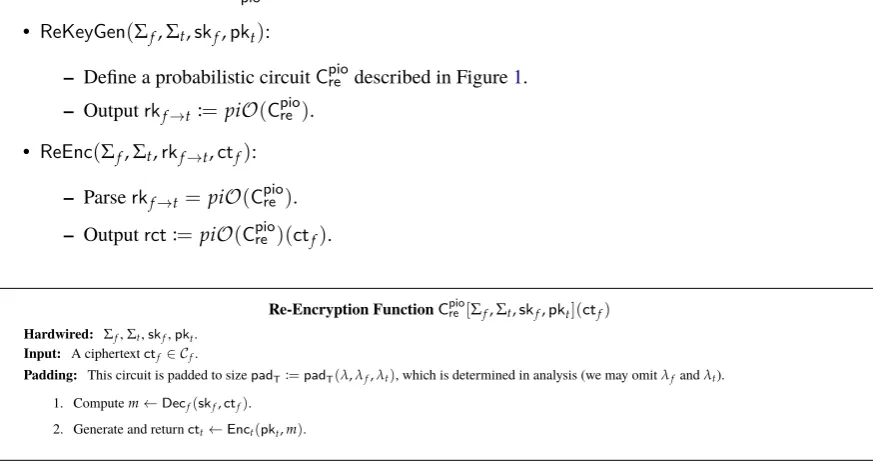
In this section, we give a high-level overview of our UPRE schemes and techniques. To achieve the re-encryption mechanism, we use a circuit with a hard-wired secret key of a delegator PKE scheme to generate a re-encryption key. This is because UPRE supportsgeneral PKE schemesand we need to decrypt ciphertexts once to re-encrypt them. However, such a circuit should not be directly revealed to a proxy to guarantee security. Therefore, we must hide information about the secret-key in a re-encryption key. That is, to use CPA security of the delegator PKE scheme, we must erase information about the secret key embedded in a re-encryption key in security proofs. This is the most notable issue to prove the security of UPRE. When we succeed in erasing secret keys from re-encryption keys in our reductions, we can directly use the CPA-security of delegators to prove the security of a UPRE scheme.
Based on IO IO is a promising tool to hide information about delegator secret keys since IO is a kind of compiler
that outputs a functionally equivalent program that does not reveal information about the original program. We define a re-encryption circuitCre, in which a delegator secret keyskf and a delegatee public keypktare hard-wired
in and which takes a delegator ciphertextctf as an input. The re-encryption circuit decryptsctf by usingskf,
obtains a plaintextm, and generates a ciphertext ofmunderpkt. We can hide information aboutskf by using PIO
(note thatCreis a randomized circuit). That is, a re-encryption key from delegator f to delegateetispiO(Cre) where piOis a PIO algorithm. A re-encrypted ciphertext is a fresh ciphertext underpkt. Thus, we can achieve
multi-hop UPRE. This construction is similar to the FHE scheme based on PIO presented by Canetti et al. [CLTV15]. However, we cannot directly use the result by Canetti et al. since the setting of unidirectional multi-hop UPRE is different from that of FHE.
The security proof proceeds as follows. To eraseskf, we use a dummy re-encryption circuit that does not run
the decryption algorithm ofΣf withskf and just outputs a dummy ciphertext underpkt(does not need plaintextm).
We expect that adversaries cannot distinguish this change. This intuition is not false. However, to formally prove it, we cannot directly use the standard CPA-security of PKE since an obfuscated circuit of the re-encryption circuit generates ciphertexts underhard-wiredpkt. It means that we cannot use a target ciphertext of the CPA-security
game and the common “punctured programming” approach unless the scheme has a kind of “puncturable” property for its secret key [CHN+18]. Therefore, we use trapdoor encryption introduced by Canetti et al. [CLTV15].
In trapdoor encryption, there are two modes for key generation. One is the standard key generation, and the other one is the trapdoor key generation, which does not output a secret key for decryption. The two modes are computationally indistinguishable. Ciphertexts under a trapdoor key are computationally/statistically/perfectly indistinguishable (See Section4.1for more details). Thus, we proceed as follows. First, we change the hard-wired public keypktinto a trapdoor keytkt. Second, we use the security of PIO. The indistinguishability undertktis
used to satisfy the condition of PIO.
We can consider the relationships among keys as a directed acyclic graph (DAG). Each vertex is a user who has a key pair, and each edge means that a re-encryption key was generated between two vertices. To prove ciphertext indistinguishability under a target public-key, we repeat the two processes above from the farthest vertex connected to the target vertex to the target vertex. We gradually erase information about secret keys of vertices connected to the target vertex. At the final step, information about the target secret key is also deleted, and we can use security under the target public-key of the delegator’s PKE scheme.
indistinguishability under a trapdoor key, which is equivalent to the standard IND-CPA security, requires stronger security of PIO. If we use perfect indistinguishability under a trapdoor key, which is achieved by re-randomizable PKE schemes such as ElGamal PKE scheme, then we can use weaker PIO for circuits that are implied by sub-exp IO for circuits and sub-exp OWF. Finally, we can use doubly-probabilistic IO introduced by Agrikola, Couteau, and Hofheinz [ACH20] instead of PIO to achieve UPRE for IND-CPA PKE. Agrikola et al. prove that we can achieve doubly-probabilistic IO by using polynomially secure IO and the exponential DDH assumption.
Based on GC The most challenging task in this work is achieving a relaxed UPRE scheme without obfuscation.
Surprisingly, we can achieve a relaxed UPRE scheme for any CPA-secure PKE scheme by using GC in combination with a secret sharing scheme. The idea is that a proxy and a delegatee are different entities and can separately use shares of a decryption key. We generateshares of a decryption key, and use a garbled circuit where one of the shares is hardwired to hide information about the decryption key.
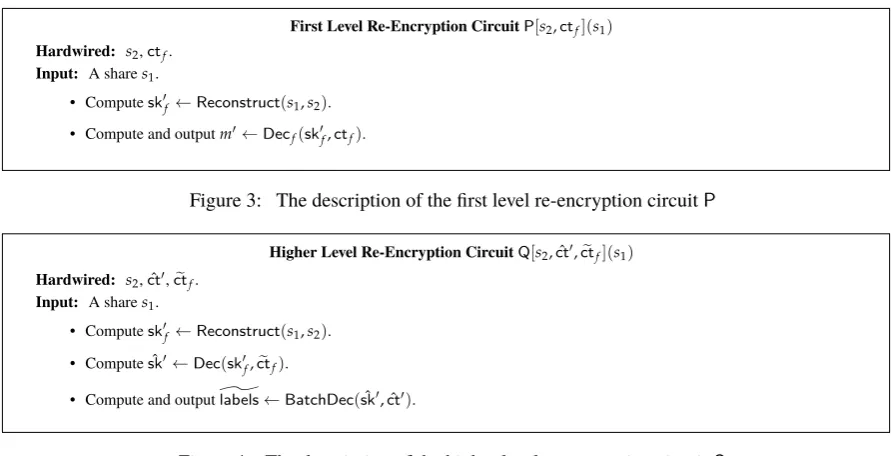
Our re-encryption mechanism proceeds in the following two steps. First, we generate shares (s1,s2) of a
delegator secret keyskf by a secret sharing scheme. We encrypt shares1by usingpktand obtainctet←Enc(pkt,s1). A re-encryption key from f totisrkf→t := (s2,ctet). Roughly speaking,s1is hidden by the CPA-security of PKE, ands2does not reveal information aboutskf by the privacy property of secret sharing. We define a circuit
Credewheres2 and the delegator ciphertextctf are hard-wired. The circuitCrede takes as inputs1, reconstructs skf from(s1,s2), and computesDecf(skf,ctf). Now, we garbleCrede[s2,ctf]and obtain a garbled circuitCfrede and labels
labelsi,b i∈[|s
1|]b∈{0,1}. We set a re-encrypted ciphertext torct := (ctet,Cf re de,
labelsi,b )(we omit
{i∈[|s1|],b∈ {0, 1}}if it is clear from the context). The delegateetcan evaluate the garbled circuit and obtain
decrypted value since the delegatee can obtains1fromctet. However, this apparently does not work since sending
labelsi,b breaks the security of GC andskf is revealed.
Before we move to the second step, we introduce the notion of weak batch encryption, which is a non-succinct variant of batch encryption [BLSV18] and easily constructed from standard CPA-secure PKE. A batch key pair(pkˆ , ˆsk) is generated from a choice strings ∈ {0, 1}λ. We can encrypt a pair of vector messages ({mi,0}i∈[λ],{mi,1}i∈[λ])by usingpkˆ . We can obtain{mi,s[i]}i∈[λ]from a batch ciphertext andskˆ. A batch
public-keypkˆ does not reveal any information abouts. Adversaries cannot obtain any information about{mi,1−s[i]}i∈[λ] from a batch ciphertext even ifskˆ is given. By using2λpairs of a public-key and secret-key of PKE, we can achieve
weak batch encryption (we select a key pair based on each bit ofs). Note that we can recyclepkˆ for many vectors of
messages. See Section5.1for details.
Now, we move to the second step. To send only{labelsi,s
1[i]]}i∈|s1| to the delegatee t, we use weak batch encryption. That is, we lets1be choice bits of a batch key pair and
labelsi,b be messages of batch encryption.
To achieve a re-encryption mechanism with this idea, at the re-encryption key generation phase, we generate a batch key pair(pkˆ , ˆsk)←BatchGen(s1). Moreover, we encrypt the batch secret-keyskˆ underpkt. That is, we
setrkf→t := (pkˆ,s2,Enc(pkt, ˆsk)). At the re-encryption phase, we generate not only the garbled circuitCfredeof
Crede[s2,ctf]and
labelsi,b i,bbut also the batch ciphertextctˆ ←BatchEnc(pkˆ,({labelsi,0}i,{labelsi,1}i)). That is, a re-encrypted ciphertext isrct:= (ctet, ˆct,Cfrede), wherectet←Enc(pkt, ˆsk).
The delegateetcan obtain the plaintextmas follows. It obtainsskˆ ←Dect(skt,ctet)by its secret keyskt, recover selected messages{labelsi,s
1[i]}i←BatchDec(skˆ, ˆct), andm
0 ←Eval(
f
Cre
de,{labelsi,s1[i]}i). By the functionality of GC, it holds thatm0 =Crede[s2,ctf](s1) =m. Thus, this construction works as relaxed UPRE for any PKE
scheme if there exists GC.
Intuitively, the re-encryption keyrkf→tdoes not reveal information aboutskf since the CPA-security of PKE
and the receiver privacy of weak batch encryption hides information abouts1. Adversaries cannot obtain any
information aboutskf from the other shares2by the privacy property of the secret sharing scheme. That is, we can
erase information aboutskf and can use the CPA-security ofpkf. Here, the choices1is fixed at the re-encryption
key generation phase and recycled in many re-encryption phases. However, this is not an issue since the security of weak batch encryption holds for many batch ciphertexts under the same batch key pair.
We explain only the single-hop case. However, we can easily extend the idea above to a multi-hop construction. See Section5for the detail.
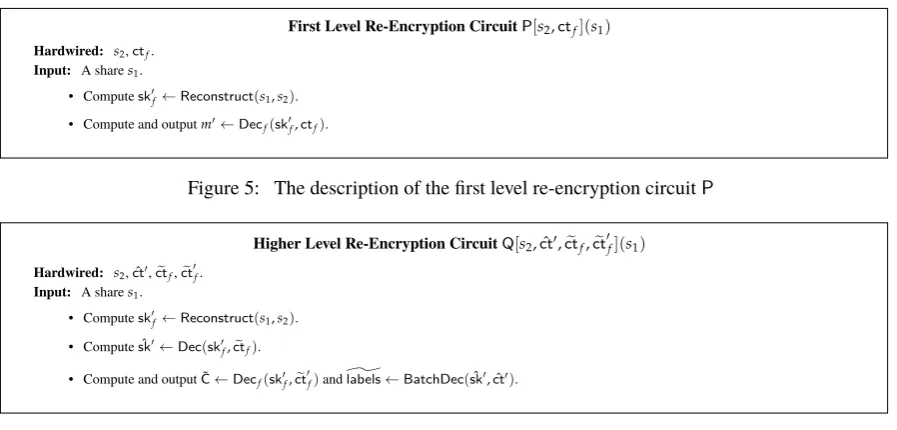
In the construction above, a delegator might obtain information about the plaintext since the re-encrypted ciphertext includesctf in the garbled circuit and the delegator hasskf. We have no way to prove that the construction
the delegatee’s public key since we can hidectf by using the security of the delegatee’s PKE scheme. Yet, this
extension incurs polynomial blow-up of ciphertext size. Thus, we can apply the re-encryption procedure only constant times.
Summary of Our Results. We give a summary of our concrete instantiations in Table1.
Table 1: Summary of our UPRE schemes. In “Type” column, rUPRE means relaxed UPRE. In “#Hop” column, const/multi means constant/multi-hop, respectively. In “Security” column, HRA and CRA means security against honest-re-encryption/corrupted-delegator-re-encryption attacks, respectively. In “Supported PKE” column,0-hiding trapdoor means trapdoor encryption that satisfies0-hiding security (see Section4.1).
Instantiation Type #Hop Security Supported PKE Assumptions Ours in Sec.4+[CLTV15] UPRE multi HRA & CRA 0-hiding trapdoor sub-exp IO and OWF Ours in Sec.4+[CLTV15] UPRE multi HRA & CRA any IND-CPA di-PIO and OWF Ours in Sec.4+[ACH20] UPRE multi HRA & CRA any IND-CPA IO and exponential DDH Ours in Sec.5 rUPRE multi HRA any IND-CPA PKE
Ours in Sec.6 rUPRE const HRA & CRA any IND-CPA PKE
1.4
Related Work
Encryption switching protocol (ESP), which was introduced by Couteau, Peters, and Pointcheval [CPP16], is a related notion. It is an interactive two-party computation that enables us to transform a ciphertext of a PKE scheme into a ciphertext of another PKE scheme and vice versa. It has a similar functionality to that of UPRE. However, they are incomparable in the following sense. In an ESP, parties must interactively communicate each other though there does not exists a proxy (and no re-encryption key). UPRE does not need interactive communication. Moreover, the proposed ESPs are not universal, that is, the protocols work only for specific PKE schemes. Thus, the purpose of ESPs is different from that of UPRE and they are incomparable.
There is a universal methodology to construct a new cryptographic system from existingsignatureschemes. Hohenberger, Koppula, and Waters introduce the notion of universal signature aggregator (USA) [HKW15], which enables us to aggregate signatures under different secret keys ofdifferentsignature schemes. Standard aggregate signatures enable us to compress multiple signatures under different secret keys ofthe samescheme into one compact signature that is verified by a set of multiple verification keys [BGLS03]. Thus, USA is a generalization of aggregate signatures. Koppula et al. [HKW15] constructed selectively (resp. adaptively) secure USA scheme from sub-exp IO, sub-exp OWF, and additive homomorphic encryption (resp. IO, OWF, homomorphic encryption, and universal samplers) in the standard (resp. random oracle) model.
Reconfigurable cryptography was introduced by Hesse, Hofheinz, and Rupp [HHR16]. It makes updating PKI easier by using long-term keys, short-term keys, and common reference strings. Reconfigurable encryption can update keys, but cannot update ciphertexts.
There is a long series of works on proxy re-encryption. After the introduction of proxy cryptography by Blaze, Bleumer, and Strauss [BBS98], improved constructions [ID03, AFGH05], CCA-secure construc-tions [CH07,LV08,HKK+12], key-private constructions [ABH09,ABPW13,NX15], obfuscation-based definition
and constructions [HRsV11,CCV12,CCL+14] have been proposed. Note that this is not an exhaustive list.
Organization. The main body of this paper consists of the following parts. In Section2, we provide preliminaries
and basic definitions. In Section3, we introduce the syntax and security definitions of UPRE. In Section4, we present our UPRE scheme based on PIO and prove its security. In Section5, we present our relaxed UPRE scheme based on GC, and prove its security. In Section6, we present our CRA-secure relaxed UPRE scheme based on GC, and prove its security.
2
Preliminaries
2.1
Notations and Basic Concepts
In this paper,x←Xdenotes selecting an element from a finite setXuniformly at random, andy←A(x)denotes assigning toythe output of a probabilistic or deterministic algorithmAon an inputx. When we explicitly show thatAuses randomnessr, we writey←A(x;r). For stringsxandy,xkydenotes the concatenation ofxandy. Let[`]denote the set of integers{1,· · ·,`},λdenote a security parameter, andy:=zdenote thatyis set, defined,
or substituted byz. PPT stands for probabilistic polynomial time.
• A function f :N→Ris a negligible function if for any constantc, there existsλ0∈Nsuch that for any
λ>λ0, f(λ)<λ−c. We writef(λ)≤negl(λ)to denote f(λ)being a negligible function.
• IfX(b)={X(b)
λ }λ∈Nforb∈ {0, 1}are two ensembles of random variables indexed byλ∈N, we say that
X(0)andX(1)are computationally indistinguishable if for any PPT distinguisherD, there exists a negligible
functionnegl(λ), such that
∆:=|Pr[D(Xλ(0)) =1]−Pr[D(X(λ1)) =1]| ≤negl(λ).
We writeX(0)≈c δX
(1)andX(0)≈ Xc (1)to denote that the advantage∆is bounded by
δandδis negligible,
respectively and call the formerδ-indistinguishability.
• The statistical distance betweenX(0)andX(1)over a countable setS is defined as∆
s(X(0),X(1)) :=
1
2∑α∈S|Pr[X (0)
λ = α]−Pr[X
(1)
λ = α]|. We say thatX
(0)and X(1)are statistically indistinguishable
(denoted by X(0) ≈ Xs (1)) if∆
s(X(0),X(1)) ≤ negl(λ). We also say that X(0) ise-close toX(1) if
∆s(X(0),X(1)) =e. Ife=0(perfectly indistinguishable), we writeX(0)
p
≈ X(1).
2.2
Basic Cryptographic Tools
Definition 2.1 (Public-key Encryption).LetMbe a message space. A PKE scheme forMis a tuple of algorithms
(KeyGen,Enc,Dec)where:
• KeyGen(1λ)takes as input the security parameter and outputs a public keypkand secret keysk. • Enc(pk,m)takes as inputpkand a messagem∈ Mand outputs a ciphertextct.
• Dec(sk,ct)takes as inputskandct, and outputs somem0 ∈ M, or⊥.
Correctness: For anym∈ Mand(sk,pk)←KeyGen(1λ), we have thatDec(sk,Enc(pk,m)) =m.
CPA-security: We define the experimentExptpkeA (1λ,b)between an adversaryAand challenger as follows.
1. The challenger runs(sk,pk)←KeyGen(1λ), and givespktoA. 2. The following process can be repeated polynomially many times.
• Asends two messagesm∗0,m∗1as the challenge messages to the challenger. • The challenger generates ciphertextct∗←Enc(pk,m∗b)and sendsct∗toA.
3. At some point,Aoutputs a guessb0forb. The experiment outputsb0. We sayPKEis CPA-secure if, for any PPT adversaryA, it holds that
AdvpkeA (λ):=|Pr[ExptpkeA (1λ, 0) =1]−Pr[ExptpkeA (1λ, 1) =1]| ≤negl(λ).
Note that we can achieve the CPA-security above by using the standard CPA-security of PKE, whereAsends the challenge messages only once (with polynomial security loss) by using the standard hybrid argument.
Definition 2.2 (Pseudorandom functions).For setsDandR, let{FK(·):D → R |K∈ {0, 1}λ}be a family of polynomially computable functions. We say thatFis pseudorandom if for any PPT adversaryA, it holds that
AdvprfF,A(λ):=|Pr[AFK(·)(1λ) =1|K← {0, 1}λ]−Pr[AR(·)(1λ) =1|R← F
U]| ≤negl(λ) ,
Theorem 2.3 ([GGM86]).If one-way functions exist, then for all efficiently computable functionsn(λ)andm(λ),
there exists a pseudorandom function that mapsn(λ)bits tom(λ)bits (i.e.,D:={0, 1}n(λ)andR:={0, 1}m(λ)).
Definition 2.4 (Puncturable pseudorandom function).For setsDandR, a puncturable pseudorandom function
PPRFconsists of a tuple of algorithms(F,Punc)that satisfies the following two conditions.
Functionality preserving under puncturing: For all polynomial size subset{xi}i∈[k] of D, and for allx ∈
D \ {xi}i∈[k], we havePr[FK(x) =FK∗(x):K← {0, 1}λ,K∗←Punc(K,{xi}i∈[k])] =1.
Pseudorandomness at punctured points: For all polynomial size subset{xi}i∈[k]ofD, and any PPT adversary
A, it holds that
Pr[A(K∗,{FK(xi)}i∈[k]) =1]−Pr[A(K∗,Uk) =1]≤negl(λ) ,
whereK← {0, 1}λ,K∗←Punc(K,{x
i}i∈[k]), andUdenotes the uniform distribution overR.
Theorem 2.5 ([GGM86,BW13,BGI14,KPTZ13]).If one-way functions exist, then for all efficiently computable
functionsn(λ)andm(λ), there exists a puncturable pseudorandom function that mapsn(λ)bits tom(λ)bits (i.e.,
D:={0, 1}n(λ)andR:={0, 1}m(λ)).
Definition 2.6 (Garbling Scheme (Garbled Circuit)).A grabling schemeGCis a two tuple(Grbl,Eval)of PPT algorithms.
• The garbling algorithmGrbl, given a security parameter1λand a circuitCwithn-bit input, outputs a garbled circuitC, together withe 2nlabels{labelsk,b}k∈[n],b∈{0,1}.
• The evaluation algorithmEval, given a garbled circuitCeandnlabels{labelsk}k∈[n], outputsy.
Correctness: We requireEval(C,e {labelsk,xk}k∈[n]) =C(x)for everyλ∈N, a circuitCwithn-bit input, and
x∈ {0, 1}n, where(
e
C,{labelsk,b}k∈[n],b∈{0,1})←Grbl(1λ,C)andxkis thek-th bit ofxfor everyk∈[n].
Security: LetSimbe a PPT algorithm. We define the following gameExptgcA(1λ,β)between a challenger and an adversaryAas follows.
1. The challenger sends the security parameter1λtoA.
2. Asends a circuitCwithn-bit input and an inputx∈ {0, 1}nto the challenger.
• Ifβ=0, then the challenger computes(C,e {labelsk,b}k∈[n],b∈{0,1})←Grbl(1λ,C)and returns
(C,e {labelsk,xk}k∈[n])toA.
• Ifβ=1, then it computes(C,e {labelsk}k∈[n])←Sim(1λ, 1|C|,C(x)), and returns(C,e {labelsk}k∈[n])
toA.
3. Aoutputsβ0∈ {0, 1}.
We say that a garbling scheme is selectively secure if there exists PPTSimsuch that for any PPTA, we have
|Pr[ExptgcA(1λ, 0) =1]−Pr[Exptgc
A(1λ, 1) =1]| ≤negl(λ).
Definition 2.7 (Secret Sharing).At-out-of-nsecret sharing scheme over message spaceMis a pair of algorithms (Share,Reconstruct)where:
• Share(1λ,m)takes as input the security parameter and a messagem∈ M, and outputs ann-tuple of shares (s1, . . . ,sn).
• Reconstruct(si1, . . . ,sit)takes as inputtshares(si1, . . . ,sit)whereik∈[n]andk∈[t]outputs a meesage
m0∈ Mor⊥.
Correctness: For anym∈ Mand(i1, . . . ,it)⊆[n]of sizet, we have that
Pr[Reconstruct(si1, . . . ,sit) =m|(s1, . . . ,sn)←Share(m)] =1.
Security: For anym,m0∈ M,S⊆[n]such that|S|<t, we have that
{si}i∈S |(s1, . . . ,sn)←Share(m)
s
≈n
s0i i∈S|(s01, . . . ,s0n)←Share(m0)
o
2.3
(Probabilistic) Indistinguishability Obfuscation
Definition 2.8 (Indistinguishability Obfuscator).A PPT algorithmiOis an IO for a circuit class{Cλ}λ∈Nif it
satisfies the following two conditions.
Functionality: For any security parameterλ∈N, circuitC∈ Cλ, and inputx, we have that
Pr[C0(x) =C(x)|C0 ←iO(C)] =1 .
Indistinguishability: For any PPT distinguisherDand for any pair of circuitsC0,C1 ∈ Cλsuch that for any inputx,C0(x) =C1(x)and|C0|=|C1|, it holds that
|Pr[D(iO(C0)) =1]−Pr[D(iO(C1)) =1]| ≤negl(λ) .
We further say thatiOis sub-exponentially secure if for any PPTDthe above advantage is smaller than 2−λefor some0<e<1.
Next, we consider a family of sets of randomized polynomial-size circuits,C:={Cλ}λ∈N. A circuit sampler forC is a distribution ensembleSamp := {Sampλ}λ∈N, where the distribution ofSampλis (C0,C1,z)with
C0,C1∈ Cλsuch thatC0andC1take inputs of the same length, andz∈ {0, 1}poly(λ). A classSof samplers forC is a set of circuit samplers forC.
Definition 2.9 (PIO for a Class of Samplers [CLTV15]).A PPT algorithmpiOis a probabilistic
indistinguisha-bility obfuscator for a class of samplersS over the randomized circuit familyC = {Cλ}λ∈N if it satisfies the
following.
Alternative Correctness [DHRW16]: For anyλ∈N, anyC∈ Cλ, anyCb←piO(C)and any individual input
x, the distribution ofC(x)b andC(x)are identical.
Security with respect toS: We define the following experimentsExptpioD (1λ,b) between a challenger and a distinguisherDas follows.
1. The challenger samples(C0,C1,z)←Sampλ.
2. The challenger computesCbb←piO(Cb)and sends(1λ,C0,C1,Cbb,z)toD.
3. Doutputs a guessb0 ∈ {0, 1}. The experiment outputsb0.
We say thatpiOis secure PIO forS if for any samplerSamp={Sampλ}λ∈N∈ S, and for any PPTD, it
holds that
|Pr[ExptpioD (1λ, 0) =1]−Pr[Exptpio
D (1λ, 1) =1]| ≤negl(λ).
As noted by Dodis et al. [DHRW16], the PIO construction by Canetti et al. [CLTV15] can be easily modified to satisfy the alternative correctness above, so we use it. Canetti et al. [CLTV15] introduced a few types of samplers. We review static-inputX-indistinguishable and dynamic-input indistinguishable samplers.
Definition 2.10 (Static-inputX-Indistinguishable-Samplers).LetX(λ)be a function bounded by2λ. The class SX-indof static-inputX-IND-samplers for a circuit familyCcontains all circuit samplersSamp={Samp
λ}λ∈N forCsatisfying the following. For anyλ∈N, there exists a setX =Xλ ⊆ {0, 1}∗of size at mostX(λ)such that
the following two conditions hold.
Xdiffering inputs: For any inputx0 ∈ X/ , for any random coinr, it holds that
Pr[C0(x0;r) =C1(x0;r)|(C0,C1,z)←Sampλ]>1−negl(λ).
X-indistinguishability: For any PPTA,AdvAsi-,indSamp(λ)≤negl(λ)·X−1holds, whereAdvAsi-,indSamp(λ)is defined
as below.
AdvsiA-,indSamp(λ):=|Pr[ExpsiA-,indSamp(1λ, 0) =1]−Pr[ExpsiA-,indSamp(1λ, 1) =1]|,
2. The challenger samples(C0,C1,z)←Sampλ.
3. The challenger computesy←Cb(x)and sends(C0,C1,z,y)toA.
4. Aoutputs a guessb0 ∈ {0, 1}. The experiment outputsb0.
Definition 2.11 (X-IND PIO for Randomized Circuits).Let X(λ) be any function bounded by2λ. A PPT
algorithmpiO(X-piO) is anX-PIO for randomized circuits if it is a PIO for the class ofX-IND samplersSX-ind overCthat includes all randomized circuits of size at mostλ.
Theorem 2.12 ([CLTV15,DHRW16]).If there exists sub-exponentially secure IO for circuits and sub-exponentially
secure puncturable PRF, then there exists anX-IND PIO with alternative correctness for randomized circuits.
Definition 2.13 (Dynamic-input Indistinguishable Sampler).We define the experimentsExpdiA-,Sampind (1λ,b) be-tween a challenger and an adversaryAas follows.
1. The challenger samples(C0,C1,z)←Sampλand sends it toA. 2. The adversaryAoutputsxand sends it to the challenger.
3. The challenger computesy←Cb(x)and sends(C0,C1,z,y)toA.
4. Aoutputs a guessb0 ∈ {0, 1}. The experiment outputsb0.
The classSdi-indof dynamic-input indistinguishable sampler for a circuit familyC contains all circuit samplers
Samp={Sampλ}λ∈NforCsatisfies the following. If for any PPTA, it holds that
AdvdiA-,Sampind (λ):=|Pr[ExpdiA-,Sampind (1λ, 0) =1]−Pr[ExpdiA-,Sampind (1λ, 1) =1]| ≤negl(λ).
Definition 2.14 (Dynamic-input PIO for Randomized Circuits).A PPT algorithmpiO(di-piO) is a dynamic-input PIO for randomized circuits if it is a PIO for the class of dynamic-dynamic-input indistinguishable samplersSdi-ind overCthat includes all randomized circuits of size at mostλ.
Canetti et al. [CLTV15] wrote that a construction of dynamic-input PIO forspecificclasses of samplers is possible as in the case of differing-input obfuscation [BGI+12] for specific circuits.
3
Definition of Universal Proxy Re-Encryption
In this section, we present the definitions of universal proxy re-encryption (UPRE). In particular, we present the definition of UPRE for PKE and its security notions. A UPRE scheme enables us to convert ciphertexts of a PKE schemeΣf into ciphertexts of a (possibly) different PKE schemeΣt. A UPRE scheme does not need a setup for a
system. That is, it can use existing PKE schemes with different parameters. UPRE can be seen as a generalization proxy re-encryption [BBS98]. Therefore, we borrow many terms of proxy re-encryption [AFGH05,CH07].
Notations. We consider multiple PKE schemes and key pairs, so we assume that every known PKE scheme is
named by a number in[N](say,1is for Goldwasser-Micali PKE,2is for ElGamal PKE etc). We also put a number in[U]for a generated key pair. When we write(pki,ski)←Genσi(1λ), we mean thati-th key pair is generated by PKE schemeΣσi = (Genσi,Encσi,Decσi)whereσi∈[N]. In this paper, when we emphasize which user is a
delegator or delegatee, we denote delegator and delegatee key pairs by(pkf,skf)and(pkt,skt), respectively (f and
tmean “from” and “to”, respectively). That is, a ciphertext underpkf will be converted into a ciphertextpkt. We
assume that in the description ofΣσi, ciphertext spaceCσi and message spaceMσi are also included. When we use Σσi as an input for algorithms ofUPRE, we interpret it as a description of algorithms (rather than Turing machines
or circuits). Note that the length of such descriptions is polynomial since algorithms of PKE should be PPT.
3.1
Unidirectional UPRE
Definition 3.1 (Universal Proxy Re-Encryption for PKE: Syntax).A universal re-encryption schemeUPRE
• ReKeyGen(1λ,Σ
σf,Σσt,skf,pkt)takes the security parameter, a pair of PKE scheme(Σσf,Σσt), a secret-key
skf ofΣσf, and a public-keypktofΣσtand outputs a re-encryption keyrkf→tfor ciphertexts underpkf. The
security parameter is often omitted.
• ReEnc(Σσf,Σσt,rkf→t,ctf)takes a pair of PKE schemes(Σσf,Σσt), a re-encryption keyrkf→t, and a
ciphertextctf underpkf ofΣσf, and outputs a re-encrypted ciphertextcttunderpkt.
Definition 3.2 (Relaxed Universal Proxy Re-Encryption for PKE: Syntax).A relaxed universal re-encryption
schemeUPREconsists of two PPT and one deterministic polynomial-time algorithms(ReKeyGen,ReEnc,mDec). • ReKeyGen(1λ,Σ
σf,Σσt,skf,pkt)is the same as in Definition3.1.
• ReEnc(Σσf,Σσt,rkf→t,ctf)takes a pair of PKE schemes(Σσf,Σσt), a re-encryption keyrkf→t, and a
ciphertextctf underpkf ofΣσf, and outputs a re-encrypted ciphertextrct. We implicitly assume thatrct
includes index`which indicates how many timesReEncwas applied so far. When we writerct(`), it means
thatrct(`)was obtained by applyingReEnc`times.
• mDec(Σσt,skt,rct(`),`) is a deterministic algorithm and takes a PKE scheme Σσt, a secret key skt, a
re-encrypted ciphertextrct(`)underrkf→t, and index`and outputs a messagem. When`=1, we omit the
index.
The difference between UPRE and relaxed UPRE is that we can use the decryption algorithm ofΣσtas it is in
UPRE. In relaxed UPRE, we need use a modified decryption algorithm though what we need for decryption is the original secret keyskt. Note that re-encrypted ciphertext spaceCσf→σt potentially depends onCσf andCσt and
possiblyrct∈ C/ σthappens.
Hereafter, we focus only on the relaxed notion since we can easily replace mDec(Σσt,skt,rct(`),`) with
Dec(skt,ctt).
On Message Space. For simplicity, we consider messages inMσ1 ∩ · · · ∩ MσN where Nis the number of
considered PKE scheme in security games (described later). We can consider{0, 1}`as a message space where`is a polynomial of a security parameter and UPRE for such a message space by considering bit-by-bit encryption for all PKE scheme. However, this is cumbersome. Thus, hereafter, we consider messages in the intersection of all message spaces though we do not explicitly mention.
Bidirectional UPRE. We can consider bidirectional UPRE, where a re-encryption key generated from key pairs
(pkf,skf)and(pkt,skt)can convert ciphertexts underpkf (resp.pkt) into ciphertexts that can be decrypted byskt
(resp.skf). Although unidirectional UPRE can support the functionality of bidirectional UPRE by generating two
re-encryption keysrkf→tandrkt→f, it is not clear whether security is preserved. We focus on unidirectional UPRE
in this study.
Functionality and Security. We introduce the correctness and a security notion of UPRE that we call security
againsthonest re-encryption attacks (HRA)for UPRE. Correctness is easy to understand.
This HRA for UPRE is based on security against HRA of PRE introduced by Cohen [Coh19]. Roughly speaking, in the setting of HRA, adversaries are allowed to obtain an honestly encrypted ciphertextvia an honest encryption oracleand can convert it into a re-encrypted ciphertext under a key of acorrupteduser via a re-encryption oracle. In PRE-CPA security, adversaries cannot obtain such a re-encrypted ciphertext because it isnot allowedto obtain a re-encryption key queryfrom an honest user to a corrupted uservia the re-encryption key oracle to prevent trivial attacks5. Cohen observes that PRE-CPA security is not sufficient for many applications of PRE. Therefore, we define HRA-security for UPRE (in fact, we also define a selective variant).
First, we considersingle-hopUPRE, where if a ciphertext is converted into another ciphertext, then we cannot convert the re-encrypted one anymore.
Definition 3.3 (UPRE for PKE: Single-Hop Correctness).A relaxed UPRE schemeUPREfor PKE is correct if
for all pairs of PKE schemes (Σσf,Σσt),(pkf,skf)←Genσf(1 λf),(pk
t,skt)←Genσt(1λt),m∈ Mσf ∩ Mσt,
ctf ←Encσf(pkf,m), it holds that
Pr[mDec(Σσt,skt,ReEnc(Σ
0,ReKeyGen(Σ0,sk
whereΣ0 := (Σ
σf,Σσt). In the case of UPRE,mDec(Σσt,·,·) =Decσt(·,·).
Before we present the definition of the HRA security for UPRE, we give an informal explanation about it. Readers who are familiar with PRE-HRA security [Coh19] may be able to skip explanations below and jump into the formal definition. Readers who are familiar with PRE-CPA security [ABH09,Coh19] may be able to skip explanations below except “Honest encryption and re-encryption query” part.
Challenge query:We consider a natural extension of the CPA security of PKE. The adversary selects a target
public-keypki∗indexed byi∗and tries to distinguish whether a target ciphertextcti∗is an encryption ofm0orm1 that it selects. This will be modeled by the challenge oracleOcha.
Key query:The adversary can be given public keyspki or key pairs(pki,ski)by specifying a user and a PKE scheme at the setup phase since we consider multiple keys and schemes. When a secret key is given, it means its owner is corrupted.
Re-encryption key query: The most notable feature is that the adversary is given re-encryption keys by the
re-encryption key oracleOrekey. If the adversary specifies existing indices of keys, say(i,j), then it is given a corresponding re-encryption key fromitoj. Here, we must restrict queries for some indices to prevent trivial attacks. Ifjis a corrupted user andiis the target user (queried toOcha), then the adversary trivially wins the security game by converting the target ciphertext and decrypting with the corrupted keyskj. Therefore, such queries
must be prohibited.
Honest encryption and re-encryption query:If the adversary specifies keys and a ciphertext to the re-encryption
oracleOreenc, then it is given a re-encrypted ciphertext generated from queried values. One might think this oracle is redundant since it is simulatable byOrekey. However, there is a subtle issue here since a re-encryption key query with a corrupted delegatee is prohibited as explained above. As Cohen observed [Coh19] in the setting of PRE, simply prohibiting such a query is not sufficient and considering re-encryption queries is meaningful.
Re-encrypted ciphertexts may leak information about a delegator key pair and help to attack a delegator ciphertext. As Cohen observed [Coh19], if a re-encryption key isEnc(pkt,skf)andit is included in a re-encrypted ciphertext, then the delegatee easily breaks security. This is unsatisfactory when we consider applications of PRE and UPRE. However, in the setting of PRE, such a construction is secure under the standard CPA-security model since it prohibits queries(i,j)(resp. (i,j,cti)) to the re-encryption key generation (resp. re-encryption) oracle [Coh19]. Thus, we introduce the notion of derivative and the honest encryption oracleOencin UPRE as Cohen did.
We say that a (re-encrypted) ciphertext is a derivative if it is the target ciphertext generated by the challenge oracle or a re-encrypted ciphertext from the target ciphertext. This is managed by a setDrv. The honest encryption
oracle allows the adversary to obtain a re-encrypted ciphertext under a corrupted key from honest encryption. The re-encryption oracle does not accept queries whose delegatee is a corrupted userjand ciphertext is a derivative to prevent trivial attacks. Moreover, the re-encryption oracle does not accept ciphertexts that are not generated via the honest encryption oracle.
Definition 3.4 (Derivative).We say that a (re-encrypted) ciphertext is a derivative when the (re-encrypted) ciphertext
is a target ciphertext itself or obtained from a target ciphertext given byOchaby applying re-encryption.
Definition 3.5 (UPRE for PKE: Single-Hop selective HRA Security).We define the experimentExpupreA -hra(1λ,b) between an adversaryAand a challenger. The experiment consists of three phases.
Phase 1 (Setup):This is the setup phase. All security parameters are chosen by the challenger.
• The challenger initializes#Keys:=0,HList := ∅,CList := ∅,#CT :=0,KeyCTList := ∅,Drv:= ∅. Note that we assume that all indices are recorded with keys and corresponding schemes though we do not explicitly write for simplicity.
• For an honest key query(i,σi,λi)fromA, if the challenger already received(i,∗,∗)before, it outputs⊥.
Otherwise, the challenger generates uncorrupted keys(pki,ski)←Genσi(1λi), sends(Σ
σi,pki)toA, and
setsHList:=HList∪iand#Keys:=#Keys+1. Ifλi <λ, then the challenger ignores the query.6
• For a corrupted key query(i,σi,λi)fromA, if the challenger already received(i,∗,∗)before, it outputs⊥.
Otherwise, the challenger generates corrupted keys(pki,ski)←Genσi(1λi), sends(Σ
σi,pki,ski)toA, and
setsCList:=CList∪iand#Keys:=#Keys+1.
LetMUbe the intersection of all message spaces defined bypki1, . . . ,pki#Keys. At the end of Phase 1, we assume that the list((1,σ1), . . . ,(#Keys,σ#Keys))is broadcasted and all entities know it.
Phase 2 (Oracle query): This is the oracle query phase.
Oenc(i,m): For an honest encryption query(i,m)wherei≤#Keys, the challenger generatescti←Encσi(pki,m),
sets#CT:=#CT+1, records(cti,Σσi,i, #CT)inKeyCTList, and gives(cti, #CT)toA.
Orekey(i,j): For a re-encryption key query(i,j) wherei,j ≤ #Keys, the challenger outputs ⊥ if i = j or i∈HList∧j∈CList. Otherwise, the challenger generatesrki→j ←ReKeyGen(Σσi,Σσj,ski,pkj)and gives
rki→jtoA.
Oreenc(i,j,k): For a re-encryption query (i,j,k) wherei,j ≤ #Keysandk ≤ #CT, the challenger does the following.
1. Ifj∈CList∧k∈Drv, then returns⊥.
2. If there is no value(∗,∗,i,k)inKeyCTList, returns⊥.
3. Otherwise, retrievesrki→jfor(i,j)(if it does not exists, generatesrki→j←ReKeyGen(Σσi,Σσj,ski,pkj)
and stores it), generatesrct←ReEnc(Σσi,Σσj,rki→j,cti)fromctiinKeyCTList, sets#CT:=#CT+1,
records(rct,Σσj,j, #CT)inKeyCTList, and gives(rct, #CT)toA.
Ocha(i∗,m0,m1): This oracle is invoked only once. For a challenge query(i∗,m0,m1)wherei∗ ∈HListand
m0,m1,∈ MU(defined at the end of Phase 1), the challenger generatesct∗←Encσi∗(pki∗,mb), gives it to
A, and sets#CT:=#CT+1,Drv:=Drv∪ {#CT},KeyCTList:=KeyCTList∪
(ct∗,Σσi∗,i
∗, #CT) .
Phase 3 (Decision) :This is the decision phase. Aoutputs a guessb0forb. The experiment outputsb0. We say theUPREis single-hop UPRE-HRA secure if, for anyσi∈[N], for any PPTA, it holds that
AdvupreA -hra(λ):=|Pr[ExpupreA -hra(1λ, 0) =1]−Pr[ExpupreA -hra(1λ, 1) =1]| ≤negl(λ).
Discussion on Definition3.5. (1) On security parameter: We can simply set∀iλi:=λ. Someλjmay be longer
than otherλi(say,λj=poly(λi)). (2) On adaptive corruption: The adversary is not allowed to adaptively corrupt
users during the experiment. This is because, in general, it is difficult to achieve security against adaptive corruption. In particular, in our setting,Orekeycannot decide whether it should return⊥or a valid re-encryption key ifjmay be corrupted later. This static security is standard in the PRE setting [AFGH05,CH07,LV08,ABH09]. One exception is the work by Fuchsbauer, Kamath, Klein, and Pietrzak [FKKP19]. The honest and corrupted key generation queries could be moved to the oracle query phase, but it does not incur a significant difference. Thus, we select a simpler model as most works on re-encryption did [AFGH05,LV08,ABH09,Coh19].
3.2
Unidirectional Multi-Hop UPRE
In this section, we introduce multi-hop UPRE, which is an extension of single-hop UPRE, where a re-encrypted ciphertextrctgenerated byrkf→tcould be re-encrypted many times. LetL= L(λ)be the maximum number of
hops that a UPRE scheme can support.
Definition 3.6 (UPRE for PKE:L-hop Correctness).A multi-hop UPRE schememUPREfor PKE isL-hop
correct if for all PKE schemes (Σσ0,Σσ1, . . . ,ΣσL) that satisfy correctness and σi−1 6= σi for all i ∈ [L],
(pki,ski)←Genσi(1λi)(for alli=0, . . . ,L),m∈ M
σ0∩ · · · ∩ MσL,ct0←Encσ0(pk0,m), it holds that
Pr[mDec(Σσj,skj,rct
(j),j) =m] =1
whererct(j)←ReEnc(Σ0j,ReKeyGen(Σj0,skj−1,pkj),rct(j−1)),rct(0)=ct0,Σ0j:= (Σσj−1,Σσj)andj∈[1,L].
The reason whymDecis indexed byjis that the decryption procedure forj-times re-encrypted ciphertexts might be different. See Section5as a concrete example.
re-encryption key from vertex (user)ito vertex (user)j, then a directed edge(i,j)is assigned between the vertices (note that edge(i,j)is not equal to(j,i)since we consider DAGs). That is, a DAGG= (V,E)denotes thatVis a set of users andEis a set of index pairs whose re-encryption key was issued. We do not consider cyclic graphs in this study since it incurs an issue of circular security in our constructions7.
We introduce the notion ofadmissible edgesto exclude trivial attacks by using oracles. Roughly speaking, an admissible edge means that ciphertexts under a target public key will not be converted into ciphertexts under corruptedpublic keys inCList. We denote byi jthere exists a path from vertexito vertexjinG.
Definition 3.7 (Admissible edge).We say that (i,j) is an admissible edge with respect to G = (V,E) if, in E∪(i,j), there does not exist a path from any vertexi∗ ∈ HList(honest user set fixed at the setup phase) to
j∗∈CListsuch that the path includes edge(i,j)as an intermediate edge (this includes the casej=j∗). That is, no i∗∈HList,j∗∈CListsuch that a pathi∗ j∗exists inG0 = (V,E∪(i,j)).
We also introduce the notion of theselective-graph modelas a weaker attack model. In the selective-graph model, the adversary must commit a graphG∗= (V∗,E∗)at the beginning of an experiment. To formally define this model, we define adeviating pair with respect toG∗andG.
Definition 3.8 (deviating pair).We say that(i,j)is a deviating pair with respect toG∗= (V∗,E∗)andG= (V,E) in the selective-graph model ifi∈V∗∧j∈Vorj∈V∗∧i∈V.
In the selective-graph model, the adversary must selecti∗ ∈ V∗as the target vertex that will be queried to
Ocha. Moreover, the adversary is not given re-encryption keys and re-encrypted ciphertexts fromOrekeyandOreenc, respectively, if queried(i,j)is a deviating pair. That is, the structure of DAG that is connected to the target vertex must be determined at the beginning of the game. We focus on security in the selective-graph model in this study since it is what our schemes achieve. For admissible edges in the selective-graph model, we consideri∗ ∈Vh∗ (defined below) instead ofi∗∈HList(i.e., replacingHListwithVh∗in Definition3.7).
Definition 3.9 (UPRE for PKE: Multi-Hop selective-graph HRA Security).We define the experimentExpupreA -msg-hra(1λ,b) between an adversaryAand a challenger. The experiment consists of three phases.
Phase 1 (Setup):This is the setup phase. All security parameters are chosen by the challenger.
• The challenger initializes #Keys := 0,HList := ∅,CList := ∅, #CT := 0,KeyCTList := ∅,Drv :=
∅,V:=∅,E:=∅.
• At the beginning of this phase, A must commit a graph G∗ = (V∗ = (Vh∗,Vc∗),E∗). We assume that V∗ = {1, . . . ,|V∗|} by using appropriate renaming. If there is an edge (i,j) ∈ E∗ such that i ∈ Vh∗∧j ∈ Vc∗, then the game aborts. The challenger generates keys(pki,ski) ←Genσi(1
λi)for all
i ∈ V∗and sends {pki}i∈V∗ h,
n
(pkj,skj)o
j∈V∗ c
toA. We assume thatAselects(σi,λi)for alli ∈ V∗
as the key generation queries below (ifλi < λfori ∈ Vh∗, then the game aborts). The challenger also
generatesrki→j ←ReKeyGen(Σσi,Σσj,ski,pkj)for all(i,j) ∈E
∗and sends them toA. The challenger
setsHList:=HList∪Vh∗,CList:=CList∪Vc∗, and#Keys:=#Keys+|V∗|.
• For thei-th honest key generation query(σi,λi)fromA, ifλi <λ, the challenger outputs⊥. Otherwise,
the challenger generates uncorrupted keys (pki,ski) ← Genσi(1λi), sends (Σ
σi,pki) to A, and sets
HList:=HList∪i,#Keys:=#Keys+1, andV:=V∪ {i}.
• For thej-th corrupted key generation query(j,σj,λj) fromA, the challenger generates corrupted keys
(pki,ski)←Genσi(1λi), sends(Σ
σi,pki,ski)toA, and setsCList:=CList∪i,#Keys:=#Keys+1, and
V:=V∪ {i}.
• The challenger maintains graphG:= (V,E)during the experiment. Note that we assume that all keys and schemes are recorded with vertices and edges though we do not explicitly write for simplicity.
Phase 2 (Oracle query): This is the oracle query phase.
Oenc(i,m): For an honest encryption query(i,m)wherei≤#Keys, the challenger generatescti←Encσi(pki,m),
sets#CT:=#CT+1, record(cti,Σσi,i, #CT)inKeyCTList, and gives(cti, #CT)toA.
Orekey(i,j): For a re-encryption key query(i,j)wherei,j≤#Keys, the challenger does the following.
1. Ifi∈V∗orj∈V∗ori=j, then output⊥.
2. Otherwise, the challenger generatesrki→j←ReKeyGen(Σσi,Σσj,ski,pkj)and updatesE:=E∪(i,j)
and givesrki→jtoA.
Oreenc(i,j,k): For a re-encryption query (i,j,k) wherei,j ≤ #Keysandk ≤ #CT, the challenger does the following.
1. If (A)(i,j)is a deviating pair with respect toG∗andG, or (B)(i,j)is not an admissible edge with respect toG∗ = (V∗,E∗)andk∈Drv, then returns⊥.
2. If there is no(∗,∗,i,k)inKeyCTList, then outputs⊥.
3. Otherwise, generatesrki→j←ReKeyGen(Σσi,Σσj,ski,pkj)andrctj ←ReEnc(Σσi,Σσj,rki→j,rcti)
fromrcti inKeyCTList, sets#CT := #CT+1, records(rctj,Σσj,j, #CT)inKeyCTList, and gives
(#CT,rctj)toA. Ifk∈Drv, then also setsDrv:=Drv∪ {#CT}.
Ocha(i∗,m0,m1): This oracle is invoked only once. For a challenge query (i∗,m0,m1)wherei∗ ∈ Vh∗ and m0,m1,∈ MU (same as defined in Definition 3.5), the challenger generatesct∗ ← Encσi∗(pki∗,mb) and gives it to A. The challenger also sets#CT := #CT+1, Drv := Drv∪ {#CT}, KeyCTList :=
KeyCTList∪
(ct∗,Σσi∗,i
∗, #CT) .
Phase 3 (Decision) :This is the decision phase. Aoutputs a guessb0forb. The experiment outputsb0. We say theUPREis multi-hop selective-graph UPRE-HRA secure if, for any PPTA, it holds that
AdvupreA -msg-hra(λ):=|Pr[ExpupreA -msg-hra(1λ, 0) =1]−Pr[ExpAupre-msg-hra(1λ, 1) =1]| ≤negl(λ).
UPRE-CPA Security. We can easily consider the CPA-security of UPRE. We can obtain the security experiment
of the CPA-security if we employ the following items in the experiment of the HRA security. 1. The honest encryption oracleOencis not used.
2. Neither the setDrvnor number#CTis used.
3. The condition thatOreencoutputs⊥for a query(i,j)such thati ∈ HList∧j∈ CList(or(i,j)is not an admissible edge) is used instead of the first and second conditions ofOreencin the experiment of the HRA security.
3.3
Security against Corrupted-Delegator Re-Encryption Attacks
Re-encrypted ciphertexts of relaxed UPRE schemes might include values that leak information about a plaintext to a delegator (that is, an entity that has a secret key for the original ciphertext). This is an important issue to use UPRE in migration of encryption systems explained in Section1.1. We will see a concrete example in Section5. To capture attacks on re-encrypted ciphertext by corrupted delegator, we define a new security notion for UPRE (and PRE), security against corrupted-delegator re-encryption attacks (CRA). We write the definition of the UPRE case. The PRE case is similarly defined as PRE-CRA security. We can also similarly define a single-hop variant.
Definition 3.10 (Selective-graph UPRE-CRA security).The experimentExpupreA -msg-cra(1λ,b)of this security notion is the same as that of multi-hop selective-graph UPRE-HRA security except that the challenge oracleOchais modified as follows.
Ocha(ic,i∗,m0,m1): This oracle is invoked only once. For a challenge query(ic,i∗,m0,m1)whereic∈Vc∗∧ i∗∈ Vh∗andm0,m1,∈ MU(same as defined in Definition3.5), the challenger does the following.
1. Generatesctic ←Encσi
c(pkic,mb). 2. Generatesrkic→i∗ =ReKeyGen(Σσi
c,Σσi∗,skic,pki∗). 3. Generatesrct∗←ReEnc(Σσi
c,Σσi∗,rkic→i∗,ctic)and gives(rct
∗,rk