Constant Communication ORAM with Small Blocksize
Tarik Moataz
Colorado State UniversityTelecom Bretagne, IMT
[email protected]
Travis Mayberry
United States Naval Academy[email protected]
Erik-Oliver Blass
Airbus Group Innovations81663 Munich, Germany
[email protected]
ABSTRACT
There have been several attempts recently at using homomorphic encryption to increase the efficiency of Oblivious RAM protocols. One of the most successful has been Onion ORAM, which achieves O(1)communication overhead with polylogarithmic server com-putation. However, it has two drawbacks. It requires a large block size ofB = Ω(log6N)with large constants. Moreover, while it only needs polylogarithmic computation complexity, that compu-tation consists mostly of expensive homomorphic multiplications. In this work, we address these problems and reduce the required block size toΩ(log4N). We remove most of the homomorphic multiplications while maintainingO(1)communication complex-ity. Our idea is to replace their homomorphic eviction routine with a new, much cheaper permute-and-merge eviction which eliminates homomorphic multiplications and maintains the same level of se-curity. In turn, this removes the need for layered encryption that Onion ORAM relies on and reduces both the minimum block size and server computation.
1.
INTRODUCTION
With cloud storage becoming increasingly popular and relied upon by both enterprise and individual users, ensuring proper se-curity and privacy is a critical research problem. Reports indicate that up to 88% of organizations [24] are using public cloud infras-tructure for at least some of their data. It is fairly straightforward to encrypt that data, but that is not always enough. Where, when and how often a user accesses their data can reveal as much about it as the plaintext itself. We call this information a user’saccess pattern. For instance, observing that an investment bank has repeatedly ac-cessed their files on a specific company may reveal that they plan to invest in that company. Crucially, there is no easy way to bound what information you might leak as part of your access pattern, es-pecially when an adversary can correlate those accesses with other outside (potentially public) information he might have.
Oblivious RAM is a tool that was designed to solve exactly this problem. Given a set of accesses to a block storage device, an ORAM algorithm allows a user to perform them on an untrusted storage device in such a way that an adversary observing those
ac-Permission to make digital or hard copies of all or part of this work for personal or classroom use is granted without fee provided that copies are not made or distributed for profit or commercial advantage and that copies bear this notice and the full citation on the first page. Copyrights for components of this work owned by others than ACM must be honored. Abstracting with credit is permitted. To copy otherwise, or republish, to post on servers or to redistribute to lists, requires prior specific permission and/or a fee. Request permissions from [email protected].
Copyright 20XX ACM X-XXXXX-XX-X/XX/XX ...$15.00.
cesses cannot determine which block the user was reading/writing. This generally involves shuffling and reencrypting the data some-how each time it is read or written to in order to unlink two ac-cesses to the same block. Unfortunately, ORAM has traditionally been very expensive to implement, causing over a thousand-fold increase in communication over unprotected accesses.
Recently there has been a flurry of research on ORAM that has managed to drastically decrease communication overhead with a new tree-based paradigm [25]. Building on that, Stefanov et al. [27] introduced Path ORAM which, along with some derivative works, is the most efficient construction currently known. However, it still requires polylogarithmic communication overhead which can re-sult in over a hundred-fold slowdown and may not be usable for many cloud applications given that cost is a driving factor in out-sourcing data. Along with work on pure Oblivious RAM, May-berry et al. [17] introduced the idea that communication overhead can be greatly reduced if the storage device is also considered to have some computational ability, which it generally does in a cloud setting. Using recent advances in homomorphic encryption, a small amount of computation on the server can be leveraged to cut a sig-nificant amount of communication to the client, see also [1].
Furthering this research, Devadas et al. [6] have recently pro-posed a hybrid ORAM-with-computation scheme that achievesO(1) communication overhead. They achieve this by consecutively wrap-ping blocks in further layers of encryption as they proceed down the tree, effectively forming an “onion” out of the blocks. Unfortu-nately, it still has some major drawbacks:
1. Their scheme requires that the block has a very large size of Ω(log6N). In practice, it can be up to 30 MB for reasonably sized databases.
2. The onion part of their scheme requires a large number of ho-momorphic multiplications, which are computationally very expensive. Depending on the encryption scheme used, over-head on the server may outweigh any communication saved.
In this work we tackle these problems. We start by showing that the homomorphic multiplications, and in fact the nesting “onion” nature of their solution, is not necessary. With careful application of an oblivious merging algorithm, all movement of blocks through the tree can be done with only homomorphic addition, resulting in a more computationally efficient algorithm. This also reduced the required block size by aO(log2N)
Table 1: Comparison of Onion ORAM and C-ORAM, containing block size, worst-case bandwidth, and number of homomorphic additions and multiplications. The simplified block value is a looser bound for easier comparison usingλ=ω(logN)andγ=O(λ3).
Scheme Block sizeB Simplified block size Worst-case bandwidth # additions # multiplications Onion ORAM Ω(γλlog2N) Ω(log6N) O(1) Θ(BλlogN) Θ(BλlogN)
C-ORAM Ω(λ[logλlogN+γ]) Ω(log4N) O(1) Θ(BλlogN) Θ(Bλ)
2.
BACKGROUND: ONION ORAM
We start by briefly introducing the main idea of Onion ORAM [6]. We then analyze its complexity to motivate our improvements.
2.1
Overview
An Oblivious RAM is a block-based storage protocol whereby a user can outsource some data to an untrusted server, and that server does not learn anything about the pattern of accesses that the user performs on that data. For instance, whether the user accesses the same block many times in a row, or each block individually in se-quence, the server will not be able to distinguish between these two access patterns. In fact, a secure ORAM guarantees thatanytwo access patterns will be indistinguishable from the perspective of the server. This is accomplished by periodically moving, shuffling and reencrypting the data so that correlations between accesses are lost. A twist on that model introduced by Mayberry et al. [17], and used in Onion ORAM, is that instead of the traditional ORAM server definition where it only stores the data passively, Onion ORAM assumes that the server can also perform computations.
Onion ORAM is a tree-based ORAM, and shares many qualities with existing schemes [23, 25, 27]. Most importantly, data blocks are stored in a tree where each node of the tree is a “bucket” which contains some number of blocks. When blocks are added to the ORAM, they start at the root of the tree and are tagged as belonging to one of the leaf nodes. As the lifecycle of the ORAM continues, blocks percolate from the root to their assigned leaf node through a process calledeviction. This way, a block can be located at any time by reading the path from its target leaf back to the root, since it is guaranteed to always reside on this path. The eviction process maintains a proper flow of blocks from the root to the leaves so that no buckets overflow with too many blocks. This is usually accomplished by picking a path in the tree, from root to a particular leaf node, and pushing all the blocks on that path as far as possible down the path toward the leaf node.
The contribution of Onion ORAM is then that it achieves con-stant communication complexity in the number of ORAM elements N, while only requiring polylogarithmic computation on the server. Although the client exchanges many pieces of data back and forth with the server, the key to havingO(1)communication complexity is that the size of one data block,B, dominates the communica-tion. All other messages, ciphertexts etc. are collectively small compared to the actual data being retrieved. Therefore it might be more intuitive to say that communication isO(B). However, it is customary in ORAM literature to refer to the communication complexity in terms of multiplicative overhead, i.e., the cost com-pared to retrieving the same data without any security. Everything is then divided byB, and we get to the notion ofO(1) communica-tion complexity. Note thatO(1)communication complexity is not difficult if you allow unrestricted computation (FHE for instance achieves this trivially), so the limit to polylogarithmic computation is important.
The main idea behind Onion ORAM is an oblivious shuffling based on (computational) Private Information Retrieval (PIR). There-with, ORAM read, write, and eviction operations can be performed without the client actually downloading data blocks and doing the
merging themselves. This saves a huge amount of communication when compared to existing schemes like Path ORAM. Compared to existing tree-based ORAM schemes, Onion ORAM introduces atriple evictionthat empties all buckets along the path instead of only pushing some elements down and leaving others at intermedi-ate points in the tree. Elements in any evicted bucket will be pushed towards both children, thereby ensuring that after an eviction the entire evicted path is empty aside from the leaves. The authors take advantage of the fact that if you choose which path to evict byreverse lexicographic ordering, then you are always guaranteed during an eviction that the sibling of every node on your path will already be empty from a previous eviction. This allows for the en-tire process to be done efficiently and smoothly, because the enen-tire contents of a parent can be copied into the empty bucket and there is no need to worry about overwriting what was there because it is necessarily empty.
This triple eviction is accomplished by sending a logarithmic number of oblivious shuffling vectors to the server. These vectors, encrypted with an additively homomorphic encryption, obliviously map an old block of the parent bucket to a new position in the child. This operation is made by a matrix multiplication between the vec-tor sent to the server and the bucket. Considering the size of the bucket as logarithmic, this algebraic computation should be per-formed a polylogarithmic number of times. This results that each block is encrypted, without transitional decryption, a logarithmic number of times, hence, the attributed name “onion”.
The above results in an ORAM with constant communication complexity and constant client-memory in the number of elements Nstored in the ORAM, see Table 1.
2.2
Analysis
As noted above,O(1)communication complexity does not im-ply that blocks are the only information exchanged between client and server. In Onion ORAM, the client still needs to retrieve meta-information and send PIR vectors for PIR reads and PIR writes. Thus, Onion ORAM chooses the block size such that all commu-nication between server and client is asymptotically dominated by block sizeB. That is, ifB∈O(|meta-information|+|PIR vectors|), then Onion ORAM has constant communication complexity.
Large Block Size: Consequently, to achieve constant communi-cation complexity, Onion ORAM requires a large block sizeB. For a security parameterγin the order of 2048 Bytes, bucket size z = Θ(λ), and number of elementsN, the block sizeBin Onion ORAM is in Ω(γλlog2N). This is a significant increase over B ∈ Ω(logN)as required by related work [25, 27]. Generally, large block sizes render ORAMs impractical for many real world scenarios where the block size is fixed and simply predetermined by an application. To mitigate the problem, Onion ORAM uses Lip-maa’s PIR [15] instead of straightforward additively homomorphic PIR [13]. This decreases block size toB ∈ Ω(γlog2λlog2N).
Lipmaa’s method requires substantially more computation than the straightforward approach, the small gain in communication is likely to be outweighed by additional computation time.
Onion ORAM block size example: For security parameterγ = 2048, number of elementsN = 220, and security parameterλ =
80, the block size must be at leastB= 2048·log2(80)·202≈33 MBits. Thus, the dataset size equals220·33·106 ≈ 35TBits. This computation is very rough and does not take into account ad-ditional, hidden constants such as the constant for the additively homomorphic cipher chunk inΩ(γlogN), or smaller, yet still sig-nificant constants, like the fact that downloads have corresponding uploads which multiplies everything by 2. Requiring blocks of size at least 4 MBytes to storeN = 220elements is impractical for many real world applications. In conclusion, Onion ORAM can only be applied to very special data sets with very large block sizes.
3.
CONSTANT COMMUNICATION ORAM
Overview: To achieve our increased efficiency and lower block size, we present a novel, efficient, oblivious bucket merging tech-nique for Onion ORAM that replaces its expensive layered encryp-tion. We apply our bucket merging during ORAM evicencryp-tion. The content of a parent node/bucket and its child node/bucket can be merged obliviously, i.e., the server does not learn any information about the load of each bucket. The idea is that the client sends a per-mutationΠto the server. Using this permutation, the server aligns the individual encrypted blocks of the two buckets and merges them into a destination bucket. The client chooses the permutation such that blocks containing real data in one bucket are always aligned to empty blocks in the other bucket. As each block is encrypted with additively homomorphic encryption, merging two blocks is a simple addition of ciphertexts. For the server, merging is oblivious, because, informally, any permutationΠfrom the client is indistin-guishable from a randomly chosen permutation.
For buckets of sizeO(z), our oblivious merging evicts elements from a parent bucket to its child withO(zlogz)bits of communi-cation instead ofO(γz2)
of Onion ORAM. As a result of applying our merging technique, we only need aconstantnumber of PIR reads and writes for ORAM operations.
Based on our merging technique, we now present increasingly sophisticated modifications to Onion ORAM to reduce its costs. We call the resulting ORAM, i.e., Onion ORAM with our modi-fication, C-ORAM. As a warm up, we present a technique allow-ingamortizedconstant communication complexity with a smaller block sizeBinΩ(zlogzlogN+γzlogN). Our second and main technique achievesconstantworst case communication complexity with smaller block size inΩ(zlogzlogN+γz).
3.1
Oblivious Merging
Oblivious merging is a technique that obliviously lines up two buckets in a specific order and merges them into one bucket. Us-ing this technique, we can evict real data elements from a bucket to another by permuting the order of blocks of one of them and then adding additively homomorphically encrypted blocks. Oblivious merging is based on an oblivious permutation generation that takes as input theconfigurationsof two buckets and outputs a permuta-tionΠ. A configuration of a bucket specifies which of the blocks in the bucket are real blocks and which are empty. PermutationΠ arranges blocks in such a way that there are no real data elements at the same position in the two blocks.
3.1.1
C-ORAM Construction
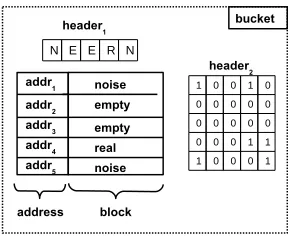
Figure 1: C-ORAM bucket structure
ORAM keeps Onion ORAM’s main construction. That is, C-ORAM is a tree-based C-ORAM composed of a main tree C-ORAM storing the actual data and a recursive ORAM storing the position map. The position map consists of a number of ORAM trees with linearly increasing height mapping a given address to a tag. Forn elements stored in the ORAM, the communication needed to access the position map is inO(log2N). As with all recent tree-based ORAMS, the recursive position map’s communication complexity is dominated by the block size. For the remainder of this paper, we therefore restrict our description to C-ORAM’s main data tree.
LetN be a power of2. C-ORAM is a binary tree withLlevels and2Lleave nodes. Each node/bucket containsµ·zblocks. Here, zis the number of slots needed to hold blocks as in Onion ORAM andµis a multiplicative constant that gives extra room in the buck-ets for noisy blocks, a detail we will cover below which is important for our construction. We maintain the same relation betweenN,L andzas in Onion ORAM, namelyN ≤z·2L−1
. Each block in a C-ORAM bucket is encrypted using an additively homomorphic encryption, e.g., Pailler’s or Damgard-Jurik’s cryptosystem. Also, each bucket contains IND-CPA encrypted meta-information, head-ers, containing additional information about a bucket’s contents.
3.1.2
Headers
Bucket headers are an important component in C-ORAM as they determine how oblivious permutations are generated. A bucket header is comprised of two parts: the first part stores for each block whether it is noisy, contains real data or is empty. The second part stores the block tags. More formally, the header is composed of two vectorsheader1andheader2. Vectorheader1has lengthµ·z, and
each element is eithernoisy,emptyorreal. Thus, each element has a size of two bits. The total size of this vector is inO(µz).header2
is a(µ·z×logN)binary matrix. The rows represent the address of the blocks. Finally, as with all tree based ORAMS, each block in a bucket also contains the encryption of its address. That is, the address of each block is encrypted separately from the block itself. We show a high level view of a C-ORAM bucket in Fig 1.
3.2
C-ORAM: First Construction
To prepare for our main contribution, we start by presenting a new technique allowing amortized constant communication com-plexity with a smaller block size.
3.2.1
Overview
the block exists in a bucket, the client downloads the encrypted headers of each bucket. Therewith, the client can generate a PIR read vector retrieving the block from a bucket. To preserve the scheme’s obliviousness, the client sends PIR read vectors for each bucket on the path. Once the block has been retrieved, the client can modify the block’s content if required, then insert it back into the root of the C-ORAM tree using PIR write. This is the standard Path-PIR behavior to read from or write into blocks [17].
Eviction in our first construction takes place after every χ = O(z)access operations. As in Onion ORAM, a path in C-ORAM is selected following deterministic reverse lexicographic order. Then, the entire root of the ORAM tree is downloaded, randomly shuf-fled and written back (additively homomorphically) encrypted. Fi-nally, the eviction is performed by repeatedly applying an oblivious merge on buckets along the selected path. Any bucket belonging to this path is obliviously merged with its parent while the other child of the parent will be overwritten by a copy of the parent bucket. We call the former bucket on the path thedestinationbucket and the latter one itssiblingbucket.
Before starting the eviction of a specific path, an invariant of the eviction process is that siblings of buckets of this path are empty, except the leaves. After the eviction, all buckets belonging to the evicted path will be empty except the leaf [6]. Note that siblings of this path, after the eviction, will not be empty anymore. See Fig 2 for a sample eviction withN = 8.
Sibling buckets, since they are simply copies of their parents, will contain blocks with tags outside the subtree of this bucket. These blocks are callednoisyblocks as they do not belong into this subtree and are essentially leftover “junk”. Now for correctness, in our construction, we will guarantee that the number of noisy blocks in any bucket is upper bounded. So, there will always be space for real elements in a bucket and will not overflow.
Elements in each bucket are encrypted using additively homo-morphic encryption, respectively. Given two bucketsB1 andB2,
oblivious merging will permute the position of blocks inB1 such
that there are no real or noisy element at the same positions inB1
andB2. Consequently, if there is a real element in theithposition
inB1, then for the scheme to be correct, theith position inB2
should be empty. The following addition of elements at the same position inB1andB2will preserve the value of the real element.
Afterχoperations, we also download the leaf bucket to delete its noisy blocks.
3.2.2
Details and Analysis
LetP(tag)denote the path starting from the root and going to the leaf identified bytag. The path is composed ofL+ 1buckets including the root. P(tag, i)refers to the bucket at theith level ofP(tag). For example,P(tag,0)is the root bucket. Ps(tag, i) is the sibling of bucketP(tag, i). Let[N]be the set of integers {1,· · ·, N},x←−$ [N]uniformly sampling a random element from set[N], andχthe period of eviction which is inO(z). Identityis an empty bucket containing only encryptions of zero.
Algorithm 1 presents details of the access operation. An access can be either an ORAMReador aWriteoperation. The only dif-ference between the two is that a write changes the value of the block before putting it back in the root. The access operation in-vokes a PIR read algorithm, see Algorithm 2 that obliviously re-trieves a block. Algorithm 3 shows the eviction where elements percolate towards their leaves using oblivious permutations, see Al-gorithm 4.
Block size:The following asymptotic analysis will be in function ofz,N, andγ. z is the size of the bucket,N the number of
ele-Input: Operationop, addressadr, datadata, counterctr, statest Output: BlockBassociated to addressaddr
// Fetch tag value from position map
1 tag=posMap(adr);
2 posMap(adr)←$ [N]; 3 ifctr=0 mod (χ)then
4 Download root bucket, refresh encryptions, randomize order of
real elements;
5 Evict(st); 6 else
7 forifrom0toLdo B=B+PIR-Read(adr,P(tag, i));
8 end
9 ifop=writethen setB=data; 10 ctr=ctr+ 1;
11 Upload IND-CPA encrypted block to rootP(tag,0);
Algorithm 1:Access(op, adr, data, ctr, st): C-ORAM access operation,1stconstruction
ments, andγthe length of the ciphertext of the additively homo-morphic encryption. The communication complexity induced by an ORAM access operation comprises a PIR read operation and the eviction process (happening everyχ ∈ O(z)accesses). The size of the bucket isµ·z, but we will show in our security analy-sis section later thatµis a constant. Therefore, we ignore it in our analysis.
First, the client performs PIR readsL+ 1times. For this, the client has to download all addresses in the path, i.e.,O(z·L·logN) bits. Also, the client should send a logarithmic number of PIR read vectorsVwith sizeO(γ·z·L)bits. Note that the computation of PIR read vectors outputs, for all but one buckets’ block, encryption of zeros. Instead of sending back a logarithmic number of blocks to the client, the server only sends a single block, the summation of all the blocks output, cf. Algorithm 1. Thus, the client only retrieves a single blockB. A PIR read applied to all buckets of the path induces an overhead inO(z·L·logN+γ·z·L+B).
For the eviction, the client downloadsheader1 and theith
col-umn ofheader2and sends permutations for all buckets in the path.
Thus, the overhead induced by the permutations isO(L·z·logz) bits. Also, after everyχ=O(z)operations, the client downloads the root and one leaf, which hasO(zB)communication complex-ity. Amortized, for each operation we haveOz(B)communication complexity (amortized overz).
In conclusion, each access hasOz(z·L·logN+γ·z·L+ z·log(z)·L+B)communication complexity. To have constant communication complexity inB, the block size should beB ∈ Ω(z·L·logN+γ·z·L+L·z·logz)∈Ω(λ·log2N+γ·λ·logN).
The above is a consequence ofz = Θ(λ),λ ∈ ω(logn), and L∈Θ(logN). Based on current attacks [15],γ=O(λ3). There-fore,λ·log2N
is dominated byγ·λ·logN, andB∈Ω(γ·λ· logN).
The block size of our first modification is already alogN multi-plicative factor improvement over the block size of Onion ORAM. However, in practice, this value is still large. The main idea of our second construction is based on the following observation. The block size has exactly the same asymptotic as transmitted vectors V. So to improve the block size, we change the way we are ac-cessing the ORAM. Note that we can de-amortize C-ORAM first construction using techniques from [30].
3.3
C-ORAM: Second Construction
Input: BucketP(tag,level)), addressadr Output: BlockB
1 Retrieve and decrypt addressesAddrof bucketP(tag,level));
// Compute the PIR-Read vector V in client side
2 ifadr∈Addrthen
// Retrieve the index α
3 α=Addr[addr];
4 forifrom1toµ·zdo
5 ifi6=αthen Vi←ENC(0) else
6 Vi←ENC(1);
7 end
8 else
9 forifrom1toµ·zdo Vi←ENC(0);
10 end
// Retrieve block in server side
11 Parse bucketP(tag,level)as(µ·z× |B|)binary matrixM;
12 B= (Pµi=1·zVi· M1,i,· · ·,Pµi=1·zVi· M|B|,i);
13 Updateheaderlevel1 of bucketP(tag,level);
Algorithm 2:PIR-Read(adr,P(tag,level))
O(z·B)bits. In our second and main construction, the eviction remains exactly the same, and our focus will only be on ORAM access.
3.3.1
Overview
In our first modification, we perform a PIR read per bucket dur-ing an access. Contrary, we now perform an oblivious merge to find out the block to retrieve. For an ORAM access totag, our idea is to perform a special evict of pathP(tag). We push allreal el-ements inP(tag)towards the leaf and then simply access the leaf bucket. So, we preserve access obliviousness and make sure that the element we want is pushed into leaf buckettag.
This approach comes with several challenges. We must preserve the bucket distribution, i.e., we have to maintain sibling empti-ness property, as guaranteed by the reverse lexicographic eviction, before evicting any path. Instead of deterministically selecting a path for eviction, we choose paths randomly. However, using ran-domized eviction, we still have to guarantee empty siblings on the evicted path. By randomly evicting a path, we might copy a bucket in its sibling which is not empty resulting therefore in a correctness flaw.
Our approach will be to temporarily clone the pathP(tag). The clone ofP(tag)serves to simulate the eviction towards the leaf bucket, and we remove the clone after the access operation. We apply the oblivious merging on the bucket of this cloned path, and at the end we will have all real elements in the leaf bucket of the cloned path. Finally, we apply a PIR read to retrieve the block.
Besides, to get rid of the amortized cost and have a scheme that only requires a constant bandwidth in the worst case, we make use of a PIR write operation that will be performed during every ac-cess. In the first construction, we have to shuffle the root bucket since oblivious merging has to be performed on random buckets for security purposes. Moreover, we need to eliminate noisy blocks from the leaf buckets and therefore after eachχoperations, the client downloads the evicted leaf to eliminate all noisy blocks. In our second C-ORAM construction, we are evicting after every ac-cess. Consequently, we can be certain that the root bucket is always empty after an eviction. The first PIR write operation that we per-form will randomly insert the block in an empty root bucket after any access obliviously. The second use of PIR write is to delete the retrieved element from the leaf. In fact, we can also delete noisy blocks by the same tool but a PIR read is needed to retrieve first the noisy block that we will overwrite with a PIR write. We dedicate Section 4.2 to analyze security and correctness of our modification.
Input: Statest
Output: Evicted path and updated statest 1 forifrom0toL−1do
2 Retrieveheaderi
1andheader
i+1 1 ;
3 RetrieveCiandCi+1respectively theithand the(i+ 1)th
column ofheaderi
2andheader
i+1
2 of the bucketP(st, i)and
P(st, i+ 1);
4 π←GenPerm((headeri1,Ci),(headeri1+1,Ci+1)), generate
the oblivious permutationπ;
// Merge the parent and destination bucket
5 P(st, i+ 1) =π(P(st, i)) +P(st, i+ 1);
6 ifi < L−1then
// Copy the parent bucket into its sibling
7 Ps(st, i) =P(st, i);
8 else
// Merge the last bucket with the sibling leaf
9 Retrieveheaderi1+1andCi+1from the sibling leaf; 10 π←GenPerm((headeri1,Ci),(header1i+1,Ci+1)); 11 P(st, i+ 1) =π(P(st, i)) +P(st, i+ 1);
12 end
13 Update(headeri1)and store it with bucketPs(st, i);
14 Update(headeri1+1)and store it with bucketP(st, i+ 1);
15 P(st, i) =Identity;
16 end
Algorithm 3:Evict(st), eviction process
3.3.2
Details and Analysis
Algorithm 5 presents the core of our second C-ORAM construc-tion. Now, instead of performing a logarithmic number of PIR reads, we only invoke anEvict-Cloneto read a block, cf. Algo-rithm 6. Evict-Cloneuses our oblivious merging, together with one PIR read to retrieve a block. Moreover, we evict after every ac-cess. In order to eliminate noisy blocks that have been percolated to the leaf bucket, we use a PIR write to delete the noisy block, cf. Algorithm 7.
Block size: The access operation in C-ORAM is composed of scheduled path eviction, eviction in the cloned path, a PIR read, and two PIR writes. The size of the headers are negligible com-pared to the PIR read and write vectors. For sake of clarity, we therefore avoid including them in our asymptotic analysis.
First, the eviction always involves an overhead ofO(zLlogz). Evict-Cloneperforms one PIR read in addition to the regular evict. Finally, we retrieve the block of sizeB. Therefore, the overhead induced by these steps isO(zLlogz+zlogN+γz+B).
Adding the two PIR writes and single PIR read operation will not change asymptotic behavior since the number of these operations is constant inN.
In conclusion, to have a bandwidth that is constant in block size B, the block size should beB∈Ω(z·L·logz+z·γ).
Withz∈Θ(λ),λ∈ω(logN)andL∈Θ(logN), we achieve B ∈ Ω(λ·[logN·logλ+γ]). In practice,γ ∈ O(λ3), soγ dominateslogN·logλ. Therefore, block sizeBisB∈Ω(γλ).
Our second C-ORAM construction achieves worst-case constant blow-up, it also omits inefficient PIR reads performed for ORAM access. This second construction improves the blocks size by a multiplicative factor oflog2N compared to Onion ORAM in the
worst case.
As you can see, the main overhead of C-ORAM’s block size comes from the size of ciphertextγ. Recall thatγ∈O(λ3).
Input: Configuration of bucketsAandB
Output: A permutation randomly lining up bucketBto bucketA
// Slots in A and B start either empty, full or noisy; mark slots in A as assigned if block from B is assigned in π
1 Letx1, x2be the number of empty and noisy slots inA; 2 Lety1, y2be the number of full and noisy slots inB; 3 d1=x1−y1;
4 d2=x2−y2; 5 forifrom1toµ·zdo
6 caseB[i]is full z←$ all empty slots inA;
7 caseB[i]is noisy
8 ifd2>0then
9 z←$ all noisy slots inA;
10 d2=d2−1;
11 else
12 z←$ all empty slots inA;
13 end
14 end
15 caseB[i]is empty 16 ifd1>0then
17 z←$ all non-assigned slots inA;
18 d1=d1−1;
19 else
20 z←$ all full slots inA;
21 end
22 end
23 π[i] =z;
24 A[z] =assigned; 25 end
26 returnπ;
Algorithm 4:GenPerm(A, B), oblivious permutation generation
4.
C-ORAM ANALYSIS
4.1
C-ORAM correctness analysis
The goal of the correctness analysis section is to show that, dur-ing any eviction (algorithmsEvictandEvict-Clone), the probabil-ity that a failure occurs is small. The failure in C-ORAM is defined as the lack of encryption of zeros in the evicted path. In this sec-tion, we only consider the proof of correctness of C-ORAM’s first construction. The proof of correctness of C-ORAM’s second con-struction is a straightforward extension from the first one. Before presenting details of our correctness analysis, we introduce some notations and assumptions.
LetBi,jrefer to the bucket at theithlevel of the path evicted at thejthstep. Each bucket containsµ·zblocks, with integerµ >1. In C-ORAM’s first construction, the root bucket containsz real elements and(µ−1)·zempty blocks. We setφ=µ−1. An empty block represents an additively homomorphic encryption of zero. Each bucket cannot have more thanz real elements at any time with high probability, as we will prove in Theorem 4.3. LetZi,j be the discrete random variable of the number of blocks containing an encryption of zero in bucketBi,j. Similarly,Ri,jrepresents the number of real blocks. Recall that if a real block is pushed to a path leading to a leaf different from its own tag, this block is called a noisy block.N˜i,jrepresents the random variable that counts the number of noisy blocks in bucketBi,j. Finally, thejth
eviction step is the eviction of thejthpath following a deterministic reverse
lexicographic order.
Formally, the eviction inEvictalgorithm fails if∃i∈ {0, . . . , L}andk∈Nsuch thatZi+1,k < Ri,korZi,k < Ri+1,k. Thus,
the proof’s goal will be to show that there is no such integeri∈ {0, . . . , L}that verifies both inequalities with high probability.
Input: Operationop, addressadr, datadata, statest Output: BlockBassociated to addressadr
// Fetch tag value from position map
1 tag=posMap(adr);
2 posMap(adr)←$ [N];
// Retrieve desired block
3 B=Evict-Clone(adr,tag); 4 ifop=writethen setB=data;
// Select a random position in the root bucket
5 pos1←$ [µ·z];
// Write back the block to the empty root
6 PIR-Write(pos1, B,P(st,0));
7 Evict(st);
// Select a random noisy block position from the header of the leaf P(st, L)
8 pos2←$ headerL;
9 N=PIR-Read(pos2,P(st, L));
// Write back the negation of the noisy block
10 PIR-Write(pos2,−N,P(st, L));
Algorithm 5:Access(op, adr, data, st): C-ORAM access oper-ation,2thconstruction
Input: Leaftagand addressadr Output: BlockB
1 Create a copy of the C-ORAM pathP(tag);
2 forifrom0toL−1do 3 Retrieveheaderi1andheader
i+1 1 ;
4 RetrieveCiandCi+1respectively theithand the(i+ 1)th
column ofheaderi
2andheader
i+1
2 of the bucketP(tag, i)and
P(tag, i+ 1);
// Generate the oblivious permutation π
5 π←GenPerm((headeri1,Ci),(headeri1+1,Ci+1));
// Merge the parent and destination bucket
6 P(tag, i+ 1) =π(P(tag, i)) +P(tag, i+ 1); 7 end
8 B=PIR-Read(adr,P(tag, L));
9 forifrom0toLdo
10 Updateheaderi1inP(tag, i); 11 end
Algorithm 6:Evict-Clone(adr, tag)
First, we need to introduce two properties that will help us to understand the proof and the eviction mechanism more thoroughly. The first property is called thepath composition historywhile the second one is thebucket composition history. Given a pathP(j), the path composition historycaptures the eviction step in which each bucket has been created. Given a bucketBi,j, thebucket
com-position historyis a sequence that captures all buckets that have contributed to the construction of the bucketBi,j.
Path composition history:In C-ORAM, the eviction follows a de-terministic reverse lexicographic order. In thejth
step of eviction, every bucket of the pathP(j)has been created on a previous evic-tion. Thus, we associate to a bucket itseviction stepduring which it has been created. In particular, every bucket in this path has been created from a different eviction step. We are interested on defining the relation between the eviction steps of buckets belonging to the same evicted path. This relation follows a pattern which is common to all evicted paths. For instance, in Fig. 3, the pathP(9)of the9th
eviction is composed of bucketsB1,8, B2,7, B3,5. These are
Input: Positionpos, bucketP(tag,level), blockB Output: Updated bucketP(tag,level)
// Compute the PIR-Write vector V in client side
1 forifrom1toµ·zdo
2 ifi6=posthen Vi←ENC(0) else
3 Vi←ENC(1);
4 end
// Write block in server side
5 Parse bucketP(tag,level)as(µ·z× |B|)binary matrixM; 6 Mi,j=Wi·Bj;
7 P(tag,level) =M+P(tag,level);
Algorithm 7:PIR-Write(pos, block,P(tag,level)),PIR-write process
Figure 2: Buckets on evicted path are with horizontal hatching. Bucket 3 is a copy of the root. Bucket 4 results from merging buck-ets 1 and 2. Bucket 6 results from merging 1, 2, and 5.
Formally, forNelements stored in the ORAM andL∈Θ(logN), one can easily show by induction that thejthevicted path, for all j≥1, is composed of{B1,j−20, B2,j−21, . . . , BL−1,j−2L−2}.
AfterLevictions, buckets belonging to an evicted path, except the leaves, are copies of a bucket from previous evictions. In our proof, we will later assume that the ORAM has performed a num-ber of evictions larger thanL. We will also consider the worst case where all buckets might eventually contain real or noisy blocks.
Bucket composition history:This property follows from the pre-vious one. Given a pathP(j), the eviction will empty all buckets in this path except the leaf. The eviction works as follows: the rootB0,jwill be merged with its destination childB1,j−20 in the path while the siblingB10,j, originally empty, will be overwritten by a copy of the root. The root is finally overwritten by an empty bucket. The bucketB1,j−20 will be merged with its destination childB2,j−21then emptied. The sibling of the bucketB1,j−20will be overwritten by the content ofB1,j−20. We reiterate the process until the end of the path (this was a recapitulation ofEvict).
Given a bucketBi,j, we are interested in enumerating the evic-tion’s steps of creation of all buckets that have contributed to bucket
Figure 3: Illustration of nine evictions. Numbers below leaves represent the order of reverse deterministic lexicographic eviction. Buckets with same shapes were full and then evicted at the same step. Example: buckets with triangular shape are evicted in step9.
Table 2: Bucket creation pattern in function of the eviction step.
Level1 8 7 6 5 4 3 2 1
-Level2 7 6 5 4 3 2 1 -
-Level3 5 4 3 2 1 - - -
-Evicted path 9 8 7 6 5 4 3 2 1
Bi,j. The bucket composition also follows a pattern that is unique to any bucket in the construction. Given the eviction algorithm, ev-ery bucket in theith
level is created by merging all buckets in the path from the root to the(i−1)thlevel, see Table 2 for an example
of this pattern forN = 16. As an example, the bucket in path9at the3rdlevel was created during the5theviction step. To determine the buckets that contributed to this bucket’s creation, we check the column that has an evicted path equal to 5. Then, we consider all buckets that are in upper levels: buckets 4 and 3 which are in lev-els 2 and 1. In general, a bucketBi,j is the result of merging the following buckets:{B0,j, B1,j−20, B2,j−21, . . . , Bi−1,j−2i−2}.
Noisy blocks: It is important to understand the source of prove-nance of noisy blocks. From a one hand, a noisy block can be cre-ated whenever an access has been performed on C-ORAM. There-fore, the accessed block is not valid anymore and should be turned to a noisy block by updating the headers. On the other hand, a noisy block can be also created from the eviction process. During an eviction, and in particular, when a parent is copied to its sibling, many real elements are no longer valid and become noisy. The main goal of this section is to upper bound the number of noisy blocks in all buckets with high probability. Our quantification has then to take into account both sources, however, one can show that the first source of noisy blocks can be included as a worst case of the second source. Recall that a bucket cannot hold more thanzreal elements which means that we can have up toz real elements turning to noise –if we access the same bucketztimes before eviction–. One can only addzadditional blocks to each bucket to handle reads, so whatever computed bound onφ, one can increase it by one. How-ever, one can show that it is not necessary. In fact, this situation is equivalent to having allzreal elements in a given bucket as noise for its sibling (which is the worst case). Thus, one can consider the first source of noisy blocks as a sub-case of the second one. We are now ready to state our main theorem.
THEOREM 4.1. Ifφ ∈ Θ(1), the probability that Zi+1,j ≥ Ri,jandZi,j≥Ri+1,jis inO(z−z), for alli∈[L]andj∈N.
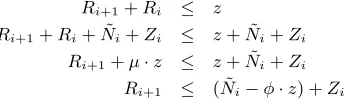
PROOF. Based on our assumption, we know that a path cannot handle more thanzreal elements with high probability. This im-plies that∀i∈ {0, . . . , L}, we haveRi+1+Ri≤z.
Here, for sake of clarity and without loss of any generality, we omit the eviction stepjfrom notation just to minimize the burden of additional indexes. To show that∀i ∈ [L], Zi+1 ≥ Riand Zi≥Ri+1, it is equivalent to show thatN˜i≤φ·z:
Ri+1+Ri ≤ z
Ri+1+Ri+ ˜Ni+Zi ≤ z+ ˜Ni+Zi Ri+1+µ·z ≤ z+ ˜Ni+Zi
Ri+1 ≤ ( ˜Ni−φ·z) +Zi Therefore, it is sufficient to show thatN˜i−φ·z ≤0in order to proof that∀i∈[L],Zi+1≥RiandZi≥Ri+1. It is clear that
these inequalities hold for any eviction stepj∈[N].
Based on the bucket composition history, notice that the noisy elements in the bucketBi,jare exactly those that exist already in the bucket Bi−1,j−2i−2, plus, all the real elements that will be evicted to the other child and therefore they are considered noisy elements for the bucketBi,j. Thus, we havePr( ˜Ni,j > φ·z) = Pr( ˜Ni−1,j−2i−2+R0i−1,j> φ·z).
We have shown in the bucket composition history thatBi,j is created by summing all the buckets{B0,j, B1,j−20, B2,j−21, . . . , Bi−1,j−2i−2}. The above equation can be then formulated more accurately such thatPr( ˜Ni,j > φ·z) = Pr(maxi( ˜N1,j−20, . . . ,
˜
Ni−1,j−2i−2) +R0i−1,j> φ·z).
The equation can be understood as follows: the noise in bucket Bi,j is the maximal amount of noise in any bucket in its history. Each bucket is created independently of the other ones in the evicted path. Therefore the quantity of noise in every bucket in the evicted path is independent of the other ones. We give more details below about the independence assumption. Since the noise is cumulative during the eviction, the bucket that has the maximum noise will represent the noise of the last bucket. Recall that based on Algo-rithm 4, the noisy blocks are added up. Also, to this quantity of noise, we add the sum of all real elements in the path that are no longer considered real elements inBi,j and therefore represent a new noise denoted byR0i−1,j.
All buckets in an evicted path areindependentof each others, i.e., the number of real elements, the number of noisy elements are independent of the the other buckets in the path. This holds since the real elements, the noise in any bucket is generated from dis-tinct evictions. First, note that a bucket is created by merging all its ancestors. We have defined in the previous section the notion ofbucket composition historythat keeps track of each bucket’s an-cestor that contributed to its creation. As have been shown, the bucket ancestors emanate from different evictions’ steps which is a consequence of the reverse deterministic lexicographic eviction. More importantly, each bucket in the evicted path has a differ-ent bucket composition history such that the intersection of all of them isempty. Formally, an evicted path, based on thepath com-position history, of the jth
step equals {B1,j−20, B2,j−21, . . . , BL−1,j−2L−2}.
Consider a bucket and its parent in the evicted path fori∈ {1, . . . , L−1},Bi,j−2i−1andBi+1,j−2i. The bucket composition is {B0,j−2i−1, B1,j−2i−1−20, B2,j−2i−1−21, . . . , Bi−1,j−2i−1−2i−2} and{B0,j−2i, B1,j−2i−20, B2,j−2i−21, . . . , Bi,j−2i−2i−1}.
By replacing each bucket in the above sequence by its own bucket composition history and by iterating the process, we will converge to a state where each bucket is composed of root buckets that were instantiated at different evictions’ steps. That is, no distinct buckets in the evicted path have a root in common. Thus, the number of real and noisy elements are independent from each other. Therefore we have
Pr( ˜Ni,j> φ·z) = 1−Pr(max
i ( ˜N1,j−20, . . . , ˜
Ni−1,j−2i−2) +R0i−1,j≤φ·z)
= 1−
i−1 Y
k=1
Pr( ˜Nk,j−2k−1+R0i−1,j≤φ·z)
We can reiterate the process of counting the noise until arriving to the root. The quantity of noise in the root is null. Then
Pr( ˜Ni,j > φ·z) = 1− i−1 Y
k=1
k−1 Y
l=1
· · · s−1 Y
t=1
Pr( ˜N0,t+R 0
0,t+
R01,s+. . .+R 0
i−1,j≤φ·z)
= 1−
i−1 Y
k=1
k−1 Y
l=1
· · · s−1 Y
t=1
Pr(R00,t+R 0
1,s+ · · ·+Ri0−1,j≤φ·z)
Recall thatR0i−1,jrepresents the number of real elements in the bucketBi−1,j that will be considered as noise in the bucketBi,j. Any bucket cannot have more thanzelements with hight probabil-ity, denotingR=R00,t+R
0
1,s+. . .+R 0
i−1,j, we then have
Pr(R ≤φ·z) = 1−Pr(i·z≥ R ≥φ·z)
= 1−
i·z
X
k=φ·z
Pr(R=k) (1)
Now, we have to compute an upper bound ofPr(R=k). One can proceed by: (1) counting all possible solutions ofR=k, then (2) multiply this value by the probability of the most likely solution. All the possible combinations of the equationx1 +. . .+xk = N equal k+NN−1
possibilities. The non-trivial part is to find an upper bound of the most likely solution that, in its general form, equalsPr(R00,t=x1AND . . . ANDR0i−1,j =xi−1). We have
thatR0i−1,xifollows a binomial distribution such thatPr(R 0 i−1,t= xi) ≤ 2i−1
xi
· 1
(2i)xi. Using the independence between buckets,
see above for the independence argument, we obtain:
Pr( i−1
^
j=0
Pr(R0j=xj)) = i−1 Y
j=0
Pr(Rj0 =xj)≤ i−1 Y
j=0 2j−1
xj
· 1
(2j)xj
≤
i−1 Y
j=0
( e 2xj
)xj = (e
2) k
i−1 Y
j=0
(1
xj )xj
We want to find a readable upper bound only in function ofk. Also, remark that the above inequality is true iff, ∀j ∈ {1, . . . , i−1}, the following statement holdsxj ≤ 2j−1. One can ver-ify with induction that withxj’s reaching their upper bounds2j−1
minimizesQi−1
j=1x
xj
j and therefore maximizes the inverse of the function. Also, there exists by construction a nonnegative inte-ger γ such thatPγ−1
i=12
i ≤ k ≤ Pγ i=12
i, which implies that γ−1≤logk≤γ+ 1. Putting everything together we obtain:
Pr( i−1
^
j=0
Pr(Rj0 =xj) = ( e
2) k
i−1 Y
j=0
(1
xj )xj
≤(e 2)
k· 1
22·(22)22· · ·
(2γ−1)2γ−1
= (e 2)
k· 1 2
Pγ−1 j=1j2j
= (e 2)
k· 1 21+(γ−2)2γ
≤(e 2)
k· 1
21+(logk−3)k ≤( 4e
k) k Now, we plug the above results in (1)
Pr(R ≤φ·z)≥ 1−
i·z
X
k=φ·z
k+i−1 k
(4e
k) k
≥ 1−
i·z
X
k=φ·z (4e
2·(k+i−1)
k2 )
k
≥ 1−(i−φ)·z·(8e
2·(φ·z+i−1)
2(φ·z)2 )
≥ 1−i·z·(8e
2
φ·z) φ·z (3)
Inequalities (2) and (3) are bounds that are reached first by replac-ingk = φ·zsince it will result on the larger value (k is in the denominator) and by summing over the final probability byi·z. Combining all results together, we have
Pr( ˜Nj,k> φ·z) ≤ 1− i−1 Y
k=1
k−1 Y
l=1
· · ·
s−1 Y
t=1
(1−Pr(j·z≥ R ≥φ·z))
≤ 1−(1−Pr(j·z≥ R ≥φ·z))O(iii!)
≤ 1−(1−i·z·(8e
2
φ·z) φ·z)O(ii
i!)
= O(i i i!iz(
e2
φ·z)
φ·z) =O(eiiz( e2 φ·z)
φ·z)
The last transitions are obtained by the binomial inequality and Stir-ling approximation. Now, we define the value ofφfor which this probability is negligible. The probability above can be simplified toPr( ˜Ni,j> φ·z) =O(ei+ln(i·z)+2φ·z−ln(φ·z)·φ·z).
This probability computation is independent of the step of evic-tionj∈N. Therefore, choosingφ∈Θ(1)(and assuming thatL∈ O(zlnz)), the probability equals:Pr( ˜Ni,j> φ·z)∈O(e−zlnz), which is negligible inz.
COROLLARY 4.1. If bucket sizez∈ω(logN),L∈Θ(logN), andφ ∈ Θ(1), the probability thatZi+1,j ≥ Ri,j andZi,j ≥ Ri+1,jis inO(N−log logN), for alli∈[L]andj∈N.
The Corollary can be derived from the main theorem by takingz∈ ω(logN).
4.2
Security Analysis
4.2.1
Oblivious merging
We prove that permutations generated by Algorithm 4 are indis-tinguishable from random permutations. Informally, we show that the adversary cannot gain any knowledge about the load of a par-ticular bucket. Applying a permutation from Algorithm 4 is equal to applying any randomly chosen permutation. We formalize our intuition in the security definition below.
First, we introduce our adversarial permutation indistinguisha-bility experiment that we denotePermG. LetMdenote a proba-bilistic algorithm that generates permutations based on the configu-rations of two buckets, andAa PPT adversary. Letkbe the bucket size andsthe security parameter. ByPermwe denote the set of all possible permutations of sizek. Let E1 = (Gen,Enc,Dec)
andE2 = (Gena,Enca,Deca)respectively denote anIND$-CPA
encryption and anIND-CPAadditively homomorphic encryption schemes. PermGAM,E1,E2(s)refers to the instantiation of the ex-periments by algorithmM,E1,E2and adversaryA.
The experimentPermGAM,E1,E2(s)consists of:
• Generate two keysk1andk2such thatk1 $
←−Gena(1s)and
k2 $
←− Gen(1s) and sendn buckets additively homomor-phic encrypted withEnca(k1, .)associated to their headers
encrypted withEnc(k2, .)to the adversaryA
• The adversaryApicks two bucketsAandB, then sends the encrypted headersheader(A)andheader(B)
• A random bit b ←− {$ 0,1} is chosen. If b = 1, π1 $
←− M(header(A),header(B)), otherwiseπ0
$
←−Perm. Send πbtoA
• Ahas access to the oracleOMthat issues permutation for any couple of headers different from those in the challenge
• Aoutputs a bitb0
• The output of the experiment is1ifb0=b, and0otherwise. IfPermGAM,E1,E2(s, b0) = 1, we say that the adversaryA succeeded.
DEFINITION4.1 (INDISTINGUISHABLE PERMUTATION). Algorithm
Mgeneratesindistinguishable permutationsiff for all PPT adver-sariesAand all possible configurations of bucketsAandB, there exists a negligible functionnegl, such that
Pr[PermGAM,E1,E2(s,1) = 1]−Pr[PermG A
M,E1,E2(s,0) = 1]≤negl(s). THEOREM 4.2. IfE1 is IND$-CPAsecure, E2 IND-CPA se-cure, then Algorithm 4 generates indistinguishable permutations.
PROOF. We consider a succession of gamesGame0,Game1and
Game2defined as follows:
• Game0is exactly the experimentPermGAM,E1,E2(s,1) • Game1is similar toGame0, except that encrypted headers
are replaced with random strings
• Game2is similar toGame1, except that encrypted buckets
are replaced with buckets with new randomly generated blocks which are additively encrypted
From the definition above, we have
Pr[Game0] = Pr[PermGAM,E1,E2(s,1) = 1]. (4) ForGame1, we can construct an efficient distinguisherB1that
re-ducesE1toIND$-CPAsecurity such that:
Pr[Game0]−Pr[Game1]≤AdvINDB1,$¯E1CPA(s). (5) Similarly forGame1, we can build an efficient distinguisherB2
that reduces the security ofE2toIND-CPAsecurity such that:
Pr[Game1]−Pr[Game2]≤AdvINDB2,¯ECPA2 (s). (6) We will no show thatPr[Game2] = Pr[PermGAM,E1,E2(s,0) = 1]. That is, we need to show that the distribution of the output of algorithmMhas a uniform distribution over the setPerm.
For sake of clarity, we assume that the number of noisy slots is zero in both buckets. Therefore, slots inAandBare either full or empty. We can easily extend the proof for the case where we have full, empty and noisy blocks.
For clarity, letXdenote the discrete random variable that repre-sents the permutation selected by the adversary and byLoadi,jthe
event ofload(A) =iand load(B) = j. Byload(A), we denote the number of real elements in bucketA. Ifb= 0, the adversary receives a permutationπ0selected uniformly at random. It is clear
Ifb = 1, the adversary receivesπ1. We need to show that the
permutations output byMare uniformly distributed.
Pr(X=π1) = X
i,j∈[n]
Pr(X=π1and Loadi,j)
= X
i,j∈[n]
Pr(X=π1|Loadi,j)·Pr(Loadi,j)
We compute the probability of selecting a permutation while the loads of bucketsAandBare fixed toiandj. The number of possi-ble configurations of valid permutations equalsValid= ki
· k−i j
. This represents the number of possible permutation from which the client can choose to generate a valid permutation. From the ad-versary view, it should take into consideration all possible config-urations of blocks in both bucketsAandB. The total number of permutations computes toTotal= ki
· k j
· k−i
j
·j!·(k−j)!. The first two terms count the possible configurations of the loads in both buckets while the three last terms are for valid permuta-tions for a fixed setting of load distribution in the buckets. The cardinality of possible configurations equals the number of possi-ble combinations from which we can selectjempty blocks from k−i, i.e., k−ji
. We then multiply this last value by the possible permutations of thek−ifull blocks and thejempty blocks that are respectively equal to(k−j)!andj!. That is,
Pr(X =π1|Loadi,j) =
Valid Total
=
k i
· k−i
j
k i
· k
j
· k−i
j
·j!·(k−j)! =
1 k!
j!·(k−j)! ·j!·(k−j)!
= 1 k!
We insert the result of this equation in the previous one and ob-tainPr(X =π1) =Pi,j∈[n]
1
k!·Pr(Loadi,j) = 1
k!.
Thus for the adversary, permutations output byMare uniformly distributed, i.e.
Pr[X=π1] = Pr[X=π0] = Pr[PermGAM,E1,E2(s,0) = 1] (7) Combining Equations 4, 5, 6, and 7, we obtain
Pr[PermGAM,E1,E2(s,1)] = Pr[Game0] ≤Pr[Game1] +AdvINDB1,$¯E1CPA(s) ≤Pr[Game2] +AdvBIND2,¯ECPA2 (s) +Adv
IND$¯CPA
B1,E1 (s) ≤Pr[PermGAM,E1,E2(s,0)] +Adv
IND¯CPA
B2,E2 (s) +Adv
IND$¯CPA
B1,E1 (s).
4.2.2
Overflow probability of C-ORAM buckets
C-ORAM eviction is similar to Onion ORAM [6]. The distribu-tion of real elements for both construcdistribu-tions is exactly the same. We have a bucket size ofµ·zwherezelements are allocated for real elements and(µ−1)zis allocated for noisy elements to preserve the correctness of C-ORAM construction. The overflow probabil-ity denotes the fact that any bucket in C-ORAM will contain more thanzelements. We want to show that this probability is negligible inn. For this, we borrow the results of Devadas et al. [6] and Ren et al. [23] that have introduced theevictionfactorχ. Throughout the paper, we have been stating thatχ=O(z), which is a result of the following theorem, without explicitly stating it before to avoid confusion.
THEOREM 4.3. For theevictionfactorχand heightLsuch that
z ≥ χandN ≤ χ·2L−1, the overflow probability after every eviction equalse
−(2z−χ)2 6χ .
Choosingz ∈ Θ(λ), L ∈ Θ(logN), χ ∈ Θ(λ) and λ ∈ ω(logN)makes the the result of Th 4.3 negligible inN.
5.
EVALUATION
We have shown analytically that it suffices to setµ= Θ(1)and have buckets of sizeΘ(z) = Θ(λ). However, we have not derived precisely what bucket size is necessary for concrete security pa-rameters. In order to get an idea of how bucket size in our scheme scales withλ, we performed a series of experiments simulating our ORAM and measuring the maximum number of used slots (real data blocks plus junk blocks) afterxnumber of operations, for var-ious values ofx. We performed 20 sets of runs for each value of the security parameter where we executed2λoperations to test security parameterλ. For each of these runs, we measured the largest bucket load in the tree and then averaged this value across all runs to deter-mine a bucket size which matches the selected security parameter. Figure 4b shows the results of this test, compared with equivalent tests run using the original Onion ORAM algorithm. Our results show that, because of the lower value ofAin C-ORAM, our bucket size is actually slightly smaller than Onion ORAM.
Additionally, we compare the efficiency of our scheme in terms of server computation to that of Onion ORAM. We aim to quantify the number of homomorphic addition and multiplication operations in each scheme, to show that we have significant improvement. Throughout this analysis, we will consider a single multiplication or addition to be over an entire block, although in practice it may be divided into chunks of smaller ciphertext. Any changes in chunk size will apply equally to both schemes so discussion of its impact will be ignored. Note however that we do not have layered encryp-tions and so, in fact, ciphertext operaencryp-tions in our scheme will be cheaper simply because they are smaller.
During eviction Onion ORAM performszselect operations on each bucket, which each require a PIR query overzslots. This re-sults in a total ofz2multiplications for each bucket, overLbuckets. Amortized overzgivesO(z·L)multiplications. Each multiplica-tion also implies an addimultiplica-tion in the select procedure, so the number of ciphertext additions is the same.
C-ORAM contains one major modification that is pertinent when comparing ciphertext operations: PIR queries are only done on the root bucket, to add new blocks, and on leaf buckets to read and re-move blocks. C-ORAM then requires onlyO(z·µ)multiplications andz·µ·Ladditions. Since we have shown thatµis a small con-stant, we effective gain a factor ofO(L)in multiplications. Cru-cially, this means the number of multiplications for C-ORAM is independent oflogN, as can be seen in Figure 5a.
Figure 5b shows the results of tests we have run to determine the computational speedup of C-ORAM compared to Onion ORAM. We considered Pailler encryption as the homomorphic cipher for our tests, using a 2048-bit semiprime, which results in ciphertexts of size 4096 bits. Tests were done on a 2013 Macbook Pro with a 2.5 GHz Intel Core i7 processor, which we found could perform 62 ciphertext multiplications per second. We then calculated how much time it would take to perform the necessary ciphertext oper-ations for one ORAM access, settingB = 100kband varyingN from216to223. Figure 5b also shows the computation necessary for the online (read) portion of the access.
1 10 100 1000 10000 100000
16 17 18 19 20 21 22 23
Optimal block size (KB)
log N
CORAM Onion ORAM
(a) Minimum efficient block size for C-ORAM and Onion ORAM
0 50 100 150 200
15 20 25 30 35 40 45 50 55 60
Minimum bucket size
Security parameter CORAM Onion ORAM
(b) Required bucket size in relation to security parameter
Figure 4: Comparison of C-ORAM and Onion ORAM
0 2000 4000 6000 8000 10000
16 17 18 19 20 21 22 23
Number of operations
log N
CORAM Mults CORAM Adds Onion Adds/Mults
(a) Required ciphertext operations for one access
0 20 40 60 80 100 120 140
16 17 18 19 20 21 22 23
Time (minutes)
log N
CORAM Read CORAM Total Onion Read Onion Total
(b) Comparison of computation time for one access
Figure 5: Comparison of C-ORAM and Onion ORAM
We stress that these evaluation results are largely to show the relative improvement of C-ORAM over Onion ORAM. We chose Paillier, because it is an established additively homomorphic en-cryption scheme, with well-understood levels of security. There are new homomorphic encryption schemes which perform much better than Paillier [2, 4, 16]. But stable, optimized implementations of them do not yet exist, and concrete parameters choices are still up for debate. Preliminary tests indicate that use of, for instance, the modern NTRU encryption scheme of López-Alt et al. [16] could allow for accesses with as little as 5 to 10 seconds of computation. However, a significant drawback that must be balanced for NTRU is that the ciphertexts are much larger, resulting in a tradeoff be-tween increased computational efficiency and higher communica-tion for the PIR porcommunica-tions of C-ORAM. We leave full exploracommunica-tion of optimized homomorphic encryption schemes to future work.
Finally, we compare the optimal block size for C-ORAM in re-lation to Onion ORAM, cf. Figure 4a. For each eviction, Onion ORAM requiresλ2Lciphertexts of sizeγto be sent by the client, while we require only permutation vectors of total sizeµλLlogλ. Sinceγ=O(λ3), this is a huge savings. For reads, Onion ORAM requiresλLγbits of ciphertext while we require only4µλγ. Comparison results: C-ORAM is able to achieve constant com-munication overhead in the worst-case, with significantly less server computation required in addition to smaller minimum block sizes. Figure 5a shows that we lower both the required number of cipher-text additions and multiplications by several orders of magnitude when compared to Onion ORAM, and Figure 5b shows that in practice this leads to a substantial improvement in efficiency. Fig-ure 4b shows that, due to our lower value ofA, the bucket size for C-ORAM is actually smaller in practice than Onion ORAM as
well. Additionally, Figure 4a shows that C-ORAM requires much smaller blocks than Onion ORAM in practice.
6.
RELATED WORK
ORAM was first introduced by Goldreich and Ostrovsky [9] and has recently received an increasing interest with the introduction of tree-based ORAM construction [3, 5, 7–12, 14, 17–19, 21–23, 25, 27–29]. ORAMs can be categorized based on the client memory setting, namely, constant client memory or sublinear client mem-ory. This categorization can be refined by taking into account the server computation nature, namely, storage-only server, versus, com-putational servers. In the following, we will briefly recapitulate some notable research works done in this area while arranging them in their corresponding categories.
Constant client memory:This category of ORAMs is very useful in the case of very restrained client memory devices such us smart-phones, embedded devices. With constant client memory, the aim of this research is to reduce the worst-case or amortized case com-munication complexity between the client and server [6, 10, 11, 14, 17, 21, 22, 25]. Polylogarithmic amortized-case cost was intro-duced by Goodrich and Mitzenmacher [10] and Pinkas and Rein-man [22] inO(log2N)but with linear worst case communication complexity. This last has been improved toO(√N·log2N)
Asymptotics for constant-client memory has been enhanced by the work of Kushilevitz et al. [14] with a communication complexity equal toO(log loglog2NN). However, this construction suffers from a large hidden constant∼30that make it less efficient compared to Shi et al. [25] for example.
While all the previous schemes are based on storage-only servers, Mayberry et al. [17] have introduced a new paradigm that takes advantage of a computational server setting. In fact, their idea is based on coupling PIR [13] with Shi et al. [25]’s ORAM. A PIR vector is used to retrieve the searched for block from the desired bucket that greatly reduces the amount of bits needed for one ac-cess. The authors show therewith that the communication complex-ity can be reduced toO(log2N). Devadas et al. [6] enhanced this idea by proposing the first amortized constant client bandwidth in a computational server. The idea is also based on merging PIR and ORAM, however, the client still needs to download a large block sizeB = Ω(log6N)which is not very practical for real-istic dataset.
Sub-linear client memory:Williams and Sion [28], Williams et al. [29] works introduce a sublinear client side memory inO(√N)but with a linear worst-case cost complexity. Stefanov et al. [26] im-proved this result by introducing a polylogarithmic communication complexity inO(log2N)but withO(√N)client memory.
Gentry et al. [7] improve the ORAM by Shi et al. [25] by replac-ing the binary tree by aκ−array tree. They introduce a new de-terministic eviction process adapted to this new structure based on reverse lexicographic ordering of leaves. This eviction method is the basis of many recent tree-based ORAMs such as Ren et al. [23] or Devadas et al. [6]. With a branching factor equal toκ= logN, the communication complexity of Gentry et al. [7]’s ORAM is in
log3N
log logN. The polylogarithmic client memory is inO(log
2
N) be-cause the client has to keep track of all elements in path during the eviction. Stefanov et al. [27] present Path ORAM, one of the most efficient construction with onlyO(logN)client memory. The bandwidth is inO(log2N)
if the block size is inΩ(logN)or in O(logN)forΩ(log2N) block sizes. Ren et al. [23] further re-duced the communication cost by2to4times.
Acknowledgements:We thank shepherds Chris Fletcher, Ling Ren, and Elaine Shi for valuable discussions improving the paper. This work was partially supported by
NSF grant 1218197.
References
[1] D. Apon, J. Katz, E. Shi, and A. Thiruvengadam. Verifiable Oblivious Storage. InProceedings of Public-Key Cryptography, pages 131–148, Buenos Aires, Argentina, 2014.
[2] Zvika Brakerski, Craig Gentry, and Vinod Vaikuntanathan. (leveled) fully homomorphic encryption without bootstrapping. InProceedings of the 3rd Innovations in Theoretical Computer Science Conference, pages 309–325. ACM, 2012.
[3] K.-M. Chung and R. Pass. A Simple ORAM.IACR Cryptology ePrint Archive, 2013:243, 2013.
[4] Jean-Sébastien Coron, Tancrède Lepoint, and Mehdi Tibouchi. Scale-invariant fully homomorphic encryption over the integers. In Public-Key Cryptography–PKC 2014, pages 311–328. Springer, 2014. [5] I. Damgård, S. Meldgaard, and J.B. Nielsen. Perfectly Secure
Obliv-ious RAM without Random Oracles. InProceedings of Theory of Cryptography Conference –TCC, pages 144–163, Providence, USA, March 2011.
[6] Srinivas Devadas, Marten van Dijk, Christopher W. Fletcher, Ling Ren, Elaine Shi, and Daniel Wichs. Onion ORAM: A Constant Band-width Blowup Oblivious RAM. IACR Cryptology ePrint Archive, 2015:5, 2015.
[7] C. Gentry, K.A. Goldman, S. Halevi, C.S. Jutla, M. Raykova, and Daniel Wichs. Optimizing ORAM and Using It Efficiently for Secure Computation. InProceedings of Privacy Enhancing Technologies, pages 1–18, 2013.
[8] O. Goldreich. Towards a Theory of Software Protection and Simu-lation by Oblivious RAMs. InProceedings of the 19th Annual ACM Symposium on Theory of Computing –STOC, pages 182–194, New York, USA, 1987.
[9] O. Goldreich and R. Ostrovsky. Software protection and simulation on oblivious rams.J. ACM, 43(3):431–473, May 1996. ISSN 0004-5411. doi: 10.1145/233551.233553. URLhttp://doi.acm.org/10. 1145/233551.233553.
[10] M.T. Goodrich and M. Mitzenmacher. Privacy-preserving access of outsourced data via oblivious ram simulation. InProceedings of Automata, Languages and Programming –ICALP, pages 576–587, Zurick, Switzerland, 2011.
[11] M.T. Goodrich, M. Mitzenmacher, Olga Ohrimenko, and Roberto Tamassia. Oblivious ram simulation with efficient worst-case access overhead. InProceedings of the 3rd ACM Cloud Computing Security Workshop –CCSW, pages 95–100, Chicago, USA, 2011.
[12] M.T. Goodrich, M. Mitzenmacher, O. Ohrimenko, and R. Tamas-sia. Privacy-preserving group data access via stateless oblivious RAM simulation. InProceedings of the Symposium on Discrete Algorithms –SODA, pages 157–167, Kyoto, Japan, 2012.
[13] E. Kushilevitz and R. Ostrovsky. Replication is not Needed: Sin-gle Database, Computationally-Private Information Retrieval. In Pro-ceedings of Foundations of Computer Science, pages 364–373, Miami Beach, USA, 1997.
[14] E. Kushilevitz, S. Lu, and R. Ostrovsky. On the (in)security of hash-based oblivious ram and a new balancing scheme. InProceedings of the Symposium on Discrete Algorithms –SODA, pages 143–156, Kyoto, Japan, 2012.
[15] H. Lipmaa. An Oblivious Transfer Protocol with Log-Squared Com-munication. In Proceedings of Information Security Conference, pages 314–328, Singapore, 2005.
[16] A. López-Alt, E. Tromer, and V. Vaikuntanathan. On-the-fly multi-party computation on the cloud via multikey fully homomorphic en-cryption. InProceedings of Symposium on Theory of Computing, pages 1219–1234, 2012.
[17] T. Mayberry, E.-O. Blass, and A.H. Chan. Efficient Private File Re-trieval by Combining ORAM and PIR. InProceedings of the Network and Distributed System Security Symposium, San Diego, USA, 2014. [18] T. Moataz, E.-O. Blass, and G. Noubir. Recursive Trees for Practical ORAM. InProceedings of Privacy Enhancing Technologies Sympo-sium, pages 115–134, Philadelphia, USA, 2015.
[19] T. Moataz, T. Mayberry, E.-O. Blass, and A.H. Chan. Resizable Tree-Based Oblivious RAM. InProceedings of Financial Cryptography and Data Security, pages 147–167, San Juan, Puerto Rico, 2015. ISBN 978-3-662-47853-0.
[20] R. Ostrovsky. Efficient computation on oblivious rams. In Proceed-ings of the Symposium on Theory of Computing –STOC, pages 514– 523, Baltimore, USA, 1990.
[21] R. Ostrovsky and V. Shoup. Private information storage (extended abstract). InProceedings of the Symposium on Theory of Computing –STOC, pages 294–303, El Paso, USA, 1997.
[22] B. Pinkas and T. Reinman. Oblivious ram revisited. InAdvances in Cryptology – CRYPTO, pages 502–519, Santa Barbara, USA, 2010. [23] L. Ren, C.W. Fletcher, A. Kwon, E. Stefanov, E. Shi, M. van Dijk, and
S. Devadas. Constants Count: Practical Improvements to Oblivious RAM , 2014. IACR Cryptology ePrint Archive 997.
[24] RightScale. State of the cloud report, 2015. URL
http://assets.rightscale.com/uploads/pdfs/ RightScale-2015-State-of-the-Cloud-Report.pdf. [25] E. Shi, T.-H.H. Chan, E. Stefanov, and M. Li. Oblivious RAM with O(log3(N))Worst-Case Cost. InProceedings of Advances in Cryp-tology – ASIACRYPT, pages 197–214, Seoul, South Korea, 2011. ISBN 978-3-642-25384-3.
[26] E. Stefanov, E. Shi, and D.X. Song. Towards practical oblivious ram. InProceedings of the Network and Distributed System Security Sym-posium, San Diego, USA, 2012. The Internet Society.
[27] E. Stefanov, M. van Dijk, E. Shi, C.W. Fletcher, L. Ren, X. Yu, and S. Devadas. Path ORAM: an extremely simple oblivious RAM proto-col. InProceedings of Conference on Computer and Communications Security, pages 299–310, Berlin, Germany, 2013. ISBN 978-1-4503-2477-9.
[28] P. Williams and R. Sion. Usable pir. InProceedings of the Network and Distributed System Security Symposium, San Diego, USA, 2008. [29] P. Williams, R. Sion, and B. Carbunar. Building castles out of mud: practical access pattern privacy and correctness on untrusted stor-age. InACM Conference on Computer and Communications Security, pages 139–148, Alexandra, USA, 2008.