ISSN(Online): 2320-9801
ISSN (Print): 2320-9798
I
nternational
J
ournal of
I
nnovative
R
esearch in
C
omputer
and
C
ommunication
E
ngineering
(An ISO 3297: 2007 Certified Organization)
Vol. 3, Issue 5, May 2015
Optimization of Cognitive Radio Sensing
Techniques Using Genetic Algorithm
Supreet Kaur, Inderdeep Kaur Aulakh
M.E Research Scholar, University Institute of Engineering & Technology, Panjab University, Chandigarh, India
Assistant Professor, University Institute of Engineering & Technology, Panjab University, Chandigarh, India
ABSTRACT: Cognitive radio technology is a low cost communication system. The main reason of choosing the cognitive system is that it prevents the interfering of licensed and authorised users; by choosing the available frequencies and waveforms automatically Today the development of the new radio technologies is limited because of the available radio spectrum. But the spectrum sensing is the vital technology in the radio networks. It enhances the spectral efficiency by filling the wireless spectrum voids.The code is written for cognitive radio architecture. In this architecture, a maximum of 300 nodes is taken as an architectural network. The aim of this work is to find the secondary users if the primary user is unable to transfer the data load which is provided to it. The problem of searching a secondary node is quite common in terms of cognitive radio networks. An optimal search method has been opted using GENETIC ALGORITHM. The genetic algorithm has three phases namely, Mutation – Cross-over, Objective Function and the fitness function .The mutation checks when the state of a node in the network changes. First of all node ids of all the nodes in the network is created .Further more if any id is repeated in the sequence , it is changed accordingly . When the data transfer comes into action and the primary user is not able to take the data load, Genetic algorithm is called, on the basis of the energy of the nodes, which are getting transferred from one end to another end. If the energy of the searched node is less than that of the threshold of the entire network then it is added to the objective function list else the node is ignored. The whole simulation is done in MATLAB 7.10 environment
KEYWORDS: Cognitive Radio, Genetic Algorithm, MATLAB, Load balance, Optimization
I. INTRODUCTION
ISSN(Online): 2320-9801
ISSN (Print): 2320-9798
I
nternational
J
ournal of
I
nnovative
R
esearch in
C
omputer
and
C
ommunication
E
ngineering
(An ISO 3297: 2007 Certified Organization)
Vol. 3, Issue 5, May 2015
resources and application requirements and could adopt their performance parameters according to user request and available resources. Secondary (cognitive) user can utilize the licensed spectrum (available white spaces) without affecting the priority utilization of the spectrum by primary user [1]. In this way, it maximizes the efficient licensed spectrum utilization.
II. RELATED WORK
Pham Tran et. al.[2], proposed a throughput-aware routing algorithm for enhancing throughput and decreasing end-to end delay in industrial cognitive radio sensor networks. In the given work the routing algorithm is targeted at large-scale networks where data are forwarded through different clusters on their ways to the sink. The limitation of proposed algorithm is the fact that it requires extra-equipped cluster-heads. However, the number of cluster-heads is much smaller than the number of sensor nodes. Simulation results show that our scheme can decrease end-to-end delay.
Tung Thanh Le et. al. [3], proposed a bandwidth-aware localized routing algorithm that is capable of sensing the available spectrum bands within a two-hop neighbouring for choosing the highly opportunistic routes. Author proposes bandwidth-aware localized-routing algorithms, which choose highly competitive solutions for routing performance in CRNs. The given BARCON algorithm is completely suitable for applying to large networks since it is capable of reducing the high computational complexity in such networks.Srinivas Sethi et. al. [4], Author Observe that the overall performance of routing protocol in CRAHN is better at less numbers of secondary users (SUs) presents in the Cognitive radio ad hoc network. They discusses about to solve Spectrum decision and route selection problem which have vital role in cognitive radio ad hoc network (CRAHN), they discussed many researchers work, who developed different methodology how efficiently select the proper route between source and destination. Given paper has been analyzed the efficiency and routing load of on-demand routing protocol based on ad hoc on-demand distance vector (AODV) routing protocol for CRAHN.Shelly Salim et. al. [5], review the on-demand routing protocols applicable for CRAHNs, which are based on AODV, DSR, and hybrid protocols. After explaining their basic principles, we qualitatively compare the protocols in terms of inherent characteristics and performance. This paper further addresses the pros and cons of routing protocols, discusses research challenges, and open issues.Pan et. al. [6], proposes a multi-channel opportunistic routing protocol (MCORP) in CRSN. When assigning the priority of candidates, they introduce a new metric that balances the remaining power of the candidate, the delivery ratio and the ETX. The delivery ratio and ETX of each link can be calculated average for all channels contained in CRSN. Also, they propose a candidate construction algorithm since there exists a trade-off between the benefit (transmission reliability) and cost (energy consumption) when selecting the optimize candidate set. The main contribution of this paper is reflected in the packet forwarding process, which can utilize multi-channels also joint with the feature of opportunistic. Natrajanet .al. [7], presents a critical review and analysis of different categories of routing protocols for cognitive radio networks. They first classify the available solutions to two broad categories: those based on full spectrum knowledge (typically used to establish performance benchmarks) and those based on local spectrum knowledge (used for real-time implementation). The full spectrum knowledge based routing solutions are analyzed from a graph-theoretic point of view, and they review the layered graph, edge coloring and conflict graph models. They classify the various local spectrum knowledge based routing protocols into the following five categories: Minimum power, Minimum delay, Maximum throughput, Geographic and Class-based routing. A total of 25 routing protocols proposed for cognitive radio networks have been reviewed. We discuss the working principle and analyze the pros and cons of the routing protocols. Finally, they propose an idea of a load balancing-based local spectrum knowledge-based routing protocol for cognitive radio ad hoc networks.
.
III. PROPOSED ALGORITHM a. GA APPROACH
The computation of the GA starts from the assortment of the chromosomes which are randomly generated. These chromosomes have certain characteristics and they follow the computation through generations. Chromosome fitness at a generation is calculated on the basis of stochastic calculation and mutation. The fitness is evaluated on individual basis and thus it gives rise to a new population of chromosomes. After this, an iterative algorithm will be used for the continuation of a process to several generations to generation, unless or until the most optimum solution is received.
ISSN(Online): 2320-9801
ISSN (Print): 2320-9798
I
nternational
J
ournal of
I
nnovative
R
esearch in
C
omputer
and
C
ommunication
E
ngineering
(An ISO 3297: 2007 Certified Organization)
Vol. 3, Issue 5, May 2015
1. Initialization: A random initial population of n chromosomes is generated. This population contains the available solutions for the specified problem.
2. Fitness measures: Evaluation of the fitness of an initial population’s chromosomes
3. Construction of a new population: Try the following steps to reproduce, until the production of the next generation completes:
Selection: A selection of chromosomes will be done in a way such that these chromosomes have the better level of fitness in the current available population.
Crossover: The crossover is done to make new individuals for the incoming generation. So with the defined probability of crossover, selected chromosomes reproduce to form new individuals.
Mutation: The new created individual will be mutated at a definite point.
4. Stopping Criteria: The process is repeated with all the above mentioned steps until a desired optimum solution is obtained or a set of maximum numbers of the population are generated. To implement the GA there are still several factors to consider, like creation of chromosomes, types of encoding used to perform the genetic algorithms, selection of the optimum chromosomes, and different criterion such as defining the fitness measure.
b. Description of the Proposed Algorithm:
1. Construct the proper chromosome structure.
2. Generate the initial population from random chromosomes. 3. Calculate the fitness measure for each chromosome. 4. Construct a new population using the following steps
Selection: Choose the fit chromosomes based on specified fitness measure and discard others, among the fit chromosomes select the best two and save them as elite chromosomes.
Crossover: Apply the crossover function on the selected chromosomes other than the elite chromosomes with a determined crossover function and rate.
Mutation: The chromosomes are mutated with a determined probability of mutation. In mutation every gene of the chromosomes is represented in form of binary bit strings. Put the chromosomes into the new
generation.
5. Return to Step 3 until the new generation contains the desired individuals. Replace the old population with the newly generated population.
6. Terminate: When a good enough solution is achieved or a number of defined generations is produced.
ISSN(Online): 2320-9801
ISSN (Print): 2320-9798
I
nternational
J
ournal of
I
nnovative
R
esearch in
C
omputer
and
C
ommunication
E
ngineering
(An ISO 3297: 2007 Certified Organization)
Vol. 3, Issue 5, May 2015
PSEUDO CODE
Start
Enter nodes less than 200 and re run the program
Generating x and y co ordinates of the nodes
Displaying the x co ordinates of the radio nodes
Variable for the node ids
Generating node ids and checking that whether any node does not contain any similar id
ID s of all the nodes are generated
Calculating the coverage set of each node
Saving the file to coverage set
Finding the source node from which the data has to be send
Finding the destination where the data has to be send
Data packets to be send
First column consists of the data
Calculating the uncovered neighbor sets of ni
Finding the common set of two nodes
Calculate TER for PU and SU
Values for Heterogeneity
%Percentage of nodes than are advanced
Number of Sensors in the box
Find false positive with various speed and connections
Secondary user detection
RSS values generated
Changing x and y coordinates to genetic elements
Calculating the distance between genetic elements
Error rate with every genetic element in finding secondary nodes
Apply GA
Calculate
Identification rate
Throughput
Normal users
Secondary Users
Secondary Users with GA
Recognition RATE
Time
Stop
V. SIMULATION RESULTS
ISSN(Online): 2320-9801
ISSN (Print): 2320-9798
I
nternational
J
ournal of
I
nnovative
R
esearch in
C
omputer
and
C
ommunication
E
ngineering
(An ISO 3297: 2007 Certified Organization)
Vol. 3, Issue 5, May 2015
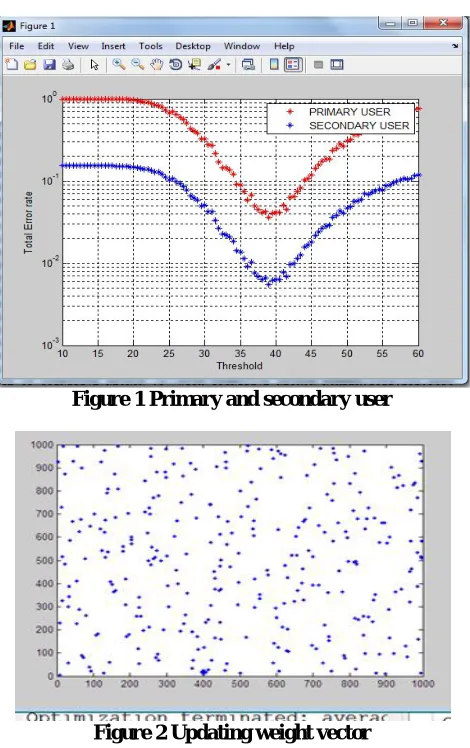
Figure 1 Primary and secondary user
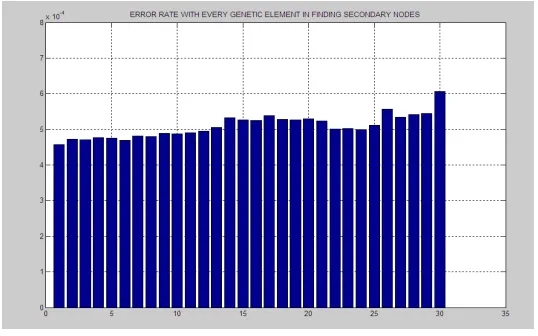
Figure 2 Updating weight vector
Above Figure shows, updating of weight vector of the nodes ranging from 0 to 1000.
Figure 3 Genetic training model
ISSN(Online): 2320-9801
ISSN (Print): 2320-9798
I
nternational
J
ournal of
I
nnovative
R
esearch in
C
omputer
and
C
ommunication
E
ngineering
(An ISO 3297: 2007 Certified Organization)
Vol. 3, Issue 5, May 2015
Figure 4 Total number of genetic processing
Above figure shows the processing of the genetic algorithm over the genetic vector .
Figure 5 Genetic Distance matrix
Above figure displays the genetic element distance matrix, using genetic model. The graph says that there are ten genetic elements and each genetic element posses a weight. The highest weight model will be selected as the genetic element for the current round. Each genetic element must satisfy the validation in each round to get selected. The validations are selected by the fitness function of genetic element model itself and it also depends upon the mutation and cross over of the taken genetic element.
Figure 6 Error rate with Genetic
ISSN(Online): 2320-9801
ISSN (Print): 2320-9798
I
nternational
J
ournal of
I
nnovative
R
esearch in
C
omputer
and
C
ommunication
E
ngineering
(An ISO 3297: 2007 Certified Organization)
Vol. 3, Issue 5, May 2015
Figure 7 Max speed versus identification rate
The above figure shows the graphical representation between maximum speed and identification rate. It has been found out that using genetic algorithm the speed has been enhanced.
Figure 8 Throughput versus Identification rate
The above figure shows the graphical representation between throughput and identification rate. It has been found out that using genetic algorithm the throughput has been enhanced.
ISSN(Online): 2320-9801
ISSN (Print): 2320-9798
I
nternational
J
ournal of
I
nnovative
R
esearch in
C
omputer
and
C
ommunication
E
ngineering
(An ISO 3297: 2007 Certified Organization)
Vol. 3, Issue 5, May 2015
Figure 9 Recognition rate versus time
The above figure shows the graphical representation between recognition rate and time. It has been found out that using genetic algorithm the node movement has been enhanced.
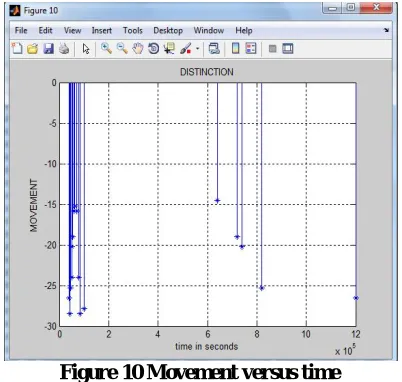
Figure 10 Movement versus time
The above figure shows the graphical representation between movement and time. It has been found out that using genetic algorithm the node movement has been enhanced in terms of time.
VI. CONCLUSION AND FUTURE WORK
Conclusion
To solve an optimization task, the given problem is needed to have a well-defined mathematical statement. Many problems can be solve in traditional ways but in cases with a very large solution set and no deterministic solution for a given problem, then an evolutionary computing approach like GA is required.
Still GA does not give a 100% solution of a problem, but it does give a solution which is one of the best for the problem. Due to the random behavior of GA, no one can predict a 100% solution and its execution time at any stage. The premature convergence of GA is also a big problem in finding a 100% result; in which GA may only find a local minimum and the algorithm just stays in that limit may ignore the optimum solutions. A poor definition of the fitness measure (FM) may also produce a bad solution. In the FM of the chromosome each gene contributes according to their specified gene weight (GW) and fitness point (FM). The FM and GW directly affects the total fitness of the chromosomes and hence the total process. The premature convergence of GA can be controlled in several ways:
ISSN(Online): 2320-9801
ISSN (Print): 2320-9798
I
nternational
J
ournal of
I
nnovative
R
esearch in
C
omputer
and
C
ommunication
E
ngineering
(An ISO 3297: 2007 Certified Organization)
Vol. 3, Issue 5, May 2015
The use of more crossover and mutation will also decrease the chances of premature convergence but still this will also randomize the new generations and will also increase the computation time.
The above mentioned possible solutions are very easy to implement but still there is an ambiguity in radio communications, as the time plays an important role and the QoS requirements of an application may put a limit on the required time. Keeping all these aspects in mind it is concluded that the proposed design is a somehow favorable solution for this spectrum allocation problem in a CR. It gives the best solution among the available solutions in time
Future Scope
This work has the research opportunities in both CR and GA fields. In the future, to get a more optimum solution a proper seed for the population can be proposed also a different crossover or mutation mechanism can be designed to increase the performance. Furthermore, a chromosome with more or less genes can be used.
REFERENCES
1. M. T. Mushtaq, M. S. Khan, M. R. Naqvi and Otto F. Koudelka, “Cognitive Radios and Cognitive Networks: A short Introduction”, Text Road Publication, pp. 56 -65,2013.
2. Pham Tran Anh Quang, Soo-Ro Kim, and Dong-Sung Kim, “A Throughput-aware Routing for Distributed Industrial Cognitive Radio Sensor Networks”, IEEE, pp.87-90,2012
3. Tung, Thanh Le and Dong-Seong Kim, “An Efficient throughput Improvement through Bandwidth Awareness in cognitive Radio Networks”, Journal of communication and networks, Vol.16,2014.
4. Sethi, Pal and Rout, “Effective Performance Evaluation of On-Demand Routing Protocol for Cognitive Radio Ad Hoc Network”, IEEE International Journal of Advanced Computer Research Vol.3, 2013.
5. Salim and Moh, “On-demand routing protocols for cognitive radio ad hoc networks”, Journal on Wireless Communication and Networking, 2013.
6. Xiongzhen Pan, Lingge Jiang and Chen He, “Spectrum Aware Multi-channel Opportunistic Routing in Cognitive Radio Sensor Networks”, IEEE International Conference on Computational and Information Sciences, 2013.