IJEDR1503029 International Journal of Engineering Development and Research (www.ijedr.org)
1
Performance of STBC based Time Frequency
Training OFDM and SC-FDMA with Adaptive
Modulation
1Yasmeen Kaur,2Kamaldeep Kaur
Student, Dept. of Electronics and Comm., Baba Banda Singh Bahadur Engineering College,Punjab1 Assistant Professor, Dept. of Electronics and Comm., Baba Banda Singh Bahadur Engineering College,Punjab2
________________________________________________________________________________________________________
Abstract—Orthogonal Frequency Division Multiplexing (OFDM) is high data rate transmission technique. Further, use of space-time block coding (STBC) to the OFDM system may help in combating severe effects of fading. In this paper, adaptive modulation based M-ary QAM,BPSK system applied to STBC based time frequency training OFDM and SC-FDMA is proposed and BER performances of all these digital modulation schemes have been compared. The TFT-OFDM signal is trained in both time and frequency domain by appending the training sequence and by inserting the grouped pilots, respectively.Such structure helps in providing better spectral efficiency and reliability.The spectral efficiency of the fixed modulation is constant, while it, in general, will increase with increasing channel SNRs for the adaptive scheme.
Keywords: OFDM, TFT-OFDM, fast fading channel, space time block coding,Adaptive modulation
________________________________________________________________________________________________________
I. INTRODUCTION
Orthogonal frequency division multiplexing (OFDM) has proved to be a promising technology for the next-generation communication. Whereas, communication via multiple transmitting antennas can improve bit error rate (BER) performance of transmission. On contrast Single carrier frequency division multiple access (SC-FDMA) has been adopted in the uplink of the LTE standard due to its lower peak-to-average-power ratio (PAPR) compared to OFDM. Space-time block coding (STBC) [1] was proposed as an attractive alternative to its trellis counterpart with a much lower decoding complexity.
There are number of OFDM-based transmission techniques that have been proposed over the recent years. Cyclic prefix-OFDM (CPprefix-OFDM) is the basic prefix-OFDM transmission technique where CP is used for filling the guard space [2].The CP-prefix-OFDM scheme utilizes CP to eliminate inter-carrier interference (ICI) and inter-block interference (IBI). In [3], a modified OFDM transmission technique known as zero-padding OFDM (ZP-OFDM) is proposed where non zero CP is replaced by zero-padding. In the ZP-OFDM scheme, zero samples are used to improve the equalization performance. In the above mentioned schemes, frequency domain pilots are used to perform channel estimation and subsequently same pilots are used for the synchronization purpose. Spectral efficiency is affected by using these frequency domain pilots. Broadcasting standard [4],DMB-T uses a modulation scheme known as time domain synchronous OFDM (TDS-OFDM). In the TDS-OFDM, a known training sequence (TS) instead of CP is used as guard interval. Thisknown TS is used for the synchronization as well as for estimating the channel conditions. As a result, the frequency domain pilots are saved in the TDS-OFDM. Hence, the TDS-OFDM provides about 10% more spectral efficiency,when compared with CP-OFDM and ZP-OFDM. In the TDS-OFDM,the iterative interference cancellation algorithm is used for channel estimation and equalization. In this iterative interference cancellation algorithm, channel equalization and channel estimation are mutually conditioned [5]. Therefore, in fast fading channels, this algorithm suffers from poor performance along with higher complexity.In [1], recently Dai and et al. have proposed, time frequency training OFDM (TFT-OFDM) transmission technique.
The channel estimation scheme, in the TFT-OFDM,is performed in both time and frequency domain. The time domain TS is used for estimating the channel path delay.Whereas, the frequency domain grouped pilots are used for estimating the channel path coefficients. The TFT-OFDM is less spectrally efficient than TDS-OFDM as out of total subcarriers about 3% are occupied by the frequency domain pilots. Meanwhile, the TFT-OFDM has proved to be more spectrally efficient than the other schemes, viz CP-OFDM and ZP-CP-OFDM.But, the BER performance of TFT-CP-OFDM, in fast fading channels, is better than CP-CP-OFDM, ZP-CP-OFDM, and TDS-OFDM [6].The proposal of space-time block coding (STBC) by the Almouti in leads to many investigations, performed on various STBC-based OFDM schemes. The performance of the CP-OFDM with space-time coding is investigated in [6], [7]. In [8], authors have proposed a tracking algorithm for frequency offset of STBC-based OFDM. Authors in [9] have proposed channel estimation and equalization schemes for the STBC based ZP-OFDM with complex input signals. The STBC based TDS-OFDM is investigated and also an efficient channel estimation, for the same, is also proposed in [10].
IJEDR1503029 International Journal of Engineering Development and Research (www.ijedr.org)
2
condition. When the channel conditions are favourable transmission done with higher data rates but, when the channel conditions are degraded transmission occurred with lower data rates.In this paper,STBC based TFT OFDM is implemented and STBC based TFT SC-FDMA is porposed,both these systems are implemented with adaptive modulation concept using four modulation schemes i.e,BPSK,4 QAM,16 QAM and 64 QAM.In this scheme, unlike other STBC based the signal is trained in both time and frequency domain. In the time domain, a known TS is appended to the data block. In the frequency domain, some groups of pilots are uniformly distributed randomly over the signal bandwidth. Orthogonal signals are generated using STBC encoding. At the receiver’s end, TS is used for estimating the channel path delay and groups of pilots help in estimating the path coefficients.Rest of paper is organized as: Section II discusses system model of STBC-based TFT-OFDM. In section III and IV, basic concept of TFT-OFDM is described and introduction to Adaptive Modulation, respectively. Section V provides simulation results and discussion.
II. SYSTEM MODEL
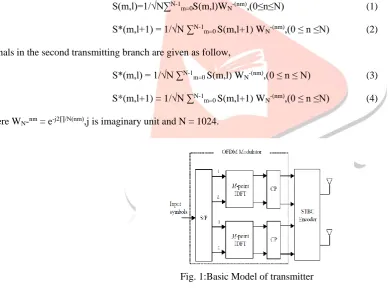
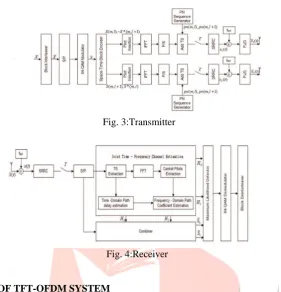
The TFT-OFDM-based communication system using STBC coding are considered. In figure 1 and 2 basic model of OFDM Transmitter and Receiver respectively are shown and in figure 3and 4, the block diagrams of transmitting and receiving ends for STBC-based TFT-OFDM system are shown.
At the transmitting end, the input bits X is fed to the block interleaver. Then, serial-to parallel conversion of the interleaved data ˜X is performed.Using 64-QAM modulation, constellation mapping of this parallel data is performed symbol-by-symbol. These constellation mapped symbols S are fed to the STBC encoder and two output sequences are produced. If S(m, l)represents the symbol on mth subcarrier in the frame l. Then,for consecutive frames, starting from lth frame, the symbol on mth subcarrier is represented as [S(m, l),−S∗(m, l + 1)],in the first output sequence, and [S(m, l + 1), S∗(m, l)], in the second output sequence. These sequences are fed to the respective transmitting branches. Afterwards, the frequency domain groups of pilots are randomly distributed over the complete signal bandwidth [4]. Inverse fast fourier transform(IFFT) is performed for producing the time-domain signals.Signals in the first transmitting branch are given as follow,
S(m,l)=1/√N∑N-1m=0S(m,l)WN-(nm),(0≤n≤N) (1)
S*(m,l+1) = 1/√N ∑N-1m=0 S(m,l+1) WN-(nm),(0 ≤ n ≤N) (2)
Signals in the second transmitting branch are given as follow,
S*(m,l) = 1/√N ∑N-1m=0 S(m,l) WN-(nm),(0 ≤ n ≤ N) (3)
S*(m,l+1) = 1/√N ∑N-1m=0 S(m,l+1) WN-(nm),(0 ≤ n ≤N) (4)
where WN-nm = e-j2∏/N(nm),j is imaginary unit and N = 1024.
Fig. 1:Basic Model of transmitter
IJEDR1503029 International Journal of Engineering Development and Research (www.ijedr.org)
3
A known time-domain TS is added to the above mentioned signals. This TS is only for estimating the channel delay. So, TS can be any sequence with good autocorrelation property. Such a sequence is generated and added to the signal before transmission.At the receiving end, the received signal is down converted,pulse-shaped and sampled Afterwards, the TS is extracted and used for estimating the channel path delay by simply performing the circular correlation of the receiver TS and the known TS. Subsequently, the fast fourier transform(FFT) of rest of the signal is performed. The central pilots from the groups of pilots are extracted. The estimated path delays and the extracted central pilots are used for estimating channel path coefficients.Fig. 3:Transmitter
Fig. 4:Receiver
III. BASIC CONCEPT OF TFT-OFDM SYSTEM
CP-OFDM scheme utilizes the cyclic prefix to eliminate the Inter-Block Interference (IBI) as well as the Inter-Carrier Interference (ICI). The Cyclic prefix is replaced by zero samples in Zero Padding OFDM (ZP-OFDM) to deal with the channel null problem and improve the equalization performance.
Both the CP-OFDM and ZP-OFDM schemes required some dedicated frequency domain pilots for synchronization and channel estimation, thus the spectral efficiency is reduced. To solve this problem, instead of the cyclic prefix, the known training sequence such as the pseudorandom noise sequence, is used as the guard interval in the Time Domain Synchronous OFDM (TDS-OFDM) scheme in [1]. Since the training sequence is known to the receiver, it can be also used for synchronization as well as channel estimation. Therefore, the large amount of frequency domain pilots used in the CP-OFDM and ZP-OFDM could be saved. Thus, TDS-OFDM outperforms CP-OFDM and ZP-OFDM.
The interference caused by the training sequence can be removed if the channel estimation is perfect, since the training sequence is known at the receiver. In addition, this Inter-Block Interference (IBI) can be calculated with relatively low complexity since the training sequence length is not large. However, the interference caused by the OFDM data block has to be calculated with high complexity, since the OFDM block length is usually large. More importantly, such interference cannot be totally eliminated even when the channel estimation is ideal, because the OFDM data block is random and unknown, and perfect OFDM detection is difficult due to the noise, the ICI, the imperfect channel equalization, and so on.
Therefore, TDS-OFDM is not accurate over fast fading channels. Such estimation error would in turn result in the unreliable cancellation of the IBI caused by the training sequence, which would deteriorate the OFDM equalization performance in the next iteration. Consequently, the performance loss is unavoidable.
In the TFT-OFDM scheme, it do not remove the IBI imposed on the training sequence, but directly use the contaminated without IBI cancellation to obtain the partial channel information; the path delays of the channel, while the rest part of the channel information; the path coefficients, are acquired by utilizing the small amount of grouped pilots in the frequency domain as shown in figure 5. In this way, the IBI caused by the OFDM data block needs not to be removed, leading to the breaking of the mutually conditional relationship between the channel estimation and channel equalization in TDS-OFDM in [1].
IJEDR1503029 International Journal of Engineering Development and Research (www.ijedr.org)
4
Figure 5: Signal structure and the corresponding joint time-frequency channel estimation of the TFT-OFDM schemeIV. INTRODUCTION TO ADAPTIVE MODULATION
A modulation method is used to carry digital information over a channel.Since different channels have different properties, the modulation method must convey the information in a form suitable for the particular channel in mind. This is typically done by assigning a waveform to each possible transmitted symbol. Then, the waveform is transmitted over the channel and in the receiver a detector is used to find which of the possible waveforms was transmitted. The frequency spectrum required to transmit the signal depends on the correlation properties of the sequence of symbols to be transmitted and the set of waveforms used to convey the information .Since all practical wireless channels change the transmitted waveforms by at least adding noise and interference, the detection process is never free from making errors. Many channels change the transmitted waveform in more complicated ways.
Adaptive modulation is a way to provide balance between Bit Error Rate (BER) and SNR through the improvement of the Spectral Efficiency. It is possible to make effective use of adaptive modulation in a slowly varying fading channel with noise based on SNR estimation.A major disadvantage with fixed modulation on channels with varying signal-to-noise ratio (SNR) is that BER probability performance is changing with the channel quality. Most applications require a certain maximum BER and there is normally no reason for providing a smaller BER than required. An adaptive modulation scheme, on the contrary, can be designed to have a BER which is constant for all channel SNRs. The spectral efficiency of the fixed modulation is constant, while it, in general, will increase with increasing channel SNRs for the adaptive scheme. This in effect means that the average spectral efficiency of the adaptive scheme is improved, while at the same time the BER is better suited to the requirement of the application. Thus, the adaptive link becomes much more efficient for data transmission. The major disadvantage is that the transmitter needs to know the channel SNR such that the best suitable modulation is chosen and the receiver must be informed on the used modulation in order to decode the information. This leads to an increased overhead in the system as compared with a fixed modulation system.
V. SIMULATION RESULTS AND DISCUSSION
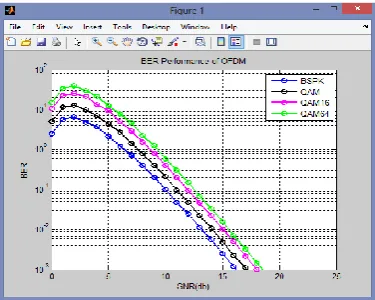
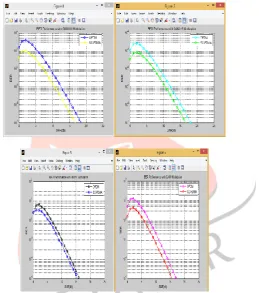
The BPSK,4-QAM,16-QAM and 64-QAM STBC is chosen for the simulation purpose. The detailed information about STBC can be found in [5]. The simulations are performed for the STBC-based TFT-OFDM and STBC based TFT-SCFDMA with adaptive modulation as shown in figure 6 and 7 respectively.The simulation results shows that BER of BPSK is less than other modulation.It can be observed that for a fix value of SNR, the BER increases for high order modulation (16-QAM and 64-QAM) in both the multiple access techniques. (OFDMA and SC-FDMA) used in LTE system.On the other hand, the lower order modulation schemes (BPSK and QPSK) experience less BER at receiver thus lower order modulations improve the system performance in terms of BER and SNR. Figure 8 shows that BER of SC-FDMA is less than OFDM .If the bandwidth efficiency of these modulation schemes is considered, the higher order modulation accommodates more data within a given bandwidth and is more bandwidth efficient as compared to lower order modulation.
IJEDR1503029 International Journal of Engineering Development and Research (www.ijedr.org)
5
Figure 7:BER performance of STBC based TFT SC-FDMA with adaptive modulationFigure 8:BER performance of OFDM with SC-FDMA
Thus, there exists a trade off between BER and bandwidth efficiency among these modulation schemes used in LTE. It is also concluded from the results that, the error probability increases as order of modulation scheme increases. Therefore, the selection of modulation schemes in adaptive modulation is quite crucial based on these results.
REFERENCES
[1] S. Zhou and G. Giannakis, “Single-carrier space-time block-coded transmissions over frequency-selective fading channels,” IEEE Transactions on Information Theory, vol. 49, no. 1, pp. 164179, 2003.
[2] B. Muquet, Z. Wang, G. Giannakis, M. De Courville, and P. Duhamel, “Cyclic prefixing or zero padding for wireless multicarrier transmissions?” IEEE Trans. Commun., vol. 50, no. 12, pp. 2136–2148, Dec. 2002.
[3] J. L. Yu and Y.-C. Lin, “Space-time-coded MIMO ZP-OFDM systems:Semi-blind channel estimation and equalization,” IEEE Transactions on Circuits and Systems I: Regular Papers, vol. 56, no. 7, pp. 13601372,2009.
[4] H. Sari, G. Karam, and I. Jeanclaude, “Transmission techniques for digital terrestrial TV broadcasting,” IEEE Commun. Mag., vol. 33, no.2, pp. 100-109, February 1995.
[5] L. Dai, Z. Wang, and Z. Yang, ”Time-frequency training ofdm with high spectral efficiency and reliable performance in high speed environments,”IEEE Journal on Selected Areas in Communications, vol.30, no. 4, pp. 695707, 2012.
[6] J. Yue and J. Gibson, “Performance of a space-time block coded OFDM system,” Signals, Systems and Computers, 2002. Conference Record of the Thirty-Sixth Asilomar Conference on, vol. 2, 2002, pp. 18621866 vol.2.
[7] Y. Li, J. Chuang, and N. Sollenberger, ”Transmitter diversity for OFDM systems and its impact on high-rate data wireless networks,” IEEE Journal on Selected Areas in Communications, vol. 17, no. 7, pp.12331243 1999.
IJEDR1503029 International Journal of Engineering Development and Research (www.ijedr.org)
6
[9] J. L. Yu and Y.-C. Lin, “Space-time-coded MIMO ZP-OFDM systems:Semi-blind channel estimation and equalization,”IEEE Transactions on Circuits and Systems I: Regular Papers, vol. 56, no. 7, pp.13601372,2009.