Theses and Dissertations
2017
The Effects of Sex and Professional Experience on
Superintendent Selection Decisions by School
Board Chairpersons
Patrick Jarrett
University of South Carolina
Follow this and additional works at:
https://scholarcommons.sc.edu/etd
Part of the
Educational Administration and Supervision Commons
This Open Access Dissertation is brought to you by Scholar Commons. It has been accepted for inclusion in Theses and Dissertations by an authorized administrator of Scholar Commons. For more information, please [email protected].
Recommended Citation
Jarrett, P.(2017).The Effects of Sex and Professional Experience on Superintendent Selection Decisions by School Board Chairpersons.
The Effects of Sex and Professional Experience on
Superintendent Selection Decisions by School Board Chairpersons
by
Patrick Jarrett
Bachelor of Arts
North Greenville University, 2007
Master of Education Converse College, 2011
Specialist in Education University of South Carolina, 2014
_______________________________________________
Submitted in Partial Fulfillment of the Requirements
for the Degree of Doctor of Philosophy in
Educational Administration
College of Education
University of South Carolina
2017
Accepted by:
Henry Tran, Major Professor
Susan Bon, Committee Member
Spencer Platt, Committee Member
Robert Ployhart, Committee Member
© Copyright by Patrick Jarrett, 2017
Dedication
Both this study and its corresponding degree are dedicated to all of my family, without
Acknowledgments
First and foremost, thanks be to God for giving me the ability, drive, and opportunity to
pursue a terminal degree. I have been blessed beyond measure.
I cannot thank enough my wife, Britain, for working tirelessly beside me as I completed
this goal. The pursuit of this degree required great sacrifices by her in terms of time, energy, and
resources that could have been used in other ways. There is no question that I would not have
started, much less completed, this degree without her constant, unquestioned support.
I thank my family for always being supportive and proud of everything I do, this degree
being no different.
I thank Dr. Henry Tran for taking a chance on and being will to work with me as I
accomplished this task. The constant level of rigor he demanded from me was only surpassed by
the level of support he provided me. Through both, he challenged and helped me to grow and
be capable of more than I thought possible.
Thanks also goes to Drs. Bon, Platt, and Ployhart for graciously serving on my committee
Abstract
The purpose of this research was to examine the effects that a superintendent candidate’s sex
and professional background and school board chairpersons’ sex have on resume screening
decisions. School board chairpersons were selected randomly from across the United States to
receive one of six types of hypothetical superintendent candidates’ resumes and respond to a
survey which requires subjects to rate the likelihood they would recommend the candidate
depicted in the resume for an interview. Variables examined were candidates’ sex (male vs.
female), professional experience (business vs. education vs. military) and sex-similarity with
school board chairperson. An ordinal regression was used to identify differences in interview
Table of Contents
DEDICATION ... iii
ACKNOWLEDGEMENTS ... iv
ABSTRACT ... v
LIST OF TABLES ... viii
LIST OF FIGURES ... ix
CHAPTER 1: INTRODUCTION ... 1
CHAPTER 2: LITERATURE REVIEW ... 7
The Superintendency ... 7
Selection Process of the Superintendent ... 16
Barriers to the Superintendency ... 32
Theoretical Framework ... 46
Purpose of the study ... 50
CHAPTER 3: METHODS ... 52
Procedure ... 52
Survey Response Rate ... 58
CHAPTER 4: RESULTS ... 66
Analysis Checks ... 66
Results ... 72
CHAPTER 5: CONCLUSION ... 78
Discussion ... 78
Limitations ... 84
Recommendations for Future Research ... 85
REFERENCES ... 88
APPENDIX A: FEMALE BUSINESS CANDIDATE RESUME ... 113
APPENDIX C: FEMALE EDUCATION CANDIDATE RESUME ... 117
APPENDIX D: MALE EDUCATION CANDIDATE RESUME ... 119
APPENDIX E: FEMALE MILITARY CANDIDATE RESUME ... 121
APPENDIX F: MALE MILITARY CANDIDATE RESUME ... 125
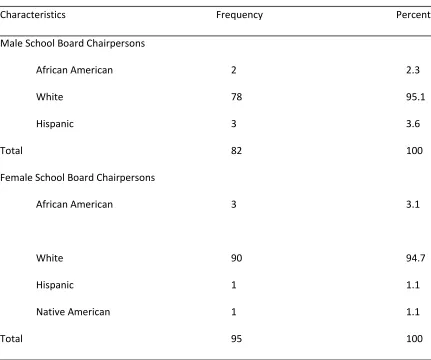
Table 3.1 School Board Chairpersons’ Demographics ... 59
Table 3.2 School Board Chairpersons Participation Frequencies by Treatment Group ... 60
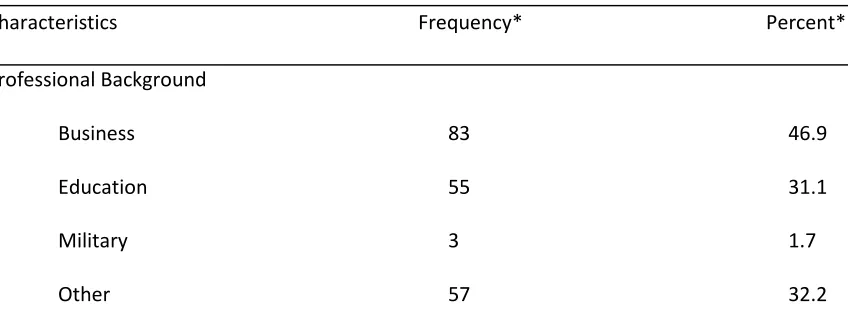
Table 3.3 School Board Chairpersons’ Professional Backgrounds ... 61
Table 3.4 Descriptive Statistics of Variables ... 63
Table 3.5 Variance of Respondents’ Number of Selections Between Treatment Groups ... 63
Table 3.6 Variance of Respondents’ District Sizes Between Treatment Groups ... 64
Table 4.1 Coefficients ... 67
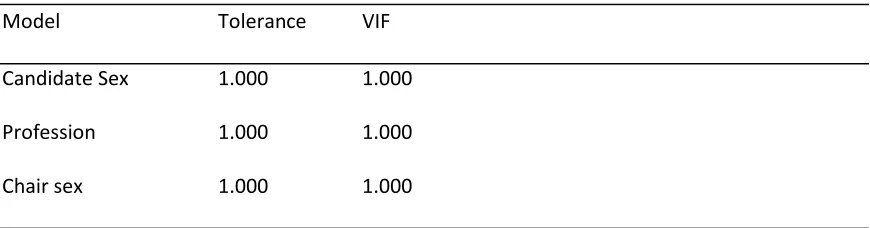
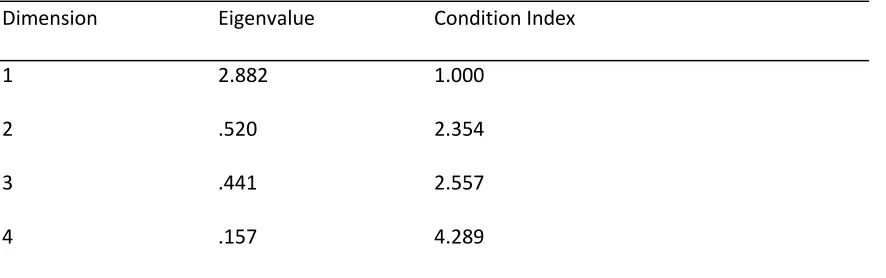
Table 4.2 Collinearity Diagnostics ... 68
Table 4.3 Test of Parallel Lines ... 69
Table 4.4 Model Fitting Information ... 70
Table 4.5 Goodness-of-Fit ... 71
Table 4.6 Pseudo R2 ... 72
List of Figures
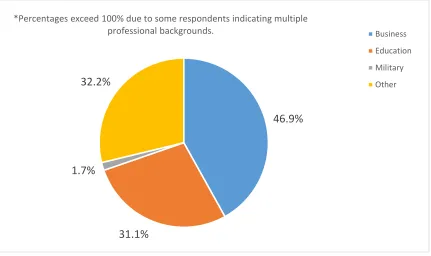
Figure 3.1 Professional Backgrounds of Respondents ... 62
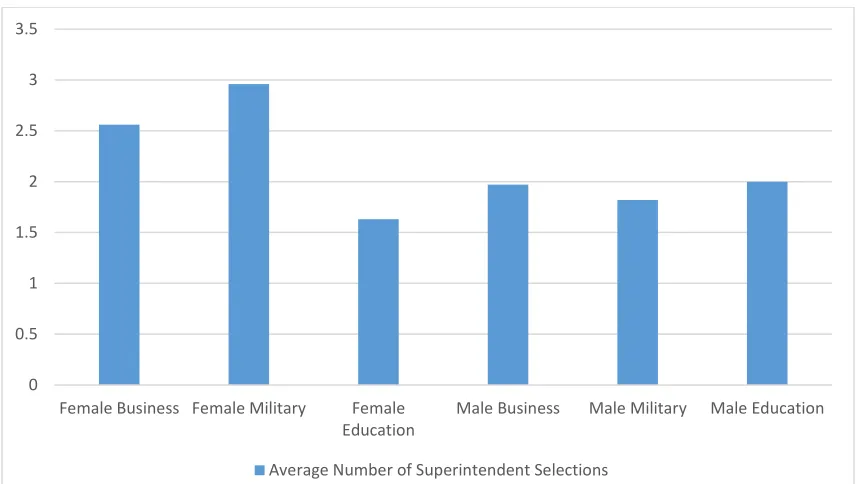
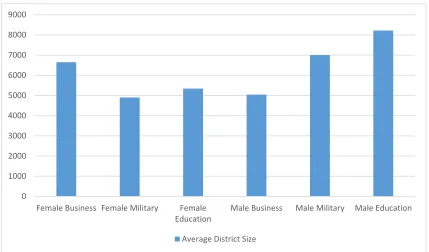
Figure 3.2 Number of Superintendent Selections of Respondents by Treatment Group ... 64
Chapter 1
Introduction
A superintendent is normally considered a school district’s most visible and influential
figure. As such, the superintendent is often seen as the “face” of the school district – for both
the community he or she serves and the educators he or she leads. Interestingly, even with the
great diversity of communities and school districts which exist across the United States,
American superintendents are most frequently White, male, and career educators (Kowalski,
McCord, Petersen, Young, & Ellerson, 2011).
While females comprise 76% of American public school teachers (National Center for
Education Statistics, n.d.) and 52% of public school principals (Goldring, Gray, & Bitterman,
2013), only 24% of public school superintendents are female (Kowalski et al., 2011). Although
the percentage of superintendents who are female is comparable to that of college presidents
(26%) (Cook, 2012) and far greater than that of Fortune 500 CEOs (4%) (Zarya, 2016), it is still
much lower than one might expect considering the disproportionately high percentage of
females who enter the field of education. In response to these glaring disproportions, Glass,
Björk, and Brunner (2000) asked: “What deters large numbers of women from becoming
superintendents? Is the position not alluring to women? Are preparation program entryways
blocked? Are school board members not inclined to hire women? Are search firms not bringing
Many have postulated plausible explanations for the dearth of female superintendents;
some of the causes are self-selected by females and others are external. Sperandio and Devdas
(2015) suggest that many women do not aspire for the superintendency, but, rather, seek roles
more closely linked to students. Grogan and Shakeshaft (2013) state that female educators’ care
for students, which is what most often motivated them to become educators in the first place,
compels them to seek roles which can directly influence students. Some have claimed women
often make career choices aimed at achieving personal satisfaction rather than career
advancement (Grogan & Shakeshaft, 2013).
One aspiring for a future superintendent position will likely have to move several times
during the course of their career in order to capitalize on vertical mobility opportunities
(Sperandio & Devdas, 2015), yet many women choose not to relocate (Glass, 2000). Munoz et al.
(2014) state that women applying for superintendent positions give up too quickly. Whatever
the reason, women are not pursuing the superintendency proportionate to the number of
women who have or are pursuing superintendent certification (Grogan & Brunner, 2005). The
most widely cited explanations for female underrepresentation are a lack of encouragement for
women to pursue the superintendency and discrimination by school board members (Glass,
2000). Some (e.g., Brunner & Kim, 2010; Sperandio & Devdas, 2014; Tallerico, 2000) posit the
latter as the paramount deterrent to more common female-occupied superintendencies.
Glass (2000) states that, although school board discrimination may play a role, the
female superintendent disparity is at least partially attributed to a number of other factors as
well, specifically that female educators: are not in positions that normally lead to the
superintendency; are not gaining superintendent credentials in preparation programs; are not
as experienced nor as interested in districtwide fiscal management as their male counterparts;
purposes other than pursuing leadership opportunities; and enter administrative positions too
late in their careers. In a direct retort to Glass (2000), Brunner and Kim (2010, p. 279) describe
Glass’ assertions as “myths and misunderstandings” and refute each, save discrimination.
Brunner and Kim (2010, p. 301) go so far as to state that they “can offer no explanation for the
dearth of women in the superintendency other than the fact that long-held biases” are the root
cause.
Stating the national underrepresentation of female superintendents is due to school
board members’ discrimination during the selection process is not a novel idea, but it is one that
lacks sufficient evidence. Claiming that the underrepresentation of female superintendents is
because board members are biased against female superintendent candidates and
substantiating that claim by pointing to the fact that females are not assuming the role of
superintendent in equitable proportions (see: Brunner & Kim, 2010) is circular reasoning – the
premise is supported by the conclusion, which is supported by the premise. Furthermore, 44%
of school board members nationally are female (National School Boards Association, 2015),
which seems to subvert this claim. Are men discriminating against women? Are women
discriminating against other women? Are there other possible factors at play? Brunner and
Kim’s (2010) assertion may very well be correct; however, more evidence is necessary to
corroborate, or perhaps invalidate, the claim.
In addition to being mostly male, superintendents are overwhelmingly career educators
(Kowalski et al., 2011). Considering that the superintendency is a position within the educational
profession this fact might seem intuitive; however, there has been a notion promulgated since
the 1980s that perhaps traditional superintendent types are not the answer to the public
education crisis. In 1983 A Nation at Risk (National Commission on Excellence in Education) was
One of the results of A Nation at Risk was a renewed interest in market-based school
reforms, such as increased school choice options and availability, increased school
accountability standards, and deregulation (Dudley-Marling & Baker, 2012). This free-market
approach to education, often referred to as neoliberalism (Harvey, 2007), has faced political
resistance, and yet has had numerous effects on public education. One effect has been the
introduction of voucher-based school choice initiatives in places such as Milwaukee, Cleveland,
and Florida and a 500% increase in attendance of charter schools nationally (U.S. Department of
Education, 2015).
Perhaps the most profound impact that neoliberalism has had on American schooling
came through the passage of No Child Left Behind (NCLB) in 2001. NCLB, which has been
embraced by groups across the American political spectrum, incorporates many market-based
concepts such as high-stakes testing and accountability, deregulation, school choice options,
merit pay, and competition among schools (Dudley-Marling & Baker, 2012). One of the results of
the rise of neoliberalism in modern American schools has been a re-thinking of school
leadership preparation and qualifications. Specifically, rather than recruiting traditional
superintendents, who began their rise to the top of school districts from the ranks of teachers,
some have called for an influx of non-educators, business and military leaders mostly, to lead
school districts to more efficient and effective outcomes (e.g., Eisinger & Hula, 2004). With
nearly half of school board members nationally being business professionals, and only relatively
few having professional education experience (Hess, 2002), one might expect a preference for
superintendent candidates with proven professional experience. Yet, the movement towards
nontraditional superintendent leadership has gained only modest traction, with nontraditional
superintendents comprising only about 5% of superintendents nationally (Kowalski et al., 2011).
superintendents – after all, nontraditional superintendents have yielded mixed results, at best
(Eisinger & Hula, 2004; Glass, 2006) – but merely to gain a better understanding of school board
members’ views of such candidates.
Another factor to consider as a potential influence on superintendent selection
decisions is the similarity-attraction paradigm, which requires the researcher to examine not
just the candidate’s sex, but that of the employer as well. Byrne’s similarity-attraction paradigm
(1971) postulates individuals like and are attracted to others who are similar, especially in held
attitudes and beliefs, which can influence selection decisions made by employers when such
characteristics become known or perceived. Within the confines of the screening stages in the
selection process, attitudes, values, or beliefs are not usually recognizable for observers of
paper credentials; however, demographic similarity between the employer and candidate on
characteristics such as sex can lead to perceived similarity in attitudes and beliefs because one
might believe that individuals of the same sex might have similar life experiences, resulting in
other similarities. This type of perceived similarity can in turn lead to interpersonal attraction
and bias in a selection decision (Graves & Powell, 1995). Fifty-six percent of school board
members are male (National School Boards Association, 2015), meaning that if
similarity-attraction effects are real in the screening decisions of superintendent candidates, then that
might be a contributing factor to the dearth of female superintendents.
The purpose of this study is to investigate the effects that superintendent candidates’
sex and professional experience and the sex of the school board chairperson have on screening
decisions. In so doing, the study will begin to expose whether or not biases exist – and to what
extent – which may explain the disproportionate percentages of female and nontraditional
of many on either side of the discussions, such as those aforementioned, who have posited
reasonable explanations for the disproportions.
The ability to yield empirical evidence to these discussions alone makes this study
significant because there is very limited research that examines the influences of sex and type of
experience on the selection of superintendent candidates. Furthermore, although research
examining the selection decisions of employers has been existent for over a century (e.g.,
Mayfield, 1964; Scott, 1915; Wagner, 1949), and many of these studies have been within the
public educational context (e.g., Reis, Young, & Jury, 1999; Young, 2005), rarely, if ever, have
school board members been the subjects of such research. Therefore, by examining the school
board members’ selection decision-making processes, the current study does far more than
address the above-stated research questions – it serves as a potentially seminal work for a new
stream of future research examining school board members’ perceptions and bias directly
Chapter 2
Literature Review
This chapter will describe the superintendency, both its historical and current statuses.
Additionally, staffing practices, especially the selection processes of superintendents, will be
discussed at length. Finally, barriers to the superintendency will be detailed as arguments for
the use of valid staffing practices and as an impetus for this study.
The Superintendency
The superintendent is arguably the single most influential, catalytic, and crucial person
within American public school districts when it comes to district decision making. He or she
wields great influence over the choice and implementation of district initiatives, district- and
school-level personnel selection decisions, and the culture and climate of the district and
schools within the district. A superintendent is the personification of, spokesperson for, and
leader to the entire educational community of the district.
Technically, superintendents possess little actual authority. With some variation from
state to state, school boards are vested by their state legislatures with the responsibility of
managing the educational system within the district and it is the board members who possess
actual authority in all school district-related matters (National School Boards Association, 2015).
The superintendent, whom the board appoints and dismisses, excepting districts in which the
the superintendent has strong influence over the board’s decisions in that his or her opinion and
experience is often trusted and accepted by the board.
The history of the superintendency. It is customary for effective and well-functioning
school boards to defer management authority of day-to-day operations to the superintendent
and to rely on his or her advice and input on all matters (Lee & Eadens, 2014), but that has not
always been standard practice. During the approximate 180 years that the position of school
superintendent has existed in the American public education context (Brunner, Grogan, & Björk;
2002), the roles and responsibilities of the position have evolved drastically.
The first superintendents were appointed in 1837 in Buffalo, New York and Louisville,
Kentucky, as the administrative duties of overseeing a school district in such large cities began to
be too much for the local governing board (Sharp & Walter, 2004). By 1850, school systems in 13
large cities had employed a superintendent and by 1900 most city school districts had a
superintendent (Kowalski, 2005). The need for the employment of a superintendent arose as a
result of many factors, including the increase in size of many city school districts, the
consolidation of rural school districts into larger districts, an expanded state curriculum in many
states, the passage of national compulsory attendance laws, mandates for increased
accountability, and ever-increasing efficiency expectations influenced by industrialization
(Kowalski, 2003).
Superintendents at first were primarily a mere clerk to the school board (Carter &
Cunningham, 1997; Petersen & Barnett, 2003); however, over time the role evolved into the
school board’s chief executive and administrative officer (American Association of School
Administrators, 1994). The role expectations of district leaders has progressed through stages of
communicator (Callahan, 1966; Kowalski, 2013), with the challenges and complexity of the job
ever-increasing and changing (Houston, 2001).
Superintendent as teacher-scholar. The earliest superintendents were essentially
master teachers (Callahan, 1962), often viewed as intellectual leaders who authored
professional journal articles and eventually became state superintendents and/or members of
academia (Björk, Kowalski, & Browne-Ferrigno, 2014). Beginning around the time of the War
Between the States, these men were seen as scholarly educational leaders and sometimes even
philosophers. They saw themselves as leaders in the community and teachers of teachers
(Callahan, 1966). The primary foci of these men were to implement state curriculum, which was
intended to instill values of American culture into students, and supervise teachers (Kowalski,
2005).
Up until the 20th century, some of the most prominent and well-known superintendents
were William Torrey Harris and William H. Maxwell. The former, a Yale-trained leader in
education and philosophy, saw the role of the superintendent as an efficient manager of school
operations, effective leader of teachers and the school culture, and outspoken advocate for the
school to the community. Maxwell, the superintendent of Brooklyn schools from 1887-1898,
believe the most important qualification for teaching was scholarship (Callahan, 1966).
The prestigious perception of early superintendents allowed these individuals the ability
to refract more modern expectations of superintendents being politicians or managers. These
superintendents did not see themselves as being separated from the teaching profession, but,
rather, spent most of their time supervising instruction or participating in scholarship.
Managerial duties were usually handled by the school board members (Kowalski, 2005).
the emphasis of superintendents as being instructional leaders has reemerged since the 1980s
(Björk, Kowalski, & Browne-Ferrigno, 2014) with 60% of modern superintendents indicating
instructional leadership as a substantial emphasis expected of them by their school boards
(Kowalski et al., 2011).
Superintendent as organizational manager. The late 1800s in America was an era of
industrialization and scientific management theory and these business movements began to
influence education and the role of the superintendent. The occupation of businessman became
an increasing position of prestige and the business ideologies and models became
ever-more influential in non-business sectors of society (Callahan, 1966). This shift came, in large
part, in pragmatic response to logistical and financial crises faced by schools around 1900 as
poor non-English-speaking immigrants, primarily from Southern and Eastern Europe poured into
America at the rate of 1 million per year. Additionally, child labor laws were enacting during
these same years, resulting in a cumulative effect of massive influxes of mostly poor and
poorly-educated students into the classrooms, stretching resources thin (Callahan, 1966).
During this critical time, school boards dominated by business-minded individuals began
assigning management duties to superintendents, such as the management of personnel,
facilities, budgets, and operations in addition to their instructional roles (Björk, Kowalski, &
Browne-Ferrigno, 2014). By 1920, superintendents were expected to be scientific managers who
were capable of improving operations by concentrating on time and efficiency (Kowalski, 2005;
Tyack & Hansot, 1982). Although the managerial concept of the superintendency lost
momentum in the 1930s following the stock market crash, strong managerial expectations
Superintendent as democratic statesman. Björk and Gurley (2003) described
superintendents of this era as astute political strategists, which, due to the philosophical and
political realities of the time period (Kowalski, 2005), was a necessary role and accurate
description. With the scarcity of resources that plagued the 1930s came the need for
superintendents to lobby and secure financial resources to maintain the viability of their
schools. This further propelled superintendents into the realm of politics as public education
came into competition with other public agencies for funding.
In addition to parents, school board members, and the local community,
superintendents were tasked with developing advantageous relations with policymakers and the
larger taxpaying community, highlighting the political acumen suddenly necessary in order to
effectively champion their schools’ interests. During this difficult post-Great Depression era, an
effective superintendent was seen as one who could accrue financial and political capital for
district initiatives. District problems had become economic, social, and political in nature and
knowledge and skills, rather than philosophy, were necessary to solve them (Kowalski, 1999,
2005). Since the 1930s, the methods by which superintendents carryout their political
responsibilities may have changed, but the political role they serve has not diminished (Björk,
Kowalski, & Browne-Ferrigno, 2014).
Superintendent as applied social scientist. After 1954, the focus of educational
leadership shifted from the idealistic to the realistic – from what educational leadership was
rather than what it should be. During this era of improved scientific research, effective
superintendent practice was seen as having research-based understandings of human beings
and organizations and applying that knowledge in practical ways. University-based administrator
preparation programs adjusted their curriculum to address not merely practitioner-based
Browne-Ferrigno, 2014). Callahan (1966) described four major factors which contributed to the
transformation of superintendent to applied social scientist: a growing dissatisfaction with
“democratic administration”, which was the popular educational leadership style of the time; a
rapid advancement in social sciences following the end of World War II; work done by the
Kellogg Foundation to advance of educational administration; and intense criticism of schools
and administration between 1950-1954, which was partially a byproduct of the hysteria of
McCarthyism, greater demand for educational services, and increasing enrollment.
After World War II, the concept of democratic leadership was criticized as being less
useful and pragmatic than necessary. Critics argued that the idealistic view of shared leadership
only exacerbated political, social, and economic problems (Kowalski, 2005). A calculated,
scientific approach to leadership, specifically at the superintendent level, was promulgated by
many.
Social science research underwent a rapid development in the years following World
War II. During the 1950s, the Kellogg Foundation allocated more than $7 million to major
universities to support research in social sciences. Many argued that social science concepts
were central to the administrative and leadership-oriented roles of the superintendent
(Kowalski, 2005), and, therefore, superintendents were expected to act upon and implement
the myriad of research flooding in.
Many factors contributed to emerging social and political concerns related to schools:
segregation’s demise was eminent, families were leaving for suburbs in masses, post-World War
II baby boomers were enrolling in schools in large numbers, and the Cold War concern was
were considered to be ill-prepared for the task (Kowalski, 2005). As a result, the role of the
superintendent was expected to transform to the empirical and pragmatic.
Superintendent as communicator. Beginning in the mid-1950s, America has become an
increasingly information-based society, which has continually increased the communicative
expectations of superintendents regarding their communication abilities and frequency (Björk,
Kowalski, & Browne-Ferrigno, 2014). Educational reforms occurring post-A Nation at Risk and
subsequently have underscored the importance of superintendents to engage in open dialogue
with stakeholders in order to maintain district support and deflect negative attention (Björk,
Kowalski, & Browne-Ferrigno, 2014). It is considered axiomatic that communication is absolutely
essential for an organization to function effectively, and an organization’s leaders, most
important of all, must be able to communicate well in order to sustain a healthy, communicating
organizational culture. The superintendent must practice effective communication by regularly
informing the school board with information, interacting with parents and other community
members, leading district personnel and initiatives. Employing oral, written, and crisis resolution
communication skills through various mediums such as district websites, newspapers, local
news outlets, social media, and in-person are considered essential functions.
The role and perception of the superintendency has changed over time as a result of
social, economic, and political conditions. The history of the superintendency shows that as the
role of the superintendent position changes, it does so by adding new responsibilities and
expectations, rather than replacing former, with the superintendency increasingly becoming
more and more complex and challenging with each new era of focus. As the position becomes
more challenging, so does the process of selecting individuals who have the necessary skill set
The roles and responsibilities of superintendents. A superintendent has numerous
district responsibilities for which he or she is directly or indirectly accountable: facility and
transportation management, financial planning and supervision, curriculum and instruction
leadership, policy implementation, public relations via numerous media vehicles, modeling
leadership to and developing it within school leaders, and school board liaison (Weiss,
Templeton, Thompson, & Tremont, 2015). Depending on the location, size, and social setting of
the district, the actual duties associated with the title of superintendent can vary greatly from
one district to another. In small and rural districts, superintendents often are directly
responsible for all of the above-mentioned functions; large and urban districts contain a cabinet
of district-level administrative personnel to whom the superintendent delegates one or more of
those functions. The role of school board liaison – which includes informing, collaborating with,
and enacting the wills of the school board – is the most important function of the
superintendency and cannot be delegated.
Superintendents are very powerful individuals not only in the realm of education, but
also in the community and politics. Building and maintaining community support for the school
district is an ever-increasing function of a superintendent. District leaders are encouraged to
develop partnerships with local organizations to accomplish common goals through
coordination, cooperation, or collaboration (Kowalski, 2013).
Some see school districts as vehicles for social justice and reform (e.g., Ratts, DeKruyf, &
Chen-Hayes, 2007), while others expect schools to preserve and transmit social norms and
values held by the community. The tension between these two conflicting perceptions is
political as much as it is philosophical, and, as the visible representative and leader of the
or promote one or both sides (Kowalski, 2013). The station holds much power of persuasion as
to which side, or direction, the district will lean.
For over a century, scholars and observers of education have understood
superintendents are in the position most influential on the quality of education the students
within their districts receive (Callahan, 1966; Rice, 1893). In a meta-analysis study of over 30
years of research, Waters and Marzano (2006) found superintendent leadership to be positively
correlated (r = .24) with student achievement. Numerous studies have since suggested
superintendents’ characteristics (Hough, 2014), tenure (Myers, 2011; Simpson, 2013), and
experience (Plotts & Gutmore, 2014; Thompson, Thompson, & Knight, 2013) all strongly impact
student achievement.
No other person is so influential on the accomplishment of secondary academic district
objectives, such as equity and personnel development. Superintendents serve as tone-setting
moral agents who have the capacity to reduce achievement gaps and ensure equitable
educational experiences for all whom are under their authority (Sherman, 2008; Wright &
Harris, 2010). The development and sustaining of learning communities within schools – a
popularly verbalized priority in school districts – is a function for which superintendents are
positioned as the primary catalyst (Sackney & Mitchell, 2008).
As important, influential, and rewarding as the job of superintendent can be, it is also
very complex, difficult, and demanding. Due to the expectations of appeasing the school board
and local community, supporting and leading the educational community, pleasing parents, and
serving students, conflict between competing stakeholders is common and managing such
conflict can be quotidian for superintendents (Cuban, 1988). A superintendent must be able to
hypercriticism from outside groups (Carter & Cunningham, 1997), which might explain why
many superintendents’ tenures are so short and why many forego the superintendency
altogether (Grogan, 2008).
The Selection Process of the Superintendent
Considering the significant impact superintendents have on the success of their
students, teachers, and schools, choosing the best candidate to fill a superintendency vacancy is
the most important and challenging function a school board must perform (Hord & Estes, 1993).
Selecting the right candidate to fill a vacancy is crucial for any organization to operate
productively and efficiently (Borucki, 1983; Dipboye, 1992; Heneman, Judge, &
Kammeyer-Mueller, 2014) and is one of the most potent ways to shape the characteristics of an
organization (Wilk & Cappelli, 2003). The potency is amplified multiplicably when the candidate
selected is to be chosen to become the future leader of the organization.
Superintendent selection, as important as it is, is a task for which board members are
often underprepared (Kowalski, 2013). The significance of the selection decision, in conjunction
with the potential for community scrutiny of or litigation due to the board’s selection
performance, is likely a cause for the increased trend in employing professional search
consultants in the last few decades (Kowalski, 2003). Whether boards choose to conduct the
staffing process on their own or under the guidance of a consulting agency, effective staffing
should be the board’s priority.
School boards across the country differ in their sizes – ranging from just a few members
on a board to a dozen or even more – and in how membership is obtained – whether through
election or appointment – but some aspects of school boards are ubiquitous. On all matters,
number of board members are in favor becomes the decision of the board and the district. With
many types of decisions, and always with personnel decisions, board members consider, debate,
and/or deliberate on choices behind closed doors, making not just the votes of board members
but also the interpersonal influence of board members on each other the deciding factors in
district decisions.
An unofficial but often-present practice of many school boards is an enhanced influence
of the school board chairperson. The chairperson, as a board member, has just one vote on all
matters just as does their board member peers; however, the influence and prestige that
corresponds with the position of chairperson coupled with the relational influence that
chairpersons often have on their peers magnifies the influence of their vote and opinion. In
addition, chairpersons are usually elevated to the position by their board member peers, which
means they are usually seen quite favorably by their peers. Many board chairpersons have the
added responsibility of serving as the public voice of the entire school board or even the entire
district, a practice which can further magnify the chairperson’s influence in non-unanimous
school board decisions.
The importance of effective staffing practices. Generally, the selection process for
superintendents follows the same staffing practices as many other comparable occupations.
Ployhart, Schneider, and Schmitt (2006) define staffing as the process of finding, assessing,
placing, and evaluating individuals for employment within an organization. It can be understood
as the process that establishes and governs the flow of applicants into and within an
organization through recruitment, selection, and employment (Heneman et al., 2014). The
selection stage – rather than recruitment or employment – has been and continues to be a stage
Selection involves the assessment and evaluation of applicants’ knowledge, skills,
abilities, and motivation using various selection methods such as resumes, cover letters,
application blanks, and interviews. A highly effective and legally permissible selection process
incorporates data from these assessments to evaluate an applicant in relation to requirements
of a position to predict the degree to which the applicant would fit the position and organization
(Heneman et al., 2014). The ultimate goal in the selection process is to find a candidate who
possesses the combination of skills, qualities, and motivation needed to improve the
effectiveness and efficiency of the organization.
Terpstra and Rozell (1993) found a relationship exists between the staffing practices an
organization employs and the effectiveness of that organization, and organizations that use
effective staffing processes, such as the use of structured interviews, validation studies, and
cognitive aptitude tests, out produce and outperform competitors (Hunter, Schmidt, & Judiesch,
1990; Kim & Ployhart, 2014). In economic terms, selecting an employee that appropriately fits
the needs of an organization can over time amount to literally millions of dollars in increased
capital; inversely, selecting an employee that poorly fits can cost millions (Schmidt & Hunter,
1998). Effective staffing is even more important within the public school setting because the
quality of the education students receive is what is at stake, which is exponentially more
valuable not only to the individual, but also the community and future generations.
Although it is difficult to overstate the importance for an organization to select the best
candidate to fill a position, it is easy and common to underestimate the difficulty involved in
making productive personnel selection decisions. Decision-makers usually are required to make
predictions of candidates’ future job performance based on limited information that might be
inadequate, inaccurate, or irrelevant. In addition to being challenging, staffing can prove to be a
recruitment, selection, and training processes, making personnel selection a component that an
organization should strive to do well.
Selection methods. Because employers are faced with the challenge of choosing only
one of many applicants to fill a particular position, and the degree of fit and success that each
applicant would bring to an organization is not and cannot be foreknown, employers rely on
certain assessments, or measurements, to make predictions as to the probability that an
applicant will be efficacious in the position and to the organization. An organization has limited
resources to exhaust on recruitment, selection, and employment, so establishing a selection
process to maximize the efficiency and effectiveness of selecting optimal candidates is vital. A
standard approach to increasing efficiency within the selection process is by separating
predictors into two types, initial and substantive assessment methods, with the distinguishing
factor being the amount of resources required to apply each, and using first the least costly
assessments to screen applicants (Heneman et al., 2014).
Initial assessments are utilized to reduce the costs associated with selection by reducing
the number of candidates to be assessed by substantive assessment methods, which require
more time and resources. This phase in the selection process is frequently referred to as
screening. Examples of predictors used to screen applicants are resumes and cover letters,
application blanks, biographical information, reference reports, handwriting analysis, literacy
testing, genetic screening, and initial interviews (Heneman et al., 2014).
After employers have reduced the size of the applicant pool, substantive assessments
are used to make more precise judgments about remaining candidates and are more involved
than initial assessments. Predictors such as personality tests, ability tests, work samples,
which candidate a job should be offered (Heneman et al., 2014). The choice and implementation
of assessments used during the selection process can, and often does, vary greatly between
different industries, different organizations within an industry, and even different managers
within the same organization.
Employers commonly use a combination of predictors to make more informed
inferences about applicants than can be achieved with just one, although more predictors does
not necessarily lead to more accurate inferences (Eisenhouse, 2008; Sarbin, 1943; Schmidt &
Hunter, 1998). Better selection decisions and inferences are made only by utilizing selection
methods with higher predictive validity, which is the most important value of any personnel
assessment method (Schmidt & Hunter, 1998). The higher the validity of an employment
assessment, the more likely the assessment will be in predicting future employment success.
Within the selection context, validity refers to the degree to which inferences made
from selection predictors are accurate (Ployhart et al., 2006). In employment testing, three chief
types of validity exist: criterion, content, and construct validities. Criterion validity demonstrates
applicants who do well on a predictive assessment will do well on the job and vice versa. For
example, if the use of the Armed Services Vocational Aptitude Battery (ASVAB) test positively
predicts performance of job-related abilities in military personnel, that would be an example of
criterion validity: individuals scoring higher on the test are more likely to be successful in
accomplishing certain job-related tasks (Grant et al., 2012), making the test criterion valid.
Content validity, as Lawche (1975) explained in his seminal work, is the degree of
association or overlap which exists between the performance of a task on a job-related test and
the ability to function within the job’s performance domain. For example, since speed is a vital
the 40-yard dash is content valid for most positions in football. A job performance domain is one
or more components of a job about which can be inferred and are operationally defined. Tasks
comprising job performance domains can range from simple, observable (e.g., arithmetic) to
highly abstract (e.g., deductive reasoning). Higher levels of abstraction for the task(s) require
greater “inferential leaps” to demonstrate validity.
The transition from content validity to construct validity occurs when abstraction and
inferential leaps become significant (Lawche, 1975). Construct validity is an investigation of the
psychological qualities a test measures and whether these explanatory constructs are
adequately included in the performance of the test. Construct validity essentially is an attempt
to validate the underlying theoretical construct (American Psychological Association, 1952) or,
as DeVon et al. (2007) simply define it: the degree to which a test instrument measures the
intended construct. Criterion, content, and construct validities are all necessary in order for an
employment assessment to be considered valid.
An example of the use and interrelation of criterion, content, and construct validity
within the educational context would be an examination of cognitive abilities of teacher
candidates. Wayne and Youngs (2003), in a systematic review of the research in the United
States, found teachers’ cognitive abilities to be correlated with student achievement. Grönqvist
and Vlachos (2008) concluded teachers with low cognitive abilities negatively affected the
educational outcomes of their high achieving students. Instruments which can assess teachers’
cognitive abilities, such as general mental ability (GMA) assessments (see below), are criterion
valid if high GMA scores are indicative of high teacher performance. GMAs are said to be
content valid for teacher selection since cognitive ability is a determinedly valuable asset for
cognitive ability is a complex and highly-abstract construct, GMAs must be determined to
adequately measure cognitive ability to be considered construct valid.
Employers, applicants, and the public at large benefit when selection decisions are made
by the most valid means available (American Psychological Association Division of
Industrial/Organizational Psychology, 1979). For this reason, determining the predictive validity
of different types of predictors has been the focus of decades of selection-related research
within the fields of industrial/organizational psychology and education. The compilation of
hundreds of studies conducted in numerous contexts examining the utility and validity of
various employment assessments has provided support, and lack of support, for the use of
various employment assessment methods.
One conclusion the wealth of research has yielded is GMAs are perhaps the most valid
predictor of future job performance and learning for applicants without prior job experience
(e.g., Hunter & Hunter, 1984; Ree & Earles, 1993; Schmidt & Hunter, 1998). GMAs may be
comprised of components such as arithmetic computations, verbal analogies, reading
comprehension, number series completion, and spatial relations (U.S. Office of Personnel
Management, n.d.). Meta-analysis has shown using GMAs ensures that an employer is selecting
employees who are the likely to learn the most from job training programs and the quickest
from job experience, both of which increase productivity (Salgado et al., 2003; Schmidt &
Hunter, 1998). So profound is the totality of validity evidence regarding GMA assessments that it
has been stated the immensity of well-established findings regarding the GMA-performance is
the greatest contribution of the industrial-organizational (I/O) psychology field to intelligence
The relationship between personalities and job performance also has been a
heavily-researched topic within I/O psychology. For the past few decades researchers have investigated
the validity of personality assessments, such as the Big Five, and concluded certain personality
traits can be used reliably to predict job performance across numerous occupations, including
teaching and educational administration (Goldberg, 1990, 1993; Hurtz & Donovan, 2000; Judge
& Zapata, 2015). In their longitudinal study, Judge, Higgins, Thoresen, and Barrick (1999) found
Big Five traits assessed during adulthood and even childhood to be useful predictors of future
career success.
Unfortunately, employment decisions are not always based on valid selection methods.
In fact, the large majority of selection decisions are made using employment assessments that
research has regularly shown to be less valid. As Highhouse (2008) piquantly points out,
“perhaps the greatest technological achievement in (I/O) psychology over the past 100 years is
the development of decision aids that substantially reduce error in the prediction of employee
performance”; and yet “the greatest failure of I/O psychology is the inability to convince
employers to use them” (p. 333).
Of all of the employment assessments, the selection interview is by far the most
commonly used (Buckley, Norris, & Wiese, 2000; Shackleton & Newell, 1991; Wilk & Cappelli,
2003), the most researched (e.g., Posthuma, Morgeson, & Campion, 2002), and yet one of the
most dubious in its predictive value (Hunter & Hunter, 1984). Dipboye (1992) defines the
selection interview as a dialogue between an applicant and an employer to gather information
and evaluate the qualifications of the applicant for employment. An interview, with or without
accompanying pre-employment assessments and predictors, has constituted the primary factor
of consideration for almost every selection decision for more than a century (Levashina,
attributed to and confidence is placed in the interview as a predictor that often the interview is
the only assessment employers use to select an employee (Levashina et al., 2014).
The use of interviews in the selection process is so pervasive that some proclaim it to be
“rare, even unthinkable, for someone to be hired without some type of interview” (Huffcutt &
Culbertson, 2010, p. 185). Because of the ubiquity of interviews in selection decisions, the
validity, reliability, and methodology of interviews have been the focus of many researchers for
the last century (Arvey & Campion, 1982; Harris, 1989; Mayfield, 1964; Posthuma et al., 2002;
Scott, 1915; Wagner, 1949). Researchers consistently find interviews to be far less reliable and
valid than other predictors (Highhouse, 2008; Reilly & Chao, 1982; Schmidt & Hunter, 1998), yet
the robust evidence provided by decades of research has done little to dissuade employers from
basing employment decisions on the employment interview.
The relatively higher costs and lower degrees of reliability and validity associated with
interviewing compared to other predictors make the popularity of interviews in the selection
process a fascinating phenomenon. The prevalence of interviews reflects a tendency to view
human judgment as a more effective predictor of an applicant’s skills and fit than other, more
objective measurements (Dipboye, 1992). Intuition-based judgments of interview performance,
which most employers believe are superior for assessing an applicant’s character (Highhouse,
2008), have consistently been shown to be ineffective in predicting job performance (Eisenkraft,
2013; Grove, Zald, Lebow, Snitz, & Nelson, 2000; Huffcutt & Arthur, 1994; McDaniel, Whetzel,
Schmidt, & Maurer, 1994).
Researchers have examined interviews and their influence on selection decisions for
decades focusing on a variety of variables, including the way in which the interview is
versus unstructured interviewing. Structured interviews are carefully and thoroughly fashioned
through the intentional incorporation of components that enhance psychometric properties and
standardization (Campion, Palmer, & Campion, 1997), while unstructured interviews are
characterized as unplanned, casual, and contain questions that are speculative, obtuse, and
highly subjective (Heneman & Judge, 2014). The less procedural variability an interviewer allows
across applicants, the greater the level of structure (Huffcutt, 1992).
Decades of interview research reviews (Arvey & Campion, 1982; Campion et al., 1997;
Harris, 1989; Carlson, Thayer, Mayfield, & Peterson, 1971; Levashina et al., 2014; Mayfield,
1964; Posthuma et al., 2002; Schmitt, 1976; Ulrich & Trumbo, 1965; Wagner, 1949; Wright,
1969) and meta-analyses (Conway, Jako, & Goodman, 1995; Huffcutt & Arthur, 1994; Huffcutt,
Conway, Roth, & Klehe, 2004; Hunter & Hunter, 1984; Latham & Sue-Chan, 1999; Marchese &
Muchinsky, 1993; McDaniel, Whetzel, Schmidt, & Maurer, 1994; Reilly & Chao, 1982; Schmidt &
Rader, 1999; Schmidt & Zimmerman, 2004; Wiesner & Cronshaw, 1988; Wright, Lichtenfels, &
Pursell, 1989) have consistently found structured interviews to be superior to unstructured
interviews in terms of reliability and validity. Yet even with the overwhelming level of support
for structured interviews, the actual implementation of structured interviews during the
selection process remains very uncommon (Johns, 1993; Levashina et al., 2014; Lievens & De
Paepe, 2004; Ryan, McFarland, Baron, & Page, 1999). Often interviewers are concerned about
having discretion over questions/scoring, want to establish personal and informal contact with
interviewees, or view the ease of preparation as a priority, resulting in significantly less
inclination to use structure in employment interviews (Lievens & De Paepe, 2004).
Impression formation. Interview research can also be segmented into microanalysis and
macroanalysis, with the former dividing the interview into units for further examination
researchers microanalyze the selection interview. Since employment selection generally follows
a process of interviewers viewing paper credentials of applicants and then interviewing the
applicants, examples of stages might be pre-interview, early (in the) interview, and
post-interview.
Whether intentionally or not, interviewers make judgments several times during the
course of the interview process: after reading credentials, after seeing the interviewee’s
appearance, after the first few minutes of examining the interviewee, after the conclusion of the
interview, and, when applicable, after discussion with other interviewers about the
interviewee’s performance. The early judgments an interviewer makes can create a bias at the
beginning of an interview, or even before an interview, which affects his or her interpretation of
everything the interviewee says and leads to a favorable or unfavorable decision (Driver, 1944;
Mayfield, 1964; Webster, 1964). Interviewers are inclined to seek information which confirms
their initial hypothesis by altering the emphasis placed on part of information made available or
by choosing areas to be further explored during an interview, a notion that has been explored in
psychology literature (Webster, 1964).
Social psychologist Solomon Asch (1946) proposed an impression formation theory
which postulates that a person’s judgment is subject to the order in which evidence is received.
He explained the process of forming an impression based on meager information occurs easily
and quickly and is difficult to forget once it is formed. An observer, such as an interviewer, after
being exposed to information, forms an immediate impression and then strives to maintain
unity within the impression by searching for compatible evidence that can be fashioned
Asch’s (1946) impression formation theory can be referred to as order effects, which is
normally understood as one of two types. Primacy effect occurs when evidence received
relatively earlier disproportionately influences judgments, while recency effect occurs when
evidence received relatively later is disproportionately influential (Highhouse & Gallo, 1997).
While order effects are universally accepted as influential factors in decision making practices,
there is great disagreement amongst researchers as to which one is more influential and the
process through which they occur.
Several studies have shown primacy effect to be a strong influence on the impressions
by observers (Cunningham, Turnbull, Regher, Marriott, & Norman, 1997; Nahari & Ben-Shakar,
2013). One example is a study by Steiner and Rain (1989) in which they asked subjects to view
four videotaped lectures by an instructor – three average performances followed by either a
good or poor performance – and to rate the instructor’s performance after each lecture and to
provide an overall performance rating after rating the fourth lecture. The study showed subjects
rated the recent poor or good inconsistent performance more similarly to preceding average
performance, maintaining the preconceived impression formed while viewing the first three
lectures.
Other studies explain recency effect is more dominant (Ahlawat, 1999; Furnham, 1986).
Price and Dahl (2014) exposed subjects to various evidences in a mock crime scenario and asked
subjects to determine guilt. They found evidence viewed more recently, even when conflicting
with previously encountered contradictory evidence, to be more influential in the subjects’
decision making and judgment.
Some have contended the mode in which observers make decisions influences order
selection team rates and narrows candidates after each phase of the selection process (Farr &
York, 1975; Sprenger & Dougherty, 2012) and primacy effect is prevalent in end-of-sequence
decisions such as reviewing a resume but not rating or deciding on a candidate until after an
interview (Farr & York, 1975; Lange, Thomas, & Davelaar, 2013; Rebitschek, Scholz, Bocklisch,
Krems, & Jahn, 2012; Smith, Greenlees, & Manley, 2009; Sumer & Knight, 1996). Order effects in
observers’ judgments have been indicated to be influenced by the rate at which information is
presented (Lange, Thomas, Buttaccio, Illingworth, & Davelaar, 2013), the complexity of the task
(Marsh & Ahn, 2006), and even the observer’s mood (Forgas, 2011). Even though little
consensus exists on the issue of which effect is more influential or more commonly occurs
(Highhouse & Gallo, 1997), since applications almost always precede interviews during the
selection process, primacy effect, specifically the bias viewing an application has on the
appraisal of subsequent interview performance and final employment decisions, is perhaps
more focal and meaningful in selection research.
Cognitive psychologist Jerome Bruner (1957) described the cognitive process through
which individuals “sort” input information. A person receiving repeated input information will
attempt to categorize information using “open” cue searching in which he or she scans the
environment to obtain information that will fit or link together. Once the person categorizes the
information, the openness to stimulation decreases and a selective searching for confirming
cues follows. At which time the observer determines a high-probability, good-fit category has
been established, the cognitive process leads to sensory “gating” in which the observer
terminates the search for additional information and normalizes or “gates outs” information not
in conformity with the existing categorization.
The processes Asch (1946) and Bruner (1957) describe of sorting information into
rejecting contrary information, is consistent with selection research evidence. In one of the first
studies of primacy effect during the selection process, Springbett (1958) asked subjects to rate
applicants after examining an application, after seeing an applicant for the first time, and,
finally, after conducting an interview with an applicant. He found the initial judgment after
viewing an application conformed to the final judgment in 88% subjects studied.
Macan and Dipboye (1990) examined recruiters’ impressions of applicants after viewing
the applicants’ name, address, educational background, employment history, work preference,
interests, and references. Recruiters indicated their pre-interview impression of each applicant
using a 7-point scale and then interviewed each applicant and indicated their overall
interview impression of each applicant using the same 7-point scale. The recruiters’ overall
post-interview impressions were significantly (r = .53, p < .01) related to their pre-post-interview
impressions based on the applicants’ credentials and information.
In a subsequent study, Macan and Dipboye (1994) created application packets, including
an application form and two recommendation letters, which were intentionally constructed to
represent high, moderate, or low applicant qualifications. Subjects then viewed photographic
slides of the interviewee and listened to an audio recording of an interview. The study showed
observers rated applicants’ interview statements relative to the quality of their qualifications,
with those with higher qualifications receiving higher ratings and those with lower qualifications
receiving lower ratings. Several other studies (Dipboye, Stramler, & Fontenelle, 1984;
Huguenard, Sager, & Ferguson, 1970; Latham, Wexiey, & Pursell, 1975; Tucker & Rowe, 1979)
corroborate the assertion that applications bias post-interview impressions.
The bulk of selection research examining the decision making process within the
reading paper qualifications and applications, and these impressions heavily influence the final
employment decisions (e.g., Mayfield, 1964; Wagner, 1949). Since qualifications and other
information are so influential on the interview process, and interviews are almost always the
central, or sole, factor in an employment decision, the role and significance of credentials is
pronounced. A better understanding of qualification-based impression formation would likely
yield more valid and accurate predictions during the selection process.
Invalid influencers. Unfortunately, valid information is often not all that is considered
during the paper qualification screening stage; characteristics of the applicant, decision-maker,
and selection context all can contribute to a decision (Heneman, 1981). The consideration of
characteristics such as race, sex, age, or religious affiliation, for example, is not only illegal but it
negatively affects predictive validity yet, unfortunately, is not uncommon in staffing decisions
within the educational context (Cole, Feild, & Giles, 2004). This type of bias can cause
discrimination.
Bias, as it is defined for the purpose of this study, is any conception – whether positive
or negative – that is consciously or subconsciously generalized and attributed to a group of
individuals who share a common characteristic. Assuming individuals of a particular race, sex, or
age group are more or less capable of accomplishing a task would be an example of bias.
Discrimination, for the purposes of this study, is defined as the unfair treatment of an individual
or group due to their perceived association with a particular characteristic. In other words, bias
would be prejudicial feelings or thoughts about a group of people; discrimination would be
actions resulting from bias.
As Greenwald and Banaji (1995) explain, individual’s attitudes, beliefs, and stereotypes
the intent or even knowledge of the individual who holds the biases. Within a selection process,
unconscious biases can affect a decision maker’s views of candidates by causing discriminatory
effects, while those effects can be consciously justified (in the decision maker’s thinking) as
being the result of other non-discriminatory influencers.
Results from past studies have suggested the race, sex, and age of teacher candidates
influence principals’ perception of the candidates during the screening of applications. For
example, Young and Fox (2002) found principals to prefer teacher candidates of age 49 over
those of 29, while Place and Vail (2013) found suburban principals to prefer the former and
urban principals to prefer the latter. Similar consideration of candidates’ demographic
information in paper qualifications has been shown to be prevalent during the screening of
applications for assistant principal and principal positions as well (Reis, Young, & Jury, 1999;
Young & De La Torre, 2006; Young & Fox, 2002), yet hitherto the current study, research has not
been conducted regarding the influence of superintendent candidates’ paper qualifications on
screening decisions. When considerations produce an adverse impact for demographic groups
of candidates, the considerations become biases which can act as barriers to career
advancement to the subjects of these biases.
Application and qualification information other than demographics, such as professional
organization involvement, level of education, and professional experiences, also can influence
screening decisions of applicants. Involvement in professional organizations is generally
encouraged and preferred, as is the obtainment of advanced degrees (Glass et al., 2000).
Preferences of prior professional experiences, however, are not as harmonious. While most
prefer applicants for educational positions who possess experience within the field of education,
there is a growing number of dissenters who view prior experience within education as
can become barriers to obtaining the superintendency for many, which is especially problematic
for those who might be otherwise seen as well qualified.
Barriers to the Superintendency
Sex. For the purposes of this study, the term “sex” is used to describe the perceived sex
of a candidate by the interviewer. The term “gender” could just as easily have been used to
depict the male or female categories; however, due to the historical use of the word sex to refer
to the male-female distinction and specifically the inclusion of the word sex in reference to
similarity-attraction paradigm research (e.g., Graves & Powell, 1995; Sacco et al., 2003; Young et
al., 1997), the researcher chose to use the word sex to describe the male-female distinction.
Additionally, since federal laws barring discrimination, such as Title VII of the Civil Rights Act of
1964 and Title IX of the Education Amendments of 1972 prohibit discrimination on the basis of
“sex” (U.S. Department of Education, 2015; U.S. Equal Employment Opportunity Commission,
n.d.), this study uses the term sex rather than gender to be consistent in terminology.
According to the most recent available data, females constitute 76% of American public
school teachers (National Center for Education Statistics, n.d.), yet only 24% of public school
superintendents are female (Kowalski et al., 2011). Considering teaching in a classroom is often
the first step on the path to the superintendency – over 95% of all superintendents were
previously teachers – this inherent disparity in the percentage of superintendents who are
female is shocking. The fact females who enter the superintendency do so as seemingly “better”
prepared candidates – with more teaching experience and education than their male
counterparts – only compounds the egregiousness of the extant circumstance (Glass et al.,
In the last 25 years the percentage of female superintendents has more than doubled;
however, some have estimated continued improvement at the observed rate would necessitate
approximately 80 years for females to achieve the superintendency proportionate to their male
counterparts (Wallace, 2015). As bleak of an estimation as that is, researchers such as Kowalski
et al. (2011) and Sperandio and Devdas (2015) contend such an estimation is perhaps too
optimistic and warn the observed increases in female superintendency likely result from a
combination of, possibly, ephemeral factors: the number of females achieving certification has
outpaced males, leading to a predominately female applicant pool; an economic crisis has led
many financially constrained districts to forego expensive selection processes and hire internal
candidates, many of whom are women who would have otherwise been overlooked; and the
recent national focus on high-stakes testing and the corresponding school and district ranking
systems have increased the value of instructional leadership, an area in which females
ubiquitously specialize (Brunner & Kim, 2010).
Self-imposed barriers. The possible contributions to the female underrepresentation are
numerous and often interrelated, resulting in complex and multifaceted interpretations of
causations and remedies to the condition. Many of the barriers expressed by aspiring and
non-aspiring female educational leaders through contemporary research are self-imposed, such as
alternative career aspirations or a lack of desire to relocate (Glass, 2000).
One self-imposed barrier for women in achieving the superintendency is a lack of
aspiration to do so. Sperandio and Devdas (2015) postulate the superintendency is not the
ultimate career goal for many women, but, rather, women tend to seek roles more closely
linked to classrooms. Care for students, which often motivated the women to become teachers,
drives them to seek roles which can directly influence students (Grogan & Shakeshaft, 2013).