Partial Replacement of M-Sand on Concrete
by Self Curing and Standard Curing Method
N.R.Monika
1, S.Sarankokila
2Assistant Professor, Department of Civil Engineering, Nandha Engineering College, Erode, Tamilnadu, India1
Assistant Professor, Department of Civil Engineering, Nandha Engineering College, Erode, Tamilnadu, India2
ABSTRACT: The volume of concrete consumed by the construction industry is very large. About 35% volume of concrete is comprised of sand. The fine aggregates or sand used is usually obtained from natural sources specially river beds or river banks. Now-a-days due to scarcity of river sand the only option to this problem is the use of artificial sand or M - sand. The material is obtained by crushing the rocks. The M sand is easily available and has shown better results as compared to the natural sand. In this project the natural sand was replaced with M Sand by 50% proportions. Plain concrete needs for a minimum period of 28 days curingto attain good strength. The present study involves the use of polyethylene glycol 400(PEG 400) in concrete which helps in self-curing and helps in better hydration and hence strength. It also shows the effect of admixture (PEG 400) on compressive strength, split tensile strength and flexural strength by varying the percentage of PEG by weight of cement by 0.3%, 0.5%, 0.7% were studied for 50% replacement of M-Sand on M25. An experimental results shows that the quality of M-Sand is better than the river sand in all aspectsand self-curing gives better results as compared to the standard moist curing.
KEYWORDS: Natural river sand, M-Sand, Self curing, Standard curing, Polyethylene Glycol.
I. INTRODUCTION
Quality of construction is the most important aspect under consideration in the construction sector. Sand is the one of the main constituents of concrete making which is about 35% of volume of concrete used in construction industry. Properties of aggregate affect the durability and performance of concrete, so fine aggregate is an essential component of concrete. Natural sand is mainly excavated from river beds and always contain high percentage of in organic materials, chlorides, sulphates, silt and clay that adversely affect the strength, durability of concrete and reinforcing steel there by reducing the life of structure, when concrete is used for buildings in aggressive environments, marine structures, nuclear structures, tunnels, precast units, etc.
M-SAND AS SUBSTITUTE FOR RIVER SAND
that compressive strength of the concrete increases with artificial sand. Karugu et al [4] said that Crushed rock sand improved most of the concrete properties. In [5] the authors prescribed that the Split tensile strength of self-cured cylinder specimen is higher than that of conventionally cured specimen.
IMPORTANCE OF SELF CURING
Some specific water-soluble chemicals added during the mixing can reduce water evaporation from and within the set concrete, making it „self-curing‟. The chemical should have abilities to reduce evaporation from solution and to improve water retention in ordinary Portland cement matrix.The self curing concrete has been done by using shrinkage reducing admixture. Here polyethylene glycol (400) is one of the shrinkage reducing admixture used in the concrete to make it as a self curing.
II. MATERIALS USED
GENERAL
The investigation was done on materials that is used in the concrete such as cement, fine aggregate, coarse aggregate, M-Sand. This lead to the use of calculating the mix design, quantity calculation etc.
PROPERTIES OF MATERIAL
The properties of each material in a concrete mix where studied at the early stage. Different tests were conducted for each material as specified by relevant IS codes.
CEMENT
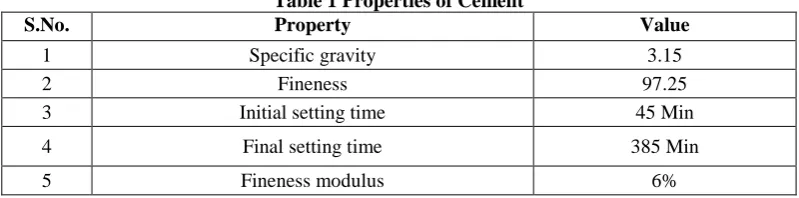
Cement is the product obtained by burning a well proportion mixture of material such as lime stone, argillaceous materials such as clay at very high temperature. It has adhesive and cohesive properties and it is shown in below table 1 . It is a binding material used with stone, brick, building blocks, etc..,The cement used for the test specimens is OPC – 53 grade conforming to IS 12269:1987.
Table 1 Properties of Cement
S.No. Property Value
1 Specific gravity 3.15
2 Fineness 97.25
3 Initial setting time 45 Min
4 Final setting time 385 Min
5 Fineness modulus 6%
FINE AGGREGATE
Sand is primarily filler for the voids in concrete. Increasing the proportion of sand in the total mix increases cement demand because of the relatively very large surface area that needs to be coated by cement paste.The properties of fine aggregate is shown in below table2.Flat elongated and angular shaped sand such as products from crushed sand, also require more water to produce workable concrete. Hence, cement demand is increased to maintain the same W/C Ratio. Locally available river sand having bulk density 1860 kg/m3 was used. River sand is sieved to 4.75 mm and the passed out sand is used.
Table 2 Properties of Fine Aggregate
S.No. Property Value
1 Specific gravity 2.65
2 Fineness modulus 5.2
COARSE AGGREGATE
The coarse aggregate properties are shown in below table 3. Beyond this, a smaller sized aggregate may have strength advantages in that internal weak planes may be less likely to exist or would be smaller and discontinuous. A rough angular surface such as in crushed aggregates will increased for a given slump, the water and cement content per cubic meter of concrete are decreased. Coarse aggregate having bulk density 1691 kg/m3. Coarse aggregate is sieved to 20 mm and the passed out is used.
Table 3 Properties of Coarse Aggregate
S.No. Property Value
1 Specific gravity 2.68
2 Fineness modulus 6.75
3 Water absorption 2.5%
MANUFACTURED SAND
Manufactured sand or M-Sand, as it is popularly known is made by powdering hard granite rocks using heavy machinery. It‟s particles are cubical in shape and finely graded and hence provides greater durability and higher strength to concrete by overcoming deficiencies like segregation, bleeding, honey combing, voids and capillary.
PROPERTIES OF MANUFACTURED SAND: Greater durability
M-Sand has balanced physical and chemical properties that can withstand any aggressive environmental and climatic conditions as it has enhanced durability, greater strength and overall economy. Usage of M-Sand can overcome the defects occurring in concrete such as honey combing, segregation, voids, etc.
High Strength
The physical properties of sand provide greater strength to the concrete by reducing segregation, bleeding, honeycombing, voids and capillary. Thus required grade of sand for the given purpose helps the concrete more compact and dense, thus increasing the strength of concrete.
Greater workability
Size, shape, texture play an important role in workability of concrete. With more surface area of sand, the demand for cement and water increases to bond the sand with coarse aggregates. The control over these physical properties of manufacturing sand makes the concrete require less amount of water and provide higher workable concrete. The less use of water also helps in increasing the strength of concrete, less effort for mixing and placement of concrete, and thus increases productivity of construction activities at site.
Economy
As discussed above, since usage of M-Sand has increased durability, higher strength, and reduction in segregation, permeability, increased workability, decreased post-concrete defects; it proves to be economical as a construction material replacing river sand. It can also save transportation cost of river sand in many cases.
Eco-friendly
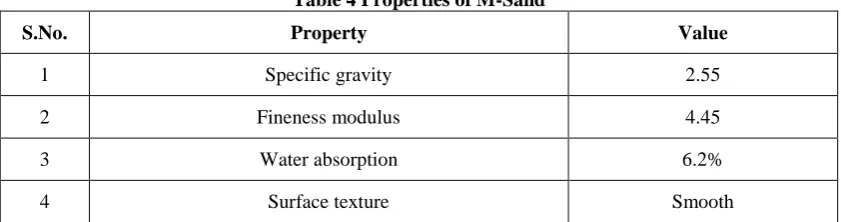
Table 4 Properties of M-Sand
S.No. Property Value
1 Specific gravity 2.55
2 Fineness modulus 4.45
3 Water absorption 6.2%
4 Surface texture Smooth
POLYETHYLENE GLYCOL
Polyethylene glycol is a condensation polymer of ethylene oxide and water with the general formula H(OCH2CH2)nOH, where n is the average number of repeating oxy ethylene groups typically from 4 to 180. The abbreviation (PEG) is termed in combination with a numeric suffix which indicates the average molecular weights. One common feature of PEG appears to be the water-soluble nature. Polyethylene glycol is non-toxic, odourless, neutral, lubricating, non-volatile and non-irritating and is used in a variety of pharmaceuticals. The properties of river sand and M-sand is shown in below table 5.
Table 5 Comparison of M-Sand and River Sand
S.No Property River sand M-Sand
1 Shape Spherical particle Cubical particle
2 Gradation Cannot be controlled Can be controlled
3 Specific gravity 2.65 2.55
4 Water absorption 7.0% 6.2%
5 Compressive strength Normal Marginally higher
6 Fineness modulus 5.2 4.45
III. MIX DESIGN
Concrete is made with the design mix ratio of 1: 1.38: 2.24 with the water cement ratio of 0.4.
IV.PREPARATION OF SPECIMENS
Keep the moulds on a porous surface and apply oil to surface of moulds. Weigh the required quantity of sand and coarse aggregate for given concrete ratio. Mix the sand and cement to form mortar. Then mix this mortar with coarse aggregate. Again mix this dry concrete with required quantity of water to provide a normal consistency. Place the wet concrete inside the mould in layers and compact well. Level the top surface of concrete to top level of mould. Mark the date and number on top surface of concrete. Hence the specimen details are shown in table 6.
Table6 Specimen Details
S.No Specimen Size Numbers
1. Prism 500mm x 100mm x 100mm 81
2. Cube 150mm x 150mm x 150mm 81
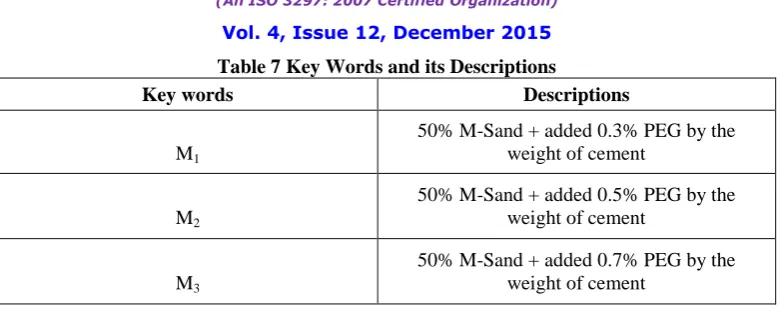
Table 7 Key Words and its Descriptions
Key words Descriptions
M1
50% M-Sand + added 0.3% PEG by the weight of cement
M2
50% M-Sand + added 0.5% PEG by the weight of cement
M3
50% M-Sand + added 0.7% PEG by the weight of cement
V. TEST ON HARDENED CONCRETE
COMPRESSIVE STRENGTH
At the end of curing period take the cubes from curing tank and wipe them clean with cloth or waste cotton. Measure the dimension of the compression face one by one. Place the cube in between compression plates of the U.T.M / compression testing machine. After the initial adjustments are over apply the load gradually over the cubes. Note the load scale reading at the time of first crack and at the time of the failure. Repeat the procedure of testing for two or more cubes and take the average values
FLEXURAL STRENGTH
The dimension of each specimen should be noted before testing. The bearing surface of the supporting and loading rollers is wiped and clean and any loose sand or other material removed from the surfaces of the specimen where they are to make contact with the rollers. The specimen is then placed in the machine in such manner that the load I applied to the upper most surface as cast in the mould. The axis of specimen is carefully aligned with the axis of the loading device. No packing is used between the bearing surfaces of the specimen and rollers. The load is applied without shock and increasing continuously at a rate of the specimen. The load is increased until the specimen fails and the maximum load applied to the specimen during the test is recorded. The magnitude of flexural strength is given by PL/BD2 where P is the applied load, L is the supported length, B and D are the breadth and depth of the prism.
SPLIT TENSILE STRENGTH
At the end of curing period take the cylinders from curing tank and wipe them clean with cloth or waste cotton. Place the cylinder in between compression plates of the U.T.M / compression testing machine. After the initial adjustments are over apply the load gradually over the cylinder. Test is carried out by placing a cylindrical specimen horizontally between the loading surfaces of a compression test machine and the load is applied until failure of the cylinder along the vertical diameter. The magnitudes of the tensile stress are given by 2P/πDL, were P is the applied load, D and L are the diameter and length of the cylinder respectively.
VI. EXPERIMENTAL RESULTS
GENERAL
After the curing period of 7, 14 and 28 days, the cubes, prisms and cylinders are taken and the respective tests are carried out to show the results and suggestions.
COMPRESSIVE STRENGTH
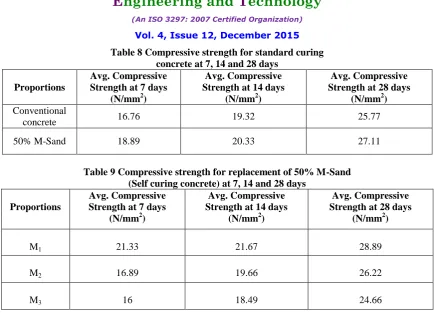
Table 8 Compressive strength for standard curing concrete at 7, 14 and 28 days
Proportions
Avg. Compressive Strength at 7 days
(N/mm2)
Avg. Compressive Strength at 14 days
(N/mm2)
Avg. Compressive Strength at 28 days
(N/mm2)
Conventional
concrete 16.76 19.32 25.77
50% M-Sand 18.89 20.33 27.11
Table 9 Compressive strength for replacement of 50% M-Sand (Self curing concrete) at 7, 14 and 28 days
Proportions
Avg. Compressive Strength at 7 days
(N/mm2)
Avg. Compressive Strength at 14 days
(N/mm2)
Avg. Compressive Strength at 28 days
(N/mm2)
M1 21.33 21.67 28.89
M2 16.89 19.66 26.22
M3 16 18.49 24.66
FLEXURAL STRENGTH
Three beam samples each of the mix with various percentage of M-Sand and various percentage of PEG were tested to determine the flexural strength after 7, 14 and 28 days using a Universal Testing Machine. The tests were conducted as per standard specificationsit is shown in table 10 and table 11.
Table 10 Flexural strength for standard curing concrete at 7, 14 and 28 days
Proportions
Avg. Flexural Strength at 7 days
(N/mm2)
Avg. Flexural Strength at 14 days
(N/mm2)
Avg. Flexural Strength at 28 days
(N/mm2)
Conventional
concrete 6.6 7.4 8.7
50% M-Sand 6.45 8.15 8.85
Table 11 Flexural strength for replacement of 50% M-Sand (Self curing concrete) at 7, 14 and 28 days
Proportions
Avg. Flexural Strength at 7 days
(N/mm2)
Avg. Flexural Strength at 14 days
(N/mm2)
Avg. Flexural Strength at 28 days
(N/mm2)
M1 6.15 8.7 9.18
M2 5.85 8.105 8.58
SPLIT TENSILE STRENGTH
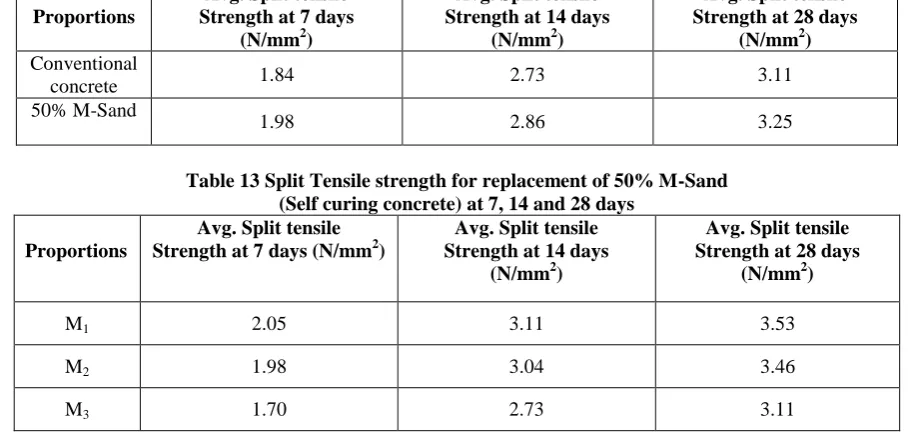
Three cylinder samples each of the mix with various percentages of M-Sand and various percentage of PEG were tested to determine the split tensile strength after 7, 14 and 28 day using a Compression Testing Machine. The tests were conducted as per standard specifications it is shown in table 12 and table 13.
Table 12 Split Tensile strength for standard curing concrete at 7, 14 and 28 days
Proportions
Avg. Split tensile Strength at 7 days
(N/mm2)
Avg. Split tensile Strength at 14 days
(N/mm2)
Avg. Split tensile Strength at 28 days
(N/mm2)
Conventional
concrete 1.84 2.73 3.11
50% M-Sand
1.98 2.86 3.25
Table 13 Split Tensile strength for replacement of 50% M-Sand (Self curing concrete) at 7, 14 and 28 days
Proportions
Avg. Split tensile Strength at 7 days (N/mm2)
Avg. Split tensile Strength at 14 days
(N/mm2)
Avg. Split tensile Strength at 28 days
(N/mm2)
M1 2.05 3.11 3.53
M2 1.98 3.04 3.46
M3 1.70 2.73 3.11
VII. CONCLUSION
In standard curing method the compressive, split tensile and flexural strength of concrete with 50% replacement of natural sand by M-Sand reveals higher strength as compared to the conventional concrete.
In self curing method the addition of 0.3 % of PEG 400 by the weight of cement with 50% replacement of M-Sand increases the strength in terms of compression, split tensile and flexural strength of concrete over 0.5% and 0.7%
of addition
.
In self curing method the addition of 0.3 % of PEG 400 by the weight of cement with 50% replacement of M-Sand increases the compressive strength of about 12% compared to the conventional concrete.
In self curing method the addition of 0.3 % of PEG 400 by the weight of cement with 50% replacement of M-Sand increases the flexural strength of about 5% compared to the conventional concrete.
In self curing method the addition of 0.3 % of PEG 400 by the weight of cement with 50% replacement of M-Sand increases the split tensile strength of about 14% compared to the conventional concrete.
The self cured M-Sand concrete using PEG 400 was more economical than the conventional concrete
.
REFERENCES
[1] Adams Joe, M. Maria Rajesh, A. Brightson, P. and M.PremAnand, “Experimental Investigation on theeffect of M-Sand in High Performance Concrete” -American Journal of Engineering Research, Vol. 02,pp-4651, 2013
[3]B.Kalyani, KAbhishek, and S. Ajay, “Determination of Mechanical Strength for High Grade Concrete by partial replacement of Artificial Sand” - International Journal of Innovative Research in Science, Engineering and Technology, Vol. 3, 2014.
[4].Karugu, K. Oyawaand W.O.Abuodha, “Partial replacement of natural river sand with Crushed rock sand in concrete production”- Global Engineers &Rechnologists Review, Vol.3, No.4, 2013.
[5] Mohanraj, A. Rajendran, M. Ramesh, and M.Mahalakshmi, “An Experimental Investigation of Eco-Friendly Self-Curing Concrete Incorporated withPolyethylene Glycol”- International Advanced ResearchJournal in Science, Engineering and Technology, Vol. 1, 2014.
[6] V.NimithaVijayaraghavan, andA.S.Wayal, “Effects of manufactured sand on compressive strength and workability of concrete”-International Journal of Structural and Civil Engineering Research, Vol. 2, No. 4,2013
[7] Patel ManishkumarDahyabhai ,“Self-Curing Concrete”- Journal of International Academic Research for Multidisciplinary, Vol 1, 2013.
[8] N.Sureshbabu and Job Thomas, “Bond characteristic of rebar in concrete with manufactured sand asfine aggregate”-American Journal of Engineering Research, Vol-1, pp-54-58, 2013.
[9] V.SyamPrakash, “Ready Mixed Concrete using manufactured sand as fine aggregate”-32nd Conferenceon Our World in Concrete & Structures,
2007.