ISSN(Online): 2320-9801 ISSN (Print): 2320-9798
I
nternational
J
ournal of
I
nnovative
R
esearch in
C
omputer
and
C
ommunication
E
ngineering
(An ISO 3297: 2007 Certified Organization)
Vol. 3, Issue 4, April 2015
Develop an Efficient Algorithm to Recognize,
Separate and Count Indian Coin
From Image using MATLAB
Rathod Prahaladsinh Kanubha1, Y.J.Parmar2
Student, Dept. of E.C., CCET, C.U. Shah University, Wadhwan, Surendranagar, Gujarat, India1
Assistant Professor, Dept. of E.C., CCET, C.U. Shah University, Wadhwan, Surendranagar, Gujarat, India2
ABSTRACT: Coins are important part of our life. We use coins in places like stores, banks, buses, trains etc. So it becomes a basic need that coins can be sorted, counted automatically. For this, there is necessary that the coins can be recognized automatically. Automated Coin Recognition System for the Indian Coins which is Rs. 1, 2, 5 and 10 with the rotation invariance. We have taken image of coin. So this system is capable to recognizing coins. Features are taken from the images using techniques as a Thresholding, canny edge detection, character recognition etc
KEYWORDS: Image Processing, binary image (Image thresholding), Image filling, Region Propping, Automated Coin Recognition and counting
I. INTRODUCTION
Image Processing Based Coin Recognition System Classification:
1) Mechanical method based systems, 2) Electromagnetic method based systems and 3) Image processing based systems.
The mechanical method based systems use parameters like radius/diameter, thickness, weight and magnetism of the coin for differentiate between the given coins. But these parameters cannot be used for differentiate between the different materials of the coins. It means if we provide two coins one original and other fake which have the same radius/diameter, thickness, weight and magnetism but with different materials of mechanical method based coin recognition system then it will treat both the given coins as original coin so these systems can be fooled easily by hackers.
Now, for the electromagnetic method based systems can differentiate between different materials because in these systems the coins are passed through an oscillating coil at a certain frequency range and different materials bring different changes in the amplitude and frequency. So these changes and the other parameters like radius/diameter, thickness, weight and magnetism can be used to differentiate between the coins. The electromagnetic method based system of coin recognition systems improves the accuracy of Recognition but still they can be fooled by some of game coins.
In the recent of years coin recognition systems based on images have also come into the picture
II. RELATED WORK
ISSN(Online): 2320-9801 ISSN (Print): 2320-9798
I
nternational
J
ournal of
I
nnovative
R
esearch in
C
omputer
and
C
ommunication
E
ngineering
(An ISO 3297: 2007 Certified Organization)
Vol. 3, Issue 4, April 2015
The accuracy rate delivered by R.Bremananth et al was 92.43%, Adnan Khashman system et al was 96.3%, Hussein R.Al-Zoubi system et al was 97%, Shatrughan Modi et al was 97.74%, Deepika Mehta was 40% to 50%. Sandeep Kaur
et, International Journal of Computer Science and Mobile Computing, Vol.no.3 Issue.9 of September- 2014, pg. no.259-262 © 2014, IJCSMC All Rights Reserved 261
Suchika Malik, Parveen Bajaj, Mukhwinder kaur are this paper presents reliable coin recognition system based on polar Fast Fourier Transform system. There are basic need to automate the counting and sorting of the coins. For this machines need to recognize the coins very fast and accurately as for further processing depends on this recognition. However the currently available algorithm to focus basically on recognition of the modern coins. In this paper they have developed ANN (Artificial Neural Network) based on automated coin recognition system for the recognition of modern coins. Then, these extracted features are going to passed as input to the trained neural network of 98.798% recognition rate has been achieved during the experiment.
Sonali A Mahajan, Chitra M.Gaikwad in his this paper is to detect denominations of Indian coins. Counting all coins manually, collected in large amount such as the coins collected at Indian temples is very difficult. The method proposed in this used reduction of technique that is the input image is reduced by database image repeatedly by the rotating it with a fixed angle at every time. Denomination of the coin is verified by comparing the coin from both sides. Thus, this method proposed here is rotation invariance and also by using two way scanning and comparison of the coin, method determine the denomination clearly even if the database is having different coins with the same radius.
Chandan singh, Amandeep kaur in his paper described polar harmonic transforms are orthogonal rotation invariant transforms which provide many numerically stable features. The kernel functions of the PHTs are consisting of the sinusoidal functions that are inherently of computation intensive. They develop a fast approaches for their computation using recursion and also 8-way symmetry /antisymmetry property of the kernel functions.
III.PROPOSED ALGORITHM
The following steps are taken in the proposed coin recognition system: Step 1: Develop RGB code for loading database of coin image in MATLAB Step 2: Convert RGB image to gray scale image using MATLAB
Step 3: Applied image thresholding on gray image for convert in binary image in MATLAB Step 4: Reduce the noise by image filling in MATLAB
Step 5: Find area and centroid of coin image using ‘regionprops’ command in MATLAB Step 6: Coin recognition and counting using area and centroid in Matlab
Step 7: Separate each coin from image and store it
IV.PSEUDO CODE
1: Read the coin image for creating data base
2: Convert RGB to gray scale image using ‘rgb2gray’ command
3: Convert gray image to binary image using ‘im2bw’ command (Thresholding) 4: Use ‘imfill’ command in MATLAB for removing noise from image
5: Use ‘regionprops’ command in MATLAB for determines area and centroid for coin image 6: According to area and centroid, built code for count and identification of coin
7: According to centroid and area, separate the each coin 8: End
V. SIMULATION RESULTS
ISSN(Online): 2320-9801 ISSN (Print): 2320-9798
I
nternational
J
ournal of
I
nnovative
R
esearch in
C
omputer
and
C
ommunication
E
ngineering
(An ISO 3297: 2007 Certified Organization)
Vol. 3, Issue 4, April 2015
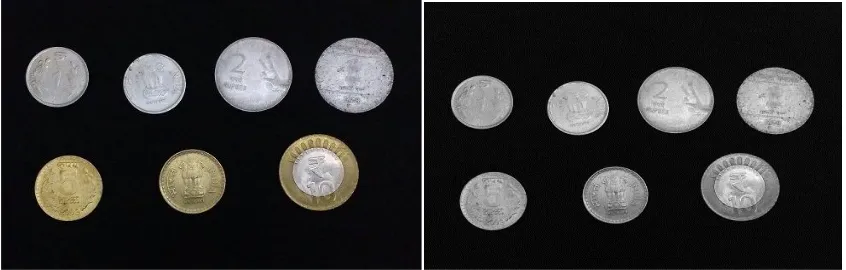
From the above step the image we got the 24-bit RGB coin image. Image processing of colour images can takes more time than the gray scale images. So, for reduction the time required for processing of images in further steps it is good to convert the 24-bit RGB image into the 8-bit Greyscale image. This shown in fig 2.
From the second step, we get gray scale image of the coin. Now, I am going to convert this gray scale image to binary image in MATLAB for next process. By this binary image, we can easily calculate the area and centroid of each and every coin. This shown in fig 3.
After converting binary image, we have some doted parts in this image as noise. After using imfill command, we have cleared image. So by this we got noise free coin image, so we have no problem now for noise and can easily calculate the area and centroid. This shown in fig 4.
We got noise free image from the fourth step. Now, we use regionprops command for finding Area and centroid of each and every coin of given image from the MATLAB. By this step, we have area and centroid of each and every coin of image.
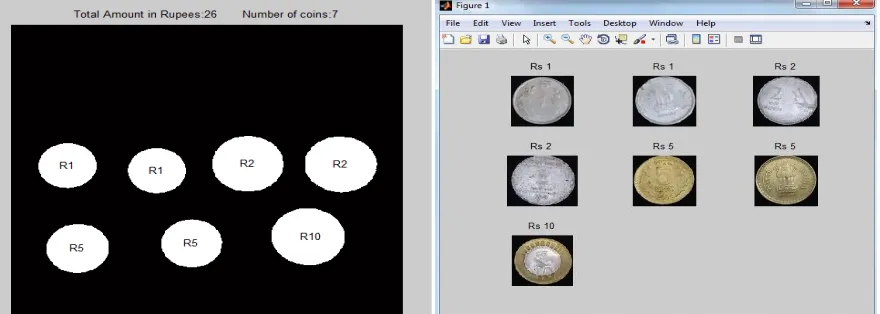
From the above step five, we get Area and centroid of coin main image. Using this, I am going to build algorithm for counting and identifying the coin in image. Using this algorithm, we can get the coin image showing its value and counting total rupees in image and total number of coin in image. This shown in fig 5.
Now from above step, we have fully identified and counted image. Now further process is separate the each and every coin from image with its value. Thus, all coins are separated from each other. We will exactly show each and every separated coin. For this separating purpose, we can use Imcrop command in MATLAB. In imcrop command, first of all we will find the centroid and area of the coin. According to the area and centroid, we set crop margined and store this cropped image to relative folders. Fig 6. Shown all separated coin from image and sub plotted.
Fig 1.Loading Image Fig 2.Gray Image
ISSN(Online): 2320-9801 ISSN (Print): 2320-9798
I
nternational
J
ournal of
I
nnovative
R
esearch in
C
omputer
and
C
ommunication
E
ngineering
(An ISO 3297: 2007 Certified Organization)
Vol. 3, Issue 4, April 2015
Fig 5.Coin Identification & Counting Fig 6. separated Image
VI.CONCLUSION AND FUTURE WORK
In This paper, presents various systems developed and existing techniques of coin recognition based on image processing method. In this paper, basically provider of various methods of recognition of the coins and get the best accuracy. It was shown that the described project contributes to the image based coin recognition and classifications. We presented an overview of the work-packages and project partners. Thereby, coins from more than 31 countries can be recognised and separated from it. Further research will be carried out to improve the recognition result and also speed. And important thing is that, the Recognition time is very less.
REFERENCES
1) Shatrughan Modi and Dr. Seema Bawa. “Automated Coin Recognition System using ANN” Dept. of Computer Science and Engineering Thapar University Patiala-147004, India.
2) Suchika Malik, Parveen Bajaj, MukhwinderKaur “Sample Coin Recognition System using Artificial Neural Network on Static Image Dataset” ECE &M.M U Sadopur Ambala India.
3) Maia Zaharieva, Martin Kampel and Sebastian Zambanini “Image based recognition of coins – An overview of the COINS project” Vienna University of Technology Institute of Computer Aided Automation Pattern Recognition and Image Processing Group Favoritenstr. 9/1832, A-1040Vienna,Austria{maia,kampel,zamba}@prip.tuwien.ac.at
4) Int. J. Open Problems Compt. Math., Vol. 2, No.2, June 2009 “Indian Coin Recognition System of Image Segmentation by Heuristic Approach and Hough Transform (HT) by C.M.VELU1 and P.VIVEKANANDAN2, 1 HOD of CSE, SKR Engineering College, Chennai– 602103,India.2Director, Knowledge Data Centre, Anna University, Chennai – 600 025,India. E-mail: [email protected], [email protected]
5) Valmik Gholap, Prof.V.S.Dhongde“A Reviewon Coin Recognition by Neural Network Using Image Subtraction” Dept. of Electronics & Telecommunication, VACOE Ahmednagar, Ahmednagar, Maharashtra, India.
6) Sandeep Kaur1, Mandeep Kaur2 “REVIEW ON THE COIN RECOGNITION SYSTEM WITH ROTATION INVARIANT” 1M.Tech, Computer Science Department & Guru Kashi University, India.2Assistant Professor, Computer Science Department & Guru Kashi University, India.1 [email protected];2 [email protected]
7) Suchikamalik*,Parveen Bajaj**, MukhwinderKaur*** “Sample Coin Recognition System using Artificial Neural Network on Static Image Dataset”.
*( Department of ECE, MM University, Sadopur-Ambala , Haryana) ** (Department of ECE, MM University, Sadopur-Ambala, Haryana) *** (Department of ECE, MM University, Sadopur-Ambala, Haryana)
8) “A New Coin Recognition andSorting System” Michael N¨olle1, Harald Penz2, Michael Rubik2,Konrad Mayer2, Igor Holl¨ander2, Reinhard Granec2ARC Seibersdorf research GmbH 1Video- and Safety Technology ,2High Performance Image Processing A-2444 Seibersdorf.
9)Martin Kampel– Maia Zaharieva “Optical Recognition of Modern and Roman Coins”.
ISSN(Online): 2320-9801 ISSN (Print): 2320-9798
I
nternational
J
ournal of
I
nnovative
R
esearch in
C
omputer
and
C
ommunication
E
ngineering
(An ISO 3297: 2007 Certified Organization)
Vol. 3, Issue 4, April 2015
BIOGRAPHY
(1) Rathod Prahaladsinh Kanubha is 4th semester Student, Dept. of M.Tech E.C., CCET, C.U.Shah University, Wadhwan-Surendranagar, Gujarat, India. He completed his B.E. in Electronics and Communication at Government Engineering College, Sector-28, Gandhinagar in 2013. And he joined his M.Tech in E.C. at C.U.Shah University from 2013.