Modern Electricity Billing System and Fuse
Detection Using GSM
Santhya, Sandhya, Saranya, Sowmeya
U.G Student, Department of ECE, SNS College of Technology, Coimbatore, Tamilnadu, India
Associate Professor, Department of ECE, SNS College of Technology, Coimbatore, Tamilnadu, India
ABSTRACT: In traditional metering method retrieving the energy data is not convenient and the cost of data logging system is high. So this project presents the design and development of Automatic Meter Reading (AMR) system. AMR system gives the information of meter reading, total load used, Auto power disconnect and reconnect system. This information is being sent and received by concerned energy Provider Company with the help of Global System for Mobile Communication (GSM) network via RS232 link. Two GSM modems are used one connected to energy meter and another connected to PC present in office of electricity board. Energy provider receives the meter readings within a second without visiting home. User interface consists of LCD which displays the power consumed and amount of bill to be paid. The advantage of our paper is not only reduces the labor cost but also increase meter reading accuracy and save huge amount of time.
KEYWORDS: GSM, AMR, interface , modem, LCD display.
I. INTRODUCTION
At present, most of the houses in India have the traditional mechanical watt hour meters and the billing system is not automated. At the end of each month a person from the electricity board goes to every house and takes the meter reading manually. These meter readings are used for electricity bill calculation and this bill sent to consumer house by post. Customer goes to electricity department for paying this bill amount. But in this technique we are required great number of persons for reading the meters. The procedures of sending the bills to customer are very laborious. From many years, the electric power systems had undergone negligible changes in their operating conditions and the equipment employed for their control and monitoring. Many attempts have been made to design the energy meter with instant billing but till now the designed energy meters did not give any replacement for the system.
An energy meter is a device which is used to measure the consumption of energy of any residence or other industrial establishment. In conventional metering system, the power usage reading is made manually by moving to the consumer locations. This requires large number of labour operators and long working hours to complete the task. This metering system becomes very difficult especially in rainy season. If any consumer did not pay the bill, the electricity worker needs to go to their home to disconnect the power supply.
In this paper we are implementing automatic energy meter connected to electricity office through GSM network. When we use the electricity, the amount which we had used is calculated by energy meter at user interface. This information is passed to the micro controller. Nowadays, Short Message Service (SMS) is widely used as a form of data communication. It is about 2.4 billion active users which equals to 74% of mobile phone subscribers sending and receiving text messages on their phones. SMS is a communication application in Global System for Mobile communication (GSM) system. It allows interchange of short text messages between mobile telephone devices using standardized communication protocols.
II. OBJECTIVES OF ENERGY METER
Our main objective is to develop a system which can transmit the meter reading of the user to the nearest electric meter billing and controlling station. When we use the electricity, the amount we had used is calculated by energy meter at user interface and then it is transmitted to EB station using GSM. If the user fails to pay the electricity bill, automatic fuse off from the electricity station will happen and after paying the bill the fuse will reconnected automatically. If there is any theft of power, the system will send a message to the EB station through the GSM.
III. SYSTEM ARCHITECTURE
1 Power supply board 2 PIC micro controller board 3 IR Sensor
4 GSM
5 LCD Display 6 Relay unit
A. Power Supply
Power supply is a reference to a source of electrical power. A device or system that supplies electrical or other types of energy to an output load or group of loads is called a power supply unit or PSU. The term is most commonly applied to electrical energy supplies, less often to mechanical ones, and rarely to others.
B. PIC Microcontroller
PIC is a family of Harvard architecture microcontrollers made by Microchip Technology, derived from the PIC1650 originally developed by General Instrument’s Microelectronics Division. The name PIC initially referred to “Peripheral Interface Controller”. PICs are popular with both industrial developers and hobbyists alike due to their low cost, wide availability, large user base, extensive collection. of application notes, availability of low cost or free development tools and serial programming (and re-programming with flash memory) capability.
C. IRSensor
IR (Infrared) is the typical light source being used in the sensor for robot to detect opaque object.
D. GSM
A GSM modem is a wireless modem that works with a GSM wireless network. A wireless modem behaves like a dial-up modem. Like a GSM mobile phone, a GSM modem requires a SIM card from a wireless carrier in order to operate. GSM is the most popular standard for mobile phones in the world.
E. LCDDisplay
Liquid crystal display is very important device in embedded system. A liquid crystal display (LCD) is a flat panel display, electronic visual display, or video display that uses the light modulating properties of liquid crystals. Liquid crystals do not emit light directly.
F. Relay Unit
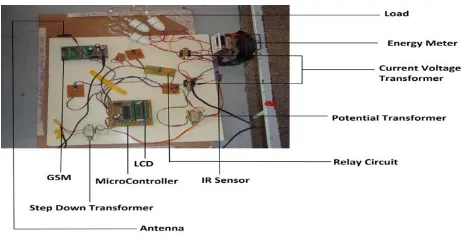
Fig. 2 Illustration of hardware GSM energy meter
V. SOFTWARE REQUIRMENTS
S.No Software Tools Work Flow
1 MPLAB V8.10 Embedded Programming
2 CCS Compiler Software
development tools
3 ORCAD PCB designing
A. MPLABIDE
MPLAB Integrated Development Environment (IDE) is a comprehensive editor, project manager and design desktop for application development of embedded designs using Microchip PIC micro and ds PIC microcontrollers.
B. CCSCompiler
The dsPIC® family of Digital Signal Controllers (DSC) combines the high performance required in DSP applications with standard microcontroller features needed for embedded applications. Additional high-performance microcontrollers (MCU) without DSP are also available for other applications. All of these devices are fully supported by a complete set of software development tools, including an optimizing C compiler, an assembler, a linker and an archiver/ librarian.
C. ORCAD
VII. SYSTEM MODULE In our paper we use two modules namely,
1. Transmitter module 2. Receiver module
1. Transmitter Module
The components used in the transmitter module are i. IR Sensor
GSM Modem In the transmitter module IR sensor is used initially IR (Infrared) is the typical light source being used in the sensor to detect opaque object. Here it senses the number of rotations of the coil in the electronic meter and hence it can detect the energy consumed by the user. Then microcontroller is used for controlling of complete AMR system. If power cut off the contents of RAM memory must be stored in EEPROM and when power will be back the energy meter will be sense by the sensor. The microcontroller is interfaced with GSM modem and LCD module. Next to this GSM modem which is suitable for long duration data transmission is used.GSM modem is connected to a microcontroller which would transmit the data from meter to the electricity board and also receives the commands from electricity board.the modem will send units or pulses(power consumption) on a regular interval or on a request.
2. Receiver Module
The components used in the receiver modules are, i. LCD display
ii. Buzzer
The Liquid crystal display is interfaced to microcontroller unit that are used to display the meter reading, power factor, power status, total load etc. When power is being consumed the sensor senses it and the microcontroller transmits that reading to the GSM and displayed by LCD. The buzzer or beeper is an audio signaling device and the typical use of buzzer includes alarm device and the buzzer buzz indicating the sudden shock or overloading.
t
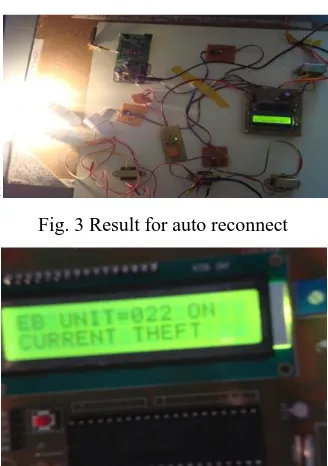
Fig. 3 Result for auto reconnect
VIII.THEFT OF POWER CAN BE DETECTED
Theft of power can be detected by using this system. If the power is taken from main it is called theft of power. In compound house system the same case is used but it is not theft of power . The person from other house use the same process of taking power ,it is called theft. To avoid this problem same IP address is given to the sub meters of compound house. So that if different IP address comes the message will be sent to EB office .Thus we can find that the power is thefted.
IX. CONCLUSION AND FUTURE ENHANCEMENT
Thus we have increased the accuracy in meter reading by eliminating human error and fuse detection process. The proposed methodology is used to automate the meter reading, to disconnect and reconnect the power line without the wastage of man power by the use of GSM technology. This method generates the message to the consumers either by day basis or weekly basis as per consumer requirements. The advantages of this project are
Automation of all features including communication from the EB office to the customer. Saves data using automatic control and storage systems.
It involves less cost to communicate.
To increase n number of consumers to communicate and automate.
This paper has been stated for the use of EB billing purposes for a locality. This same technique of RF signalling and Ad-Hoc data transfer can be used in various other fields like disaster management for sending data to the relief centers. This technology can also be used in sending messages and information to nearby hospitals in emergency situations like in case of natural calamities
REFERENCES
[1] Abhinanthan Jain, Dilip Kumar, JyotiKedia, “design and development of GSM based energy meter”, International Journal of Computer Applications (0975-888) Volume 47- No.12, June 2012.
[2] T.Anananthapadmanabha, A.D.Kulkarni, Madhvaraja, and A.P. Suma, “automatic meter reading (AMR) based distribution security monitoring and distribution – supervisory control and data acquisition (D-SCADA) control”, Journal of Electrical and Electronics Engineering Research Vol.3(6), pp. 108-120, August 2011.
[3] Dr.Boyina, S. Rao, B.Gnanasakeranathan, M.Raguram, S.Pravinkumar, P.Kamalesh’ “domestic prepaid energy meter distribution system for saving of power consumption”, IJAET/VOLIII/ ISSUE II/ APRIL-JUNE,2012/26-29.
[4] GuillaumePeersman and SrbaCvetkovic, “The Global System for Mobile Communications Short Message Service”, IEEE Personal Communications pp 16-23, June 2000.
[5] Liting Cao JingwenTianYanxia Liu “ Remote Real Time Automatic Meter Reading System Based on Wireless Sensor Networks”, Proceeding of 3rd International Conference on Innovative Computing Information and Control, 2008 (ICICIC-08), pp: 591 - 591.
[6] MoeRahnema, “Overview of The GSM System and Protocol Architecture” IEEE Communication Magazine, pp. 92-100, April 1993.
[7] H.G.Rodney, C.H.Lee, C.S.Kean, V.H.Mok, “Automatic Power Meter Reading and Distribution control using ICT and GSM networks”, in 1international conference of the IETE Brunei Darussalan Network, May 2008.