Detection Moving Object Combination
Median Algorithm and Three Temporal
Differences and Filtering in Image Processing
Techniques
Ahmed Mahgoub Ahmed Talab1,*, Hanana Elnage2, Alnazeir Abdalla Adam3
Associate Professor, Deportment of Mathematics, El Imam EL Mahdi University, Kosti, Sudan1 Assistance Professor, College of Science, King Khalid University, Saudi Arabia 2 Assistance Professor, College of Education, While Nile University, Kosti, Sudan3
ABSTRACT: Video Background extraction is a key step in numerous automatic applications. In this article, we recommend a new approach by using three sequential images in limited period and giving the precise threshold. The extracted image is sorted as foreground image while if less than the threshold is classified as background. We newly proposed method mix between median and three frame difference method; and using filtering to elimination of residual noise. The empirical work displays that our method is fast, and no shadow was recorded.
KEYWORDS: Median method; three differences; Moving object detection. I. INTRODUCTION
Background subtraction is one of the main tools in automaticity content analysis and widely used it, especially in video surveillance [1-5]. Extraction of detect moving object is a necessary and significant investigation topic of the scrutiny system; In the Intelligent Transportation System, the detection of moving objects from image sequences is an a crucial step; Moving objects, results control thee efficiency and preciseness of continuous image processing [1-11]. Video established tracking in the computer vision field such as medical image processing; visual surveillance, and faces tracking. The image identification is one of the important works in computer vision applications [1- 12]. In this article, Three Temporal Difference and Median Algorithm are combined. Median algorithm had a good performance in stably environment and complex environment; the benefit of this approach is it successful extraction of background image. In the situation of environment in short time had a big alteration them edianal growth gives poor performance. Three temporal differences have not a background and in sensitive in status at sunshine and night three temporal differences have excellent performance than the median algorithm, which are used by the time difference for three consecutive images by adapting the threshold to extract an image of the moving area. For extra complex background, it is not easy to track the moving objects. So the combination benefit of median algorithm and three temporal differences is to produce excellent performance [1-13].
II. ALGORITHMS
A. Three temporal difference algorithm
uses logic algorithm segmentation motion blocks, if the three successive images were
1
,
, I
,
,
1,
N N N
I
x y
x y
I
x y
, the mathematics is as follows:
,
1
,
,
(1)
a N N
I
x y
I
x y
I
x y
,
,
1
,
(2)
b N N
I
x y
I
x y
I
x y
,
1
,
I
,
(3)
0
a b
c
I
x y
x y
T
I
x y
Otherwise
To get the
I
c
x y
,
, we give a threshold, this threshold can take off noise and can be set for various light conditions, then we set the threshold conditions for 12.B. Median algorithm
In median algorithm, there commended probability of the pixel being a background is larger than being foreground. In a very small space of time, for example, frames, the grey level of background will change within a very small range, but the grey level of the foreground objects is significantly varied with each car. The gray color diversity within the car is existed, and it relates to each part color. Grounded on this hypothesis frequently specific value of pixel can be extracted and classified to be a background image. This algorithm employing two dimensional image sequences, for every pixel(x,y), the corresponding point’s values in former N frames are:
,
,...,
2
,
, I
1
,
.
T N T T
I
x y
I
x y
x y
Calculate the sequence of values by applies the median algorithm and assume the outcome as background value of present image, the calculating formula of background magnitude is:
T N,
,...,
T 2,
,
T 1,
(4)
BG
Median I
x y
I
x y
I
x y
This investigation recommended a new approach to get the value of steady background by employing three temporal difference algorithms, and the altered background pixels are assessed through the median algorithm. The outcome from the new method is close to real background.
C. The Proposed Method:
The aim of this investigation is to propose a new approach to get background and foreground image from moving video , since the majority of the current methods are miserable about slowness of image extraction, the extracted image most of the time appeared by shadow, furthermore , all other approaches need larger space memory devices. The suggested approach used the Median Algorithm with three temporal difference algorithms the new can obtain the outcomes of three different images; and we have to combine the benefits of median method and three temporal methods here in after we outline the main steps:
Calculation of background in proposed method:
For the recommended approach if the number of frames is less than 40 we apply the average image to compute the
initial background. If the number of frames is larger than or equal to 40, the learning rate
is used to update the background image calculation the following calculating formula is used:
1
1
,
1(5)
N N N
BG
BG
x y
I
1
,
N
BG
x y
,
N
BG
x y
=Old background pixel at position(x, y).
1
,
N
I
x y
= The pixel at pixel at position (x, y) of the new image.
= Learning rate.This method can actually eliminate the shortage in median method.
Calculation of foreground in proposed method:
1. Three serial frames parted by fixed interval,
I
N1
x y
,
,
I
N
x y
,
and I
N1
x y
,
, respectively, were altered in to Gray images for simple and real time.2. Using
I
N1
x y
,
,
I
N
x y
,
and I
N1
x y
,
.3. Via (1) we can obtain two diversity images
D
N
x y
,
,
D
N1
x y
,
.
1 1 1,
,
,
,
,
,
N N N
N N N
D
x y
I
x y
I
x y
D
x y
I
x y
I
x y
4. Comparing the value pixels in
D
N
x y
,
,
D
N1
x y
,
to the certain threshold (T2) we conclude theforegroundaccording to equations (3).
2 1 2
1 if
& D
0 Otherwise
N N
D
T
T
foreground
5. Using filtering in image processing in the calculated foreground was found and then the parts with size less than the certain threshold were ejected.
III.COMPARISONOFSTANDARDMETHOD
The performance of the recommended algorithm is obtained by using the root Mean Square Error (RMS) to estimate if the background is better or not, and the average time is used to asses if the algorithm is fast enough or not. We should determine a pure background frame STBG (x, y) from the video or man-made it for the contrast. The RMS error and average time were defined as follow:
21 1
1
,
,
(6)
M N error
x y
RMS
BG x y
STBG x y
M
N
1
1
( )
(7)
ti i
average t
time
t
The tinier the RMS error, the higher is the efficiency of the background image. The smaller RMS error implies that the pixel of background extraction is divided nearer to the real background scene. Conversely, it is worse. After estimating background image; we use equation (8) to judge if the foreground image is better or not:
(8)
i
BD
background
frame
We show an empirical outcome of the recommended object tracking approach. The proposed algorithm was performed in MATLAB (R2012 b), and experimented in windows 8 with Intel (R) core (TM) i7-3632QM CPU @ 2.20 GHz 2.20 GHz with a memory of 4GB. The object video successions come from MATLAB (traffic.mj2) which is communally on hand, the size of the video sequences is 120 × 160 pixels.
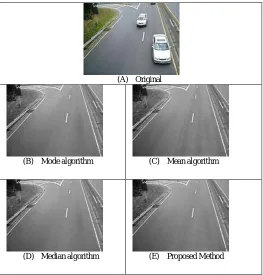
(A) Original
(B) Mode algorithm (C) Mean algorithm
(D) Median algorithm (E) Proposed Method
Fig. 1. Background extraction based on different method from video 1.
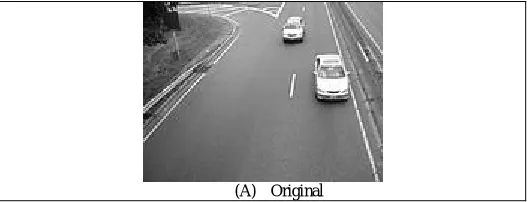
We have the same tests of another data, and the outcomes indicated in Figure 1. The video is clear. Figure 1a is an original frame in the video. The time of the video is 90 frames.
(B)Mean algorithm (C) Mode algorithm
(D) Median algorithm (E) Proposed method
Fig.2: Foreground extraction base on different method from video 2.
The foreground extract from the suggested approach as shown in figure (2.E) display no shadow in front of the extracted object, while shadow was a remark in the foreground extracted using the mean, and mode algorithms. It depended on the standard of contrast (6), (7) and (8) in article; we compute the (RMS), count, and average time (t) and corresponding to Figure.2; the values are indicated in Table 1.
Table .1: The values of RMS, Count and average time (t) through different algorithm
Mean algorithm Mode algorithm Median Algorithm Proposed Method
RMS error 0.0483 0.0382 0.0216 0.0024
Count 1453 1399 1379 1276
time 0.4922 1.5431 0.3899 0.2138
The Number of pixels for the extracted foreground image in video 1 was 1276 for the suggested method while it was arrayed from 1399 to 1453 for the other approaches. This outcome displays clearly that our method is decreasing the number pixels in a foreground image since the proposed approach is no shadow. The recommended method average time and memory usage are very tiny equated with current known methods. The explanation behind the small average time is that the computation step is less than calculation steps used in other methods, which is concluded that our proposed method is ultra fast.
(B) TTD algorithm (C ) Proposed method
Fig.3. Foreground extraction base on different method and use Filtering processing.
Established on the standard of comparison (8), we can compute the Count (white pixels) and average time (t) corresponding to Figure (3). The values are indicated in Table (2).
Table.2: the values of Count through different algorithm
Three Temporal Differences algorithm Proposed method
count 1734 1468
The outcomes of investigations under the same conditions are displayed in figure (3). The Number of pixels for the extracted foreground image in video (traffic.mj2) from MATLAB was 1468 for the suggested method while it was ranged from 1734 for the other approaches. This demonstrates clearly that our approach yields a better quality for foreground image; since no shadows were noted while Three Temporal Differences method recorded some shadows.
V. CONCLUSION
In this paper, we propose Algorithm successfully used in a continuous image. We applied the median method approach as the principal tracking algorithm and the three temporal differences method to subtract sequential images, it also used to filtered image to remove noise. The empirical outcomes of the recommended method in this investigation successfully extract background and foreground image. The test results yield that the suggested method is fast, precise and no noise and shadow was recorded with all extracted images.
ACKNOWLEDGMENT
The author would like to thank all brothers in Elimam EL Mahdi University in gratefully appreciates for his assistance within the research.
REFERENCES
[1] Ahmed Mahgoub Ahmed Talab,Zhangcan Huang and XiongJiang,Video Background Extraction Using Improved Mean Algorithm and Frame Difference Method , Research Journal of Applied Sciences, Engineering and Technology 7(22): 4795-4800, 2014.
[2] Meijin, L., Z. Ying and H. Jiandeng, 2009. Video background extraction based on improved mode algorithm. Proceeding of 3rd International
Conference on Genetic and Evolutionary Computing (WGEC'09), pp: 331-334. [3] Ahmed Mahgoub Ahmed Talab, Zhangcan Huang, FangXi,LiuHaiming,Moving Crack detection based on Improved VIBE and
MultipleFiltering in Image Processing Techniques, International Journal of Signal Processing, Image Processing and Pattern Recognition,Vol. 8, No. 2 (2015), pp. 275-286
[4] Barnich,O. and M. V. Droogenbroeck, "VIBE: A powerful random technique to estimate the background in video sequences", University of Li'ege Montefiore Institute, INTELSIG Group Li'ege,ICASSP 2009, pp. 945-948.
[5] M. Olivier Barnich and M.V. Droogenbroeck, "ViBe: A Universal Background Subtraction Algorithmfor Video Sequences", IEEE
Transactions on Image Processing, vol. 20, (2011), pp.1709-1724. [6] Ahmed Mahgoub Ahmed Talab,Moving Objects Tracking Established On Background Extraction Using Two Image Sequence and Single
[7]Wang, L. and N.H. Yung, 2010. Extraction of moving objects from their background based on multiple adaptive thresholds and boundary evaluation. IEEE T. Intell. Transp., 11: 40-51.
[8] Wu, J., Z.M., Cui, H.J. Yue and G.M. Zhang, 2012. Semantic analysis of traffic video using image understanding. J.Multimedia, 7: 41-48. [9] Yang, Y.Z., X.F. He, Y.Z. Chen and Z.K. Bao, 2008.Traffic parameter detection based on video images [J]. ControlEng. China, 3: 36. [10] Yang, J., R. Stiefelhagen, U. Meier and A. Waibel, 1998. Visual tracking for multimodal human computer interaction. Proceedings of the SIGCHI Conference on Human Factors in Computing Systems. ACM Press/AddisonWesley Publishing Co., New York, pp: 140-147.
[11] Barron, J.L., D.J. Fleet and S.S. Beauchemin, 1994. Performance of optical flow techniques. Int. J. Comput. Vision,12(1): 43-77. [12] Comaniciu, D., V. Ramesh and P. Meer, 2000. Realtime tracking of non-rigid objects using mean shift.Proceedings of IEEE Conference on
Computer Vision and Pattern Recognition, pp: 142-149. [13]Chen, S.W., L.K. Wang and J.H. Lan, 2011. Moving Object tracking based on background subtraction combined temporal difference.