FPGA Implementation of Median Filter using an
Improved Algorithm for Image Processing
Ateng Eric
M.E Student
Department of Electronics & Communication Engineering
GTU Post-Graduate School, Gujarat Technological University, Ahmedabad – 382 424, Gujarat, India
Abstract
To solve the contradiction between the noise reducing effect and the time complexity of the standard median filter algorithm, this paper proposed an improved median filter algorithm. This paper focuses on a 3x3 image window filtering in which the sorting network of the filter should be able to produce the desired result within the shortest time possible. That means, the sorting network will be able to exercise parallelism in processing the image pixel and the number of the required hardware maintained minimal. The algorithm derived shows that the sorting network will be able to produce the result within the required time. The improved filter algorithm was implemented using Hardware Description Language Verilog, simulated using Xilinx isim and was loaded on to Xilinx FPGA. The hardware result showed that this proposed algorithm has better output result as compared to standard median algorithm as well as adaptive median algorithm. It has a good application prospect in real-time image processing.
Keywords: FPGAs, PSNR, Standard Median Filter, Adaptive Median Filter, Processing Element, Salt and Pepper noise _______________________________________________________________________________________________________
I.
I
NTRODUCTIONDigital images are often corrupted by Impulse noise due to errors generated in noisy sensor, errors that occur in the process of converting signals from analog-to-digital and also errors that are generated in the communication channels. This error that occurs inevitably alters some of the pixels intensity while some of the pixels remain unchanged. In order to remove impulse noise and enhance the affected image quality, the median filter has been studied and a method based on an improved median filtering algorithm has been proposed. This method removes or effectively suppresses the impulse noise in the image while preserving the image edge information and enhancing the image quality.
The proposed method is a spatial domain approach and uses the overlapping window to filter the signal based on the selection of an effective median per window. The approach chosen in this work is based on a functional level 2n +1 window that makes the selection of the normal median easier, since the number of elements in the window is odd. The median so chosen is confirmed as the effective median or, where the median is an impulse, a more representative value is sought and used as the effective median. The improved median filtering algorithms uses the median switching technique to compute an effective median when the active median of the window is an impulse.
The performance of the proposed effective median filter has been implemented and evaluated in Xilinx FPGA [1] using a 3 × 3 fixed window for simulations on an image that has been subjected to various degrees of corruption with impulse noise. The results demonstrate the effectiveness of the proposed algorithm vis-à-vis the standard and adaptive median filtering algorithms, and other.
II.
P
RINCIPAL OF THE ALGORITHMRelated Work: A.
Median filtering is a popular algorithm of noise removal, employed extensively in applications involving signal and image processing. This non-linear technique has been proven to be a good alternative to linear filtering as it can effectively suppress impulse noise while preserving the edge information. The median is defined as the middle element of a group of numbers after the numbers are sorted either in ascending or descending order [1, 2].
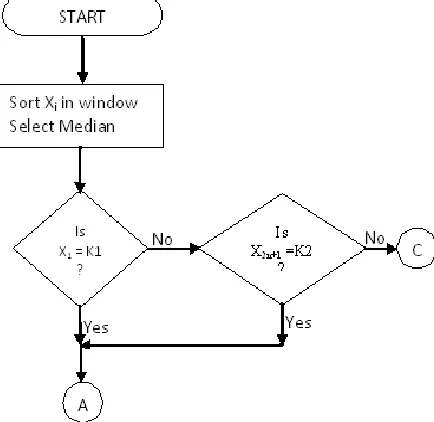
Fig. 1: Median filtering algorithm
The standard median filter performs well as long as the spatial density of the impulse noise is not large (as a rule of thumb, Pa
and Pb less than 20%).
However, Adaptive median filtering can handle impulse noise with probabilities even larger than these. An additional benefit of the adaptive median filter is that it seeks to preserve detail while smoothing non-impulse noise, something that the "standard" median filter does not do. As in all the nonlinear ordered statistics filters in literature [2], the adaptive median filter also works in a rectangular window area, Sxy. Unlike other filters, however, the adaptive median filter changes (increases) the size of the window during filter operation, depending on certain conditions. Keep in mind that the output of the filter is a single value used to replace the value of the pixel at (x, y), the particular point on which the window is centred at a given time.
Improved Median Filter Algorithm: B.
In the proposed method the size of the window is fixed, however, the (effective) median may be different from the value at the middle of the sorted pixel values. The proposed effective median filter is designed to diminish the problem faced by the standard median filter and reduce that of the adaptive median filter. As with the standard median technique, the window is chosen to cover a 𝑘×𝑘 array of pixels such that
𝑘² = 2𝑛+1 ⟹ 𝑛 = (𝑘²−1)/2
Where for integer 𝑛>0, 𝑘=3,5,7,…. In the proposed technique of filtering, as in standard median filter [4], the pixels are sorted and the median is selected from a sorted list of the current window.
The improved median filter algorithm is partitioned into three stages, which we call levels A, B and C processing, respectively. The algorithm starts from a processing step before the process continues to the three levels. In the pre-processing stage the window is selected and the values in the window are sorted and save in the sorted list. The minimum pixel value, Xmin, and the maximum pixel value, Xmax, are compared with impulse values K1 and K2, respectively, where K1=0 and
K2=255. If Xmin = K1 or if Xmax = K2 then the window has impulse noise and processing proceeds through all levels A, B, and C.
Otherwise processing proceeds through only level C.
At Level A processing, median value is confirmed as the effective median Xmed, when K1<median<K2. While in Level B processing, the two impulses are detected and switched with the effective median, the pixels are then re-sorted and processing continues to the next level. Finally, at Level C, first difference (D) between the pixels is computed by considering the sub-list starting from the second value and ending at the eighth value. If the difference between second sorted pixel and minimum value is greater than D, then the first pixel value is switched with the effective median. Also, if the difference between maximum sorted value and second last value is greater than D, the maximum value is switched with the effective median.
III.
H
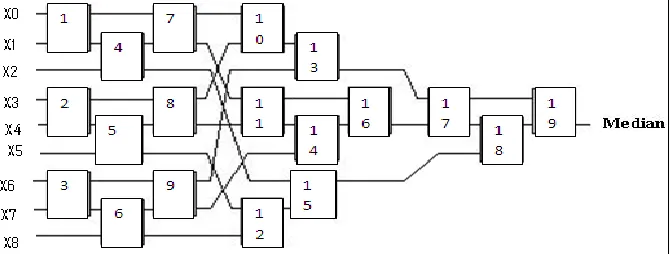
ARDWARE IMPLEMENTATIONWith the use of a sliding window, the number of comparison units for vertical sorting is reduced [7]. Each block is a comparison unit, and by using registers in between each stage, the median filter is a highly optimized and pipelined which delivers one pixel per cycle. Y0-Y2are input pixels from memory, which are sorted and stored into registers. These sorted pixels and the stored results from the sliding window, X0-X8, which are then horizontally and diagonally sorted before determining the median.
Fig. 2: Pipelined 3x3 Median Filter Architecture
The internal forwarding registers are also called Shift Registers which are required to shift X0-X1-X2 in parallel at a time; and the next X3-X4-X5 in the pipelined architecture, hence enabling parallel processing in the design.
A processing element is shown below with registered outputs for pipelining the stages.
Fig. 3: Processing Element
The triangular groups with three nodes perform a full sorting on three elements. In this figure we observe that some nodes only use one of their two outputs. This allows eliminating in these nodes one of the multiplexers, reducing the used resources.
The median filtering module is basically composed of the comparison unit which consist of comparator and two 2:1 MUX. In order to keep the synchronization of the entire module, the comparison unit is completed by using synchronous circuits. If some pixels do not execute the compare operation in a clock cycle, these pixels can save in the delay unit, and then they can participate in the next clock cycle. The median filtering module structure is shown below.
This median filtering module includes 19 comparison units, and the processing divide into 9 clock cycles [6, 7]. The first step of the Median Filter algorithm is accomplished from the first clock cycle to the third clock cycle, and the pixels are sorted horizontally. Due to the parallel processing ability of FPGA, although compare operation needs 9 times, the compare operation can complete in 3 clock cycles. Therefore, the processing efficiency is significantly improved. The second step and the third step are similar to the first steps.
IV.
R
ESULTS AND ANALYSISIn order to test the performance rate of this proposed algorithm, experiments are performed at different noise levels ranging from 20% to 60% on an image. The image is a two dimensional 8-bit greyscale image. Impulse noise of different percentages ranging from 20% to 60% is added to the two types to the image. Intensive simulations were carried out on the polluted image with different percentages of impulse noise (salt and pepper). The standard median filter, the adaptive median filter and the improved median filter are applied to the corrupted image by impulse noise. The result of the application of the various types of median filter shows that the improved median filter achieves better results than the standard median filter and the adaptive median filter. The outcome of the performances of the filtering operations is demonstrated by the output of the images shown below.
Original Grey-Scale Image (Img1) and Its Histogram: A.
Experiment:
B.
The image corrupted by 20%, 40% and 60% impulse noise.
Result 1: C.
Application Standard MF, Adaptive MF and An Improved Median Algorithm to the 20% corrupted image above respectively
Result 2: D.
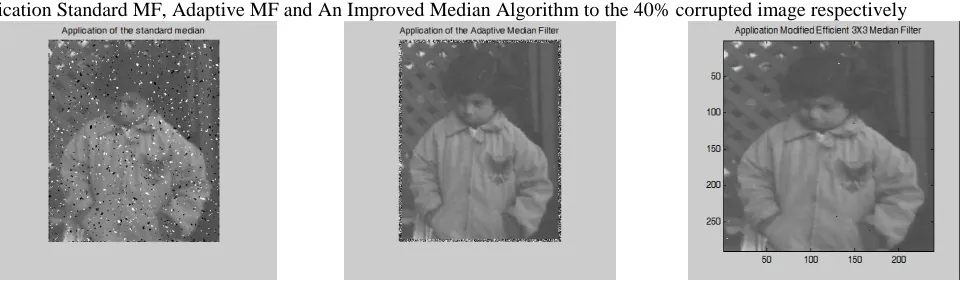
Application Standard MF, Adaptive MF and An Improved Median Algorithm to the 40% corrupted image respectively
Result 3: E.
Application Standard MF, Adaptive MF and An Improved Median Algorithm to the 60% corrupted image respectively.
The original greyscale image and it subsequent corrupted images by impulse noise of different percentages ranging from 20% to 60% and the application of the standard median filter, adaptive median filter and the improved median filter to the various corrupted images with impulse noise(salt and pepper). The results of the improved median filter are better as compared to the results of the standard median filter and the adaptive median filter.
From the test above, it’s seen that when the impulse noise in the image is increased the improved median filtering algorithm achieves more enhanced images than the other nonlinear ordered statistic filter. Like the other median filters, the performance of the improved median filter deteriorates as the noise factor increases. The peak signal to noise ratio of the improved median filtering algorithm, the adaptive median filtering algorithm, the standard median filtering algorithm, the maximum filtering algorithm and the minimum filtering algorithm are shown in the table below.
The peak signal-to-noise ratio (PSNR) is one of the best known techniques for assessing the amount of noise that an image is polluted with and, for that matter, the amount of noise left in a filtered image. The peak signal-to-noise criterion is adopted to measure the performance of various digital filtering techniques quantitatively. It is the measure of the peak error.
A lower value for Mean Square Error (MSE) means lesser error, and as seen from the inverse relation between the MSE and PSNR, this translates to a high value of PSNR. Logically, a higher value of PSNR is good because it means that the ratio of Signal to Noise is higher. Here, the 'signal' is the original image, and the 'noise' is the error in reconstruction or restoration. So, if you find a filtering or compression scheme having a lower MSE and a high PSNR, you can recognize that it is a better one. PSNR
Table - 1:
Peak signal-to-Noise Ratio for Image Img1
Filter Methods 20% Impulse Noise
(dB)
30% Impulse Noise (dB)
40% Impulse Noise (dB)
50% Impulse Noise (dB)
60% Impulse Noise (dB)
Standard Median Filter
33.7247 32.0697 30.9096 30.1609 29.6766
Adaptive Median Filter 34.3249
32.5212 31.2830 30.3179 29.5663
Proposed (Improved)
Median Filter 39.8655 35.4730 33.3537 31.9645 30.8219
Graphical representation of the result of peak signal-to-noise ratio for the above image after applying several filtering techniques
V.
C
ONCLUSIONThe paper proposed an improved median filter algorithm for image noise reduction. The proposed median filtering algorithm was implemented on Xilinx FPGA and tested on an image with different percentages of impulse noise introduced in the image ranging from 20% to 60% impulse noise pollution. The results of the proposed median filtering algorithm implemented are compared to those of the standard and adaptive median filtering method.
Experimental results shows that improved algorithm when applied to corrupted images produces better picture quality after the filtering process than the standard and adaptive median filter. The improved median filter is good in detecting edge pixels and preserving them. It does not weaken signal since it only replaces noisy pixels in the window with the effective median. The intensity of the noise in the image does not influence the improved algorithm to select a noisy pixel as the effective median.
A
CKNOWLEDGMENTThis work would not fully be successful without the guidance and contribution from Mr. Rohit Khanna and Mr. Aditya K. Sinha, all of CDAC-ACTS, Pune.
I would also like to thank Centre for Development of Advanced Computing Affiliate of Computer Training School for giving me the opportunity to use their facility successfully.
R
EFERENCES[1] K. Vasanth, S. Karthik, S. Nirmal Raj, P. Preetha Mol. “Fpga Implementation of Optimized Sorting Network Algorithm for Median Filters” IEEE Journal 2010.
[2] Pingjun Wei, Liang Zhang, Changzheng Ma, Tat Soon Yeo. “Fast MF Algorithm Based on FPGA,” IEEE journal, ICSP 2010 Proceeding.
[3] Yan Lu, Ming Dai, Lei Jiang, Shi Li. “Sort Optimization Algorithm of Median Filtering Based on FPGA” IEEE 2010 International Conference on Machine Vision and Human-machine Interface.
[4] Wang Wei, Yang Bing, “The Design and Implementation of Fast Median Filtering Algorithm based on FPGA,” Electronic components applications, Jan. vol.10, no.1, pp.57, 2008.
[5] Li Feifei, Liu Weining, “The improvement and fast implementation of median filtering algorithm with FPGA,” Computer Engineering, July, vol.35, no.14, pp.175, 2009.
[6] Madhuri Gundam, Dimitrios Charalampidis. “Median Filter on FPGAs” 44th IEEE South-eastern Symposium on System Theory, University of North Florida, Jacksonville, FL March 11-13, 2012.
[7] Andrea Sanny, Viktor K. Prasanna. “Energy-Efficient Median Filter on FPGA” IEEE journal 2013.
[8] Yueli Hu, Huijie Ji. “Research on Image Median Filtering Algorithm and Its FPGA Implementation” Global Congress on Intelligent Systems, IEEE journal 2009.
[9] Madhuri Gundam, Dimitrios Charalampidis. “Median Filter on FPGAs” 44th IEEE South-eastern Symposium on System Theory, University of North Florida, Jacksonville, FL March 11-13, 2012.
[10] Zhu Jie, Zhu Xiao-juan, He Ming. Design of Real-Time Image Median Filtering Based on FPGA. Computer Measurement & Control. 2007. [11] R.C.Gonzalez and R.E. Wood, Digital Image Processing, Prentice-Hall, India, Second Edition, 2007.
[12] Goutsias, J,Vincent, L., and Bloomberg, D. S. (eds.), Mathematical Morphology and Its Applications to Image and Signal Processing, Kluwer Academic Publishers, Boston, MA., 2000.
[13] Ritter,G.X. and Wilson, J.N., Handbook of Computer Vision Algorithms in Image Algebra, CRC Press, Boca Raton, FL., 2001. [14] Russ, John C., The Image Processing Handbook (Third Edition), CRC Press, 1999.