Impact on Mechanical Properties of SFRC for
Cement Replacement Using Fly Ash
Sreegowri G R, Dr. N. Sakthieswaran
Department of Civil Engineering, Mohandas College of Engineering and Technology, Thiruvananthapuram,
Kerala, India
Department of Civil Engineering, Anna University Regional Campus, Tirunelveli, Tamilnadu, India
ABSTRACT: This paper presents a comprehensive study of impact on mechanical properties of steel fibre reinforced concrete when cement is partially replaced by fly ash and M-Sand. Addition of fibres to concrete improves its structural characteristics such as flexural strength, impact strength, tensile strength, ductility and flexural toughness. Even though fly ash replacement reduces strength properties, it improves workability of steel fibre reinforced concrete. Properties investigated include compressive strength, flexural tensile strength and split tensile strength of hardened concrete. Fly ash content used was 0%, 10%, 20% and 30% in mass basis and fibre volume fraction was 0%, 0.5% and 1.5% in volume basis. Laboratory results showed that the optimum percentage of replacement of M-Sand was found to be 80%, since beyond 80% replacement of M-Sand with river sand there is a reduction in compressive strength found. From the results, it is observed that the addition of fly ash as cement replacement in fresh steel fibre reinforced concrete increases workability when compared to reference concrete made without fly ash. The addition of steel fibres to concrete mixture did not improve its long term compressive strength and only up to 10% in compressive strength with increase in fibre content was observed. The presence of fly ash decreased the average compressive strength by 11% & 13% for 20% and 30% fly ash replacement ratio. Steel fibres did not recover compressive strength loss of fly ash. There is an increase in split tensile strength varying from 1% to 65% with addition of fibres to concrete. Steel fibre addition increases ultimate flexural tensile strength of material.
KEYWORDS: steel fibres; flexural tensile strength; fly ash replacement; split tensile strength;compressive strength
I. INTRODUCTION
Fiber reinforced concrete has so far been successfully used in slabs on grade, shotcrete, architectural panels, precast products, offshore structures, structures in seismic regions, thin and thick repairs, crash barriers, footings, hydraulic structures and many other applications. This paper reviews research on the mechanical properties and durability of fiber reinforced concrete. In particular, issues related to fiber-matrix interaction, reinforcement mechanisms, standardized testing, resistance to dynamic loads, and transport properties are discussed. The principal fibers in common commercial use for Civil Engineering applications include steel (SFRC/SFRS), glass, carbon and aramid.
Concrete carries flaws and micro-cracks both in the material and at the interfaces even before an external load is applied. These defects and micro-cracks emanate from excess water, bleeding, plastic settlement, thermal and shrinkage strains and stress concentrations imposed by external restraints. Under an applied load, distributed micro-cracks propagate, coalesce and align themselves to produce macro-cracks. When loads are further increased, conditions of critical crack growth are attained at the tips of the macro-cracks and unstable and catastrophic failure is precipitated. Fibers not only suppress the formation of cracks, but also abate their propagation and growth.
Department of CSE, MCA &CE, Mohandas College of Engineering and Technology, Thiruvananthapuram, Kerala, India crack opening and crack growth by effectively bridging across macro-cracks. This post-peak macro-crack bridging is the primary reinforcement mechanism in the majority of commercial fiber reinforced concrete composites. Though many studies have been done, the
II. OBJECTIVESOFRESEARCH
The main objectives of this research are:
To make the M-Sand as a value added material in construction field.
To understand the behavior of cement paste when a portion of cement is replaced with fly ash.
To investigate the effect of steel fibres in concrete and to find out the optimum percentage of replacement. To study the mechanical properties such as split tensile strength, flexural strength and compressive strength. To study the workability properties such as slump and vee-bee time.
III. LITERATUREREVIEW
Qian et al [1] investigated optimisation of fibre content and flyash content in hybrid Polypropylene- Steel fibre concrete with low fibre content. They concluded that high performance hybrid fibre concrete should possess good capacity on compaction and static properties such as compressive strength and splitting strength. The optimum dosage of PP fibre was 0.15% for 400kg/m3 cement and 100kg/m3 flyash in concrete. A certain content of flyash is necessary to evenly disperse hybrid fibres containing ultra fine polypropylene fibres.
Sharma et al [2] carried out experiments on FRC with steel fibres, lead fibres and a combination of the two. They concluded that steel fibres increased all the mechanical properties of concrete studied in this work but do not enhance radiation shielding properties compared to plain concrete. Concrete added with both lead and steel fibres possesses excellent flexural toughness, compressive and tensile strength and also displays increase in radiation shielding properties that are upto 50% higher compared to plain concrete.
Singh et al [3] studied the strength and flexural toughness of HyFRC containing different combinations of steel and polypropylene fibres. In case of static flexural strength test, an increase in the flexural strength by 80% and centre point deflection by 84% corresponding to peak load was observed for HyFRC with 75% steel fibres and 25% PP fibres.
Parveen et al [4] investigated the effect of variation of the PP fibres ranging from 0.1% to 0.4% along with 0.8% steel fibres on behaviour of fibrous concrete. Hybrid (steel and polypropylene) fibres showed about 5.7% increase in compressive strength. But as PP fibre content increased beyond 0.2%, compressive strength decreases. Split tensile strength increased by about 47%.
Yao et al [5] found that reinforcement of concrete with randomly distributed short fibres may improve the toughness of cementitious matrices by preventing or controlling the initiation and propagation of cracks. High ultimate strain capacity fibres such as PP or steel fibres are used to bridge macrocracks in matrix. Between these two fibres, hybrid system containing PP are less effective in controlling matrix crack opening. Improvement of 31.4% in compressive strength, 36.5% in split tensile strength & 33.9%-199.5% in toughness indices were obtained for carbon-steel hybrid composite compared to unreinforced concrete.
Meddah et al [6] investigated the effects of addition of various types of waste metallic fibres (WMF) and polypropylene fibres (WPF) on mechanical properties of FRC. Results obtained have shown that WPF decreases compressive strength of WFRC when using long fibres with high volume fraction. Compressive strength was also slightly decreased with composites containing more than 2% of WMF. Ductility, toughness & post cracking behaviour of WFRC are improved when using multimodel composites compared to composites reinforced with mono-fibre system.
Maruthachalam et al [8] studied the mechanical properties of fibrous concrete reinforced with recycled polyethylene terephthalate (RPET) fibre and steel fibre upto a volume fraction of 0.5%. Compressive strength was 41.25% more than the conventional concrete. Split tensile strength also increased by 40.87% and flexural strength by 25.88% with respect to conventional concrete.
Hameed et al [9] studied the flexural properties of metallic- hybrid-reinforced concrete. On the basis of three-point bending tests perfrmrd on notched prismatic specimens they concluded that high modulus hook-ended carbon steel fibre effective in controlling micro cracks at high stress level which resulted in an increase in the toughness of the material. Use of metallic fibre in hybrid form resulted in improved behaviourof composites regarding crack control, strength & toughness.
Ghorpade [10] reviewed that 1% glass fibre volume can be taken as optimum dosage for glass fibre high performance concrete for giving maximum possible compressive strength where silica fume is used as admixture. For that, the optimum dosage of silica fume should be 10%. She also revealed that percentage increase in split tensile strength at 28 days of 1% fibre volume and 10% silica fume concrete over plain concrete without fibre and silica fume is 18%.
Soundararajan et al [11] evaluated the effect of crimped profile of polypropylene fibres on improvement in failure properties of concrete in flexural tension and compression. For best performance of fibres, the optimum dosage should be upto 0.3%. Compressive strength was increased to around 7.68%, split tensile strength and flexural strength was increased to around 7.67% and 57.14% respectively. They also revealed the role of polypropylene fibres in delaying crack formation.
Chandra et al [12] studied the effect of steel and palm fibres on the properties of class C fly ash based concrete. The split tensile strength increased from 25 to 50% with respect to concrete mix without fibre. An improvement in the modulus of elasticity was also noticed.
Pande et al [13] investigated the effects of steel fibres on modulus of elasticity of concrete. They revealed that weight density of concrete increases with increase in steel fibre content. Increase in the modulus of elasticity by the addition of 1mm diameter steel fibres was more than the value obtained by 0.5mm diameter steel fibres. Also addition of crimped steel fibres to silica fume concrete enhanced basic characteristics of its stress-strain response.
IV. MATERIALSANDMETHODS
Ordinary Portland Cement (OPC) of 43 grade as per IS 8112 and M-Sand (a by-product from the granite crushing process in quarrying activities) was used for the investigation. The specific gravity of M-Sand is 2.83.
Cement concrete mortar specimens of 150x150x150 mm cubes were cast with different materials. After 48 hours the specimens were demoulded and subjected to curing for 7, 14 and 28 days in water curing. For each system triplicate specimens were cast. The cubes are tested in the compression testing machine (1000KN capacity). The ultimate load at which the cube fails was taken.
Split tensile strength test was carried out as per ASTM C496-90. Concrete cylinder of size 60mm diameter and 100mm height were cast. For each system triplicate specimens were casted. Cylinders are tested in the Universal testing machine of 1000kN capacity.
Flexural strength test was carried out as per TS-EN 12390-5. These TS-EN standards are derived from the European Norm Standard. After the curing period was over the specimens were tested for flexural strength. The measurements were taken for 7 days, 14 days and 28 days tested as per TS-EN 12390-5 in the universal testing machine of 1000KN capacity. Triplicate specimens were cast and average flexural measurements were reported.
Department of CSE, MCA &CE, Mohandas College of Engineering and Technology, Thiruvananthapuram, Kerala, India
V. MIXDESIGN
Control mix was of M40 grade. Cement used was 43 grade OPC. Target strength for mix proportions was calculated using the expression,
s
f
f
ck ck1
.
65
,
Target strength obtained was 38.25 N/mm2. Based on experience adopt water cement ratio as 0.40 as the cement is 43 grade. For 100mm slump, water content was estimated as 197 litres. Using water cement ratio 0.4, cement content was obtained as 350kg/m3.For mix design using fly ash as partial replacement of OPC, water cement ratio and concrete grade was same as that of control mix. Cement used was 270kg/m3 and savings of cement while using fly ash was 80kg/m3. Fly ash used was 115kg/m3.
VI. RESULTS
A.WORKABILITY
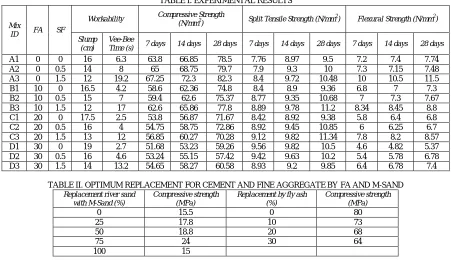
Table I shows the slump values of different mixes. Increase in steel fibre content causes additional reduction in workability. Addition of fly ash as cement replacement in fresh steel fibre reinforced concrete increases workability when compared to reference concrete made without fly ash. Increase in fly ash content causes further increase in workability. Spherical shaped fly ash particles reduce the internal friction in fresh concrete thus increasing the flow ability of fresh concrete. The influence of fly ash on workability is also due to difference between specific gravities of cement and fly ash. Specific gravity of fly ash is lower than specific gravity of Ordinary Portland Cement weight replacement of fly ash with cement results in an increase in binder volume of a concrete that govern workability of concrete.
The change in fly ash content of concrete influences Vee Bee time more than slump value. It is found that Vee-Bee time is more sensitive not only towards steel fibre addition but also fly ash addition. Therefore these comparisons made between Vee-Bee time and slump value workabilities show that Vee Bee time measurement is more appropriate than slump value measurement as an indicator of workability of fresh fibre reinforced concrete.
B. COMPRESSIVE STRENGTH
TABLE I. EXPERIMENTAL RESULTS
Mix
ID FA SF
Workability Compressive Strength
(N/mm2) Split Tensile Strength (N/mm
2
) Flexural Strength (N/mm2)
Slump (cm)
Vee-Bee
Time (s) 7 days 14 days 28 days 7 days 14 days 28 days 7 days 14 days 28 days
A1 0 0 16 6.3 63.8 66.85 78.5 7.76 8.97 9.5 7.2 7.4 7.74
A2 0 0.5 14 8 65 68.75 79.7 7.9 9.3 10 7.3 7.15 7.48
A3 0 1.5 12 19.2 67.25 72.3 82.3 8.4 9.72 10.48 10 10.5 11.5
B1 10 0 16.5 4.2 58.6 62.36 74.8 8.4 8.9 9.36 6.8 7 7.3
B2 10 0.5 15 7 59.4 62.6 75.37 8.77 9.35 10.68 7 7.3 7.67
B3 10 1.5 12 17 62.6 65.86 77.8 8.89 9.78 11.2 8.34 8.45 8.8
C1 20 0 17.5 2.5 53.8 56.87 71.67 8.42 8.92 9.38 5.8 6.4 6.8
C2 20 0.5 16 4 54.75 58.75 72.86 8.92 9.45 10.85 6 6.25 6.7
C3 20 1.5 13 12 56.85 60.27 70.28 9.12 9.82 11.34 7.8 8.2 8.57
D1 30 0 19 2.7 51.68 53.23 59.26 9.56 9.82 10.5 4.6 4.82 5.37
D2 30 0.5 16 4.6 53.24 55.15 57.42 9.42 9.63 10.2 5.4 5.78 6.78
D3 30 1.5 14 13.2 54.65 58.27 60.58 8.93 9.2 9.85 6.4 6.78 7.4
TABLE II. OPTIMUM REPLACEMENT FOR CEMENT AND FINE AGGREGATE BY FA AND M-SAND
Replacement river sand with M-Sand (%)
Compressive strength (MPa)
Replacement by fly ash (%)
Compressive strength (MPa)
0 15.5 0 80
25 17.8 10 73
50 18.8 20 68
75 24 30 64
100 15
Fine aggregate was replaced with M-Sand ranging from 0%, 25%, 50%, 75% and 100% (Table II). Steel fibres are added in the range 0.5%, 1% and 1.5%. The mortar specimens were cast with different combinations and tested for its compressive strength after 28 days. After testing, the mix proportions were selected on the basis of maximum compressive strength. From table 1, it is found out that, the optimum percentage of replacement of M-Sand was found to be 80%, since beyond 80% replacement of river sand with M-Sand there is a reduction in compressive strength. Cement was replaced by fly ash ranging from 0%, 10%, 20% and 30%.The concrete specimens were cast with different combinations and tested for its compressive strength after 28 days. The compressive strength shows a decreasing trend with increase in fly ash percentage.
C. SPLITTENSILESTRENGTH
The results show that there is an increase in split tensile strength varying from 1% to 65% with addition of fibres to concrete (Table I). Highest volume fraction of fibres gives maximum increase in strength. Split tensile strength of steel fibre reinforced concrete containing 20% fly ash was comparable with reference to ordinary Portland cement concrete. It was comparable for concrete containing 20% fly ash up to 0.5% volume fraction of steel fibre but it was lower for 0.5% and 1.5% volume fraction of steel fibre.
D. FLEXURAL STRENGTH
Department of CSE, MCA &CE, Mohandas College of Engineering and Technology, Thiruvananthapuram, Kerala, India
VII.CONCLUSIONS
This paper focused on the effect of flyash and M-sand on SFRC and to identify which will give better performance. The following conclusions are made:
(1) When M - Sand is used to replace fine aggregate content in mortar, the compressive strength increased. The optimum percentage of replacement of sand with M-Sand in mortar was found to be 80%.
(2) As the Fly ash content is increased gradually in SFRC, the compressive strength decreased gradually. The compressive strength shows a decreasing trend with increase in fly ash percentage.
(3) But the presence of steel fibres prevents the further reduction of compressive strength. (4) The steel fibre addition increases the ultimate flexural tensile strength of material.
(5) Fly ash decreases the average compressive strength of steel fibre reinforced concrete. Steel fibres did not recover the compressive strength.
(6) Replacement of fine aggregate with M-Sand also improves the workability. The change in fly ash content of concrete influences the Vee Bee time more than the slump value. From the above studies it is concluded that concrete casted by replacing cement with fly ash and fine aggregate with M Sand was found to be better than any other system.
REFERENCES
[1] C.X. Qian, P. Stroeven. Development of hybrid polypropylene-steel fibre-reinforced concrete. Cement and Concrete Research 30 (2000) 63-69. [2] Akanshu Sharma, G.R. Reddy, L. Varshney, H. Bharathkumar, K.K. Vaze, A.K. Ghosh, H.S. Kushwaha, T.S. Krishnamoorthy. Experimental
investigations on mechanical and radiation shielding properties of hybrid lead-steel fibre reinforced concrete. Nuclear Engineering nd Design 239 (2009) 1180-1185.
[3] S.P. Singh, A.P. Singh, V. Bajaj. Strength and Flexural toughness of concrete reinforced with steel-polypropylene hybrid fibres. Asian Journal of Civil Engineering (2010) 495-507.
[4] Parveen, Ankit Sharma. Structural behaviour of fibrous concrete using polypropylene fibres. International Journal of Modern Engineering Research (2013) 1279-1282.
[5] Wu Yao, Jie Li, Keru Wu. Mechanical properties of hybrid fibre reinforced concrete at low fibre volume fraction. Cement and Concrete Research 33 (2003) 27-30.
[6] Mohammed Seddik Meddah, Mohammed Bencheikh. Properties of concrete reinforced with different kinds of industrial waste fibre materials. Construction and Building Materials 23 (2009) 3196-3205.
[7] Darole J.S, Prof. Kulkarni V.P, Prof. Shaikh A.P, Prof. Gite B.E. Effect of Hybrid Fibre on Mechanical Properties of concrete. International Journal of Engineering Research and Applications (2013) 1408-1411.
[8] Maruthachalam D, Muthukumar J. Mechanical performance of recycled PET fibre reinforced concrete with low volume fraction. International Journal of Structural and Civil Engineering Research (2013).
[9] Rashid Hameed, Anaclet Turasinze, Frederic Duprat, Alain Sellier. Study on the flexural properties of metalli-hybrid-fibre-reinforced concrete. Maejo International Journal of Science and Technology (2010) 169-184.
[10] Vaishali.G.Ghorpade. An experimental investigation on glass fibre reinforced high performance concrete with silica fume as admixture. Singapore Concrete Institute (2010).
[11] V.M. Sounthararajan, S. Thirumurugan, A. Sivakumar. Reinforcing Efficiency of crimped profile of polypropylene fibres on the cementitious matrix. Research Journal of Applied Sciences, Engineering and Technology (2013) 2662-2667.
[12] Ravichandra.A, Rama Mohan Rao. P. Effect of hybrid fibres on the properties of class C fly ash based concrete. International Journal of Structural and Civil Engineering (2012).