DEVELOPMENT OF COMPUTER-AIDED MATERIALS AND MANUFACTURING PROCESS SELECTION SOFTWARE
USING BOOTHROYD-DEWHURST METHODOLOGY
ZAEIME BIN SULONG @ ZAKARIA
A project report submitted in partial fulfilment of the requirements for the award of the degree of Master of Engineering (Mechanical – Advanced Manufacturing Technology)
Faculty of Mechanical Engineering Universiti Teknologi Malaysia
iii
iv
ACKNOWLEDGEMENT
First of all, I would like to thank to Allah S.W.T for giving me strength and guidance to complete this project. I would like to express my sincere thanks to my supervisor Dr. Ariffin Bin Haji Abdul Razak for the constant guidance, invaluable knowledge, and constructive ideas in leading me to accomplish this project.
v
ABSTRACT
vi
ABSTRAK
vii
TABLE OF CONTENTS
CHAPTER TITLE PAGE
DECLARATION ii
DEDICATION iii
ACKNOWLEDGEMENTS iv
ABSTRACT v
ABSTRAK vi
TABLE OF CONTENTS vii
LIST OF TABLES xi
LIST OF FIGURES xii
LIST OF SYMBOLS AND ABBREVIATION xvi
LIST OF APPENDICES xvii
1 INTRODUCTION
1.1 Project Introduction 1
1.2 Project Objective 2
1.3 Scope 2
1.4 Problem Statement 3
1.5 Selected Parts 4
1.6 Thesis Structure 6
viii
2 LITERATURE VIEW ON MATERIAL AND
MANUFACTURING PROCESSES
2.1 Introduction 8
2.2 Manufacturing processes 10
2.2.1 Sand Casting 12
2.2.2 Investment Casting 13
2.2.3 Die Casting 14
2.2.4 Extrusion 16
2.2.4.1 Impact Extrusion 17
2.2.4.2 Hot Extrusion 18
2.2.5 Cold Heading 20
2.2.6 Closed Die Forging 21
2.2.7 Powder Metallurgy 22
2.2.8 Rotary Swaging 23
2.2.9 Machining Process 24
2.2.10 Electrochemical Machining (ECM) 25
2.2.11 Electric Discharge Machining (EDM) 26
2.2.12 Wire EDM 27
2.2.13 Sheet Metal Process 28
2.2.14 Metal Spinning 29
2.3 Engineering Materials 30
2.3.1 Metals 31
2.4 Study Material 35
2.4.1 Cast Iron 36
2.4.2 Carbon Steel 37
2.4.3 Alloy Steel 37
2.4.4 Stainless Steel 38
2.4.5 Aluminium and Alloys 40
2.4.6 Copper and Alloys 42
2.4.7 Zinc and Alloys 44
2.4.8 Magnesium and Alloys 45
ix
2.4.10 Nickel and Alloys 47
2.4.11 Refractory Metals 48
2.5 Materials Properties 49
2.6 Review on previous study 53
2.6.1 Simultaneous Design for
Manufacturing Process Selection of
Engineering Plastics 53
2.6.2 Computer Aided Design for
Manufacturing Process Selection 60 2.6.3 Computer-aided manufacturing
planning for mass
customization:part1,framework 67
2.7 Summary 70
3 BOOTHROYD DEWHURST METHODOLOGY
3.1 Introduction 71
3.2 General Shape Attributes 73
3.3 Selection of Manufacturing Process 78
3.4 Selection of Material 80
3.5 Final Eliminating Process 81
3.6 Reason of Eliminating 82
3.7 Summary 83
4 TOOL FOR SOFTWARE DEVELOPMENT
4.1 Introduction 84
4.2 Visual Basic 85
4.3 Summary 88
5 DEVELOPMENT OF PROTOTYPE SOFTWARE
5.1 Introduction 89
x
5.3.1 Main Interface 97
5.3.2 Credit Interface 98
5.3.3 Input Data Graphic User Interface 99 5.3.4 Result Graphic User Interface 101 5.3.5 Info Guide Graphic User Interface 102
5.3.6 Help Graphic User Interface 103
5.4 Summary 104
6 VERIFICATION OF CAM-MaPS SOFTWARE
6.1 Introduction 105
6.2 Case Studies 106
6.2.1 Prismatic Part 106
6.2.2 Rotational Part 110
6.3 Summary 114
7 DISCUSSIONS
7.1 Introduction 115
7.2 Discussion on Prismatic Part Case Study 116
7.3 Discussion on Rotational Part Case Study 117
7.4 Summary 119
8 CONCLUSIONS
8.1 Introduction 120
8.2 Future Work Recommendations 121
8.3 Concluding remark 122
REFERENCES 124
xi
LIST OF TABLES
TABLE NO. TITLE PAGE
2.1 Hot extrusion temperature for various metals 19
3.1 The selected of part attribute 78
3.2 The selected of part material requirement 78 5.1 Example flow of process selection in manufacturing
processes 93
5.2 Example how to rank the process by rating system 94 6.1 Shape attributes for stapler handler 107 6.2 Requirements of production factors for the stapler
handler 108
6.3 Requirements of properties factors for the stapler
handler 108
6.4 Shape attributes for the gear 111
xii
LIST OF FIGURES
FIGURE NO. TITLE PAGE
1.1 Survey of designers’ knowledge of manufacturing
process 3
1.2 Survey of designers’ knowledge of polymer materials 4
1.3 The handle of stapler gun 5
1.4 The selected gear for case study 6
2.1 Schematic diagram for sand casting mold 12 2.2 Sequences to produce a metal casting in sand mold 13 2.3 Schematic sequences producing the part using
investment casting 14
2.4 Hot chamber die casting 15
2.5 Cold chamber die casting 16
2.6 The illustration for extrusion of a roundness bar 17
2.7 Forward extrusion open die 18
2.8 Example of hot extrusion die for Aluminium 19
2.9 The illustration for cold heading process and the
sample product 20
2.10 Sequences of closed die forging in produced piston
rod 21
2.11 Sequences in powder metallurgy process and the
sample of product 22
2.12 Components of rotary swaging, Sequences in rotary
swaging process and the sample of product 23 2.13 The turning process and milling process 24
xiii
2.15 The schematic of EDM process, the EDM milling
and sample of products using EDM process 26 2.16 The schematic of WEDM process in cutting the
workpiece 27
2.17 The schematic of stamping operation 28
2.18 Common die-bending operations, using V and wiping
die 29
2.19 Schematic illustration of the conventional spinning process Types of parts conventionally spun. All parts
are antisymm 30
2.20 The schematic of DCA 56
2.21 Master input card in HyperQ/PP 58
2.22 Envelope size specification card 58
2.23 Internal geometry specification cards 59
2.24 Process ranking card 59
2.25 Detailed DCA for selected process 60
2.26 Design dependency diagram this diagram views
process selection 63
2.27 Master input card in DFPS 64
2.28 Surface roughness/ tolerances specification card 64 2.29 Part shape classification/ envelop sizes specification 65
2.30 Process ranking card 65
2.31 Detail DCA for selected process 66
2.32 DCA online help for process/material compatibility 66
2.33 Architecture of computer-aided manufacturing
planning (CAMP) system for mass customization 69
3.1 Flow chart to performed selection material and process
72
3.2 Depressions in a single direction and Depressions in
more than one direction 73
xiv
3.4 Uniform cross section and Non-uniform cross section 74 3.5 Different area for cross section in non-uniform part 75
3.6 Part that can be generated by rotation of a single axis and Part that cannot be generated by rotation of a single axis
75
3.7 The splined shaft 76
3.8 A bottle of water with captured cavities attribute 76
3.9 The plastic ball with enclosed attribute 77 3.10 part with draft, part with draft free surfaces 77
3.11 Process Elimination by Geometric Attributes 79 3.12 Process Elimination by Part Application Information 80 3.13 Final process elimination by process/material
combination 81
4.1 Front page GUI of Visual Basic 85
5.1 The structure of prototype software 89
5.2 Form of part attributes 90
5.3 Example data keep in by user in production factors
section 90
5.4 Example the input data by user for materials
properties factor 94
5.5 The sequence step of software 95
5.6 Proposed graphic user interface for main page of
CAM-MaPS 96
5.7 Appearance GUI of credit page 97
5.8 The proposed input data graphic user interface 98
5.9 The graphic user interface for the result 99 5.10 Selection for shape attributes, processes, materials
and material properties 100
5.11 The interface of Helps page 103
6.1 Image of stapler gun 106
xv
6.3 Result generated for stapler holder 108
6.4 Example of application gears 109
6.5 The view of input data GUI after user fill the
requirement data for gear 112
xvi
LIST OF SYMBOLS AND ABBREVIATION
ECM Electro chemical machining EDM Electro discharge machining
Kg Kilogram
mm Millimetre MPa Mega Pascal
Ø Diameter
Ti-O Titanium Oxide
xvii
LIST OF APPENDICES
APPENDIX TITLE PAGE
A1 Properties of each material involved in database systems 127
A2 Descriptions for the material 128
B Manufacturing processes and their attributes 130 C The relation between manufacturing processes to
engineering materials 133
D Shape generation capabilities of processes 134
E1 Capability of Sand Casting process 135
E2 Capability of investment casting process 136
E3 Capability of die casting process 137
E4 Capability of impact extrusion process 138
E5 Capability of cold heading process 139
E6 Capability of hot forging (closed die) process 140 E7 Capability of pressing and sintering (power metal parts)
process 141
E8 Capability of rotary swaging process 142
E9 Capability of hot extrusion process 143
E10 Capability of machining (from stock) process 144
E11 Capability of electrochemical machining (ECM) process 145 E12 Capability of electrical discharge machining (EDM)
process 146
CHAPTER 1
INTRODUCTION
1.1 Project Introduction
2
selection of materials and processes. Symbols or icons also will be asserting in this application to facilitate user to choose according desirable suitability parts.
1.2 Project Objective
The objective of this project is to develop a prototype software system for selection of material and manufacturing processes based on Boothroyd-Dewhurst DfM methodology. By using this application it will help user to do selection in materials and manufacturing processes in a short time. The data or parameter key in by the user to be generated by computer to get the result and it is an intelligent method, comparing with the manual method.
1.3 Scope
To accomplish this project, there are some scopes or limitation given by the supervisor. Following are the scopes project proposed:
1. Review on Boothroyd-Dewhurst DfM methodology.
2. Use Microsoft Visual Basic programming language for prototype system development.
3. Develop a prototype software system for selecting the proper material and manufacturing process.
3
1.4 Problem Statement
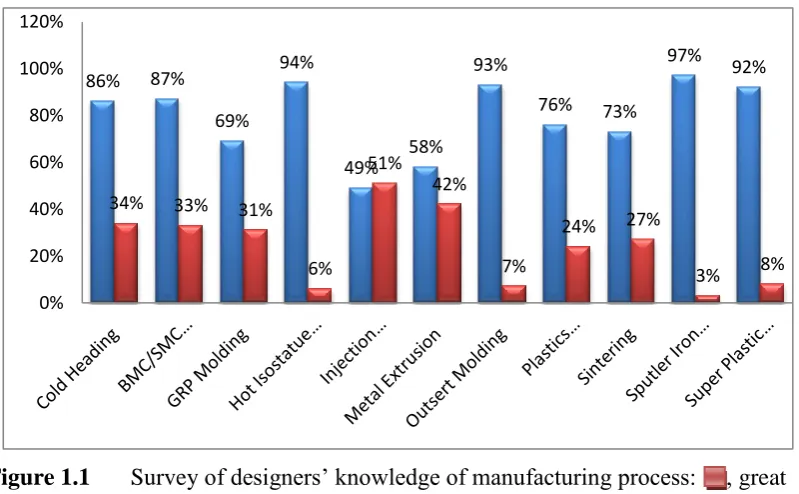
There are many process manufacturing resides within industries nowadays. It comprise of conventional, CNC and advance processes. Similarly material resides within markets now, which are found in several kinds. Sometime a designer tends to conceive parts in terms of processes and materials which they are most familiar and exclude those which proved more economic. Then the opportunities for major manufacturing improvements may be lost through such limited selections of manufacturing processes and associated materials in the early stage of the product design. Figure 1.1 and Figure 1.2 show on survey were made on designers in Britain on their knowledge on material and processes occur in industry [1].
Figure 1.1 Survey of designers’ knowledge of manufacturing process: , great deal/ fail amount: , little or nothing
86% 87% 69% 94% 49% 58% 93% 76% 73% 97% 92%
34% 33% 31%
4
Figure 1.2 Survey of designers’ knowledge of polymer materials: , great deal/ fail amount: , little or nothing [1]
By using Boothroyd-Dewhurst DFM methodology it will solve the problem in choosing appropriate material and processes. But nowadays it was done manually by referring the tables and it would be quite time-consuming to choose what kinds of material and processes suitably in producing product or part. Sometimes error also occurs during referring the tables because it has been lots items within one table. Due to this, by developing a prototype software application, it is able to solve problems easily.
1.5 Selected Parts
To ensure the different in result after generated by prototype software, two different types in shape was selected. The first is prismatic part and the second one is
5
rotational part. The part has been selected to do the selection by using the Boothroyd Dewhurst methodology by states all the parameter of the part such as shape attributes, material properties, production factor, dimension and image of parts. After that the parameters will be key in into the prototype software application system. For the selected prismatic part, it was a handle of gun stapler. Figure 1.3 shows the actual view of the part. In actual situation, this handle made from steel where it requires strong and rustless. The main function of handle is to acting as a medium to transfer forces from hand gripping to active the knuckle system of gun stapler. Finally, the selection of material and manufacturing process of this part will do it by using the Boothroyd Dewhurst methodology.
Figure 1.3 The handle of stapler gun
6
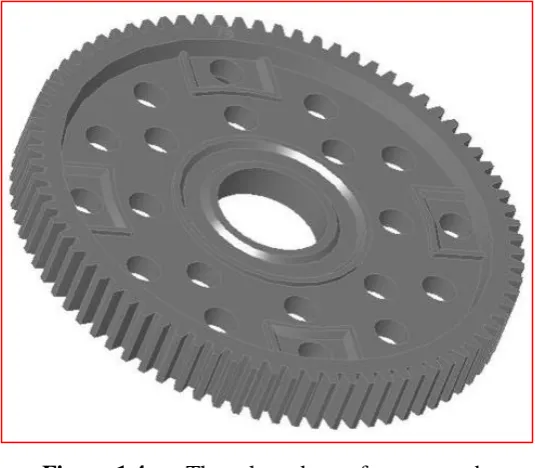
Figure 1.4 The selected gear for case study
1.6 Thesis Structure
7
suggestions will conclude and the chapter of sources on the materials studies will be listed at references.
1.7 Summary
![Figure 1.2 Survey of designers’ knowledge of polymer materials: , great deal/ fail amount: , little or nothing [1]](https://thumb-us.123doks.com/thumbv2/123dok_us/1305274.1163163/20.595.126.511.66.319/figure-survey-designers-knowledge-polymer-materials-great-little.webp)