Available Online atwww.ijcsmc.com
International Journal of Computer Science and Mobile Computing
A Monthly Journal of Computer Science and Information Technology
ISSN 2320–088X
IMPACT FACTOR: 5.258
IJCSMC, Vol. 5, Issue. 7, July 2016, pg.123 – 129
A Fuzzy Adaptive Multi-Featured and Zone
Adaptive Method for Target Coverage in WSN
Kiran
IGDTUW, Electronics and comm, Kashmiri gate, New Delhi [email protected]
Md. Ejaz Aslam Lodhi
IGDTUW, Electronics and comm, Kashmiri gate, New Delhi [email protected]
ABSTRACT: Sensor Network is real time network with specification of environment specific critical nodes. To provide the regular monitoring and uninterrupted battery backup, it is required to track the nodes continuously. In mobile sensor network, such kind of target node tracking is more critical. In this present work, multi-featured and fuzzy trained method is defined for target tracking. At the earlier phase, zone featured predictive measure is defined to track the nodes more accurately. Later on, energy, fault and coverage based analysis is defined to generate the coverset. The proposed model is implied in dynamic random sensor network. The simulation results show that the proposed method has improved the network life and reduced the coverage fault.
Keywords: Coverage, Dynamic Fuzzy, Target Coverset, Mobile Sensor Network
I. INTRODUCTION
A sensor network is the adhoc network defined without specification of any specialized controller or infrastructure. These kinds of networks are basically defined to provide high level cooperative communication between the pair of sensor nodes which can be available at different geometric locations. This heavy communication is drawn in real time with specification of real scenario or the application. This real time connectivity also increases the network criticality. Because of this these networks are suffers from heavy communication load. The dedicated network requires the direct transition between the network elements or the nodes so that the fast and safe communication will be obtained from the work. To provide high communication, the network requires the high bandwidth. The short distance communication is also the basic requirement of this network form. In biometric application, environment data processing, video communications are the common application areas of such networks. This network form also provides the internal communication observation with cooperative node identification and the control. The communication support is here provided at multiple mode as well as for single mode. The parameter driven analysis with cooperative connectivity is applied and observed. The communication distance, communication media and technology are the other parameter which can control the communication so that the effective communication will be drawn.
II. COVERAGE
Coverage [4][5][6] is one the most required and effective phenomenon associated with the sensor network. It is considered as one of the critical research issue which is required in real time sensor network to improve the network QoS (Quality of Service). This problem is basically focused on the effective utilization of network resources in different forms and specification to the application and process. The coverage is process associated to the network architecture, localization and the deployment in collective form. The coverage performance and the deployment measures are required to apply for effective monitoring under various parameters and constraints.
The performance measures are required to implement to achieve effective feature map based on application characterization.
Figure 1 : Sensing Behavior
The main criteria of these coverage algorithms are based on the sensing range which is considered as the limitation of sensor network. It considers the same critical constraint as key constraint and optimizes the network under different aspects and methods. Here figure 1 is showing the sensing behavior of nodes with specification of direction of sensing. The direction can be redundant or not, depending on the network type.
After identifying the degree, the coverage degree is identified to observe the number of possible communication supported by the node. The coverage requirement, fault and the tolerance driven constraints are also defined with specification of application and environment. The objective of coverage is to improve the network life time and reduce the power consumption of these active and critical sensors. According to the requirement and the behavior, coverage problem is divided in two sub domain.
A. Area Coverage
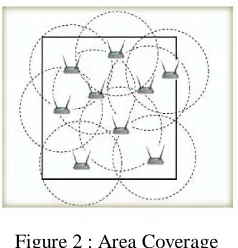
The area converge is method defined basically to cover the available geometric network region by using the available sensor nodes. The point specific monitoring can be applied to cover the maximum network region. The localization specific distributed mechanism is here defined to provide the effective network coverage. To achieve the area coverage, effective static or dynamic node deployment is required. There is the requirement to provide the regular node monitoring and backup provider to achieve the long time observation to the network. The area coverage is here shown in figure 2
Figure 2 : Area Coverage
The effective area coverage solution is able to provide the generation of effective network cover so that the optimized communication will be formed in the network. The observations on orphan nodes, multihop nodes, effective cooperative nodes are also required to reduce the communication drop.
B. Target Coverage
and characteristics but also provides the regular backup in terms of battery power, data requirement etc. In a sensor network, there is the challenge to identify the nodes that can provide the regular backup to the target nodes. The basic criteria of coverage election are based on the sensing range. But the regular monitoring of a node by same sensor node, can decrease the life of that sensor node. Because of this, there is the requirement of some ordering method to switch between multiple sensors and provide a session specific monitoring or coverage.
Figure 3 : Target Coverage[11]
Now the election of such nodes is based on the energy and distance optimization measures. Some other parameters are also used by other researchers to identify the coverage node. The set of sensor nodes that can monitor all the targets are collectively called coverset. The primary requirement of target coverage algorithm to identify the possible cover sets in a network. Here the figure is showing the target coverage problem with 5 sensors and 6 target nodes. The figure is showing each of the target node with relative covered sensor node. Once the target covers are generated, the next work is to set the activation sequence. This process of sequence setup is called scheduling method. To optimize the target coverage and the network communication, there is the requirement to improve coverset formation process and the relative scheduling algorithm.
III. LITERATURE SURVEY
Different researchers have improved the coverage algorithms by applying the network configuration, node placement or the optimization algorithms. Some of the work of earlier researchers for coverage optimization is described in this chapter. Karegaonkar et. al.(2015) has provided a study work on different approaches and methods to improve the network connectivity and the coverage. Author identified the feature vectors that affects network coverage as well as identified the various challenges faced by the researchers in coverage optimization. The improvement of different authors is achieved in terms of minimum distance connectivity while working on mobile sensor network. Author also defined a comparative observation on different algorithms respective to the objective, outcome and limitation of the approach[1].
Huang et. al.(2011) has provided a work on target coverage using multiple sensors and multiple targets based approach. The heuristic algorithm was integrated to improve the life of network. The target observed analysis was provided to achieve the maximum possibibility of target coverage. Author improved the greedy algorithm by applying the constraint satisfaction for parametric analysis[2]. Babacar et. al.(2014) has provided a work on target coverage to improve the network life time and provided the maximum network utilization. Author provided the distance driven analysis on network coverage and provided the life time maximization to achieve the probabilistic analysis with distance parameter specification. Author defined an improvement to the classical weighted algorithm to achieve the implication of disjoint and non-disjoint set covers. Author provided the evaluation to improve the coverage management and extend the network life time. A probabilistic profit analysis function is also implied to improve the network life and achieved the performance enhancement[3].
Meng Jin et. al.(2011) has defined an incomplete coverage control algorithm for mobile constraint target tracking. The work is applied on pre-deployed sensors by analyzing the energy within the relative trajectory. The predictive algorithm is here defined to improve the connectivity and network life time. Author generated the predicted cells based feature set to generate the mobility model and provided the cell consist tracking of mobile nodes. A coverage ratio based optimized algorithm was defined to improve the rate of coverage. The network lifetime was also improved by the algorithm[7]. Ren et. al.(2014) defined a work on event detection and optimization in real time environment to provide solution against sensing cover problem. The method includes the energy harvesting deployment of network under quality observation and duty cycle analysis. The sensing coverage based quality optimization is here provided to improve the algorithm in centralized and distributed environment. The accurate network monitoring for period specification is defined to predict the energy harvesting. The adaptive framework is defined to achieve the energy prediction based fluctuation os that the effective target monitoring will be obtained
IV. PROPOSED WORK
method will be applied for scheduling the coversets. Finally, the communication and mentoring will be done based on which the network analysis will be applied. The work will be defined to improve the network life and communication.
V. Research Methodology
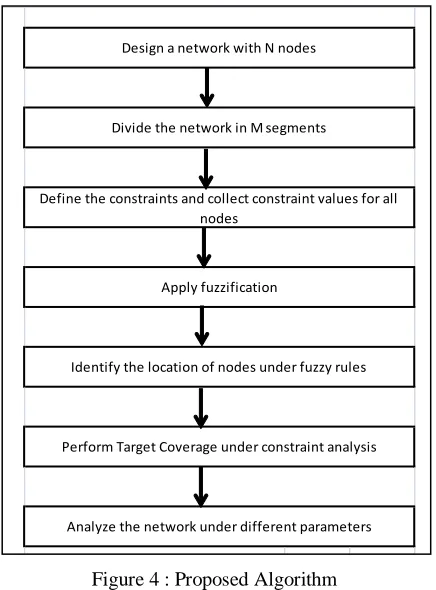
The presented work is about to define an solution for target coverage problem under fuzzy integrated parameterized approach. Here multiple constraints will be defined to perform target coverage under fuzzy logic. The constraints covered in this work include sensing range, load, fault, energy evaporation factor etc. After generating the coversets, the greedy method will be applied for scheduling the activation of these coversets.
Figure 4 : Proposed Algorithm
Here figure 4 is showing the basic process defined in this research to optimize the target coverage problem. This problem is here divided in three main phases. The algorithmic process formulation for zone based coverage mapping is shown here in table 1
Table 1 : Target Tracking Algorithm
TargetTracking(node1, node2 ,SensingRange, ZoneSize, AdpSw)
/*node1 and node2 sensor nodes with energy and the positional specification, sensing range is the maximum range of a node to apply the cover, Zone size is the network zone division, AdpSw is the adaptive expective node switching to cover the uncertainity vector*/
{
1. [x1 y1]=GetPosition(node1)
[x2 y2]=GetPosition(node2)
[Get the absolute node position of both nodes]
2. [zone1]=GetZone(x1,y1,ZoneSize)
[zone2]=GetZone(x2,y2,ZoneSize)
[Get the zone based on the size specific ratio
Define the constraints and collect constraint values for all nodes
Apply fuzzification
Identify the location of nodes under fuzzy rules
Perform Target Coverage under constraint analysis
Analyze the network under different parameters Design a network with N nodes
analysis]
3. [pxmin1 pymin1 pxmax1
pymax1]=GetPeaks(zone1,AdpSw,x1,y1)
[pxmin2 pymin2 pxmax2
pymax2]=GetPeaks(zone2,AdpSw,x2,y2)
[Get the peak position of node within zone under the positional switching aspect]
4. dist1=GetDist(pxmin1, pymin1,pxmax2,pxmax2)
dist2=GetDist(pxmin2, pymin2,pxmax1,pxmax1)
[Get the distance observation between the peak points]
5. if (dist1<=SensingRange Or
dist2<=SensingRange)
[Check the node is in coverage region
{
6. Return 1;
[Return the coverage estimation vector]
}
Else
{
7. return 0;
[Node is not in coverage under uncertainty]
}
A. Fuzzy Logic
Fuzzy logic is the conditional rule based model applied on specific attributes and stages to provide the effective results. This model is applied on different stages and processes based on the application specification. In this work, the network modeling and the cooperative node analysis is applied using fuzzy operators. The fuzzy operators are here applied on different parameters including the distance analysis, energy analysis and the fault level analysis. The fault node identification is also done here using fuzzy operator. There are three steps that are to be used to create a fuzzy model:
Fuzzification (using membership functions to graphically describe a situation)
Rule evaluation (application of fuzzy rules)
Defuzzification (obtaining the crisp or actual results)
In this work, the members of target covers are elected using fuzzy logic. All the parameters including sensing range, load, energy and failure probability are mapped under fuzzy logic.
VI. RESULTS
Table 2 : Network Scenario
Parameters Values
Number of Sensor Nodes 50
Number of Target Nodes 3
Network Area 300x300 Mtr
Sensing Range 50 Mtr
Initial Energy Random
Topology Random
Zone Size 30 Mtr
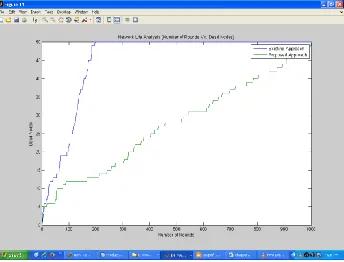
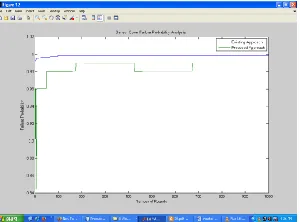
The existing approach is here defined to generate the coverset using energy and coverage range based approach. The proposed approach where combined the failure probability and load as the inclusive parameters. These parameters are observed under fuzzy approach with each communication round. The coverset activation is also done using fuzzy based parametric analysis. The sub-section is here presenting the comparative results obtained from the work.
Figure 5 : Alive Node Analysis (Existing Vs. Proposed)
Here figure 5 is showing the comparative analysis of this alive nodes for both the existing and proposed approach for target coverage. Here x axis is showing the number of communication rounds and y axis is showing the number of alive nodes in the network. The network survived in existing approach upto 200 rounds but in proposed approach, the network resided for 1000 rounds.
Figure 6 : Dead Node Analysis (Existing Vs. Proposed)
Figure 7 : Failure Probability Analysis (Existing Vs. Proposed)
Here figure 7 is showing the comparative failure probability analysis for existing and proposed approach. Here figure is showing the analysis against the communication rounds. Here x axis is showing the communication rounds and y axis is showing the failure probability. It figure shows that the failure probability in existing approach was higher.
VII. CONCLUSION AND FUTURE SCOPE
In this present work, an adaptive dynamic fuzzy integrated zone specific method is defined for node tracking in mobile sensor network. The fault and energy adaptive analysis generated the effective coverage to the mobile targets. The simulation results show that the method has improved the network life and fault in target tracking is also reduced. In future the work can be improved by integrating some optimization algorithm. More work can be done to reduce the target tracking fault.
References
[1] S. M. Karegaonkar and A. R. Raut, "Review on target coverage and network connectivity in Mobile Sensor Networks," Electronics and Communication Systems (ICECS), 2015 2nd International Conference on, Coimbatore, 2015, pp. 490-493.
[2] Jau-Wu Huang, Chia-Mao Hung, Kai-Chao Yang and Jia-Shung Wang, "Energy-efficient probabilistic target coverage in wireless sensor networks," 2011 17th IEEE International Conference on Networks, Singapore, 2011, pp. 53-58.
[3] B. Diop, D. Diongue and O. Thiare, "Target coverage management in wireless sensor networks," Wireless Sensors (ICWiSE), 2014 IEEE Conference on, Subang, 2014, pp. 25-30.
[4] J. W. Huang, C. M. Hung, K. C. Yang and J. S. Wang, "Probabilistic Target Coverage in Wireless Sensor Networks," Broadband and Wireless Computing, Communication and Applications (BWCCA), 2011 International Conference on, Barcelona, 2011, pp. 345-350.
[5] G. Han; L. Liu; J. Jiang; L. Shu; G. Hancke, "Analysis of Energy-Efficient Connected Target Coverage Algorithms for Industrial Wireless Sensor Networks," in IEEE Transactions on Industrial Informatics , vol. pp, no.99, pp.1-1
[6] D. Bajaj and Manju, "Maximum coverage heuristics (MCH) for target coverage problem in Wireless Sensor Network," Advance Computing Conference (IACC), 2014 IEEE International, Gurgaon, 2014, pp. 300-305.
[7] M. Jin, Z. Gao, R. Huang, X. Chang and F. Qi, "An Incomplete Coverage Control Based on Target Tracking Wireless Sensor Network," Mobile Ad-hoc and Sensor Networks (MSN), 2011 Seventh International Conference on, Beijing, 2011, pp. 15-19.
[8] C. W. Yu, K. M. Yu, W. T. So, C. T. Lin and C. Y. Lin, "Target Coverage in Wireless Sensor Networks," Mobile Ad-hoc and Sensor Networks (MSN), 2011 Seventh International Conference on, Beijing, 2011, pp. 408-412.
![Figure 3 : Target Coverage[11]](https://thumb-us.123doks.com/thumbv2/123dok_us/1918556.1251745/3.612.252.374.117.228/figure-target-coverage.webp)