Open Access Journal of Sports Medicine
Dove
press
O r i g i n A l r e S e A r c h
open access to scientific and medical research
Open Access Full Text Article
randomized controlled trial of Micro-Mobile
compression
®
on lactate clearance and subsequent
exercise performance in elite male cyclists
iñigo San Millán1
Kristen Bing1
carrie Brill1
John c hill1
larry e Miller2
1University of colorado School of Medicine, Aurora, cO, 2Miller Scientific consulting, inc, Arden, nc, USA
correspondence: larry e Miller Miller Scientific Consulting, inc, 26 Portobello road, Arden, nc 28704, USA
Tel +1 928 607 9657 Fax +1 928 268 3563
email [email protected]
Background: The purpose of this paper was to assess the feasibility of Micro-Mobile Compression® (MMC) on lactate clearance following exhaustive exercise and on subsequent
exercise performance.
Methods: Elite male cyclists were randomized to MMC (n = 8) or passive recovery (control, n = 8). MMC is incorporated into a sandal that intermittently compresses the venous plexus during non-weight bearing to augment venous return. On day 1, subjects performed a graded exercise test on a cycle ergometer followed by 60 minutes of seated recovery, with or without MMC. Blood lactate concentration ([La−]) was measured during exercise and recovery. Subjects
returned home for 3 more hours of seated recovery, with or without MMC. On days 2 and 3, subjects exercised to exhaustion in a fixed-load cycle ergometer test at 85% peak power and then repeated the day 1 post-exercise recovery procedures. Lactate clearance data after the time to exhaustion tests on days 2 and 3 were averaged to adjust for interday variation.
Results: On the day after MMC or control recovery, mean time to exhaustion was 15% longer (mean difference, 2.1 minutes) in the MMC group (P = 0.30). The standardized mean difference of MMC for time to exhaustion was 0.55, defined as a moderate treatment effect. Following the graded exercise test, area under the 60-minute lactate curve was nonsignificantly lower with MMC (3.2 ± 0.4 millimolar [mM]) versus control (3.5 ± 0.4 mM, P = 0.10) and times from end of exercise to 4mM and 2mM were 2.1 minutes (P = 0.58) and 7.2 minutes (P = 0.12) shorter, although neither achieved statistical significance. Following time to exhaustion testing, the area under the 60-minute lactate curve was lower with MMC (3.2 ± 0.2 mM) versus control (3.5 ± 0.2 mM, P = 0.02) and times from end of exercise to 4mM and 2mM were 4.4 minutes (P = 0.02) and 7.6 minutes (P , 0.01) faster. The standardized mean difference of MMC on most lactate clearance parameters was .0.8, defined as a large treatment effect.
Conclusion: MMC yields large treatment effects on lactate clearance following high-intensity exercise and moderate treatment effects on subsequent exercise performance in elite male cyclists.
Keywords: cycling, graded exercise test, recovery, time to exhaustion, venous return
Introduction
Strenuous exercise elicits important stresses on the musculoskeletal system and meta-bolic functions that can impair subsequent exercise performance and interfere with training practices. Fluxes in muscle cell metabolites associated with energy utilization during heavy exercise (eg, lactate) can delay recovery, influence muscle glycogen reserves, and, in some circumstances, contribute to transient decreases in subsequent exercise performance. Active recovery is a highly beneficial and advantageous training strategy compared with passive recovery since augmented post-exercise circulation
Open Access Journal of Sports Medicine downloaded from https://www.dovepress.com/ by 118.70.13.36 on 26-Aug-2020
For personal use only.
Number of times this article has been viewed
This article was published in the following Dove Press journal: Open Access Journal of Sports Medicine
Dovepress San Millán et al
encourages lactate clearance and, in some cases, may enhance subsequent exercise performance.1–7 Recent studies have
reported mixed findings on exercise performance following active recovery with compression garments8–11 or whole body
vibration.12–14 Additionally, compliance with compression
garments is generally poor9 and the availability of whole
body vibration units is limited to research use.
Micro-Mobile Compression® (MMC) is a novel
technol-ogy that simulates the effects of active recovery by augment-ing blood flow through the deep veins of the leg via cyclic pressure pulses to the plantar venous plexus. The platform for MMC is a sandal that provides cyclic compression to the arch of the foot when the user is in a non-weight bearing position. Dohm et al15 reported that MMC augmented blood flow
velocity 12-fold above resting levels in the posterior tibial vein and four-fold above resting levels in the popliteal vein of healthy adults. A distinct theoretical advantage of MMC is that post-exercise circulation and lactate clearance may be augmented without the deleterious effects of decreased glycogen resynthesis in type I muscle fibers,16 lower muscle
reoxygenation rates,17 and declines in subsequent exercise
performance17,18 that have been reported in some studies of
traditional exercise-based active recovery. The hypothesis of this randomized, controlled trial was that MMC would allow for enhanced clearance of blood lactate immediately follow-ing exhaustive exercise and an improvement in subsequent high-intensity, fixed-load exercise performance.
Materials and methods
Subjects
This prospective, randomized, controlled trial was conducted at the Human Performance Laboratory of the Anschutz Health and Wellness Center at the University of Colorado School of Medicine, Aurora, CO, USA. All study proce-dures were conducted in accordance with the Declaration of Helsinki and in accordance with a predefined protocol that was approved by all researchers and the Colorado Multiple Institutional Review Board. All participants gave informed consent before any study procedures were performed.
Eligible subjects were 16 elite (Pro/category 1/category 2) male road cyclists, aged 21–42 years. Consecutive eligible subjects were randomly assigned to MMC or passive recov-ery only (control) using a computerized random-number generator with a 1:1 allocation ratio and a block size of four. Treatment assignments were hidden from investigators and subjects via sealed and secured envelopes until each subject was randomized. Blinding of interventions was not feasible in this study.
interventions
cycle ergometry graded exercise test
Subjects were instructed to have adequate sleep the night before the test and to avoid food, alcohol, tobacco, and caf-feine within 3 hours of the test. Each subject was provided with nutrition recommendations for the 3 days prior to exer-cise testing as well as during the 3-day experimental period. The dietary recommendations were consistent each day, and included complete abstinence from alcohol and consumption of a diet with 70% of calories from carbohydrate, 15% from protein, and 15% from fat.
Subjects performed a graded exercise test to exhaustion on a calibrated, electrically braked cycle ergometer (Lode Excalibur Sport, Lode, Groningen, The Netherlands) on day 1. Subjects performed an incremental test according to our protocol,19 which was slightly modified for this study. The
initial workload was 2 W/kg, with increments of 0.5 W/kg every 3 minutes until volitional exhaustion. Maximal oxygen consumption (VO2max), blood lactate concentration ([La−]),
heart rate, and power output were measured during the graded exercise test. Oxygen consumption (VO2), carbon dioxide pro-duction (VCO2), ventilation, and respiratory exchange ratio were determined through indirect calorimetry (ParvoMedics TrueOne 2400 Metabolic Measurement System, Parvo-Medics Inc, Sandy, UT, USA). Criteria for attainment of VO2max included two of the following: respiratory exchange ratio .1.1, maximal heart rate within 10 beats per minute of the calculated value, or an O2 plateau (,50 mL per minute) with an increase in power output. Heart rate was continuously monitored with a heart monitor (Polar S725x, Polar Electro, Kempele, Finland). At the end of each stage, a sample of capil-lary blood (25 µL) from the earlobe was collected to analyze both intracellular and extracellular levels of L-lactate (YSI 1500 Sport, YSI, Yellow Springs, OH, USA).
Time to exhaustion
On days 2 and 3 at the same time of day, subjects performed a fixed-load exercise test at 85% of peak power output (power outputPeak) determined on day 1, on the electrically braked cycle ergometer. Pretest procedures were identical to those of the graded exercise test. Subjects were requested to maintain the prescribed power output during exercise until volitional exhaustion. Gas exchange and heart rate were measured identi-cally to day 1. [La−] was measured only at the end of exercise.
exercise recovery procedures
On each of the 3 days after the exercise tests were completed, subjects recovered by sitting barefooted in the laboratory
Open Access Journal of Sports Medicine downloaded from https://www.dovepress.com/ by 118.70.13.36 on 26-Aug-2020
Dovepress MMc for lactate clearance and exercise performance
for 60 minutes, with or without MMC. Blood was collected at 10-minute intervals throughout the 60-minute recovery period. Participants ingested a sports drink containing 1.5 g/kg of carbohydrates during recovery. Thereafter, subjects returned to their residences and immediately com-pleted an additional 3 hours of seated passive recovery, with or without MMC. The post-exercise recovery procedures were identical on each day.
Micro-Mobile compression
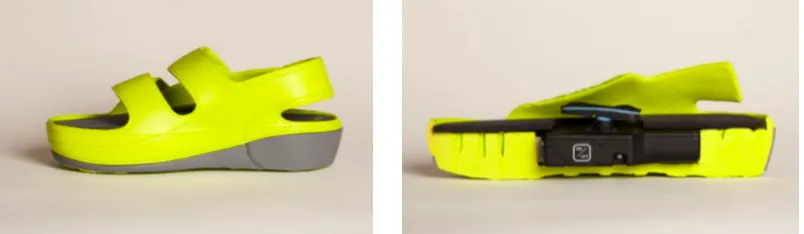
The MMC device (AVEX, LLC, Grand Junction, CO, USA, Figure 1) consists of a motorized thrusting arm and pressure pad powered by a long-lasting rechargeable battery. The unit is user-activated by depressing a power switch on the body of the motor, which is housed in a hollow within the sole of a custom sandal. Upon activation, the device thrusts an 18.6 cm2 pressure
pad directly onto the sole of the foot, compressing the plantar venous plexus. The MMC device adjusts the height of its thrust until the exerted pressure on the arch of the foot reaches a measured force of 3.76 N/cm2. The thrusting pad remains
pressed on the arch of the foot for 2 seconds before retreating to its resting position. This thrust-pause-retreat cycle repeats every 20 seconds while the wearer is non-weight bearing. A pressure-sensitive interrupt switch is activated if the wearer stands up. The MMC device returns to its cyclical thrusting rhythm after 60 seconds of wearer inactivity.
Data analysis
Lactate clearance data after the time to exhaustion tests on days 2 and 3 were averaged to adjust for interday varia-tion20 and between-group comparisons were adjusted for
peak lactate concentration using analysis of covariance. The correlation of time to exhaustion on days 2 and 3 was high (r= 0.78). The area under the lactate curve during the 60-min-ute post-exercise recovery period was comp60-min-uted using the trapezoidal rule described by Matthews et al.21 To calculate
the time needed for peak lactate to reach fixed markers of lactate clearance, individual blood [La−] values were
plot-ted at each time point during the 60-minute recovery period using a smoothed curve fitting model (Microsoft Excel, 2010, Redmond, WA, USA). Two fixed time points on each plotted lactate clearance curve were identified, ie, the time for lactate concentration to decline from peak to 4 mM ([La−]
4mM) and
2 mM ([La−]
2mM), respectively.
Time to exhaustion data on days 2 and 3 were averaged to adjust for interday variation,20 and values were assessed
with analysis of variance to compare the MMC and control groups. Analysis of covariance was explored to assess the potential influence of baseline characteristics and graded exercise test data. None of these variables influenced the effect of treatment group on time to exhaustion and, therefore, unadjusted data are reported.
Statistical significance was set at P, 0.05. Continuous variables were reported as the mean ± standard deviation. Baseline subject characteristics and graded exercise test data were compared using an independent-samples t-test. For each main outcome, the mean between-group difference and 95% confidence interval (CI) were calculated. The standardized mean difference was also calculated for each variable, defined as the between-group mean difference divided by the common standard deviation. For reference, a standardized mean differ-ence of 0.2 is considered small, 0.5 is moderate, 0.8 is large, and 1.0 is very large.22 The sample size in this study allowed
the detection of a standardized mean difference .1.5, assum-ing two-sided alpha = 0.05, statistical power = 80%, and a 1:1 allocation ratio. All statistical tests were performed using NCSS software, version 7.1.21 (NCSS, LLC, Kaysville, UT, USA).
Results
Subject compliance
All subjects completed the 3-day testing period, and compli-ance with the testing protocol and dietary recommendations
Figure 1 The Micro-Mobile compression® device. external (left) and long-axis cross sectional (right) views. Activation switch and pressure pad in raised position shown in right panel.
Open Access Journal of Sports Medicine downloaded from https://www.dovepress.com/ by 118.70.13.36 on 26-Aug-2020
Dovepress San Millán et al
was 100%. No discomfort or complications were reported in subjects allocated to MMC or control.
Subject characteristics
Subject characteristics included a mean age of 29 ± 5 (range 21–42) years, body mass index of 21.7 ± 1.9 kg/m2, VO
2max
of 60 ± 6 mL/kg per minute, and peak power of 349 ± 40 W. The MMC and control groups did not differ in baseline char-acteristics (Table 1) or in responses to the cycle ergometer graded exercise test (Table 2).
Time to exhaustion with high-intensity,
fixed-load ergometry
On the day after exhaustive exercise followed by MMC or control recovery, mean time to exhaustion with high-intensity, fixed-load cycling was 15% greater (mean differ-ence 2.1 minutes, 95% CI −2.1 to 6.3) in the MMC group (16.2 ± 4.9 minutes) versus control (14.1 ± 2.6 minutes), although statistical significance was not achieved (P= 0.30). The standardized mean difference of MMC on time to exhaustion was 0.55, representing a moderate effect.
lactate clearance after graded
exercise testing
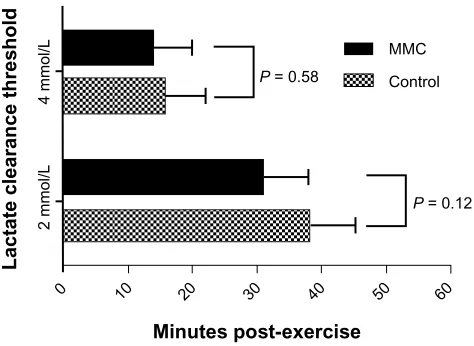
Following the graded exercise test, the area under the 60-minute lactate curve was nonsignificantly lower with MMC (3.2 ± 0.4 mM) versus control (3.5 ± 0.4 mM, mean difference 95% CI −0.8 to 0.1 mM, P = 0.10), indicating somewhat faster lactate clearance with MMC (Figure 2). The mean time required for lactate concentration to fall from peak exercise to [La−]
4mM was 2.1 minutes shorter with MMC
versus control (mean difference 95% CI −5.8 to 9.9 minutes,
P= 0.58). Similarly, the mean time for [La−] to fall from
peak exercise to [La−]
2mM was 7.2 minutes shorter with MMC
versus control (mean difference 95% CI −2.0 to 16.4 minutes,
P= 0.12, Figure 3). Despite the lack of statistically significant group differences, the standardized mean difference of MMC on lactate clearance parameters after graded exercise test
Table 1 Baseline subject characteristics
Variable MMC
(n = 8)
Control (n = 8)
P-value
Age (years) 29.4 ± 6.1 29.3 ± 4.9 0.96
height (cm) 179 ± 4 178 ± 5 0.79
Weight (kg) 70.7 ± 6.3 67.5 ± 8.0 0.39
Body mass index (kg/m2) 22.1 ± 2.0 21.2 ± 1.7 0.35
Body fat (%) 10.4 ± 1.8 11.1 ± 1.0 0.40
Note: Values are mean ± standard deviation. Abbreviation: MMc, Micro-Mobile compression®.
Table 2 exercise capacity measures from cycle ergometer graded exercise test
Variable MMC
(n = 8)
Control (n = 8)
P-value
VO2max
Absolute (l per minute) 4.3 ± 0.6 3.9 ± 0.3 0.08 relative (ml/kg per minute) 61.0 ± 6.5 58.6 ± 5.7 0.44 PO (W)
Peak 362 ± 45 337 ± 33 0.22
85% peak 307 ± 38 286 ± 28 0.22
PO (W/kg)
Peak 5.1 ± 0.6 5.0 ± 0.4 0.62
85% peak 4.4 ± 0.5 4.3 ± 0.3 0.62
VO2 max/PO ([ml/kg per minute]/W) 11.9 ± 0.9 11.6 ± 1.2 0.49 [la−]
Peak (mM) 8.2 ± 1.3 8.5 ± 1.2 0.39
Note: Values are mean ± standard deviation.
Abbreviations: PO, power output; [la−], blood lactate concentration; VO 2max, maximal oxygen consumption; MMc, Micro-Mobile compression®.
60 50 40 30 20
10 0
2
0
Minutes post-exercise
Lactate concentration (mmol/L)
P = 0.10 Control MMC
4 6 8
Figure 2 Area under the 60-minute lactate curve after graded exercise test. P-value represents the difference in 60-minute area under the lactate curve with MMc versus control. Plotted values are means.
Abbreviation: MMc, Micro-Mobile compression®.
60 50 40 30 20 10 0
4 mmol/L
2 mmol/L
Lactate clearance threshold
P = 0.12 P = 0.58
MMC
Control
Minutes post-exercise
Figure 3 lactate clearance time to 4 mM and 2 mM thresholds after graded exercise test. Values are means ± 95% confidence intervals.
Abbreviation: MMc, Micro-Mobile compression®.
Open Access Journal of Sports Medicine downloaded from https://www.dovepress.com/ by 118.70.13.36 on 26-Aug-2020
Dovepress MMc for lactate clearance and exercise performance
was 0.88 (large effect) for the area under the 60-minute lactate curve, 0.29 (small effect) for time from peak to [La−]
4mM, and
0.85 (large effect) for time from peak to [La−]
2mM.
lactate clearance after high-intensity,
fixed-load ergometry
Following time to exhaustion testing, the area under the 60-minute lactate curve was lower with MMC (3.2 ± 0.2 mM) versus control (3.5 ± 0.2 mM, mean difference 95% CI −0.1 to
−0.5 mM, P= 0.02, Figure 4). The time from peak to [La−]
4mM
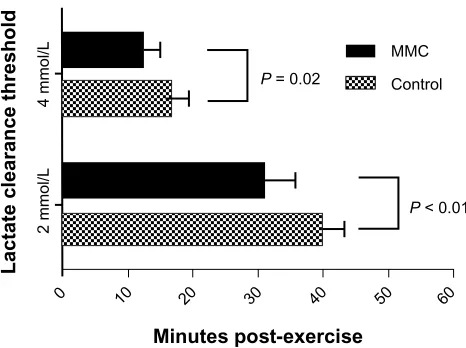
was 4.4 minutes faster with MMC versus control (mean dif-ference 95% CI −0.9 to −7.9 minutes, P= 0.02) and time to [La−]
2mM was 7.6 minutes faster with MMC versus control
(mean difference 95% CI −3.0 to −12.2 minutes, P, 0.01, Figure 5). The standardized mean difference of MMC on all lactate clearance parameters after time to exhaustion tests was .1.0, representing very large effects.
Discussion
The major findings of this randomized, controlled trial are that application of MMC results in faster clearance of blood lactate following high-intensity exercise and yields moder-ate improvements in subsequent exercise performance in elite male cyclists. Although statistical significance was not achieved for all lactate clearance and performance parameters, calculated treatment effects were moderate to very large in most cases, despite the fact that the study was underpowered for some outcomes. This study represents the first published report on the potential applicability of MMC for enhancement of athletic performance.
Blood lactate testing is extensively utilized in the field of applied exercise physiology and sports performance.
60 50
40 30
20 10
0 2
0
Minutes post-exercise
Lactate concentration (mmol/L)
P = 0.02 Control MMC
4 6 8
Figure 4 Area under the 60-minute lactate curve after fixed-load cycle ergometry at 85% peak power. P-value represents the difference in 60-minute area under the lactate curve with MMc versus control. Plotted values are means.
Abbreviation: MMc, Micro-Mobile compression®.
60 50 40 30 20 10 0
4 mmol/L
2 mmol/L
Lactate clearance threshold
P < 0.01
P = 0.02
MMC
Control
Minutes post-exercise
Figure 5 Lactate clearance time to 4 mM and 2 mM thresholds after fixed-load cycle ergometry at 85% peak power. Values are means ± 95% confidence intervals. Abbreviation: MMc, Micro-Mobile compression®.
It is well documented that highly trained athletes accu-mulate lower blood lactate levels,23–28 probably due to an
enhanced lactate clearance capacity.29 Lactate concentration
at submaximal exercise intensities has discriminative ability to predict performance in competitive cyclists.19 Early in
recovery, following high-intensity, fixed-load exercise that elicits high blood lactate accumulations, as in our study, enhanced lactate removal may aid recovery by a number of metabolic processes, including facilitating conversion to glucose in the liver and increasing substrate availability for many organs in the body, including the heart, brain, and less active skeletal muscle.29,30 Various types of active recovery
following intense exercise have been shown to improve lactate removal.1–6,31–34 Further, active exercise recovery after
strenuous exercise clears accumulated blood lactate in an intensity-dependent manner faster than passive recovery.35
These effects are probably due to increased lactate efflux from active muscle, promoted by enhancing local blood flow and flow-related oxygen delivery, with little or no atten-dant increase in metabolic demand caused by the mode of active recovery employed. It is also plausible that effective forms of active recovery, in addition, may be instrumental in helping fatigued muscle shift metabolic processes more quickly in ways that shorten the time needed to replenish glycogen stores for heavy exercise training or competition on subsequent days.
Prior studies with MMC have yielded outcomes that are supportive of our findings. Dohm et al15 demonstrated
that MMC yields venous velocity increases 12-fold above resting levels for the posterior tibial artery and four-fold for the popliteal artery, which were comparable with the peak venous velocities demonstrated with an intermittent
Open Access Journal of Sports Medicine downloaded from https://www.dovepress.com/ by 118.70.13.36 on 26-Aug-2020
Dovepress San Millán et al
pneumatic compression system approved by the US Food and Drug Administration. Charles et al36 compared MMC
and below-knee graduated compression stockings on peak venous velocity at the popliteal vein. MMC yielded a four-fold increase in peak venous velocity versus no change for compression stockings. Based on the pronounced venous augmentation observed with MMC in these studies, the ben-eficial influence of MMC on lactate clearance in the current study was not surprising. In fact, all lactate clearance para-meters in this study were associated with a large or very large standardized mean difference, with the exception of [La−]
4mM
following the graded exercise test. Given that the time from peak lactate to [La−]
4mM was approximately 15 minutes, it is
plausible that a greater duration of MMC is required to elicit maximal benefit on lactate clearance.
The exercise performance treatment effect in the cur-rent study was of such a magnitude to suggest moderate performance enhancement with exercise or competition on consecutive days, thereby warranting additional larger scale studies. However, the mechanism by which MMC influ-ences subsequent exercise performance is unknown. Venous plexus compression is known to exert shearing stress on the endothelial lining yielding nitric oxide-mediated vasodila-tion,37 which is known to regulate the microcirculation in
upstream muscle38 and to influence glycogen replenishment
rates.39 Animal studies demonstrate that intermittent
pneu-matic leg compressions improve exercise tolerance, in part, by enhancing blood flow to collateral-dependent tissues.40
Additionally, muscle damage indices such as creatine kinase concentration41 and lymphatic outflow kinetics42 have been
explored as possible mediators of exercise performance on consecutive days with compression clothing or devices. These markers are candidates for further study in order to deter-mine the mechanism by which MMC influences subsequent exercise performance.
This study had several limitations worth mentioning. First, despite the promising lactate clearance outcomes with MMC over 60 minutes post-exercise, we did not assess exer-cise performance during this period. Instead, we focused on exercise performance the day after MMC, a design that is applicable to cyclists participating in intensive training on consecutive days or those competing in multiple-day stage races. Second, the sample size was sufficient only to detect large treatment effects compared with passive recovery. We therefore calculated the standardized mean difference of treatment effects to supplement formal hypothesis tests. Next, no formal comparisons with other active recovery methods were integrated into this study design. The results
of this study are generalizable only to competitive male cyclists and, therefore, extrapolation of the study outcomes to females or to non-cyclist endurance athletes should be done with caution. Finally, it is plausible that the wide range of subject ages may have confounded recovery from exercise, despite the fact that no differences in age were identified between groups.
Conclusion
This randomized, controlled trial demonstrated that MMC augments clearance of blood lactate following high-intensity exercise and moderately improves subsequent exercise performance in elite male cyclists. Larger, prospective, ran-domized, controlled trials are warranted to evaluate further the effect and mechanism of action of MMC technology on exercise performance and recovery.
Acknowledgment
The authors thank William G Herbert for research and edito-rial assistance.
Disclosure
This research was supported in part by AVEX LLC (Grand Junction, CO, USA).
References
1. Ahmaidi S, Granier P, Taoutaou Z, Mercier J, Dubouchaud H, Prefaut C. Effects of active recovery on plasma lactate and anaerobic power following repeated intensive exercise. Med Sci Sports Exerc. 1996;28(4):450–456.
2. Belcastro AN, Bonen A. Lactic acid removal rates during controlled and uncontrolled recovery exercise. J Appl Physiol. 1975;39(6):932–936. 3. Dodd S, Powers SK, Callender T, Brooks E. Blood lactate disappearance
at various intensities of recovery exercise. J Appl Physiol. 1984;57(5): 1462–1465.
4. Gisolfi C, Robinson S, Turrell ES. Effects of aerobic work performed during recovery from exhausting work. J Appl Physiol. 1966;21(6): 1767–1772.
5. Hermansen L, Stensvold I. Production and removal of lactate during exercise in man. Acta Physiol Scand. 1972;86(2):191–201.
6. Spierer DK, Goldsmith R, Baran DA, Hryniewicz K, Katz SD. Effects of active vs passive recovery on work performed during serial supra-maximal exercise tests. Int J Sports Med. 2004;25(2):109–114. 7. Koizumi K, Fujita Y, Muramatsu S, Manabe M, Ito M, Nomura J.
Active recovery effects on local oxygenation level during intensive cycling bouts. J Sports Sci. 2011;29(9):919–926.
8. Sperlich B, Born DP, Kaskinoro K, Kalliokoski KK, Laaksonen MS. Squeezing the muscle: compression clothing and muscle metabolism during recovery from high intensity exercise. PLoS One. 2013;8(4): e60923.
9. MacRae BA, Cotter JD, Laing RM. Compression garments and exercise: garment considerations, physiology and performance. Sports Med. 2011;41(10):815–843.
10. Hamlin MJ, Mitchell CJ, Ward FD, Draper N, Shearman JP, Kimber NE. Effect of compression garments on short-term recovery of repeated sprint and 3-km running performance in rugby union players. J Strength Cond Res. 2012;26(11):2975–2982.
Open Access Journal of Sports Medicine downloaded from https://www.dovepress.com/ by 118.70.13.36 on 26-Aug-2020
Open Access Journal of Sports Medicine
Publish your work in this journal
Submit your manuscript here: http://www.dovepress.com/open-access-journal-of-sports-medicine-journal
Open Access Journal of Sports Medicine is an international, peer-reviewed, open access journal publishing original research, reports, reviews and commentaries on all areas of sports medicine. The manuscript management system is completely online and includes a very quick and fair peer-review system.
Visit http://www.dovepress.com/testimonials.php to read real quotes from published authors.
Dovepress
Dove
press
MMc for lactate clearance and exercise performance
11. de Glanville KM, Hamlin MJ. Positive effect of lower body compres-sion garments on subsequent 40-km cycling time trial performance.
J Strength Cond Res. 2012;26(2):480–486.
12. Kosar AC, Candow DG, Putland JT. Potential beneficial effects of whole-body vibration for muscle recovery after exercise. J Strength Cond Res. 2012;26(10):2907–2911.
13. Colson SS, Petit PD. Lower limbs power and stiffness after whole-body vibration. Int J Sports Med. 2013;34(4):318–323.
14. Marin PJ, Herrero AJ, Milton JG, Hazell TJ, Garcia-Lopez D. Whole-body vibration applied during upper body exercise improves performance. J Strength Cond Res. 2013;27(7):1807–1812.
15. Dohm M, Williams KM, Novotny T. Micro-mobile foot compression device compared with pneumatic compression device. Clin Orthop Relat Res. 2011;469(6):1692–1700.
16. Fairchild TJ, Armstrong AA, Rao A, Liu H, Lawrence S, Fournier PA. Glycogen synthesis in muscle fibers during active recovery from intense exercise. Med Sci Sports Exerc. 2003;35(4):595–602.
17. Ohya T, Aramaki Y, Kitagawa K. Effect of duration of active or passive recovery on performance and muscle oxygenation during intermittent sprint cycling exercise. Int J Sports Med. 2013;34(7):616–622. 18. Dupont G, Blondel N, Berthoin S. Performance for short
intermit-tent runs: active recovery vs passive recovery. Eur J Appl Physiol. 2003;89(6):548–554.
19. San Millán I, Gonzalez-Haro C, Sagasti M. Physiological differences between road cyclists of different categories. Med Sci Sports Exerc. 2009;41:S48.
20. Fric J Jr, Fric J, Boldt F, et al. Reproducibility of post-exercise lactate and anaerobic threshold. Int J Sports Med. 1988;9(5):310–312. 21. Matthews JN, Altman DG, Campbell MJ, Royston P. Analysis of serial
measurements in medical research. BMJ. 1990;300(6719):230–235. 22. Cohen J. Statistical Power Analysis for the Behavioral Sciences. 2nd ed.
Hillsdale, NJ: Lawrence Erlbaum; 1988.
23. Donovan CM, Brooks GA. Endurance training affects lactate clearance, not lactate production. Am J Physiol. 1983;244(1):E83–E92. 24. Hurley BF, Hagberg JM, Allen WK, et al. Effect of training on blood
lactate levels during submaximal exercise. J Appl Physiol. 1984;56(5): 1260–1264.
25. Jansson E, Kaijser L. Substrate utilization and enzymes in skeletal muscle of extremely endurance-trained men. J Appl Physiol. 1987;62(3): 999–1005.
26. Kjaer M, Bangsbo J, Lortie G, Galbo H. Hormonal response to exercise in humans: influence of hypoxia and physical training. Am J Physiol. 1988;254(2 Pt 2):R197–R203.
27. MacRae HS, Dennis SC, Bosch AN, Noakes TD. Effects of training on lactate production and removal during progressive exercise in humans.
J Appl Physiol. 1992;72(5):1649–1656.
28. Bergman BC, Wolfel EE, Butterfield GE, et al. Active muscle and whole body lactate kinetics after endurance training in men. J Appl Physiol. 1999;87(5):1684–1696.
29. Brooks GA. Cell-cell and intracellular lactate shuttles. J Physiol. 2009;587(Pt 23):5591–5600.
30. Gladden LB. Lactic acid: new roles in a new millennium. Proc Natl Acad Sci U S A. 2001;98(2):395–397.
31. Kraemer WJ, Flanagan SD, Comstock BA, et al. Effects of a whole body compression garment on markers of recovery after a heavy resis-tance workout in men and women. J Strength Cond Res. 2010;24(3): 804–814.
32. Taoutaou Z, Granier P, Mercier B, Mercier J, Ahmaidi S, Prefaut C. Lactate kinetics during passive and partially active recovery in endur-ance and sprint athletes. Eur J Appl Physiol Occup Physiol. 1996;73(5): 465–470.
33. Bonen A, Belcastro AN. Comparison of self-selected recovery methods on lactic acid removal rates. Med Sci Sports. 1976;8(3):176–178. 34. Monedero J, Donne B. Effect of recovery interventions on lactate
removal and subsequent performance. Int J Sports Med. 2000;21(8): 593–597.
35. Menzies P, Menzies C, McIntyre L, Paterson P, Wilson J, Kemi OJ. Blood lactate clearance during active recovery after an intense run-ning bout depends on the intensity of the active recovery. J Sports Sci. 2010;28(9):975–982.
36. Charles T, Macintosh S, Fingleton J, Weatherall M, Beasley R. Efficacy of micro-mobile foot compression device in increasing lower limb venous blood flow. Int J Vasc Med. In press.
37. Bryan NS. Application of nitric oxide in drug discovery and development. Expert Opin Drug Discov. 2011;6(11):1139–1154. 38. Chen LE, Liu K, Qi WN, et al. Role of nitric oxide in vasodilation in
upstream muscle during intermittent pneumatic compression. J Appl Physiol. 2002;92(2):559–566.
39. Dai Z, Wu Z, Yang Y, et al. Nitric oxide and energy metabolism in mammals. Biofactors. 2013;39(4):383–391.
40. Roseguini BT, Arce-Esquivel AA, Newcomer SC, Yang HT, Terjung R, Laughlin MH. Intermittent pneumatic leg compressions enhance mus-cle performance and blood flow in a model of peripheral arterial insufficiency. J Appl Physiol. 2012;112(9):1556–1563.
41. Cochrane DJ, Booker HR, Mundel T, Barnes MJ. Does intermittent pneumatic leg compression enhance muscle recovery after strenuous eccentric exercise? Int J Sports Med. April 19, 2013. [Epub ahead of print.]
42. Kraemer WJ, Bush JA, Wickham RB, et al. Continuous compression as an effective therapeutic intervention in treating eccentric-exercise induced muscle soreness. J Sport Rehabil. 2001;10:11–23.
Open Access Journal of Sports Medicine downloaded from https://www.dovepress.com/ by 118.70.13.36 on 26-Aug-2020