Two 1-Round Protocols for Delegation of Computation
Ran Canetti∗ Ben Riva† Guy N. Rothblum‡
September 21, 2011
Abstract
Consider a weak client that wishes to delegate computation to an untrusted server and be able to succinctly verify the correctness of the result, all within one round of interaction. We provide solutions for two relaxed variants of this problem. Specifically:
• We consider a model where the client delegates the computation totwo or moreservers, and is guaranteed to output the correct answer as long as even asingleserver is honest. We call this model Refereed Delegation of Computation (RDoC). In this model, we show a 1-roundunconditionally statistically soundprotocol for any log-space uniformN C circuit. In contrast, all known one-round delegation protocols with a single server are only computationally sound.
• We consider a model with a non-succinct offline stage andpubic verifiability. (Previously, this model was considered only with private verifiability, namely the client has to maintain some secret local information pertaining to the offline stage [Gennaro et al., CRYPTO 2010]). Public verifia-bility does away with the secret state, and so allows delegating the offline stage to a “semi-trusted” external third party that is potentially used by many clients, even mutually suspicious ones. It also allows for a stronger, more adaptive notion of soundness.
In this model we show a 1-round computationally-sound protocol for any circuitC,even a non-uniform one. The client runs in timepoly(log(size(C)), depth(C)), and soundness is guaranteed assuming the existence of collisions resistant hashing and poly-logarithmic PIR. Previously, pub-licly verifiable one round delegation protocols were known only for functions in log-space uniform N C.
∗
Boston University and Tel Aviv University,[email protected].
†
Tel Aviv University,[email protected].
‡
Contents
1 Introduction 1
1.1 Our Contributions . . . 1
1.2 Organization . . . 3
2 Prior Work 3 3 The Protocols of [GKR08, KR09] 4 3.1 Preliminaries: Low Degree Extension (LDE) . . . 4
3.2 The Bare-Bones Protocol, Given a Circuit Specification Oracle . . . 4
3.3 Realizing the Oracle forL-uniformN C Circuits . . . 6
3.4 The Transformation of [KR09] . . . 6
4 Refereed Delegation of Computation 6 4.1 The Model . . . 6
4.1.1 Parallel Repetition for RDoC . . . 7
4.1.2 From Two Servers toN Servers . . . 7
4.2 One-round RDoC for AnyL-uniformN C Computation . . . 7
4.2.1 The Protocol of [FK97] . . . 7
4.2.2 The Protocol, Given a Circuit Specification Oracle . . . 10
4.2.3 Realizing the Oracle forL-uniformN CCircuits . . . 14
5 Publicly Verifiable Delegation of Computation (PVDoC) 15 5.1 The Model . . . 16
1 Introduction
An emerging paradigm in modern computing is pay-per-useCloud Computing. As companies and users reduce their computing assets and turn to weaker computing devices, an increasing number and variety of computations are being performed remotely by untrusted parties that may be error-prone or even malicious. This shift motivates exploring methods for delegating computations reliably: a weak client delegates his computation to a powerful server. After the server returns the result of the computation, the client should be able to verify the correctness of that result using considerablylessresources than required to actually
performthe computation from scratch.
Prior work has considered using an interactive protocol for delegating computation from a client to an untrusted server. These works ask for protocols where the client does not worktoo much(ideally, the client will only have to do work that is quasilinear in the input length). There has been a rich body of work on this question. Kilian [Kil92] proposes a protocol that uses two rounds of interaction for delegating any polynomial-time computation. Micali [Mic00] “squashes” the Kilian protocol to one round in the Ran-dom Oracle model. These protocols enjoy public verifiability, namely the client keeps no private state. A non publicly verifiable, one round version of these protocols is shown to be sound based on non-standard extractability assumptions [CL08, BCCT11, GLR11]. The soundness guarantee of these protocols is only computational.
Goldwasser, Kalai and Rothblum [GKR08] propose a delegation protocol with statistical soundness. However, the protocol works only for log-space uniformN C circuits, and the number of rounds is quasilin-ear in the depth of the circuit.
A relaxation of the model, suggested by [GGP10], considers two stages of the protocol, offline and online. In the offline stage we fix a function (or a circuit) f and allow the client to work harder (e.g., proportional to the size off). In the 1-round online stage, the client can delegate the computation off(x) for any inputx, and can verify the result in time much smaller than the size off. However, in all the recent works in this model (i.e. [GGP10, CKV10, AIK10, Chu11, Ben11]), the result of the offline stage must be kept secret from the server — or else, a malicious server can cheat. This forces the client to perform the expensive offline stage by herself (or by a completely trusted entity).
1.1 Our Contributions
We present two natural extensions of the existing models. In each one of these extended models we show a protocol with properties that are not known to be achievable by previous constructions. More specifically:
Refereed Delegation of Computation (RDoC) Model. Instead of delegating the computation to a single server, we let the client interact withtwo or moreservers, and require that the client outputs the right value as long as there existsoneserver that follows the protocol. That is, the client asks for the value off(x) from several servers. In case they make contradictory claims aboutf(x), they “play” against each other in a protocol where the weak client can efficiently determine the true claim as long as there is at leastonehonest server. As for the efficiency, we require that the computational requirements from an honest server are not much more than those required to compute the function in the first place, and that the client’s running time would be much smaller than required to compute the function. (If the client interacts with three servers, at least a majority of them follow their protocols, then it suffices to simply ask each server for the answer and take the majority answer. Even if we assume there is only one honest server, the client can still detect inconsistency and compute the problem on its own. However, these solutions are not satisfactory for us.)
Another related model is the multi-prover model (MIP). Here a verifier/client interacts with two or more provers. However, in the MIP model, soundness is guaranteed only if no two malicious provers/servers can communicate or coordinate their strategies during the protocol. This assumption is arguably less realistic for cloud computing. Moreover, the definition of MIP allows cases where even a single malicious prover/server can cause the verifier/client to reject the proof of valid statements.
A 1-round unconditionally-sound RDoC for any circuit computable inL-uniformN C. We show a one-round delegation of computation (RDoC) protocol in this model with statistical soundness. The protocol adapts techniques from the work of Feige and Kilian [FK97], who construct a RDoC protocol where the servers are inefficient even for log-space computations, together with ideas and techniques from the work of Goldwasser, Kalai and Rothblum [GKR08], and some new techniques.
We provide a brief overview of the protocol. For the description here we restrict attention to the case when there are exactly two servers, one honest and one malicious (but the referee/client does not know which is honest). We later show how to extend our protocols to more than two servers.
In high level, our protocol follows the structure of the [GKR08] interactive proof. We view the compu-tation as a circuit. The servers make claims about the output layer of the circuit, and we use a (very efficient) sum-check protocol to reduce a claim about a high layer in the circuit, which we call an input claim, into a claim about a lower layer (closer to the circuit’s input layer), we call this an output claim. The guarantee is that if the input claim is false, then w.h.p. over the referee’s coins the output claim will also be false. They use this sub-protocol to reduce the claim about the circuit’s output layer into a claim about the circuit’s input layer, and complete the protocol by noting that claims about the input layer can be verified by the referee in quasi-linear time.
However, the [GKR08] protocol is highly interactive: First, each sum-check sub-protocol requires a logarithmic number of rounds. Second, the claim for each layer in the circuit depends on the coins chosen by the referee in the sum-check for the layer above it, so all of these sum check protocols must be run sequentially from the top circuit output layer to the bottom circuit input layer. To eliminate the first source of interaction, we use a variant of the one-round refereed game for the sum check test from [FK97]. This still leaves us with a significant technical obstacle: How can we collapse all of sum-check protocols from the different layers into just one round of interaction? The difficulty comes from the fact that, in order to run the [FK97] protocol, both servers need to know the claim being debated. This claim, however, depends on the referee’s (non-public) coins in the sum check for the layer above. Revealing all of those coins to both servers ahead of time would compromise soundness.
We overcome this obstacle (and additional lower-level ones) using techniques tailored to our setting. In a nutshell, the claim for each layer is the value of a low-degree multi-variate polynomial (sayp) on a certain secret point (sayz) that is known only to the referee. The referee sends to each server a different low-degree parametric curve passing through the pointz(but also through many others), and asks for the (low-degree) polynomialq describing p restricted to that server’s curve. Essentially, soundness follows because each server (on its own) cannot tell which of the points on its curve is the one that the referee will be checking. If the server cheats and sendsq0 6=q, then (sinceqandq0are low degree polynomials over a larger field) with high probability the server must be cheating on the pointzthat the referee is checking on.
In September 2011 Kol and Raz have posted an alternative exposition of this protocol [KR11]. That paper contains also an extension of this protocol that somewhat reduces the workload of the client at the price of a comparable increase in the number of rounds. We note that our protocol was posted at [CRR11b] and described at [CRR11c].
Another protocol in this model is described in [CRR11a]. That protocol has computational soundness and takes a logarithmic number of rounds.
during the offline stage, or alternatively rely on the assistance of a trusted party that will perform the offline stage on the client’s behalf. However, all the recent protocols in this model require the client to keep some secret information that pertains to the offline stage. This secret information is then used in the verification process. Having such secret information is a serious impediment. First, it requires the client to put complete trust in the entity that participates in the offline stage. Furthermore, in some of the protocols soundness is only guaranteed as long as the server does not know which past interactions convinced the client.
We define a similar model in which avoids these impediments. Instead of an offline stage that ends with a secret key, the offline stage ends with a public data that: (1) can be verified by anyone, and, (2) can be used by anyone to verify the computation of any input (in the online stage).
Imagine that some well-known company (e.g., Microsoft, Google) publishes short public keys for a set of different circuits. (Or, Microsoft ships these keys as part of its products, as is currently done with Certificate Authorities.) Any interested party can also check these values and verify that they are correct. Later on, a (weak) client can take these values and delegate its computation toanyserver, without running the offline stage by itself.
A 1-round computationally-sound PVDoC for non-uniform circuits. We give a brief overview of the protocol. Our starting point is again the [GKR08] protocol, squashed by [KR09] to a single round trip. The difficulty that prevents this protocol from working for larger circuits is that the client cannot verify claims about the circuit structure because the explicit circuit was too large (larger than the client running time) and (for general non-uniform circuits) there was no shorter implicit representation. We solve this difficulty by adding the following offline stage: First, all possible queries on the structure of the circuit to be evaluated are computed in advance. Next, the answers to all these queries are Merkle tree hashed using a function that is chosen from a family of collision resistant hash functions. The output of the offline stage is the root of the Merkle tree hashing. Notice that the same root can be reused in an online stage byanyinterested client delegating a computation toanyserver. (These values do not depend on the input, but only on the circuit itself.) Since the circuit is publicly known, anyone can re-compute the root and publicly verify that it is indeed the correct value. In the online stage, the client runs in timepoly(log(size(C)), depth(C)).
We remark that the same techniques can be also applied directly on the [GKR08] protocol (i.e., without using the [KR09] transformation). In addition to supporting more general circuits, the resulting protocol is (arguably) simpler to understand and potentially easier to implement than the full [GKR08] protocol. Furthermore, although the resulting protocol requirespoly(log(size(C)), depth(C))number of rounds, the practicality of each sub-protocol ( [GKR08] and Merkle Tree) is fairly reasonable compared to previous constructions (e.g., that use fully homomorphic encryption or PIR with huge databases).
1.2 Organization
Section 2 reviews prior work. Section 3 describes the protocol of [GKR08] which we will use extensively in our constructions. Section 4 defines the model of refereed delegation of computation, shows a “parallel repetition” theorem of RDoC protocols and describes how to extend RDoC with two servers to any number of servers. Furthermore, it reviews the protocol of [FK97] which we use in our construction and presents the construction of one-round RDoC for anyL-uniformN C computation. Section 5 defines the model of publicly verifiable delegation of computation, and presents the construction of one-round computationally sound PVDoC for any circuit.
2 Prior Work
on their techniques and show efficient computationally sound protocols, whose security is based on crypto-graphic assumptions and where soundness holds only against computationally bounded cheating provers. Micali gets a non-interactive computationally sound proof based on the existence of a Random Oracle whereas Kilian gets a two-round interactive computationally sound proof assuming the existence of col-lision resistance hash family.
Goldwasser et. al.[GKR08] present an information theoretically sound interactive proof protocol for verifiable computation for any language inL-uniformN C. The number of rounds between the prover and the verifier is poly-logarithmic in the size of the computation. Using the technique of Kalai and Raz [KR09] this protocol can be transformed into a one-round protocol, assuming the existence of a computational Private Information Retrieval scheme with poly-log communication.
Gennaroet al.[GGP10], Chunget. al.[CKV10] and Applebaumet al.[AIK10] consider a model with an offline stage. Based on the existence of a fully homomorphic encryption, they construct computationally sound protocols, where in the offline stage the verifier runs in time proportional to the size of the compu-tation. Afterwards, in an online stage, the verifier (using the secret result of the online stage) runs in time proportional to the size of its inputs and the computation results. In these works, as long as the verifier does not encounter cheating provers, the same pre-processing information can be used in multiple rounds, yielding improved amortized complexity. Recently, Benabbaset al.[Ben11] and Chunget al.[Chu11] show protocols in which security is preserved even if the verifier encounter cheating provers. We stress that in all the above works, the offline stage ends with a secret key that is known only to the verifier.
A related proof model with several provers is the model of Multi-Prover Interactive Proofs, suggested by Ben-Oret al.[BOGKW88]. In this model, even ifallof the provers cheat, the verifier will detect that they are cheating. However, soundness is guaranteed assuming that malicious proverscannotcommunicate or coordinate their strategies during the protocol. This is in contrast to the refereed games of Feige and Kilian [FK97] and to our RDoC model, where soundness is guaranteed as long as one server is honest, even if some group of malicious servers communicateduringthe protocol. In addition, the referee learns who are the cheating provers.
3 The Protocols of [GKR08, KR09]
Given that our protocols rely heavily on the structure of the [GKR08, KR09] protocols, we start with a brief exposition of them.
3.1 Preliminaries: Low Degree Extension (LDE)
Given a fieldF, a subsetH⊆F and a functionf :Hm →F, we let the low degree extension off, denoted
e
f =LDE(f), be theuniquemulti-variate polynomialfe:Fm→F that satisfies:
• (low-degree)deg(fe)<|H|for each variable.
• (extension)f(x) =fe(x)for allx∈Hm.
Such polynomials can be constructed using Lagrange Interpolation.
Similarly we define the low degree extension of a vector. Let α : Hm → {0, . . .|H|m −1} be the
lexicographic order ofHm. Given a vectorw~ = (w0, . . . wk−1)∈Fk, wherek≤ |H|m, we can view this vector as a functionfw~ :Hm →F such thatfw~(z) =wα(z)whenα(z)≤k−1andfw~(z) = 0otherwise.
We define the low degree extension of the vectorw~ to beLDE(fw~).
3.2 The Bare-Bones Protocol, Given a Circuit Specification Oracle
Notations and Parameters: The protocol is between a server and a client, where both know the inputx
of lengthk.
Given an arithmetic circuit C : {0,1}k → {0,1} of fan-in 2 gates, size S and depthd, the players
poly(d, log(S)), 2) An integermsuch thatS ≤ |H|m ≤poly(S), 3) An extension fieldF ofH such that |F| ≤poly(|H|). (The size ofF influences the soundness of the protocol.).
Using standard techniques, we can transform the arithmetic circuit C to a new arithmetic circuitC0 :
Fk →FSover the fieldF with the following properties: 1)C0is of sizepoly(S)and depthd, with fan-in 2 gates, 2) Each layer, except for the input layer, is of sizeS(simply by adding dummy gates), 3) For every (x1, . . . , xk)∈ {0,1}k,C0(x1, . . . , xk) = (C(x1, . . . , xk),0, . . . ,0).
Letspecc()be the predicate describing a circuitC. That is,specc(i, b, w1, w2, w3) returns 1 if in the
i-th layer ofC there is a gate that connects wiresw2 andw3 to wirew1, and this gate is a b-gate where
b ∈ {0 = add,1 = mult}.1 Letspecgc(i) be the low degree extension ofspecc(i,·,·,·,·)with respect to H, F andm, of degreeδ(that depends onspecc()) in each variable. In this section we assume the client has
an oracle access tospecgc0(i).
We denote the output layer as the 0 layer and the other layers according to their distance from the output layer. The input layer is thed-th layer. For0 ≤i≤ dwe associate a vectorvi = (vi,0, . . . , vi,S−1) ∈FS with the values of all gates of thei-th layer in the computation ofC0(x1, . . . , xk). v0 is the circuit result (C(x1, . . . , xk),0, . . . ,0)andvd is the circuit input(x1, . . . , xk). LetVei : Fm → F be the low degree
extension of the vectorvi with respect toH, F andm. This polynomial is of degree≤ |H| −1in each of
its variables, and givenvican be computed in time ≤poly(|F|m) = poly(S). Since vdis of lengthk,Ved
can be computed in time≤k·poly(|H|, m).
The Protocol: The server claims thatC0(x1, . . . , xk) = (0, . . . ,0). An interactive protocol is executed
between the server and the client. In each step the server reduces the correctness of the computation of layerito the correctness of the computation of layeri+ 1. Concretely, for layeri, the server claims that
e
Vi(ui) = ri for some randomly chosenui that the client picked and sent to the server. Then, the server
reduces the correctness of this claim to the correctness ofVei+1(ui+1) = ri+1 for some randomly chosen ui+1that the client picked. This process continues until they reach the input layer and then the client verifies the correctness of this layer by himself (asVedis small and known to the client).
We now describe in detail the reduction between the layers. Letfu(i): (Fm)3 →F be the a3m-variate
polynomial of size≤poly(S)and degree≤2δdefined by
fu(i)(p, w, w0) =
e
β(u, p)·[specgc0(i+1)(0, p, w, w0)(Vei+1(w) +Vei+1(w0)) + specgc0(i+1)(1, p, w, w0)(Vei+1(w)·Vei+1(w0)) ]
whereβe(u, p)is a|H| −1degree polynomial that depends only onF, H andm, and, can be computed in
timepoly(|H|, m) (see [Rot09]). Note that given an oracle access tospecgc0(i) and the values ofVei+1(w)
andVei+1(w0), the polynomialf
(i)
u (p, w, w0)can be evaluated in timepoly(|H|, m).
Now, given a claim for layerithatVei(ui) =rifor some randomly chosenuithat the client picked and
sent to the server, it can be shown thatVei(ui) = P
p,w,w0∈Hmf
(i)
ui (p, w, w
0). Thus, proving that e
Vi(ui) =ri
is equivalent to proving thatri =Pp,w,w0∈Hmf
(i)
ui(p, w, w 0).
This part is done by a standardsum-checkinteractive protocol between the two players. For each layer of the circuit, the client and the server execute a sum-check interactive protocol that consists of3mrounds. The last step of the sum-check requires a computation offu(ii)(p, w, w
0)by the client. In order to do that, the
server sends a low degree polynomialVei+1(γ(t))whereγ(t)is the 1-degree curve that passes throughwand w0. Using this polynomial, the client computesVei+1(w)andVei+1(w0)and uses that to compute and verify fu(ii)(p, w, w
0). Then, the client picks a random pointt0 on the curveγ(t) and continues to the correctness
proof of the claimed value ofVei+1(γ(t0))(whereui+1 =γ(t0)in the next round).
1
Complexity: It is shown in [Rot09] that by taking F such that |F| ≥ 700mdδ = poly(|H|) we get soundness of 1001 . In addition, the overall running time of the server ispoly(|F|m) =poly(S), the running
time of the client ispoly(|F|, m)+k·poly(|H|, m) =k·poly(d, log(S))and the communication complexity ispoly(|F|, m) =poly(d, log(S)).
3.3 Realizing the Oracle forL-uniformN CCircuits
The above protocol is presented for any circuit given an oracle access tospecgc0(i). [GKR08] shows how to
realize the protocol without an oracle access but for a more restricted class of languages,L-uniform N C, which is the class of languages that can be computed by circuits of poly-size and poly-logarithmic depth where there is a log-space Turing Machine that generates those circuits.
Specifically, [GKR08] shows the following:
1. For a languageLinN L(i.e.,Lhas a non-deterministic log-space Turing Machine), it is possible to compute thespecgc(i) (wherecis the circuit that computesL) in timepoly(log(k)). Thus, the client can compute it by himself and, as a result, realize the bare-bones protocol.
2. For a languageLinL-uniformN C, the client delegates also the computation of the oracle answers to the server. More specifically, letC be the circuit that computesL and let T Mspec(c) the Turing Machine that computes specgc(i). Since L is L-uniform, T Mspec(c) is also non-deterministic log-space Turing Machine, and therefore the computation ofT Mspec(c) can be delegated to the server. As a result, the bare-bones protocol is executed once for the delegation of C, and dtimes for the delegations ofT Mspec(c). Hence, the running time of the client is stillk·poly(d, log(S)).
3.4 The Transformation of [KR09]
Assuming the existence of a poly-logarithmic cPIR scheme, [KR09] presents a transformation from any public-coin unconditionally-sound proof system into a one-round computationally-sound proof system. In high level the transformation is as follows. The verifier sends all the random coins together in the same round, hidden inside different cPIR queries. The (honest) prover prepares a database with all the possible answers, and returns the answers to the verifier queries all together. Then, the verifier peels the cPIR answers and feeds the original verifier with the results.
The exact transformation is more subtle, and we refer the reader to [KR09] for more details. We note that the transformation does not change the expressiveness of the underlying protocol, and in particular, transforming the protocol of [GKR08] results in a protocol forL-uniformN C circuits.
We denote the verifier’s message in this protocol by GKR-KRv(S, d, λ)given the circuit sizeS, depth dand security parameterλ. Similarly, we denote the verifier’s response by GKR-KRp(C, x, q)for a given
circuitC, inputxand queriesq =GKR-KRv(S, d, λ).
4 Refereed Delegation of Computation
4.1 The Model
A refereed delegation of computation for a functionf is a protocol between a referee/clientRandN servers
P1, P2, . . . , PN. All parties may use local randomness. The referee and the servers receive an inputx. The
servers claim different results for the computation off(x)and the referee should be able to determine the correct answer with high probability. We assume that at least one of the servers is honest.
Definition 1(Refereed Delegation of Computation). Let(P1, P2, . . . , PN, R)be anε-RDoC withN servers for a functionf if the following holds:
• The complexity of the referee is at most quasi-linear in|x|and the complexity of the (honest) servers is polynomial in the complexity of evaluatingf.
For completeness of the description, we briefly review the model of Refereed Games [FK97]. A refereed game (RG) for a languageLis a protocol between a refereeRand two competingunboundedserversP1and
P2. All three parties may use local randomness. The referee and the servers receivex ∈ {0,1}∗. Without loss of generality we can assumeP1 claims thatx∈LandP2claims thatx /∈L, and the referee should be able to determine the correct answer with probability at least 2/3.
4.1.1 Parallel Repetition for RDoC
We have the following “parallel repetition” theorem for RDoC for boolean functions.
Theorem 2(Parallel Repetition for RDoC). Let(P1, P2, . . . , PN, R)be aε-RDoC for a boolean functionf, and let(P1k, P2k, . . . , PNk, Rk)be a RDoC obtained by running(P1, P2, . . . , PN, R)ktimes in parallel and in whichRkaccepts if and only ifRaccepted in the majority of the executions. Then,(P1k, P2k, . . . , PNk, Rk)
is a RDoC with error probabilityεpoly(k).
Proof (sketch). We use the fact that parallel repetition reduces the error probability of any interactive proof system, and we build an interactive proof system(P, V)for the languageL ={ x |f(x) = 1 }from our RDoC(P1, P2, . . . , PN, R). Without loss of generality, we assumex ∈LandP1 is an honest server. We view the refereeRand the honest serverP1as the verifierV, and the other servers as the proverP. Similarly, we viewP1kandRkas the verifierVkin the parallel repetition version of(P, V). Since(P1, P2, . . . , PN, R)
is a RDoC, the soundness of (P, V) is bounded by ε. Now, if we assume there are malicious servers
P2k, . . . , PNk that convince the referee in(P1k, P2k, . . . , PNk, Rk)with probabilityp, it means there is a prover
Pk that can convince Vk with probabilityp. However, since the parallel repetition of interactive proofs reduced the error probability toεpoly(l),pis negligible.
4.1.2 From Two Servers toN Servers
In the next section we show a protocol for RDoC with two servers. Here we show how, given a RDoC with two servers and negligible error probability, one can construct a RDoC withN servers and negligible error probability, where we only need to assume that at leastoneof them is honest. The idea is to execute the RDoC with two servers between each pair of servers. By the soundness of the RDoC with two servers, with high probability there exists an honest serverPithat convinces the referee inallof his “games”. The referee
outputs the claimed result ofPi.
This solution can be executed in parallel for all pairs, and therefore keeps the number of rounds the same. However, it requires N·(N−2 1) different executions of the protocol.
4.2 One-round RDoC for AnyL-uniformN C Computation
We start by describing the one-round refereed game for the sum-check task of [FK97].
4.2.1 The Protocol of [FK97]
Intuition. We present a variant of the one-round refereed game from [FK97] for the sum-check task. In this task we have a finite fieldF, a subset ofFdenoted byH, a fixed numberkand a multivariate polynomial
f :Fk → F of degree≤din each variable.2 The referee can evaluatef by himself in polynomial time in the size off. Server 1 claims that
X
x1,x2,...,xk∈H
f(x1, x2, . . . , xk) =N0
2The [FK97] protocol considersf:{0,1}k→
for some valueN0and Server 2 claims otherwise (denote this value byN00).
Lundet al.[LFKN92] show an interactive proof with one server for the sum-check task. Their protocol requires k rounds. In the first round, the server sends to the client the univariate polynomial g1(x) =
X
x2,...,xk∈H
f(x, x2, . . . , xk) and the client checks if X
x∈H
g1(x) = N0. Then, the client chooses a random
elementc1 ∈F and sends it to the server. The protocol continues to the next rounds, where in roundi(for
i∈[2..k]) the server sends to the clientgi(x) = X
xi,...,xk∈H
f(c1, . . . , ci−1, x, xi+1. . . , xk)and client checks
if X
x∈H
gi(x) = gi−1(ci−1). Then, the client chooses another random elementci ∈ F and sends it to the
server. In the last round, the client does not sendckto the server. Instead, he computes f(c1, . . . , ck) by
himself, and checks whether it equals togk(ck). Note that the correctness of the protocol requires that the
server cannot guess theci-s in advance as they are randomly chosen by the client. Actually, this is why the
protocol requireskrounds. If the client would have send all theci-s in one round, the server could easily
cheat.
In order to reduce the number of rounds, the protocol of [FK97] uses information from both servers. Intuitively, instead of asking the server for a fixed prefix along the rounds (i.e.,c1, c2, . . . ci−1 is the prefix for roundi), for eachi∈[1..k]the referee asks on many random prefixes of lengthi. This allows the referee to send all those prefixes in a single round. However now, since the prefixes are not fixed, the referee cannot efficiently do theconsistency checkbetweengi(x)andgi−1(x)(i.e., checking that
X
x∈H
gi(x) =gi−1(ci−1)).
So, the referee uses the second server for that. The consistency check is done by asking both servers for the polynomialsgi-s for random prefixes, such that for each lengthithere is one prefix that both servers receive
from the referee. If both servers answer the same for that specific prefix, then by the assumption that one of the servers is honest, this answer is correct.
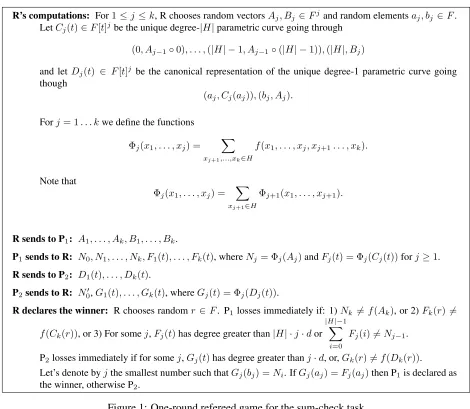
The Protocol. Following the intuition behind the protocol, we now describe the protocol in detail. Recall that we have a finite fieldF, a subset ofF denoted byH, a fixed numberkand a multivariate polynomial
f :Fk→F of degree≤din each variable. Server 1 claims that
X
x1,x2,...,xk∈H
f(x1, x2, . . . , xk) =N0
for some valueN0and Server 2 claims otherwise (denote this value byN00).
For simplicity, we use the shorthand a◦b for a vector that is a concatenation ofaand b(where a, b
are vectors or single elements). We assume the elements ofH are0,1, . . . ,|H| −1. Instead of working with prefixes, all computations are done using low degree parametric curves, which is a more compact representation. (A parametric curve of degreedinF[t]j is a tuple ofjone-parameter polynomials over the fieldF, each one of degree≤d.)
The protocol is as presented in Figure 1.
Theorem 3. LetF be a finite field andH subset ofF. Letf : Fk → F be a multivariate polynomial of degree≤din each variable and letN = X
x1,x2,...,xk∈H
f(x1, x2, . . . , xk). The above protocol is a refereed
game with the following properties:
• IfP1claims thatN0 =N, then he will be declared as the winner with probability≥1−|H|·2k
2·d
|F| .
• IfP1claims thatN0 6=N, then he will be declared as the winner with probability≤
|H|·2k2·d
R’s computations: For1≤j≤k, R chooses random vectorsAj, Bj ∈Fj and random elementsaj, bj ∈F.
LetCj(t)∈F[t]jbe the unique degree-|H|parametric curve going through
(0, Aj−1◦0), . . . ,(|H| −1, Aj−1◦(|H| −1)),(|H|, Bj)
and let Dj(t) ∈ F[t]j be the canonical representation of the unique degree-1 parametric curve going
though
(aj, Cj(aj)),(bj, Aj).
Forj= 1. . . kwe define the functions
Φj(x1, . . . , xj) =
X
xj+1,...,xk∈H
f(x1, . . . , xj, xj+1. . . , xk).
Note that
Φj(x1, . . . , xj) = X
xj+1∈H
Φj+1(x1, . . . , xj+1).
R sends to P1: A1, . . . , Ak, B1, . . . , Bk.
P1sends to R: N0, N1, . . . , Nk, F1(t), . . . , Fk(t), whereNj = Φj(Aj)andFj(t) = Φj(Cj(t))forj≥1.
R sends to P2: D1(t), . . . , Dk(t).
P2sends to R: N00,G1(t), . . . , Gk(t), whereGj(t) = Φj(Dj(t)).
R declares the winner: R chooses randomr ∈F. P1losses immediately if: 1)Nk 6=f(Ak), or 2)Fk(r)6=
f(Ck(r)), or 3) For somej,Fj(t)has degree greater than|H| ·j·dor
|H|−1 X
i=0
Fj(i)6=Nj−1.
P2losses immediately if for somej,Gj(t)has degree greater thanj·d, or,Gk(r)6=f(Dk(r)).
Let’s denote byjthe smallest number such thatGj(bj) =Ni. IfGj(aj) =Fj(aj)then P1is declared as
the winner, otherwise P2.
Figure 1: One-round refereed game for the sum-check task
The referee is polynomial in|H|andk, the (honest) servers are polynomial in|F|k and the
communi-cation complexity is polynomial in|F|andk.
Proof (sketch). LetS1be the event that
X
x1,x2,...,xk∈H
f(x1, x2, . . . , xk)6=N0
butP1 is declared as the winner (i.e., P2 is the honest server). Let Ui be the event that Fi(t) is indeed
Φi(Ci(t)), letEibe the event thatFi(ai)is indeedΦi(Ci(ai))and letE0 be the event thatFk(r)is indeed f(Ck(r)).
P r[S1]≤P r[E0∧ ¬Uk] +P r[∃i∈[1..k]s.t. Ei∧ ¬Ui]≤P r[E0∧ ¬Uk] + k X
i=1
P r[Ei∧ ¬Ui].
By the fact that two distinct univariate degree-tpolynomials agree on at mosttpoints we get that
P r[E0∧ ¬Uk]≤
and that
P r[Ei∧ ¬Ui]≤
|H| ·i·d |F| ≤
|H| ·k·d |F| .
Thus,
P r[S1]≤
|H| ·k·d |F| +k·
|H| ·k·d
|F| ≤(k+ 1)·
|H| ·k·d |F| .
LetS2be the event thatP1is the honest server butP2is declared to be the winner. Using a similar proof, we have that
P r[S2]≤(k+ 1)·
k·d |F|.
The only difference is that in this case the degrees ofGj(t)are smaller than the degrees ofFj(t)by a factor
of|H|.
Therefore, the soundness of the protocol is bounded by |H|·|F|2k2·d.
We remark that our protocol from Section 4.2.2 has another difference compared to the above protocol. We increase by one the degrees of the curvesCkandDk. Using a similar argument to the above it can be
shown that the soundness of that protocol is bounded by (|H|+1)|F|·2k2·d.
4.2.2 The Protocol, Given a Circuit Specification Oracle
The intuition behind our protocol is as follows. We assume the referee has an oracle access tospecgc0(i). We
use the idea of [GKR08] to check the entire computation by checking the sum-checks between each two consecutive layers. We use the protocol of [FK97] to run each sum-check in a single round of communica-tion. Ideally, we would like to execute all the sum-checks in parallel, in a single round. But, we cannot do that directly since the security of the [GKR08] protocol requires that the referee sends the randomuito the
server onlyafterthe execution of the(i−1)-th sum-check. Still, in order to use the protocol of [FK97], the servers have to knowui since this value determines the function for the sum-check test. Thus, we change
the “linking” between the layers.
For simplicity, we now describe the protocol as a sequential protocol with several rounds. However, since we want a one-round protocol, all servers actually execute all rounds of the this protocoltogether, in a single round. The referee chooses his messages for all rounds together and sends them to the servers in one message. Then, the servers answer all rounds together. Last, the referee reads all answers, starting from the input layer towards the output layer, and checks the servers’ answers until he finds who is the honest server. (In our protocol the direction of the “linking” reductions is different than in [GKR08].) We denote this protocol by(P1, P2, R).
Given an input x, for each layerithe referee chooses two random parametric curvesγi(t), ϕi(t)that
intersect at pointzi(γi(zi)corresponds to the pointuiof [GKR08]). The referee sendsγi(t), ϕi(t)toP1and
P2, respectively, and asks the servers for the polynomialsVei(γi(t))andVei(ϕi(t)). Next, he checks whether
those polynomials agree on zi. If they agree, then he assumes both answers are correct and continues to
checking the next layer, i−1. Otherwise, he executes a one-round sum-check protocol a la.[FK97] to determine the correct value of Vei(γi(zi)). (Actually, we use a variation of the protocol of [FK97] which
we describe in Section 4.2.1.) But, as we mentioned before, we do not want to explicitly give the servers the value ofzi. Instead, the servers answer the sum-check challenges forallthe points onγi(t)andϕi(t),
including the value atzi. Then, the referee uses the referee of the one-round sum-check protocol of [FK97]
to determine who is the honest server.
A subtle issue here is how the referee checks the correctness of the sum-checks without being able to computefz(ii)by himself. The protocol of [FK97] assumes the referee can computef
(i)
zi by himself for any
the referee needs to compute fz(ii) on three points: two points that are known only to P1 and one point
that is known only to P2. In order to solve this problem we again use the point-on-a-line technique to get those values “implicitly” from the servers themselves. When the referee believes that the answers on
e
Vi+1(γi+1(t))andVei+1(ϕi+1(t))for layeri+1are correct, he takes few random points on those polynomials
and uses that to compute the values offz(ii)on those three points. The solution requires increasing by one
the degrees of the polynomials of the protocol of [FK97] in order to keep the added points secret (see Section 4.2.1).
The detailed protocol(P1, P2, R)is presented in Figures 2 and 3. Since some of the polynomials conceal secret intersection points, when the referee sends some polynomial to the servers, we require that he sends the canonical representation of that polynomial.
The referee’s running time ispoly(|F|, m, d,|H|) +k·poly(|H|, m) =k·poly(d, log(S)), the servers running time is poly(S,|F|, m, d) = poly(S) and the communication complexity is poly(|F|, m, d) =
poly(d, log(S)).
Theorem 4. Let L be a language inN Cand letCLbe the circuit that decides onL. For any inputxand for any constant error probabilityε, given a circuit specification oracle forCL, the protocol(P1(x), P2(x), R(x))
isε-RDoC with two servers for the circuitCL.
The crucial point of the proof is that a server can cheat with high probability only if he knows the curves’ intersection points. Let’s see what information each server has about the other server’s curves.
Lemma 5. LetV1be the view ofP1and letibe a round in the protocol. For allα, α0, β, β0, γ, γ0 ∈F and
j∈[1. . .3m]
P r[zi =α|V1] = P r[zi =α0|V1] (1)
P r[aj =β|V1] = P r[aj =β0|V1] (2)
P r[r=γ|V1] = P r[r =γ0|V1]. (3)
LetV2 be the view ofP2 and letibe a round in the protocol. For allα, α0, β, β0, γ, γ0, ζ, ζ0 ∈ F and
j∈[1. . .3m]
P r[zi =α|V2] = P r[zi =α0|V2] (4)
P r[aj =β|V2] = P r[aj =β0|V2] (5)
P r[bj =γ|V2] = P r[bj =γ0|V2] (6)
P r[r=ζ|V2] = P r[r =ζ0|V2]. (7)
Proof. The lemma follows from inspecting the protocol.
1. ϕi(t)is of degree-2. Even if we give P1 the exact values ofw1, w10 (and not only implicitly as part ofC3m), there is still one degree of secret information, and thereforeϕi(t)can still go through any
possible point(zi, γi(zi))for allzi ∈F.
2. Dj(t)is of degree at least 1. Even if we giveP1the value ofbj, he does not have enough information
to recoverDj(t), so any(aj, Cj(aj))is a possible intersection point.
3. SinceP1 has no information onw1, w10 besides from the curveC3m, ris simply a random point on
the curve from his point of view.
4. γi(t)is of degree-4. Even if we giveP2the exact values ofw0, w00, w2, w02(and not only implicitly as part ofD3m), there is still one degree of secret information, and thereforeγi(t)can still go through
Publicly known parameters
H, F, m, d, S, k, δas in Section 3.
Initialization
Fori = 1, . . . d, R randomly pickszi ∈F, a random degree-4 parametric curveγi(t)∈F[t]m, and a random
degree-2 parametric curveϕi(t)∈F[t]mgoing through(zi, γi(zi)).
He also setsγ0=ϕ0≡0andz0= 0, and computesMd(t) =Ved(γd(t))andQd(t) =Ved(ϕd(t)).
Fori=d, . . . ,1 R’s computations :
R setsw0=γi(0), w00 =γi(1), w1=ϕi(0), w01=ϕi(1), w2=γi(2), w02=γi(3)and randomly chooses
p0, p1, p2∈F.
For1≤j≤3m, R chooses random vectorsAj, Bj∈Fjand random elementsaj, bj ∈F. R setsA3m
top0◦w0,◦w00 and chooses a randomr∈F.
For1≤j≤3m−1letCj(t)∈F[t]jbe the unique degree-|H|parametric curve going through
(0, Aj−1◦0), . . . ,(|H| −1, Aj−1◦(|H| −1)),(|H|, Bj)
and letC3m(t)∈F[t]3mbe the unique degree-(|H|+ 1)parametric curve going through
(0, A3m−1◦0), . . . ,(|H| −1, A3m−1◦(|H| −1)),(|H|, B3m),(r, p1◦w1◦w01).
For1≤j≤3m−1, letDj(t)∈F[t]jbe the unique degree-1 parametric curve going through
(aj, Cj(aj)),(bj, Aj)
and letD3m(t)∈F[t]3mbe the unique degree-2 parametric curve going through
(r, p2◦w2◦w02),(a3m, C3m(a3m)),(b3m, A3m).
We define
Φq,j(x1, . . . , xj) =
X
xj+1,...,x3m∈H
fq(i−1)(x1, . . . , xj, xj+1, . . . , xk).
R sends to P1 :
Cj(t), Aj, for1≤j≤3m, and the curveγi−1(t).
P1sends to R :
For allq∈FdefineNj,q= Φγi−1(q),j(Aj)andFj,q(t) = Φγi−1(q),j(Cj(t)).
P1sendsNj,q, Fj,q(t)for1≤j≤3mand allq∈F, and,Mi−1(t)whereMi−1(t) =Vei−1(γi−1(t)).
R sends to P2 :
Dj(t)for1≤j ≤3m, and the curveϕi−1(t).
P2sends to R :
For allq∈FdefineGj,q(t) = Φϕi−1(q),j(t)).
P2sendsGj,q(t)for1≤j≤3mand allq∈F, and,Qi−1(t)whereQi−1(t) =Vei−1(ϕi−1(t)). Figure 2: One-round RDoC protocol: initialization and interactive phase
5. Cj(t)is of degree at least|H|. Even if we giveP2the value ofbj, he does not have enough information
Checking layerifori=d, . . . ,1
P1is declared as the cheater ifMi−1(t)has degree bigger than4·m·(|H| −1). P2is declared as the cheater if
Qi−1(t)has degree bigger than2·m·(|H| −1).
IfMi−1(zi−1) = Qi−1(zi−1) the referee continues to the proof of layeri−1. Otherwise, he continues as
follows.
GivenMi(t), R computes:
• fz(ii−1−1)(Ai,3m)andf (i−1)
zi−1 (p2◦w2◦w02)usingMi(0), Mi(1), andMi(2), Mi(3)(and the oracle).
• fz(ii−1−1)(p1◦w1◦w 0
1)usingQi(0), Qi(1)(and the oracle).
Now, R verifies the sum-check ofMi−1(zi−1) = X
p,w,w0∈Hm
fz(ii−1−1)(p, w, w
0)using the referee from [FK97].
Concretely:
• The referee setsN0,zi−1 =Mi−1(zi−1).
• P1is declared as the cheater if: 1)N3m,zi−1 6=f
(i−1)
zi−1 (A3m), or 2)F3m,zi−1(r)6=f
(i−1)
zi−1 (p1◦w1◦w 0
1),
or 3) For somej,Fj,zi−1(t)has degree greater thandeg(Cj)·j·2δor |H|−1
X
m=0
Fj,zi−1(m)6=Nj−1,zi−1.
• P2 is declared as the cheater if for some j, Gj,zi−1(t) has degree greater than deg(Dj)·j ·2δ, or, G3m,zi−1(r)6=f
(i−1)
zi−1 (p2◦w2◦w20).
• Let’s denote by j the smallest number such thatGj,zi−1(bj) = Nj,zi−1. IfGj,zi−1(aj) = Fj,zi−1(aj) then P1is declared as the honest, otherwise P2is declared as the honest.
Outputting the result
If P1was declared as the honest server or P2was declared as the cheater, R outputsM0(0), otherwise he outputs
Q0(0). (Recall thatM0(0)is the claimed result of P1andQ0(0)is the claimed result of P2.)
Figure 3: One-round RDoC protocol: verification of answers
6. Similar argument as in (5) goes forbj.
7. SinceP2 has no information onw2, w02 besides from the curveD3m,r is simply a random point on
the curve from his point of view.
Proof of Theorem 4. Using Lemma 5, let’s see how much a malicious server can cheat without knowing the intersection points (zi, aj, bj). For a fixed inputxand a fixed circuitC, letS1 be the event that althoughP1 is the malicious server and the referee outputs a wrong result (i.e.,M0(0)that is not equal toC(x)). LetTi
be the event thatMi(t)is indeedVei(γi(t)), and letEi be the event thatMi(zi)is indeedVei(γi(zi)). Then,
P r[S1]≤P r[¬T0∧Td−1]≤P r[∃i∈[d−1]s.t.¬Ti∧Ti+1]≤
d−1
X
i=0
P r[¬Ti∧Ti+1].
For everyi∈[d−1],
P r[¬Ti∧Ti+1] =P r[¬Ti∧Ti+1∧Ei] +P r[¬Ti∧Ti+1∧ ¬Ei].
By the soundness property of the protocol from [FK97] (see Section 4.2.1), we have that
P r[¬Ti∧Ti+1∧ ¬Ei]≤P r[Ti+1∧ ¬Ei]≤
(|H|+ 1)·2(3m)2·2δ
|F| =
(|H|+ 1)·36m2·δ
By the fact that two distinct univariate degree-tpolynomials agree on at mosttpoints we get that
P r[¬Ti∧Ti+1∧Ei]≤P r[¬Ti∧Ei]≤
4m·(|H| −1)
|F| .
Therefore, we get that (assumingm >4)
P r[¬Ti∧Ti+1]≤
(|H|+ 1)·36m2·δ
|F| +
4m·(|H| −1)
|F| ≤
(|H|+ 1)·37m2·δ
|F| .
Thus, summing the error probabilities for all layers, we get
P r[S1]≤d·
(|H|+ 1)·37m2·δ |F| .
Let S2 be the event that although P2 is the malicious server the referee outputs a wrong result (i.e.,
Q0(0)that is not equal toC(x)). Using a similar proof, we have thatP r[S2]is also bounded by the same probability. The only difference is that in this case the degrees ofQi(t)are smaller than the degrees ofMi(t)
by a factor of2.
Thus, for any constant soundnessεwe can takeFto be of size≥ (|H|+1)ε·37m2·δwhich ispoly(|H|).
4.2.3 Realizing the Oracle forL-uniformN C Circuits
For any languageL∈ L-uniformN C there exists a circuitCLof poly-size and polylogarithmic-depth that
computesL. Furthermore, the polynomialsspecgc(i)ofCLcan be computed by a log-space TM, which means
thatspecgc(i)can be computed by anN L circuit,Cspec(L). As shown in [GKR08], the circuit specification
functionspecgc(i) of circuits inN Lcan be computed in poly-logarithmic time. This means that the referee
can computespecgc(i)ofCspec(L)by himself, and execute the protocol from Section 4.2.2 without an oracle assistance.
Recall the idea of [GKR08] for extending thebare-bonesprotocol toL-uniformN C circuits. In order to verify the computation of the circuitCL, the client runs the bare-bones protocol for verifyingCL, and
asks the server for the required values of the circuit specification functionspecgc(i)(i.e. the server acts as the
oracle). Then, the client checks each of those claimed values by executing the bare-bones protocol for the circuitCspec(L)(for which he can compute the oracle answers by himself).
Now, if we try to follow this idea for extending the protocol from Section 4.2.2 to work withL-uniform
N C circuits, and try to run in parallel the protocol also for verification ofCspec(L), we get contradicting requirements. On the one hand, for verification ofCspec(L), both servers have to knowpj, wj, wj0 forj =
0,1,2as those are theinputsfor the specification circuit (and the protocol assumes those inputs are known to both servers), but on the other hand, for verification ofCL, the soundness of the protocol requires that
those values will not be known to both servers.
In order to tackle this problem, we use a similar idea to the one used in the previous protocol. The referee asks the servers to answer on many points, without revealing the actualpj, wj, w0j. Note that each
one ofpj, wj, wj0 is at least “implicitly” known to both servers. E.g.,p0, w0, w00 is implicitly known toP2 fromD3k(t)(and is explicitly known toP1 byA3m). Also, we can explicitly send the values ofp0andp2 toP1, and the values ofp1toP2, without ruining the soundness of the previous protocol.
Using those two observations, we construct a protocol(P10, P20, R0)for any language inL-uniformN C. For verification of the output ofCL, the referee executes the protocol from Section 4.2.2 with two
modifica-tions: 1) The referee sends toP10 also the values ofp0, p2 and toP20 also the values ofp1for all layers, and, 2)P10 sends the (claimed) values ofspecgc(i)(b, p0, w0, w00)andspecgc(i)(b, p2, w2, w
0
For each of the answers specgc(i)(b, pj, wj, w0j), the referee executes the protocol from Section 4.2.2
for verification of those claimed values using the circuit Cspec(L) (for which he can compute the circuit specification by himself). As we mentioned before, neither ofpj, wj, wj0 (forj= 0,1,2) is explicitly known
to both servers. So instead we ask one of the servers to answer on many points instead of the specific
pj, wj, wj0. Specifically, for verification ofspecgc(i)(b, p0, w0, w 0
0)of layeriofCL, we execute the protocol
from Section 4.2.2, whereP10 plays the role of P1 and knowsp0, w0, w00, andP20 plays the role of P2 for
all the pointson the curveD3m(t)as the possible inputs forCspec(L). (There are at most|F|points on this curve). This means thatP20 does not know the specificp0, w0, w00. However, sinceD3m(t) passes through p0, w0, w00, one of those answers will be the neededP20’s answer for the inputp0, w0, w00. Similarly, the same roles go forp2, w2, w20 (which is also included inD3m(t)). Forp1, w1, w10 for all layers ofCL,P20 plays the role ofP1in the protocol of Section 4.2.2 andP10 plays the role ofP2forall the pointson the curveC3m(t)
(which includesp1, w1, w01).
When the referee receives the messages from both servers (for verification ofCspec(L)and of CL), he
checks if they agree on all the values ofspecgc(i)(b, pj, wj, w 0
j). If they disagree on some of the values, then
the referee checks one of those disagreements using the refereeRfrom Section 4.2.2 and outputs according to its answer. If the servers agree on all the values ofspecgc(i), then by the assumption that one of them is honest, those values are correct. Then, the referee verifies the computation of the circuit CL given the
values ofspecgc(i)he got before. He runs the checking phase of the referee from Section 4.2.2 and outputs
according to its answer.
The overhead of this solution is only polynomial in all parameters. For each layer we have three in-vocations of the protocol form Section 4.2.2 where one of the servers executes the protocol for|F|points. Summing over all layers, the total overhead is≤3·d· |F| ·depth(Cspec(L))which is still poly-logarithmic in the size of the input.
Theorem 6. Let L be a language inL-uniformN C. For any inputxand for any constant error probability
ε, the protocol(P10(x), P20(x), R0(x))isε-RDoC with two servers for the circuitCL.
Proof. Note that the information that the referee sends for the verification ofCspec(L) is independent of the messages for the verification of CL. Those proofs share only one piece of information, the values of pj, wj, wj0 as the inputs for the circuitCspec(L).
Let’s assumeP10 is the cheater. He can cheat either on some value ofspecgc(i) or on the computation of
CL. In the first case, he will be caught with high probability by the soundness of the protocol from Section
4.2.2. For the second case, ifP10 cheats on the computation ofCL(while the values ofspecgc(i)are correct),
then it means he can cheat in the protocol from Section 4.2.2 in the case where he has an oracle access to
g specc(i).
By a union bound of the cheating probabilities of the3d+ 1invocations of the protocol, we can bound the probability of cheating by(3d+ 1)·d·(|H|+1)|F·37| m2·δ. Thus, for any constant soundnessεwe can take
F to be of size≥(3d+ 1)·d·(|H|+1)ε·37m2·δ which ispoly(|H|).
5 Publicly Verifiable Delegation of Computation (PVDoC)
Previous constructions and definitions (e.g., [GGP10, CKV10, AIK10, Chu11, Ben11]) allow the client to work longer in the offline stage, and compute some secret key which he could later use in the online stage. This assumes that at some point in time, the clientcanwork harder or has access to a trusted third-party. Furthermore, the server must not learn any information about this key, so if the client uses the assistance of a trusted third-party he has to get a unique secret key, for his use only.
enough) player can verify that key. An example for a real-world scenario is the following:
• Google publishes a (singed) set of public keys that corresponds to a set of functions.
• Google’s competitors (or anyone in that matter) can verify these keys and in particular publish an accusation proof in case some of the keys are invalid.
• A client can delegate his computation toanyserver, using the published public keys. He does not have to run the offline stage by himself.
• In case the proof of the server is invalid, the client can publish the transcript and its own coins, and prove that the server is a cheater. We stress that by publishing his coins, the client does not loss privacy of any other key (as happens with some of the previous constructions).
5.1 The Model
A Publicly Verifiable Delegation of Computation (PVDoC) scheme consists of offline and online stages. The offline stage is executed only once before the online stage whereas the online stage can be executed many times. The algorithms are as following:
• KeyGen(F, λ)→P K: Based on the security parameterλ, the deterministic key generation algorithm
generates a public key that encodes the functionF, which is used by a client to verify delegations of
F.
LetT(F)be the time bound required to computeF on any input. We require that the running time of the algorithm will be≤poly(T(F), λ).
• ProbGen(x, P K, λ)→(kx, cx): The problem generation algorithm uses the public key and the input
xto generate a challengecxthat is given to the server, and a secret keykxthat is kept private by the
client.
• Compute(x, P K, cx) → (y, πy): Using the public key and the input, the server computes the
func-tion’s outputy=F(x)along with a proof of correctnessπy given the challengecx.
We require that the running time of the algorithm will be≤poly(T(F), λ).
• VerifyResult(P K, kx, y, πy)→y∪ ⊥: Using the secret keykx, the verification algorithm verifies the
server’s proofπyand if succussed outputsy. Otherwise it outputs⊥.
We require that the sum of the running times of this algorithm andProbGen()for the same input, will beo(T(F), λ).
Note that sinceKeyGen()is deterministic, anyone can verify (inpoly(T(F), λ)time) whetherP K is a valid encoding of the target functionF.
As for completeness and soundness, we require the following:
Definition 7(ε-secure PVDoC). We say that a scheme is aε-secure PVDoC for a circuitCif after the offline stage (and given a validP K) the following holds for any inputxand(kx, cx) =ProbGen(x, P K, λ):
• (Completeness) If(y, πy) =Compute(x, P K, cx)thenVerifyResult(P K, kx, y, πy) =y.
5.2 One-round PVDoC for More ThanL-uniformN C
Given a circuit specification oracle, the bare-bones protocol from Section 3.2 requires the client to run in time proportional tomax(d,log(S)). However, it remains to see how to realize the oracle. As discussed above, [GKR08] shows a way to realize the oracle for L-uniform N C languages, and using the transformation of [KR09] one can get a one-round computational sound PVDoC protocol for these languages.
If we are interested in a larger class of languages, we can use the next technique. Given a circuitC, in the offline stage, the client (or some other third party) computes the polynomialsspecgc(i)and the evaluation of these polynomials on all their domains. Then, the client computes the root of the Merkle Hash Tree on these values (i.e., the tree leaves are the values of the polynomials).
Later on, in the online stage, the client and the server run the bare-bones protocol under cPIR queries. However, instead of delegating also the computation of the circuit specification predicate, the client asks this value from the server, along with a proof of consistency with the root of the Merkle Hash Tree.
A useful property of this protocol is that the information computed in the offline stage can be used by any interested client, and, as such, the protocol is secure also against adaptive adversaries. It is publicly verifiable as opposed to previous solutions in the offline/online model.
Figure 4 presents the detailed protocol.
Theorem 8. For any circuit C and for any constant error probabilityε, the protocol from Figure 4 isε -secure PVDoC for the circuitC. In the online stage, the client runs inpoly(depth(C), log(size(C)))time and the server inpoly(size(C))time.
Proof. Completeness follows from inspecting the protocol.
As for soundness, we will look on the protocol as a composition of two different protocols. The first is the protocol of GKR-KR where the verification ofC(x)is reduced to the correctness of a random point on the low degree extension of the inputx, given a circuit specification oracle. We denote bys1 the soundness of GKR-KR (can be arbitrarily small, see [GKR08, KR09]). The second protocol is the cPIR queries on a database which includes the circuit specification truth table augmented with proofs of consistency. The soundness of this protocols2is negligible from the collision resistancy of the hash function
Since we hide the queries using cPIR queries, the requested bi, wi
1, w2i, wi3 in the second protocol are computationally indistinguishable, and therefore, the server in the first protocol does not get useful informa-tion about it (otherwise, we can break the security of the cPIR).
We claim that the soundness of the composition is bounded bys1 +s2+neg(λ). Suppose there is an adversaryAthat breaks the protocol with probabilityp≥s1+s2+neg(λ) +cwherec > 0is a constant. In order to cheat, the adversary has to cheat (at least) in either the first or the second protocol. LetA1be an adversary for the GKR-KR protocol that simulates the second protocol and executesAon both the GKR-KR messages and the simulated ones and letp1be the probability it cheats. Similarly, letA2be an adversary for the second protocol where it simulates the GKR-KR messages, and letp2be its cheating probability. Since
P r[Acheats]≤P r[A1cheats] +P r[A2cheats]we get thatp1+p2≥p≥s1+s2+neg(λ) +c. Hence, one ofpiis at leastsi+c/2 +neg(λ), which contradicts the assumption about the soundness of the original
protocols.
By carefully picking the parameters of the GKR-KR protocol and the hash function we use, it is possible to get any constant soundness.
KeyGen(F, λ):
This algorithm is called in the offline stage. LetCbe the circuit that computes the functionF, and lethbe a collision resistant hash function given the security parameterλ. Also, define the GKR-KR protocol parameters as in Section 3.2.
• Compute the polynomials specgc(i) and the values of specgc(i)(b, w1, w2, w3) for all b ∈ {0,1} and
w1, w2, w3∈Fm.
• Construct a Merkle Hash Tree where the leaves of the tree are the valuesh(specgc(i)(b, w1, w2, w3)).
• Return P K = [IDF, size(C), depth(C), λ, h, root)]where IDF is a short string that identifies the
functionF, androotis the root of the merkle hash tree.
Note that any player can compute all the above values. In particular, onceP K is published, other players can verify it. However, this computation requires polynomial time (in the size ofC).
ProbGen(x, P K):
When the client wants to delegate a computation (in the online stage), he computes the following:
• Let m1 = GKR-KRc(size(C), depth(C), λ) be the first message sent by the client in the GKR-KR
protocol for the bare-bones protocol only (i.e., for verification of the computation of C only), and let (b(i), w(i)
1 , w (i) 2 , w
(i)
3 ) (for i = 0. . . depth(C)) be the quadruplets that the protocol queries for their
g
specc(i)values.
• Compute cPIR queries for each quadruplet(b(i), w(i)1 , w2(i), w3(i)). Denote the resulting set of queries by
m2.
• Letkxbe the random coins used for the computation of GKR-KRc and the cPIR queries. Returncx =
[m1, m2]andkx.
Note that the above steps do not depend on the inputx.
Compute(x, P K, cx):
The server receives the inputx, the public key and the challenge, and does the following:
• Evaluatey=C(x).
• Prepare two databases. The first is a database with the answers to the GKR-KR protocol, and the second is a database that includes the values ofspecgc(i)(b, w1, w2, w3)augmented with the Merkle Hash Tree proofs
of consistency. I.e., the database consists of2|F|3m = poly(size(C))entries, where in the(a, b, c, d)
entry there is the value ofspecgc(i)(a, b, c, d)and the path in Merkle Hash Tree fromh(specgc(i)(a, b, c, d)) to the root.
• Let(m1, m2) =cx. Computem01 =GKR-KRp(C, x, m1)(i.e. the answers according to the GKR-KR
protocol and the first database).
• Compute the cPIR answers for the queriesm2and the second database. Denote the results bym02.
• Returny,[m01, m02]. VerifyResult(P K, kx, y, πy):
Let(m01, m02) =πy. Using the secret keykx, the client does the following:
• Verify that the answers inm02are consistent with the root fromP K.
• Run the verifier of the GKR-KR protocol onm01where each time a value ofspecgc(i)is needed, use the answers fromm02.
If both checks succussed, outputy. Otherwise, output⊥.
References
[AIK10] Benny Applebaum, Yuval Ishai, and Eyal Kushilevitz,From secrecy to soundness: efficient verification via secure computation, Proceedings of the 37th international colloquium conference on Automata, languages and programming, Springer-Verlag, 2010, pp. 152–163.
[BCCT11] Nir Bitansky, Ran Canetti, Alessandro Chiesa, and Eran Tromer,From extractable collision resistance to succinct non-interactive arguments of knowledge, and back again, Cryptology ePrint Archive, Report 2011/443, 2011,http://eprint.iacr.org/.
[Ben11] Verifiable delegation of computation over large datasets, CRYPTO, vol. 6841, 2011, p. 110.
[BFLS91] L´aszl´o Babai, Lance Fortnow, Leonid A. Levin, and Mario Szegedy,Checking computations in poly-logarithmic time, Proceedings of the twenty-third annual ACM symposium on Theory of computing, ACM, 1991, pp. 21–32.
[BIN97] Mihir Bellare, Russell Impagliazzo, and Moni Naor,Does parallel repetition lower the error in compu-tationally sound protocols?, Proceedings of the 38th Annual Symposium on Foundations of Computer Science, IEEE Computer Society, 1997, pp. 374–383.
[BOGKW88] Michael Ben-Or, Shafi Goldwasser, Joe Kilian, and Avi Wigderson,Multi-prover interactive proofs: how to remove intractability assumptions, Proceedings of the twentieth annual ACM symposium on Theory of computing, ACM, 1988, pp. 113–131.
[CHS05] Ran Canetti, Shai Halevi, and Michael Steiner,Hardness amplification of weakly verifiable puzzles, Proceedings of the second Theory of Cryptography Conference, Springer-Verlag, 2005, pp. 17–33.
[Chu11] Memory delegation, CRYPTO, vol. 6841, 2011, p. 147.
[CKV10] Kai Min Chung, Yael Kalai, and Salil Vadhan,Improved delegation of computation using fully homo-morphic encryption, Proceedings of the 30th annual conference on Advances in cryptology, Springer-Verlag, 2010, pp. 483–501.
[CL08] Giovanni Crescenzo and Helger Lipmaa,Succinct NP proofs from an extractability assumption, Pro-ceedings of the 4th conference on Computability in Europe: Logic and Theory of Algorithms, Springer-Verlag, 2008, pp. 175–185.
[CRR11a] Ran Canetti, Ben Riva, and Guy N. Rothblum,QUIN: Practical delegation of computation using mul-tiple clouds (to appear), Proceedings of the 18th ACM Conference on Computer and Communications Security, 2011.
[CRR11b] Ran Canetti, Ben Riva, and Guy N. Rothblum, Refereed delegation of computation, 2011, http: //www.cs.tau.ac.il/˜canetti/CRR11.pdf.
[CRR11c] Ran Canetti, Ben Riva, and Guy N. Rothblum,Verifiable computation with two or more clouds, Work-shop on Cryptography and Security in Clouds, 2011, http://www.zurich.ibm.com/˜cca/ csc2011/submissions/riva.pdf.
[FK97] Uriel Feige and Joe Kilian,Making games short (extended abstract), Proceedings of the twenty-ninth annual ACM symposium on Theory of computing, ACM, 1997, pp. 506–516.
[GGP10] Rosario Gennaro, Craig Gentry, and Bryan Parno,Non-interactive verifiable computing: outsourcing computation to untrusted workers, Proceedings of the 30th annual conference on Advances in cryptol-ogy, Springer-Verlag, 2010, pp. 465–482.
[GKR08] Shafi Goldwasser, Yael Tauman Kalai, and Guy N. Rothblum,Delegating computation: interactive proofs for muggles, Proceedings of the 40th annual ACM symposium on Theory of computing, ACM, 2008, pp. 113–122.
[Kil92] Joe Kilian,A note on efficient zero-knowledge proofs and arguments (extended abstract), Proceedings of the twenty-fourth annual ACM symposium on Theory of computing, ACM, 1992, pp. 723–732.
[KR09] Yael Tauman Kalai and Ran Raz,Probabilistically checkable arguments, Proceedings of the 29th An-nual International Cryptology Conference on Advances in Cryptology, Springer-Verlag, 2009, pp. 143– 159.
[KR11] Gillat Kol and Ran Raz, Competing provers protocols for circuit evaluation, Tech. Report TR11-122, Electronic Colloquium on Computational Complexity, September 14 2011, http://eccc. hpi-web.de/.
[LFKN92] Carsten Lund, Lance Fortnow, Howard Karloff, and Noam Nisan,Algebraic methods for interactive proof systems, J. ACM39(1992), 859–868.
[Mic00] Silvio Micali,Computationally sound proofs, SIAM J. Comput.30(2000), 1253–1298.