DIFFRACTION OF EM PLANE WAVE BY A SLIT IN AN IMPEDANCE PLANE USING MALIUZHINETS FUNCTION
M. Naveed and Q. A. Naqvi
Department of Electronics Quaid-i-Azam University Islamabad, Pakistan
K. Hongo
3-34-24, Nakashizu, Sakura City, Chiba, Japan
Abstract—Diffraction of an electromagnetic plane wave from a slit in an impedance plane has been presented. The method is based on Maliuzhinets technique for impedance surfaces. Comparison of the field patterns with different values of the face impedance are also presented. 1. INTRODUCTION
The double perfectly conducting wedge scattering was investigated by Elsherbeni and Hamid [1]. They presented the solution for the diffraction of an incident plane wave by a slit in a perfectly conducting plane considering it as composed of two wedges. In recent years, high frequency description of the scattering from edges in non perfectly conducting surfaces has attracted the interest of many researchers due to its practical applications. Impedance surfaces represent a canonical approach for the coated conducting geometries. Moreover, the application of geometrical theory of diffraction (GTD) to the scattering from a wedge with impedance faces is applicable to the analysis of practical structures involving edges in an impedance surface. It may be noted that scattering from slits, half plane, impedance surfaces and study of high frequency diffraction are topics of current interest [2–13].
plane waves, which contains an unknown weight function. The weight function is found by considering boundary, radiation and edge conditions.
The Maliuzhinets function [15, 16] plays a key role in the theory of diffraction by wedges with imperfectly conducting surfaces. Nearly all available exact solutions for nonmetallic wedges are expressed in terms of Maliuzhinets function.
2. FORMULATION OF THE PROBLEM
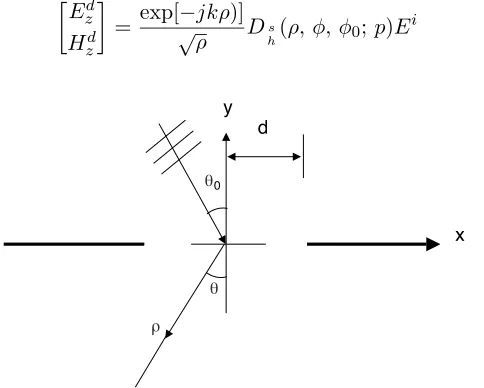
A slit may be viewed as two coplanar wedges each with zero wedge angle, separated by a certain width. The slit geometry and co-ordinates of the problem are shown in Fig. 1. Width of the slit is 2d. A dual cylindrical coordinate system is used for the slit geometry, because it has been considered as combination of two wedges. We consider a two dimensional case in which the edge is a straight line and the incident rays all lie in planes normal to the edge. Then the diffracted rays are also normal to the edge, and emanate from it in all directions. Let the incident field is
Ezi Hi z
=
E0
H0
exp [jk(xcosφ0+ysinφ0)] (1)
The uniform expression for the field diffracted from a wedge has the form
Ezd Hzd
= exp[√−jkρ)]
ρ Dhs(ρ, φ, φ0;p)E
i (2)
x y
d
0 θ
θ
ρ
where p = n1 = φωπ is the parameter associated with the wedge angle φω. The diffraction coefficient can be defined as [17]
Ds
h(ρ, φ, φ0, n) = −
√ ρ
Ψ(Φ−π−φ) Ψ(Φ−φ0)
sign
sin
π+φ−φ0
2n
cos
π+φ−φ0
2n
F 2kρnsin
π+φ−φ0
2n
+Ψ(Φ +π−φ) Ψ(Φ−φ0)
sign
sin
π−(φ−φ0)
2n
cos
π−(φ−φ0)
2n
F 2kρnsin
π−(φ−φ0)
2n
−Ψ(Φ−π−φ) Ψ(Φ−φ0)
sign
sin
π+φ+φ0
2n
cos
π+φ+φ0
2n
F 2kρnsin
π+φ+φ0
2n
−Ψ(Φ +π−φ) Ψ(Φ−φ0)
sign
sin
π−(φ+φ0)
2n
cos
π−(φ+φ0)
2n
F 2kρnsin
π−(φ+φ0)
2n
(3)
Ds and Dh are the diffraction coefficients of E and H polarizations
respectively with the same form except the definition of sinθ± contained in the functions Ψ(α). FunctionF(x) is the Fresnel integral defined as
F(x) = 1 πexp
jx2+jπ 4
∞
x
exp(−jµ2)dµ (4) and Ψ(α) =ψΦ α+θ++ π 2 ψΦ α−θ++ 3π 2 ψΦ
α+θ−−3π 2 ψΦ α−θ−−π 2
whereψφ(.) is the Maliuzhinets function.
For the half plane,n= 2,φω = 2π and Φ =π, therefore
Ds
h(ρ, φ, φ0,2) = −
√ ρ
Ψ(−φ) Ψ(π−φ0)
sign
sin
π+φ−φ0
4
cos
π+φ−φ0
4
F 8kρsin
π+φ−φ0
4
+Ψ(2π−φ) Ψ(π−φ0)
sign
sin
π−(φ−φ0)
4
cos
π−(φ−φ0)
4
F 8kρsin
π−(φ−φ0)
4
− Ψ(−φ) Ψ(π−φ0)
sign
sin
π+φ+φ0
4
cos
π+φ+φ0
4
F 8kρsin
π+φ+φ0
4
−Ψ(2π−φ) Ψ(π−φ0)
sign
sin
π−(φ+φ0)
4
cos
π−(φ+φ0)
4
F 8kρsin
π−(φ+φ0)
4 (5) and Ψ(α) = ψπ α+θ++ π 2 ψπ α−θ++ 3π 2 ψπ
α+θ−−3π 2 ψπ α−θ−−π 2 (6) The Maliuzhinets functionψπ(α) for the half-plane is given by
Ψπ(α) = exp
− 1 8π
α
0
πsint−2√2πsin2t + 2t πcost dt
(7)
sinθ± = ζ1
± for E-polarization, sinθ± = ζ± for H-polarization. The
angles between the incident and diffracted rays and normal to the half plane areφand φ0 respectively.
For large argument, Fresnel integral can be given as F(x) = 1
2√πxexp
−jπ 4
(8)
3. ELECTROMAGNETIC FIELD DIFFRACTED FROM THE SLIT
We shall apply (2) and (5) to determine the field diffracted by an infinitely long slit of width “2d” in a thin impedance plane. Let the edges of the slit are atx=±d, y= 0. The singly diffracted field at an observation point,E1d is the sum of two terms of the form (5).
3.1. Field from Right Edge
The field diffracted from right edge is Erd(ρ1, φ1) =Dr(ρ1, φ01, φ1)ρ−
1 2
1 exp(−jkρ1)E
where
Dr(ρ1, φ01, φ1) = −
1 4√2πk
Ψ(−φ1)
Ψ(π−φ01)
cotπ+φ1−φ01 4 +Ψ(2π−φ1)
Ψ(π−φ01)
cotπ−φ1+φ01 4 − Ψ(−φ1)
Ψ(π−φ01)
cotπ+φ1+φ01 4 −Ψ(2π−φ1)
Ψ(π−φ01)
cotπ−φ1−φ01 4
(10) In the far field of the slit (ρd)
ρ1=ρ−dsinθ, φ1 =
3π
2 +θ, φ01= π 2 +θ0
This far-field substitution forρ1 is used in the exponential term; in the
amplitude termρ1=ρ
Dr
ρ, π 2 +θ0,
3π 2 +θ
= − 1 4√2πk
Ψ−3π2 −θ Ψπ2 −φ0
cot2π+θ−φ0 4 + Ψ
π
2 −θ
Ψπ2 −φ0
cotφ0−θ 4 −Ψ
−3π
2 −θ
Ψπ2 −φ0
cot3π+θ+φ0 4 − Ψ
π
2 −θ
Ψπ2 −φ0
cot−π−θ−φ0 4
(11)
3.2. Field from Left Edge
The field diffracted from left edge is Eld(ρ2, φ2) =Dl(ρ2, φ02, φ2)ρ−
1 2
2 exp(−jkρ2)E
i (12)
where
Dl(ρ2, φ02, φ2) = −
1 4√2πk
Ψ(−φ2)
Ψ(π−φ02)
cotπ+φ2−φ02 4 +Ψ(2π−φ2)
Ψ(π−φ02)
cotπ−φ1+φ02 4 − Ψ(−φ2)
Ψ(π−φ02)
−Ψ(2π−φ2)
Ψ(π−φ02)
cotπ−φ2−φ02 4
(13)
In the far field of the slit (ρd) ρ2=ρ+dsinθ, φ2 =
3π
2 −θ, φ02= π 2 −θ0
This far-field substitution forρ2 is used in the exponential term; in the
amplitude termρ2=ρ
Dl
ρ, π 2 −θ0,
3π 2 −θ
= − 1 4√2πk
Ψ−3π2 +θ Ψπ2 +φ0
cot2π−θ+φ0 4 + Ψ
π
2 +θ
Ψπ2 +φ0
cot−φ0+θ 4
−Ψ
−3π
2 +θ
Ψπ2 +φ0
cot3π−θ−φ0 4 − Ψ
π
2 −θ
Ψπ2 −φ0
cot−π+θ+φ0 4
(14)
The field diffracted from the slit can be calculated by taking the linear combination of the two terms (9) and (12).
E(ρ, φ) =Er(ρ1, φ1) +El(ρ2, φ2) (15)
4. DISCUSSION
____ E-polarization _ _ _ H-polarization
____ E-polarization _ _ _ H-polarization
____ E-polarization _ _ _ H-polarization
___ E-polarization _ _ _ H-polarization
0= 0 0= 30
0= 0 0= 30
φ φ
φ φ
(a)
(b)
_
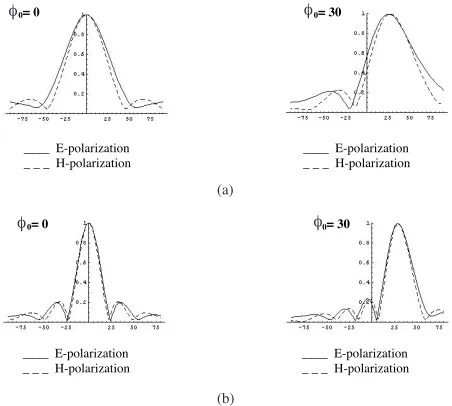
Figure 2. (a)E and H-polarizations for impedance 0.2–0.5j with slit widthkd= 4, (b)E and H-polarizations for impedance 0.2–0.5j with slit width kd= 8.
____ 0.2-0.5j _ _ 0.2j 0.5j
____ 0.2-0.5j _ _ 0.2j 0.5j
____ 0.2-0.5j _ _ 0.2j 0.5j
____ 0.2-0.5j _ _ 0.2j 0.5j
E-Polarization H-Polarization
E-Polarization H-Polarization
(a)
(b)
_ _
_ _
REFERENCES
1. Elsherbeni, A. Z. and M. Hamid, “Diffraction by a wide double wedge,”IEEE Transactions on Antennas and Propagation, Vol. 32, No. 11, November 1984.
2. Ghazi, G. and M. Shahabadi, “Modal analysis of extraordinary transmission through an array of subwavelength slits,” Progress In Electromagnetics Research, PIER 79, 59–74, 2008.
3. Zahedi, M. M. and M. S. Abrishamian, “Scattering from semi-elliptic channel loaded with impedance elliptical cylinder,”
Progress In Electromagnetics Research, PIER 79, 47–58, 2008. 4. Imran, A., Q. A. Naqvi, and K. Hongo, “Diffraction of
electromagnetic plane wave by an impedance strip,” Progress in Electromagnetics Research, PIER 75, 303—318, 2007.
5. Hongo, K. and Q. A. Naqvi, “Diffraction of electromagnetic wave by disk and circular hole in a perfectly conducting plane,”Progress In Electromagnetics Research, PIER 68, 113–150, 2007.
6. Imran, A., Q. A. Naqvi, and K. Hongo, “Diffraction of plane wave by two parallel slits in an infinitely long impedance plane using the method of Kobayashi potential,”Progress In Electromagnetics Research, PIER 63, 107–123, 2006.
7. Hussain, W., “Asymptotic analysis of a line source diffraction by a perfectly conducting half-plane in a bi-isotropic medium,”
Progress In Electromagnetics Research, PIER 58, 271–283, 2006. 8. Ciarkowski, A., “Electromagetic pulse diffraction by a moving
half-plane,”Progress In Electromagnetics Research, PIER 64, 53– 67, 2006.
9. Cinar, G. and A. Bykaksoy, “A hybrid method for the solution of plane wave diffraction by an impedance loaded parallel plate waveguide,” Progress In Electromagnetics Research, PIER 60, 293–310, 2006.
10. Senior, T. A. and E. Topsakal, “Diffraction by an anisotropic impedance half place-revised solution,” Progress In Electromag-netics Research, PIER 53, 1–19, 2005.
11. Naveed, M., Q. A. Naqvi, and K. Hongo, “Scattering of electromagnetic plane wave by a perfectly conducting slit and a PEMC parallel cylinder,” Progress In Electromagnetics Research M, Vol. 1, 45–58, 2008.
13. Liang, C.-H., Z. Liu, and H. Di, “Study on the blockage of electromagnetic rays analytically,” Progress In Electromagnetics Research B, Vol. 1, 253–268, 2008.
14. Maliuzhinets, G. D., “Excitation, reflection and emission of surface waves from a wedge with given face impedances,”Journal of Mathematical Physics, 752–755, 1958.
15. Osipov, A. V., “A simple approximation of the Maliuzhinets function for describing wedge diffraction,”IEEE Transactions on Antennas and Propagation, Vol. 53, No. 8, August 2005.
16. Hongo, K. and E. Nakajima, “Polynomial approximation of Maliuzhinets function,” IEEE Transactions on Antennas and Propagation, Vol. 34, No. 7, July 1986.